display VOLKSWAGEN CORRADO 1993 User Guide
[x] Cancel search | Manufacturer: VOLKSWAGEN, Model Year: 1993, Model line: CORRADO, Model: VOLKSWAGEN CORRADO 1993Pages: 920, PDF Size: 6.92 MB
Page 589 of 920

G - TESTS W/CODES
Article Text (p. 7)
1993 Volkswagen Corrado
For Volkswagen Technical Site: http://vw.belcom.ru
Copyright © 1998 Mitchell Repair Information Company, LLC
Wednesday, March 22, 2000 09:11PM
arrow button twice to select END OUTPUT function on scan tester. Press
"Q" to enter input. Turn ignition off. Disconnect scan tester.
READ MEASUREMENT & READ MEASURING (TEST) VALUE BLOCK
NOTE: See ENTERING SELF-DIAGNOSTICS for additional scan tester
operating instructions.
Corrado SLC (2.8L)
1) Connect Scan Tester (VAG 1551) to Data Link Connectors
(DLC) located in center console, in front of shift lever. With scan
tester in READ MEASURING VALUE BLOCK function, press "01" to "06"
buttons to select desired display group. See appropriate DISPLAY GROUP
table.
2) When display group is selected, only the second number is
shown on display (the zero does not appear on display). With READ
MEASUREMENT BLOCK function completed, select END OUTPUT function on
scan tester. Turn ignition off. Disconnect scan tester.
DISPLAY GROUP (CORRADO SLC)ÄÄÄÄÄÄÄÄÄÄÄÄÄÄÄÄÄÄÄÄÄÄÄÄÄÄÄÄÄÄÄÄÄÄÄÄÄÄÄÄÄÄÄÄÄÄÄÄÄÄÄÄÄÄÄDisplay Group Number Display
& Channel Number Parameters
01
1 ..................................... Engine Speed
2 ....................... Engine Coolant Temperature
3 ............................. Oxygen Sensor Signal
4 .................................. Ignition Timing
02
1 ..................................... Engine Speed
2 ................................... Injection Time
3 ................................... System Voltage
4 .................. EGR Temperature (If Applicable)
03
1 ..................................... Engine Speed
2 ...................................... Engine Load
3 ................................... Throttle Angle
4 ............. Intake Air Temperature (At Manifold)
04
1 ..................................... Engine Speed
2 ...................................... Engine Load
3 .................................... Vehicle Speed
4 .............. Switch Positions (Operating Status)
05
1 ..................................... Engine Speed
2 ..................... Idle Air Control (IAC) Valve
3 ................................... IAC Duty Cycle
4 ............ Switch Positions (A/C & Auto. Trans.)
06
1 ............................. Oxygen Sensor Signal
2 ........... Oxygen Sensor Adaptive Learning (Idle)
Page 614 of 920

I - SYSTEM/COMPONENT TESTS
Article Text (p. 2)
1993 Volkswagen Corrado
For Volkswagen Technical Site: http://vw.belcom.ru
Copyright © 1998 Mitchell Repair Information Company, LLC
Wednesday, March 22, 2000 09:11PM
COMPUTERIZED ENGINE CONTROLS
ELECTRONIC CONTROL MODULE (ECM)
Ground & Power Circuits
Check ECM ground and power circuits using the values in the
appropriate J - PIN VOLTAGE CHARTS article.
ENGINE SENSORS & SWITCHES
ENGINE COOLANT TEMPERATURE SENSOR
Corrado SLC (2.8L)
1) Ensure engine is cold. Connect Scan Tester (VAG 1551) to
Data Link Connectors (DLC) located in center console, in front of
shift lever. Start engine and allow it to idle.
2) With scan tester in READ TEST VALUE BLOCK function, select
group No. 01 and read coolant temperature value in field No. 2 of scan
tester. Temperature value must increase uniformly without
interruption. If value increases as specified, select END OUTPUT
function on scan tester.
3) If displayed value does not change or if engine
malfunctions during certain temperature ranges, turn ignition off and
measure engine coolant temperature sensor resistance. See ENGINE
COOLANT TEMPERATURE SENSOR RESISTANCE table.
ENGINE COOLANT TEMPERATURE SENSOR RESISTANCEÄÄÄÄÄÄÄÄÄÄÄÄÄÄÄÄÄÄÄÄÄÄÄÄÄÄÄÄÄÄÄÄÄÄÄÄÄÄÄÄÄÄÄÄÄTemperature
øF (øC) Ohms
68 (20) ......................... 3000-2000
86 (30) ......................... 2000-1500
104 (40) ........................ 1500-1000
122 (50) ......................... 1000-800
140 (60) .......................... 700-500
158 (70) .......................... 500-375
176 (80) .......................... 375-275
194 (90) .......................... 275-225
ÄÄÄÄÄÄÄÄÄÄÄÄÄÄÄÄÄÄÄÄÄÄÄÄÄÄÄÄÄÄÄÄÄÄÄÄÄÄÄÄÄÄÄÄÄ INTAKE AIR TEMPERATURE SENSOR
Corrado SLC (2.8L)
1) Turn ignition off. Disconnect intake air temperature
sensor. Remove sensor from intake manifold and plug opening in
manifold. Reconnect sensor to wiring harness.
2) Connect Scan Tester (VAG 1551) to Data Link Connectors
(DLC) located in center console, in front of shift lever. Start engine
and allow it to idle. With scan tester in READ TEST VALUE BLOCK
function, select group 03 and read intake air temperature sensor value
in field No. 4 of scan tester.
3) Spray sensor with cooling spray and observe value on scan
Page 615 of 920

I - SYSTEM/COMPONENT TESTS
Article Text (p. 3)
1993 Volkswagen Corrado
For Volkswagen Technical Site: http://vw.belcom.ru
Copyright © 1998 Mitchell Repair Information Company, LLC
Wednesday, March 22, 2000 09:11PM
tester. Scan tester value must decrease. If temperature value does not
change, repair intake air temperature sensor circuit or replace sensor
as necessary. After repairs, erase Diagnostic Trouble Code (DTC)
memory (if applicable) and select END OUTPUT function.
HALL EFFECT SENSOR
Corrado SLC (2.8L)
Testing information is not available from manufacturer. These
vehicles are equipped with a distributorless ignition system.
FUEL SYSTEM
ACCELERATION/FULL THROTTLE ENRICHMENT & DECELERATION FUEL
CUT-OFF
Corrado SLC (2.8L)
1) Ensure engine coolant temperature is at least 176øF
(80
øC). Connect Scan Tester (VAG 1551) to Data Link Connectors (DLC)
located in center console, in front of shift lever.
2) Start engine and allow it to idle. With scan tester in
READ TEST VALUE BLOCK function, select group No. 04 and read value in
field No. 4 of scan tester. Display value must be 00010 at idle.
3) Using accelerator pedal, increase engine speed to 3000 RPM
and observe scan tester. Display value in field No. 4 of scan tester
must briefly be 10100. Release accelerator pedal and observe scan
tester.
4) Display value in field No. 4 of scan tester must briefly
be 00011, then return to 00010 at idle. If values are not as
specified, see THROTTLE POSITION (TP) SENSOR ADJUSTMENT procedures in
the D - ADJUSTMENTS article. If values are as specified, select END
OUTPUT function on scan tester.
FUEL INJECTORS & CIRCUIT
Corrado SLC (2.8L)
1) To access fuel injectors, remove ignition wires. Remove
hose from mass airflow sensor. Disconnect hose to fuel evaporative
(frequency) solenoid valve at throttle body.
2) Disconnect throttle position sensor and idle air control
valve. Disconnect accelerator cable from throttle body. Disconnect and
plug coolant hoses at throttle body.
3) Disconnect hose from air intake heated tube. Detach fuel
lines at cylinder head cover and remove from fuel rail. Disconnect
vacuum hose from fuel pressure regulator. Remove intake manifold upper
section. See Fig. 2.
4) With intake manifold upper section removed, disconnect
wiring harness from fuel injectors. Using a Digital Volt-Ohmmeter
(DVOM) and test leads from Adapter Kit (VW 1594), check fuel injector
resistance. See Fig. 3.
5) Fuel injector resistance should be 15.0-21.5 ohms. If
resistance is zero ohms, check for a short circuit in wiring harness.
Page 669 of 920
MAINTENANCE REMINDER LIGHT RESET PROCEDURES
Article Text
1993 Volkswagen Corrado
For Volkswagen Technical Site: http://vw.belcom.ru
Copyright © 1998 Mitchell Repair Information Company, LLC
Wednesday, March 22, 2000 09:20PM
ARTICLE BEGINNING
1983-96 MAINTENANCE
Volkswagen Maintenance Reminder Light Reset Procedures
EGR MAINTENANCE LIGHT (IF EQUIPPED)
EGR light comes on at 15,000 mile intervals to indicate EGR
servicing is required. After checking EGR system, reset mileage
counter. See RESETTING MILEAGE COUNTER.
OXYGEN SENSOR WARNING LIGHT (IF EQUIPPED)
Oxygen sensor (OXS) light comes on at 30,000 mile intervals
to indicate oxygen sensor replacement. After installing new sensor,
reset mileage counter. See RESETTING MILEAGE COUNTER.
RESETTING MILEAGE COUNTER (IF EQUIPPED)
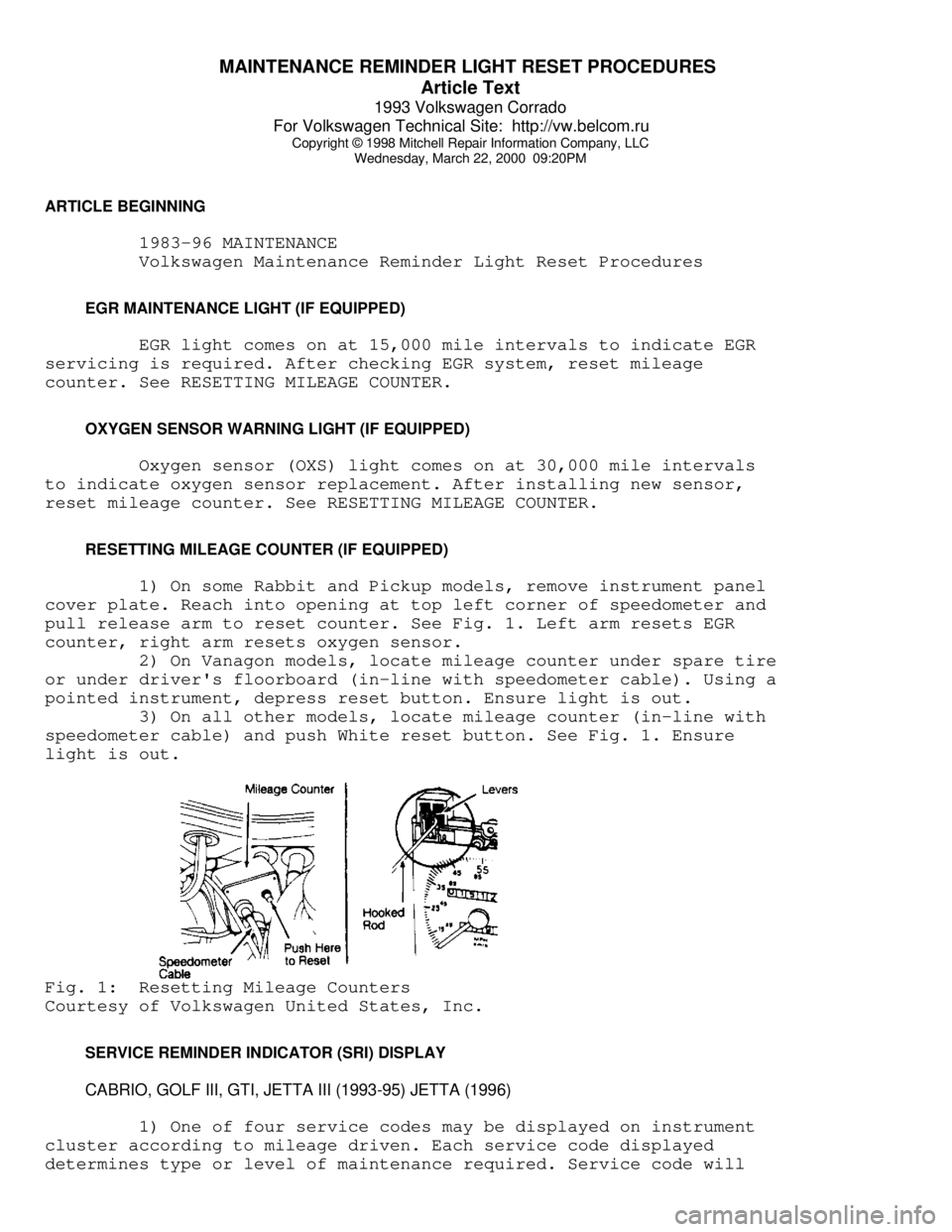
1) On some Rabbit and Pickup models, remove instrument panel
cover plate. Reach into opening at top left corner of speedometer and
pull release arm to reset counter. See Fig. 1. Left arm resets EGR
counter, right arm resets oxygen sensor.
2) On Vanagon models, locate mileage counter under spare tire
or under driver's floorboard (in-line with speedometer cable). Using a
pointed instrument, depress reset button. Ensure light is out.
3) On all other models, locate mileage counter (in-line with
speedometer cable) and push White reset button. See Fig. 1. Ensure
light is out.Fig. 1: Resetting Mileage Counters
Courtesy of Volkswagen United States, Inc.
SERVICE REMINDER INDICATOR (SRI) DISPLAY
CABRIO, GOLF III, GTI, JETTA III (1993-95) JETTA (1996)
1) One of four service codes may be displayed on instrument
cluster according to mileage driven. Each service code displayed
determines type or level of maintenance required. Service code will
Page 670 of 920

MAINTENANCE REMINDER LIGHT RESET PROCEDURES
Article Text (p. 2)
1993 Volkswagen Corrado
For Volkswagen Technical Site: http://vw.belcom.ru
Copyright © 1998 Mitchell Repair Information Company, LLC
Wednesday, March 22, 2000 09:20PM
flash for approximately 3 seconds in odometer display window as
ignition is turned on. When servicing becomes due (every 7500 miles),
appropriate service code will flash for approximately 60 seconds. The
four service codes available for display are as follows:
* IN 00 (No Service Necessary)
* OEL (Oil Change Service) Every 7500 Miles
* IN 01 (Inspection Service) Every 15,000 Miles
* IN 02 (Additional Servicing Work) Every 30,000 Miles
2) After performing required maintenance, each effected
service code displayed must be reset individually. For example, at 15,
000 miles service codes OEL and IN 01 will both need to be reset.
3) To reset service codes, turn ignition on. Press and hold
odometer reset button located below speedometer. While holding button,
press clock reset button (lower button for digital clock) located to
left of fuel gauge. Release buttons. Programming mode is now
activated. Service code OEL1.S (distance counter) should be displayed.
4) Press clock reset button once more. 7500 miles should now
be indicated on display. Desired mileage for reset may be attained by
pressing clock reset button. Mileage displayed will decrease in
increments of 500 miles each time button is pressed. This feature
should only be used to calibrate mileage when instrument cluster is
replaced. When desired mileage is displayed, press odometer reset
button.
5) Service code OEL2.S (time counter) should be displayed.
Press clock reset button. 6 (months) will be indicated on display.
Time counter for next oil change may be set by pressing clock reset
button if instrument cluster was replaced. When desired time is
displayed, press odometer reset button.
6) Service code IN 01.S (time counter) should be displayed.
Press clock reset button. 12 (months) will be indicated on display.
Time counter for next maintenance interval may be set by pressing
clock reset button if instrument cluster was replaced. When desired
time is displayed, press odometer reset button.
7) Service code IN 02.S (distance counter) should be
displayed. Press clock reset button. 30,000 (miles) will be indicated
on display. Desired mileage for reset may be attained by pressing
clock reset button. Mileage displayed will decrease in increments of
500 miles each time button is pressed. This feature should only be
used to calibrate mileage when instrument cluster is replaced. When
desired mileage is displayed, turn ignition off. Programming is now
stored in memory.
END OF ARTICLE
Page 686 of 920

SCHEDULED SERVICES
Article Text (p. 4)
1993 Volkswagen Corrado
For Volkswagen Technical Site: http://vw.belcom.ru
Copyright © 1998 Mitchell Repair Information Company, LLC
Wednesday, March 22, 2000 09:22PM
To avoid possible damage to vehicle use only ethylene-glycol
based coolants with a mixture ratio from 44-68% anti-freeze.
DO NOT use 100% anti-freeze as it will cause the formation
of cooling system deposits. This results in coolant
temperatures of over 300ø F (149øC) which can melt plastics.
100% anti-freeze has a freeze point of only -8
ø F (-22øC).
CAUTION: Propylene-Glycol Mixtures has a smaller temperature range
than Ethylene-Glycol. The temperature range (freeze-boil)
of a 50/50 Anti-Freeze/Water Mix is as follows:
Propylene-Glycol -26
ø F (-32øC) - 257ø F (125øC)
Ethylene-Glycol -35
ø F (-37øC) - 263ø F (128øC)
CAUTION: Propylene-Glycol/Ethylene-Glycol Mixtures can cause the
destabilization of various corrosion inhibitors. Also
Propylene-Glycol/Ethylene-Glycol has a different specific
gravity than Ethylene-Glycol coolant, which will result in
inaccurate freeze point calculations.
ELECTROSTATIC DISCHARGE SENSITIVE (ESD) PARTS
WARNING: Many solid state electrical components can be damaged by
static electricity (ESD). Some will display a warning label,
but many will not. Discharge personal static electricity by
touching a metal ground point on the vehicle prior to
servicing any ESD sensitive component.
ELECTRIC SHOCK HAZARD
WARNING: Contact with live components of ignition system while
engine is running could lead to a fatal electric shock.
ENGINE OIL
CAUTION: Never use non-detergent or straight mineral oil.
FUEL SYSTEM SERVICE
WARNING: Relieve fuel system pressure prior to servicing any fuel
system component (fuel injection models).
HALOGEN BULBS
Halogen bulbs contain pressurized gas which may explode if
overheated. DO NOT touch glass portion of bulb with bare hands. Eye
protection should be worn when handling or working around halogen
bulbs.
RADIATOR CAP
CAUTION: Always disconnect the fan motor when working near the
Page 725 of 920

SPECIFICATIONS & ELECTRIC COOLING FANS
Article Text (p. 2)
1993 Volkswagen Corrado
For Volkswagen Technical Site: http://vw.belcom.ru
Copyright © 1998 Mitchell Repair Information Company, LLC
Wednesday, March 22, 2000 09:23PM
fan is not coming on at proper temperature and engine is
overheating.
Corrado SLC, Passat GLX
The cooling fan is either a 1 or 2-speed motor. If vehicle is
equipped with single-speed motor, the fan comes on at 198-207øF (92-
97
øC) and turns off at 183-196øF (84-91øC). If equipped with a 2-speed
motor, low speed of cooling fan should come on at 198-208
øF (92-98øC)
on vehicles without A/C, or 183-207
øF (84-97øC) on vehicles with A/C.
Low speed will shut off at 183-196
øF (84-91øC) on all vehicles. High
speed comes on at 210-226
øF (99-108øC) on vehicles without A/C, or
201-226
øF (94-108øC) on vehicles with A/C. High speed will shut off at
196-220
øF (91-104øC) on all vehicles.
After-Run Thermoswitch
An after-run switch is used to help prevent fuel
vaporization. The thermoswitch turns cooling fan on when temperatures
in engine compartment exceeds 230
øF (110øC), and turns it off at 217øF
(103
øC).
Passat GL
The cooling fan is a 2-speed motor. Low speed of cooling fan
should come on at 198-207
øF (92-97øC) and will shut off at 183-196øF
(84-91
øC). High speed comes on at 210-221øF (99-105øC) and will shut
off at 196-208
øF (91-98øC).
TROUBLE SHOOTING
NOTE: Trouble shooting information not available from manufacturer.
TESTING
ENGINE COOLANT TEMPERATURE (ECT) SENSOR
Corrado SLC & Passat GLX (2.8L)
1) Ensure engine is cold. Connect Scan Tester (VAG 1551) to
Data Link Connectors (DLC) located in center console, in front of
shift lever.
2) Start engine and allow it to idle. With scan tester in
READ TEST VALUE BLOCK function, select group No. 01 and read coolant
temperature value in field No. 2 of scan tester. Temperature value
must increase uniformly without interruption. If value increases as
specified, select END OUTPUT function on scan tester.
3) If displayed value does not change or if engine
malfunctions during certain temperature ranges, turn ignition off and
measure engine coolant temperature sensor resistance. See ECT SENSOR
LOCATION table. Replace ECT sensor if resistance is not within
specification. See ECT SENSOR RESISTANCE table.
Passat GL
1) Ensure engine is cold. Connect Scan Tester (VAG 1551) to
Data Link Connectors (DLC) located in center console. Start engine and
Page 726 of 920

SPECIFICATIONS & ELECTRIC COOLING FANS
Article Text (p. 3)
1993 Volkswagen Corrado
For Volkswagen Technical Site: http://vw.belcom.ru
Copyright © 1998 Mitchell Repair Information Company, LLC
Wednesday, March 22, 2000 09:23PM
allow it to idle. With scan tester in READ MEASUREMENT BLOCK function,
read coolant temperature value in channel No. 1 of scan tester.
2) If temperature value increases uniformly without
interruption, sensor and its circuit are okay. Select END OUTPUT
function on scan tester. If display value is incorrect, test wiring
harness for open or short circuit. See Corrado SLC WIRING DIAGRAMS,
or Passat WIRING DIAGRAMS articles.
3) If necessary, use test leads from Adapter Kit (VAG 1594)
to measure ECT sensor resistance. See ECT SENSOR LOCATION table.
Replace engine coolant temperature sensor if not within specification.
See ECT SENSOR RESISTANCE table.
ECT SENSOR RESISTANCE TABLEÄÄÄÄÄÄÄÄÄÄÄÄÄÄÄÄÄÄÄÄÄÄÄÄÄÄÄÄÄÄÄÄÄÄÄÄÄÄÄÄÄÄÄÄÄÄÄÄÄÄÄÄÄÄÄÄÄÄÄÄTemperature
øF (øC) Ohms
68 (20) ........................................ 3000-2000
86 (30) ........................................ 2000-1500
104 (40) ....................................... 1500-1000
122 (50) ........................................ 1000-800
140 (60) ......................................... 700-500
158 (70) ......................................... 500-375
176 (80) ......................................... 375-275
194 (90) ......................................... 275-225
ÄÄÄÄÄÄÄÄÄÄÄÄÄÄÄÄÄÄÄÄÄÄÄÄÄÄÄÄÄÄÄÄÄÄÄÄÄÄÄÄÄÄÄÄÄÄÄÄÄÄÄÄÄÄÄÄÄÄÄÄECT SENSOR LOCATION TABLE
ÄÄÄÄÄÄÄÄÄÄÄÄÄÄÄÄÄÄÄÄÄÄÄÄÄÄÄÄÄÄÄÄÄÄÄÄÄÄÄÄÄÄÄÄÄÄÄÄÄÄÄÄÄÄÄÄÄÄÄÄModel Location
Corrado SLC & Passat GLX
Blue, Brown & Yellow Sensor . On Radiator Near Upper Hose
Passat GL .............................. Below Distributor
ÄÄÄÄÄÄÄÄÄÄÄÄÄÄÄÄÄÄÄÄÄÄÄÄÄÄÄÄÄÄÄÄÄÄÄÄÄÄÄÄÄÄÄÄÄÄÄÄÄÄÄÄÄÄÄÄÄÄÄÄEND OF ARTICLE
Page 813 of 920

TROUBLE SHOOTING - BASIC PROCEDURES
Article Text (p. 22)
1993 Volkswagen Corrado
For Volkswagen Technical Site: http://vw.belcom.ru
Copyright © 1998 Mitchell Repair Information Company, LLC
Wednesday, March 22, 2000 09:26PM
as heard. Extra differential thrust washers installed during axle
repair can cause a condition of partial lock-up that creates this
chatter.
AXLE SHAFT NOISE
Axle shaft noise is similar to gear noise and pinion bearing
whine. Axle shaft bearing noise will normally distinguish itself from
gear noise by occurring in all driving modes (Drive, cruise, coast and
float), and will persist with transmission in Neutral while vehicle is
moving at problem speed.
If vehicle displays this noise condition, remove suspect
axle shafts, replace wheel seals and install a new set of bearings.
Re-evaluate vehicle for noise before removing any internal components.
VIBRATION
Vibration is a high-frequency trembling, shaking or grinding
condition (felt or heard) that may be constant or variable in level
and can occur during the total operating speed range of the vehicle.
The types of vibrations that can be felt in the vehicle can
be divided into 3 main groups:
* Vibrations of various unbalanced rotating parts of the
vehicle.
* Resonance vibrations of the body and frame structures caused
by rotating of unbalanced parts.
* Tip-in moans of resonance vibrations from stressed engine or
exhaust system mounts or driveline flexing modes.
DRIVE AXLE - RWD TROUBLE SHOOTING
WARNING: This is GENERAL information. This article is not intended
to be specific to any unique situation or individual vehicle
configuration. The purpose of this Trouble Shooting
information is to provide a list of common causes to
problem symptoms. For model-specific Trouble Shooting,
refer to SUBJECT, DIAGNOSTIC, or TESTING articles available
in the section(s) you are accessing. For definitions
of listed noises or sounds, see DRIVE AXLE - NOISE DIAGNOSIS.
DRIVE AXLE (RWD) TROUBLE SHOOTINGÄÄÄÄÄÄÄÄÄÄÄÄÄÄÄÄÄÄÄÄÄÄÄÄÄÄÄÄÄÄÄÄÄÄÄÄÄÄÄÄÄÄÄÄÄÄÄÄÄÄÄÄÄÄÄÄÄÄÄÄÄÄÄÄÄÄÄÄÄÄCONDITION POSSIBLE CAUSE CORRECTION
ÄÄÄÄÄÄÄÄÄÄÄÄÄÄÄÄÄÄÄÄÄÄÄÄÄÄÄÄÄÄÄÄÄÄÄÄÄÄÄÄÄÄÄÄÄÄÄÄÄÄÄÄÄÄÄÄÄÄÄÄÄÄÄÄÄÄÄÄÄÄKnocking or Clunking
Differential Side Gear
Clearance Check Clearance
Worn Pinion Shaft Replace Pinion Shaft
Axle Shaft End Play Check End Play
Page 863 of 920

WAVEFORMS - INJECTOR PATTERN TUTORIAL
Article Text (p. 4)
1993 Volkswagen Corrado
For Volkswagen Technical Site: http://vw.belcom.ru
Copyright © 1998 Mitchell Repair Information Company, LLC
Wednesday, March 22, 2000 09:26PM
In any cases of doubt regarding the use of a noid light, a
lab scope will overcome all inherent weaknesses.
OVERVIEW OF DVOM
A DVOM is typically used to check injector resistance and
available voltage at the injector. Some techs also use it check
injector on-time either with a built-in feature or by using the
dwell/duty function.
There are situations where the DVOM performs these checks
dependably, and other situations where it can deceive you. It is
important to be aware of these strengths and weaknesses. We will cover
the topics above in the following text.
Checking Injector Resistance
If a short in an injector coil winding is constant, an
ohmmeter will accurately identify the lower resistance. The same is
true with an open winding. Unfortunately, an intermittent short is an
exception. A faulty injector with an intermittent short will show
"good" if the ohmmeter cannot force the short to occur during testing.
Alcohol in fuel typically causes an intermittent short,
happening only when the injector coil is hot and loaded by a current
high enough to jump the air gap between two bare windings or to break
down any oxides that may have formed between them.
When you measure resistance with an ohmmeter, you are only
applying a small current of a few milliamps. This is nowhere near
enough to load the coil sufficiently to detect most problems. As a
result, most resistance checks identify intermittently shorted
injectors as being normal.
There are two methods to get around this limitation. The
first is to purchase an tool that checks injector coil windings under
full load. The Kent-Moore J-39021 is such a tool, though there are
others. The Kent-Moore costs around $240 at the time of this writing
and works on many different manufacturer's systems.
The second method is to use a lab scope. Remember, a lab
scope allows you to see the regular operation of a circuit in real
time. If an injector is having an short or intermittent short, the lab
scope will show it.
Checking Available Voltage At the Injector
Verifying a fuel injector has the proper voltage to operate
correctly is good diagnostic technique. Finding an open circuit on the
feed circuit like a broken wire or connector is an accurate check with
a DVOM. Unfortunately, finding an intermittent or excessive resistance
problem with a DVOM is unreliable.
Let's explore this drawback. Remember that a voltage drop due
to excessive resistance will only occur when a circuit is operating?
Since the injector circuit is only operating for a few milliseconds at
a time, a DVOM will only see a potential fault for a few milliseconds.
The remaining 90+% of the time the unloaded injector circuit will show
normal battery voltage.
Since DVOMs update their display roughly two to five times a