warning VOLKSWAGEN CORRADO 1993 User Guide
[x] Cancel search | Manufacturer: VOLKSWAGEN, Model Year: 1993, Model line: CORRADO, Model: VOLKSWAGEN CORRADO 1993Pages: 920, PDF Size: 6.92 MB
Page 271 of 920

* SUSPENSION UNIFORM INSPECTION GUIDELINES *
Article Text (p. 60)
1993 Volkswagen Corrado
For Volkswagen Technical Site: http://vw.belcom.ru
Copyright © 1998 Mitchell Repair Information Company, LLC
Wednesday, March 22, 2000 08:45PMÄÄÄÄÄÄÄÄÄÄÄÄÄÄÄÄÄÄÄÄÄÄÄÄÄÄÄÂÄÄÄÄÄÄÂÄÄÄÄÄÄÄÄÄÄÄÄÄÄÄÄÄÄÄÄÄÄÄÄÄÄÄÄÄÄÄÄÄÄÄCondition
³ Code ³ Procedure
ÄÄÄÄÄÄÄÄÄÄÄÄÄÄÄÄÄÄÄÄÄÄÄÄÄÄÄÅÄÄÄÄÄÄÅÄÄÄÄÄÄÄÄÄÄÄÄÄÄÄÄÄÄÄÄÄÄÄÄÄÄÄÄÄÄÄÄÄÄÄRear axle seal on rear-
³ A ³ Require replacement of seal and
wheel drive leaking
³ ³ inspection of axle, bearing,
³ ³ housing, and vent tube
ÄÄÄÄÄÄÄÄÄÄÄÄÄÄÄÄÄÄÄÄÄÄÄÄÄÄÄÅÄÄÄÄÄÄÅÄÄÄÄÄÄÄÄÄÄÄÄÄÄÄÄÄÄÄÄÄÄÄÄÄÄÄÄÄÄÄÄÄÄÄSeal bent
³ A,1 ³ Suggest replacement.
ÄÄÄÄÄÄÄÄÄÄÄÄÄÄÄÄÄÄÄÄÄÄÄÄÄÄÄÅÄÄÄÄÄÄÅÄÄÄÄÄÄÄÄÄÄÄÄÄÄÄÄÄÄÄÄÄÄÄÄÄÄÄÄÄÄÄÄÄÄÄSeal leaking
³ A ³ Require replacement of seal and
³ ³ inspection of bearings.
ÄÄÄÄÄÄÄÄÄÄÄÄÄÄÄÄÄÄÄÄÄÄÄÄÄÄÄÅÄÄÄÄÄÄÅÄÄÄÄÄÄÄÄÄÄÄÄÄÄÄÄÄÄÄÄÄÄÄÄÄÄÄÄÄÄÄÄÄÄÄSeal missing
³ C ³ Require replacement.
ÄÄÄÄÄÄÄÄÄÄÄÄÄÄÄÄÄÄÄÄÄÄÄÄÄÄÄÅÄÄÄÄÄÄÅÄÄÄÄÄÄÄÄÄÄÄÄÄÄÄÄÄÄÄÄÄÄÄÄÄÄÄÄÄÄÄÄÄÄÄSeal torn
³ A ³ Require replacement.
ÄÄÄÄÄÄÄÄÄÄÄÄÄÄÄÄÄÄÄÄÄÄÄÄÄÄÄÅÄÄÄÄÄÄÅÄÄÄÄÄÄÄÄÄÄÄÄÄÄÄÄÄÄÄÄÄÄÄÄÄÄÄÄÄÄÄÄÄÄÄWheel bearing assembly
³ A ³ Require replacement of bearing
feels rough when rotated
³ ³ assembly.
ÄÄÄÄÄÄÄÄÄÄÄÄÄÄÄÄÄÄÄÄÄÄÄÄÄÄÄÅÄÄÄÄÄÄÅÄÄÄÄÄÄÄÄÄÄÄÄÄÄÄÄÄÄÄÄÄÄÄÄÄÄÄÄÄÄÄÄÄÄÄWheel bearing balls are
³ A ³ Require replacement of bearing
pitted
³ ³ assembly.
ÄÄÄÄÄÄÄÄÄÄÄÄÄÄÄÄÄÄÄÄÄÄÄÄÄÄÄÅÄÄÄÄÄÄÅÄÄÄÄÄÄÄÄÄÄÄÄÄÄÄÄÄÄÄÄÄÄÄÄÄÄÄÄÄÄÄÄÄÄÄWheel bearing balls are
³ A ³ Require replacement of bearing
worn
³ ³ assembly.
ÄÄÄÄÄÄÄÄÄÄÄÄÄÄÄÄÄÄÄÄÄÄÄÄÄÄÄÅÄÄÄÄÄÄÅÄÄÄÄÄÄÄÄÄÄÄÄÄÄÄÄÄÄÄÄÄÄÄÄÄÄÄÄÄÄÄÄÄÄÄWheel bearing end-play
³ A ³ Require adjustment of bearing, if
exceeds vehicle
³ ³ possible. If proper adjustment
manufacturer's specs
³ ³ cannot be obtained, require repair
³ ³ or replacement of worn component.
ÄÄÄÄÄÄÄÄÄÄÄÄÄÄÄÄÄÄÄÄÄÄÄÄÄÄÄÅÄÄÄÄÄÄÅÄÄÄÄÄÄÄÄÄÄÄÄÄÄÄÄÄÄÄÄÄÄÄÄÄÄÄÄÄÄÄÄÄÄÄWheel bearing race is loose
³ A ³ Require replacement of hub
in the hub bore
³ ³ assembly and wheel bearings.
ÄÄÄÄÄÄÄÄÄÄÄÄÄÄÄÄÄÄÄÄÄÄÄÄÄÄÄÅÄÄÄÄÄÄÅÄÄÄÄÄÄÄÄÄÄÄÄÄÄÄÄÄÄÄÄÄÄÄÄÄÄÄÄÄÄÄÄÄÄÄWheel bearing races are
³ A ³ Require replacement of bearing
pitted
³ ³ assembly.
ÄÄÄÄÄÄÄÄÄÄÄÄÄÄÄÄÄÄÄÄÄÄÄÄÄÄÄÅÄÄÄÄÄÄÅÄÄÄÄÄÄÄÄÄÄÄÄÄÄÄÄÄÄÄÄÄÄÄÄÄÄÄÄÄÄÄÄÄÄÄWheel bearing races are
³ A ³ Require replacement of bearing
worn
³ ³ assembly.
ÄÄÄÄÄÄÄÄÄÄÄÄÄÄÄÄÄÄÄÄÄÄÄÄÄÄÄÅÄÄÄÄÄÄÅÄÄÄÄÄÄÄÄÄÄÄÄÄÄÄÄÄÄÄÄÄÄÄÄÄÄÄÄÄÄÄÄÄÄÄWheel bearing rollers are
³ A ³ Require replacement of bearing
pitted
³ ³ assembly.
ÄÄÄÄÄÄÄÄÄÄÄÄÄÄÄÄÄÄÄÄÄÄÄÄÄÄÄÅÄÄÄÄÄÄÅÄÄÄÄÄÄÄÄÄÄÄÄÄÄÄÄÄÄÄÄÄÄÄÄÄÄÄÄÄÄÄÄÄÄÄWheel bearing rollers are
³ A ³ Require replacement of bearing
worn
³ ³ assembly.
ÄÄÄÄÄÄÄÄÄÄÄÄÄÄÄÄÄÄÄÄÄÄÄÄÄÄÄÁÄÄÄÄÄÄÁÄÄÄÄÄÄÄÄÄÄÄÄÄÄÄÄÄÄÄÄÄÄÄÄÄÄÄÄÄÄÄÄÄÄÄ WHEELS & TIRES
TIRES
WARNING: These guidelines do not apply to split rims.
Page 276 of 920

* SUSPENSION UNIFORM INSPECTION GUIDELINES *
Article Text (p. 65)
1993 Volkswagen Corrado
For Volkswagen Technical Site: http://vw.belcom.ru
Copyright © 1998 Mitchell Repair Information Company, LLC
Wednesday, March 22, 2000 08:45PMÄÄÄÄÄÄÄÄÄÄÄÄÄÄÄÄÄÄÄÄÄÄÄÄÄÄÄÄÄÅÄÄÄÄÄÄÅÄÄÄÄÄÄÄÄÄÄÄÄÄÄÄÄÄÄÄÄÄÄÄÄÄÄÄÄÄÄÄÄÄThreads stripped (threads
³ A ³ Require replacement of
missing)
³ ³ component with stripped threads.
ÄÄÄÄÄÄÄÄÄÄÄÄÄÄÄÄÄÄÄÄÄÄÄÄÄÄÄÄÄÁÄÄÄÄÄÄÁÄÄÄÄÄÄÄÄÄÄÄÄÄÄÄÄÄÄÄÄÄÄÄÄÄÄÄÄÄÄÄÄÄNOTE: (1) Some manufacturers require replacement of all studs on that
wheel if two or more studs or nuts on the same wheel are
broken or missing.
(2) Only required if removing wheel.
ÄÄÄÄÄÄÄÄÄÄÄÄÄÄÄÄÄÄÄÄÄÄÄÄÄÄÄÄÄÄÄÄÄÄÄÄÄÄÄÄÄÄÄÄÄÄÄÄÄÄÄÄÄÄÄÄÄÄÄÄÄÄÄÄÄÄÄÄÄÄ WHEELS
WARNING: Mounting a regular tire on a high-pressure compact spare
wheel is not permitted. Attempting to mount a tire of one
diameter on a wheel of a different diameter or flange type
may result in serious injury or death. If the wheel
identification stamp is not legible, or cannot be found,
DO NOT use the wheel until the size and type have been
properly identified. Wheels of different diameter, offset,
or width cannot be mixed on the same axle. Bead seat tapers
cannot be interchanged.
WHEELS
ÄÄÄÄÄÄÄÄÄÄÄÄÄÄÄÄÄÄÄÄÄÄÄÄÄÄÄÂÄÄÄÄÄÄÂÄÄÄÄÄÄÄÄÄÄÄÄÄÄÄÄÄÄÄÄÄÄÄÄÄÄÄÄÄÄÄÄÄÄÄCondition
³ Code ³ Procedure
ÄÄÄÄÄÄÄÄÄÄÄÄÄÄÄÄÄÄÄÄÄÄÄÄÄÄÄÅÄÄÄÄÄÄÅÄÄÄÄÄÄÄÄÄÄÄÄÄÄÄÄÄÄÄÄÄÄÄÄÄÄÄÄÄÄÄÄÄÄÄBead leaking, caused by
³ A ³ Require repair or replacement.
wheel rim flange
³ ³ See caution below.
ÄÄÄÄÄÄÄÄÄÄÄÄÄÄÄÄÄÄÄÄÄÄÄÄÄÄÄÁÄÄÄÄÄÄÁÄÄÄÄÄÄÄÄÄÄÄÄÄÄÄÄÄÄÄÄÄÄÄÄÄÄÄÄÄÄÄÄÄÄÄCAUTION: DO NOT attempt to correct a bent wheel rim.
ÄÄÄÄÄÄÄÄÄÄÄÄÄÄÄÄÄÄÄÄÄÄÄÄÄÄÄÂÄÄÄÄÄÄÂÄÄÄÄÄÄÄÄÄÄÄÄÄÄÄÄÄÄÄÄÄÄÄÄÄÄÄÄÄÄÄÄÄÄÄBent wheel hub mounting
³ A ³ Require replacement.
surface
³ ³
ÄÄÄÄÄÄÄÄÄÄÄÄÄÄÄÄÄÄÄÄÄÄÄÄÄÄÄÅÄÄÄÄÄÄÅÄÄÄÄÄÄÄÄÄÄÄÄÄÄÄÄÄÄÄÄÄÄÄÄÄÄÄÄÄÄÄÄÄÄÄBent wheel rim, causing
³ B,2 ³ Suggest replacement.
vibration
³ ³ See caution above.
ÄÄÄÄÄÄÄÄÄÄÄÄÄÄÄÄÄÄÄÄÄÄÄÄÄÄÄÅÄÄÄÄÄÄÅÄÄÄÄÄÄÄÄÄÄÄÄÄÄÄÄÄÄÄÄÄÄÄÄÄÄÄÄÄÄÄÄÄÄÄBroken
³ A ³ Require replacement.
ÄÄÄÄÄÄÄÄÄÄÄÄÄÄÄÄÄÄÄÄÄÄÄÄÄÄÄÅÄÄÄÄÄÄÅÄÄÄÄÄÄÄÄÄÄÄÄÄÄÄÄÄÄÄÄÄÄÄÄÄÄÄÄÄÄÄÄÄÄÄCast wheel porous, causing
³ A ³ Require repair or replacement.
a leak
³ ³
ÄÄÄÄÄÄÄÄÄÄÄÄÄÄÄÄÄÄÄÄÄÄÄÄÄÄÄÅÄÄÄÄÄÄÅÄÄÄÄÄÄÄÄÄÄÄÄÄÄÄÄÄÄÄÄÄÄÄÄÄÄÄÄÄÄÄÄÄÄÄClip-on balance weight is
³ B,2 ³ Suggest replacement.
incorrect type for wheel
³ ³ rim flange
³ ³
ÄÄÄÄÄÄÄÄÄÄÄÄÄÄÄÄÄÄÄÄÄÄÄÄÄÄÄÅÄÄÄÄÄÄÅÄÄÄÄÄÄÄÄÄÄÄÄÄÄÄÄÄÄÄÄÄÄÄÄÄÄÄÄÄÄÄÄÄÄÄCorrosion, affecting
³ A ³ Require replacement.
structural integrity
³ ³
ÄÄÄÄÄÄÄÄÄÄÄÄÄÄÄÄÄÄÄÄÄÄÄÄÄÄÄÅÄÄÄÄÄÄÅÄÄÄÄÄÄÄÄÄÄÄÄÄÄÄÄÄÄÄÄÄÄÄÄÄÄÄÄÄÄÄÄÄÄÄCorrosion build-up on wheel
³ A ³ Require repair.
hub mounting surface
³ ³
ÄÄÄÄÄÄÄÄÄÄÄÄÄÄÄÄÄÄÄÄÄÄÄÄÄÄÄÅÄÄÄÄÄÄÅÄÄÄÄÄÄÄÄÄÄÄÄÄÄÄÄÄÄÄÄÄÄÄÄÄÄÄÄÄÄÄÄÄÄÄ
Page 376 of 920

A/C-HEATER SYSTEM - MANUAL
Article Text
1993 Volkswagen Corrado
For Volkswagen Technical Site: http://vw.belcom.ru
Copyright © 1998 Mitchell Repair Information Company, LLC
Wednesday, March 22, 2000 08:49PM
ARTICLE BEGINNING
1993 MANUAL A/C-HEATER SYSTEMS
Volkswagen United States, Inc.
Corrado SLC
SPECIFICATIONS
SPECIFICATIONS TABLEÄÄÄÄÄÄÄÄÄÄÄÄÄÄÄÄÄÄÄÄÄÄÄÄÄÄÄÄÄÄÄÄÄÄÄÄÄÄÄÄÄÄÄÄÄÄÄÄÄÄÄÄÄÄÄÄÄÄÄÄÄÄÄApplication Specification
Compressor Type ........................ Sanden SD-709 7-Cyl.
Compressor Belt Tension (1)
System Oil Capacity (2) ........................ 3.9-4.4 ozs.
Refrigerant (R-134a) Capacity ................ 35.0-36.6 ozs.
System Operating Pressures
High Side ............................ 203 psi (13.8 kg/cm
ý)
Low Side ............................... 17 psi (1.1 kg/cm
ý)
(1) - Ribbed belt uses automatic belt tensioner.
(2) - Use PAG Compressor Oil (Part No. G 052 154 A2).
ÄÄÄÄÄÄÄÄÄÄÄÄÄÄÄÄÄÄÄÄÄÄÄÄÄÄÄÄÄÄÄÄÄÄÄÄÄÄÄÄÄÄÄÄÄÄÄÄÄÄÄÄÄÄÄÄÄÄÄÄÄÄÄWARNING: To avoid injury from accidental air bag deployment, read and
carefully follow all SERVICE PRECAUTIONS and DISABLING &
ACTIVATING AIR BAG SYSTEM procedures.
AIR BAG SYSTEM PRECAUTIONS
SYSTEM OPERATION CHECK
Two lights pertaining to air bag system are located directly
above air bag symbol in instrument cluster. Control light is used to
indicate readiness of system. With ignition on, control light comes on
for about 5-8 seconds then goes out, while diagnosis unit in air bag
control unit performs an electronic test cycle of system.
If control light does not function as described, a fault
probably exists in system. If fault occurs while ignition is on, it
will be stored in fault memory. Warning light will then come on, and
air bag system will be switched off. If warning light comes on or
flickers while driving, air bag system should be tested.
SERVICE PRECAUTIONS
Observe these precautions when working with air bag systems:
* DO NOT use computer memory saver tool. Using computer memory
tool will keep air bag system active and may cause accidental
deployment of air bag unit.
Page 377 of 920

A/C-HEATER SYSTEM - MANUAL
Article Text (p. 2)
1993 Volkswagen Corrado
For Volkswagen Technical Site: http://vw.belcom.ru
Copyright © 1998 Mitchell Repair Information Company, LLC
Wednesday, March 22, 2000 08:49PM
* Disable air bag system before servicing any air bag system or
steering column component. See DISABLING & ACTIVATING AIR BAG
SYSTEM.
* Because of critical operating requirements of system, DO NOT
attempt to service any air bag system component.
* DO NOT leave air bag parts unattended. Install parts in vehicle
immediately after obtaining.
* DO NOT use air bag components that have been dropped from height
of more than 18 inches.
* DO NOT allow chemical cleaners, oil and grease to contact vinyl
covering on air bag unit.
* DO NOT place stickers or covers on steering wheel.
* Always disable air bag system before performing electric welding
on vehicle.
* Air bag system can only be tested using Diagnostic Tester (VAG
1551) and Multimeter (US-1119). Never use test light on air bag
system.
* DO NOT expose air bag unit to temperatures greater than 194øF
(90
øC).
DISABLING & ACTIVATING AIR BAG SYSTEM
WARNING: System voltage is retained for about 20 MINUTES after system
is deactivated. Wait about 20 MINUTES after system is
disabled before servicing, as air bag may accidentally
deploy, causing personal injury.
Disabling & Activating System
To disable system, disconnect negative battery cable. Wait 20
MINUTES before working on vehicle. To activate system, reconnect
negative battery cable. Verify system is functioning properly. See
SYSTEM OPERATION CHECK.
CAUTION: When battery is disconnected, radio will go into anti-theft
protection mode. Obtain radio anti-theft protection code
from owner prior to servicing vehicle.
DESCRIPTION
The air conditioning system is a cycling clutch type.
Compressor is cycled on and off by a thermostatic switch to maintain
constant cooling rate. System components include evaporator, expansion
valve, receiver-drier, control panel and condenser. A dual-pressure
switch includes a high-pressure cut-out switch and a low-pressure cut-
out switch.
Control panel includes 3 rotary knobs over 2 push buttons.
See Fig. 1. Left knob controls the fan and increases fan speed when
turned clockwise. Center knob is the temperature control and increases
heat by turning clockwise. Right knob controls air distribution.
The 2 push buttons are ON/OFF switches controlling A/C. Left
button controls normal A/C (outside air). Right button gives maximum
A/C using recirculating air. See Fig. 1.
Page 382 of 920

A/C-HEATER SYSTEM - MANUAL
Article Text (p. 7)
1993 Volkswagen Corrado
For Volkswagen Technical Site: http://vw.belcom.ru
Copyright © 1998 Mitchell Repair Information Company, LLC
Wednesday, March 22, 2000 08:49PM
refrigerant from A/C system.
Low-Pressure Cut-Out Switch
Locate A/C pressure switch on refrigerant line (right strut
tower). Switch is identified by its 4 wires. Ensure switch opens below
29 psi (2.0 kg/cmý). Ensure switch closes above 43.5 psi (3.0 kg/cmý).
Replace switch if necessary.
REMOVAL & INSTALLATION
WARNING: To avoid injury from accidental air bag deployment, read and
carefully follow all SERVICE PRECAUTIONS and DISABLING &
ACTIVATING AIR BAG SYSTEM procedures.
A/C-HEATER CONTROL PANEL
Removal & Installation
Remove control panel trim. Remove control panel mounting
screws and pull cover forward out of dashboard. Disconnect harness
connector and control cables. Remove A/C-heater control panel. To
install, reverse removal procedures.
Page 406 of 920

ALTERNATOR & REGULATOR
Article Text (p. 2)
1993 Volkswagen Corrado
For Volkswagen Technical Site: http://vw.belcom.ru
Copyright © 1998 Mitchell Repair Information Company, LLC
Wednesday, March 22, 2000 08:56PM
(1) - Turn tensioning nut on toothed rack with Torque Wrench
(VAG1410) and Ring Insert (SW VAG 1410-2).
(2) - Start engine and let it idle for 5 minutes. Loosen bolts and
retighten belt to specification.
(3) - Serpentine belt tension automatically adjusted by tensioner.ÄÄÄÄÄÄÄÄÄÄÄÄÄÄÄÄÄÄÄÄÄÄÄÄÄÄÄÄÄÄÄÄÄÄÄÄÄÄÄÄÄÄÄÄÄÄÄÄÄÄÄÄÄÄÄÄÄÄÄÄÄÄÄÄÄÄÄÄÄÄ ON-VEHICLE TESTING
WIRING CONTINUITY TEST
1) With ignition off, connect a voltmeter between alternator
B+ terminal and ground. Voltmeter should indicate battery voltage. If
battery voltage is not present, check wiring between alternator and
battery.
2) Turn ignition on and ensure alternator indicator light
comes on. If light does not come on, check wiring between alternator
and warning light, including indicator bulb.
OUTPUT TEST
CAUTION: DO NOT load electrical system for more than 15-20 seconds
during output test or possible system damage may occur.
1) Ensure connections at battery, alternator, and starter
(most vehicles) are clean and tight. Ensure alternator, engine and
body are properly grounded. Ensure alternator drive belt is tight and
in good condition.
2) Turn off all accessories. Start engine and allow to idle.
Connect ammeter following manufacturer's instructions. Run engine at
2000 RPM. Adjust carbon pile on tester to obtain maximum alternator
output. DO NOT allow battery voltage to drop to less than 12.6 volts.
3) Alternator output should equal alternator rated output,
minus 16-20 amps. If reading is more than 20 amps less than alternator
rating, replace regulator and retest. If output is still low, repair
or replace alternator.
REGULATOR CONTROL VOLTAGE TEST
1) Connect ammeter following manufacturer's instructions.
Connect voltmeter leads to battery terminals. Start engine and run at
3000 RPM.
2) Run engine until voltage stops rising. Voltage should be
13.5-14.5 volts. If reading is incorrect, remove regulator and ensure
brushes are longer than 3/16" (5 mm). Replace if necessary.
3) If brushes are okay and regulator fails to keep voltage
within specified limits, replace regulator and retest. If voltage is
still incorrect, repair or replace alternator.
BENCH TESTING
Page 409 of 920

ANTI-LOCK BRAKE SAFETY PRECAUTIONS
Article Text
1993 Volkswagen Corrado
For Volkswagen Technical Site: http://vw.belcom.ru
Copyright © 1998 Mitchell Repair Information Company, LLC
Wednesday, March 22, 2000 08:57PM
ARTICLE BEGINNING
GENERAL INFORMATION
Anti-Lock Brake Safety Precautions
* PLEASE READ THIS FIRST *
This article is intended for general information purposes
only. This information may not apply to all makes and models. If
vehicle is equipped with Anti-Lock Brake System (ABS), refer to
appropriate ANTI-LOCK BRAKE SYSTEM article in the BRAKES section for
description, operation, depressurizing, testing, system bleeding,
trouble shooting and servicing of specific system.
WARNING: Failure to depressurize ABS could lead to physical injury.
ANTI-LOCK BRAKE SAFETY PRECAUTIONS
WARNING: Failure to depressurize ABS could lead to physical injury.
* NEVER open a bleeder valve or loosen a hydraulic line
while ABS is pressurized.
* NEVER disconnect or reconnect any electrical connectors
while ignition is on. Damage to ABS control unit may result.
* DO NOT attempt to bleed hyudarulic system without first
referring to the appropriate ANTI-LOCK BRAKE SYSTEM article
in the BRAKES section.
* Only use specially designed brake hoses/lines on ABS equipped
vehicles.
* DO NOT tap on speed sensor components (sensor, sensor rings).
Sensor rings must be pressed into hubs, NOT hammered into
hubs. Striking these components can cause demagnetization or
a loss of polarization, affecting the accuracy of the speed
signal returning to the ABS control unit.
* DO NOT mix tire sizes. Increasing the width, as long as tires
remain close to the original diameter, is acceptable. Rolling
diameter must be identical for all 4 tires. Some
manufacturers recommend tires of the same brand, style and
type. Failure to follow this precaution may cause inaccurate
wheel speed readings.
* DO NOT contaminate speed sensor components with grease. Only
use recommended coating, when system calls for an
anti-corrosion coating.
* When speed sensor components have been removed, ALWAYS check
sensor-to-ring air gaps when applicable. These specifications
can be found in each appropriate article.
* ONLY use rocommended brake fluids. DO NOT use silicone brake
fluids in an ABS equipped vehicle.
* When instlling transmittion devices (CB's, telephones, etc.)
on ABS equipped vehicles, DO NOT locate the antenna near the
ABS control unit (or any control unit).
Page 411 of 920

ANTI-LOCK BRAKE SYSTEM
Article Text
1993 Volkswagen Corrado
For Volkswagen Technical Site: http://vw.belcom.ru
Copyright © 1998 Mitchell Repair Information Company, LLC
Wednesday, March 22, 2000 08:57PM
ARTICLE BEGINNING
1993 BRAKES
Volkswagen Anti-Lock
Corrado SLC
ANTI-LOCK BRAKE SAFETY PRECAUTIONS
* NEVER open a bleeder valve or loosen a hydraulic line while
ABS is pressurized
* NEVER disconnect or reconnect any electrical connectors while
ignition is on. Damage to ABS control unit may result.
* DO NOT attempt to bleed hydraulic system without first
referring to the appropriate article.
* Only use specially designed brake hoses/lines on ABS-equipped
vehicles.
* DO NOT tap on speed sensor components (sensor, sensor rings).
Speed rings must be pressed, NOT hammered into hubs. Striking
these components can cause demagnetization or a loss of
polarization, affecting the accuracy of the speed signal
returning to the ABS control unit.
* DO NOT mix tire sizes. Increasing the width, as long as tires
remain close to the original diameter, is acceptable. Rolling
diameter must be identical for all 4 tires. Some
manufacturers recommend tires of the same brand, style and
type. Failure to follow this precaution may cause inaccurate
wheel speed readings.
* DO NOT contaminate speed sensor components with grease. Only
use recommended anti-corrosion coating.
* When speed sensor components have been removed, ALWAYS check
sensor-to-ring air gaps when applicable. These specifications
can be found in each appropriate article.
* ONLY use recommended brake fluids. DO NOT use silicone brake
fluids in an ABS-equipped vehicle.
* When installing transmitting devices (CB's, telephones, etc.)
on ABS-equipped vehicles, DO NOT locate the antenna near the
ABS control unit (or any control unit).
* Disconnect all on-board computers, when using electric
welding equipment.
* DO NOT expose the ABS control unit to prolonged periods of
high heat (185øF/85øC for 2 hours is generally considered a
maximum limit).
DESCRIPTION
A Teves Anti-Lock Brake System (ABS) is used. See Fig. 1.
This system reduces the chance of wheel lock-up during heavy braking.
The system consists of 4 wheel speed sensors, Electronic Control Unit
(ECU), hydraulic modulator/pump and solenoid valves, ANTILOCK and
BRAKE warning lights. There are 2 relays located at fuse/relay panel,
Page 412 of 920

ANTI-LOCK BRAKE SYSTEM
Article Text (p. 2)
1993 Volkswagen Corrado
For Volkswagen Technical Site: http://vw.belcom.ru
Copyright © 1998 Mitchell Repair Information Company, LLC
Wednesday, March 22, 2000 08:57PM
to protect the hydraulic modulator and ECU.
NOTE: For more brake system information, see BRAKE SYSTEM
article in the BRAKES section.
OPERATION
When pressure is applied to brake pedal, ECU monitors input
signals from each wheel speed sensor. If ECU measures a rate of
reduction greater than what is programmed in ECU, the ECU will output
a signal to appropriate solenoid valve. Each solenoid valve allows
hydraulic pressure to increase or decrease to the appropriate wheel
cylinder.
If a system failure occurs, ANTILOCK warning light, located
on instrument panel, will come on. System will be deactivated, but
conventional brake system will still operate. If brake fluid level
drops too low, BRAKE warning light, located on instrument panel, will
come on.
CAUTION: See ANTI-LOCK BRAKE SAFETY PRECAUTIONS in this article.
CAUTION: The ABS system is under extremely high pressure. Depressurize
the brake system before loosening or removing any hydraulic
component.
DEPRESSURIZING BRAKE SYSTEM
Turn ignition off. Depress and release brake pedal 25-35
times, or until there is a noticeable increase in the effort to
depress the brake pedal. DO NOT turn ignition on until all hydraulic
lines and components are fully tighten.
BLEEDING BRAKE SYSTEM
FRONT BRAKES
Depressurize brake system. See DEPRESSURIZING BRAKE SYSTEM.
Connect a container with hose to left front bleeder screw. Have
assistant depress and release brake pedal a few times. Holding brake
pedal down, open bleeder screw and allow fluid to enter container.
Close bleeder screw and then release brake pedal. Continue this method
until no air is present in fluid. Check master cylinder fluid level to
make sure it does not go below minimum level mark. Use same procedure
for right front brake.
REAR BRAKES
CAUTION: When bleeding rear brakes, accumulator pressure (about 3100
psi) is used to assist in procedure. Use eye protection when
performing this procedure. DO NOT allow pump to run longer
than 2 minutes. See ANTI-LOCK BRAKE SAFETY PRECAUTIONS in
Page 414 of 920
ANTI-LOCK BRAKE SYSTEM
Article Text (p. 4)
1993 Volkswagen Corrado
For Volkswagen Technical Site: http://vw.belcom.ru
Copyright © 1998 Mitchell Repair Information Company, LLC
Wednesday, March 22, 2000 08:57PM
HYDRAULIC MODULATOR/PUMP
Depressurize brake system. See DEPRESSURIZING BRAKE SYSTEM.
Turn ignition on. Hydraulic modulator/pump should operate for 60
seconds maximum and then stop. Depress brake pedal a few times; pump
should operate again for a few seconds. If pump motor does not
operate, check electrical system. If pump motor operates for more than
60 seconds, internal or external hydraulic leak may be indicated.
Check for external leaks. If external leak is not found, further
testing may be needed to check for internal leaks.
ANTILOCK WARNING LIGHT
Start engine. ANTILOCK warning light should come on, then
turn off after a few seconds. If light does not come on when engine is
started, check electrical system. If light comes on and stays on,
fault has been detected by the ECU and testing will be needed. See
SYSTEM TESTING under DIAGNOSIS & TESTING.
DIAGNOSIS & TESTING
SYSTEM TESTING
NOTE: Check battery condition, brake fluid level, electrical
connections and wiring for damage. If fluid level is
incorrect or battery and/or electrical connections are
faulty, correct problem before preceding. Perform each step,
in sequence, to test entire system, except for ECU. If
faulty ECU is suspected, replace with a known good one, and
retest system. Unplug ECU connector for all test steps.
Power-To-ECU Test
Turn ignition off. Unplug ECU connector. Turn ignition on.
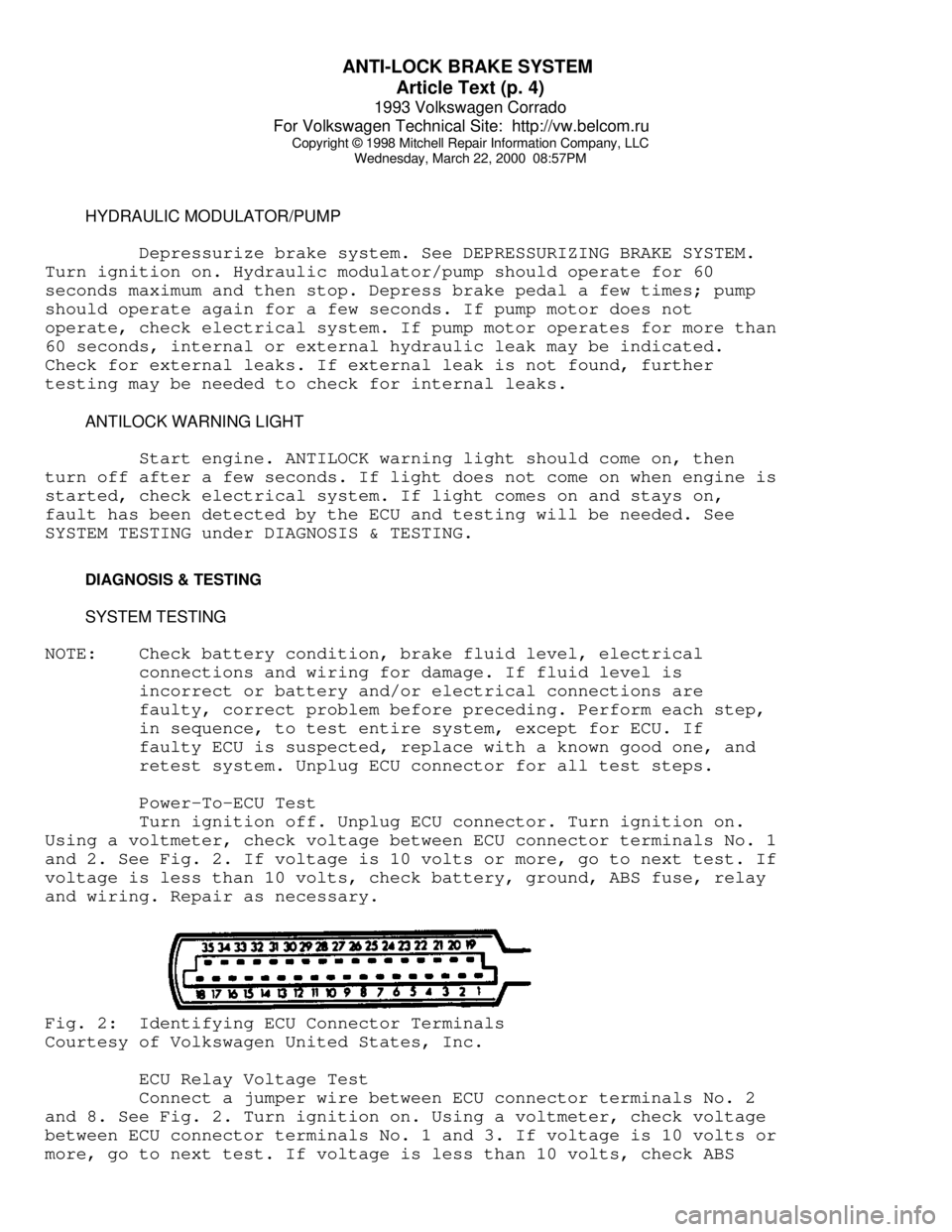
Using a voltmeter, check voltage between ECU connector terminals No. 1
and 2. See Fig. 2. If voltage is 10 volts or more, go to next test. If
voltage is less than 10 volts, check battery, ground, ABS fuse, relay
and wiring. Repair as necessary.Fig. 2: Identifying ECU Connector Terminals
Courtesy of Volkswagen United States, Inc.
ECU Relay Voltage Test
Connect a jumper wire between ECU connector terminals No. 2
and 8. See Fig. 2. Turn ignition on. Using a voltmeter, check voltage
between ECU connector terminals No. 1 and 3. If voltage is 10 volts or
more, go to next test. If voltage is less than 10 volts, check ABS