check engine light VOLKSWAGEN CORRADO 1993 Owner's Manual
[x] Cancel search | Manufacturer: VOLKSWAGEN, Model Year: 1993, Model line: CORRADO, Model: VOLKSWAGEN CORRADO 1993Pages: 920, PDF Size: 6.92 MB
Page 584 of 920
G - TESTS W/CODES
Article Text (p. 2)
1993 Volkswagen Corrado
For Volkswagen Technical Site: http://vw.belcom.ru
Copyright © 1998 Mitchell Repair Information Company, LLC
Wednesday, March 22, 2000 09:11PM
4444 (no faults indicated) or Code 0000 (end of output) appears. To
end code retrieval procedure, reconnect jumper cable to data link
connectors or turn ignition off.
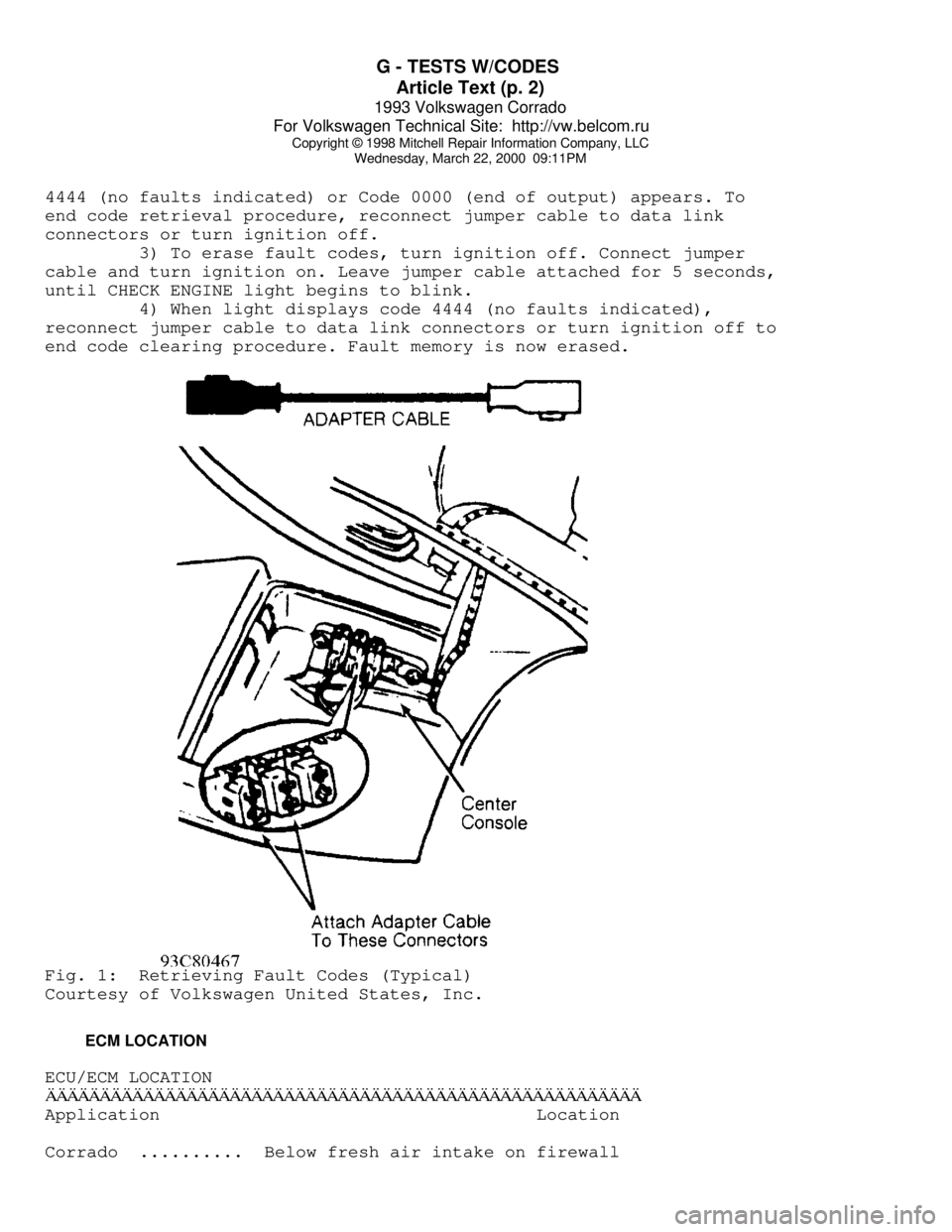
3) To erase fault codes, turn ignition off. Connect jumper
cable and turn ignition on. Leave jumper cable attached for 5 seconds,
until CHECK ENGINE light begins to blink.
4) When light displays code 4444 (no faults indicated),
reconnect jumper cable to data link connectors or turn ignition off to
end code clearing procedure. Fault memory is now erased.Fig. 1: Retrieving Fault Codes (Typical)
Courtesy of Volkswagen United States, Inc.
ECM LOCATION
ECU/ECM LOCATIONÄÄÄÄÄÄÄÄÄÄÄÄÄÄÄÄÄÄÄÄÄÄÄÄÄÄÄÄÄÄÄÄÄÄÄÄÄÄÄÄÄÄÄÄÄÄÄÄÄÄÄÄÄÄÄApplication Location
Corrado .......... Below fresh air intake on firewall
Page 586 of 920

G - TESTS W/CODES
Article Text (p. 4)
1993 Volkswagen Corrado
For Volkswagen Technical Site: http://vw.belcom.ru
Copyright © 1998 Mitchell Repair Information Company, LLC
Wednesday, March 22, 2000 09:11PM
Exceeded
00585 (2411) ... EGR Temperature Sensor ...... Short Ckt To Ground
Or Faulty Sensor
00586 (----) ........ EGR Control ........ EGR Valve Sticking Open
01025 (----) .. Malfunction Indicator Light .... Open/Short Ckt To
Ground Or Battery
Voltage
01242 (4332) ...... ECM Output Stage ........ Faulty Ckt To Output
Check Controlled
Components
01247 (4343) ... EVAP Frequency Solenoid ...... Open/Short Ckt To
Ground Or Battery
Voltage
01249 (4411) ....... Injector No. 1 ............ Open/Short Ckt To
Ground Or Battery
Voltage
01250 (4412) ....... Injector No. 2 ............ Open/Short Ckt To
Ground Or Battery
Voltage
01251 (4413) ....... Injector No. 3 ............ Open/Short Ckt To
Ground Or Battery
Voltage
01252 (4414) ....... Injector No. 4 ............ Open/Short Ckt To
Ground Or Battery
Voltage
01253 (4415) ....... Injector No. 5 ............ Open/Short Ckt To
Ground Or Battery
Voltage
01254 (4422) ....... Injector No. 6 ............ Open/Short Ckt To
Ground Or Battery
Voltage
01257 (4431) .. Idle Air Control (IAC) Valve ... Open/Short Ckt To
Ground Or Battery
Voltage
01259 (4433) ....... Fuel Pump Relay ....... Open Ckt Or Short Ckt
To Battery Voltage
01265 (4312) .. EGR Frequency (2-Way) Valve .... Open/Short Ckt To
Ground Or Battery
Voltage
65535 (1111) ... Electronic Control Module .... Replace Faulty ECM
(1) - For testing information, see J - PIN VOLTAGE CHARTS article.
(2) - Blink code is 4-digit malfunction indicator CHECK ENGINE
light code.
(3) - Check intake and exhaust systems for leaks. Check for too low
or too high a fuel pressure. Also check for malfunctioning
fuel injectors or engine misfire.
(4) - Check intake and exhaust systems for leaks. Check for mass
airflow sensor hot wire not burning off cleanly. Check for
faulty oxygen sensor control and for EVAP frequency solenoid
sticking open. Also check for malfunctioning fuel injectors or
engine misfire.
Page 602 of 920

H - TESTS W/O CODES
Article Text (p. 6)
1993 Volkswagen Corrado
For Volkswagen Technical Site: http://vw.belcom.ru
Copyright © 1998 Mitchell Repair Information Company, LLC
Wednesday, March 22, 2000 09:11PM
* Check full throttle switch.
* Check ignition timing.
ENGINE RUNS UNEVENLY OVER ENTIRE SPEED RANGE
* Check auxiliary air intake system.
* Check injector fuel pressure and volume.
* Check ignition timing, spark plugs, distributor, secondary
ignition wiring and coil.
INTERMITTENTS
INTERMITTENT PROBLEM DIAGNOSIS
Intermittent fault testing requires duplicating circuit or
component failure to identify the problem. These procedures may lead
to the computer setting a fault code (on some systems) which may help
in diagnosis.
If problem vehicle does not produce fault codes, monitor
voltage or resistance values using a DVOM while attempting to
reproduce conditions causing intermittent fault. A status change on
DVOM indicates a fault has been located.
Use a DVOM to pinpoint faults. When monitoring voltage,
ensure ignition switch is in ON position or engine is running. Ensure
ignition switch is in OFF position or negative battery cable is
disconnected when monitoring circuit resistance. Status changes on
DVOM during test procedures indicate area of fault.
TEST PROCEDURES
Intermittent Simulation
To reproduce the conditions creating an intermittent fault,
use the following methods:
* Lightly vibrate component.
* Heat component.
* Wiggle or bend wiring harness.
* Spray component with water.
* Remove/apply vacuum source.
Monitor circuit/component voltage or resistance while
simulating intermittent. If engine is running, monitor for self-
diagnostic codes. Use the test results to identify a faulty component
or circuit. For system or component testing refer to the appropriate
I - SYS/COMP TESTS article in this section. See the menu below:
* For Cabriolet, see: I - SYSTEM/COMPONENT TESTS
* For Corrado SLC, see: I - SYSTEM/COMPONENT TESTS
* For EuroVan, see: I - SYSTEM/COMPONENT TESTS
* For Fox, see: I - SYSTEM/COMPONENT TESTS
* For Golf, GTI, Jetta, see: I - SYSTEM/COMPONENT TESTS
* For Passat GL 2.0L 4-Cylinder, see:
Page 628 of 920

INTERFERENCE VERIFICATION CHECK FOR OHC ENGINE
Article Text (p. 3)
1993 Volkswagen Corrado
For Volkswagen Technical Site: http://vw.belcom.ru
Copyright © 1998 Mitchell Repair Information Company, LLC
Wednesday, March 22, 2000 09:12PM
1976-80 ..... (2) 1.5L 4-Cyl. Diesel ...... (3) 60,000
1981-84 ........ (2) 1.6L 4-Cyl.
Diesel & Turbo Diesel ....... (3) 60,000
1983-84 .......... 1.7L 4-Cyl. ............ (3) 60,000
1.8L 4-Cyl. ............ (3) 60,000
Scirocco
1976-79 .......... 1.5L 4-Cyl. ............ (3) 60,000
1976-80 .......... 1.6L 4-Cyl. ............ (3) 60,000
1983-84 .......... 1.7L 4-Cyl. ............ (3) 60,000
1.8L 4-Cyl. ............ (3) 60,000
1985-89 ....... 1.8L 4-Cyl. (DOHC) ........ (3) 60,000
1.8L 4-Cyl. (SOHC) ........ (3) 60,000
Scirocco (Canadian)
1989 .......... 1.8L 4-Cyl. (DOHC) ........ (3) 60,000
1.8L 4-Cyl. (SOHC) ........ (3) 60,000
(1) - Other interference engine applications may exist which
are not indicated here.
(2) - Interference engine. Check for possible damage to
piston(s) or valve(s) if there has been a timing belt
failure.
(3) - Although the vehicle manufacturer does not recommend a
specific scheduled maintenance interval, aftermarket
belt manufacturers suggest the belt be replaced at
60,000 mile intervals.
(4) - Vehicle manufacturer recommends replacing all belts at
the same time.ÄÄÄÄÄÄÄÄÄÄÄÄÄÄÄÄÄÄÄÄÄÄÄÄÄÄÄÄÄÄÄÄÄÄÄÄÄÄÄÄÄÄÄÄÄÄÄÄÄÄÄÄÄÄÄÄÄÄÄÄTIMING BELT INTERFERENCE VERIF. TABLE - LIGHT TRUCKS (1)
ÄÄÄÄÄÄÄÄÄÄÄÄÄÄÄÄÄÄÄÄÄÄÄÄÄÄÄÄÄÄÄÄÄÄÄÄÄÄÄÄÄÄÄÄÄÄÄÄÄÄÄÄÄÄÄÄÄÄÄÄ Replacement Interval
Application Engine (Miles)
Eurovan (Canadian)
1992-96 .......... 2.5L 5-Cyl. ............ (3) 60,000
Pickup
1980 ....... (2) 1.5L 4-Cyl. Diesel ....... (3) 60,000
1980-83 .......... 1.6L 4-Cyl. ............ (3) 60,000
1981-83 .... (2) 1.6L 4-Cyl. Diesel ....... (3) 60,000
1.7L 4-Cyl. ............ (3) 60,000
Transporter (Canadian)
1992-96 .......... 2.5L 5-Cyl. ............ (3) 60,000
Vanagon
1981-82 .... (2) 1.6L 4-Cyl. Diesel ....... (3) 60,000
(1) - Other interference engine applications may exist which
are not indicated here.
(2) - Interference engine. Check for possible damage to
piston(s) or valve(s) if there has been a timing belt
failure.
(3) - Although the vehicle manufacturer does not recommend a
Page 630 of 920

J - PIN VOLTAGE CHARTS
Article Text
1993 Volkswagen Corrado
For Volkswagen Technical Site: http://vw.belcom.ru
Copyright © 1998 Mitchell Repair Information Company, LLC
Wednesday, March 22, 2000 09:14PM
ARTICLE BEGINNING
1993 ENGINE PERFORMANCE
Volkswagen Pin Voltage Charts
Corrado SLC
INTRODUCTION
Pin voltage charts are supplied to reduce diagnostic time.
Checking pin voltages at ECU/ECM determines whether ECU/ECM is
receiving and transmitting proper voltage signals. Charts may also
help determine if ECU/ECM harness has an electrical short or open.
NOTE: Unless stated otherwise in testing procedures, perform all
voltage tests using a Digital Volt-Ohmmeter (DVOM) with a
minimum 10-megohm input impedance. Voltage readings may vary
slightly due to battery condition or charging rate.
ECU PIN VOLTAGES (CORRADO SLC)
ECU PIN VOLTAGES (CORRADO SLC - MOTRONIC)ÄÄÄÄÄÄÄÄÄÄÄÄÄÄÄÄÄÄÄÄÄÄÄÄÄÄÄÄÄÄÄÄÄÄÄÄÄÄÄÄÄÄÄÄÄÄÄÄÄÄÄÄÄÄÄÄÄÄÄÄÄÄÄÄÄÄÄÄÄÄComponent/Circuit (1) Test Conditions & Specified Value
(VAG 1598 Terminal No.) Additional Steps Or Test Result
ECU NOT CONNECTED TO VAG 1598/18
Voltage Supply -
Control Module (1 & 54) ... Ignition Off ..... Battery Voltage
Voltage Supply -
Control Module
Relay (1 & 23) ........ (2) Ignition Off ... Battery Voltage
Wiring To Fuel Pump
(6 & 55 - Jumper) ......... Ignition On ....... Fuel Pump Must
Operate
Heated Oxygen (O2)
Sensor Relay (7 & 28 -
Briefly Jumper) ....... (2) Ignition On ......... Relay Must
Operate (Click)
Malfunction Indicator
Light (5 & 10 - Jumper) ... Ignition On .. MIL Must Illuminate
Wiring For A/C (39 & 55) .... Ignition On,
A/C Switch On .... Battery Voltage
Wiring To A/C Compressor
(37 & 38 - Jumper) ........ Ignition On ......... A/C Magnetic
Clutch Operates
Fuel Injector No. 1
(23 & 24) ................. Ignition Off ........ 15-21.5 Ohms
Fuel Injector No. 2
(3 & 23) .................. Ignition Off ........ 15-21.5 Ohms
Fuel Injector No. 3
Page 685 of 920

SCHEDULED SERVICES
Article Text (p. 3)
1993 Volkswagen Corrado
For Volkswagen Technical Site: http://vw.belcom.ru
Copyright © 1998 Mitchell Repair Information Company, LLC
Wednesday, March 22, 2000 09:22PM
restored, driveability problems may exist on some vehicles.
These vehicles may require a relearn procedure. See COMPUTER
RELEARN PROCEDURES article in GENERAL INFORMATION section.
REPLACING BLOWN FUSES
Before replacing a blown fuse, remove ignition key, turn off
all lights and accessories to avoid damaging the electrical system. Be
sure to use fuse with the correct indicated amperage rating. The use
of an incorrect amperage rating fuse may result in a dangerous
electrical system overload.
BRAKE PAD REPLACEMENT
WARNING: Use caution when checking and/or changing brake pads, some
pads may contain asbestos which can irritate eyes and may
cause other health hazards. A water based solution should be
used to clean brake dust from wheel and brake components.
DO NOT use compressed air to blow off brake dust.
BRAKE SYSTEM
CAUTION: If brake warning light comes on while driving it indicates
a low fluid level or failure in one of the braking
circuits. If the brake pedal can be depressed further than
normal it is an indication that one of the brake circuits
is not functioning. Stop vehicle and check brake reservoir
fluid level. If level is below MIN mark, DO NOT drive
vehicle. Have it towed to a repair shop. If level is
between the MIN and MAX marks, proceed cautiously to a
repair shop.
BRAKE PAD WEAR INDICATOR
Indicator will cause a squealing or scraping noise, warning
that brake pads need replacement.
BRAKE PEDAL PRESSURE WITH ENGINE NOT RUNNING
CAUTION: Brake pedal requires extreme pressure to stop the vehicle
when the engine is not running.
CATALYTIC CONVERTER
Continued operation of vehicle with a severe malfunction
could cause converter to overheat, resulting in possible damage to
converter and vehicle.
Any modification to the exhaust system on turbo models, which
reduces exhaust backpressure, will lead to lean fuel mixtures and
excessive spark advance. This could cause serious engine damage.
COOLANT (PROPYLENE-GLYCOL FORMULATIONS)
Page 695 of 920

SCHEDULED SERVICES
Article Text (p. 13)
1993 Volkswagen Corrado
For Volkswagen Technical Site: http://vw.belcom.ru
Copyright © 1998 Mitchell Repair Information Company, LLC
Wednesday, March 22, 2000 09:22PM³ ³ Check Operation of Horn, Wipers/Washers & All Exterior Lights ³
ÃÄÄÄÅÄÄÄÄÄÄÄÄÄÄÄÄÄÄÄÄÄÄÄÄÄÄÄÄÄÄÄÄÄÄÄÄÄÄÄÄÄÄÄÄÄÄÄÄÄÄÄÄÄÄÄÄÄÄÄÄÄÄÄÄÄÄÄÄ´
³
³ Inspect Condition of Wiper Blades ³
ÃÄÄÄÅÄÄÄÄÄÄÄÄÄÄÄÄÄÄÄÄÄÄÄÄÄÄÄÄÄÄÄÄÄÄÄÄÄÄÄÄÄÄÄÄÄÄÄÄÄÄÄÄÄÄÄÄÄÄÄÄÄÄÄÄÄÄÄÄ´
³
³ Check Headlight Alignment ³
ÃÄÄÄÅÄÄÄÄÄÄÄÄÄÄÄÄÄÄÄÄÄÄÄÄÄÄÄÄÄÄÄÄÄÄÄÄÄÄÄÄÄÄÄÄÄÄÄÄÄÄÄÄÄÄÄÄÄÄÄÄÄÄÄÄÄÄÄÄ´
³
³ Lubricate Weatherstripping with Silicone ³
ÃÄÄÄÅÄÄÄÄÄÄÄÄÄÄÄÄÄÄÄÄÄÄÄÄÄÄÄÄÄÄÄÄÄÄÄÄÄÄÄÄÄÄÄÄÄÄÄÄÄÄÄÄÄÄÄÄÄÄÄÄÄÄÄÄÄÄÄÄ´
³
³ Door/Hood/Trunk Stops, Hinges & Locks ³
ÃÄÄÄÅÄÄÄÄÄÄÄÄÄÄÄÄÄÄÄÄÄÄÄÄÄÄÄÄÄÄÄÄÄÄÄÄÄÄÄÄÄÄÄÄÄÄÄÄÄÄÄÄÄÄÄÄÄÄÄÄÄÄÄÄÄÄÄÄ´
³
³ Check Body Drain Holes ³
ÃÄÄÄÅÄÄÄÄÄÄÄÄÄÄÄÄÄÄÄÄÄÄÄÄÄÄÄÄÄÄÄÄÄÄÄÄÄÄÄÄÄÄÄÄÄÄÄÄÄÄÄÄÄÄÄÄÄÄÄÄÄÄÄÄÄÄÄÄ´
³
³ Check Automatic Seat Belt Operation (1990-94) ³
ÃÄÄÄÅÄÄÄÄÄÄÄÄÄÄÄÄÄÄÄÄÄÄÄÄÄÄÄÄÄÄÄÄÄÄÄÄÄÄÄÄÄÄÄÄÄÄÄÄÄÄÄÄÄÄÄÄÄÄÄÄÄÄÄÄÄÄÄÄ´
³
³ Check Seat Belt Webbing and Release Mechanisms ³
ÃÄÄÄÅÄÄÄÄÄÄÄÄÄÄÄÄÄÄÄÄÄÄÄÄÄÄÄÄÄÄÄÄÄÄÄÄÄÄÄÄÄÄÄÄÄÄÄÄÄÄÄÄÄÄÄÄÄÄÄÄÄÄÄÄÄÄÄÄ´
³
³ Windshield Washer System ³
ÃÄÄÄÅÄÄÄÄÄÄÄÄÄÄÄÄÄÄÄÄÄÄÄÄÄÄÄÄÄÄÄÄÄÄÄÄÄÄÄÄÄÄÄÄÄÄÄÄÄÄÄÄÄÄÄÄÄÄÄÄÄÄÄÄÄÄÄÄ´
³
³ Parking Brake Adjustment ³
ÃÄÄÄÅÄÄÄÄÄÄÄÄÄÄÄÄÄÄÄÄÄÄÄÄÄÄÄÄÄÄÄÄÄÄÄÄÄÄÄÄÄÄÄÄÄÄÄÄÄÄÄÄÄÄÄÄÄÄÄÄÄÄÄÄÄÄÄÄ´
³
³ Check Clutch Adjustment ³
ÃÄÄÄÅÄÄÄÄÄÄÄÄÄÄÄÄÄÄÄÄÄÄÄÄÄÄÄÄÄÄÄÄÄÄÄÄÄÄÄÄÄÄÄÄÄÄÄÄÄÄÄÄÄÄÄÄÄÄÄÄÄÄÄÄÄÄÄÄ´
³
³ Suspension & Wheel Bearings ³
ÃÄÄÄÅÄÄÄÄÄÄÄÄÄÄÄÄÄÄÄÄÄÄÄÄÄÄÄÄÄÄÄÄÄÄÄÄÄÄÄÄÄÄÄÄÄÄÄÄÄÄÄÄÄÄÄÄÄÄÄÄÄÄÄÄÄÄÄÄ´
³
³ Check Shift Interlock Operation ³
ÃÄÄÄÅÄÄÄÄÄÄÄÄÄÄÄÄÄÄÄÄÄÄÄÄÄÄÄÄÄÄÄÄÄÄÄÄÄÄÄÄÄÄÄÄÄÄÄÄÄÄÄÄÄÄÄÄÄÄÄÄÄÄÄÄÄÄÄÄ´
³
³ Inspect Steering Linkage/Front Suspension ³
ÃÄÄÄÅÄÄÄÄÄÄÄÄÄÄÄÄÄÄÄÄÄÄÄÄÄÄÄÄÄÄÄÄÄÄÄÄÄÄÄÄÄÄÄÄÄÄÄÄÄÄÄÄÄÄÄÄÄÄÄÄÄÄÄÄÄÄÄÄ´
³
³ Lubricate Chassis ³
ÃÄÄÄÅÄÄÄÄÄÄÄÄÄÄÄÄÄÄÄÄÄÄÄÄÄÄÄÄÄÄÄÄÄÄÄÄÄÄÄÄÄÄÄÄÄÄÄÄÄÄÄÄÄÄÄÄÄÄÄÄÄÄÄÄÄÄÄÄ´
³
³ Inspect Brake Pads, Rotors and Calipers ³
ÃÄÄÄÅÄÄÄÄÄÄÄÄÄÄÄÄÄÄÄÄÄÄÄÄÄÄÄÄÄÄÄÄÄÄÄÄÄÄÄÄÄÄÄÄÄÄÄÄÄÄÄÄÄÄÄÄÄÄÄÄÄÄÄÄÄÄÄÄ´
³
³ Inspect Brake System Hoses & Lines ³
ÃÄÄÄÅÄÄÄÄÄÄÄÄÄÄÄÄÄÄÄÄÄÄÄÄÄÄÄÄÄÄÄÄÄÄÄÄÄÄÄÄÄÄÄÄÄÄÄÄÄÄÄÄÄÄÄÄÄÄÄÄÄÄÄÄÄÄÄÄ´
³
³ Inspect Shocks/Struts for Leakage ³
ÃÄÄÄÅÄÄÄÄÄÄÄÄÄÄÄÄÄÄÄÄÄÄÄÄÄÄÄÄÄÄÄÄÄÄÄÄÄÄÄÄÄÄÄÄÄÄÄÄÄÄÄÄÄÄÄÄÄÄÄÄÄÄÄÄÄÄÄÄ´
³
³ Inspect Tire Wear and Condition ³
ÃÄÄÄÅÄÄÄÄÄÄÄÄÄÄÄÄÄÄÄÄÄÄÄÄÄÄÄÄÄÄÄÄÄÄÄÄÄÄÄÄÄÄÄÄÄÄÄÄÄÄÄÄÄÄÄÄÄÄÄÄÄÄÄÄÄÄÄÄ´
³
³ Rotate Tires and Adjust Air Pressure (Including Spare) ³
ÃÄÄÄÅÄÄÄÄÄÄÄÄÄÄÄÄÄÄÄÄÄÄÄÄÄÄÄÄÄÄÄÄÄÄÄÄÄÄÄÄÄÄÄÄÄÄÄÄÄÄÄÄÄÄÄÄÄÄÄÄÄÄÄÄÄÄÄÄ´
³
³ Road Test ³
ÃÄÄÄÁÄÄÄÄÄÄÄÄÄÄÄÄÄÄÄÄÄÄÄÄÄÄÄÄÄÄÄÄÄÄÄÄÄÄÄÄÄÄÄÄÄÄÄÄÄÄÄÄÄÄÄÄÄÄÄÄÄÄÄÄÄÄÄÄ´
³ Replace
³
ÃÄÄÄÂÄÄÄÄÄÄÄÄÄÄÄÄÄÄÄÄÄÄÄÄÄÄÄÄÄÄÄÄÄÄÄÄÄÄÄÄÄÄÄÄÄÄÄÄÄÄÄÄÄÄÄÄÄÄÄÄÄÄÄÄÄÄÄÄ´
³
³ Engine Oil ³
ÃÄÄÄÅÄÄÄÄÄÄÄÄÄÄÄÄÄÄÄÄÄÄÄÄÄÄÄÄÄÄÄÄÄÄÄÄÄÄÄÄÄÄÄÄÄÄÄÄÄÄÄÄÄÄÄÄÄÄÄÄÄÄÄÄÄÄÄÄ´
³
³ Oil Filter ³
ÃÄÄÄÁÄÄÄÄÄÄÄÄÄÄÄÄÄÄÄÄÄÄÄÄÄÄÄÄÄÄÄÄÄÄÄÄÄÄÄÄÄÄÄÄÄÄÄÄÄÄÄÄÄÄÄÄÄÄÄÄÄÄÄÄÄÄÄÄ´
³ Lubrication Specifications
³
ÃÄÄÄÄÄÄÄÄÄÄÄÄÄÄÄÄÄÄÄÄÄÄÄÄÄÄÄÄÄÄÄÄÄÄÄÄÄÄÄÄÄÄÄÄÄÄÄÄÄÄÄÄÄÄÄÄÄÄÄÄÄÄÄÄÄÄÄÄ´
³ Application Specification
³
³
³
Page 702 of 920

SCHEDULED SERVICES
Article Text (p. 20)
1993 Volkswagen Corrado
For Volkswagen Technical Site: http://vw.belcom.ru
Copyright © 1998 Mitchell Repair Information Company, LLC
Wednesday, March 22, 2000 09:22PM³ ³ Check Exhaust System & Heat Shielding ³
ÃÄÄÄÅÄÄÄÄÄÄÄÄÄÄÄÄÄÄÄÄÄÄÄÄÄÄÄÄÄÄÄÄÄÄÄÄÄÄÄÄÄÄÄÄÄÄÄÄÄÄÄÄÄÄÄÄÄÄÄÄÄÄÄÄÄÄÄÄ´
³
³ Clean Battery and Battery Terminals ³
ÃÄÄÄÅÄÄÄÄÄÄÄÄÄÄÄÄÄÄÄÄÄÄÄÄÄÄÄÄÄÄÄÄÄÄÄÄÄÄÄÄÄÄÄÄÄÄÄÄÄÄÄÄÄÄÄÄÄÄÄÄÄÄÄÄÄÄÄÄ´
³
³ Inspect Fuel/Tank/Cap/Lines ³
ÃÄÄÄÅÄÄÄÄÄÄÄÄÄÄÄÄÄÄÄÄÄÄÄÄÄÄÄÄÄÄÄÄÄÄÄÄÄÄÄÄÄÄÄÄÄÄÄÄÄÄÄÄÄÄÄÄÄÄÄÄÄÄÄÄÄÄÄÄ´
³
³ Check Operation of Horn, Wipers/Washers & All Exterior Lights ³
ÃÄÄÄÅÄÄÄÄÄÄÄÄÄÄÄÄÄÄÄÄÄÄÄÄÄÄÄÄÄÄÄÄÄÄÄÄÄÄÄÄÄÄÄÄÄÄÄÄÄÄÄÄÄÄÄÄÄÄÄÄÄÄÄÄÄÄÄÄ´
³
³ Inspect Condition of Wiper Blades ³
ÃÄÄÄÅÄÄÄÄÄÄÄÄÄÄÄÄÄÄÄÄÄÄÄÄÄÄÄÄÄÄÄÄÄÄÄÄÄÄÄÄÄÄÄÄÄÄÄÄÄÄÄÄÄÄÄÄÄÄÄÄÄÄÄÄÄÄÄÄ´
³
³ Check Headlight Alignment ³
ÃÄÄÄÅÄÄÄÄÄÄÄÄÄÄÄÄÄÄÄÄÄÄÄÄÄÄÄÄÄÄÄÄÄÄÄÄÄÄÄÄÄÄÄÄÄÄÄÄÄÄÄÄÄÄÄÄÄÄÄÄÄÄÄÄÄÄÄÄ´
³
³ Lubricate Weatherstripping with Silicone ³
ÃÄÄÄÅÄÄÄÄÄÄÄÄÄÄÄÄÄÄÄÄÄÄÄÄÄÄÄÄÄÄÄÄÄÄÄÄÄÄÄÄÄÄÄÄÄÄÄÄÄÄÄÄÄÄÄÄÄÄÄÄÄÄÄÄÄÄÄÄ´
³
³ Door/Hood/Trunk Stops, Hinges & Locks ³
ÃÄÄÄÅÄÄÄÄÄÄÄÄÄÄÄÄÄÄÄÄÄÄÄÄÄÄÄÄÄÄÄÄÄÄÄÄÄÄÄÄÄÄÄÄÄÄÄÄÄÄÄÄÄÄÄÄÄÄÄÄÄÄÄÄÄÄÄÄ´
³
³ Check Body Drain Holes ³
ÃÄÄÄÅÄÄÄÄÄÄÄÄÄÄÄÄÄÄÄÄÄÄÄÄÄÄÄÄÄÄÄÄÄÄÄÄÄÄÄÄÄÄÄÄÄÄÄÄÄÄÄÄÄÄÄÄÄÄÄÄÄÄÄÄÄÄÄÄ´
³
³ Check Automatic Seat Belt Operation (1990-94) ³
ÃÄÄÄÅÄÄÄÄÄÄÄÄÄÄÄÄÄÄÄÄÄÄÄÄÄÄÄÄÄÄÄÄÄÄÄÄÄÄÄÄÄÄÄÄÄÄÄÄÄÄÄÄÄÄÄÄÄÄÄÄÄÄÄÄÄÄÄÄ´
³
³ Check Seat Belt Webbing and Release Mechanisms ³
ÃÄÄÄÅÄÄÄÄÄÄÄÄÄÄÄÄÄÄÄÄÄÄÄÄÄÄÄÄÄÄÄÄÄÄÄÄÄÄÄÄÄÄÄÄÄÄÄÄÄÄÄÄÄÄÄÄÄÄÄÄÄÄÄÄÄÄÄÄ´
³
³ Windshield Washer System ³
ÃÄÄÄÅÄÄÄÄÄÄÄÄÄÄÄÄÄÄÄÄÄÄÄÄÄÄÄÄÄÄÄÄÄÄÄÄÄÄÄÄÄÄÄÄÄÄÄÄÄÄÄÄÄÄÄÄÄÄÄÄÄÄÄÄÄÄÄÄ´
³
³ Parking Brake Adjustment ³
ÃÄÄÄÅÄÄÄÄÄÄÄÄÄÄÄÄÄÄÄÄÄÄÄÄÄÄÄÄÄÄÄÄÄÄÄÄÄÄÄÄÄÄÄÄÄÄÄÄÄÄÄÄÄÄÄÄÄÄÄÄÄÄÄÄÄÄÄÄ´
³
³ Check Clutch Adjustment ³
ÃÄÄÄÅÄÄÄÄÄÄÄÄÄÄÄÄÄÄÄÄÄÄÄÄÄÄÄÄÄÄÄÄÄÄÄÄÄÄÄÄÄÄÄÄÄÄÄÄÄÄÄÄÄÄÄÄÄÄÄÄÄÄÄÄÄÄÄÄ´
³
³ Suspension & Wheel Bearings ³
ÃÄÄÄÅÄÄÄÄÄÄÄÄÄÄÄÄÄÄÄÄÄÄÄÄÄÄÄÄÄÄÄÄÄÄÄÄÄÄÄÄÄÄÄÄÄÄÄÄÄÄÄÄÄÄÄÄÄÄÄÄÄÄÄÄÄÄÄÄ´
³
³ Check Shift Interlock Operation ³
ÃÄÄÄÅÄÄÄÄÄÄÄÄÄÄÄÄÄÄÄÄÄÄÄÄÄÄÄÄÄÄÄÄÄÄÄÄÄÄÄÄÄÄÄÄÄÄÄÄÄÄÄÄÄÄÄÄÄÄÄÄÄÄÄÄÄÄÄÄ´
³
³ Inspect Steering Linkage/Front Suspension ³
ÃÄÄÄÅÄÄÄÄÄÄÄÄÄÄÄÄÄÄÄÄÄÄÄÄÄÄÄÄÄÄÄÄÄÄÄÄÄÄÄÄÄÄÄÄÄÄÄÄÄÄÄÄÄÄÄÄÄÄÄÄÄÄÄÄÄÄÄÄ´
³
³ Lubricate Chassis ³
ÃÄÄÄÅÄÄÄÄÄÄÄÄÄÄÄÄÄÄÄÄÄÄÄÄÄÄÄÄÄÄÄÄÄÄÄÄÄÄÄÄÄÄÄÄÄÄÄÄÄÄÄÄÄÄÄÄÄÄÄÄÄÄÄÄÄÄÄÄ´
³
³ Inspect Brake Pads, Rotors and Calipers ³
ÃÄÄÄÅÄÄÄÄÄÄÄÄÄÄÄÄÄÄÄÄÄÄÄÄÄÄÄÄÄÄÄÄÄÄÄÄÄÄÄÄÄÄÄÄÄÄÄÄÄÄÄÄÄÄÄÄÄÄÄÄÄÄÄÄÄÄÄÄ´
³
³ Inspect Brake System Hoses & Lines ³
ÃÄÄÄÅÄÄÄÄÄÄÄÄÄÄÄÄÄÄÄÄÄÄÄÄÄÄÄÄÄÄÄÄÄÄÄÄÄÄÄÄÄÄÄÄÄÄÄÄÄÄÄÄÄÄÄÄÄÄÄÄÄÄÄÄÄÄÄÄ´
³
³ Inspect Shocks/Struts for Leakage ³
ÃÄÄÄÅÄÄÄÄÄÄÄÄÄÄÄÄÄÄÄÄÄÄÄÄÄÄÄÄÄÄÄÄÄÄÄÄÄÄÄÄÄÄÄÄÄÄÄÄÄÄÄÄÄÄÄÄÄÄÄÄÄÄÄÄÄÄÄÄ´
³
³ Inspect Tire Wear and Condition ³
ÃÄÄÄÅÄÄÄÄÄÄÄÄÄÄÄÄÄÄÄÄÄÄÄÄÄÄÄÄÄÄÄÄÄÄÄÄÄÄÄÄÄÄÄÄÄÄÄÄÄÄÄÄÄÄÄÄÄÄÄÄÄÄÄÄÄÄÄÄ´
³
³ Rotate Tires and Adjust Air Pressure (Including Spare) ³
ÃÄÄÄÅÄÄÄÄÄÄÄÄÄÄÄÄÄÄÄÄÄÄÄÄÄÄÄÄÄÄÄÄÄÄÄÄÄÄÄÄÄÄÄÄÄÄÄÄÄÄÄÄÄÄÄÄÄÄÄÄÄÄÄÄÄÄÄÄ´
³
³ Road Test ³
ÃÄÄÄÁÄÄÄÄÄÄÄÄÄÄÄÄÄÄÄÄÄÄÄÄÄÄÄÄÄÄÄÄÄÄÄÄÄÄÄÄÄÄÄÄÄÄÄÄÄÄÄÄÄÄÄÄÄÄÄÄÄÄÄÄÄÄÄÄ´
³ Replace
³
ÃÄÄÄÂÄÄÄÄÄÄÄÄÄÄÄÄÄÄÄÄÄÄÄÄÄÄÄÄÄÄÄÄÄÄÄÄÄÄÄÄÄÄÄÄÄÄÄÄÄÄÄÄÄÄÄÄÄÄÄÄÄÄÄÄÄÄÄÄ´
³
³ Engine Oil ³
ÃÄÄÄÅÄÄÄÄÄÄÄÄÄÄÄÄÄÄÄÄÄÄÄÄÄÄÄÄÄÄÄÄÄÄÄÄÄÄÄÄÄÄÄÄÄÄÄÄÄÄÄÄÄÄÄÄÄÄÄÄÄÄÄÄÄÄÄÄ´
Page 756 of 920

SUSPENSION - FRONT
Article Text (p. 2)
1993 Volkswagen Corrado
For Volkswagen Technical Site: http://vw.belcom.ru
Copyright © 1998 Mitchell Repair Information Company, LLC
Wednesday, March 22, 2000 09:24PM
NOTE: See WHEEL ALIGNMENT SPECIFICATIONS & PROCEDURES article in
the WHEEL ALIGNMENT section.
WHEEL BEARING
No adjustment is required.
BALL JOINT CHECKING
Raise and support vehicle. Inspect ball joints for excessive
play and damaged rubber boots. There should be no vertical or
horizontal ball joint play. Replace ball joint if any play is present.
REMOVAL & INSTALLATION
HUB & KNUCKLE ASSEMBLY
Use exploded view illustration when removing or installing
hub and knuckle assembly. See Fig. 1.
LOWER CONTROL ARM & BALL JOINT
Removal
1) Raise and support vehicle. Remove bolt retaining ball
joint at steering knuckle. Separate ball joint from housing. Leave
control arm hanging in mounts at subframe.
2) If control arm is not to be removed and ball joint is
riveted to control arm, drill out ball joint rivets using a 9/32" (7
mm) drill. After drilling rivets, chisel off rivet heads (if
necessary). If ball joint is bolted to control arm, remove bolts.
Remove ball joint.
3) If control arm is to be removed from vehicle, remove
stabilizer bar link rod nut, washers, and bushings. Remove pivot bolt
and "U" bracket housing inner pivot pin. Slide out control arm.
NOTE: On vehicles with automatic transmission, engine may have to
be lifted slightly to gain access to pivot bolts.
Inspection
Check lower control arm bushings for excessive wear, cracks
or contamination. Replace bushings if necessary. To replace bushings,
press out worn bushing. Select new bushing and press into position.
Ensure bushing does not twist when seating into place.
Installation
Slide new ball joint into slot in control arm. Install and
tighten ball joint retaining bolts. Install lower control arm to
subframe. Install ball joint into steering knuckle. To complete
installation, reverse removal procedure. Tighten control arm bolts
with vehicle on ground. Tighten all bolts and nuts to specification.
See TORQUE SPECIFICATIONS table at end of article. Check wheel
Page 757 of 920

SUSPENSION - FRONT
Article Text (p. 3)
1993 Volkswagen Corrado
For Volkswagen Technical Site: http://vw.belcom.ru
Copyright © 1998 Mitchell Repair Information Company, LLC
Wednesday, March 22, 2000 09:24PM
alignment. See WHEEL ALIGNMENT SPECIFICATIONS & PROCEDURES article in
the WHEEL ALIGNMENT section.
STRUT ASSEMBLY
Removal
1) Raise and support vehicle. Remove wheel assembly.
Disconnect and wire caliper aside. Remove bolts retaining strut to
steering knuckle. Note top bolt is used for front wheel camber
adjustment.
2) Support front suspension arm and components. Pry
suspension strut from steering knuckle. Remove upper strut retaining
nuts from inside engine compartment. Remove strut assembly.
Installation
To install, reverse removal procedure. Tighten bolts and nuts
to specification. See TORQUE SPECIFICATIONS table at end of article.
Check wheel alignment. See WHEEL ALIGNMENT SPECIFICATIONS & PROCEDURES
article in the WHEEL ALIGNMENT section.
FRONT SUSPENSION ASSEMBLY
Removal
1) Raise and support vehicle at center with safety stands.
Disconnect brake line and plug openings. Leave flex line in place.
Remove stabilizer link rod nut, bushings and washers.
2) Remove tie rod nut. Separate tie rod from steering
knuckle. Disconnect inner portion of constant velocity joint from
transaxle drive flange.
3) Remove lower control arm front pivot bolt. Remove "U"
shaped bracket bolts at control arm rear pivot.
NOTE: On vehicles with automatic transmission, engine may have to
be lifted slightly to gain access to pivot bolts.
4) Support suspension assembly. Remove upper strut retaining
nuts. Remove suspension assembly from vehicle.
Installation
To install, reverse removal procedure. Ensure convex side of
thrust washer faces pivot bolt head. Tighten bolts and nuts to
specification. Check wheel alignment. Proceed to appropriate
WHEEL ALIGNMENT SPECIFICATIONS & PROCEDURES article in the WHEEL
ALIGNMENT section.
WHEEL BEARING
Removal
1) Remove axle shaft nut with front wheels on ground. Raise
and support vehicle. Allow suspension to hang free. Remove wheel
assembly. Remove brake caliper attaching bolts. Remove caliper and
wire aside. Remove brake disc retaining screw and remove disc.