Temperature VOLKSWAGEN E-GOLF 2019 User Guide
[x] Cancel search | Manufacturer: VOLKSWAGEN, Model Year: 2019, Model line: E-GOLF, Model: VOLKSWAGEN E-GOLF 2019Pages: 394, PDF Size: 3.86 MB
Page 169 of 394

WARNING
Driving faster than the maximum speed for which the winter tires on your vehicle were de-signed can cause sudden tire failure including a blowout and sudden deflation, loss of con-trol, crashes and serious personal injuries.
x Winter tires have a maximum speed rating that may be lower than your vehicle's maximum speed.
x Never drive faster than the maximum speed for which the winter tires installed on your vehicle are rated because tires that are driven faster than their rated speed can fail suddenly.
x Never exceed the maximum load rating for the winter tires installed on your vehicle.
Install summer tires promptly in the spring. Summer tires offer better handling characteristics for temperatures above +45 °F (+7 °C). They are quieter, do not wear as quickly, and reduce power consumption.
The Tire Pressure Monitoring System must be recalibrated whenever you remove and remount or change any wheel or tire on the vehicle, even if the reinstalled or replacement wheels and tires are
identical to those that were removed and even if the tire pressure does not change ⇒ Tire Pressure Monitoring System (TPMS) and recalibration through the Infotainment system.
If necessary, ask your authorized Volkswagen dealer or authorized Volkswagen Service Facility about permissible winter tire dimensions.
Snow chains
Page 173 of 394

Sidewall separation
The parting of the rubber compound from the cord material in the sidewall.
Speed rating (letter code)
A standardized letter code indicating the maximum speed at which a tire is designed to be driven for extended periods of time. The ratings range from 93 mph or 150 km/h (“P”) to 186 mph or (300 km/h) “Y”.
The speed rating letter code, where applicable, is molded on the tire sidewall. You may not find this information on all tires because it is not required by law.
Tire Pressure Monitoring System
A system that detects when at least one of a vehicle's tires is underinflated and illuminates a low tire-pressure warning light.
Tread
The portion of a tire that normally touches the road.
Tread rib
A tread section running circumferentially around a tire.
Tread separation
Tire failure caused by the tread pulling away from the tire carcass.
Tread wear indicators (TWI)
Raised areas within the main tread grooves that show, visually, when tires are worn and near the end of their useful life
Uniform Tire Quality Grading (UTQG)
A tire information system developed by the U.S. National Highway Traffic Safety Administration (NHTSA) that is designed to help buyers compare tires. UTQG is not a safety rating, nor is it a guaran-tee that a tire will last for a certain number of miles or perform a certain way. It gives tire buyers more information to compare with factors such as price, brand loyalty and dealer recommendations. Under UTQG, tires are graded by the tire manufacturers in 3 areas: tread wear, traction and temperature resistance. UTQG information is molded into the tire sidewalls.
U.S. DOT Tire Identification Number (TIN)
A tire's serial number. It begins with the letters “DOT” (“Department of Transportation”) and indicates that the tire meets all federal standards. The next 2 numbers or letters indicate the plant where the tire was manufactured. The last 4 numbers represent the week and year of manufacture.
For example, the numbers 1709 mean that the tire was produced in the 17th week of 2009. Any other numbers are marketing codes used by the tire manufacturer. This information is used to help identify affected consumers if a tire defect requires a recall.
Vehicle capacity weight
The total rated cargo, luggage and passenger load. Passenger load is 150 lbs (68 kilograms) times the vehicle's total seating capacity (as listed on the label inside the driver door).
Vehicle maximum load on the tire
The load on an individual tire that is determined by taking each axle's share of the maximum loaded vehicle weight (GAWR) and dividing by 2.
Vehicle normal load on the tire
The load on an individual tire that is determined by taking each axle's share of the curb weight, acces-sory weight, and normal occupant weight (distributed according to the table below) and dividing by 2.
Page 177 of 394

WARNING
The temperature grade for this tire is established for a tire that is properly inflated and not overloaded. Excessive speed, underinflation or excessive loading, either separately or in combination, can cause heat buildup and possible tire failure.
Page 187 of 394
WARNING
Some kinds of cigarette lighters can be lit unintentionally, or crushed causing a fire that can result in serious burns and vehicle damage.
x Always make sure that there are no lighters in the seat tracks or near other moving parts before adjusting the seats.
x Before closing a storage compartment, always make sure that no cigarette lighter can be activated, crushed, or otherwise damaged.
x Never leave a cigarette lighter in a storage compartment, on the instrument panel, or in other places in the vehicle. Heat buildup in the passenger and luggage compartment of a parked vehicle can result in temperatures in the vehicle that are much higher than the outside temperatures, particularly in summer. High temperatures could cause the cigarette lighter to catch fire.
NOTICE
x The defroster heating wires or antenna in the rear window can be damaged by hard or sharp things on the shelf below the rear window.
x Do not keep any food, medicine, or other items sensitive to heat or cold in the vehicle. They can be damaged or made unusable by heat or cold.
x Things that are made of transparent materials (such as eyeglasses, magnifying glasses, or transparent suction cups on the windows) can magnify sunlight and damage the vehicle.
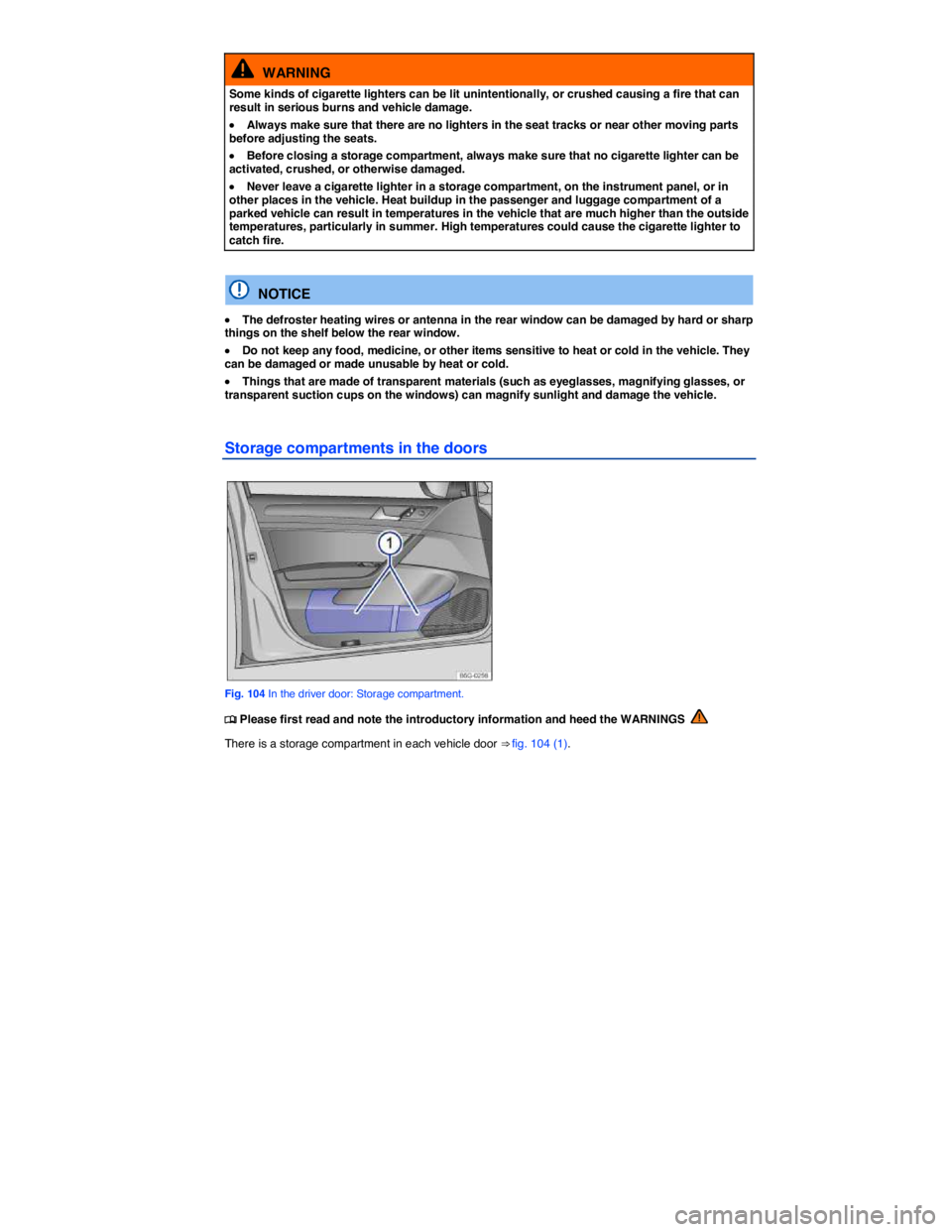
Storage compartments in the doors
Fig. 104 In the driver door: Storage compartment.
Page 209 of 394

Switching the ignition on and off
x Briefly press the starter button once without operating the brake or clutch pedals ⇒ .
Emergency start feature
If an authorized remote control vehicle key is in the passenger compartment but the instrument cluster displays No key in range when you push the starter button, the remote control vehicle key battery is weak or dead. You can still start the electric motor using the Emergency start feature.
x Make sure the selector lever is in the Park (P) position.
x Hold the remote control vehicle key to the right of the steering column trim immediately after press-
ing the starter button ⇒ fig. 122.
x The ignition automatically switches on and the electric motor starts.
Emergency shut-off
If the electric motor does not switch off by briefly pressing the starter button, emergency shut-off is necessary:
x Press the starter button twice within 3 seconds or press and hold the button longer than 1 second
⇒ in Stopping the electric motor
x The electric motor switches off automatically.
If no authorized remote control vehicle key is identified in the passenger compartment after the electric motor has been switched off, the electric motor cannot be restarted. A related message is shown in the instrument cluster display.
WARNING
Unintended vehicle movement can cause serious personal injury.
x Do not depress the brake or clutch pedals when switching on the ignition, as the electric motor could otherwise be activated immediately.
WARNING
Improper use of vehicle keys can result in serious personal injury.
x Always take the key with you when you leave the vehicle. Children or unauthorized per-sons may use it to lock the vehicle, start the electric motor, and operate vehicle systems such as the power windows, leading to serious personal injury.
x Never leave children, disabled persons, or anyone who cannot help themselves in the vehicle. The doors can be locked using the remote control vehicle key. This could result in people being trapped in the vehicle in an emergency. For example, depending on the time of year, people trapped in the vehicle can be exposed to very high or very low temperatures.
x Heat buildup in the passenger and luggage compartment of a parked vehicle can result in temperatures in the vehicle that are much higher than the outside temperatures, particularly in summer. Temperatures can quickly reach levels that can cause unconsciousness and death, particularly to small children.
If the ignition is switched on or the electric motor is activated and the driver door is opened, a chime sounds. The chime is also a reminder to switch off the electric motor and turn off the ignition before leaving and locking the vehicle from the outside.
Page 212 of 394

WARNING
An unattended vehicle that is ready to drive can be driven without authorization, causing crashes, other accidents and serious personal injury.
x Never leave the vehicle unattended when it is ready to drive.
x Always switch off the ignition before leaving the vehicle.
x Always make sure to move the selector lever to P (Park) and firmly apply the parking brake when leaving the vehicle.
x Always make sure that all doors, windows, the hood and rear hatch are completely closed and locked before leaving the vehicle.
At very low outside temperatures when the high-voltage battery is consequently very cold, elec-trical driving and the vehicle range may be limited.
Setting off
Page 232 of 394
WARNING
Parking improperly can cause serious personal injury.
x Never remove the key from the ignition switch while the vehicle is moving or rolling to a stop. The steering wheel will lock and you will not be able to steer or control the vehicle.
x Never park the vehicle where the hot exhaust system or catalytic converter could ignite flammable materials, such as brush, leaves, dry grass, spilled fuel, etc.
x Always apply the parking brake when parking your vehicle.
x Improper use of the parking brake can seriously injure you and your passengers.
x Never use the parking brake to slow down the vehicle when it is moving, except in an emergency. The stopping distance is much longer because only the rear wheels are braked. Always use the foot brake to stop the vehicle.
x Never leave children or anyone who cannot help themselves behind in the vehicle. They could release the parking brake and move the gear selector lever or gear shift, which could cause the vehicle to start moving. This can lead to a crash and serious personal injuries.
x Always take the key with you when you leave the vehicle. The electric motor can be start-ed and vehicle systems such as the power windows can be operated, leading to serious per-sonal injury.
x Never leave children, disabled persons, or anyone who cannot help themselves in the vehicle. The doors can be locked with the remote control vehicle key, trapping passengers in the vehicle in an emergency. For example, depending on the time of year, people trapped in the vehicle can be exposed to very high or very low temperatures.
x Heat buildup in the passenger and luggage compartment of a parked vehicle can result in temperatures in the vehicle that are much higher than the outside temperatures, particularly in summer. Temperatures can quickly reach levels that can cause unconsciousness and death, particularly to small children.
NOTICE
x Always be careful when you park in areas with parking barriers or high curbs. These vary in height and could damage your bumper and related parts if the front of your vehicle hits a barri-er or curb that is too high while you are getting into or out of a parking spot. To help prevent damage, stop before the tires of your vehicle touch a parking barrier or curb.
x Always be careful when you enter a driveway or drive up or down steep ramps or over curbs or other obstacles. Parts of the vehicle close to the ground may be damaged (such as bumper covers, spoilers, and parts of the electric drive).
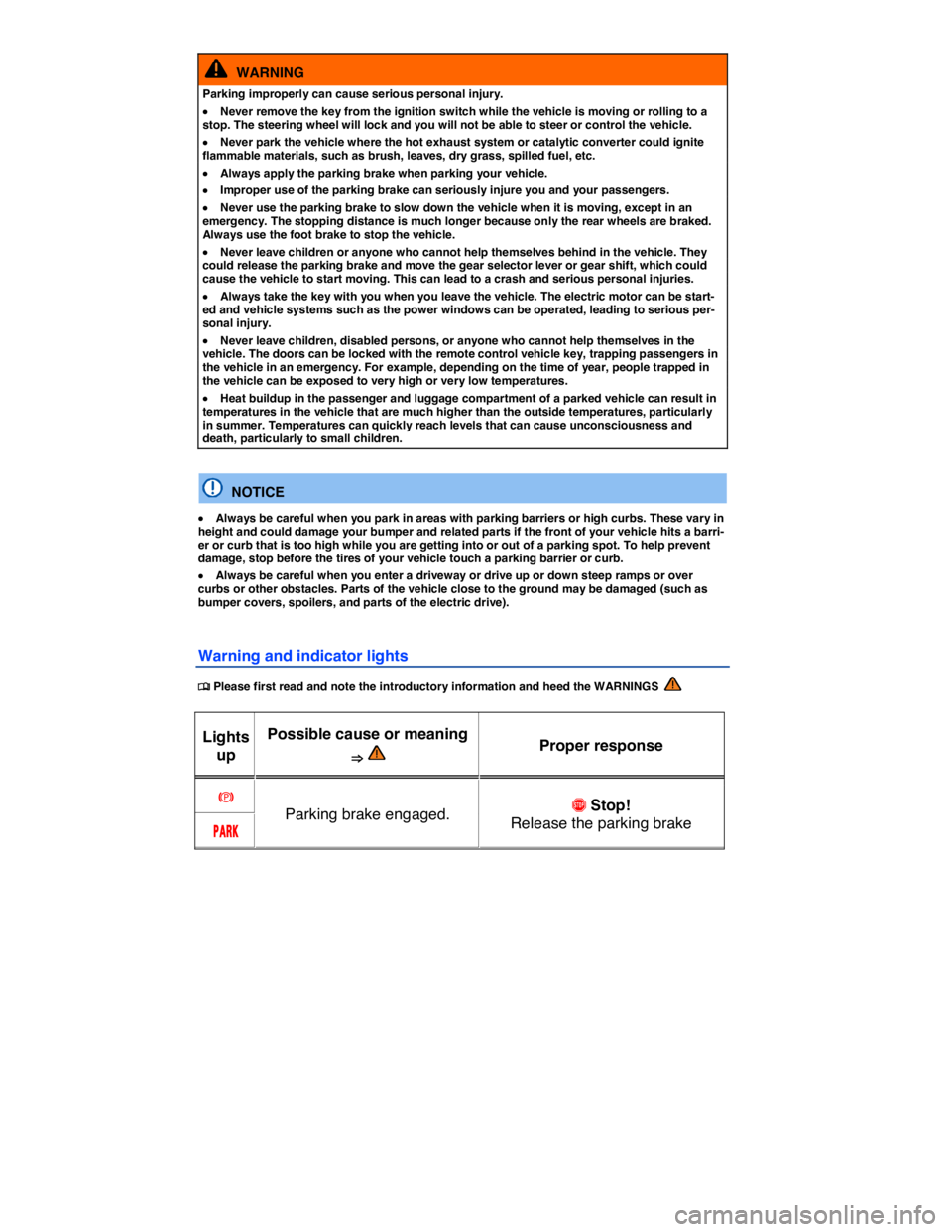
Warning and indicator lights
Page 264 of 394

Temperature monitoring
During the charging process the charging cable can become slightly warmer. This is normal and no cause for concern
If the control unit or the charging cable becomes too hot, the charging current will automatically be reduced If the control unit or the charging cable continues to get hot even at the lowest charging current, the protection unit will be switched off, and will remain switched off until it has cooled down sufficiently.
If no other sources of heat, such as direct sunlight, can be identified as relevant, have the outlet checked by properly qualified and trained experts.
Charging cable for charging at charging stations (if equipped)
Keep the charging cable for charging at a charging station safely in its bag in the luggage compart-ment. Follow the operating manual for the charging station. Before using the charging cable, read the procedure for charging with alternating current
WARNING
Charging the high-voltage battery improperly, using improper or damaged outlets and charg-ing cables, improper handling of the high-voltage battery or failure to follow safe charging procedures can cause short circuits, electric shock, explosions, fire, burns, injuries and death.
x Always connect the charging cable to a properly functioning 110 Volt Ground Fault Circuit (GFI) wall outlet. The outlet must be properly protected from water, moisture and other fluids.
x Always check the fuse protection of the GFI outlet before connecting the charging cable.
x Never connect the charging cable to a conventional power outlet, regardless of whether the outlet is protected or not.
x Never use the charging cable with an extension cord of any kind.
x Never let plugs or connectors come into contact with water, moisture, or any other fluids.
x Never use any charging cable if it is damaged and never use the charging cable with a damaged GFI outlet.
x Never attempt to alter or repair cables or other electrical components.
x Never let anybody stay in the vehicle while the high-voltage battery is charging.
x Never do any kind of work on the outside or inside of the vehicle while the high-voltage battery is charging.
x Always disconnect the charging cable completely from the vehicle before starting the motor.
WARNING
If you are not familiar with the outlet or the electrical installation or it has not been checked by qualified experts, never use it for charging. Even very low charging currents can cause serious damage and in particular fires if the socket or electrical installation is in bad condi-tion. If necessary, get expert assistance from a qualified electrical installation specialist.
WARNING
If a 110 Volt outlet is being used for charging, never charge 2 or more vehicles on outlets of the same fuse at the same time. Use a different fuse circuit for charging another vehicle. Al-ways comply with the maximum load for the fuse circuit used. If necessary, get expert assis-tance.
Page 299 of 394

Opening the Air conditioning menu
x Press the -%.5 ⇒ fig. 150 button.
The current air conditioning settings are displayed in the upper section of the screen, for example, the temperatures that are currently set for the driver and passenger sides. Set temperatures up to +72 °F (+22 °C) are shown with blue arrows, while temperatures above +72 °F (+22 °C) are shown with red arrows.
Tap the corresponding function key to switch a function on or off, or to select a submenu.
Function
key
Effect
/&& Switch off the Climatronic.
/. Switch on the Climatronic.
Setup
Page 300 of 394

x Turn the temperature knob to the center position.
x Open and adjust all air vents in the instrument panel ⇒, Air vents.
x Turn the air distribution knob to the desired setting.
x Push the !