battery replace VOLKSWAGEN EOS 2007 Owners Manual
[x] Cancel search | Manufacturer: VOLKSWAGEN, Model Year: 2007, Model line: EOS, Model: VOLKSWAGEN EOS 2007Pages: 381, PDF Size: 3.89 MB
Page 34 of 381
To find the nearest qualified independent repair facility, locksmith, or Volkswagen dealer which can cut and code replacement vehicle keys, call the VW Customer Care Hotline at 1-800-822-8987 or visit http://www.vw.com and search for “replacement keys.”
Canadian customers can contact an authorized Volkswagen dealer or Volkswagen Service Facility or call the Volkswagen Canada Customer CARE Center at 1-800-822-8987.
NOTICE
The remote control vehicle keys contain electrical components. Protect them from damage, moisture and rough handling.
Do not press the buttons on the remote control vehicle key unless you actually want to use the function in question. Since terrain and conditions vary, pressing a button on the remote control vehicle key when it is not necessary may unlock the vehicle or set off the panic alarm, even if you think you are out of range.
Remote control vehicle key functions can be temporarily disrupted by interference from transmit-ters near the vehicle that use the same frequency range (such as radio equipment or mobile phones).
Things between the remote control vehicle key and vehicle, bad weather, as well as a weak battery can reduce the operating range.
If the remote control vehicle key buttons, Unlocking or locking the vehicle from the outside or the power locking buttons, Unlocking or locking the vehicle from the inside are pushed repeatedly in quick succession, the power locking system is switched off for a brief period to help keep it from being overloaded. The vehicle is then unlocked for about 30 seconds. Unless a door or the luggage com-partment lid is opened in this span of time, the vehicle is automatically locked afterwards.
Mechanical key
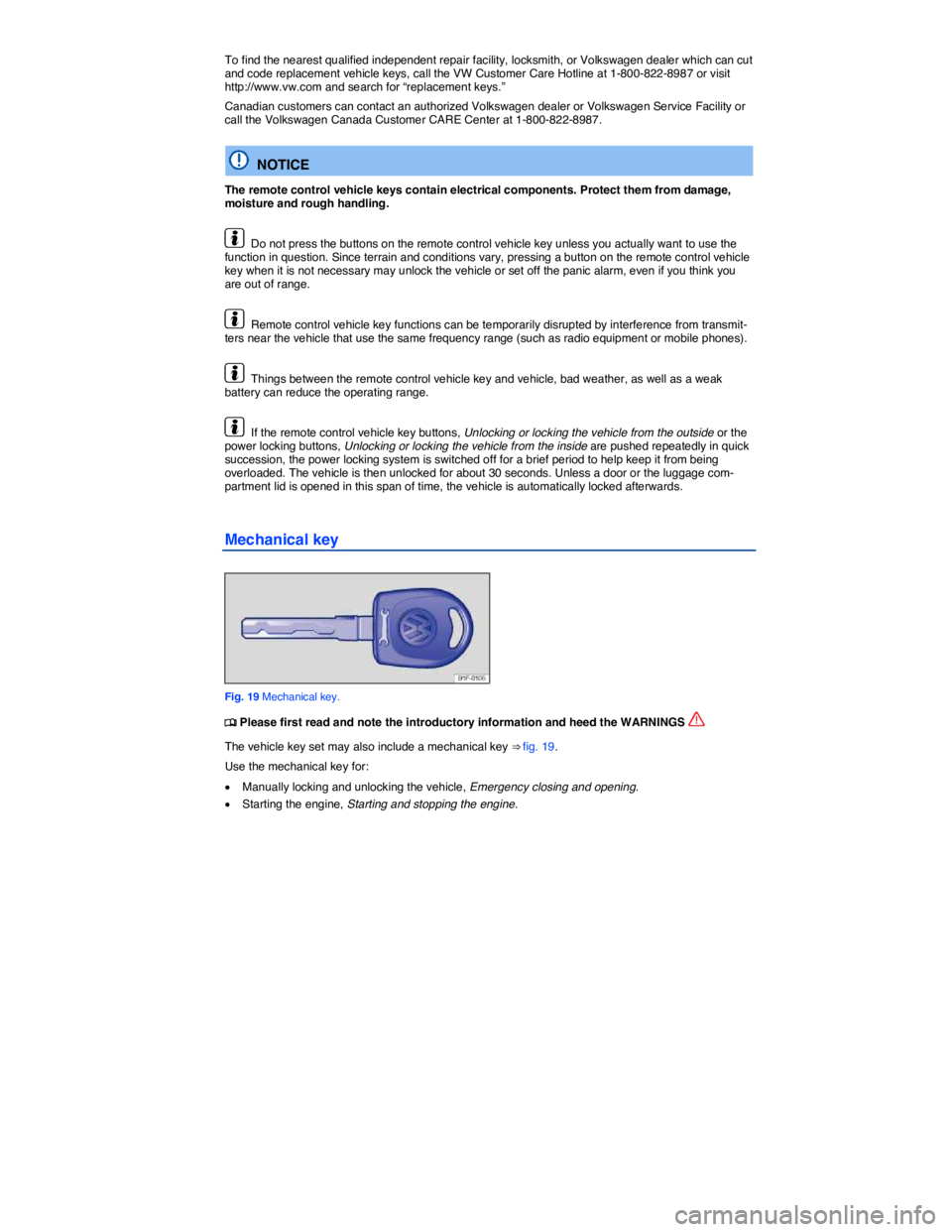
Fig. 19 Mechanical key.
Page 172 of 381

Passenger car tire
A tire intended for use on passenger cars, multipurpose passenger vehicles, and trucks, that have a gross vehicle weight rating (GVWR) of 10,000 pounds or less.
Ply
A layer of rubber-coated parallel cords.
Ply separation
A parting of rubber compound between adjacent plies.
Pneumatic tire
A mechanical device made of rubber, chemicals, fabric, and steel or other materials, that, when mounted on an automotive wheel, provides the traction and contains the gas or fluid that sustains the load.
Production options weight
The combined weight of installed regular production options weighing over 5 lbs (2.3 kg) more then the standard items they replace, and not previously considered as curb weight or accessory weight. These include, for example, heavy-duty brakes, ride levelers, heavy-duty battery, and special trim.
Radial ply tires
A pneumatic tire in which the ply cords that extend to the beads are laid at substantially 90 degrees to the centerline of the tread.
Recommended inflation pressure
The tire pressure recommended by the vehicle manufacturer for a tire of a specified size that has not been driven for more than a couple of miles (kilometers) at low speeds in the 3 hour period before the tire pressure is measured or adjusted.
Reinforced tire
A tire designed to operate at higher loads and at higher inflation pressures than the corresponding standard tire.
Rim
The outer edge of a wheel upon which the tire beads are seated.
Rim diameter
The nominal diameter of the wheel's tire bead seating surface. If you change your wheel size, to wheels of a different diameter, you will have to purchase new tires to match the new wheels.
Rim size
Designation means rim diameter and width.
Rim type designation
The industry or manufacturer's designation for a rim by style or code.
Rim width
The nominal distance between wheel rim flanges.
Section width
The linear distance between the exteriors of the sidewalls of an inflated tire, excluding elevations due to labeling decoration, or protective bands.
Sidewall
The portion of a tire between the bead and the tread.
Page 183 of 381
your vehicle to ensure that the replacement or alternate tires and wheels allow the TPMS to continue to function properly.
Spare wheel or compact spare wheel
The spare wheel or compact spare wheel has no tire pressure sensor. When the spare or compact spare wheel is mounted on the vehicle, the Tire Pressure Monitoring System (TPMS) indicator light will flash in the instrument cluster display. The TPMS continues to monitor the other 3 wheels.
Tire storage
If the tires do not move for an extended period of time, the sensors will not transmit tire pressures to the system. This saves sensor battery life. The sensors are reactivated by driving the vehicle again.
WARNING
Incorrect tire pressure can cause sudden tire failure, loss of vehicle control and serious personal injury.
x Always check and correct air pressure in all 4 tires, particularly after changing, exchanging, or repairing tires.
x After that, always make sure that all 4 tires are inflated to the correct tire pressure for the tires installed on the vehicle.
x See the tire pressure label ⇒ fig. 104, Tire inflation pressure and the Owner's Literature for recommended cold tire inflation pressure and other important information.
x When replacing tires or wheel rims on vehicles equipped with TPMS, always read and heed all of the information and WARNINGS, Tires and wheels.
NOTICE
x The wheel electronics are attached to special aluminum valves on the wheels. These valves are screwed on rigidly. Never bend the valves “into position” when checking and adjusting tire pressure.
x Missing tire air valve caps could result in damage to the valves, as well as to the sensors on the Tire Pressure Monitoring System. Therefore, make sure your valve caps conform to the specifications of those originally installed on the vehicle and that they are always tightly and properly screwed on to the valves. Do not use metallic valve caps
x Do not use “comfort valve caps.” They do not seal properly and can damage the sensors.
x When changing or rotating the tires, be careful not to damage the valves or sensors.
x The aluminum valves that are installed should be replaced after about 6 years of use due to aging of the rubber seals. The valves can be replaced when a tire is changed. Do not reuse aluminum valves after they are removed. They must be replaced. The tire pressure sensors can be reused.
Page 250 of 381
Emergency starting and starting the engine with a very weak vehicle battery or after the vehicle battery has been replaced may change or delete system settings (including time, date, personal convenience settings, and programming). Check the settings and correct as necessary once the vehicle battery has built up a sufficient charge.
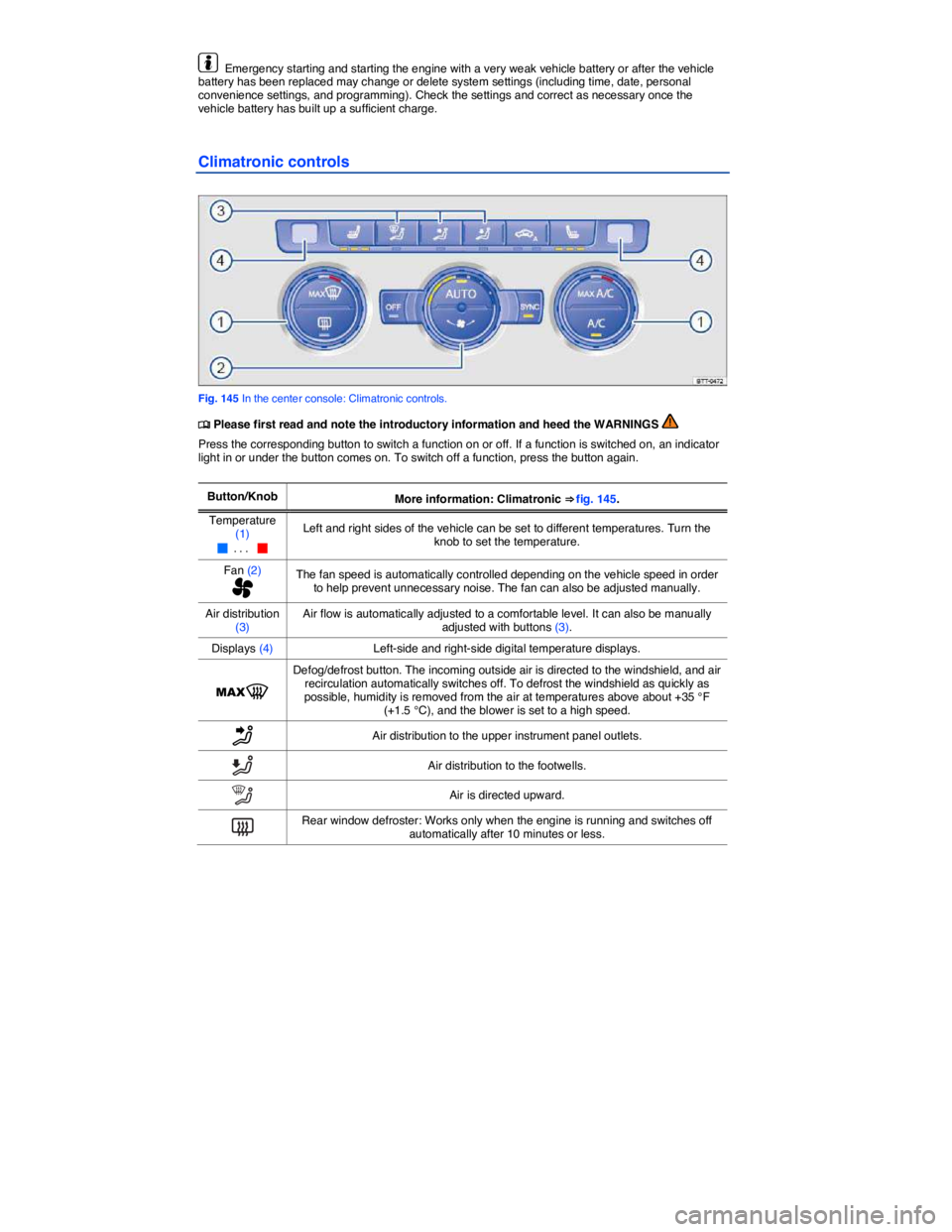
Climatronic controls
Fig. 145 In the center console: Climatronic controls.
Page 285 of 381
WARNING
Working on the batteries or the electrical system in your vehicle can cause serious acid burns, fires, explosions, or electrical shocks. Always read and heed the following WARNINGS and safety precautions before working on the batteries or the electrical system.
x Before working on the electrical system, always switch off the ignition and all electrical consumers and disconnect the negative (-) cable from the standard 12 Volt battery.
x When you change a light bulb, always switch off the light first.
x Always keep children away from battery acid and vehicle batteries in general.
x Always wear eye protection. Never let battery acid or lead particles come into contact with your eyes, skin, or clothing.
x Sulfuric battery acid is very corrosive. It can burn unprotected skin and cause blindness. Always wear protective gloves and eye protection. To reduce your risk of injury, never tilt the batteries, as this could spill acid through the vents and burn you.
x If you get battery acid in your eyes or on your skin, immediately rinse with cold water for several minutes and then get immediate medical attention. If you swallow any battery acid, get medical attention immediately.
x When disconnecting the batteries from the vehicle electrical system, always disconnect the negative cable (-) first and then the positive cable (+).
x Always switch off all electrical consumers before reconnecting 12 Volt batteries. Reconnect the plus cable (+) first and then the negative cable (-). Never reverse the polarity of the connections. This could cause a fire.
x A highly explosive mixture of gases is given off when the battery is being charged.
x Do not smoke and avoid fires, sparks, and open flames when working. Never create sparks or electrostatic charges when handling cables and electrical equipment. Never short circuit the battery terminals. High-energy sparks can cause serious personal injury.
x Never use or attempt to charge a damaged or frozen battery, or a battery that was frozen but has thawed. Charging a frozen or thawed battery could cause explosions and chemical burns! Replace damaged or frozen vehicle batteries immediately. A dead battery can freeze at temperatures around +32 °F (0 °C).
x If the battery has a vent line or tube, make sure that it is properly connected to the battery.
WARNING
California Proposition 65 Warning
x Battery posts, terminals, and related accessories contain lead and lead components, chemicals known to the State of California to cause cancer and reproductive harm. Wash your hands after handling.
NOTICE
x Do not expose the vehicle battery to direct sunlight for an extended period of time as ultraviolet rays may damage the battery housing.
x If the vehicle is left standing in the cold for a long time, protect the vehicle battery from freezing. A battery will be permanently damaged by freezing.
Emergency starting and starting the engine with a very weak vehicle battery or after the vehicle battery has been replaced may change or delete system settings (including time, date, personal convenience settings, and programming). Check the settings and correct as necessary once the vehicle battery has built up a sufficient charge.
Page 289 of 381
Vehicles with Keyless Access
If the ignition will not start after reconnecting the vehicle battery, lock the vehicle from the outside and
unlock it again ⇒ page 42, Unlocking or locking the vehicle with Keyless Access. Then try to start the ignition again. If the ignition cannot be switched on, contact an authorized Volkswagen dealer, an authorized Volkswagen Service Facility, or another qualified workshop for assistance.
Automatic electrical load deactivation
If the vehicle battery drain is high, the intelligent onboard electrical system management automatically takes steps to help prevent battery drain.
x The idle speed is increased so that the alternator provides more power.
x The power to devices that consume a lot of electricity is cut back or switched off completely.
x When the engine is started, the power supply to the 12 Volt sockets is temporarily interrupted.
The onboard electrical system management cannot always keep the battery from being drained. For example, the battery will drain if the engine is not running, but the ignition is switched on or the parking lights are left on for a long time when parked.
What drains the vehicle battery?
x Long periods when the engine is not running, especially when the ignition is on.
x Using electrical systems or devices when the engine is switched off.
x Leaving the vehicle unlocked for several days when not in use.
x Operating the CSC roof when the engine is switched off.
x The selector lever is left for a long period of time in any position other than P when the ignition is switched off, Starting and stopping the engine.
WARNING
Failure to use the proper battery with proper mounting and connections may cause short circuits, fires, and serious personal injuries.
x Always use only maintenance-free or cycle-free, leak-proof batteries with the same specifications and dimensions as the original equipment battery. Specifications are listed on the battery housing.
WARNING
When the vehicle battery is charged, it produces highly explosive hydrogen gas.
x Charge vehicle batteries only in well-ventilated areas.
x Never charge a frozen or thawed battery. A dead battery can freeze at temperatures around +32 °F (0 °C).
x You must replace the vehicle battery if it was frozen.
x Incorrectly connected cables can cause a short-circuit. First connect the positive cable (+) and then the negative cable (-).
NOTICE
x Never disconnect the vehicle battery or connect 2 vehicle batteries to each other when the ignition is switched on or the engine is running. Doing this may damage the electrical system or electronic components.
Page 325 of 381

Frequently asked questions (FAQ)
If you suspect a malfunction or vehicle damage, read and follow the following advice before contacting an authorized Volkswagen dealer or an authorized Volkswagen Service Facility. You may also find helpful information under “Special considerations” or “Checklist” in the index.
Description Possible causes, among others Possible remedy
Engine does not start.
Vehicle battery dead. – Perform jump-start – Charge vehicle battery.
The wrong vehicle key is used. Use a valid vehicle key
Fuel level too low. Refuel
Vehicle cannot be locked or unlocked using vehicle key.
– Battery in the remote control vehicle key is dead. – Too far away from the vehicle (out of range). – Buttons have been pressed too many times.
– Replace the battery in the remote control vehicle key – Move closer to vehicle. – Synchronize vehicle key – Lock or unlock vehicle manually
Unusual noises. Cold engine, braking assist systems, electronic steering column lock.
Check the “Noises” entry in the index.
Odd driving behavior. Assistance systems activated. Check the “Assistance systems” entry in the index.
DSG® Direct Shift Gearbox too hot. Stop vehicle as soon as you can safely do so.
Front seats cannot be adjusted with power controls.
Vehicle battery dead. Charge vehicle battery
Fuse blown. Check fuse and replace if necessary
CSC roof will not move. CSC roof malfunction. Check whether any technical requirement for opening and closing the CSC roof is not met. If necessary contact an authorized Volkswagen dealer or an authorized Volkswagen Service Facility.
Features do not work as described in this manual. Settings were adjusted in the Volkswagen Information System.
Check and reset to factory settings if necessary.
Headlights do not light up the road as they should.
– Headlights incorrectly adjusted. – Light bulbs burned out. – Low beams not switched on.
– Have the headlight range adjusted by an authorized Volkswagen dealer or an authorized Volkswagen Service Facility. – Change light bulbs – Switch on low beams
Electrical consumers do not work. Vehicle battery charge too low. Charge vehicle battery
Remaining fuel level too low. Refuel
Fuse blown. Check fuse and replace if necessary
Page 371 of 381
WARNING
Improper use of jumper cables when jump-starting a vehicle with a dead battery can cause the battery to explode, leading to serious personal injury. To help reduce the risk of battery explosion:
x All work on the batteries or the electrical system in your vehicle can cause serious acid burns, fires, or electrical shocks. Always read and heed the following WARNINGS and safety
precautions before working on the batteries or the electrical system ⇒ page 366, Vehicle battery.
x Always make sure that the battery providing starting assistance (the booster battery) has the same voltage as the dead battery (12 V) and about the same amperage capacity (see battery label).
x Never jump-start a vehicle with a thawed or frozen vehicle battery. The battery can explode. A dead battery can freeze at temperatures around +32 °F (0 °C).
x A battery that is frozen or was frozen, but has since thawed, must be replaced.
x When the vehicle battery is jump-started, it gives off hydrogen gas, which is highly explosive! Always keep fire, sparks, open flame, and smoking materials far away from vehicle batteries. Never use a mobile telephone while connecting or disconnecting jumper cables.
x Jump-start batteries only in well-ventilated areas. Batteries give off highly explosive hydrogen gas during jump-starting.
x Always route the jumper cables so that they cannot get caught in any moving parts in the engine compartment.
x Never short out the battery terminals by connecting the positive (+) and negative (-) terminals with each other.
x Never connect the negative cable from the other vehicle directly to the negative terminal of the dead battery, as this may cause the hydrogen gas given off by the dead battery to explode.
x Never attach the negative cable from the vehicle providing starting assistance to any part of the fuel system or to the brake hoses or brake lines.
x Never allow the non-insulated parts of the battery clamps to touch.
x Never allow the jumper cable attached to the positive battery terminal to contact metal parts of the vehicle.
x Always follow the instructions of the jumper cable manufacturer.
NOTICE
To help prevent extensive damage to the vehicle electrical system, read and heed the following:
x Connecting jumper cables improperly can cause a short circuit and do expensive damage to the vehicle's electrical system.
x Do not let the vehicles touch each other while the jumper cables are connected. If they do, electrical current may flow between the vehicles when the positive (+) terminals are connected, causing electrical system damage.
Page 373 of 381

Before removing the jumper cables
x Switch off the headlights (if they are on).
x In the vehicle with the dead battery, switch on the heater fan and the rear window defroster. This helps to minimize voltage spikes when the cables are disconnected.
Removing jumper cables
With the engine running, remove the jumper cables in reverse order to the way they were connected.
1. Disconnect the black (-) cable from the vehicle with the dead battery.
2. Disconnect the black (-) cable from the other vehicle (vehicle with the good battery).
3. Disconnect the red (+) cable from the other vehicle (vehicle with the good battery).
4. Disconnect the red (+) cable from the vehicle with the dead battery.
5. Close the battery cover.
6. If necessary, unscrew the towing eye on the front of the vehicle ⇒ page 469, Installing the front towing eye.
WARNING
Improper use of jumper cables when jump-starting a vehicle with a dead battery can cause the battery to explode, leading to serious personal injury. To help reduce the risk of battery explosion:
x All work on the batteries or the electrical system in your vehicle can cause serious acid burns, fires, or electrical shocks. Always read and heed the following WARNINGS and safety
precautions before working on the batteries or the electrical system ⇒ page 366, Vehicle battery.
x Always wear proper eye protection. Never lean over the vehicle battery.
x Attach the jumper cables in the correct order: first the positive cable, then the negative cable.
x Never connect the negative cable from the vehicle providing starting assistance to parts of the fuel system or to the brake hoses or brake lines.
x Never allow the non-insulated parts of the battery clamps to touch.
x Never allow the jumper cable attached to the positive battery terminal to contact metal parts of the vehicle.
x Check the battery acid level indicator window on the vehicle battery. Use a flashlight, never a match, cigarette lighter, or other open flame. If you cannot see the color of the window clearly, or if it is light yellow or colorless, do not jump-start the vehicle. Get expert assistance.
x Avoid electrostatic discharge in the vicinity of the vehicle battery. Sparks may cause the hydrogen gas escaping from the vehicle battery to ignite.
x Never jump-start a vehicle with a battery that is damaged or frozen or that was frozen and has thawed. The battery can explode. Replace the battery instead.
x Always follow the instructions of the jumper cable manufacturer.
x Always make sure that the battery providing starting assistance has the same voltage as the dead battery (12 V) and about the same capacity (see battery label).
x Batteries give off explosive hydrogen gas. Always keep fire, sparks, open flame and smoking materials away from batteries.
x Never connect the negative cable from the other vehicle directly to the negative terminal of the dead battery. The hydrogen gas from the battery is explosive.
x Never short out the battery terminals by connecting the positive (+) and negative (-) terminals with each other.