brake light VOLKSWAGEN EOS 2013 1.G User Guide
[x] Cancel search | Manufacturer: VOLKSWAGEN, Model Year: 2013, Model line: EOS, Model: VOLKSWAGEN EOS 2013 1.GPages: 329, PDF Size: 5.17 MB
Page 172 of 329

inputs to help keep the vehicle going in the intended direction. If you are traveling at a speed that
causes you to run off the road before ESC can provide any assistance, you may not experience the
benefits of ESC.
ESC includes and/or works together with the ABS, BAS, ASR, EDL, and XDL systems (see below).
ESC is switched on all the time. In certain situations when you need less traction or additional traction
cannot be achieved, you can switch off ASR by pressing the m button ⇒ fig. 126. Be sure to switch
ASR on again when you no longer need less traction.
Anti-Lock Brake System (ABS)
ABS helps to keep the wheels from locking up and helps to maintain the driver's ability to steer and
control the vehicle. This means the vehicle is less likely to skid, even during hard braking:
x Push the brake pedal down hard and hold it there. Don't take your foot off the pedal or reduce the
force on the pedal!
x Do not “pump” the brake pedal or let up on it!
x Steer the vehicle while pushing down hard on the brake pedal.
x ABS stops working if you release or let up on the brake.
When ABS is doing its job, you will notice a slight vibration through the brake pedal and hear a
noise. ABS cannot shorten the stopping distance under all conditions. The stopping distance may
even be longer, for instance, when driving on gravel or on newly fallen snow covering an icy or
slippery surface.
Brake Assist (BAS)
The Brake Assist System can help to reduce stopping distances. If you press the brake pedal very
quickly, BAS detects an emergency situation. It then very quickly builds up full brake system pressure,
maximizing braking power and reducing the stopping distance. This way, ABS can be activated more
quickly and efficiently.
Do not reduce pressure on the brake pedal! BAS switches off automatically as soon as you release or
let up on the brake.
Anti-Slip Regulation (ASR)
ASR reduces engine power directed to spinning wheels and adjusts power to the road conditions.
Even under poor road conditions, ASR can make it easier to get moving, accelerate, and climb hills.
ASR can be switched on or off manually
Electronic Differential Lock (EDL and XDL)
EDL is applied during regular straight-line acceleration. EDL gently brakes a drive wheel that has lost
traction (spinning) and redirects the drive force to other drive wheels. In extreme cases, EDL
automatically switches off to keep the brake from overheating. As soon as the brake has cooled down,
EDL automatically switches on again.
XDL is an extension of the Electronic Differential Lock system. XDL does not react to drive wheel
slippage when driving straight ahead. Instead, XDL detects slippage of the inside front wheel during
fast cornering. XDL applies enough brake pressure to this wheel in order to stop the slippage. This
improves traction, which helps the vehicle stay on track.
Page 175 of 329

Brake fluid specifications
Volkswagen has developed a special brake fluid that is optimized for the brake system in your
Volkswagen. Volkswagen recommends that you use brake fluid that expressly conforms to quality
standard VW Standard 501 14 for optimum performance of the brake system. Check the information
on the container for the brake fluid you want to use to make sure it meets the requirements for your
vehicle.
Brake fluid that complies with VW Standard 501 14 can be purchased from your authorized
Volkswagen dealer or authorized Volkswagen Service Facility.
If this special brake fluid is not available you may – under these circumstances – use another high-
quality brake fluid that complies with U.S. Federal Motor Vehicle Safety Standard (FMVSS) 116 DOT 4
⇒ .
Please note, however, that not all brake fluids that comply with U.S. Federal Motor Vehicle Safety
Standard FMVSS 116 DOT 4 have the same chemical composition. Some of these brake fluids can
contain chemicals that could, over time, degrade or damage internal parts of the vehicle’s brake
system.
Volkswagen therefore recommends that you use brake fluid that expressly complies with VW
Standard 501 14 for optimum brake system performance over the long term.
Brake fluid level
The fluid level in the transparent brake fluid reservoir must always be between the MIN and MAX
marking ⇒ .
On some vehicles, engine components block the view of the brake fluid reservoir and make it
impossible to see the brake fluid level. If you cannot clearly see the brake fluid level in the brake fluid
reservoir, please see an authorized Volkswagen dealer or authorized Volkswagen Service Facility.
The brake fluid level drops slightly when the vehicle is being used as the brake pads wear and the
brakes are automatically adjusted.
Changing brake fluid
Brake fluid must be changed according to the service schedule in your ⇒ Booklet Warranty and
Maintenance. Have the brake fluid checked by an authorized Volkswagen dealer or an authorized
Volkswagen Service Facility. Refill only with new brake fluid that meets the standards listed above.
WARNING
Brake failure and reduced brake performance can be caused by not having enough brake
fluid in the reservoir or by old or incorrect brake fluid.
x Check the brake system and brake fluid level regularly.
x Always change the brake fluid according to the service schedule in your
⇒ Booklet Warranty and Maintenance.
x Hard braking with old brake fluid may cause vapor lock. Vapor lock reduces braking
performance, increases stopping distances and can even cause total brake failure.
x Always make sure that only the correct brake fluid is used. Only use brake fluid that
expressly conforms to VW Standard 501 14 or, if it is not available, only use a high-quality
brake fluid that conforms to U.S. Standard FMVSS 116 DOT 4 requirements.
x Using another brake fluid, or one that is not of high quality, can impair the function of the
brake system and reduce its effectiveness. If the container does not say that the brake fluid
complies with VW Standard 501 14, or U.S. Standard FMVSS 116 DOT 4, do not use it.
x The brake fluid must be new.
Page 179 of 329
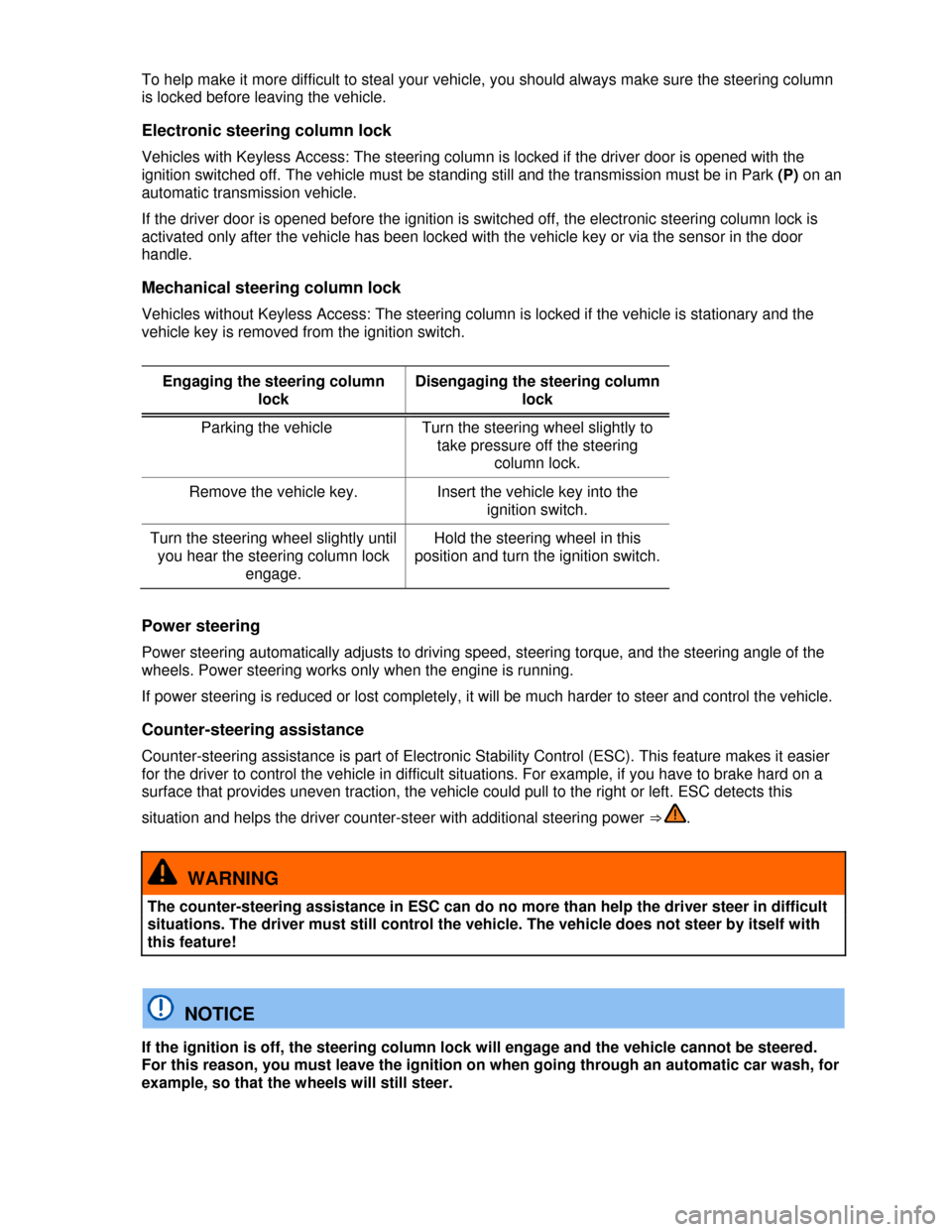
To help make it more difficult to steal your vehicle, you should always make sure the steering column
is locked before leaving the vehicle.
Electronic steering column lock
Vehicles with Keyless Access: The steering column is locked if the driver door is opened with the
ignition switched off. The vehicle must be standing still and the transmission must be in Park (P) on an
automatic transmission vehicle.
If the driver door is opened before the ignition is switched off, the electronic steering column lock is
activated only after the vehicle has been locked with the vehicle key or via the sensor in the door
handle.
Mechanical steering column lock
Vehicles without Keyless Access: The steering column is locked if the vehicle is stationary and the
vehicle key is removed from the ignition switch.
Engaging the steering column
lock
Disengaging the steering column
lock
Parking the vehicle Turn the steering wheel slightly to
take pressure off the steering
column lock.
Remove the vehicle key. Insert the vehicle key into the
ignition switch.
Turn the steering wheel slightly until
you hear the steering column lock
engage.
Hold the steering wheel in this
position and turn the ignition switch.
Power steering
Power steering automatically adjusts to driving speed, steering torque, and the steering angle of the
wheels. Power steering works only when the engine is running.
If power steering is reduced or lost completely, it will be much harder to steer and control the vehicle.
Counter-steering assistance
Counter-steering assistance is part of Electronic Stability Control (ESC). This feature makes it easier
for the driver to control the vehicle in difficult situations. For example, if you have to brake hard on a
surface that provides uneven traction, the vehicle could pull to the right or left. ESC detects this
situation and helps the driver counter-steer with additional steering power ⇒ .
WARNING
The counter-steering assistance in ESC can do no more than help the driver steer in difficult
situations. The driver must still control the vehicle. The vehicle does not steer by itself with
this feature!
NOTICE
If the ignition is off, the steering column lock will engage and the vehicle cannot be steered.
For this reason, you must leave the ignition on when going through an automatic car wash, for
example, so that the wheels will still steer.
Page 199 of 329

Your vehicle's Tire Pressure Monitoring System (TPMS) uses the Anti-lock Brake System (ABS)
sensors to indirectly check the tire pressure of all 4 tires while you are driving. The sensors monitor the
tread circumference (rolling circumference) and vibration characteristics of the individual tires. TPMS
warns if there is a significant loss of pressure in one or more tires while the vehicle is moving.
Pressure loss is signaled by the indicator light Ç (described below) as well as by acoustic warnings and
text warnings in the instrument cluster display if your vehicle has this display (Multi-Function Indicator -
MFI).
The original benchmark pressure is the recommended maximum load cold tire inflation pressure for
the tires that come with your vehicle. This pressure is listed on the tire pressure label on the driver
door jamb Error! Bookmark not defined.. After adjusting the tire pressures in all 4 tires, you must
confirm and store the new cold inflation pressures by pressing the SET button, which changes the
benchmark pressure to match the current pressure of the tires on your vehicle
Recalibrating the TPMS to reset the benchmark cold tire inflation pressure with proper use of the SET
button is explained below
More information:
x Transporting
x Braking, stopping and parking
x Exterior care and cleaning
x Tires and wheels
x Parts, accessories, repairs and modifications
Page 221 of 329

¥ Engine oil level
¥ Engine coolant level
¥ Brake fluid level
¥ Tire pressure
¥ Vehicle lighting necessary for driving safety:
– Turn signals
– Low beams and high beams
– Taillights
– Brake lights
– License plate lights
Information regarding changing light bulbs
WARNING
Disregarding the safety-related checklist may lead to accidents and injuries.
x Please note and follow the points listed in the checklist.
Page 225 of 329

WARNING
The engine compartment of any motor vehicle is a potentially dangerous area and can cause
serious personal injury.
x Always use extreme caution when doing any work in the engine compartment. Always
follow commonly accepted safety practices and use common sense. Never risk personal
injury.
x Never perform any work in the engine compartment unless you know exactly how to carry
out the job and have the correct technical information and the correct tools.
x If you are uncertain about what to do, have the work performed by an authorized
Volkswagen dealer, an authorized Volkswagen Service Facility, or another qualified
workshop. Serious personal injury may result from improperly performed work.
x We strongly recommend that you always have HID – High Intensity Discharge (Xenon)
headlights and H7 bulbs replaced by a qualified technician. Serious personal injury may
result from improperly performed work.
x Never open or close the engine hood if steam or coolant is escaping. Hot steam or coolant
can cause serious burns. Always wait until you no longer see or hear steam or coolant
escaping from the engine.
x Always let the engine cool down completely before carefully opening the hood.
x Hot parts of the engine and the exhaust system will burn skin on contact.
x When the engine has cooled down and you are ready to open the hood:
– Firmly apply the parking brake and shift the transmission into Park (P) (automatic) or
Neutral (manual only).
– Take the vehicle key out of the ignition.
– On vehicles with Keyless Access, make sure that the remote control vehicle key is out
of range of the vehicle and that the vehicle cannot be started by depressing the starter
button
– Always keep children and others away from the engine compartment and never leave
them unsupervised.
x The engine coolant system is under pressure when the engine is hot. Never unscrew the
coolant expansion tank cap when the engine is hot. Hot coolant can spray out and cause
severe burns and other serious injuries.
– Turn the cap slowly and very carefully in a counterclockwise direction while applying
light downward pressure on the top of the cap.
– Always protect your face, hands, and arms from hot escaping coolant or steam by
covering the cap with a large, thick rag.
x Never spill fluids on the engine or exhaust system when refilling. Spilling fluids onto hot
parts of the engine or exhaust system can cause a fire.
Page 226 of 329
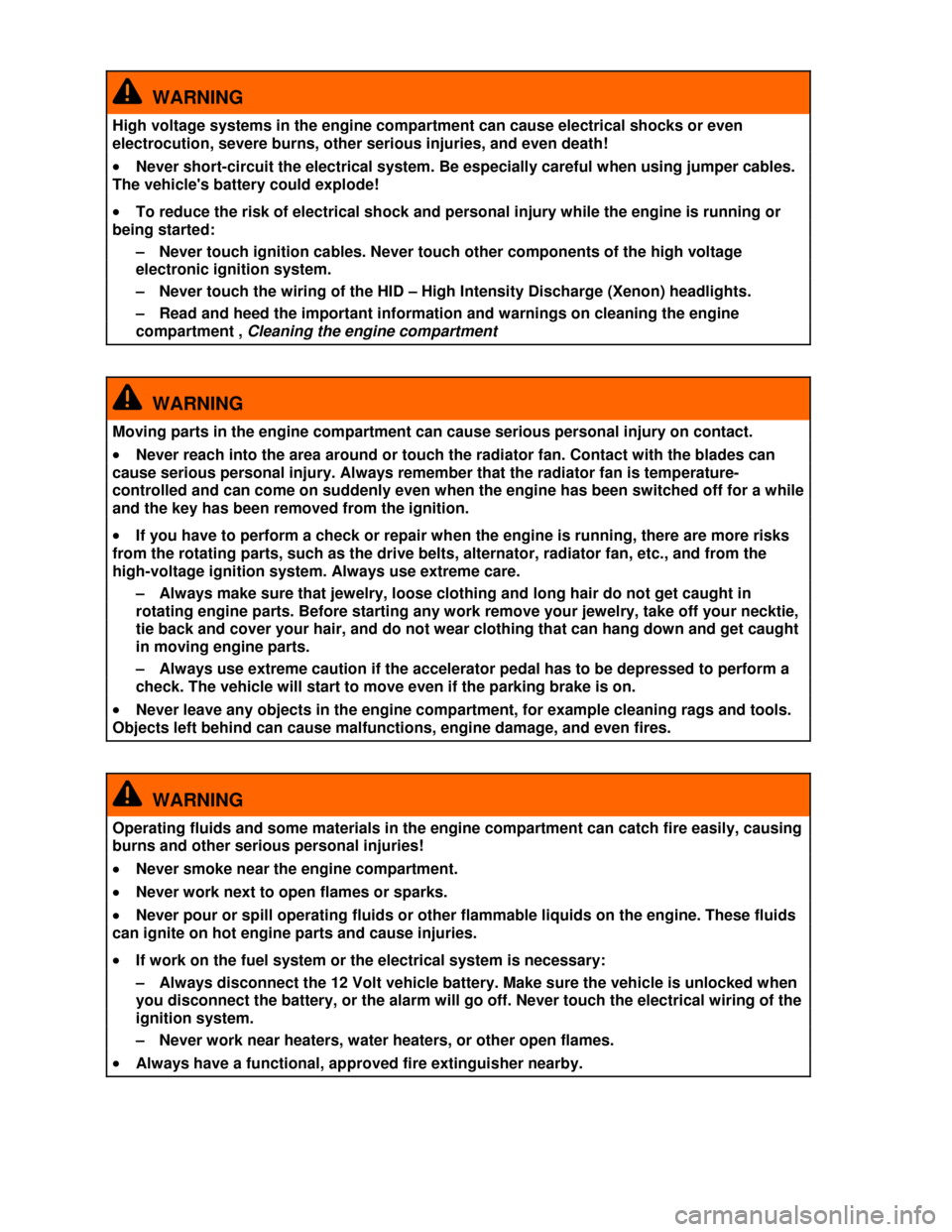
WARNING
High voltage systems in the engine compartment can cause electrical shocks or even
electrocution, severe burns, other serious injuries, and even death!
x Never short-circuit the electrical system. Be especially careful when using jumper cables.
The vehicle's battery could explode!
x To reduce the risk of electrical shock and personal injury while the engine is running or
being started:
– Never touch ignition cables. Never touch other components of the high voltage
electronic ignition system.
– Never touch the wiring of the HID – High Intensity Discharge (Xenon) headlights.
– Read and heed the important information and warnings on cleaning the engine
compartment , Cleaning the engine compartment
WARNING
Moving parts in the engine compartment can cause serious personal injury on contact.
x Never reach into the area around or touch the radiator fan. Contact with the blades can
cause serious personal injury. Always remember that the radiator fan is temperature-
controlled and can come on suddenly even when the engine has been switched off for a while
and the key has been removed from the ignition.
x If you have to perform a check or repair when the engine is running, there are more risks
from the rotating parts, such as the drive belts, alternator, radiator fan, etc., and from the
high-voltage ignition system. Always use extreme care.
– Always make sure that jewelry, loose clothing and long hair do not get caught in
rotating engine parts. Before starting any work remove your jewelry, take off your necktie,
tie back and cover your hair, and do not wear clothing that can hang down and get caught
in moving engine parts.
– Always use extreme caution if the accelerator pedal has to be depressed to perform a
check. The vehicle will start to move even if the parking brake is on.
x Never leave any objects in the engine compartment, for example cleaning rags and tools.
Objects left behind can cause malfunctions, engine damage, and even fires.
WARNING
Operating fluids and some materials in the engine compartment can catch fire easily, causing
burns and other serious personal injuries!
x Never smoke near the engine compartment.
x Never work next to open flames or sparks.
x Never pour or spill operating fluids or other flammable liquids on the engine. These fluids
can ignite on hot engine parts and cause injuries.
x If work on the fuel system or the electrical system is necessary:
– Always disconnect the 12 Volt vehicle battery. Make sure the vehicle is unlocked when
you disconnect the battery, or the alarm will go off. Never touch the electrical wiring of the
ignition system.
– Never work near heaters, water heaters, or other open flames.
x Always have a functional, approved fire extinguisher nearby.
Page 252 of 329
WARNING
After the vehicle has been washed, the wet brakes or, in winter, brake discs or pads coated
with ice, react slower and need longer stopping distances.
x Always dry the brakes and clean off any ice coatings with a few careful applications of the
brake. Make sure not to endanger other motorists or cyclists or disobey legal requirements.
NOTICE
Never wash the CSC roof with a power washer or use “brushless” automatic car washes. Water
that is sprayed under high pressure may cause leaks or may damage the rubber seals of the
CSC roof.
x Do not use any rubber care materials that contain silicone or any cleaners that contain
acids such as industrial dust remover or insect remover on the CSC roof seals.
NOTICE
x Water temperature should not be more than +140 °F (+60 °C).
x To help prevent damage to the paint, do not wash the vehicle in direct sunlight.
x In order for Park Distance Control to work correctly, the sensors in the rear bumper must be
kept clean and clear of snow and ice.
x When using a power washer or steam cleaner, only spray the sensors directly for a short
period of time and always keep the nozzle at least 4 inches (10 cm) from the sensor.
x Do not clean icy or snow-covered windows with a power washer.
x When washing or rinsing the vehicle in cold weather, do not let water get into the lock
cylinders or point the hose at gaps around the doors, hood, or luggage compartment lid. The
water could freeze on the locks and seals and make it difficult to open the vehicle!
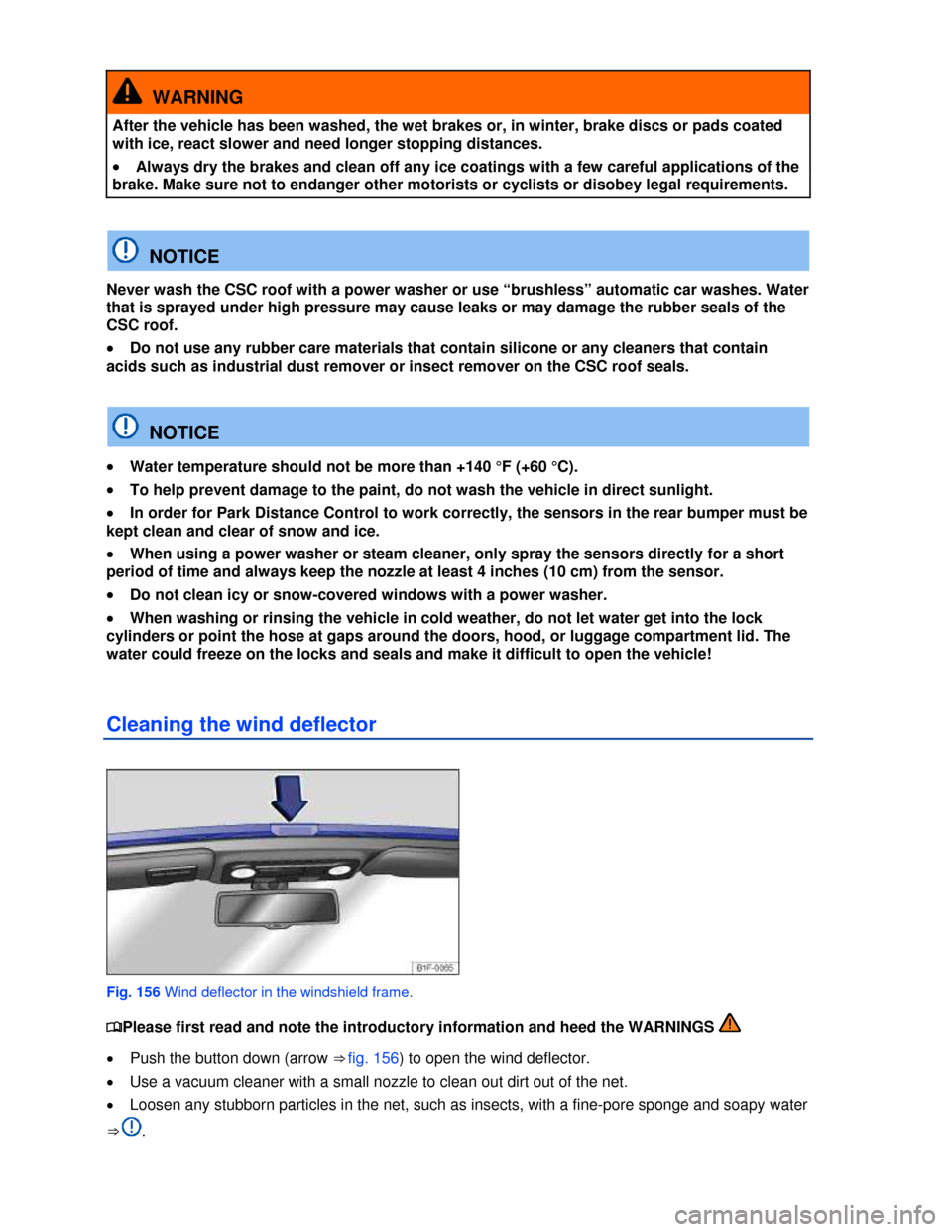
Cleaning the wind deflector
Fig. 156 Wind deflector in the windshield frame.
Page 260 of 329
The design of the wheel bolts is matched to the factory-installed wheels. If different wheels are
installed, wheel bolts with the right length and bolt head shape must be used. This helps to ensure that
wheels can be mounted securely and that the brakes will work correctly
In most cases, you cannot use wheel bolts from a different vehicle. Even wheel rims from the same
model may not fit properly.
Tires and wheel rims approved by Volkswagen have been matched precisely to your vehicle model
and contribute considerably to good handling and safe vehicle performance.
Tightening torque
Wheel bolts must always be installed with the correct tightening torque . The required tightening torque
for your vehicle's wheel bolts is 88 ft-lbs (120 Nm). After changing a wheel, the bolt torque must be
checked as soon as possible with an accurate torque wrench. See an authorized Volkswagen dealer
or an authorized Volkswagen Service Facility.
Wheel rims with bolted rim rings
Wheel rims with bolted rim rings have several parts. The parts are bolted together with special screws
in a special process. This helps to ensure that they will work properly, prevent leaks, run true and
safely. Damaged wheel rims must be replaced, and you must never take them apart or try to repair
them yourself. Have an authorized Volkswagen dealer or an authorized Volkswagen Service Facility
repair them for you ⇒ .
Wheel rims with bolted decorative covers
Light-alloy wheels may have interchangeable decorative covers attached to the rim with self-locking
screws. If you want to replace damaged wheel covers, contact your authorized Volkswagen dealer or
authorized Volkswagen Service Facility.
WARNING
Using improper or damaged wheel rims can affect driving safety, cause accidents and severe
personal injury.
x Use only wheel rims approved for the vehicle.
x Regularly check wheel rims for damage and replace them if necessary.
WARNING
Improper loosening and tightening of the bolts on wheel rims with bolted rim rings can cause
accidents and severe personal injury.
x Never loosen bolted connections on wheel rims with bolted rim rings.
x Have all work on wheel rims with bolted rim rings performed by an authorized Volkswagen
dealer or authorized Volkswagen Service Facility.
Applicable only in the United States
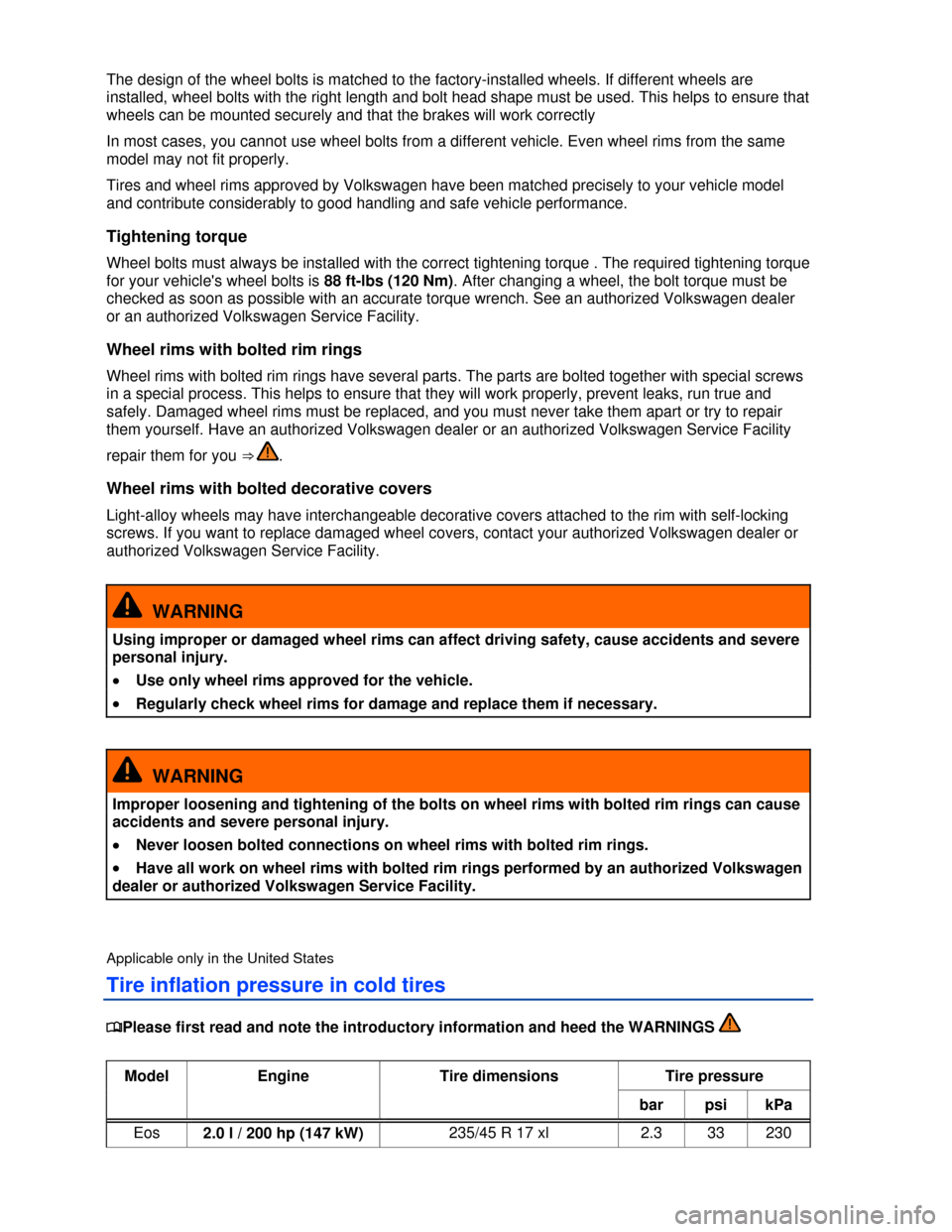
Tire inflation pressure in cold tires
Page 325 of 329

Before removing the jumper cables
x Switch off the headlights (if they are on).
x In the vehicle with the dead battery, switch on the heater fan and the rear window defroster. This helps to minimize voltage spikes when the cables are disconnected.
Removing jumper cables
With the engine running, remove the jumper cables in reverse order to the way they were connected.
1. Disconnect the black (-) cable from the vehicle with the dead battery.
2. Disconnect the black (-) cable from the other vehicle (vehicle with the good battery).
3. Disconnect the red (+) cable from the other vehicle (vehicle with the good battery).
4. Disconnect the red (+) cable from the vehicle with the dead battery.
5. Close the battery cover.
6. If necessary, unscrew the towing eye on the front of the vehicle
WARNING
Improper use of jumper cables when jump-starting a vehicle with a dead battery can cause the battery to explode, leading to serious personal injury. To help reduce the risk of battery explosion:
x All work on the batteries or the electrical system in your vehicle can cause serious acid burns, fires, or electrical shocks. Always read and heed the following WARNINGS and safety precautions before working on the batteries or the electrical system , Vehicle battery.
x Always wear proper eye protection. Never lean over the vehicle battery.
x Attach the jumper cables in the correct order: first the positive cable, then the negative cable.
x Never connect the negative cable from the vehicle providing starting assistance to parts of the fuel system or to the brake hoses or brake lines.
x Never allow the non-insulated parts of the battery clamps to touch.
x Never allow the jumper cable attached to the positive battery terminal to contact metal parts of the vehicle.
x Check the battery acid level indicator window on the vehicle battery. Use a flashlight, never a match, cigarette lighter, or other open flame. If you cannot see the color of the window clearly, or if it is light yellow or colorless, do not jump-start the vehicle. Get expert assistance.
x Avoid electrostatic discharge in the vicinity of the vehicle battery. Sparks may cause the hydrogen gas escaping from the vehicle battery to ignite.
x Never jump-start a vehicle with a battery that is damaged or frozen or that was frozen and has thawed. The battery can explode. Replace the battery instead.
x Always follow the instructions of the jumper cable manufacturer.
x Always make sure that the battery providing starting assistance has the same voltage as the dead battery (12 V) and about the same capacity (see battery label).
x Batteries give off explosive hydrogen gas. Always keep fire, sparks, open flame and smoking materials away from batteries.
x Never connect the negative cable from the other vehicle directly to the negative terminal of the dead battery. The hydrogen gas from the battery is explosive.
x Never short out the battery terminals by connecting the positive (+) and negative (-) terminals with each other.