steering VOLKSWAGEN EOS 2013 1.G User Guide
[x] Cancel search | Manufacturer: VOLKSWAGEN, Model Year: 2013, Model line: EOS, Model: VOLKSWAGEN EOS 2013 1.GPages: 329, PDF Size: 5.17 MB
Page 101 of 329
The delay period can be adjusted and the function can be switched on and off in the Lights &
Vision menu
If the “Coming home” feature is switched on and the driver door is opened, no warning chime will
sound to alert you that the lights are still on.
Instrument panel lighting and headlight range adjustment
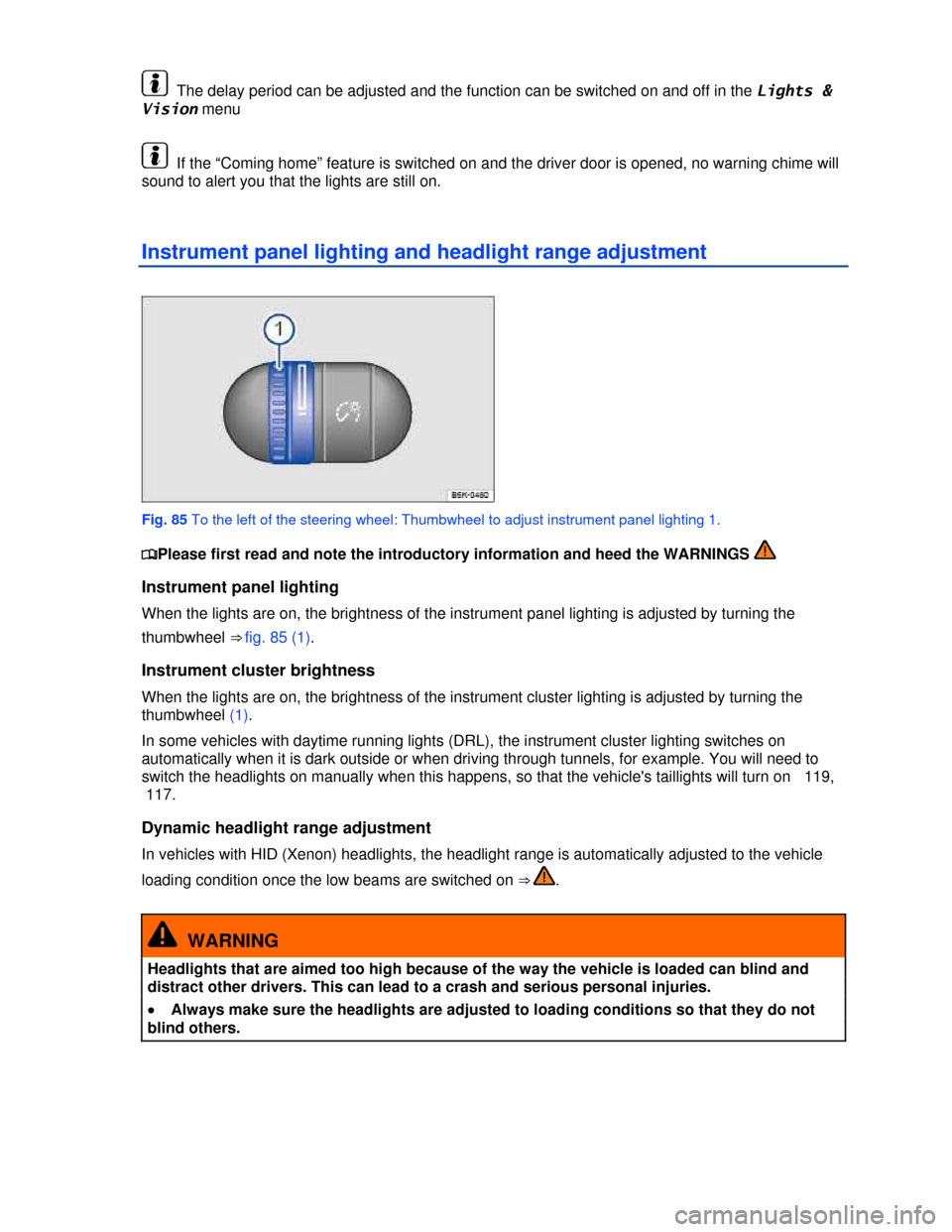
Fig. 85 To the left of the steering wheel: Thumbwheel to adjust instrument panel lighting 1.
Page 108 of 329
Headlight washer system
The headlight washer system cleans the headlight glass.
If the ignition and the headlights (high or low beams) are switched on, the headlights are cleaned the
first time and every fifth time the front windshield washers are activated. This happens only when the
low or high beams are on when the windshield wiper lever is pulled towards the steering wheel.
However, the headlights must still be washed by hand periodically (for instance, during refueling) in
order to get rid of hard-to-remove dirt (like insect splatter).
To help make sure that the headlight cleaning system works during winter weather, always keep the
headlight washer nozzles free of snow and remove any ice with a deicer spray before driving. Use a
deicer spray to remove any ice.
If there is something on the windshield, the wiper will try to wipe it away. If it continues to block
the wiper, the wiper will stop moving. Remove the obstacle and switch the wiper on again.
Windshield wiper service position
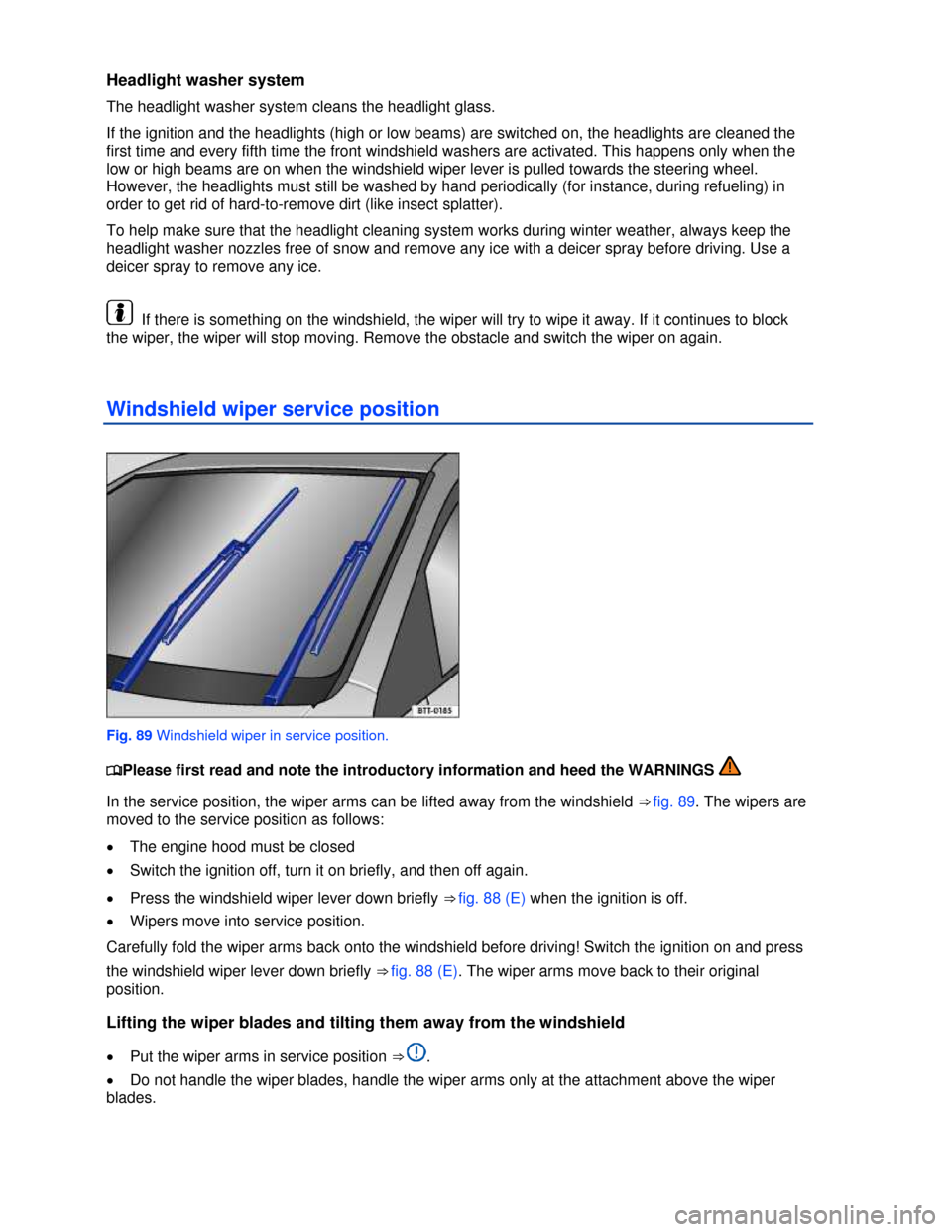
Fig. 89 Windshield wiper in service position.
Page 128 of 329

WARNING
Unsecured or incorrectly stowed items can fly through the vehicle, causing serious personal
injury during hard braking or sharp steering or in an accident. Loose items can also be struck
and thrown through the passenger compartment by the front airbags if they inflate. To help
reduce the risk of serious personal injury:
x Always stow all objects securely in the vehicle. Always put luggage and heavy items in the
luggage compartment.
x Always secure objects in the passenger compartment properly with suitable straps so that
they cannot move into the deployment zone of a side or front airbag during sudden braking,
in a sudden maneuver, or in a collision.
x Always keep storage compartments closed while driving.
x Never stow hard, heavy, or sharp objects in the vehicle's open storage compartments, on
the shelf behind the rear seat bench, or on the top of the instrument panel.
x Always remove hard, heavy, or sharp objects from clothing and bags in the vehicle
interior and stow them securely in the luggage compartment.
WARNING
Transporting heavy objects causes the handling characteristics of the vehicle to change and
increases braking distances. Heavy loads which are not properly stowed or secured in the
vehicle can lead to a loss of vehicle control and cause serious personal injury.
x Transporting heavy items causes the handling characteristics of the vehicle to change by
shifting the vehicle's center of gravity.
x Always distribute luggage evenly and as low as possible within the vehicle. The vehicle
capacity weight figures apply when the load is distributed evenly in the vehicle (passengers
and luggage).
x Always stow luggage and heavy items in the luggage compartment as far forward of the
rear axle as possible and secure them with appropriate straps.
x Never exceed the vehicle's Gross Vehicle Weight Rating or Gross Axle Weight Ratings,
which are printed on the Safety Compliance Certification Label located on the door jamb of
the driver door. Exceeding the permissible weight can cause the vehicle to skid and behave
differently.
x Always adapt your speed and driving style to accommodate your payload and its weight
distribution within your vehicle.
x Be especially cautious and gentle when stepping on the accelerator pedal and avoid
sudden braking and other maneuvers.
x Brake earlier than you would if you were not driving a loaded vehicle.
NOTICE
The defroster heating wires in the rear window can be damaged by objects that rub against
them.
Page 161 of 329
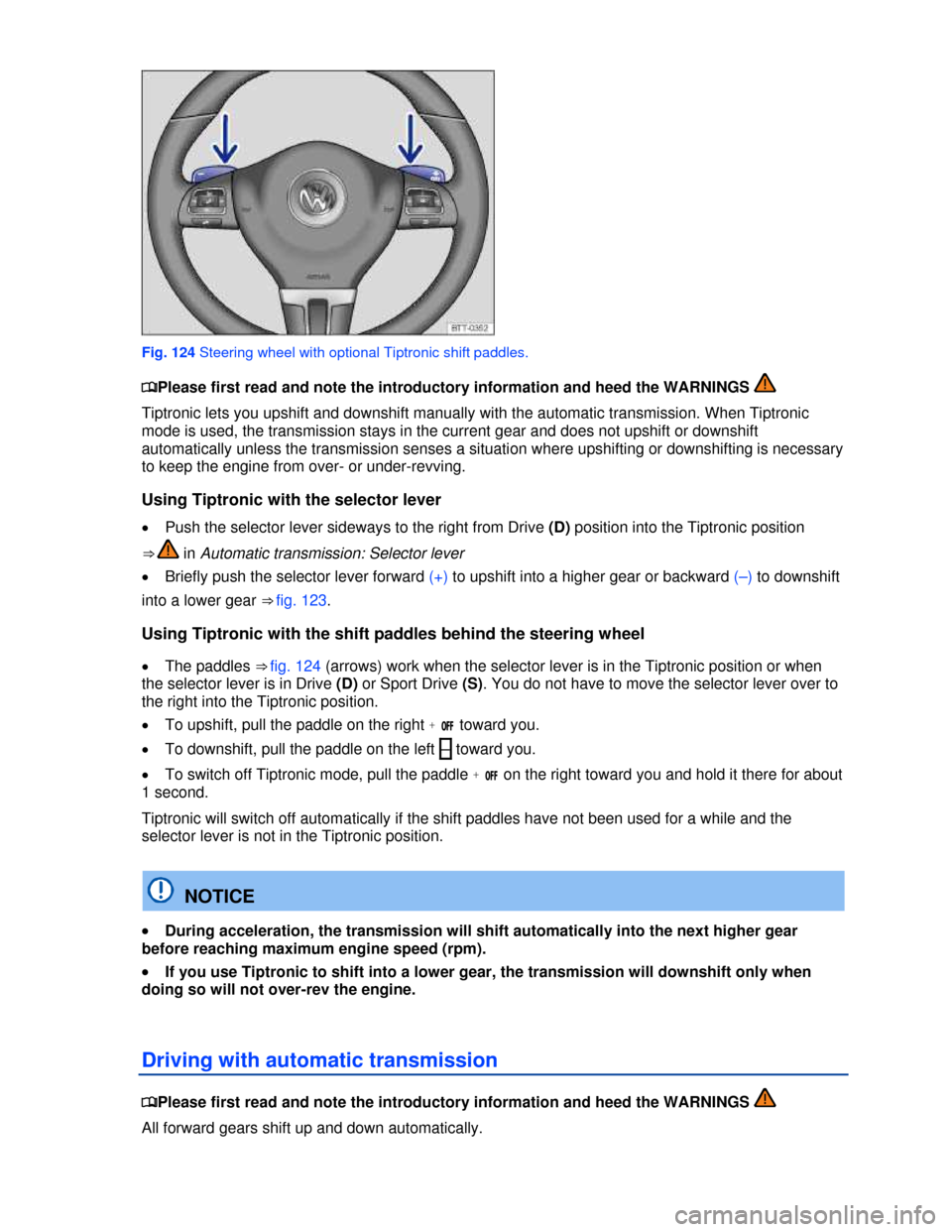
Fig. 124 Steering wheel with optional Tiptronic shift paddles.
Page 162 of 329
Driving on hills
The steeper the grade, the lower the gear that must be selected. Lower gears increase the braking
effect of the engine. Never coast downhill in Neutral (N).
x Reduce speed.
x Switch to Tiptronic mode by moving the selector lever from Drive (D) to the right into the Tiptronic
position
x Downshift by pulling the selector lever back briefly (-).
x OR: Downshift using the paddles on the steering wheel
If you stop and start up again when going uphill, you should use Hill Hold as long as the engine is
running.
Vehicles without Hill Hold: If you stop on a hill with the vehicle in gear, you must depress the brake
pedal or engage the parking brake to keep the vehicle from rolling. Do not release the brake pedal or
the parking brake until the vehicle has started to move forward ⇒ .
Kick-down acceleration
The kick-down feature permits maximum acceleration when the selector lever is in the Drive (D), Sport
Drive (S) or Tiptronic mode.
If you push the accelerator all the way down, the vehicle will automatically downshift, depending on
vehicle speed and engine speed (rpm). This feature lets you take advantage of the full acceleration
capacity of the vehicle ⇒ .
With kick-down actuated, the transmission will stay in the current gear longer and not upshift until the
engine reaches maximum rpm.
WARNING
Rapid acceleration can cause skidding and loss of traction, especially on slippery roads,
resulting in a loss of vehicle control, collisions, and serious personal injury.
x Only use the kick-down feature or fast acceleration if visibility, weather, road, and traffic
conditions permit and other drivers will not be endangered by your driving and the vehicle's
acceleration.
x Always adapt your driving to the traffic flow.
x Note that the drive wheels can spin and the vehicle can swerve when ASR is switched off,
especially when the road is slippery.
x Once you have accelerated, switch ASR back on again.
NOTICE
x When stopping on hills with the transmission in a drive gear, do not use the accelerator to
help prevent the vehicle from rolling backwards. This can cause the automatic transmission to
overheat and be damaged.
x Never let the vehicle coast or roll down a hill in Neutral (N), especially when the engine is
not running. The transmission will not be lubricated and will be damaged.
Automatic transmission malfunction
Page 165 of 329
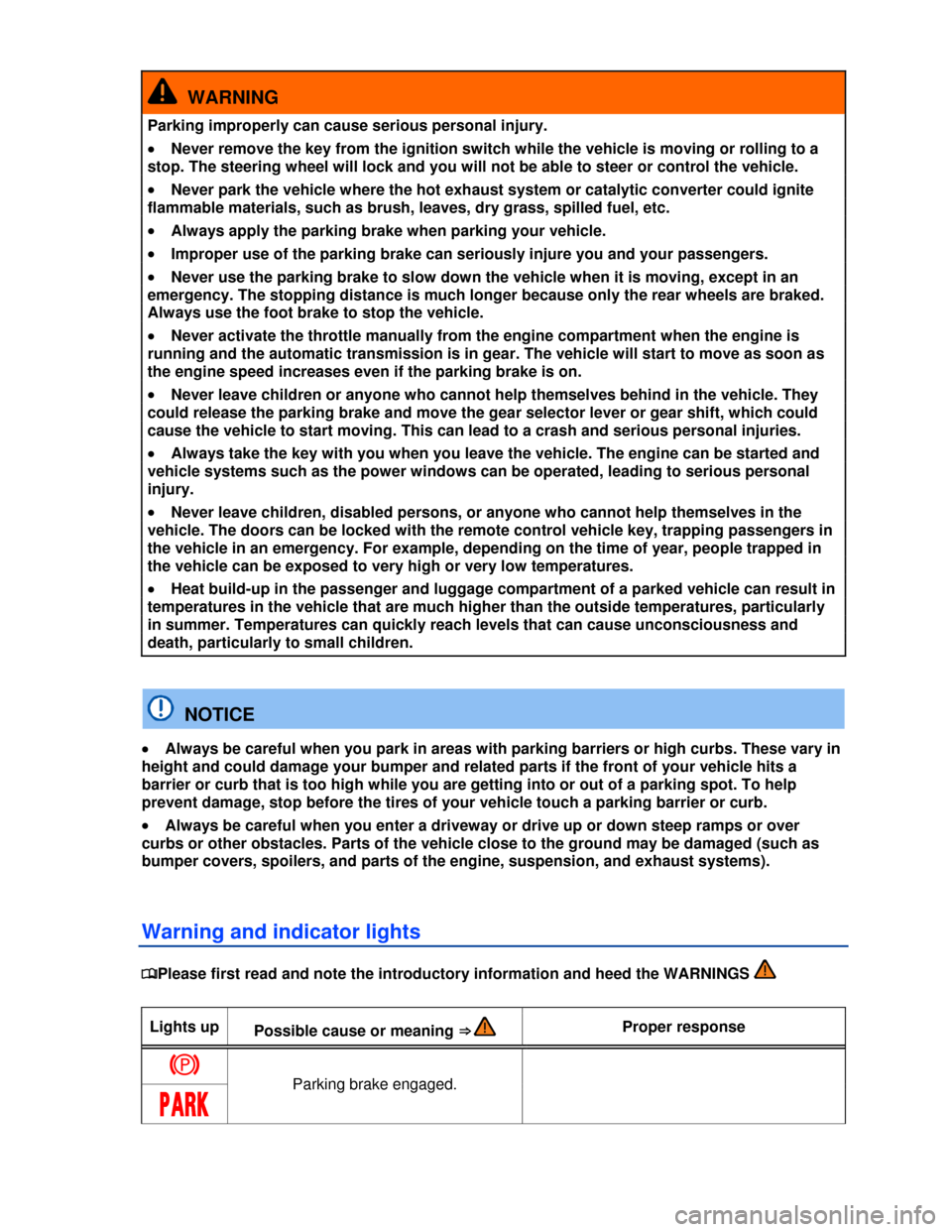
WARNING
Parking improperly can cause serious personal injury.
x Never remove the key from the ignition switch while the vehicle is moving or rolling to a
stop. The steering wheel will lock and you will not be able to steer or control the vehicle.
x Never park the vehicle where the hot exhaust system or catalytic converter could ignite
flammable materials, such as brush, leaves, dry grass, spilled fuel, etc.
x Always apply the parking brake when parking your vehicle.
x Improper use of the parking brake can seriously injure you and your passengers.
x Never use the parking brake to slow down the vehicle when it is moving, except in an
emergency. The stopping distance is much longer because only the rear wheels are braked.
Always use the foot brake to stop the vehicle.
x Never activate the throttle manually from the engine compartment when the engine is
running and the automatic transmission is in gear. The vehicle will start to move as soon as
the engine speed increases even if the parking brake is on.
x Never leave children or anyone who cannot help themselves behind in the vehicle. They
could release the parking brake and move the gear selector lever or gear shift, which could
cause the vehicle to start moving. This can lead to a crash and serious personal injuries.
x Always take the key with you when you leave the vehicle. The engine can be started and
vehicle systems such as the power windows can be operated, leading to serious personal
injury.
x Never leave children, disabled persons, or anyone who cannot help themselves in the
vehicle. The doors can be locked with the remote control vehicle key, trapping passengers in
the vehicle in an emergency. For example, depending on the time of year, people trapped in
the vehicle can be exposed to very high or very low temperatures.
x Heat build-up in the passenger and luggage compartment of a parked vehicle can result in
temperatures in the vehicle that are much higher than the outside temperatures, particularly
in summer. Temperatures can quickly reach levels that can cause unconsciousness and
death, particularly to small children.
NOTICE
x Always be careful when you park in areas with parking barriers or high curbs. These vary in
height and could damage your bumper and related parts if the front of your vehicle hits a
barrier or curb that is too high while you are getting into or out of a parking spot. To help
prevent damage, stop before the tires of your vehicle touch a parking barrier or curb.
x Always be careful when you enter a driveway or drive up or down steep ramps or over
curbs or other obstacles. Parts of the vehicle close to the ground may be damaged (such as
bumper covers, spoilers, and parts of the engine, suspension, and exhaust systems).
Warning and indicator lights
Page 167 of 329
WARNING
Failure to heed warning lights and instrument cluster text messages can cause the vehicle to
break down in traffic and result in a collision and serious personal injury.
x Never ignore warning lights or text WARNINGS.
x Always stop the vehicle as soon as it is safe to do so.
WARNING
Driving with bad brakes can cause a collision and serious personal injury.
x If the brake warning light BRAKE or h does not go out, or comes on when driving, either the
brake fluid level in the reservoir is too low or there is a fault in the brake system. Stop the
vehicle as soon as you can do so safely and get expert assistance 202, Brake fluid.
x If the brake warning light BRAKE or h comes on at the same time as the ABS warning
light ABS or j, the ABS may not be working properly. This could cause the rear wheels to lock
up relatively quickly during braking. Rear wheel brake lock-up can cause loss of vehicle
control.
x If you believe the vehicle is safe to drive, drive slowly and very carefully to the nearest
authorized Volkswagen dealer, authorized Volkswagen Service Facility, or other qualified
workshop and have the brake system inspected. Avoid sudden hard braking and steering.
x If the ABS indicator light ABS or j does not go out, or if it comes on while driving, the ABS
system is not working properly. The vehicle can then be stopped only with the standard
brakes (without ABS). You will not have the protection ABS provides. Contact your
authorized Volkswagen dealer or an authorized Volkswagen Service Facility as soon as
possible.
x If the symbol BRAKE WEAR or i lights up in the instrument cluster display, whether alone or
together with a text message, immediately contact an authorized Volkswagen dealer or
authorized Volkswagen Service Facility to have the brake pads checked and, if necessary,
replaced.
NOTICE
Failure to heed warning lights or text WARNINGS can result in vehicle damage.
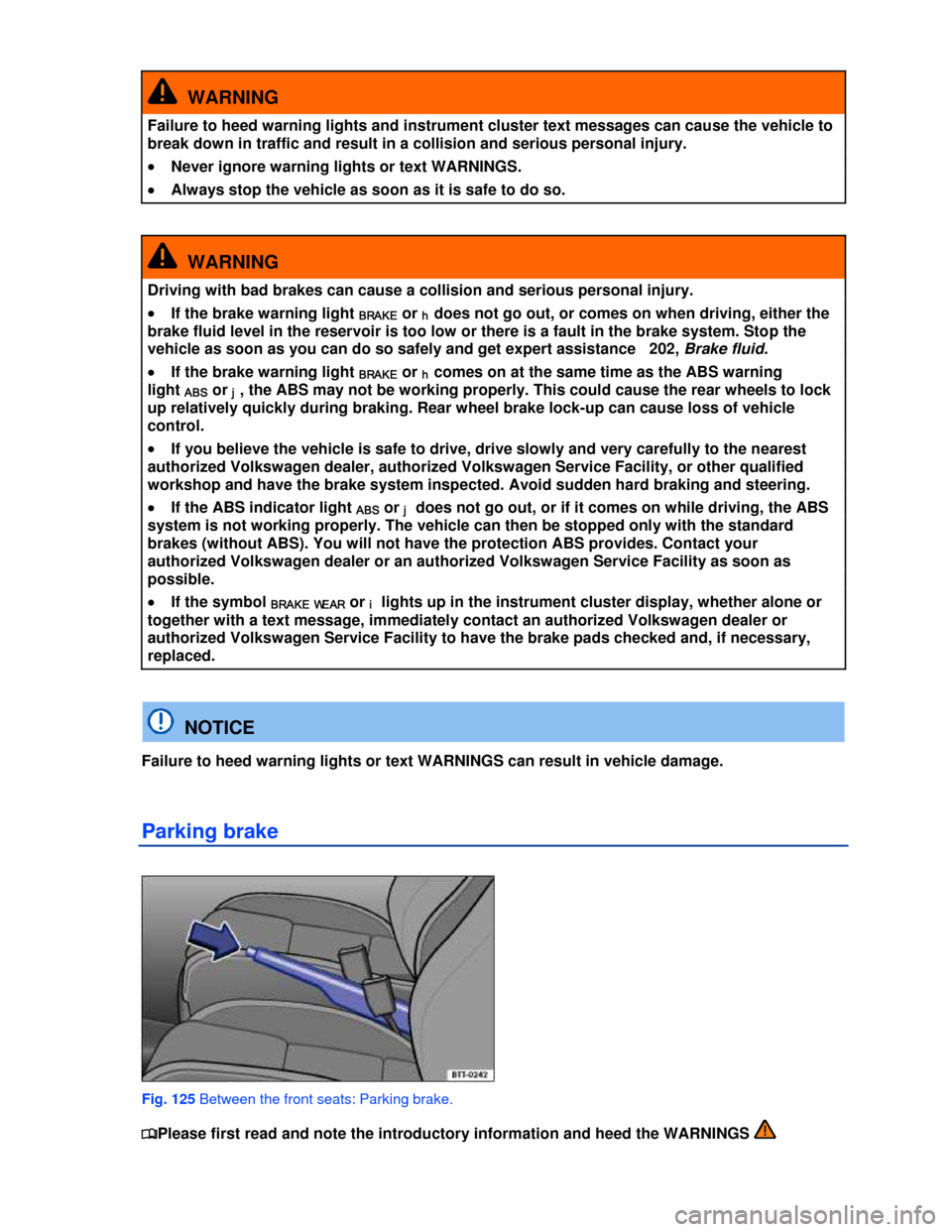
Parking brake
Fig. 125 Between the front seats: Parking brake.
Page 169 of 329
x Lock the vehicle.
On hills
Before stopping the engine, turn the steering wheel so that, if the vehicle starts to roll, its front wheels
will roll into the curb:
x Facing downhill, turn the front wheels so that they point toward the curb.
x Facing uphill, turn the front wheels so that they point away from the curb.
WARNING
The vehicle exhaust system and the catalytic converter get very hot. They can cause fires and
serious personal injury.
x Never park where the hot exhaust system could ignite flammable materials, such as
brush, leaves, dry grass, spilled fuel, etc.
NOTICE
x Always be careful when you park in areas with parking barriers or high curbs. These vary in
height and could damage your bumper and related parts if the front of your vehicle hits a
barrier or curb that is too high while you are getting into or out of a parking spot. To help
prevent damage, stop before the tires of your vehicle touch a parking barrier or curb.
x Always be careful when you enter a driveway or drive up or down steep ramps or over
curbs or other obstacles. Parts of the vehicle close to the ground may be damaged (such as
bumper covers, spoilers, and parts of the engine, suspension, and exhaust systems).
About the brakes
Page 177 of 329
Steering
Page 178 of 329
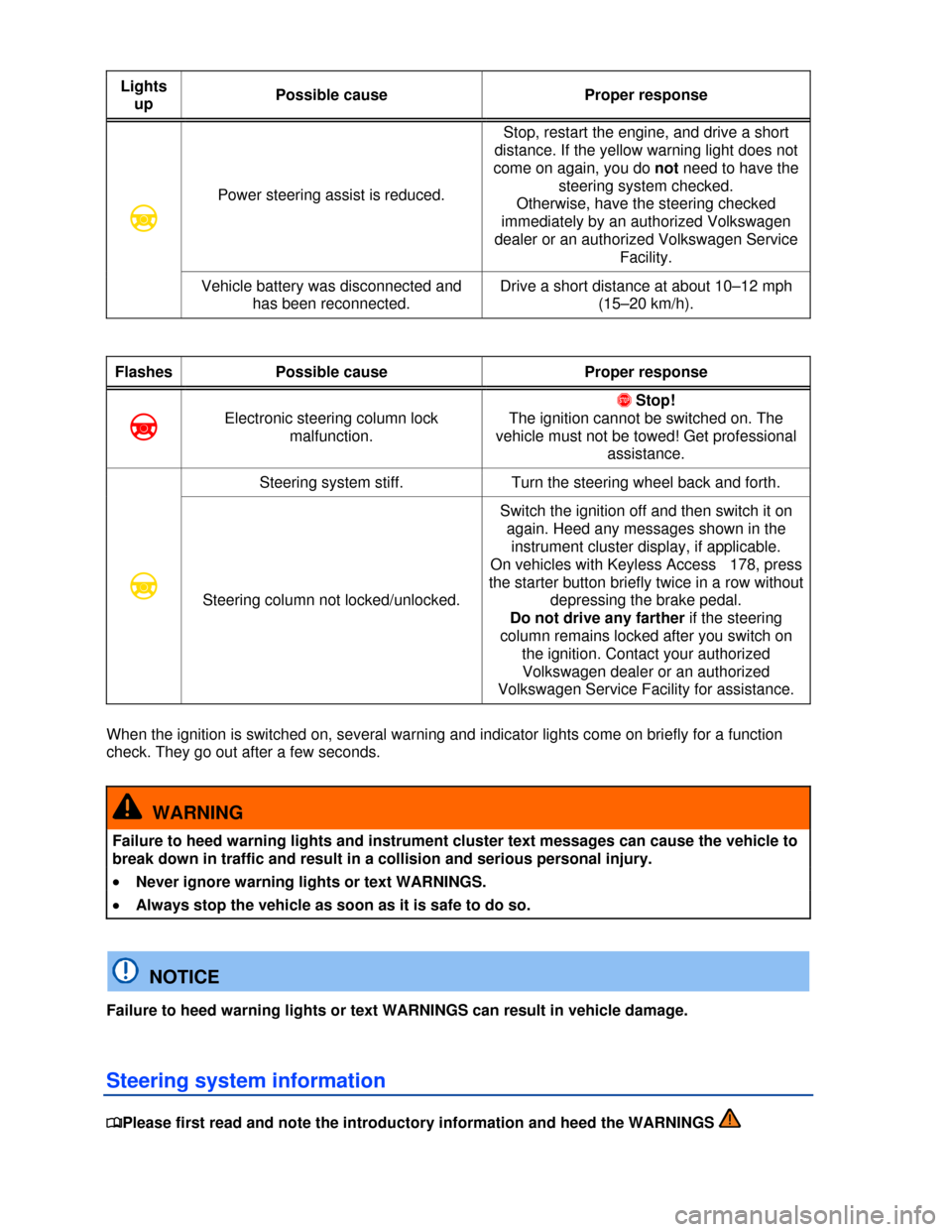
Lights
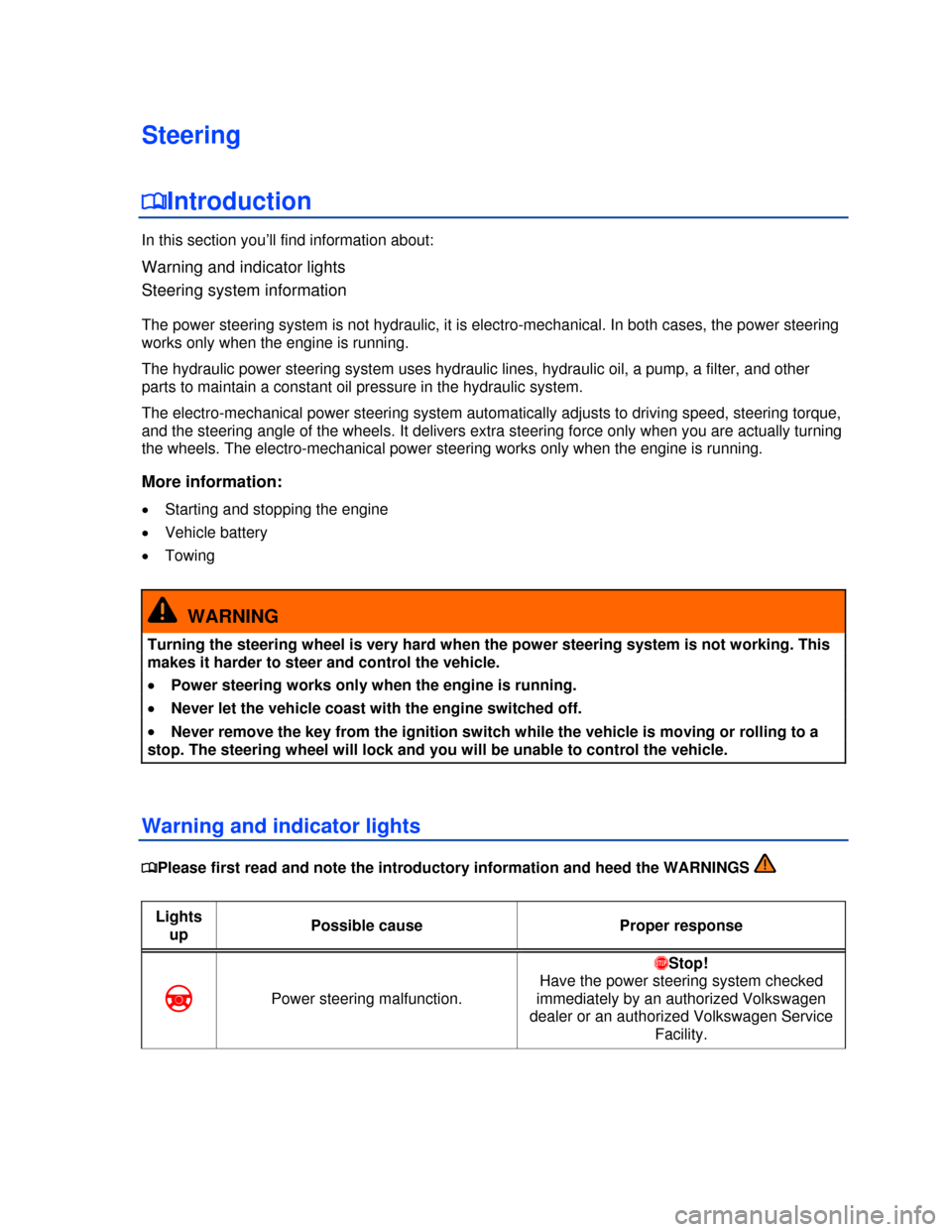
up Possible cause Proper response
D
Power steering assist is reduced.
Stop, restart the engine, and drive a short
distance. If the yellow warning light does not
come on again, you do not need to have the
steering system checked.
Otherwise, have the steering checked
immediately by an authorized Volkswagen
dealer or an authorized Volkswagen Service
Facility.
Vehicle battery was disconnected and
has been reconnected.
Drive a short distance at about 10–12 mph
(15–20 km/h).
Flashes Possible cause Proper response
D Electronic steering column lock
malfunction.