check engine VOLKSWAGEN GOLF 1993 1H / 3.G User Guide
[x] Cancel search | Manufacturer: VOLKSWAGEN, Model Year: 1993, Model line: GOLF, Model: VOLKSWAGEN GOLF 1993 1H / 3.GPages: 156, PDF Size: 6.36 MB
Page 75 of 156
Downloaded from www.Manualslib.com manuals search engine DRIVING TIPS
The technical prerequisites
for a low fuel consumpt ion and efficienc y "" ere " built in" at the factory. Particular Im
p ortance was placed on the lowes t possible
d is turban ce to the enviro nme nt. To retain and make the best possible use of these characteristics attent ion should be paid to the fo llow ing points
~Even those vehicles which do W not have a catalytic converter should be driven on unleaded petrol for the sake of the environment.
~The prescribed maintenance W operations should be carried out exactly as specified in the Service Schedule.
Having your vehicle regularly serviced by a Volkswagen dealer not only ensures that it is always operationally fit, but it also ensures economy, lowest possible burden on the environment and a long service life.
~Check the tyre pressures every 4 W weeks.
Low tyre pressures increase the rolling resistance. This not only increases the fuel consumption and tyre wear, but the handling is also impaired.
~Do not carry unnecessary ballast W in the luggage boot
Particularly in town traffic when one has to accelerate often, weight has a great influence on the fuel consumption. As a
rule ofthumb: For every 100 kg ofweight the consumption increases by approximately litre per 100 km.
~Remove roof rack immediately Wafter use
Particularly at high speeds the increased air resistance makes itself felt considerably.
~Electrical consumers should W only be switched on when they are actually required
Heated rear windows, additional driving lights and heater blower consume a considerable amount of current. The higher alternator load also increases the fuel consumption. For instance, overa period of 10 hours, the heated rear window will increase the fuel consumption by approximately 1 litre.
~Check the fuel consumption regW ularly
The fuel consumption should be checked each time the tank is filled up. By doing this inconsistencies on the vehicle which lead to an increased fuel consumption can be discovered sooner.
• Check the engine oil level each time the tank is filled up The oil consumption depends to a g reat ex
tent on the engine load and speed. Depend
ing on the style of driving the consumption
can be as much as 1 .0 litr es/1 000 km .
It
IS no rmal fo r the oil consumption of a ne w
engine to reach its lowest level after a cer
tain mileage has be en covered . The con
sumption cannot be properly assessed until
the vehicle has run appro x. 5000 km.
This also applies to the fuel consumption
and the engine output.
73
Page 77 of 156
Downloaded from www.Manualslib.com manuals search engine DRIVING TIPS
Brakes
General notes
• Brake lining wear depends to a la rge ex
t e nt on the operating conditions and style of riving. On vehicles which are used mainly
n town traffi c and stop/start conditions or are driven hard it may be nece ssary to have the thickness of the brake linings checked by a Volkswagen dealer in be tween the in
t er vals given in the Ser vice Schedule. On 'ehic les with brake pad wear indicato r, worn front pads w ill b e indic ated by a wa rnIng lamp -see page 48.
• Change down in good time when driving
d ownhill , in order to make use of the engine
braking effect. This relieves strain on the
brake system . When the brakes are appl ied
d o not keep them on conti nuo usly, apply
a n d release alternately.
• Under certain
operating conditions, for
ex ample after driv ing through water, after
h eavy ra in or after washi ng the vehicle the
braking effect may be reduced by wet, or in linter iced-up brake discs and linings -the
brakes must be dried out first by applying th e footbrake. The
fu
ll braking effect may also be reduced
when vehicle has been driven for som e
tim e on heavily salted roads witho ut using the bra kes, because th e layer of salt on
discs and pads has to wear off first.
Attention
If a front spoiler or full size wheel trims are retrofitted, it is necessary to ensure that the flow of air to the front brakes is not restricted -otherwise the brakes can overheat.
Brake serve
Attention The servo is operated by vacuum which is only generated when en
gine is running. For this reason the vehicle should not be allowed to roll with the engine switched off.
When the brake servo is not working because, for example, the vehicle is being towed or because a defect has occurred on the brake servo itself, the brake pedal must be pressed considerably harder to compensate for the absence of servo assistance.
75
Page 78 of 156
Downloaded from www.Manualslib.com manuals search engine DRIVING TIPS
Anti-locking brake system *
The AB S plays a major part in i ncreasing the active safety of the vehicle . The big adva ntage when compa red with a conve ntional brake system is t hat even when braking
hard on a s lippery road surfac e the bes t
poss ib le ste erabili ty is retained for the road
cond it io n because the wheels do not lock.
H
owever o ne mus t not expec t the ABS
sys tem t~ sho rt en the brak ing dis ta nce in all co nditions. When driv ing on grave l or o n
fr esh snow cove ring a slipp ery surf ace, I.e. when one shou ld be driving very care fully In
a ny case, the s topping distance may even be slightly longer
How the ABS system works
A n automatic check is made when a speed
of approx. 7 km/h is reached,. When this
hap pens a pumping no ise can be heard. W
he n the tu
rning speed of a w heel reac hes a leve l which is too low fo r the ve hicle speed
and it ten ds to lock , the brake pre ssu re to
t his whee l is r educ ed. On the fron t axle the
b rake press ure is regulated fo r eac h wheel
ind iv idually, whereas on the rear axle, the
press ure is regulated fo r bo th wheels at the
sam e tim e. As a result the braking effect IS the same f or both rear w heels and the driving stabi lity is reta ined as f a r as po~sible. This regulating process makes Itself known by movement .of the b~ake pedal and is accompanied by nOises. This is do ne deli berat ely as a warni ng to the
driver that a wheel or the wheels a re In th e
lock ing range So that the ABS can r egu la te
effec tively in th is range the brake peda l
must remai n depressed -on no account
should it be pumped l
Attention However the ABS system cannot overcome the physical limits. This must be borne in mind particularly on slippery or wet roads. When the ABS com es into the control range the speed must immediately be adapted to the road and traffic conditions. The increased amount of safety available must not tempt one into taking risks.
If a def ect occurs o n the ASS It is indicated by a warni ng lamp -see page 49.
76
Page 79 of 156
Downloaded from www.Manualslib.com manuals search engine DRIVING TIPS
Trailer towing
The vehicle is intended main ly for the trans
portation of persons and luggage but it can, with the appropriate technical equipment,
also be used to tow a trailer.
Technical requirements
• If the vehicle is suppl ied with a factoryfi tted towing bracket, all that is technically
a nd legally necessary for trailer towing wil l
have been taken into account.
• If the trailer to be towed
has a 7 pin plug, an adapte r cable can be used whi ch IS ob
tained from a Volkswagen dealer.
• Volkswagen dealers have
all the necessary information on the In stallation of towing
brackets and the fitti ng of a heavy-duty cooling system. The installation should there
f ore be done by them .
Operations instructions
• On the Golf saloon with a factory
fitted towing bracket* the removable ball
coupling will
be fitted. Fitting/remo ving in
struc tions and instructions on correct stowage of the ball coupling in the spare wheel
well can be found in a linen bag in the ve
hicle luggage compartment.
•
On the Golf estate with a factory fitted
towing bracket* the remova ble ball coupl
ing is stored inside the vehicle next to the
spare wheel, together w ith instructions on
fitting.
• Pitching movements between towing
vehicle
and trailer can be reduced by hea vy
duty springs and shock absorbers on the
rear axle. If these springs and shock absorbers have not alread y been fitted at the
factory, they can, in many cases, be service
installed by a Volkswagen dealer.
• The permissible trailer weight -see
page 144 -m ust not
be exceeded on any account.
• If the the trailer weight
is below the
permissible maximum, a correspondingly
steeper gradient
can be climbed. •
The given trailer weights
are only appli
cable for altitudes up to 1000 m above sea level. As the engine output and thus the
climbing ability drops due to the decreasing
air density , the weight of vehic le and trailer
must also be reduced by 10 % for each
further 1000 m or part thereof.
• Where possible make full use of the
maximum permissible drawbar weight
on ball of the towing bracket -see page 144
but do not exceed it.
• While observing the permissible trailer
and drawbar weight, distribute the load in the trailer so that heavy objects are as nea r as possible to the axle. The objects must
also be secured so that they cannot slip
about.
• Check the ty
re pressures on the towing
v ehicle, and adjust for full load conditions,
and also check the pressures on the trailer
• T he headlight settings, should
be checked w ith trailer attached before mov
ing off and adjusted as necessary. On vehicles with headlight beam control it is on ly necessary to turn the knurled disc in dash in the appropriate directIOn .
77
Page 86 of 156
Downloaded from www.Manualslib.com manuals search engine GENERAL MAINTENANCE ~~~~~~=--------------------
Diesel engines
Diesel fuel
to DIN 51 601. eN1) not lower than 45.
Driving in winter
When using summer Diesel trouble may be experienced at temperatures below Ooe because the fuel thickens due to wax separ
ation.
For this reason, w inter Diesel which
is more
resistant to cold is sold during the winter in Germany, and this works satisfactorily
down to between -15 and -22°e, depend
ing on the type of fuel used.
In countries with different climatic condi
tions the Diesel fuels offered have a differ
ent temperature characteristic. Check with
Volkswagen dealers or filling stations
in the
country concerned regarding the character
istic s of Diesel fuels.
Filter preheating
The vehicle is fitted with a filter preheater.
This will ensure , that the fuel system remains operational down to about -25°e provided that winter Diesel which is cold resistant down to -15°e is used. Diluting with
petrol is then no longer necessary under
these conditions.
If, at temperatures below -25°e the fuel is waxed to such an extent that the engine w ill
not sta rt it is sufficient to place the vehicle in a warm room for a while .
Fuel additives (anti-waxing agents) and
similar fluids must not be mixed with the
Diesel fuel.
11 Cetane N u bee ind icates the ig nltabillty of
D iesel.
84
Page 91 of 156
Downloaded from www.Manualslib.com manuals search engine GENERAL MAINTENANCE
w hen corrosion protected parts are reewed.
dih Because when washing the en~gine petrol, grease and oil deposits are washed off, the dirty water must be cleaned by an oil separator. For this reason engine washing should only be carried out in a workshop or filling station.
\folkswagen dealers have stocks of the
h igh-quality cleaning and prese rvation ma
te rials re commended by the factory and
have the equipment ne cessary to appl y them .
Underseal
The under side of the vehicle is coated with a special compound to protect It from cor
rosion and damage .
H ow ever,
as this protective layer becomes
a m aged when the ve hicle is in use , the
p rotecti ve coating under the body and on
t h e runn ing gear should be examined at de
fi ned inter vals -prefer ably befo re and after the winter season -and any damage made
g ood. Volksw
agen dealers have stocks of the cor
rect compound,
have the necessary equip
ment and are famil iar w ith th e application
proc edure . We advise you ther efore to have
the patching up or additional coating done by a Vol ksw agen dealer.
Note for vehicles with a catalytic
converter
Due to the high temperatures which occur in the afterburning process, additional heat
shi elds are fitted over the catalytic con
v e rter. Underbodysealant must not
be applied to the se shields, the catal ytic con
v erter or the exhaust pies. Remo val of the
heat shields is also not permissible .
Cavity preservation
All cavities on the vehicle which could be susceptible to corros ion are given perma
nent protect ion at the factory.
This coating does not need check i
ng or any
subsequent treatment. Should a small
amount
of wa x run out of the cavities at high
ambient te mperatures it can be re moved
with a plastic scraper and some white spirit.
Note
On no account allow the tail lights to com e
Into contact with dry cleaning solvent.
If the wax which has run out is removed with clean petrol, heed the safety and environmental protection regulations.
89
Page 92 of 156
Downloaded from www.Manualslib.com manuals search engine GENERAL MAINTENANCE
Bonnet
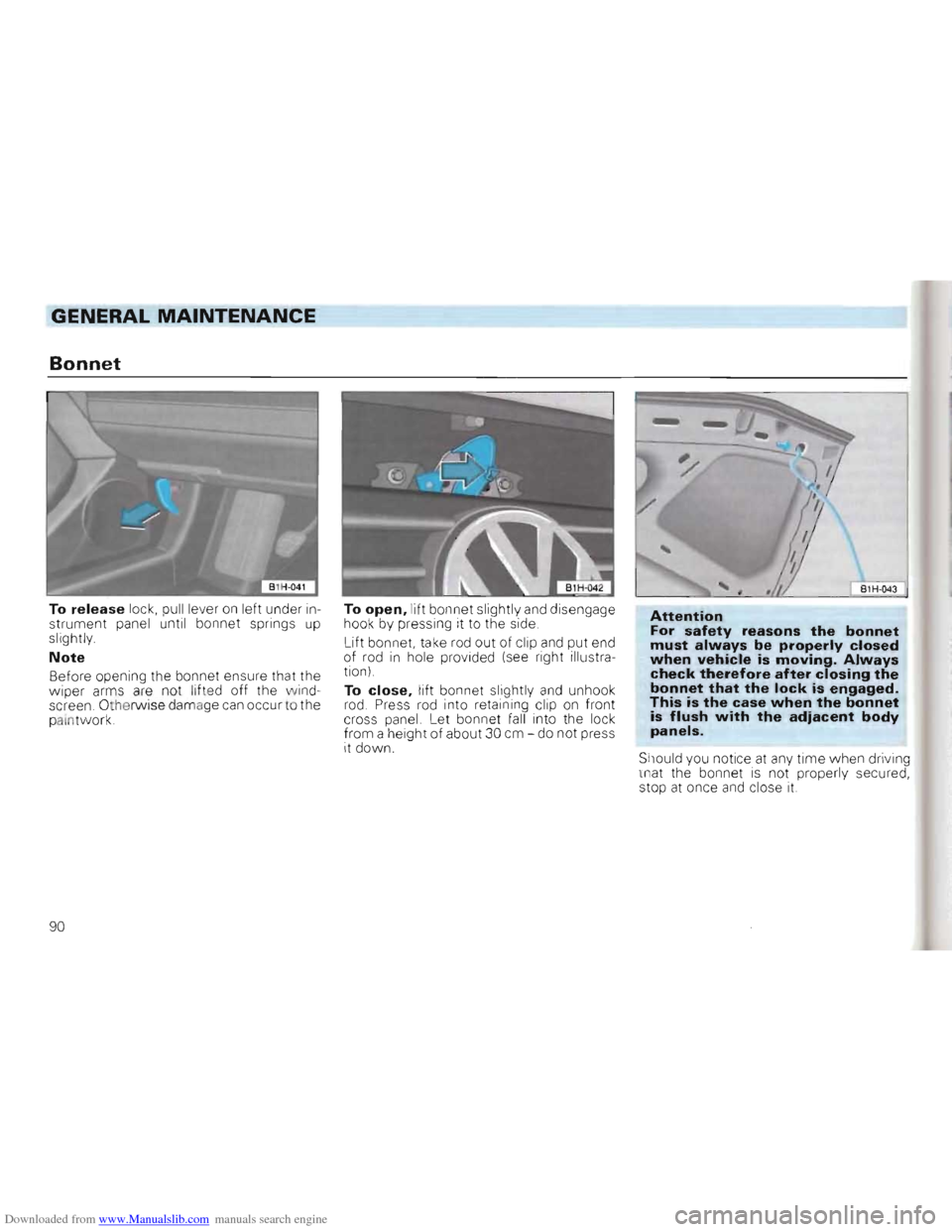
To release lock, pull lever on left under in
strument panel until bonnet springs up slightly.
Note
Before opening the bo nnet ensure that the
wiper arms are not lifted off the wind
screen. Othe rwise damage can occur to the
palntwork. To
open, lift
bonnet slightly and disengage
hook by pressing it to the side.
Lift bonnet, take rod out of
clip
and put end
of rod in hole provided (see right illustra
tion)
To
close, lift bonnet slightly and unhoo k
rod. Press rod into retaining cl ip on front
cross panel. Let bonnet fall into the lock
from a height of about 30 cm -do not press
it down.
B1H -043
Attention For safety reasons the bonnet must always be properly closed when vehicle is moving. Always check therefore after closing the bonnet that the lock is engaged. This is the case when the bonnet is flush with the adiacent body panels.
Should you notice at any time when driving
that the bonnet is not properly secured,
stop at once and close it.
90
Page 93 of 156
Downloaded from www.Manualslib.com manuals search engine GENERAL MAINTE NA NCE
Engine c ompartmen t
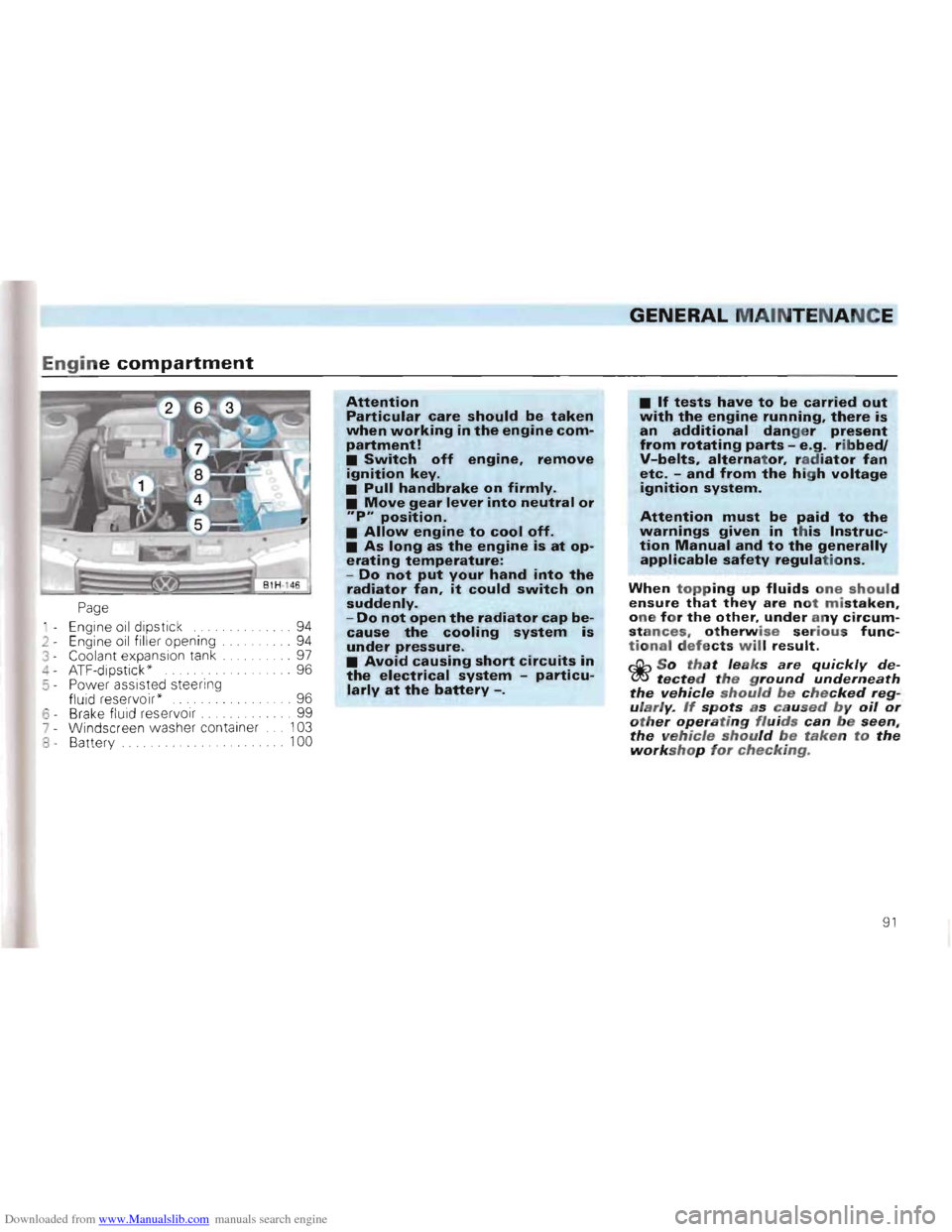
Page
Engine oil dip sti ck . . 94
2 - Eng ine o
il filler openi ng ... ...... . 94
3 - Coolant exp ansion ta nk .. 97
4 -ATF-dip sti ck " . . . . . . . . . . . .. . 96
5 - Power assist ed steering flu id r eservoir '
6 Brak e fl uid re se rvo ir .
7 - Wi nd sc reen w ash er c on tainer
8 Battery .
Attention
Particular care should be taken
when working in the engine com
partment!
• Switch off engine. remove ignition key_
•
Pull handbrake on firmly.
• Move gear lever into neutral or
"P" position.
• Allow engine to cool off.
• As long as the engine is at op
erating temperature:
-Do not put your hand into the
radiator fan. it could switch on
suddenly.
-Do not open the radiator cap be
cause the cooling system is
under pressure.
• Avoid causing short circuits in
the electrical system -particu
larly at the battery -.
. .. 96
. .. 99
10 3
100
• If tests have to be ca rried o ut with the engine running. there is an additional dang e r present from rotating parts - e.g . ribbedl V-belts, alternator, ra d iator fan etc. -and fro m the high voltage ignition system.
Attention m ust be paid to the w arn ings given in this Instruction Manual and to the generally ap plicable safety regulations.
When topp ing up fluids one should ensure that they are not mistaken. one for the other, under any circum stances. otherwise serious fu nctional defects will result.
rJjh So that leaks are quickly de(!J!J tected the ground underneath the vehicle should be checked regularly. If spots as caused by oil or other operating fluids can be seen, the vehicle should be taken to the workshop for checking.
91
Page 96 of 156
Downloaded from www.Manualslib.com manuals search engine GENERAL MAINTENANCE
Checking oil level
Every eng ine uses a certain amount of oil. The oil consumption can be up to 1.0
litr es per 1000 km -see also page 73. The
engine oil l eve l must therefore be ch ecke d
a t regula r int ervals, preferab ly w hen fillin g
the tank and before a long Journey.
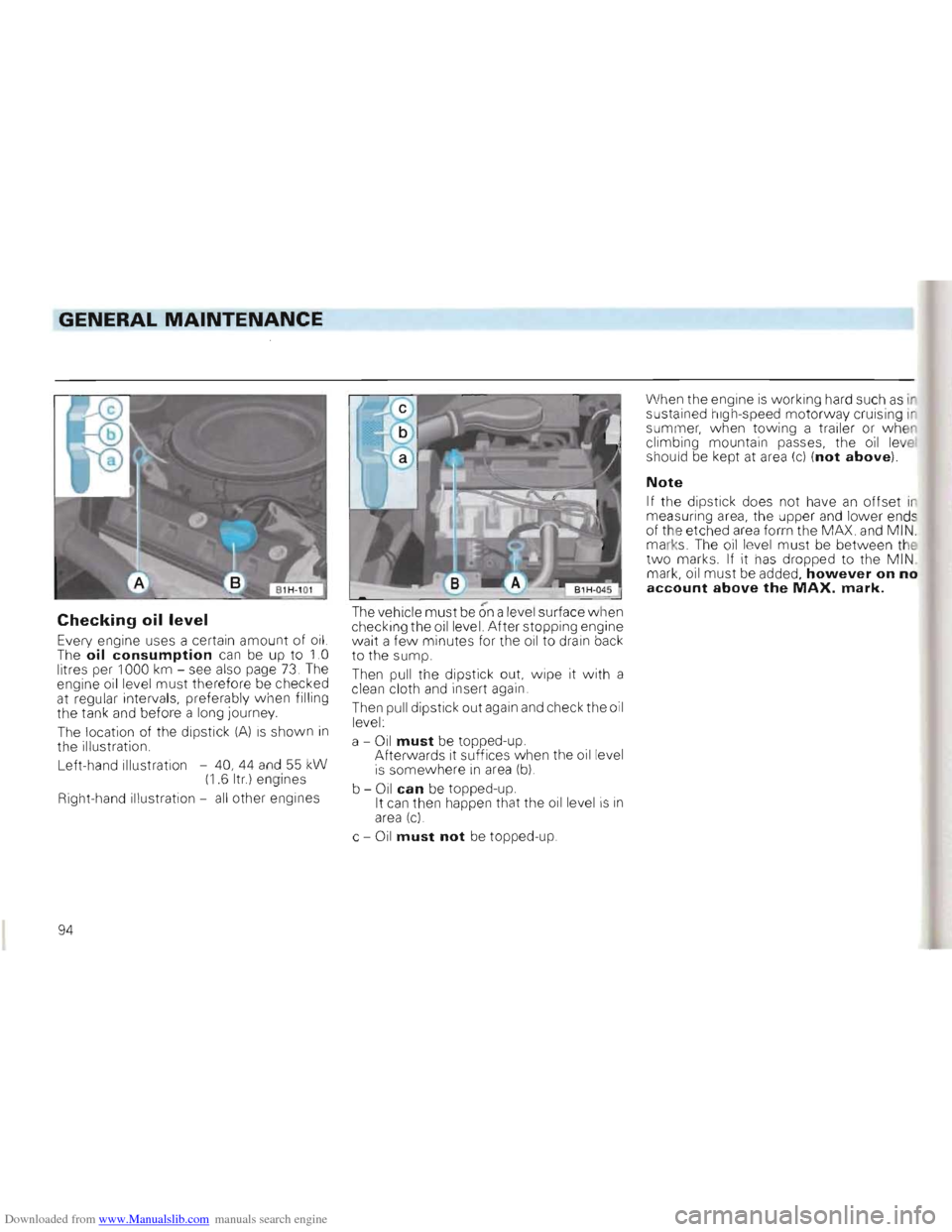
The locat ion of the dipst ick (A) IS shown in th e illustration.
Left-hand illustration -40 , 44 an d
55 kW (1 .6 Itr) en gi nes
Right-hand illustration -
all other engines
The ve hicle must be on a leve l surface when checking the oil level. A fter stopping engine
wa it a fe w minutes for the oil to drain back
to the sum p.
T hen pu ll the dipstick out, wipe it with a
clean cloth and insert again
Then pull dipstick out again
and check th e oi l
level :
a -
Oil must be topped-up.
Afterwards it suffices when the oil level
is somewhere in area (b)
b -Oil can be topped-up.
I t can then happen that the oil level is in area (c)
c -Oil must not be topped-up. When
the engine
is working hard such as ir
sustained high-speed motorway cruisin g in
summer, when towing a trailer or w he n
c limbing mountain passes , the o
il lev e! should be kept at area (c) (not above).
Note
If t he dipstick does not have an offset in
meas uring area, the upper and lower ends
of the etched area forrn the MAX. and MIN .
marks. The oil level must be between the two marks. If it has dropped to the M I N . mark, oil mu st be added, however on no account above the MAX. mark.
94
Page 97 of 156
Downloaded from www.Manualslib.com manuals search engine GENERAL MAINTENANCE
Topping up engine oil
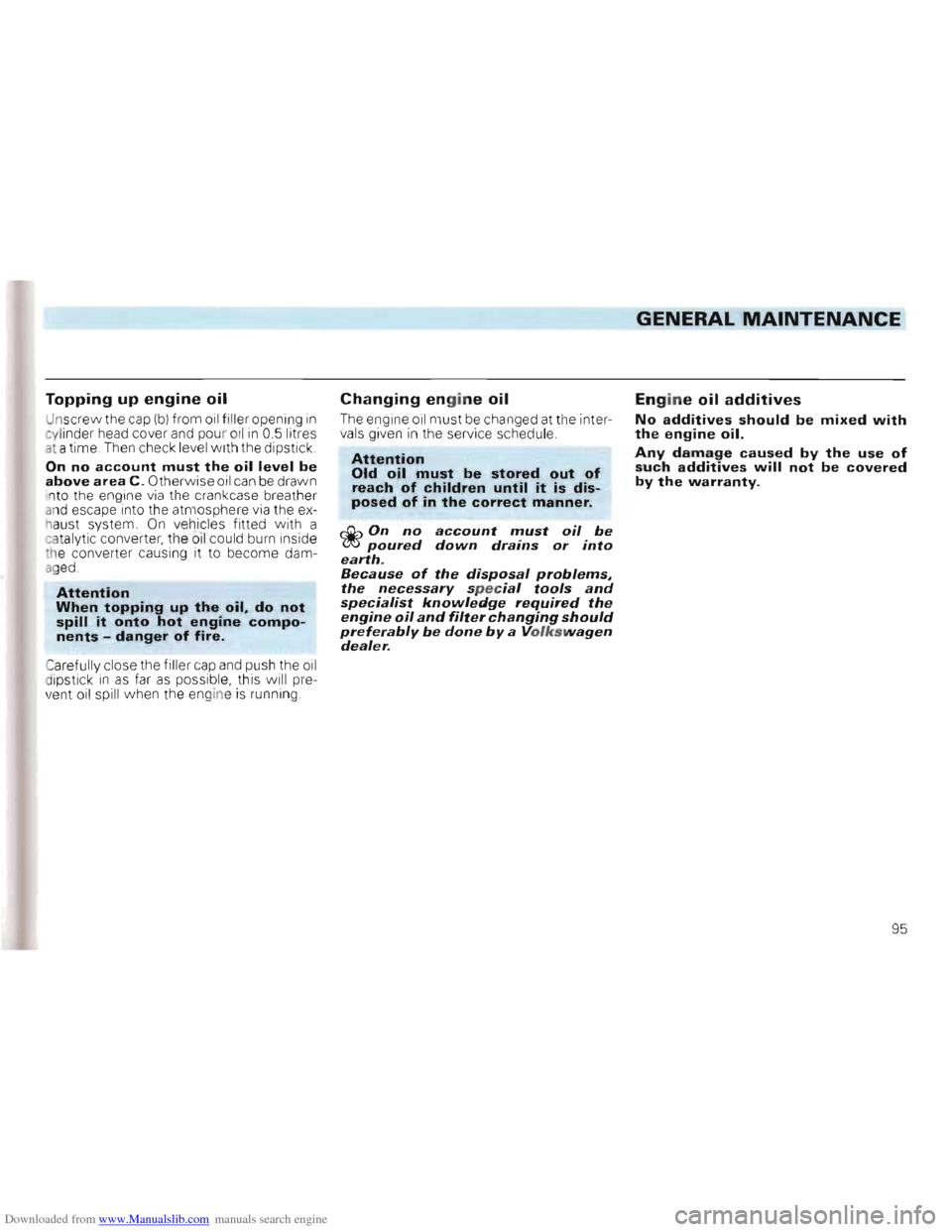
Unscrew the cap (b) from oil filler ope ning in cylinder head cover an d po ur 0 11 in 0 .5 litr es
at a time. Then check le ve l with th e dipst ic k .
On no account must the oil level be above area C . Otherwise oil can b e drawn
n to the engine via the crankcase breathe r
a n d escape into the atm osphere via th e ex·
h aust system. On ve hicl es fitted with a catalytic conve rte r, t he oil could burn inside the conve rter causing it to become dam·
a ged
Attention When topping up the oil. do not spill it onto hot engine components -danger of fire.
C arefully close the filler cap a n d push the oil ipsti ck in as far as possible, this w ill pre
vent oil spill when the engine is running .
Changing engine oil
The engine oil must be changed at the inter
v a ls g iven in the ser v ice sch e d ule .
Attention Old oil must be stored out of reach of children until it is disposed of in the correct manner,
r1Ib On no account must oil be ~poured down d,'ain s or into earth. Because of the disposal problems, the necessary special tools and specialist knowledge required the engine oiland filter ch anging should preferably be done by a Volkswagen dealer.
En gin e oil additives
No additives should be mixed with
the engine oil.
A ny damage caused by the use of
su ch additives will not be covered
by the warranty.
95