warning VOLKSWAGEN GOLF 2004 User Guide
[x] Cancel search | Manufacturer: VOLKSWAGEN, Model Year: 2004, Model line: GOLF, Model: VOLKSWAGEN GOLF 2004Pages: 444, PDF Size: 92.7 MB
Page 90 of 444
WARNING
Always make sure that you the suggestions and heed th e WARN INGS in this Booklet.
Safety equipment
Additional important information that yo u
need to know fo r you r own safety and the safety of your passengers and others is in the Bookl ets of your Literature.
T his
The safety are part of the occupan t rest rain t system and work together to
help reduce the risk
of injury in accident situation s.
Your safe ty and the safety of your pass enge rs
s houldn 't be left t o chance. Adva n ces in te ch
n ology have mad e variety of feature s available to help red uce the risk of injury in a collisio n.
T he followin g is lis tingofjust a few of th e s afe ty
f e at ures in your Vo lk sw age n:
sophisticate d safe ty belt s for all seating positio n s.
sa fe ty belt force for the front seats
s eati ng po sition s,
safety be lt pre te nsioners for the front seatin g
p ositions and for the outboard rear seating pos i
t io ns in combin ati o n w it h optional re a r s id e air
b ags,
sa fety b elt he ight adjustment for the front s eat s,
fr ont airbags sys te m ,
sid e airb ags for the front seats, optiona l for the outboard re a r seats ( fo u r doors ve hicl e)
2 Safe driving
S id e Protection ai rbags,
h ead res tra in ts fo r ea ch seat in g positi on , and
adjustable s teerin g column.
T he se
individua l sa fety features, wo rk t ogeth er as a syste m to help protect yo u and your passeng ers in a wid e range of collis io ns. T hese features can't work as a sys te m if they are notal
w ays correctJy a dju ste d and correc tl y used!
T
his Bookle t p rov ides important in for matio n
a b out why these features are important, how they w ork to help protect yo u and your passengers and the y m ust be adju ste d and used to get the g re atest ben efit an d reduce the lik eli
h oo d of injury. T he Booklet a ls o conta in s i mpo r
t a nt WARNINGS th a t yo u a nd you r passenge rs mus t alw ays rea d and hee d in order to he lp r e
d uce th e risk o f perso nal inju ry.
Safety is
everybody' s responsibility!
Page 91 of 444
driver.
For your safety and the safety of your pas
sengers, before driving always:
- Make sure
that all lights and signals are
operating corr ect ly.
- Make su re
that the tire pres sure is cor
r
ect.
- Make sure that all windows are clean
and afford good visibility to the outside .
- Secure all luggage and
other items care
page
re
stra int correctly to protect children
53.
- S it properly in your seat and make sure
that your passengers do the same
4.
- Fasten your safety belt and wear it prop
erly. Also instruct your passenge rs to
fasten their safety belts properly
Safe driving is directly related to the condition of the vehicle, the driver as well as
the driver' s ability to concentra te on the road without being distracted.
The driver is responsible for the safety of
the vehi cle and all of its occupants. If your
ability to drive is impa ir ed, safety risks for
everybody in
the vehicle in crease and you
a lso becom e a hazard to everyo ne else
on
the There fo re:
- Never let yourse lf be di stracted by pas
sengers
or by using the Infotainm ent
syste m or a cellular tel ephone.
- Never drive w
hen your driving ability is
impa ired (by medication s, alco hol,
drugs,
etc.) .
- Observe a
ll traffic laws, rules of th e road
and speed limit s and plain common sense. -
Alway s
adjust you r speed to road, traffic
a
nd weathe r conditions.
- Take frequen t breaks on long trip
s.
Don't drive for more than two hours at a
s tretch.
-
Do n ot drive when you are tir ed, unde r
pressure
or when you are stresse d.
WARNING
Impaired driving safety increases the risk of serious personal injury and death whenever a
vehicle is being used
Page 92 of 444
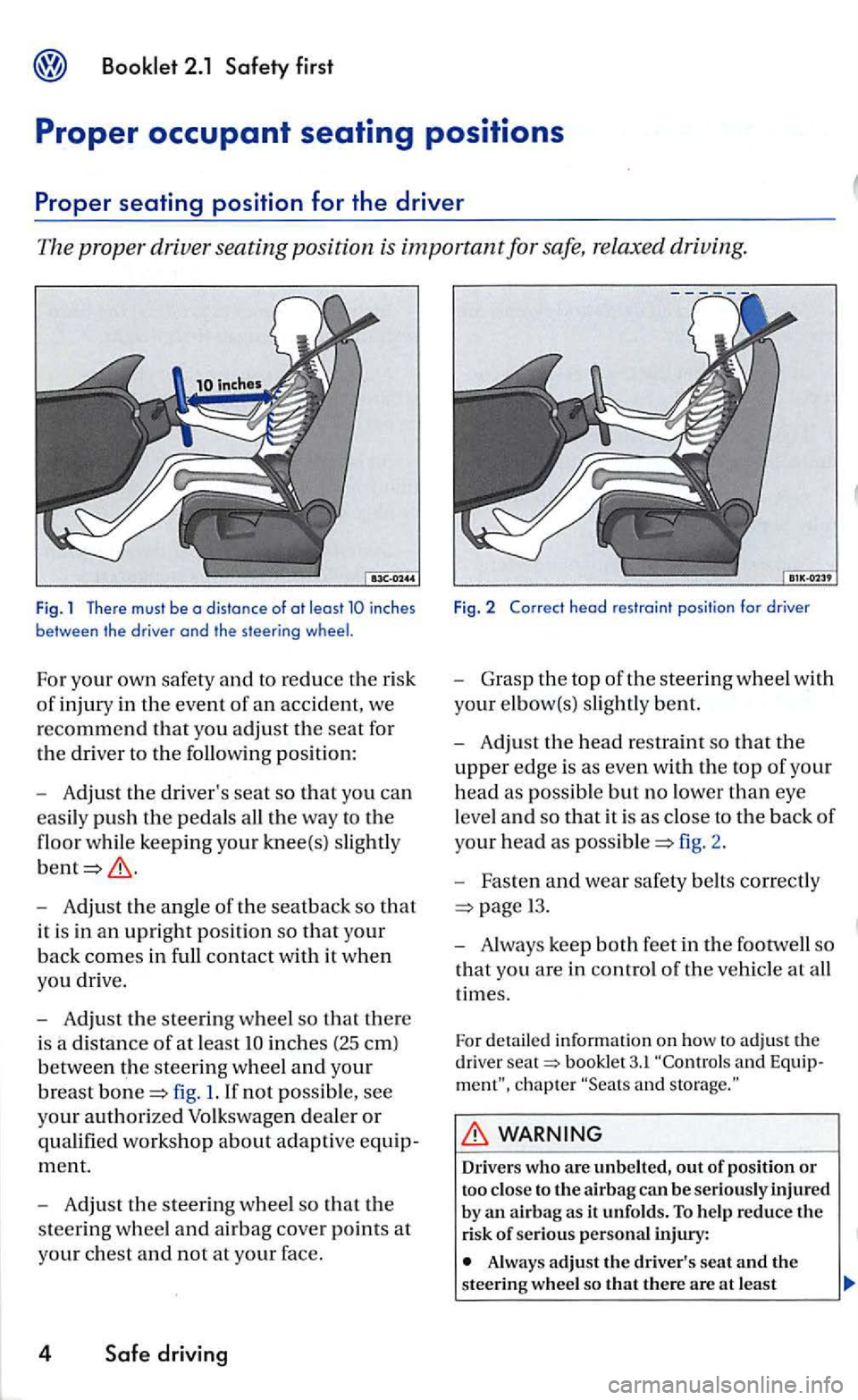
- Adjust the angle of th e seatback so that
it is in an upri ght position so that your
back comes in full contact with it whe n
yo u dri ve.
-
Adju st the s teerin g w heel so that there
i s a dis
tance of at least
fig. 1. If not poss ibl e, see
yo
ur authorized Volksw agen dealer or
qualified workshop about adaptive
fig. 2 .
- Fasten
and wea r safety belts correctly
13.
-Always keep both feet in the footwell so
that yo u are in con trol of the vehicle at all
tim es.
For detailed information on how to adjust th e
d rive r bookle t 3.1 chapter
WARNING
Dr ivers who are unbelted, out of pos itio n or too close to tl1e airbag can be serio usly injured by an airbag as it unfold s. To help reduce the risk of seriou s personal injury:
Page 93 of 444
inches (25 em) between your breastbone and the steering wheel.
Always hold the s teering wheel on the
Never hold the steering wheel at the 12 o'clock position or with your hands at other positions inside the steering wheel rim or on the steering wheel hub. Holding the steering
wheel the wrong way can cause serious
2.1 Safety first
(continued)
Always sit in an upright posit i on and never lean against or place any part of your body too
close to the area where the airbags are located.
strained.
Never adjust the seats the vehicl e is mov ing. Your seat may move unexpecte dly and yo u could lose control of the vehicle.
Never drive wit11 the backrest reclined or tilted far back! The fart her t11e backrests are tilted back, the greater the risk of injury due to
incorrect positionin g ofthe safety belt and
Children must always ride in child seats
page restraints on t11e front seat some important things to
Move the front passenger seat back as
far as possible. There must be a minimum
of
Adjust th e angle of the seat back so that
it is in an upright position and your back
comes in full contact with it whenever the
veh icle is moving.
Adjust the head restra int so that the
upper edge is as eve n with the top of your
h
ead as poss ible but not lower than eye
leve l
and so that it is as close to the back of
your head as
Keep both feet flat on the floor in the
footwell in fron t
of the front passenger
seat.
Fasten and wea r safety belt s co rrectly
13.
For detail ed inform ation on how to adju st the
front passenger bookl et 3.1 and s torage.""
WARNING
Front seat passengers who are unbelted, out of posit ion or too close to the airbag can be
risk of serious
Passengers must always sit in an upright position and nev er lean against or place any part of their body too clos e to the area where the airbags are located.
Passengers who are u nbelted, out
Safe driving 5
Page 94 of 444
Always make sure that there are at least
Each passenger must always sit on a seat of their own and properly fasten and wear the safety belt be longing to that seat.
Before driving , always adjust the front senger seat and head re straint properly.
Alway s keep your feet on the floor in front of the seat. Never rest them on the seat, ment panel, out of the window, etc. The airbag
tect you properly and can even increa se th e
risk of injury in a crash.
Neve r drive with the backre st recl ined or tilted far back! The farth er the b ackrests are
tilted back, the greater the risk ofinjury due to
in correct positioning of the safety belt and
must always ride in seats 53. a child seat on the front passenger page
Mak e sure that the seatback s are
curel y lat ch ed in the upright position.
A djust th e head restraint so that the
upper edge is as even with the top of your
head as possible but no lower than eye
pag e 7. If a passe nger is s ittin g in
the rear center seating pos ition, this
pac t h ead restra int is not h eight
a ble , but it must always bee n rais ed
eve r the center rear seating posit ion is
belt on
page 23
Keep both feet flat in the footwell in
front
of the rear seat.
6 Safe driving
Fasten and wear safe ty belt s properly
13.
Make sure that children are always
prop e
rly restra in ed in a child re str aint that
is appropriate for thei r size and age
5 3 .
WARNING
Pas sengers who are improperly seated on the rear seat can be se riou sly injure d in a crash.
Each passen ge r must always sit on a seat of th eir own and properly fasten and wear the safety belt belonging to that seat.
belt s only offer maximum tion when the seat back is securely latched in
th e upright po siti on and the safety belts are
properly positioned on the body. By not sitting
upright , a re ar seat pass enger increases the risk of personal injury from improperl y
Always adjust the head restraint properly so that it can give maximum
Page 95 of 444

pant restraint system and can help to reduce the risk of injuries in accident
tions.
Fig. 3 Correctly adjusted head res traint viewed
from the fron t
The head restraints must be
justed to be
tection.
Adjust the head restrain t so that the
upper edge ofthe restraint is w ith the
top of your head, but no
and so it is as to t he back of your
hea d as fig. 3 and fig. 4 .
Adju stin g head booklet 3. t and
Driving without head restraints or with prot>erly adjusted head restraints increases the risk of se rious injuries in a collision. To help reduce the risk of injury:
Always drive with the head restraints in
place and properly adjust ed.
F ig . 4 Correctly adjusted head rest rain t viewed
from the side
WARNING (continued)
Every person in the ve hicl e must have a properly adjusted hea d restraint.
Always make sure each person in the
cordin g to occupants' size so that upper edge is as eve n with the top of the person's hea d, but no low er th an eye level and so it is as
close t o the bac k of to the hea d as poss ible.
Never attempt to adjust head r estraint while driving. lfyou have d rive n off and must ad ju st driver headrest for an y reason, stop the ve hicle safe ly before attemptin g to adjust the head rest ra int.
must always be properly
page
The center head res trai nt on th e rear seat cannot be adjusted fo r height on th e Golf GTI.
Page 96 of 444
WARNING
Driving head restraint s or with im
properly adjusted head restraints increases
t h e risk of seriou s injuries in a co llision.
To help reduce the risk of injury:
Always drive with the head restraints in
place and properly adjusted. Remember that the rear center head restraint is not height ad
justable and that it must be rai sed up all the way whenever the center rear seat is occupied.
Every person in the vehicl e must have a
properly adjusted head restraint.
Always make sure each person in th e ve
hicle properly adjusts their head restraint.
Neve r attempt to adjust head restraint while driving. If you have driven off and must
adju st the driver headres t for any reason, first
stop the vehicl e sa fely before attempting to adjust th e head restraint.
Childre n must always be properly re
stra ined in a child restraint that is appropriate
for their age and page 53.
Tips
The active front hea d restr aint s ca n al so activate
w he n a passenge r pushe s up again st the backrest with enou gh force (for exampl e if yo u let
yourse lf ju st fall into the seat abruptly) or if th e
h ead restraint is pu shed from behind . Th is is
no rmal and
will not damage the he ad rest ra int. It will go back to it s origina l posit ion right
The followin g lists only some of th e pos ition s
that will increase the risk of seriou s injury and
death.
n eve r stand up in the vehicl e
neve r stand on th e sea ts
n eve r knee l on the seat s
neve r lie do wn on th e rear seat
Page 97 of 444
neve r lean up aga inst th e in strum ent pan el
n eve r sit on the edge of th e se at
neve r sit sid eways
neve r lean out th e w indow
neve r put your feet ou t th e w indo w
neve r put your feet on the in strument panel
neve r rest your feet o n the seat cu shion or back of th e sea t
never ride in the footwcll
n eve r sit o n th e front o r r ea r center armrest
first
n eve r rid e in th e ca rgo area.
WARNING
Improp er seating positions increase the risk of serious persona l injury and death w henever a
ve hicle is being used.
Alway s make sure that all vehicle occu
p ants stay in a proper seating position and are
properly res trained wheneve r the vehicle is
being used.
The pedals must always be free lo move and must never be in teJfered with by a
floor mat or any other object.
Make sure th at all ped als move freely without in
t e rf ere nce and that nothin g prevents th em from
r e turning to their origin al po sitions.
u se floor mats that le ave th e pedal area free and c a n be secured with floor mat f aste ners.
If a brak e cir cui t
fails, increa sed brake pedal trave l is req uired to brin g the vehicle to a full sto p.
WARNING
that cannot move freely can cause lo ss of vehicle control and increase the risk of se
riou s injury.
Neve r pla ce any objects in the driver's footwell. An object could get into the pedal area
and interf ere with pedal function . In case of sudden braking or an accident, you would not b e a ble to brake or acce le rat e!
Always make sure th at nothing ca n fall or move into the driver' s footwell.
Always use floor mats that can be securely a ttached to the floor mat fas tene rs and
do not inteJfe re with th e free movement of the pedals .
only floor mats that leave the ped al a rea un
ob structed and th at are firml y secured so that
th ey cannot slip out of po siti on. s e
c urin g th e floor mats will prevent them from
s lid ing into positi ons that could interfer e with th
e
pedals or im pair safe operatio n of your ve
hicl e in oth er ways.
You ca n obtain suitabl e floor mats from your au
th orized Volkswage n dea ler .
WARNING
Page 98 of 444
Always make sure that floor mats are erly secured.
Never place or install floor mats or other floor coverings in the vehicle that cannot be properly secured in place to prevent them
from slipping and interfering the pedals or the abiliry to control the vehicle.
Never place or install floor mats or other floor cover ings on top of already installed floor mats. Additional floor mats and other
Stowing
Loading the
(cont inued)
cove rings re d uce the s ize of the pedal area and interfe re with pedal s.
Always properly reinstall and secure floor mats that have been removed for cleaning.
Alway s m ake sure tl1at objects cannot fall
into
All luggage and other objects must be properly stowed and secured in the luggage
compartment.
Loose items in the luggage compartmen t
can shift suddenl y changing ve hicl e
in a sudden ve hicle maneuver o r in a
sion.
- Distribute th e lo ad eve nly in the
gage compartment.
- Always pla
ce and properly secure heavy
it
ems as far forward as possibl e in the
gage compartment.
-heavy luggage as low as possib le
in the lu ggage
compartment.
-
lu ggage using the tie-do wns
provided page 12 .
- Make sure
that th e rear seat b ack is
cure ly latched in plac e.
WARNING
Improperly stored lugg age or other item s can fly through the vehicle causing serious
(continued)
Always put objec ts, for example, luggag e or othe r heavy items in the lu ggage compartment.
Alwa ys secure objects in t11e lu ggage
able straps.
WARNING
Heavy loads influence the way your hicle handles . To help reduce the risk of a los s of control leading to serious personal injury:
Always keep in mind whe n transporting h eavy objects, that a c han ge in center of graviry can also cause changes in vehicle
heavy objects as far forward in the luggage compartment as poss ible.
Never excee d the Gross Axle Weig ht Rati ng
o r the Gross Vehicle Weig ht Rating specified on the safe ty compli ance stick er on the left door jamb. Exceeding pe rmissibl e w eig ht
sta ndards can cause the vehicle to slide and handle diff ere n tly.
Page 101 of 444
Safety
wear safety
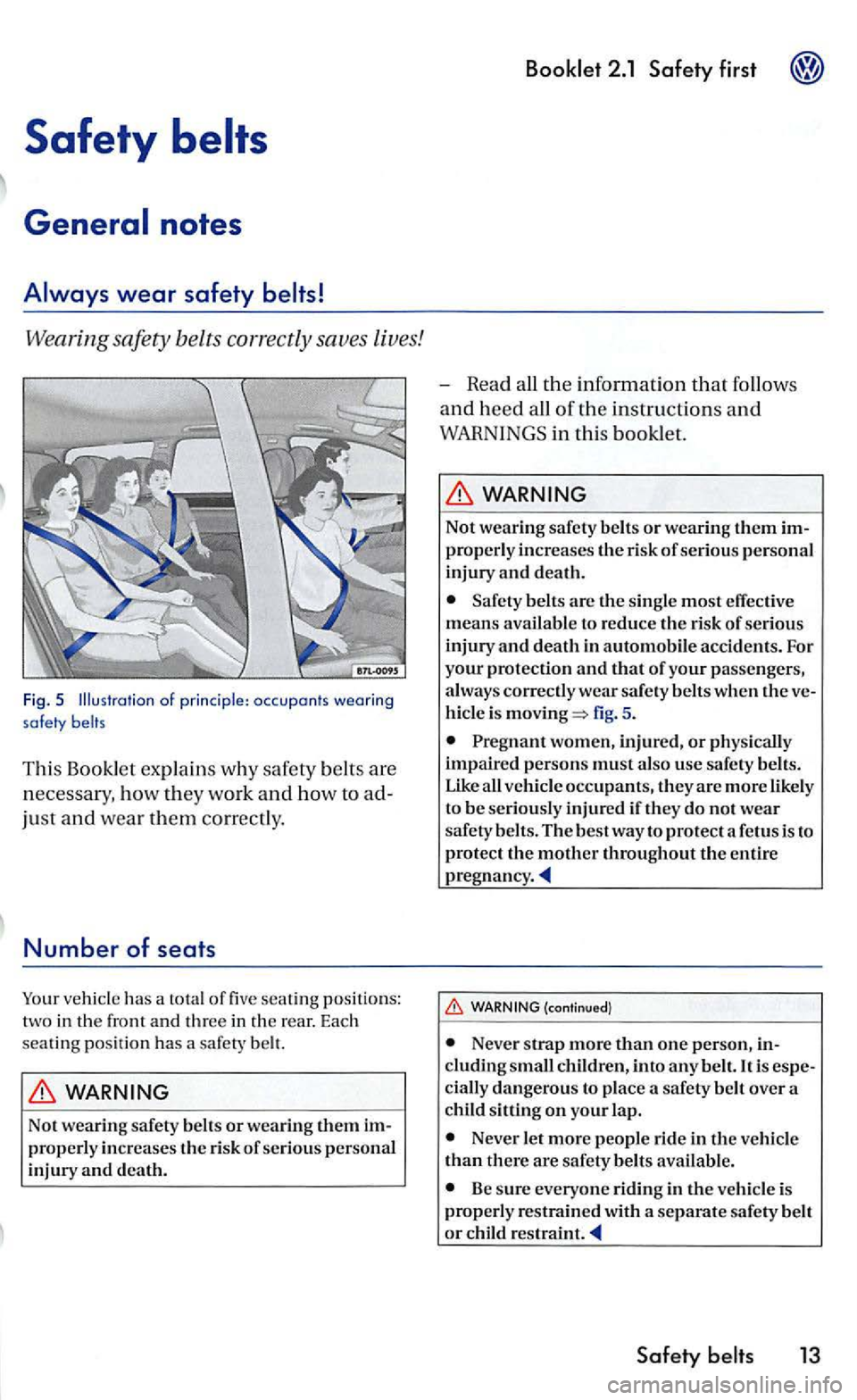
Wearing safety belts correctly saves lives!
Fig. 5 of principle: occu pants wearing safety belts
This Booklet expla in s w hy safety belt s are
necessa ry . how they work and how to
just and wear them correctly .
Number of seats
Your vehicl e has a total of five se ating position s:
two in t h e fron t and three in th e re ar. Eac h seating positio n has a sa fe ty belt.
WARNING
Not wearin g safety belts or wea ring them
- Read all the information that follows
and heed all of the instructio ns and
WARNINGS in thi s bookl et.
WARNING
No t wearing safety belt s o r wearing them properly increases the ris k of se rious pe rson al
injury and death.
Safety belts are th e s ingle most effective
means availa ble to reduce the risk of serious inju ry and death in automobile acciden ts . For your protection and that of your passengers,
a lways correctl y wear safety belts when the hicle is fig. 5 .
Pregnant women, injured, or physically
i mpaired person s must also use safety belts.
Like vehicl e occ upants, th ey are more like ly
to be se riously injured if th ey do not wear safety belts. The best way to protect a fetus is to protec t the mother throughout the entire
pregnancy
(continued !
Never strap more than one person, cluding cially dangerous to plac e a safety belt over a child sittin g on your lap.
Neve r let more people ride in the ve hicle than there are safety belts available.
B e sure everyo ne ridin g in the vehicl e is properl y res trained with a separate sa fety belt
o r chil d res train t
Safety