brake VOLKSWAGEN GOLF 2004 Workshop Manual
[x] Cancel search | Manufacturer: VOLKSWAGEN, Model Year: 2004, Model line: GOLF, Model: VOLKSWAGEN GOLF 2004Pages: 444, PDF Size: 92.7 MB
Page 294 of 444
Booklet 3.2 Tip s and Advice
vehicl e handles diff ere ntl y wh en towin g a
tr ai ler because of the additional weigh t and weight distribution. Safe ty, pe rform ance and econo m y will greatl y depend on how carefull y
yo u load your trailer and op erat e your rig.
Before you actually to w your trail er, p ractic e
turning. stopping and b ack ing up in an area away from traffic until learn the feel of your vehicle and trail er unit.
Backing
up i s diffi cult and requi res practi ce.
Stee rin g whil e backing up is gen erall y opposite of that when backin g your vehicl e with out a
trailer.
Keep
more distance between your vehicl e and the one in front of yo u. will need more room to stop.
To compensate for the trail er. you will need a
larger than normal turning radius.
When passing, remember that you cannot erate as fast as you normally would because of the added load. Make sure yo u have enough
room to pass. After passing. allow plenty of room for you r trailer before c hanging lanes again.
Avoid je rk y s tart s, sharp turn s or rapid lan e changes.
Parking
After parking. always block th e wheels of both ve hicl e and trail er. Do not park with a traile r on a slope. If it cannot be a voided, do so only after doing th e follo wing:
Apply fo ot brake .
Have someone place chocks under both hicl e and trail er whee ls .
With the c hock s in place, s lo w ly re lease brak es until wheel blo cks absorb the load.
Turn w heels to curb (ve hicl e facing downhill)
o r to the stre et (when facing uphill).
Appl y parkin g brak e firmly.
automatic transmi ssion in
If you move the selecto r leve r of the automatic tran smission to
position.
Restarting
When restarting after parkin g on a slop e, reverse
the proc edure:
S tart the engine.
S hift transmission into gear.
le a se the parking brake and slowly move away from the wheel block s.
Stop and hav e someone re trie ve the wheel
b lock s.
Note
Neve r to w trailer during the break-in period of your vehicl e.
If yo u tow a trailer , yo ur Volksw age n m ay quire more frequent maimenance due to the
ext ra load.
Always check local reg ulations regardi ng
trailer to w in g.
Applies to vehicles: with anti-theft a larm system and a traile r towing set
Linking your trailer to the vehicle's anti-theft alarm system
The anti-theft alarm syste m will be triggere d as soon as the ele ctrical connec tion
between the trailer
and
or qualified
wo rkshop, if you want to inte grat e your trai le r to th e ve hicle's anti-theft a larm
Connecting your trailer to the anti-theft alarm syste m
If yo u ve hicle was built to include both the th eft al arm system and a trailer towin g th en t he trail er towing package (if available) is
in tegrated into the anti-theft alarm sys te m . Thi s
18 Driving and protecting the environment
Page 295 of 444
is what you mus t do if you going to tow
Inse rt the trailer connector completely into the vehicle trailer socket.
Lock th e ve hicle with the remote key.
The trail er is now integ rat ed int o th e theft alarm system
For more information about the anti-theft alarm bookl et3. 1 chapter "Anti -theft Alarm
Disco nnecting your trailer from the anti-th eft
alarm system
Unlock th e vehicle with the remote key.
The anti-theft alarm sys tem is now ofT.
Note
Mod ify ing the electrical system improperly can cause expe nsive damage to the veh icle's trical sys tem. recommend yo u have your thorized Vol kswagen dealer o r qualified
driving sty le,
Co nditions of use (wea ther, road s urface) .
Technical conditions.
Think ahead when driving
A ve hicl e uses most fuel when accel erating. If
yo u think ahead when driving. you need to brake less and accelerate less. pos-
Regular servicing
B y having your vehicle serviced regularly by a authorized dealer you can es tabl is h the basis for a good fuel economy even you start drivin g. v iced e ngine give s yo u th e be nefit of better fuel
efficie ncy as well as maximum re liabilit y and greater resale value. B
y
adopting an economica l driv ing style and ticipat ing the traffic ahead, you can easily duce fuel consumption by Thi s section sug ges ts som e w ays to reduce th e impact on th e
e nvironment while reduci ng operatin g costs at
the same
s ibl e, let the vehicle roll slo wly to a stop. for
light is
A n engine that is no t properly maintained can usc up to 10% more f uel than necessary.
the oil level every time you get gas consumption dep ends la rgely on the e ngin e load and engine
Driving and protecting the environment 19
Page 298 of 444
you h ave accessories on your vehicle. ch eck
w ith the car operator befo re washin g yo ur
ve hicle. fo ld the outsid e mi rro rs to avoid damage.
Vehicl e paint is durabl e e no ugh that the ve hicl e
can normall y be washed without p rob le m s in on the pa int mainly depends on the type of car the brushes used. the filterin g oft he was h water,
and th e typ e of detergent s wax solutions used, e tc.lfthe paint is sc rat ch ed or dull go ing through the car wash, imme di ately bring thi s to the atten tion of the car ator.
t h e ve hicle has been wa sh e d, th e discs and pad s will be wet (th ey could eve n icy in the winte r) and stoppin g will be
Washing by hand
- F irst s often the dirt w ith water a nd rinse
off.
-
in a
wa rd motio n usin g ge ntl e pressure.
- Rin
se out the sponge or was h glove
specia l on ly on h ard
move dirt or gr im e.
-
a second s ponge or was h glove to
w ip e down th e wheel rim s an d under th e
door
- R inse the thoroughl y w ith
water.
- Dry the painte d surfac es
and protection
lo nger. the brakes with several care ful brak e applicatio ns befo re driv ing
WARNING
Wet brakes or brakes coated with icc or road salt react slow er and need longer stopping tances .
Carefully apply brakes for a test.
Always dry brakes and clean otT icc ings and salt coatings with a few cautious brake applications.
Alwa ys read and heed all power a nd braki ng
- When it is cold outside, m ake sure yo u
w
ipe rubbe r seals and th eir contact
faces dry so that they do not freeze. a
s
ilicone s p ray to keep rubber seals pliable.
- Afte r was
hing you r
first by gen tly
WARNING
W et or brakes co ated w ith icc or road
s a lt reac t s lower and need lo n ge r stopping tances.
apply brakes for test.
Alwa ys dry brakes and clean otT ice in gs and salt coatin gs with a few cautious brake applications.
Always read an d heed all t3, power a nd bra kin g dis-
Page 299 of 444
edges under the vehicl e can cut exposed
ski n.
Alway s protect your hands and arms from cuts on sharp m etal edges when clea ning th e underbody, the inside of th e wheel housin gs
etc.
Never try to remov e mud or dust if the vehicle dry . a dry cloth or
sponge fo r cleaning could damage th e paint or
3.2 Tip s and Advice
glass on your vehicle . dirt . mud or dust with plent y of wate r before removing it.
When rinsing the vehicle. do no t let water ge t
int o th e lock cylinders or point the hose at gaps
around the doors. hood or tail gate. The water could freeze and make it difficult to open the hicle.
To he lp preve nt damage to th e pai nt, do not was h the vehicle in direct sunl ight.
F o r th e sake of environment
To protect the environme nt. wash the vehicle
only in specia l was h bays that c an handle oily
d irt that is wash ed off th e car.
- Do nor use a power washer to remove
ic e
or snow page 25.
- Neve r use concentrated jet nozzles or
so-called
- After ve hicl e has been washed, the
brake
dis cs and pads will be we t (they
could even be icy in the win te r) and
th e brakes with seve ra l care ful brake
application s before drivin g page 13.
WARNING
brakes or bra kes coa ted with ice or road salt react slower and n eed longer stoppin g tances.
Ca re full y apply brake s for a test.
1
l ap plicab le
Always dry and cl ean off ice ings and salt coatings with a few cautious brake applicati ons.
Always rea d and heed all power and braking
WARNING
Improper usc of powe r was he rs ca n cause rious , in vis ible and perm an ent tire damage leading to tire failur e an d loss of ve hicle trol.
Never wa sh tire s wi th the water out in a direc t stream even at
temperature sh o uld not be more than F
If yo u use power wash e r. be sure to keep it a
sa fe d istance from the sors' > in the front and rear bumpers . you h old
it too to the sensors, you could damage
them.
and protection 23
Page 302 of 444
a soft cloth to re m ove dust and d irt
from
the rubber gaskets.
- Spray
rubber gaskets with silicone or
u
se another veh icle care product to kee p
them soft and p revent freez ing.
Locks
Lock cylinders can freeze up in winter.
To de-ice the door lock cylinder we recommend
using a sp e cia l spray to repl enish lubricatin g oils and pro vid e an ti- co rro sio n pro tect ion. Ask you r
authorized Volkswagen dea le r for ass istance.
ca n also use sp ecia l ch ro m e clea ner. cleaners will he lp remove surface grime and sta ins from chrome surface s.
an acid free dete rgent to clean the
w h
eels .
E very three months
- Apply a hard wax compound to the
w
heel s .
26
for rubber sea ls w ill also prevent pre mature aging and leaks. The doors will be easier to open. rubber seals are well maintained, they
will not freeze as easi ly in winter.
Note
The use of door lock de-icers contai ning grease
solvents can cause the lock cylinders to rust.
Note
To prevent scratching c hrome surface s:
Do not use an abrasive care prod uc t o n
chrome.
Do not clea n or polish chrome pa rts that are
dirty or dusty or clean or polis h them in a sandy or dusty environment.
Light alloy wheels require reg ular care to keep them look ing nice. is impor tant to remove
road salt and brake dust by regularly wash ing th e
wheels, other w ise th e finish will be hard to clean.
Always use
an acid-free detergent for alloy
w heels.
Do not use vehicle polish
or other abras ive prod
ucts. the protective coating is damaged, for example by stone im pact. the damaged area should be repaired immediately .
Page 303 of 444
Improper us e of power was hers can ca use riou s, invisib le and permane nt tir e damage leading to tire failure and los s of vehicle
Neve r wash tires with a jet that sprays the water out in a direct strea m eve n from a ta n ce or fo r a v ery sh ort time.
3.2 Tips and Advice
tances.
Carefull y apply brakes for a te st.
few cautious brake applicat ions.
A lwa ys read and heed all 13,
The underbody of the ve hicl e is coated to help prot ect it from corrosion and
damage.
The undercoat ing could be da m age d during
normal use but, particularly when dri vin g
road. recommend th at the undercoa ting un
th e ve hicle and the prot ective coat ings on th e
s u sp en sion be in sp ec te d, an d re paired if n eces
sary, bef o re and after the winter season.
R
epair wo rk and additio nal undercoating
s hou ld be carried out onl y by an a uth orized Volkswage n deale r or qualified workshop .
the engine compartment
The sys tem gets very ho t when the hicle is drive n and can cause fir e res ultin g in serious pe rso na l injury.
Neve r a ppl y additional undercoating or rust proofin g on or near the exl ta u st manifold,
exl ta ust pip es, catalytic conve rter or heat shie ld s.
Be especially carefu l w hen cleaning the engine compartment!
Anti-corrosion treotment
The engine compartment is treated at t h e page 39.
Good corro sion protection is pa rti cularl y impor
tant in th e w inter where road salt is used. To ve nt salt damage , th e en tir e e ng in e ment should be th orou ghly cleaned befor e and after th e salt ing perio d.
Your authorized
Volk swag en dealer has th e right cleane rs and prese rva tives and th e
ommend hav ing this w ork perform ed by an thorize d Volkswage n dea ler.
Corr osio n prot ection i s re mov ed when th e engin e compart m ent is cleaned with grea se
s ol ve nts. th e engin e is cleaned , m ake s
ur e th at corrosion protec
tion is app lied to surfaces, seams, jo in ts and co mponents in the
e n g in e compartment.
Plenum
Remove leaves from th e plenum in front of the w indshie ld unde r th e e ngin e hood. Hcmovi ng
l eaves and d ebris reg ularl y he lp s preve nt th e
wate r dr ain ho les from beco min g bloc ke d, and it
h elps to preve nt debris from gettin g in sid e th e
ve hicl e throu gh th e heati ng and ventilation ducts.
The en gin e compartment of any motor ve hicl e
is a potentially dangerous area and can cause seriou s perso nal injury .
Page 315 of 444
Booklet 3.2 Tips and Advice
be taken working on
(Automatic tran smissio n).
2. Apply th e parkin g brake firmly.
3. off the eng in e and remove the
k
ey f rom the ignition.
4. Wail
for the engine to cool down.
5. Keep chi ldren and othe rs away from the
ve hicle .
6.
the e ngin e hood.
All serv ice fluids. sp ark plugs . batteri es etc. are
constantly being develo ped and improved. kept up-to-da te
by the manufactur er. For thi s reaso n mend that you have these replaced by an rized Volkswage n dealer. A lways read the notes
b elow . Th e e ngin e or any motor vehicle is a hazardous
WARNING
E ngine
fo rni a cause cancer and birth defec ts and reproduc tive harm. In additio n, certain fluid s
containe d in vehicl es and cerlain products of component wea r co ntain or emit ch e m ica ls
kn ow n to th e to ca use
ca ncer a nd birth defect s o r o th er r eproductive
h arm.
Ba ttery pos ts,
th e of to
(continued)
cause ca ncer and reproductive harm. hands after handling.
WARNING
T he e ng in e comparlmenl of any m olo rvc hicl c
is a polcnli ally dangero us area ca n ca use seriou s pe rso nal inju ry.
Alwa ys use extreme ca ution when doin g
any work in he e ng in e compartment. Always
follow commonl y acce pled p rac tice s and usc common se nse. Neve r risk perso nal
injury.
Never perform any work in the e ng in e
compartment unless you know exactl y how to
ca rry ou t th e job
ni cal info rm ation and th e correcltools ! you arc uncerla in w hat to have the wo rk
p erformed by an aulhorized Volkswage n
d ealer or works hop. Se rious
form ed work.
Neve r o pe n the engine hood if you see stea m or coola nl escap in g fro m the en g in e comparrment. I-Iots team orcoolanl ca n cause serious burns. Alw ays wait until yo u no longe r sec or hear stea m or coolant escap ing fro m the engine.
Alwa ys le t th e en g in e cool do wn pl ete ly before care full y opening the engine
h ood. I-lo t compone nt s will burn sk in on tacl.
th e e ng in e has coo le d down and you
selecto r mati c transmi ssio n).
- Rem ove th e k
ey from the ign ition.
- K
eep children and others away from
Page 316 of 444
WARNING (continued)
Never reach into the area around or tou ch the radiator fan. Contact w ith the blade s can resuh in se riou s personal injury. Always m ember that the radiator fan is controll ed and can turn on
m oved from the ignit ion.
Never unscrew the coolant expa nsio n tank cap when th e engin e is hot. A hot engine will heat the coo la nt and put it under pressure . mov in g a cap that i s under pressure ca n rcsuh in seriou s personal injury and/or burns.
A lway s prote ct face, hand s and arms from hot esca ping coolant or steam b y cove ring the ca p with a large, thick rag.
Turn the cap slow ly a nd very carefully in a
counter- clo ckw ise direction whil e applying
light downward pressure on the top of the cap.
Never spill on hot engine parts o r hot
e xhau st sys te m . S pilled
Neve r short-circuitthc elec trica l sys te m ,
es peciall y w here th e jumper cabl es are tached -th e balleri es could explode!
Neve r leave any objects in the e ngine partment, for exam ple cleaning rag s and too ls. Objects
Neve r work unde r the veh ic le unless you
h ave safely secured th e ve hicl e from movin g.
I f yo u must work under th e ve hicl e wit h th e
w hee ls on th e ground, always make sure the vehicl e is on leve l ground, th e wh eels arc
b locked from movin g and th e key is not in the
ignition.
Always support your ve hicle with safety
s tands if you have to wo rk underneath it. The
ja ck suppli ed with the ve hicle is not s tron g enough for this purpose and can co llap se causin g se riou s personal injury.
If you have to perform a check or r ep a ir
w hen th e e ngine is running, there arc more
ri sks from
the ro tating parts, such as the drive
WARNING (con tinued)
Neve r to uch the e lec tr ica l w ir in g of the ig ni tio n sys tem.
Always make sure that j ewe lry, loose clothing and lo ng hair do not get caught in
rota ting engine pans. Before startin g any work remove jewelry, tie back and cover
hair, and do not wear clothing that can hang down and get caught in mov ing gin e parts.
Always use extre me cauti on if the erator pedal has to be depresse d to perform
a ch eck. The vehicle could move suddenly, eve n if the parking brake is applied.
If wor k on the fu el sys te m or th e electrica l
syste m is necessa ry:
Always discon nect th e balleries. Make
sure th e vehicle is unlo cked when
Neve r sm oke .
Neve r work nea r heaters, wa te r h eaters of other open names .
A lways have an approve d fire ext guis her nearby.
To avo id electrical shock and personal jury w hil e the eng ine is running or being
s tarted :
n ever touch ignition cables,
never to uch othe r component s of the
high vohage electronic ignition syste m,
never touch the gas discharged (Xeno n) headlights wiring.
Note
Whe n chang ing or topp ing orr service fluids. make absolutel y ce rtain that you fill the fluid s
into the corr ect reservoirs. Using incorrec t fluids will resuh in serious malf unct ions and engine
damage!
For the sake of environment
Service fluid leaks are harmful to the environ-
ment. Reg ularl y check the ground undernea th
your vehicle . you find spots of oil or other
fluids. have your vehic le checked by your rized dealer or a qualified
Page 324 of 444
Booklet 3.2 Tips and Advice
functional problem s or engine damage could be caused
Warning temperature
The warning symbol lights up if the coolant temperatur e is too high or if the
coolant level is too
Low.
Ther e is a fault if:
The wa rnin g symbol does not go out aga in afte r a few seconds.
The wa rnin g symbol light s up or flas hes whil e the vehicle is moving. Three warning s
This means th at eith er th e coolant leve l is too low or the coo lant temperature is too high.
Th ere may be a m essage in the i
nstrument
clu ste r inf orming you or advi sing you of th e
Coolant temperature too high
Fir st look at the coolan t tempe rature gau ge. The coolant temperature is too hi gh if th e need le is
o ver to th e fa r right on the dial. the vehicle,
switc h the engine wait for it to cool down. the coo lant level.
I f th e coo lant level is co rrect, th e over heating may be caused by a radia tor fan fault. the ra diator fan fuse and have it replaced if page
If th e wa rnin g light lights up again after driving
o n for short distan ce, stop the vehicle switch otT th e e ngine. an authorized Volkswagen dea le r or a qu alified worksh op.
when towing a trailer
If you have to c limb a lo ng g rad e w ith high temperatures in low gea r at high gin e ture booklet 3. 1 and If th e
w arning light in th e in st rument cluster flas hes, stop and a llo w the e ngine to coo l down
48 Checking and Filling
for minutes at idl e. For more inform ation 15.
alw ays read and heed all
Hot steam or coolant ca n cause seriou s burns.
Neve r open the engine hood if you see steam or coolant escaping from the engine compartment. Always wait until you no longe r see or hear steam or coolant escaping from the
e n gine.
Always let the engine to cool down pl ete ly before carefully opening the engin e hood. Hot components will burn tact.
When the engine has coo led down and you are ready to open the engine hood:
-
move the key f rom the ignitio n.
- Appl y
the parking brake firmly and put the selector in ( Park, automatic mission) or Neutral (manual
Never reach into the area around or tou ch
th e rad iator fan. with the blades ca n
re sult in serio us personal injury.
remembe r th at the radiator fan is temperature-controlled and can turn on
fo r a longer p eriod of tim e and the
key has been r emoved fro m the ig nition.
Never unscrew the coola nt expansion tank cap when the e ngin e is hot. A hot engine will
Page 329 of 444
drive if you have clear vis io n through all the windows.
A defect ive or d irt y w iper blade can scratch
t h e rear glass.
Never clean gla ss panel with fuel. nail polish remove r, p aint thinn er o r similar flu ids.
Thi s ca n damage th e w iper bla d es.
Never move the w iper or the wiper arm your hand can dam age it.
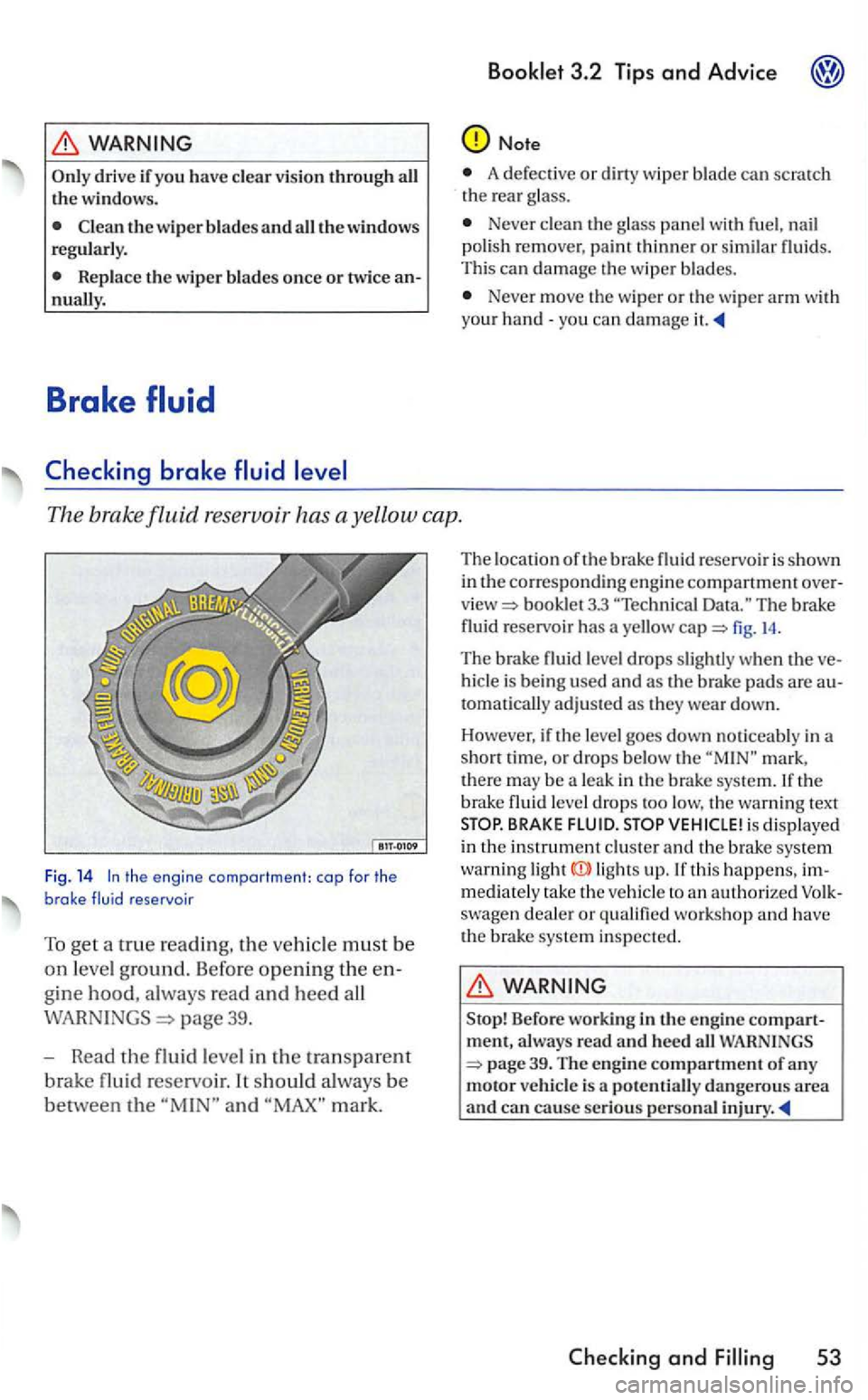
The brak e fluid reservoir has a ye llow cap.
Fig. 14 the engine compartment: cap for the brake fluid reservoir
To get a true reading, the m ust b e
on leve l ground. Before opening th e en
g
ine hood, a lways read and heed all
page 39.
- Read
the fluid leve l in the tra nsparent
bra ke fluid re servoir. It should always be
between the and mark.
Th e lo cation of th e brake fluid reservoi r is shown
in
bookl et 3.3 The brake
fluid reservoir has a yello w fig. 14 .
The brake fluid lev el drops s lightl y when th e ve
hicl e is bein g used and a s th e brake pad s are autom atically adju sted a s they wear down.
Ho wev
er, if th e le ve l goes down noticeably in a
s ho rt time, or drops below th e mark ,
th ere may be a leak in the brake system. If the b rake fluid leve l d rops too low, the wa rnin g text BRAKE FLUID. is displayed
in the instrument clu ste r and th e b rake system warni ng ligh ts up. If t his happens, immediately rake th e ve hicle to an au thorize d swage n deale r or q ualifi ed wo rkshop a nd have
th e brake system inspected.
Stop! Before wo rkin g in th e engin e compartment, a lways read and heed all WARNINGS
53