wheel VOLKSWAGEN GOLF 2004 Repair Manual
[x] Cancel search | Manufacturer: VOLKSWAGEN, Model Year: 2004, Model line: GOLF, Model: VOLKSWAGEN GOLF 2004Pages: 444, PDF Size: 92.7 MB
Page 339 of 444
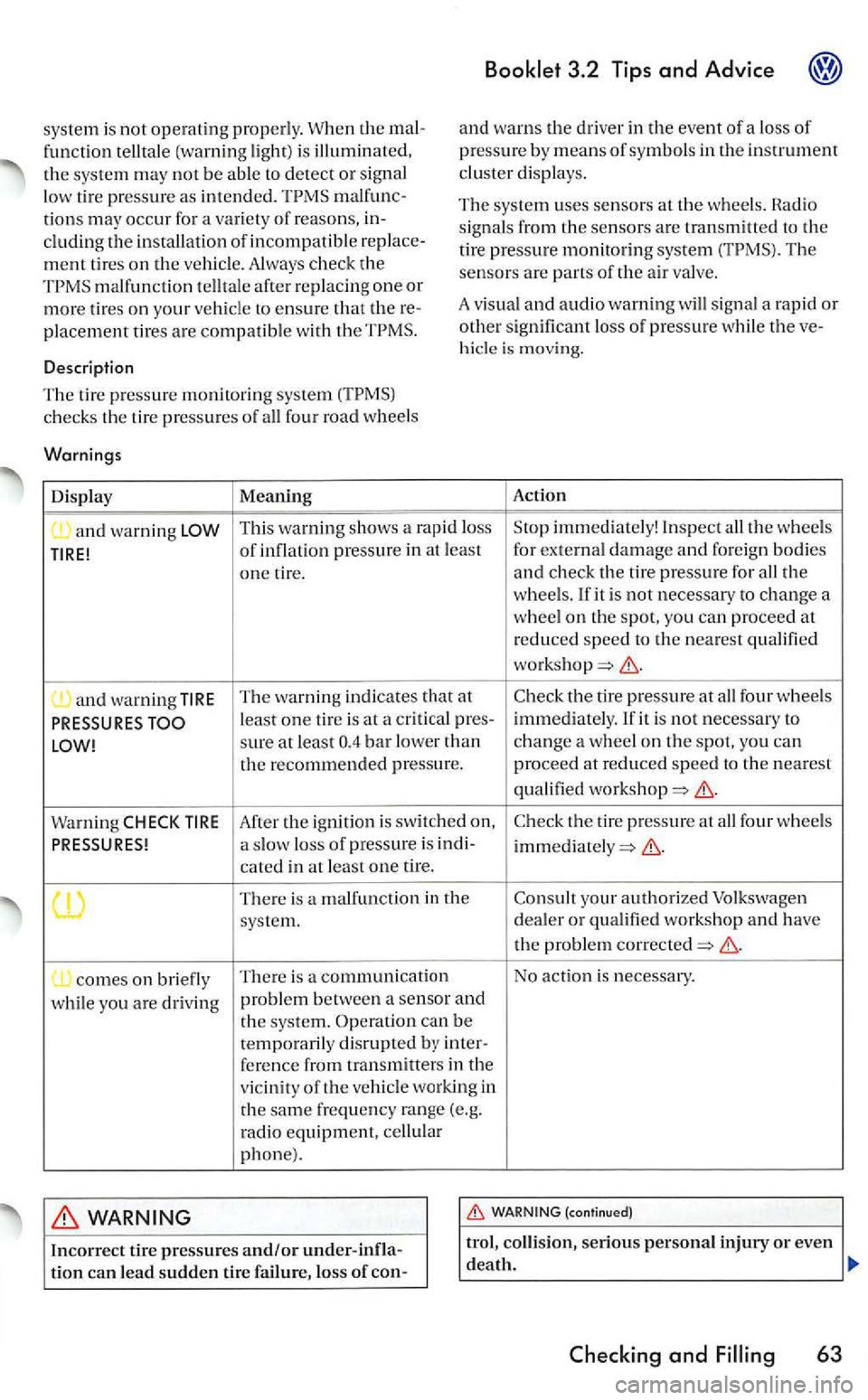
syste m is not operating properly. When the malfunct ion telltale (warning light) is illuminat ed, the system may not be able to detect or signal
low tire pressure as intended. malfunc
tions may occur for a var iety of reasons, including the installation of incompatible replacement tires on the vehicle. Always check the
and warns the driver in the event of a lo ss of pressu re by means of symbols in the instrument cluster dis plays.
Descri
ption
The system uses sensors at th e whee ls . Rad io
signals from the sensors are transmitted to the tire pressure monitoring system Th e sensors are parts of the air valve.
A visua l
and audio warning will signal a rapid or other significant loss of pressure while the ve
hicle is moving .
The tir e pressure monitorin g system
This warning shows a rapid loss Stop immediately! Inspect all the wheels
T
IRE! of i nflation pressure in at least for e
xt ernal damage and for eign bodies
one tire. and check the tire pressure for all the wheels. If it is not necessary to change a
w heel on th e spot, you can proceed at reduced speed the nearest qualified
and warnin g TIRE The warn ing indicates that at Chec
k the tire pressure at all fou r whee ls leas t one tire is at a criti ca l pres- immediately. If it is not necessary to sure at least
Warning CHECK TIRE After the ig n it ion is switched Check the tire pressure at all fou r wheels a slow loss of pressure is indi-
There is a malfunct ion in the Consult your a uthorized Volkswagen
system. dealer or qualified workshop and have
the p ro ble m corrected
comes on briefly There is a communica tion No action i
s necessaty.
while you are
driving problem between a sensor and the system. Operation can be temporarily di srupted by inter-
f ere nce from transmitters in the
v icinity of the vehicl e working in
t h e same frequency range (e.g.
rad io equipment, cell ula r phone).
WARNING
Checking and 63
Page 340 of 444
the instrument cluster, stop and insp ec t th e
tir es.
can also lead t o sudden tire failur e, in
cluding a blowout and sudden deflati on, causing loss of ve hicle control.
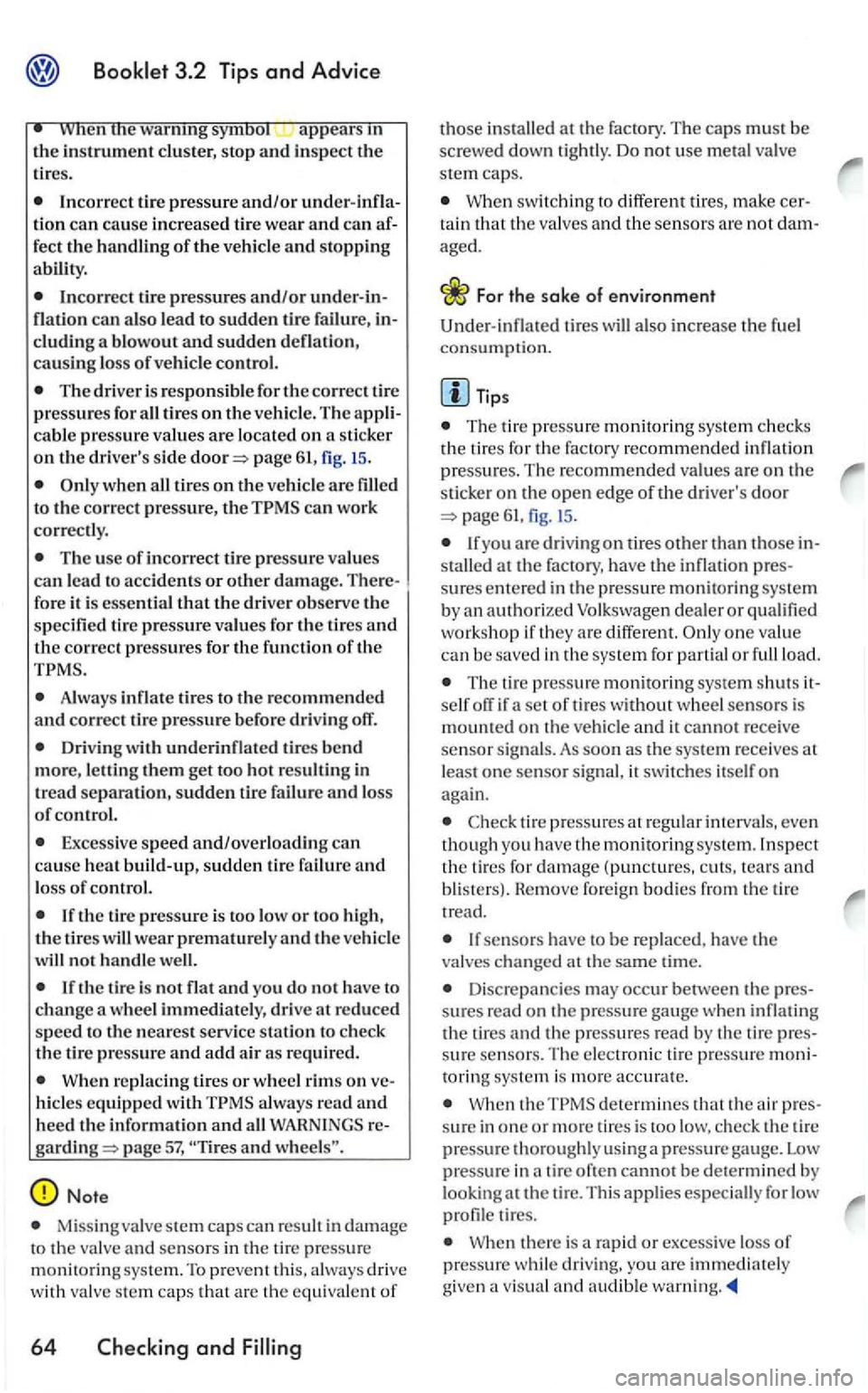
The driv er i s responsible for the correct tire pressures fo r all tire s on the vehicl e. Th e appli
cable pressure valu es are locat ed on a sticker on the driver' s sid e page 61, fig . 15 .
w hen all on the ve hicl e are filled
to the correct pressure, th e can work
corre ctly.
A lways inflat e tire s to the recomme nd ed
and correct tire pres sure before driving off.
in tread separa tion, sudden
Excess ive speed and/overloadin g can
ca use heat build-up , sudden tir e failur e and lo ss of control.
If th e tire is no t flat and you do not have to change a w hee l immediate ly , drive at reduce d
s peed to tJ1e neares t se rvic e statio n to ch ec k the tir e press ure and add air as req uired.
Whe n r epl acing tir es or wheel rim s on ve
hicles equipped with always read and heed the information and all repage 57, and
Note
M iss in g va lve stem caps can result in damage
to the valve and senso rs in the tire pressure
monitor ing sys tem. To preve nt thi s. a lways drive
wit h valve stem caps that are th e equiva le nt of
64
tho se installed
When switc hin g to diff erent tires, make cer
tain that the valves and the se nsors are not dam
ag ed .
For the sake of environment
Unde r-inflated tires will a lso in crease the fu el
consumption.
Tips
The tir e press ure mon itoring system ch ecks
th e tir es for the fac to ry recommend ed in flat ion pressures. The recommended val ues are on th e sticker on the o pen edge of th e driver's door
61, fig.
you are driving on tires other than those in
s talled at th e factory, have the inflati on pres
s ure s entered in the press ure monitor ing sys tem
by an authorized Vol kswage n dea ler or qua lified
works hop if they are different.
Th e tire pressure monitor ing system sh uts itself off if a set of tir es without whee l sensors is
mounted on th e veh icle and it cannot receive senso r sig nals. As soon as the syste m rece ives at
lea st one se nsor signa l, it switches itself on
again.
tir e pressures at regu lar int ervals, even
though you have the monitoring system. In spec t
th e
tires for damage (punctu res , cuts, t ea rs a nd
blis ter s). He move foreig n bodi es from the tir e
tread.
senso rs have to be rep laced, have the valves ch anged at th e sa me tim e.
Disc repancies may occur between the pres
sures read on the press ure ga uge when inflating the tires and th e pressures read by the tire pressu re sensors. The electro nic tire pressure monitoring system is m ore accurate.
When deter min es tha t the air pres
s u re in o ne or more tires is too low, ch eck the tire
pressure thoroughly using a pressu re Low pressure in a tire often cannot be determi ned by
looking at the tire. This applies especially for low
profile tires.
When there is a rap id or excessi ve loss of pressure while driving. you are immediately
g iven vis u a l and aud ible warn ing .
Page 341 of 444
to the USA models
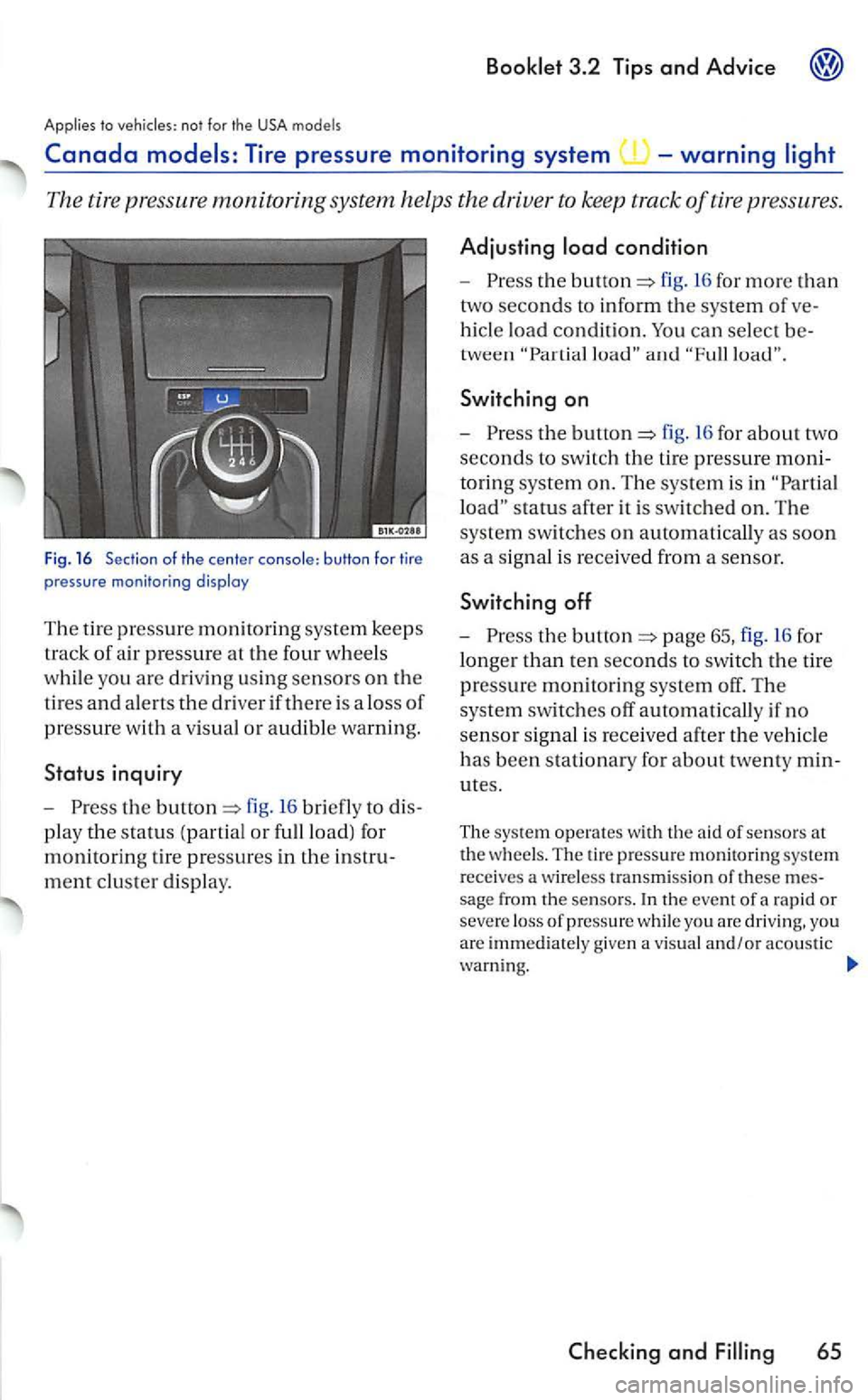
The tire pressure monitoring system helps the driver to keep track of tire pressures.
Fig. 16 Section of the center console: button for tire
p ressure monitoring disploy
T he tir e pressure monitoring system keep s
track
of air pressure at the four wheels
w hil e yo u
are driving using sen so rs on th e
tir
es and alerts the dri ver if th ere is a lo ss of
pressure with a visual or audibl e warning.
Status inquiry
-
play the status (partial or full load) for
m
onito ring tir e press ures in the
ment clu ster display.
Adjusting
the fig. 16 for more than
two seconds to inform th e system of
hicle load condition.
Switching on
-the fig. 16 for about two
seconds to switch the tire press ure
tori ng syste m on. The system is in
after it is switched o n. The
system
switches on autom atic ally as soon
as a sig nal is receive d from a sensor.
Switching off
-page 65, fig. 16 for
lo nger than te n seconds to switch th e ti re
pressure monito ring system off. The
system switches off automatically if no
sensor sig na l i s received aft e r th e vehicle
has been statio nary for about twenty
th e a id of se nso rs at t h e w heels . The tir e pressure monitoring syste m
rece ives a wireless transmissio n of these sage from the senso rs. In the event of a rapid or severe loss of pressu re wh ile yo u are driving, you are immediately given a visual and/or acoust ic
warning .
65
Page 342 of 444
3.2 Tips and Advice
Displays in the instrument
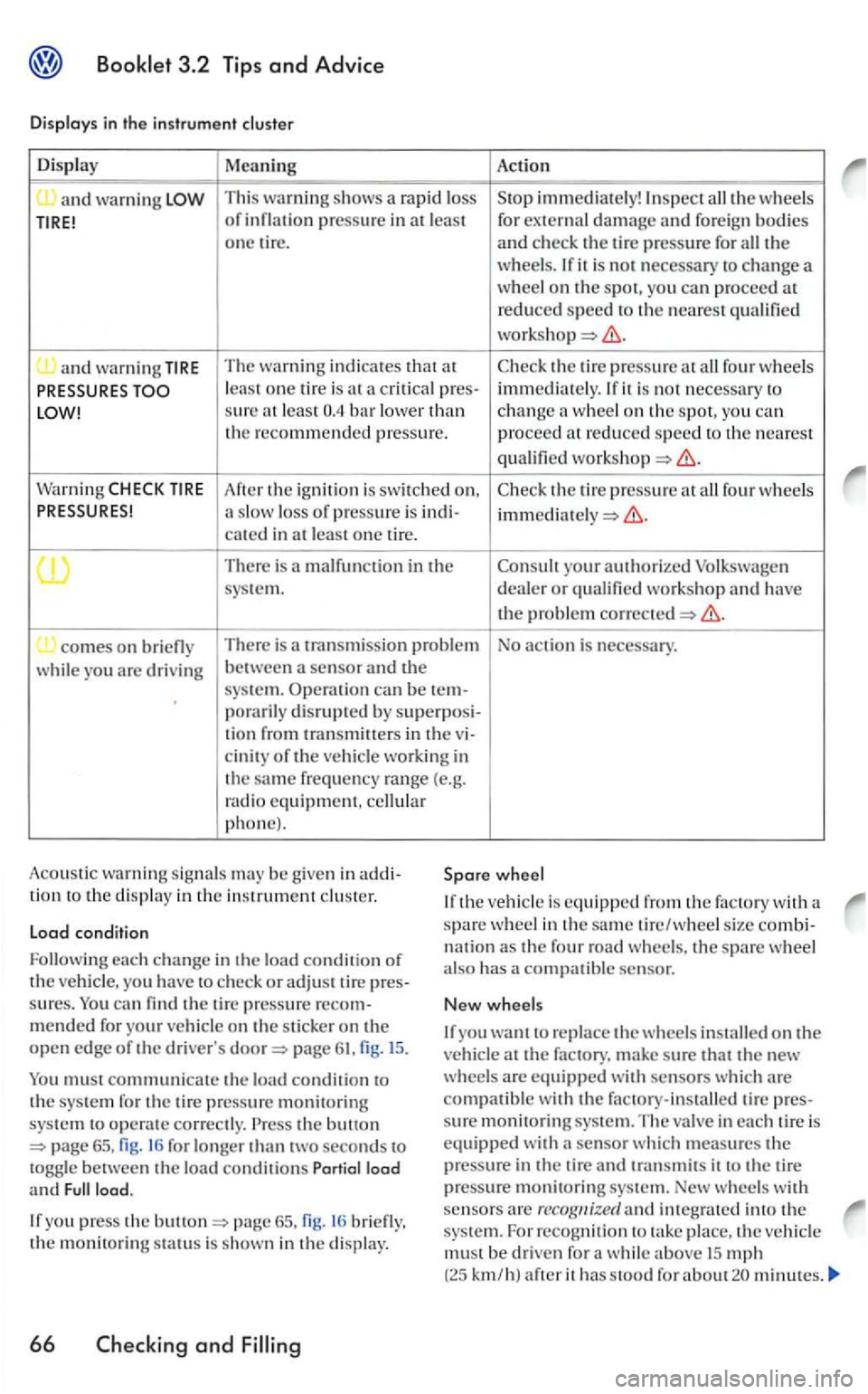
Display Meaning Act io n -and warni ng T hi s warning shows a rapid loss immediately! In spect the wheels of p ressure in least for external damage and for eign bodies
o ne tir e. and check th e tire pressure for th e wheels. If it is not necessary to change a wheel on the spot, you pro ceed at
reduced s p e ed to the nea re st
and warnin g TIRE The warning ind ic a tes that at Check th e tire pressure at four wheels
sure at least
Warn ing After the ignition is switched on. Check th e tire pressure at four wheels a slow loss of pressure is in di-ca tcd in at le a st one tire.
T here is a malfunction in the your authorized Volkswagen
sys tem. dealer o r
comes o n
disrupted by superposi-
tion from transmi tters in the
the same frequency range (e.g.
rad io equipment. phone).
Load condition
Followi ng
each change in th e load conditio n of
th e yo u have check or adjust tir e sure s. can
page
mus t communicate th e load condition to the sys te m for the tire pressure monitoring system to operat e correctly. the bullon 16 for lo nger th an two seconds to
If you press the bullon briefly. th e monitoring status is shown in the display.
66
wheel
If the vehicle is equipped the fac tory with a
spare wheel in th e same tire /wheel s ize
you re place the w heels o n the at the factory. make sure that the new
w heels are equipped with se nsors whic h are compatible with the factory-installe d tire sure monitoring sys te m. The val ve in each tire is equipped with
mus t be dri ven for a while above mph (25 km/h ) after it has s tood fo r about
Page 343 of 444
you are using tires w ith inflatio n
p ressures than those recommended by the tory, the tir e press ure val ues must be re programmed. swagen dealer or q ualified workshop.
you mount wheels whic h d o not have sen sors or have incompatible sensors . th e sys tem cannot recognize the wheel s. The tir e pressure monitoring sys te m is not abl e to measure infla
tion press ure. A malfun ction is di sp la ye d.
S t
oring tires
T he se nsors se nd signa ls to t h e tir e press ure
monitori ng sys te m only whi le you arc driv ing .
D eclaration of complianc e
Siemens declares that the product is in full c onfo rmit y w ith the essential requi rements and the other re levant prov i
sio ns of directi ve 19 99/5/EG.
WARNING
In correc t tire pressures and/or unde r- inflati o n can lead t o
an d can
Incorrect t ire p ressures and/o r under-i n
flatio n ca n also lead to sudden tir e failure, bl owout and sudden d eflati on, causing loss of ve hicl e control.
Always make sure that a ll tires are properl y
inflat ed t o tire press ures fo r th e tires o n
t h e vehicl e and the kind of driv in g yo u plan to
do.
WARNING
The d rive r is responsib le for the correct tire
press ures for all tires on th e ve hicle. The cable pressure values arc loc ate d on sticke r
o n the dri ver's sid e page 61.
correctly.
The use of in correct tire pressure values can lead to acci den ts or other damage. There
f o re it i s esse ntial that the d river observe the
s p ecified tire p ressure va lues fo r the tires an d
Booklet 3.2 Tips and Advice
WARNI NG (continued)
the correc t pressures fo r the functi on of the
W hen the
the ti re is not flat and you do no t have to
c h an ge a w heel immed ia tely, drive
required fig. 15.
WARNING
Incorrect tire pressure can result in sudde n
t ire failur e loss of control, co llisio n, seri ous
personal i njury an d even death.
A lways in flat e tires to the recommended and correct tire pressure before dri ving
D rivi ng with unde rinfl atc d ti res b end m ore, le ttin g them get too h o t res ulting in tread sep aration, sudden tire failure and loss
o f co ntrol .
Exces sive speed and/ overloading can cause heat build-up , sudden tire fa ilure a nd
l oss of control.
not handl e we ll.
Missin g valve ste m caps can resu lt in damage to th e va lve and sensor s in the tire pressure mon itorin g sys te m. To pre vent t his, alwa ys dri ve
with valve stem caps that are the equi valent of th ose insta lled va lve
s te m caps.
Whe n switc hin g to t a in that the va lve s and the sensors not aged.
For the sake of environment
Low tire pressures also increase fuel consump
tion.
The tire pressu re monitoring syste m checks
th e tires for the fac tory recommend ed inflation
Page 344 of 444
3.2 Tips and Advice
pressures. The recommended values are on the
s ticker on th e open edge of the driver's door 61, fig. 1 5 .
yo u are driving on tire s other than those in
s tall ed at the factory, have the inflation pres
sures entered in the pressure monito rin g sys te m by a Volk sw agen Serv ice® fac ilit y if they are dif
ferent . O nl y one va lue can be save d in the syste m for partial or full load.
The tire pressure monitoring sys te m shuts itself off if a se t of tire s w ithout wheel sensors is mounted on the vehicle and it cannot receive sensor s ignal s. As soon as th e sys te m recei ve s at
tir e press ures at regular interva ls. even though yo u have the monitoring sys te m. Inspect the tire s for damage (punctures. cuts. tears and blister s). Remove foreign bodies from the tire
tread .
sensors have to be repla ced. have the valve s changed at the same time.
Discre pancies may occur betwee n th e pres
sures read on the pressure gauge when inflating the tires and the pressure s read b y the tire pres
sure sensors. The e lectroni c tire pressu re moni
torin g sys te m is more accurate.
The corr ect tire pressure for the tires originally installed on your vehicle is Liste d on
th e tire pr
essure label on the open edge of the driver's door.
The recommended tire pressure s arc on the tire
pres sure lab el and in the page 6 1, T hi s means that the pressure must be c hecke d and adjusted w hen tire has not been driven for more t han a couple of miles (k ilometers ) at low speeds during the previo us three hours. Air in the tires
expands when the tire heat s up as a result of in
ternal friction as it flexes in use. The tire pressure is high er w he n the tir e has war med up than when it is
tir e that counts. There for e, you should nev er le t a ir out of
a warm tir e to matc h p a ge 61. The tire s
would the n be underinflatcd and could fail sud
denly.
The tir e pressure la b e l o n your Volkswagen lists the recommended co ld tire inflation pressures for the new, orig in al equipment tires we re on yo ur ve hicl e at the tim e it was m anufa ctured.
For the location of the page 61, fig . 15 .
Most tir
es lose air naturally over time. They can
also lose some air if you drive ove r a pothole or h it a c urb whil e pa rking. is usually not possible
t o see w hether the radia l tires u se d today are un
derinflated jus t b y looki ng at them.
Therefore, be sure to check tire pressur es at least once a month and always be for e goin g on a lo ng
68 Checking and
trip. Mak e sure to ta ke the numbe r of p eople and the amount of lu ggage into ac count whe n ad justing tire pressure for a trip -eve n one that you wou ld not consider to b e page and ve hicle load for more important information.
Vehicles that h ave full hub caps have va lve ex
t ende rs in stead of dust caps. To ch ec k tire pressure or add ai r. yo u do not need to remove the
extender. Be sure to re in stall v a lve dus t cap s
aft er checkin g or adjustin g tir e pressure.
A lways use an
accurate tire pressure gauge whe n manually c hecking and adju sting inflatio n pres -sures.
let air our of the tire slowly with the edge of the tir e and keep checkin g the pressure until you rea ch the pressure that is correct for the load (passenge rs
and lu gga ge) and kind of dri vin g yo u pla n to do.
th e pressure in an y tire is to o low, no te the dif
fere nce be tween the pressure in the co ld tir e and the pressure you need and add the air that yo u
need to r e ac h the correc t p res sure for the ve hicle
lo ad (passengers and luggage) for the tires on
your ve hicle as listed on the on your ve hicl e and in thi s manual and th e kind of dri vin g yo u plan
Page 348 of 444
3.2 Tip s and Advice
Tire service
The serv ice life of tires depends on a lot of different things including proper
lation and balancing, correct tire pressure and driving style.
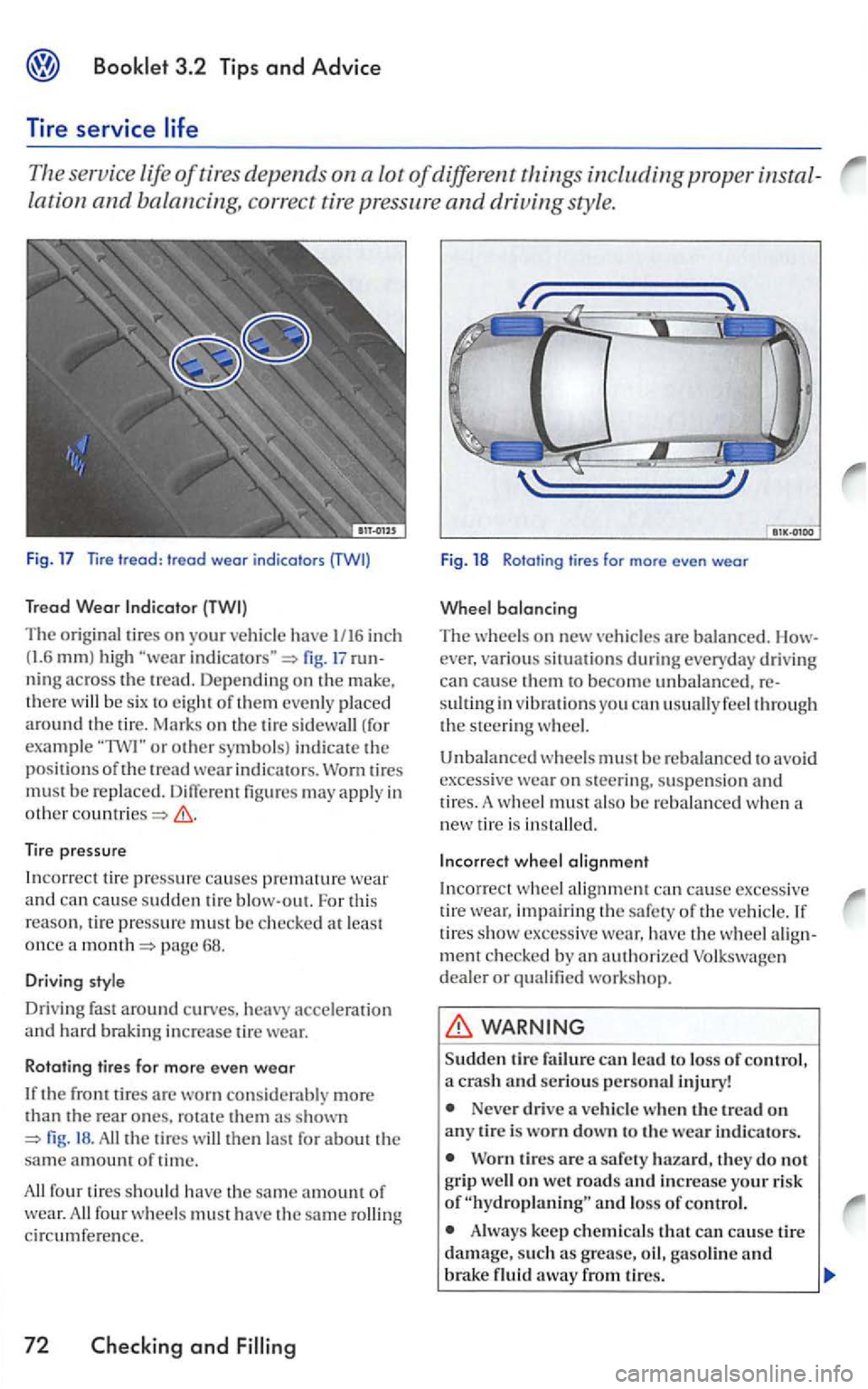
Fig. 17 Tire tread : tread wear indicators (TWI)
T re ad
Wear Indicator {T W I)
The original tires on your ve hicle have 1/16 inch
(1.6 mm) high fig . 17 ning across the tread. Dependi ng on the m ake, there will be six to eight o f them evenly placed around th e tire.
he tread
Tir e press ure
In correct tire pressure cau ses premature wear and ca n cause sudden tire blow-out. For this
reason , tire pressure must be c h ecke d at least once a page 68.
D riving style
Driving fast around curve s, heavy acceleration and hard braki ng increase tire
Rota ting tires for m ore even wear
If the front tires arc worn considerably more than the rear ones. rotate them shown 18 . All the tires will then last for about the same amount of time.
A
ll four tires should h ave the same amount of wear. All four w heels mus t have th e same ro llin g
circumference.
72
Fig_ 18 Rotat ing tires for more even wear
Wheel balanci ng
The wheels on new vehicles are balanced. I lowvario us s ituation s during everyday driv ing can cause them to become unbalanced, re
s u lting in vibrations you can usu ally feel through
t h e stee ring wheel.
tire wea r. impairin g the safe ty of the ve hicl e. tires show excess ive wea r. have the w heel a lig n-
m ent checke d by Volkswagen
d ealer or qualified works ho p.
Sudden tire failu re
Never drive ve hicle when
Worn tires safety
and loss of comrol.
Always keep chemical s that can cause tire
damage, s u ch as grease,
Page 349 of 444
(continued)
T ires age even if they arc not being used
and can f ail suddenly, especially at high
s peeds. Tire s that are more than 6 years old can only be used in an emerge ncy and then special care and at lo we r speeds.
(continued)
Never mount used tires on yo ur ve hicle if yo u are not sure of their used tir es may have been damaged eve n though the damage cannot be seen that can lead to sudden tire fa ilure and loss of vehicl e control.
Ne w tires and wheels have to be broke n in.
Ratio of height to width (aspect ratio)
of tire - Load
index &
speed rating
in
hicle's design
. The tires and rim s approved by Volk swagen are specially matched to th e te ristics of th e ve hicl e and can make a major comribution to good road ho ldin g and safe
We recommend that all wo rk on tires and wheels be performed by an authorized Volkswage n dealer. They arc famil iar with recommended procedures and have the sp ecial tools
and spare pa rts as well as the proper facilit ies for disposing of the old tires .
Author ized Volkswage n dealers have
the sary info rmation about technical requirements for installing or changin g tires and rims.
R
eplacing tires and wheels
Tires should b e replaced at lea st in pairs and not
individuall y (fo r example both front !ires or
ve hicle with read and heed th e page 75,
Page 350 of 444
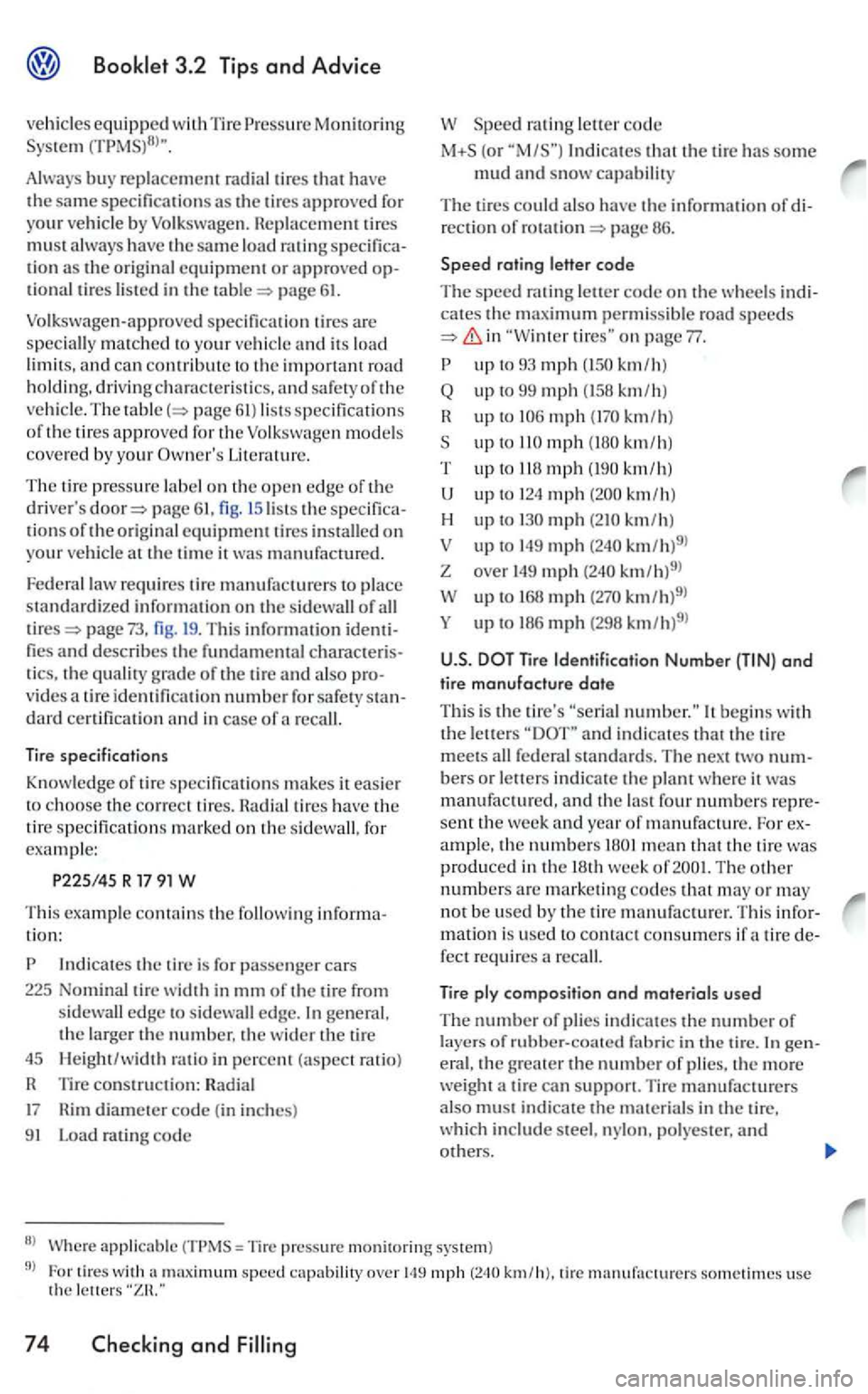
eq uipped with Tire Monitoring
Always buy replacement rad ia l tires that have the same s p ecifica tions as the tires approved for your by
th e original equipment or approved optional tires listed in the page
and its load
limits, and can contribute t o the important road holding, driv ing characteris tics. and safety of the vehi cle. The page 6 1) lists specifications of t h e tires approve d for the Literature.
T he tir e pressure label on the open edge of th e driver's page fig. 15lis ts the s pecifications of the o riginal equipment tires installed o n your ve hicl e at the time it was manufactured.
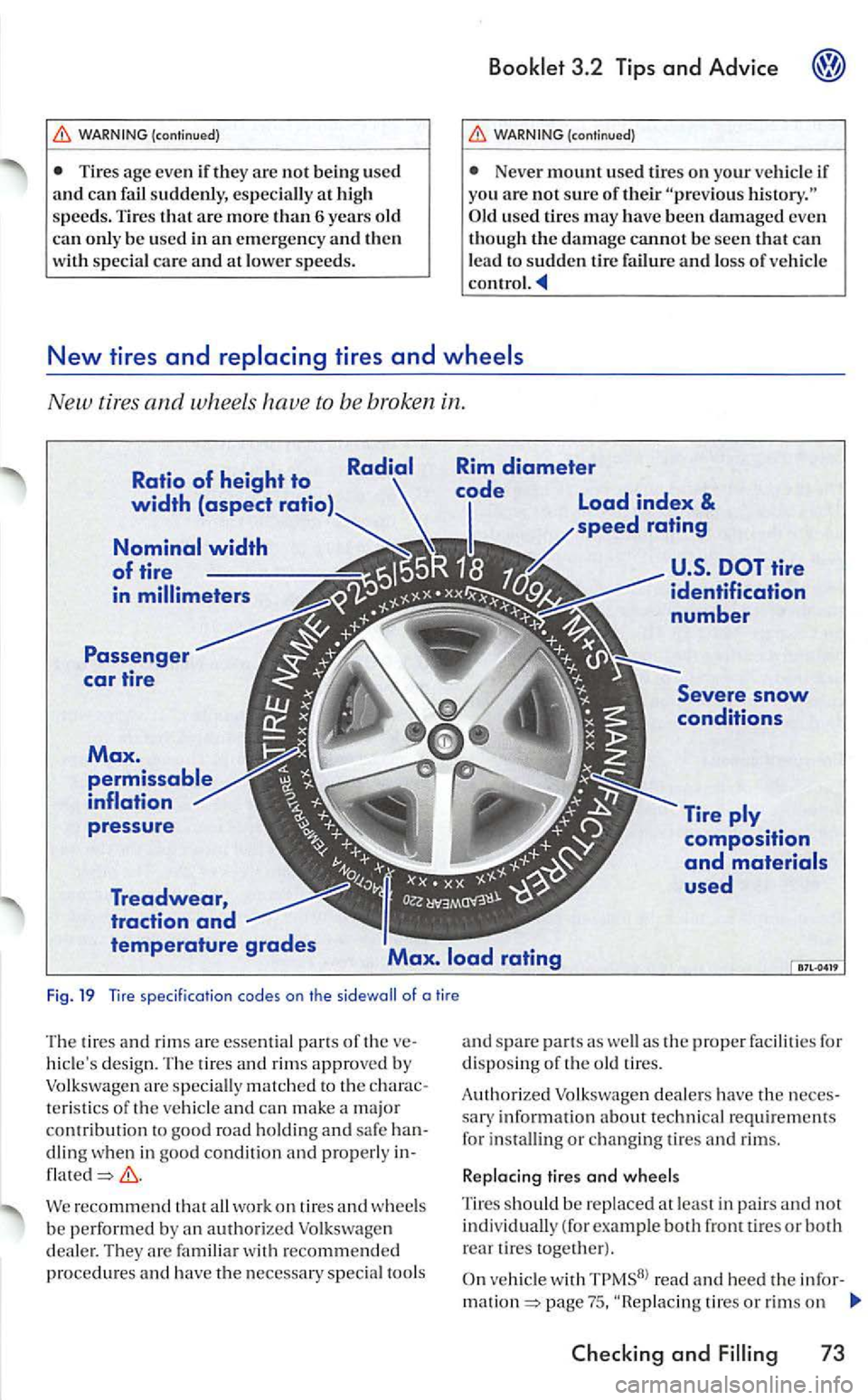
Federal law requires tire manufacturers to place standardized information on the sidewall of all page fig. 19 . This information identifies and describes the fundamental characteristics, the qualit y grade of the tire and also provides a tire identificatio n number for safety stan dard certification and in case of a recall.
Tir e
specifications
K n
owledge of tire specificatio ns makes it easier to choose the correct tires. Rad ial tires have the
tir e specifications marked on the sidewall, for exampl e:
R 17 91 W
T
his example contains the follow ing informa
t ion:
rat ing letter code
(o r Indicates that the tire has some mud and snow capability
The tires coul d also have the information of direction of page 86.
Speed rating letter code
The speed rati ng letter code o n the wheels indicates the maximum permissible road speeds in o n 77.
up to 93 mph
km/h )
R
up to km/h)
up to mph
mph
krn /h)9l
W
up t o 168 mph
Tire Identification Number and tire manufacture dote
T
his i s the t ire's begi ns with th e letters
mean tha t the tire was produced in th e 18th week
fabric in the tire. In gen the g reater the number o f plies, the m ore weight tire can support. Tir e manufacturers
a lso must indicate the materials in the tire, which include steel, nylon, polyes ter, and others.
system)
For tires with maxim um sp eed over t49 mph (240 le tt ers
74 Checking and
Page 351 of 444
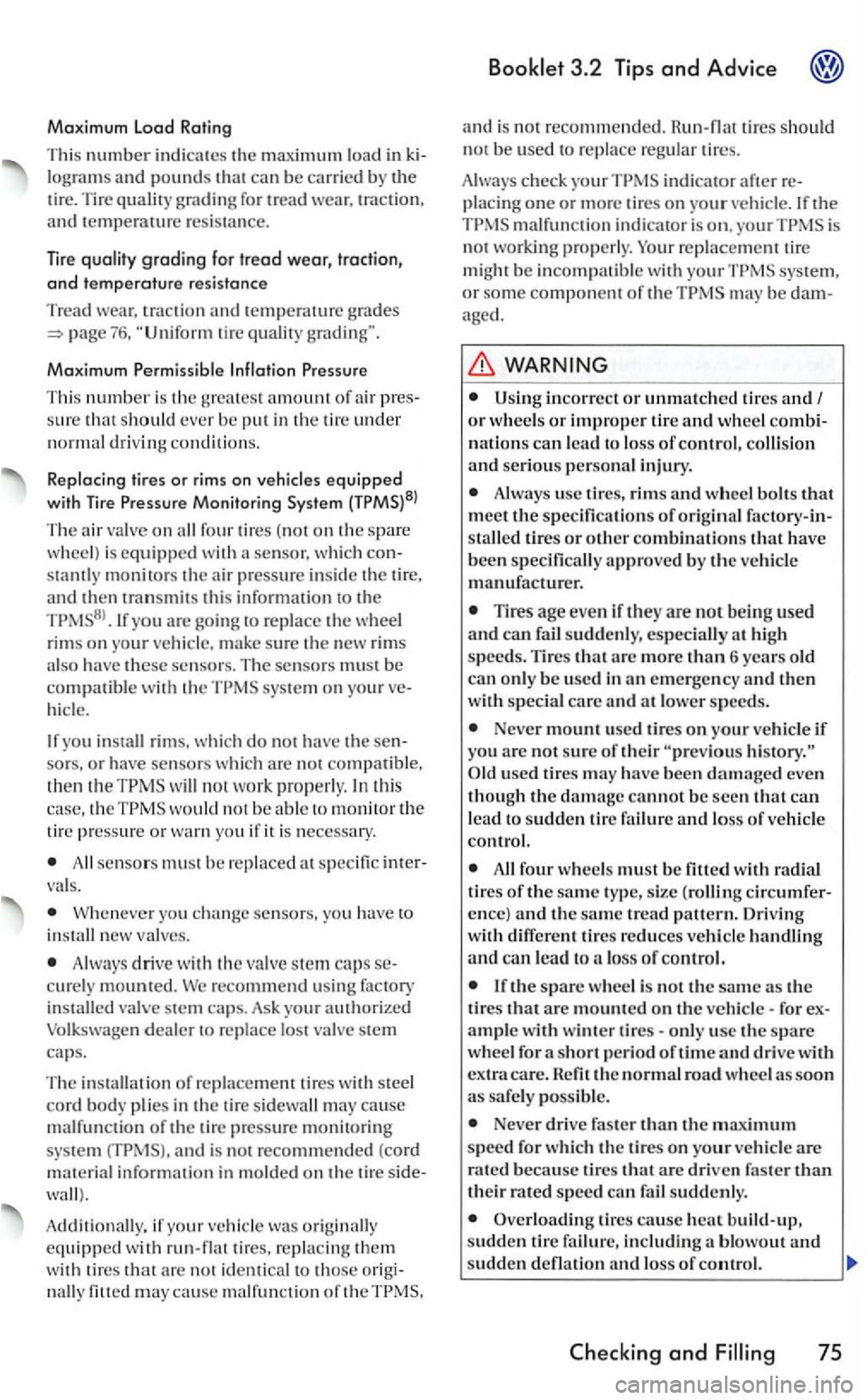
Maximum Load Ratin g
This number indi cates the maximum load in and pounds that can be carried b y th e
tire. Tire
and temperature resistance.
Tire quality grading for tr ead wear, traction,
and temperature resistance
Tread trac tion tempe rature grades
Maximum Permissibl e
su re that sh o ul d ever be put in t he tir e under normal driv in g con d itio ns.
Replacin g tire s
or rims on
stantly monitors the air pressure in sid e the tire , and then transmit s thi s information to th e
you arc goin g to replace the wheel
rims on your ve hicl e, have these se n sors. The sensors must be compatibl e with the sys te m on yo ur hicle .
you rims. which do not sors, or have sensors w hi ch are not compatibl e,
then the TPM S will no t wo rk properly. wo uld not be able to monit or the tir e pressure o r you if it i s necessaty.
senso rs mus t b e rep laced at sp ecific va ls.
yo u ch an ge sen sors, yo u have to new valv es.
driv e wi th the stem caps curely m ounted . valve stem caps. your authorized Volk swage n dealer to re p lace lost va lve stem caps.
T he in stallat i
on of replacement ti res w ith steel cord p lie s in th e tire sidewal l may cause m alfuncti on of the tire pressure monitoring sys te m and is no t recomme nded (cord material inform ation in molded o n the tir e
if your ve hicle was equipped with r un-flat tires. rep la cin g them
wi th tire s that are not identical to th ose fill ed may cause mal function of the
3.2 Tips and Advice
and i s not recommended. Run-flat ti res should not be used to replace regular tires.
indicator after p la cing o ne or more tire s on you r ve hicle. the m alfu nctio n indi cator is is
not working p ro perly. Your r eplacement tire
m ight be incompatible with system,
o r some component of the be age d.
Usin g incorrect or unmatch ed tires and I or wheels or imprope r tire and wheel
use tires , rims and wheel b o lts that meet the sp ecificatio ns o f o ri ginal
Tires age even if they are n o l b eing used and can fail suddenly, especially a t hi gh
s peeds. Tires that arc m ore tha n 6 years old can only be used in an em erge ncy and then
w ith special care and lower speed s.
Never moun t used tires o n your ve hicl e if you are not sure o f their
four whee ls mus t be fitt ed with radial tires o f the same ence) and the same tread pattern. Dri ving with different tires reduces vehicle and can lead t o loss of contro l.
If the s pare wheel is no t the sam e as the tires that are m ounted on the vehicle-fo r ample with winter tires-on ly usc th e spare w heel fo r a short perio d of t im e and drive with extra care. Refit the normal road w heel as s oo n
a s safe ly possibl e.
Neve r drive fa ster th a n the maximum
speed f or which the tires on your ve hicl e are
r a te d because ti res that are driven faste r than their ra te d speed can suddenly.
Ov erloading tires cause heat build -up,
sudde n tire failure, including a blowout and sudden d eflati on and loss of control.