light VOLKSWAGEN GOLF PLUS 2004 Owner's Manual
[x] Cancel search | Manufacturer: VOLKSWAGEN, Model Year: 2004, Model line: GOLF PLUS, Model: VOLKSWAGEN GOLF PLUS 2004Pages: 541, PDF Size: 98.86 MB
Page 56 of 541
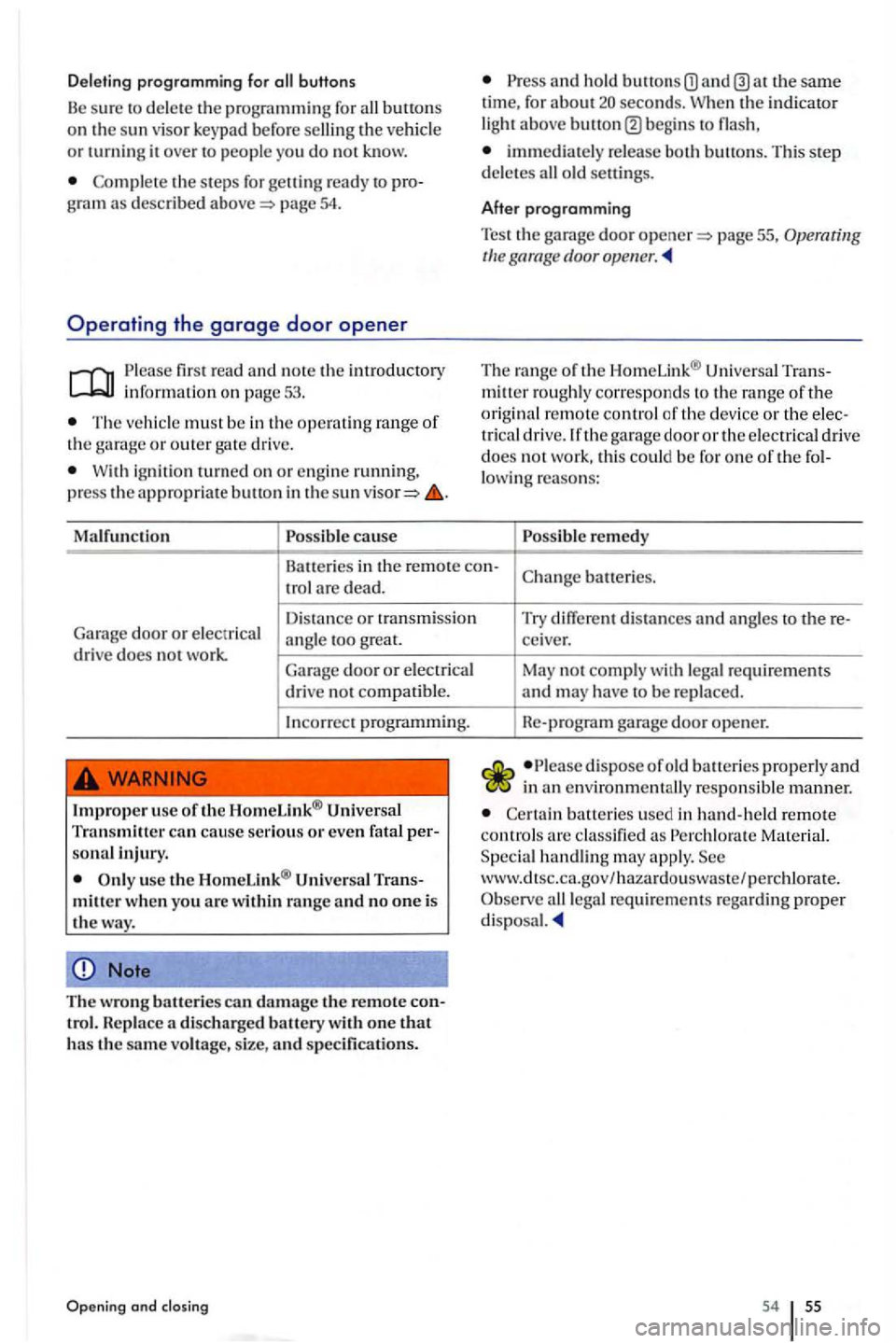
Deleting programming for
pro gramming for th e or turning it ove r to people you do not know.
the s te p s for getting ready to pro
gram as describ ed p age 5 4.
Operating the garage door opener
fir st re ad and note the introductory information on page 53.
The vehicl e must be in the operating range of th e garage or outer ga te drive.
W ith ig nit ion on or engin e running, press the appropriate button in th e sun
an d h old at the same tim e, for about seco nds. When the indicator
light abov e b egi ns to
immediately re lease both buttons. Thi s step dele tes
page 55, door
The rang e of th e 1-lomeLink® Trans
m itt er roughly
corresponds to th e range of the orig inal re mot e control of the device or th e e lec
tri ca l drive. Jfthe garage door or the e lec trical drive
does not work, this coul d be fo r o ne o f the fol
lo wing reasons:
re medy
Batteri es in th e remote con-batteries.
tr ol are dead.
Dis ta nce
or tr ansmission
G arag e door or e lectrica l
angl e too great.
dri ve does not work. Garage door or electrical
drive no t compatible.
In co rre ct programmin g.
usc th e HomcLink ® Trans
mi tter when you arc within range and no one is
th e way.
Note
The wro n g batteries can damage the remote control. Rep lace a discharge d battery wi th one that has th e sam e vo ltage , size , and specifications.
Opening and closin g
Try differe nt dista nces and angles to there-ce iver.
May not co mpl y with legal requirements and may have to be r e placed .
Re-program garage d
oor opener.
di spose of old batteries properly and in a n envir onmentally respon sibl e manner.
clas sified Material. S pec ial handling m ay apply. Se c wwlv.cltsc.ca .gov/ haza rdou swaste/perchlorate . lega l requir ements rega rdin g proper
54 5 5
Page 59 of 541
Prope r sea ting posit ion
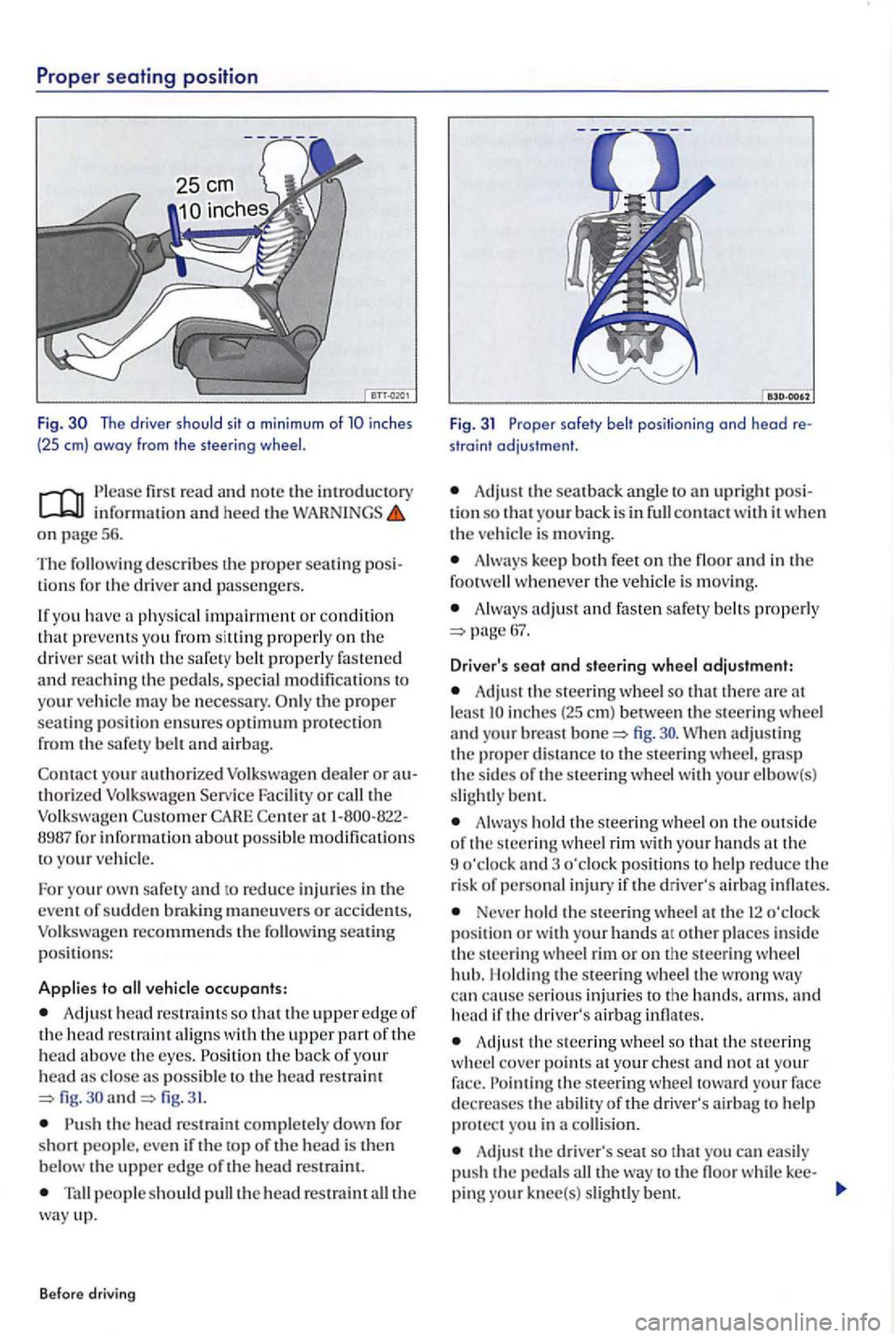
Fig. The driver should sit o min imum of inches
(25 em) away from the steering
first read and note the introductory information an d heed the WARNINGS on page 5 6.
Th e
describes th e proper sea tin g lio ns for the driver and passengers .
If yo u hav e
physical impairment or condition that preve nts you from siltin g properly on the driver wit h the safe ty belt properly fastened and re a ching th e pedals, special modificatio ns to
your ve hicle may be necessary. p roper seating positi on ensures optimum protection from the safety belt and airbag.
Con t
act yo ur authorized Volkswagen dealer o r authorized Volk swage n Serv ice Facility or the Volkswagen Custo m er CAHE Cente r 1-800-822-
8987 fo r informati on about poss ible modification s
t o your ve hicl e.
F o r yo u r
own safety and to reduce inj urie s in the
event of sudde n brakin g maneuve rs or accid ents, Volkswagen recommends the seating p o siti ons:
Applies to vehicle occupants:
Adj ust head re straint s so that the upper edge of the head restraint aligns with the upper part of the head above th e eyes . the ba ck of your head close as poss ible fig. and fig. 31.
the head re straint completely down fo r
short people. eve n if the top of th e head is the n
b elow the uppe r edge o f the head re strai nt.
people s ho uld pull the head restraint the way up.
Before driving
Fig. 31 Proper safety belt positioning ond head re
straint adjustment.
Adjust the sea t back ang le to upri ght posi
tion so that your back is in conta ct w ith it w he n the vehicle is moving.
Alw ays keep both feet on th e floor a nd in the
foot whenever the vehicl e is mov in g.
A lway s adjust a nd fasten safety belt s pro perly
A dju st the steering wheel so that the re are lea st fig .
Always ho ld th e s teering wheel o n the out sid e
o f th e s teerin g wheel rim with your hands the
9 o'cloc k and 3 o'cloc k pos ition s to help re duce the
r is k of personal injury if the driver' s airb ag infl ates.
Never ho ld the steering wheel a t th e 12 o'clock position or w ith your hands at ot her places in side the steerin g wheel rim or o n the steerin g whee l
hub. l lo ldin g the steerin g w hee l the wro ng can cause se rious injurie s to the arms. and head if the driver's airbag infl ates.
Adju st the s teerin g wheel so that the s teerin g
w heel cove r points the ste erin g wh ee l toward your face
d ecrea ses the abilit y of the driver's airba g to help protect you in a collision.
Adju st the driver's seat so that you can easily
pu sh the pedal s the way to th e floo r while kee-
pin g knee(s) slightl y bent.
Page 64 of 541
Note
When removin g or reinstalling the head restrai nt,
take car e t ha t head restraint does not strik e the headliner or the back of the front seat. T he
headlin er or oth er parts of the vehicle could erw ise be
position
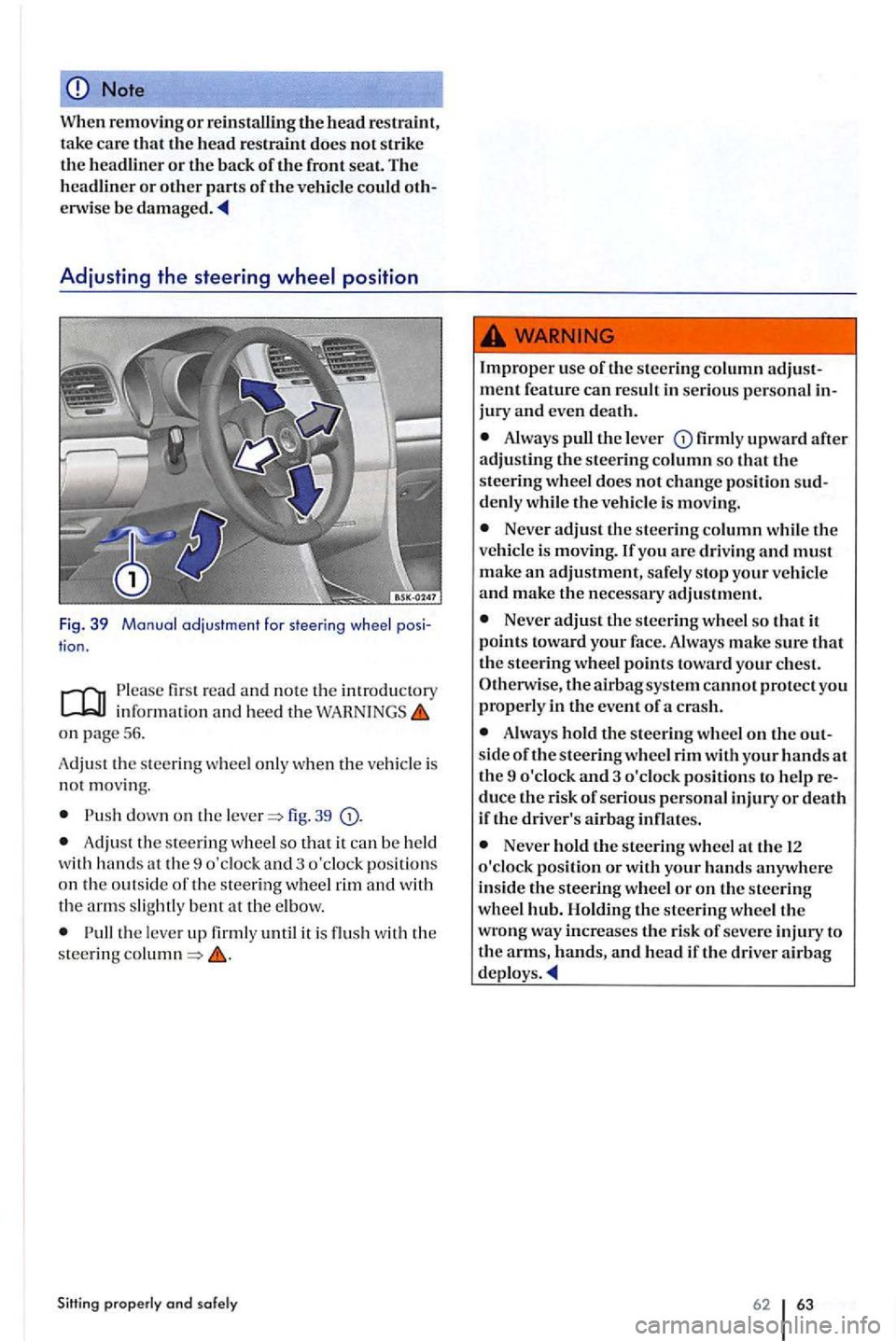
Fig. 39 Manual adjustment far steering whee l pos i
tion.
firs t read and note the introd ucto ry
on page 56.
A dju st th e
steering wheel only when the vehicle is not movin g.
fig. 39
Adju st th e steerin g w hee l so th a t it ca n be held
w ith hands at th e 9 o'clock and 3 o'clock pos itions on the ou ts ide of the stee ring whee l rim and w ith
the arm s slight ly at the e lb ow.
the lever up firmly until it is flu sh with the steering
Always puLl the lever firml y upward after adjustin g th e steering column so that th e
s teering wheel does not ch ange positi on sud
d enl y whil e U1e vehicl e is movin g.
Neve r adjust the stee rin g column w hile the ve hicl e is moving. you are driving and must make an adjustment, safely s top you r vehicle and make the necessary adjustment.
Neve r adjust the steerin g wheel so that it points toward your fac e. Alway s make sure th at
Alwa ys hold U1e steering w hee l o n th e out side of th e steering wheel rim with your hands at
th e 9 o'clo ck and 3 o'clock positions to h elp
Neve r hold the steering w heel at the 12 o'clock position or with your hands anywhere
in side the s teering wheel o r on th e steering
w hee l hub. Holdin g th e stee rin g wheel the wro ng way increases the r isk of seve re injury to the arms, hands, and head if th e driver airb ag
62 63
Page 67 of 541
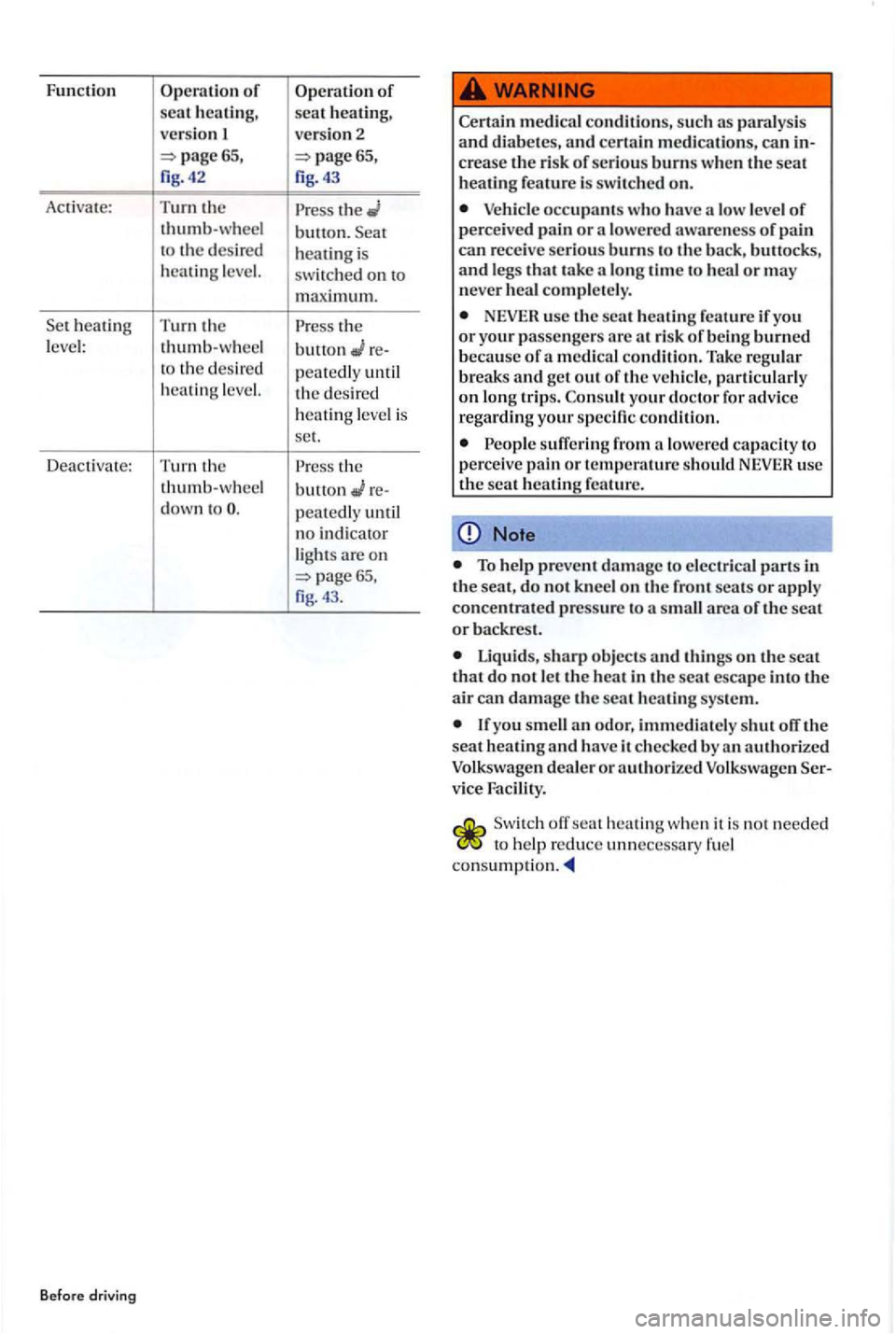
Function Operation of scat heating,
versio n
Activate:
Turn the
thumb-wheel
t o th e desired
h eat
ing level.
heatin g T urn the
l eve l: thumb- w heel to th e desired
heatin g level.
D eac tivate:
Turn the
thumb-w hee l
down t o
Befo re driving
Operation of sca t heating,
versio n 2
th e button. heating is
switc h ed on maximum.
the
button
re-
p
eat e dl y until
th e des ired
h
eatin g leve l is
set.
th e
button
rc-
pcat cdly until
n o indi cator
light s are o n
Certain medical conditions, su ch as pa ralysis and diabetes, and certai n medication s, can crease the risk of seriou s burns when the seat heating feature is swi tched on.
Vehicle occupants who have a low level of perceived pain or a lowered awareness of pain can rece ive seriou s burns to the back, buttocks, and leg s that take a long tim e to heal or may neve r heal completely.
NEVER usc the scat
To help preven t damage to elec trica l parts in the seat, do not kneel on the front scats or apply concentrated pressure to a small area or the seat or backrest.
Liquids, sharp objects and things on the scat that do not le t th e heat in the seat escape into the air can damage the seat heating system.
lfyou smell an odor, immediatel y shut off the seat heating and have it checked by an authorized
Volkswagen dealer or authorized Volkswagen vice Facility.
off
Page 68 of 541
Safety
Introduction
this sec tion y o u'll find informatio n on th e lowing:
Warning light ................ .... .. , .. .. , . . . 68
F ro ntal collis ions and l ows of ph ys ics . . . . . . . . . . . . 69
Whot happens to passengers no t wearing a safety
b elt? . . . . . . . . . . . . . . . . . . . . . . . . . . . . . . . . . . . . . . .
. . . . . . . . . .
. . 7 5
Safety belt exte nder . . . . . . . . . . . . . . . . . . . . . . . . . . 7 6
Safety belt retractor , pre te nsio ner, load limiter . . . . 78
Serv ice and d isposal of belt prete nsioners . . . . . . . 78
th e co nditi on of all safe ry belt s re gul arly. If a
sa fe ty belt s h ows da m age to we bbin g, b in din gs,
r et rac tors or bu ckles, have the safe ty belt replaced
b y an auth orized Volkswagen deafer or an rized Volk swagen Service rized Volkswagen deale rs and authorize d sw age n Se rv ice Fa cilities
Adju stin g th e seatin g pos ition
A ir ba g page
safety and c hild page
erl y position ed safety belt increa ses th e risk of severe pe rsona l injury or death. S afety belt s
offer optimum protection only whe n they are
u sed pro perly.
Safety belt s are the singl e most effecti ve
m eans availabl e to reduce th e r is k of seriou s jury and dea th in automobil e accid ents. For
your protection and that of your passengers ,
hicl e is moving.
Sitting properly and safely
Every person in the vehicle must b e properly
seat ed on
for e the vehicl e starts to move, and must k eep the belt properl y fastened while riding in the hicle. This applie s to the drive r and all g ers, ev en when ju st dri ving around town.
Alwa ys secure children in the vehicl e with a
restraint s ys te m appropriate for their age,
weight and page
Never attac h the safety belt to the buckl e o f another seat. Attachin g the safety belt to the wrong buckle will reduce safe ty belt
Never le t any obje cts or liquids get into the
s a fety belt latch and pre v ent it from working
prop erly. Alway s keep the belts clean. Dirty belt s
m ay n ot work correctly and can impair the
Neve r remove a safety belt w hil e the ve hicl e
i s moving. Doing so will increas e your risk of being injured or kill ed.
Ne ve r strap more than one person, includin g
s mall child ren, into any single safety belt .
N eve r let children or ba bies ride sitting on your lap and never place
Several layers of heavy clothing may
Ne ver wea r belt s ove r rigid or breakabl e jects in or on your clothing, such as eye glas ses,
p ens, keys etc., as these may ca us e injury.
Never use comfort clips or device s that creat slack in tl1e shoulder belt. Howev e r, spe cial clips may be require d for the correct use of some
c hild restraint sy ste m s.
Always ke ep saf ety belt buckl es fre e of anything
that may prevent the buckle from la tchin g sec urely.
Safe ty belt s off er optimum protecti on only when th e scat b ack is upright and belts a rc correctl y position ed on th e body
66 67
Page 69 of 541
Damage to safety belt s reduces their ef
fectiven ess increase s the ris k of seriou s perinjury is
b ein g used.
Neve r safety belt s beco me damage d by
b ei ng caught in the door or seat hardware.
Torn or frayed safety te ar, and dam
aged safety hardware break in accident.
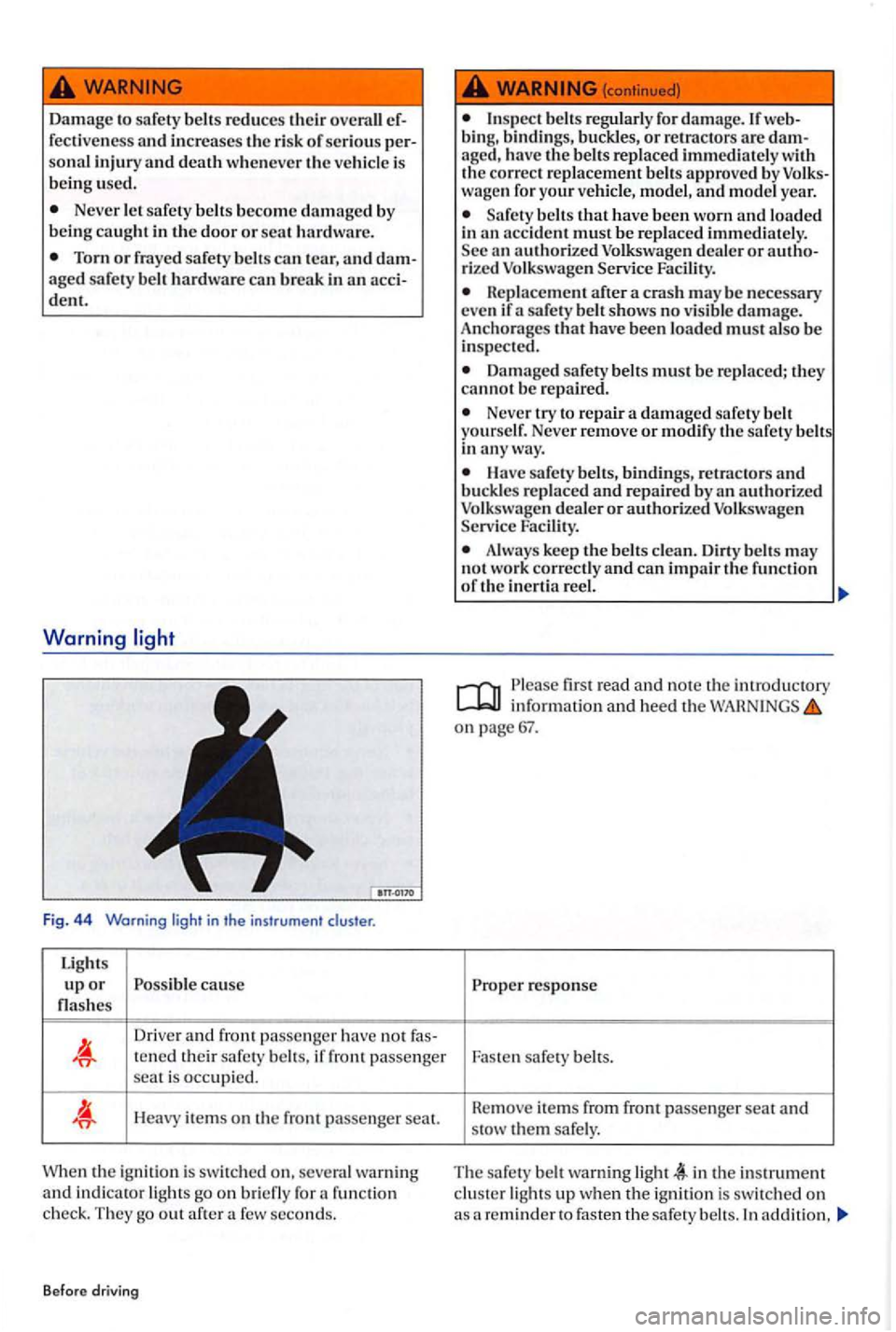
Warn ing
Fig. 44 Warning
Light s
u p o r cause
Driver and fron t pa sse nger have not fas-te n ed their safety if fron t passenger
sea t is occupied.
H eavy items on the front passenger seal.
the ignition is switched on. warning and in dica tor go on fun ction c he ck. They out after few seconds.
Before driving
for damage. If web
bin g, bindings, or re tra cto rs are damaged, have the approve d by wage n for your and year .
Safety that have bee n worn and in an accide nt must be
after a cras h may be nece ssary
eve n if safety sho ws no damage.
Anchorages that have been must
Damage d safety the y canno t b e re p air ed.
Neve r try to re pair a damage d sa fety Never remove or m odify th e safety
Have sa fety belts, binding s, retractor s and
or authorized Serv ice
k ee p the may
n ot work correct ly and ca n impair the function
o f th e in erti a
firs t rea d and note the introductory information and heed the on page 67.
Proper respo nse
Faste n safe ty
T he safety warning in the instrument
In add ition,
Page 70 of 541
you hear a warn ing chime. The warning light stop
when the driver and front passenger correctly fas ten their sa fety belts. If the safety belts have not been fastened when a speed of more than 15 mph is reached or if the safety be lts are unfastened
while the vehicle is moving , a warning chime for
up to seco nds. The belt warning light also
When the ignition is sw itched on, the warning
and of phy sic s
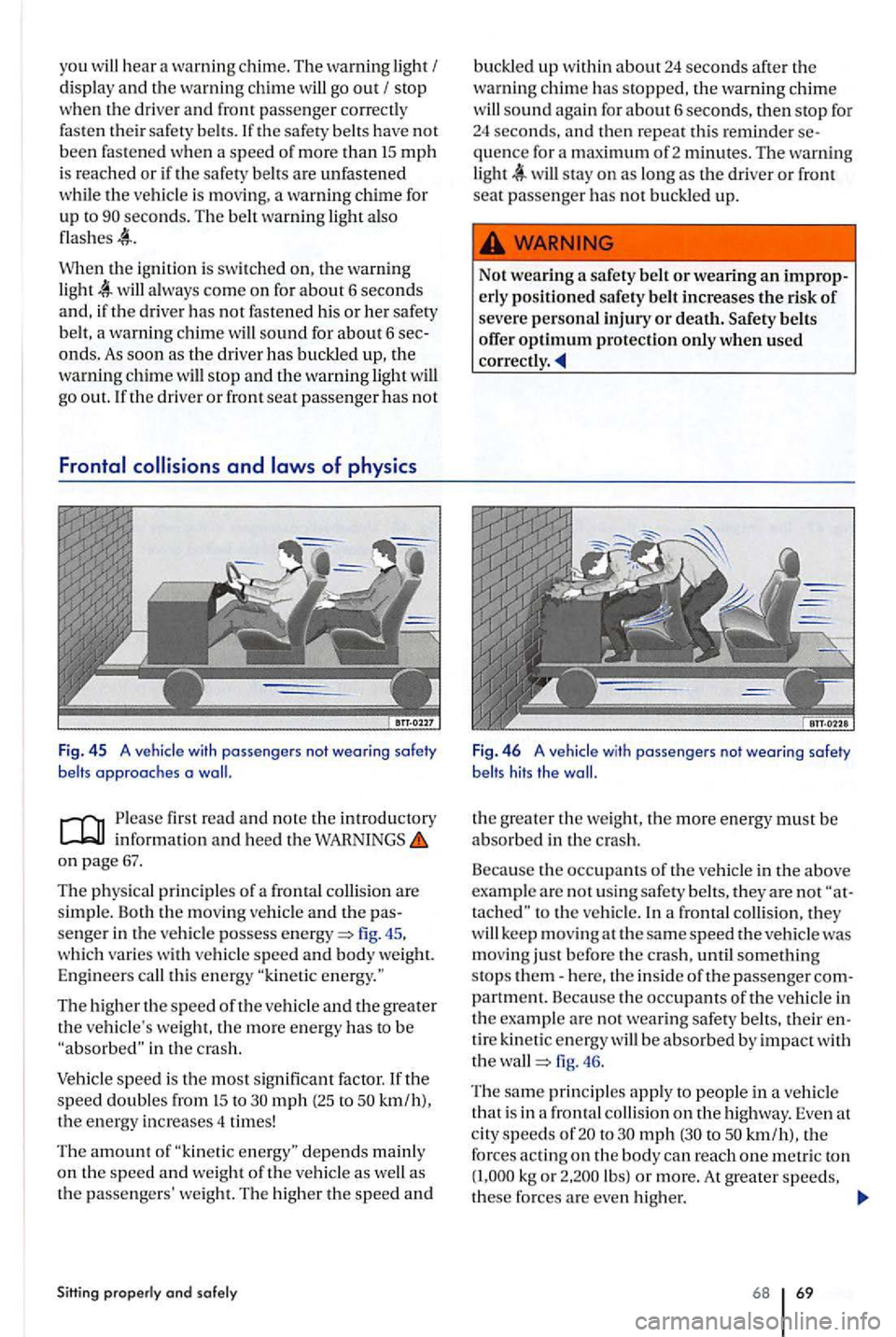
Fig. 4 5 A vehicle with passengers not wearing safety belts approaches a
on page 67.
The physical principles of a frontal
fig . 45.
which varies wit h vehicle speed and body weight.
Engineer s
The higher the speed of the ve hicle and the greater
the vehicle's weight. the more en ergy has to be in the cras h.
Vehicle speed i s th e most sig nificant factor. If the speed doubl es from to mph (25 to kmlh),
the energy increases 4 times!
The amount of as
the passengers' weight. The higher the speed an d
Sitting properly and solely
buckled up within about24 seconds after the
warn ing chim e has stopped, the warnin g chime sound again for about 6 seco nds, then stop for 24 seconds, and then rep eat this reminder sequence for a
Fig. 4 6 A vehicle with passengers not wearing safety
belts hits the
the greater the we ig ht, the more energy must be abso rbed in the crash.
Beca use the occupants of th e vehicle in the above
example a re not usi ng safety belts, they are not
kee p m oving at the same speed the vehicle was
mo vin g just before the crash, until somethin g
stops th em-here, the inside of the passenger com
partment. Because the occupants of the vehicle in
th e exa mpl e are not wearing safety belt s, th eir en
tire kine
tic energy be absorbed by impact with
the fig. 46.
Th e
same pri ncipl es app ly to p eople in a veh icle
th at is in a fron ta l
to mph to kmlh), the forces acting on th e bod y can reach one metri c ton kg o r lbs) or more. At grea te r speeds,
th ese forces are even hi ghe r.
68 69
Page 78 of 541
the colli sio n to help prot ect a n unrestrained front
sea t occ upa nt. The airba g m ay then not pro vide
e nou gh protection fo r an occ upant not wearin g a
s af ety be
lt.
u sc th e safety belt ex te nd er ap proved by Volkswag en for you r vehicl e.
Safety belt extenders offer optimum protec
tion onl y w hen they are prop erl y used.
A driver or passe nger wh o is not properl y
re strain ed ca n be seriou sly injured by strikin g
th e interi or o f t he passe nger compartment or by the s afety be lt itse lf, w hich can be displac ed fro m stron ger parts of the body int o se nsitiv e
area s lik e the abdomen.
usc the extender when the belt is not
lon g eno ugh t o be worn low and snug and th e person is in the correct sea ting po sition . R e m o
ve an d stow extender sa fe ly w hen no t needed.
Never usc the safety belt extender if you can prop erl y attach the safe ty be lt wit hout it. safety belt ex tender when not n eeded can crease the risk of inju ry, especiall y in a co llision.
Never use safety belt ex tender if the dis
tan ce (B ) between the front ed ge of the safe ty
b elt exte nd er buckle (A) and th e ce nterlin e of the perso n using the safety belt exte nde r= page 76, fig. 56 © is less than 6 in ches (15 em ).
Never leave an unused safe ty belt exte nder in the belt bu ckl e. Remo ve and stow the sa fety belt
ex te n d er safely wh en no t n eeded.
Sitti ng p roperly and safely
Always make sur e that the tongue of the
sa fety belt extender is securely inserted into the buckle for the seating position that belongs to
th e sca t where the safety belt extende r i s being
u se d. Attaching the safety belt to th e wrong
bu ckle will reduc e safety belt effec tive ness and can cause se rious perso nal injury.
Never usc more than one sa fe ty bel t extende r
w it h a safety belt. more than on e safety
b elt extender can change the way the sa fety
belt passes over the body a nd can cause seriou s
injury.
Never use the safety be lt ex tender to secure
a child restrai nt.
Never use a sa fety belt ex tend er on your
Neve r usc the safety belt ex tender you ob
t a in ed for your vehicl e for any other ve hicle,
regardless of m ake , model , or model year.
Note
Leaving the extender attached to the s afety be lt buck le when the front seat i s occ upied an d the safe ty belt is not being used w ill sig n al t o th e
a irbag control unit that the fron t passenger sea t
i s occupied and that the saf e ty be lt is be ing used. The electron ic contro l unit for th e a ir b ag system
will the n r eceive incorrect information that will
- ca use th e sa fety belt prete n sioner to deplo y unnecessarily in colli sion s and -ca use the front passe nger airb ag to dep loy
later in colli sion s in whic h th e front airba g
wo uld otherwise be triggered earlier to help
protec t a n unrestrain ed fron t sea t passe nger.
A pre te nsioner that has deployed cannot be p aired. The e ntire safety belt must be replaced.
! Note
If the safety belt extender is left atta ch ed to the
safe ty belt buckle, the safety belt warni ng sys te m
w ill sense that the sa fe ty be lt fo r th at seat is being
used . The w arning light will not come on and th e warning chime will not sound even though the
s cat is occ upie d and the safety belt is not b eing u sed.
76 77
Page 83 of 541
Monitoring the Advanced Airbag System
Please rea d and no te the introductory
on page80.
T he A dva n
ced Airb ag (including the e lec
troni c control unit , sensors and sys te m wiring ) is monitore d continu ously to make sure that it is
functioning properly when ever the ig nition is on. Each time you on th e ig nition , the airbag
system indicator light will come on fo r a few
seconds (se lf-d iag nosis).
The airbag system must be inspected when the indicator light
does not come on when th e ignition is swi tched on,
does n ot go out a few seconds after you have switch ed on th e ignition,
goe s out and th en comes o n again or blink s afte r th e ig n ition i s switch ed on,
o r if it comes on or blink s while dri ving.
PASSENGER
If th e sys te m d etec ts a irba g sys te m m alfun c
ti on , th e indi cator lig ht comes on and stays on to
a le n th e dri ver to th e prob le m. I also reminds yo u
to have the a irbagsys te m checke d immediat ely by an authoriz ed Volk sw agen dealer or an auth ori zed Volkswa gen Facility. !fa malfunction oc
c ur s that turns the front a irbag on th e passenger
s ide off, th e BAG
not inflate when it should.
Ha ve the airbag system inspected immediately by your authorized Volkswagen dealer or authorize d Volkswagen
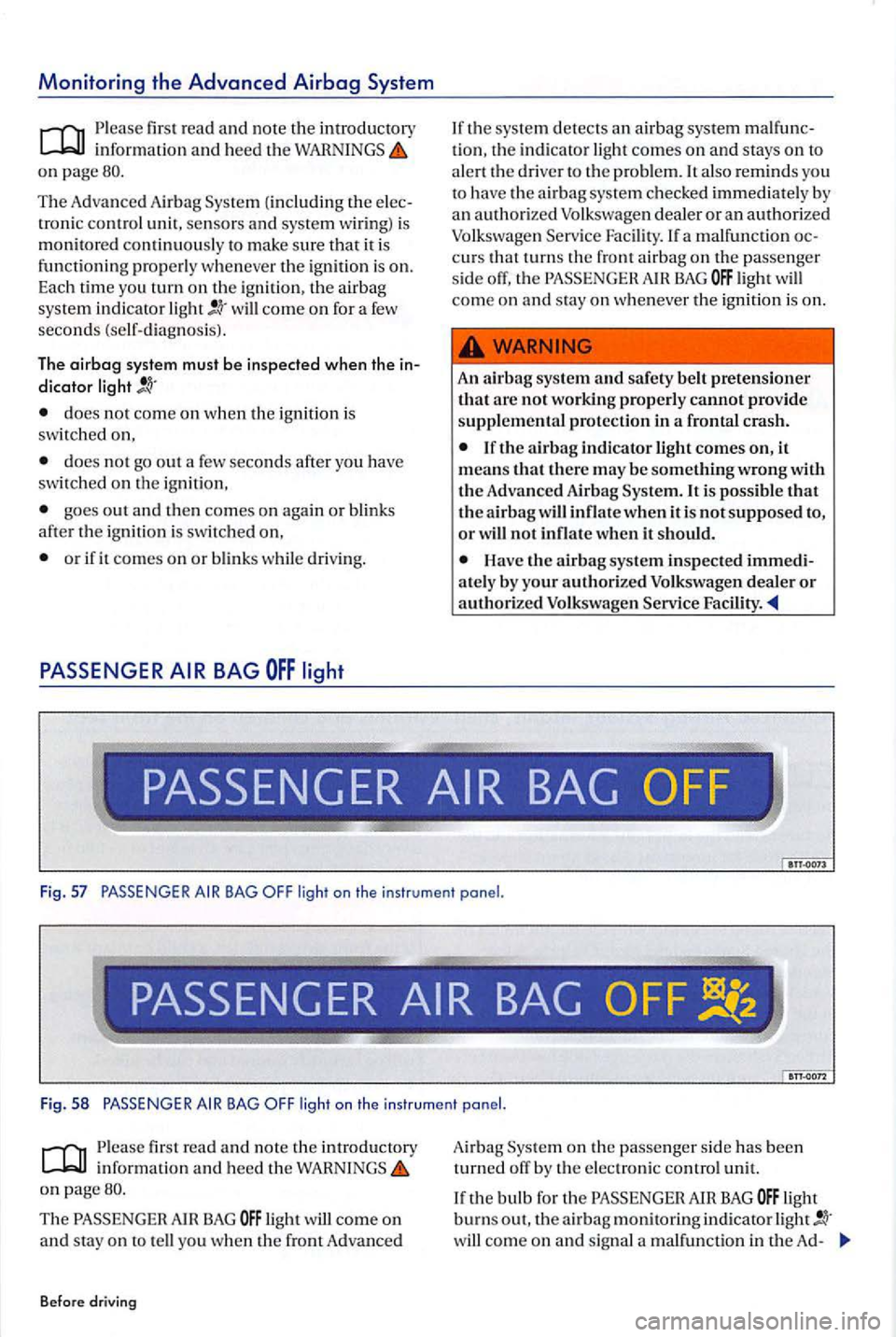
Fig . 57 light on the instrum ent
PASSENGER
Fig. 5 8 BAG lig ht on the in strume nt
Plea se first rea d and note the introducto ry
on page
The
on th e passenger sid e has been turned off by th e e lec tronic control unit.
If th e bulb for the
ligh t burns out, the a irbag monitoring indicator will come on and signa l a m alfun ction in th e Ad-
Page 85 of 541
light does not
come
on ...
the ligh t
vice Facili ty.
The light should
BAG light shou ld come on w he n the ign ition is on and an adult is
the lig ht
co mes on and sta ys on unde r these circ um stances,
mak e sure that :
th e adult on the front passenger seat is
the adult is not we igh t off the seat by holding o n to t he passe nge r assis t handle abov e the front passe nger doo r or supporting their weight on th e armres t o r hold in g onto the ass ist ha ndle on the in strument panel;
t h e safet y belt is be in g properly wo rn and that th ere is no t a lo t o f s la c k in the s afet y be lt webbing;
Access ory seat covers or cu sh ions or other
thi ngs that m ay cause an incorrect reading or pression on the weight-se nsin g mat under the
fir st read and note the introd uc tory inform ation an d heed the on page 80.
Front airbags and how they work
Airbags are only supplem ental restra ints. They are not a substit ute for safety belt s that must be w orn even though th e front seatin g po sitions are equip ped wi th front airb ags. The fron t a ir bags can provid e additional prote ct ion for the chest and head of the drive r and the fr ont seat passe nger when seat s, safety belt s, h ead restraints and, for
th e dri ver, th e s teering wheel, are properly used and have been properly adju sted.
Before driving
the statu s of the Adva nced Air bag has changed whi le the vehicle is moving, the BAG ligh t blinks for about 5 seconds to catch the driver's attention . If this pens, a lways stop as soon as it is safe to do so and check the steps described above.
light does not go ofT when an adult who is not very sm all is sitting on the front passen ge r seat after taking the steps described above, make sure the adult is properly seat e d and restrained a t one of the rear seating
position s.
Have the airbag system inspected by your authorized Volkswagen dealer or authorized Volkswag en
sen ge r seat d ete cts an empty seat, th e front airba g on the passenger sid e will be tu rned off, and the light stay on.
sen ge r safety belt itself is buckled and the front passe nge r seat is no t occupied, the
the air bag sys te m deploys in a collis io n , a
ga s ge nerator fills th e a ir bags that break open the padded cove rs on the steering w heel and th e strume n t panel. The front airbags inflate between
th e s teerin g w heel and th e driver and between th e
in strumen t panel a nd th e front passenger.
Fron t air bag s in combination wit h properly wo rn
sa fety be lt s s low down and limit the occupant's forward movement. Toge ther they help to prevent th e driv er