engine VOLKSWAGEN GOLF PLUS 2007 User Guide
[x] Cancel search | Manufacturer: VOLKSWAGEN, Model Year: 2007, Model line: GOLF PLUS, Model: VOLKSWAGEN GOLF PLUS 2007Pages: 541, PDF Size: 98.86 MB
Page 32 of 541
Technical data
In thi s section yo u 'll find inf ormatio n on the fol
l owing:
.... _.. . . 31
Engi ne data and dimensions ......... _. . . . . . . . . 32
D im ensions . . . . . . . . . . . . . . . . . . . . . . . . . . . . . . . . . 33
Th e engine configu rat io n ca n be found on the ve
hi cle identification label in the Warranty an d
Maint enance bookle t or in th e officia l vehicle documents.
Specifications in ve hicl e documents al
way s take precede nce. Th e specificatio n s i n thi s
Manual r e fer to the basic m odel. The stated values m ay vary, dep ending upon diff erent equipment opti o ns o r models , a s well as with respect to special vehicles and vehicles exported to different countries.
45-7-5545
o
PRSSRT Lim. NRR
147kl.J
..
D9l 162 5RQ 5SL TQ3 352 BGV 12H
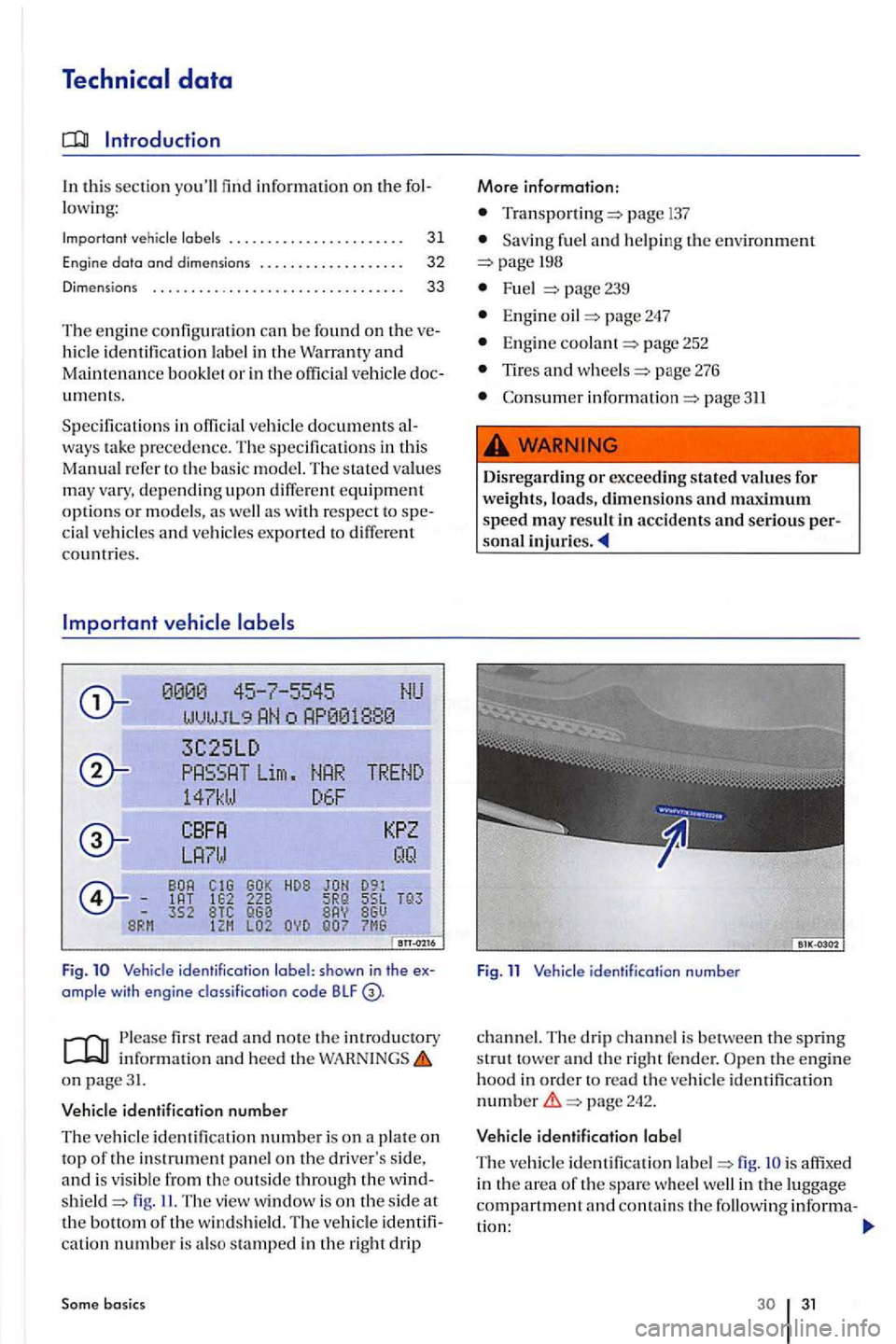
Fig. Vehicle identification Iobel: shown in the ex
ample with eng ine classi fication code BLF
read and no te th e introductory informatio n an d heed th e on page31.
V ehicl e id entification number
The ve hicl e identification number is on a plate on top of the in strument pan el o n the dri ver's s ide,
and is v isibl e from the outsid e th rough the windfig . The v iew window is on t h e side at the botto m of th e w ind shi eld. Th e vehicle identification number i s al so in the right drip
Some basic s
M ore informatio n:
page
Sav ing fuel and helping th e enviro nment
Fu el page 23 9
Engine page 247
En gin e page 252
Tires and 276
page 311
Disregarding or exceeding stated values for weights , loads, dimensions and maximum speed may result in accidents and serious per-son al
Fig. 11 Vehicle identification number
c h a
nnel. The drip ch annel is between the spring stru t towe r and the right fender.
p age 242.
Vehicle identification Iobel
T he ve hicle i
dentifi cation fig . is in th e area o f th e spare w heel well in the luggage
compartm en t a nd contains th e follo wing informa-
tion :
31
Page 33 of 541
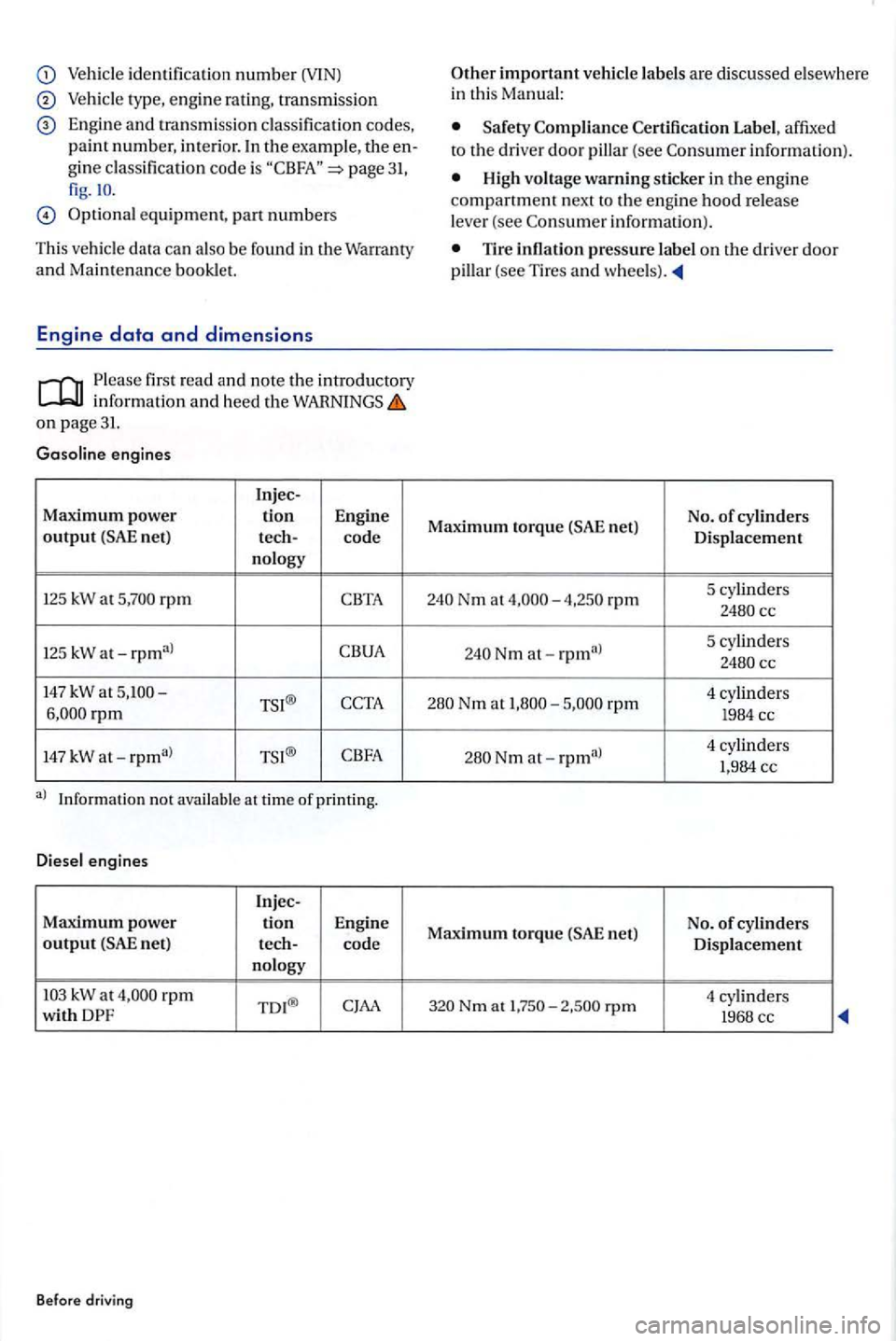
identificatio n number (VlN)
Veh icle type, eng in e rating , tran smission
E n gine and tra nsm iss io n classificatio n cod es, pain t num ber, interior. In the exa mple,
3 1, fig.IO.
equipment, part num bers
Thi s ve
hicle data can also b e fou nd i n t he War ra nty
and Maintenan ce booklet.
Engine data and dimensions
first read and note the in trod uctory inform ation and heed th e WARNINGS on page31.
G aso line engi nes
Injec -
Maxim um power
rp m
125 kW at-
147 kW at
kW at rpm T D I®
Before dri ving
Safety
i nfo rmatio n).
Hi gh vo ltage warning sticker in the en gin e compartment next to the eng ine hood r elease leve r (see in format ion) .
Tire infl ati o n pressure la b el o n th e driver door
pillar (see Tires and
Maximum torqu e net) N
o. of cy linders
Disp laceme n t
Nm at rpm 5 cy linders
5 cy linders
N m at-4 cylinders
1 ,984 cc
Max
imum torque n et) N
o. of cy lin ders
Di sp lacement
N m at rp m 4 cylinde
rs 196 8 cc
Page 34 of 541
Dimensions
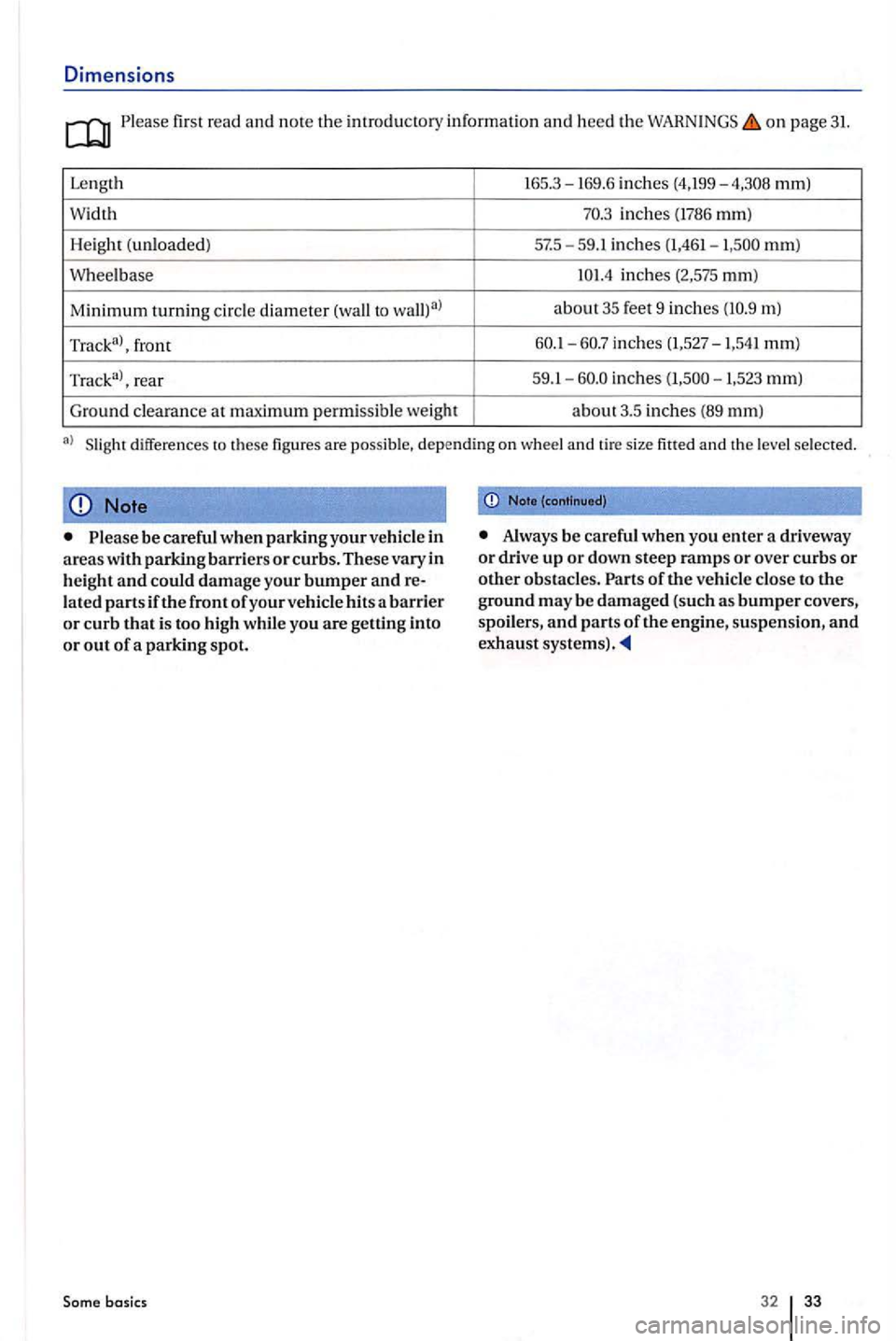
Please first read a nd note th e imrodu ctory informa tion and hee d th e on pa ge 31.
Le ngt h 165.3-
16 9 .6 in ches (4,199-mm)
W id th
inch es (1786 mm)
H eig
ht ( unload ed ) 57.5-59.1 in ch es (1,461-mm)
W h
eelb ase inch es (2,575 mm)
M inimum turning circl e diamet er
(wall to abou t 35 feet 9 inch es m)
inch es 1,523 mm)
G ro
und clearance at maximum p ermi ssibl e we ig ht about3.5 inch es (8 9 mm)
a)
Note
Plea se be careful when parking your vehicle in
areas with parking barriers or curbs. These vary in
height and could dama ge you r bumper and
basic s
Note (continued)
Always be carefu l when you enter a driveway or dri ve up or down steep ramps or over curbs or other obstacles . Part s of the vehicle close to the ground may be damaged (such as bumper covers ,
spoil ers , and parts of the engine, su sp en sion, and exhaust
32 33
Page 39 of 541
Power
Introducti on
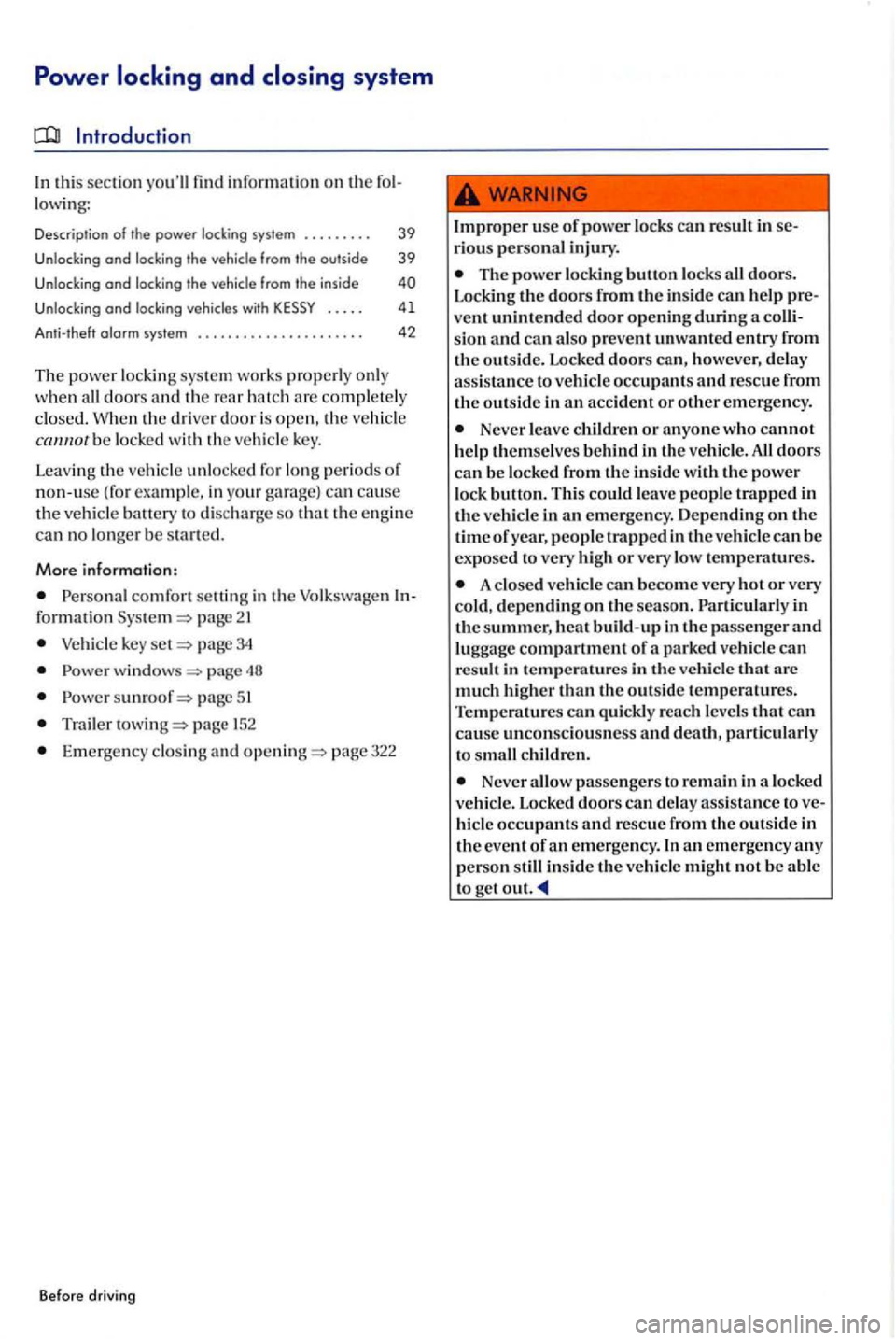
In t his section you'll fin d information on th e fol
low ing:
Descr ip tio n of the power system . . . . . . . . . 39
Unlocking and locking the veh icle from outside 39
Unlocking and locking the vehicle from the inside
. . . . . 41
alarm system . . . . . . . . . . . . . . . . . . . . . . 42
The powe r locki ng sys te m works properly on ly
w he n all doors and t he rear ha tc h co mpl ete ly
cl osed. When th e driver door is open, th e vehicle b e locke d with the vehicle key.
Leavi ng the vehi cle unlocke d for long perio ds of
no n-use (for examp le, in your garage) can ca use th e veh icle battery to discharge so that the engine
ca n n o longer be sta rt ed.
More information:
Pe rsonal comfort settin g in t he Volkswagen Informatio n pag e 21
Vehicle key page 34
Powe r page
Power page 51
Trailer p age 152
Eme rge ncy clos ing a nd pag e 322
Before drivi ng
Improper use of powe r locks can res ult in se
r io us perso nal inju ry.
Th e powe r locki ng button locks all doo rs.
Lockin g th e doo rs f ro m the insid e ca n h elp pre
ven t unintended d oor o penin g during a colli
s io n and ca n also prevent un wa nted entry from th e outsid e. Lock ed d oors ca n, however, d e lay
a ss istance to vehicl e occupant s and resc ue from
th e outsid e in an accid ent or o ther em erge ncy .
Neve r le a ve childr en or an yone who cannot help themselves behind in the ve hicl e. All do ors
can be lo ck ed fro m th e in side w ith the power
l oc k button. T his co uld leave people trapped in ve hicl e in an em erge ncy. Dep endin g on the
tim e of peopl e trappe d in the ve hicl e ca n b e
ex po sed t o very high or very lo w t emperatures.
A close d ve hicl e ca n beco me very hot or very d ep ending on the seaso n. Particularly i n
th e summer, heat build -up in lh e passe nge r and lu ggage compartment of a parked ve hicl e ca n
res ult in temperatures in the ve hicle that are much hi gher tha n th e o utside temperatures .
T e mperatures can quickly reac h leve ls that can cause unconsci ousn ess and deatJ1, parti cularly
t o s mall childr en .
Neve r all ow passe nge rs to re main in a lo ck e d
ve hicl e. Locked doors ca n delay ass is ta nce to ve
hicle occupants and r esc ue f ro m the o ut side in
th e event of an emerge ncy. In an em erge ncy an y perso n still insid e th e vehicle might no t b e a ble
t o ge t
Page 42 of 541
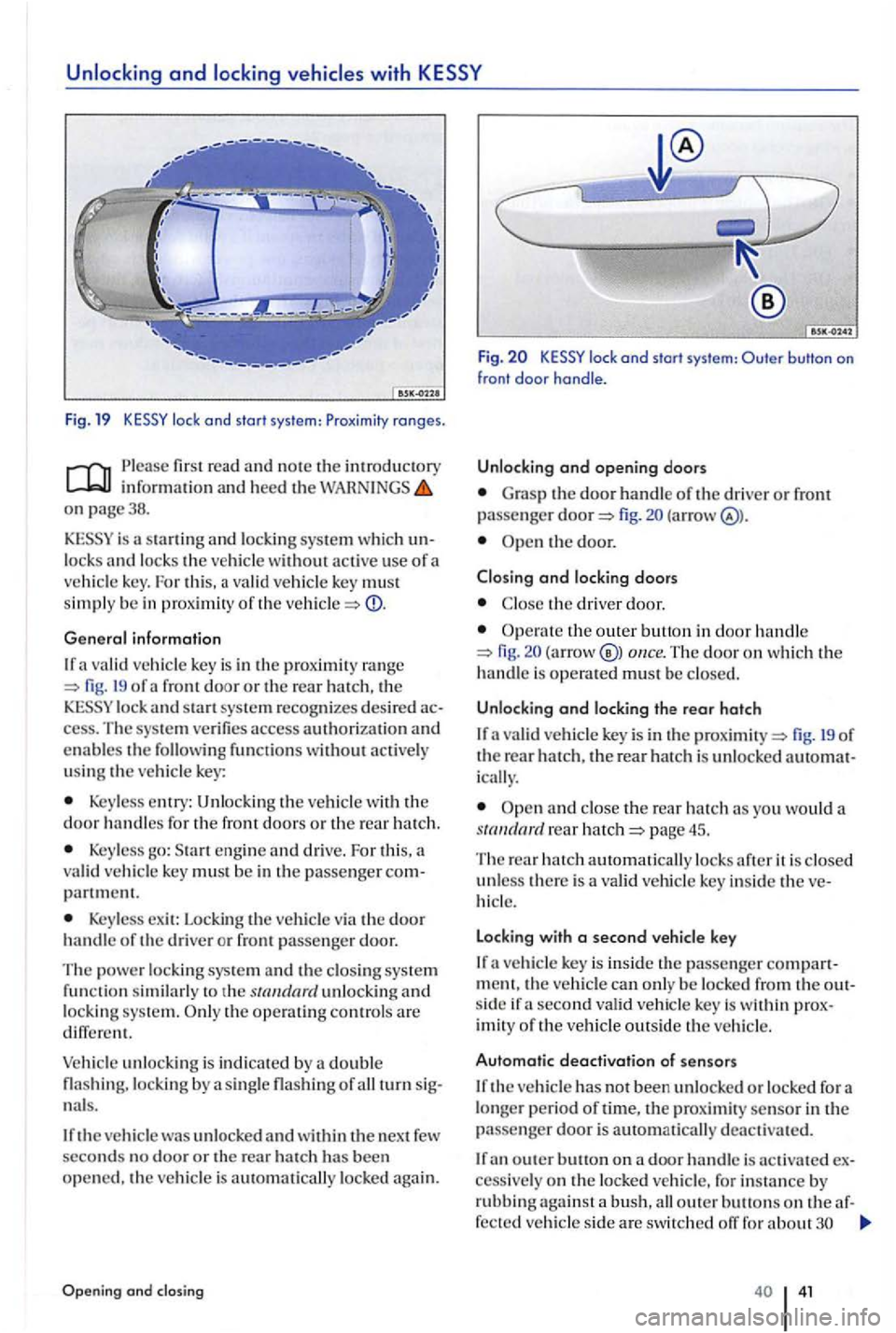
Unlocking and locking vehicles with
Fig. 19
on page38.
sta rting and system which unlocks and lock s the vehicle without active use of a vehicle key. For this, a valid ve hicle key must simply be in proximity of the
General information
If a va lid vehicl e key is in the proximity range fig . 19 of lock and start system recognizes desired access. T he system verifie s access authorization and enables the followin g functions without actively using the vehicle key:
Keyless entry: Unlocking the vehicle with the door handles fo r the front doors o r the rear hatch.
Keyless go: Start engine and drive. For this. a
valid vehicle key mus t be in the passenger com
partment.
Keyless exi t: Locking the vehicle via the door handle of the driver or fro nt passenger door.
T he power locking system an d the closing system fu nction similarly to th e unlockin g and locking system. the operating con trols are
Veh icle unlocking is indicated by double fla shing. locking by a single fla shing of all turn signals.
the vehicle was unlocked and within the next few seconds n o door o r the rear ha tch has been opened. the vehicle is automatically locked again.
and closing
Fig. lock and start system :
Grasp the door handle of the driver or front passenger fig . (arrow
the driver door.
the outer button in door h andle fig. (arrow The door on whic h the
h andle is operated mus t be closed.
Unlocking and locking the rear hatch
If a va lid vehicle key is in the fig. 19 of the rear hatch, th e rear hatch is unlocked automat
i c ally.
and close the rear hatch as you would a page 45.
The rear hatch automatically locks afte r it is closed unless there is a vali d ve hicl e ke y inside the ve
hicle.
Locking with a second vehicle key
I f a vehicle key is ins ide th e passenger compartment. the vehicl e can only be locked from the outside if a second vali d vehicle key is within proximity of the vehicle outside th e vehicle.
Automatic deactivation of sensors
If the vehicle has not been unlocked or locked fora longer period of time, tJ1e proximity sensor in the passenger door is automatically deactivated.
If an o uter button on a door handle is activated excessively o n the locked vehicle, for instance by rubbing against a bush, all outer buttons on the af-
fected ve hicle side are switched for about
Page 70 of 541
you hear a warn ing chime. The warning light stop
when the driver and front passenger correctly fas ten their sa fety belts. If the safety belts have not been fastened when a speed of more than 15 mph is reached or if the safety be lts are unfastened
while the vehicle is moving , a warning chime for
up to seco nds. The belt warning light also
When the ignition is sw itched on, the warning
and of phy sic s
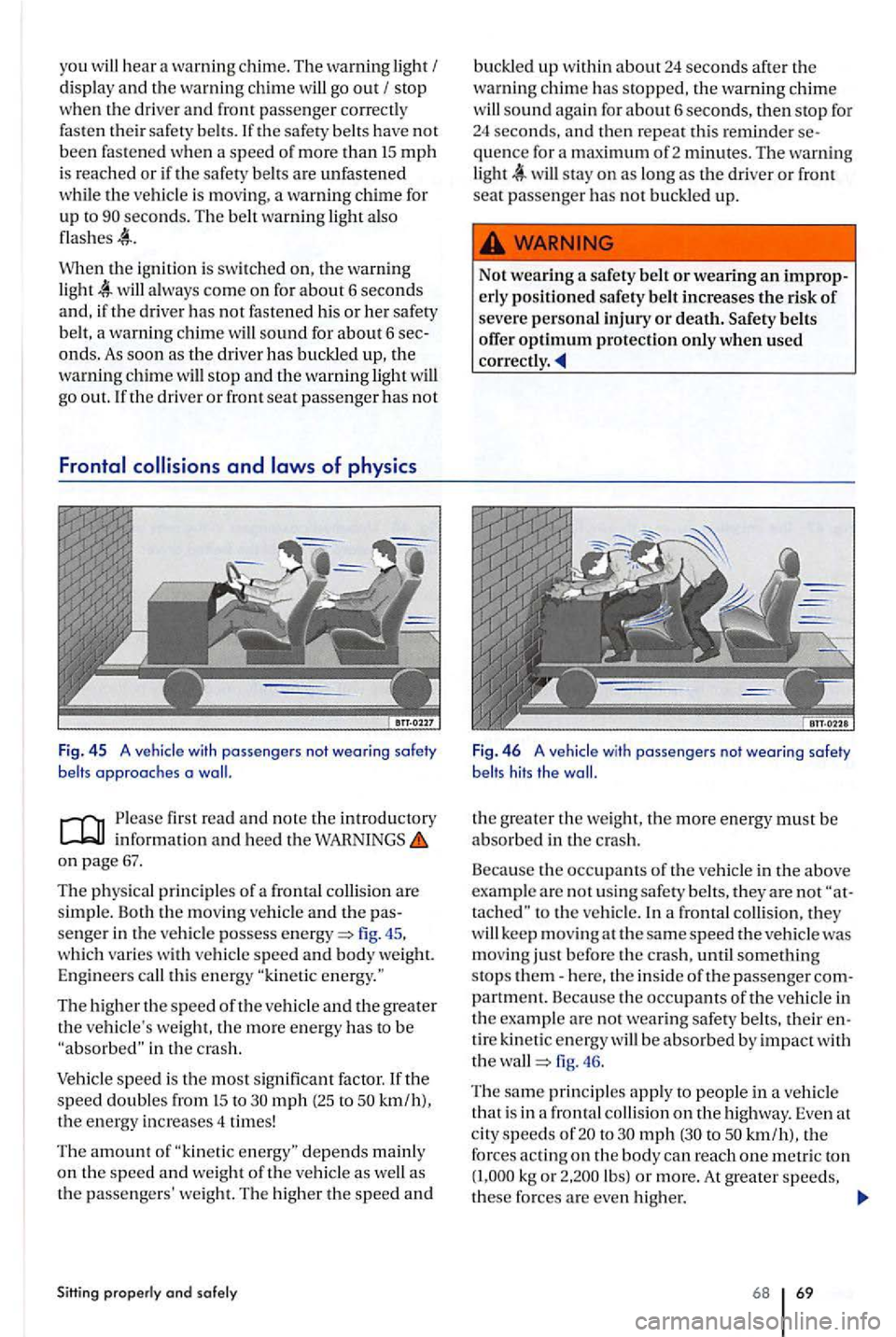
Fig. 4 5 A vehicle with passengers not wearing safety belts approaches a
on page 67.
The physical principles of a frontal
fig . 45.
which varies wit h vehicle speed and body weight.
Engineer s
The higher the speed of the ve hicle and the greater
the vehicle's weight. the more en ergy has to be in the cras h.
Vehicle speed i s th e most sig nificant factor. If the speed doubl es from to mph (25 to kmlh),
the energy increases 4 times!
The amount of as
the passengers' weight. The higher the speed an d
Sitting properly and solely
buckled up within about24 seconds after the
warn ing chim e has stopped, the warnin g chime sound again for about 6 seco nds, then stop for 24 seconds, and then rep eat this reminder sequence for a
Fig. 4 6 A vehicle with passengers not wearing safety
belts hits the
the greater the we ig ht, the more energy must be abso rbed in the crash.
Beca use the occupants of th e vehicle in the above
example a re not usi ng safety belts, they are not
kee p m oving at the same speed the vehicle was
mo vin g just before the crash, until somethin g
stops th em-here, the inside of the passenger com
partment. Because the occupants of the vehicle in
th e exa mpl e are not wearing safety belt s, th eir en
tire kine
tic energy be absorbed by impact with
the fig. 46.
Th e
same pri ncipl es app ly to p eople in a veh icle
th at is in a fron ta l
to mph to kmlh), the forces acting on th e bod y can reach one metri c ton kg o r lbs) or more. At grea te r speeds,
th ese forces are even hi ghe r.
68 69
Page 130 of 541
Windshield wiper lever
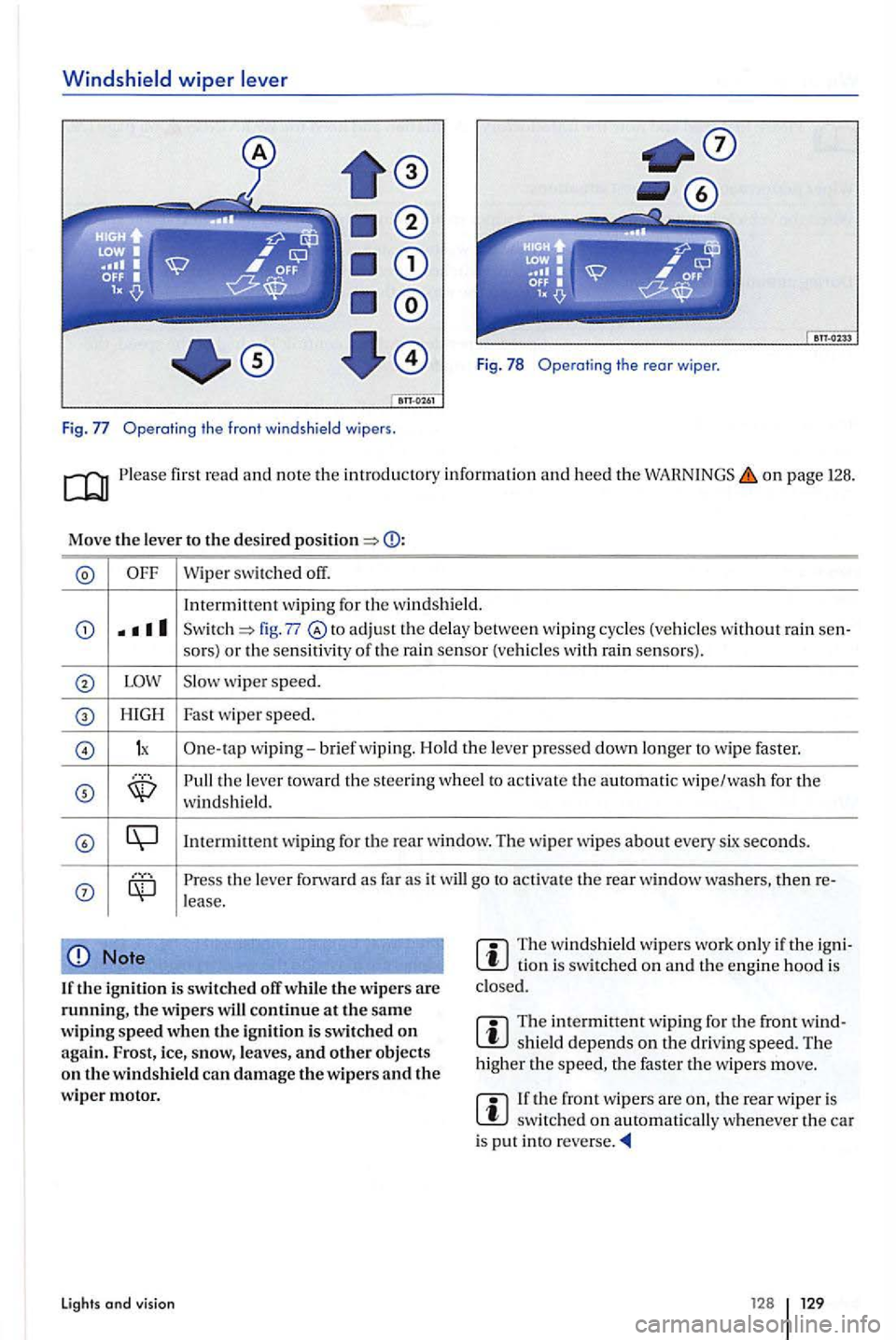
Fig . 78 Operating the rear wiper .
Fig. Operatin g t he front windsh ie ld wipers .
on page 128.
Move the leve r to t he des ired
Wipe r switched off.
In term itt
ent wiping for the w ind shield.
fig. 77 to adj ust the delay between wip ing cycles (vehicles wit hout rain sen-
so rs) or the sensit iv ity of th e rain sensor (vehicle s w ith rain senso rs).
w iper speed.
H IGH Fast wipe r speed.
1x One-ta p wip ing-brief wiping. Hold th e lever presse d down longer to wipe faster.
the le ve r towa rd t he stee ring whee l to activat e the au toma tic wipe/wa sh for the windsh ie ld.
the leve r forward as far as it will go to ac tiva te the rear window then re-lease.
Note
If the ig n it io n i s swi tc h ed off whil e the w ipers are th e w ipers continue a t the sa me
w ip ing sp eed when the ign ition i s swi tched on agai n.
The w in ds hield wipe rs work only if th e tio n i s sw itched on and th e engine hood is
clo sed.
Th e intermittent wip ing for the front shield depends on the driving speed. The
h igh er the the faster th e wipers move.
th e rear w ip e r is s witc hed on automatically w henever the car is pu t in to
Lights and visi o n 12 8
Page 133 of 541
The sensor cannot always recognize rain and activate the wipers.
Switch the wipers on manually when water on the windshield reduces visibility.
131, fig. 81 (arrow) regularl y and check the wipe r b lades fo r damage.
T o remove wax and coats of polish safely, we recommend usin g a n alcoho l-based s hi eld
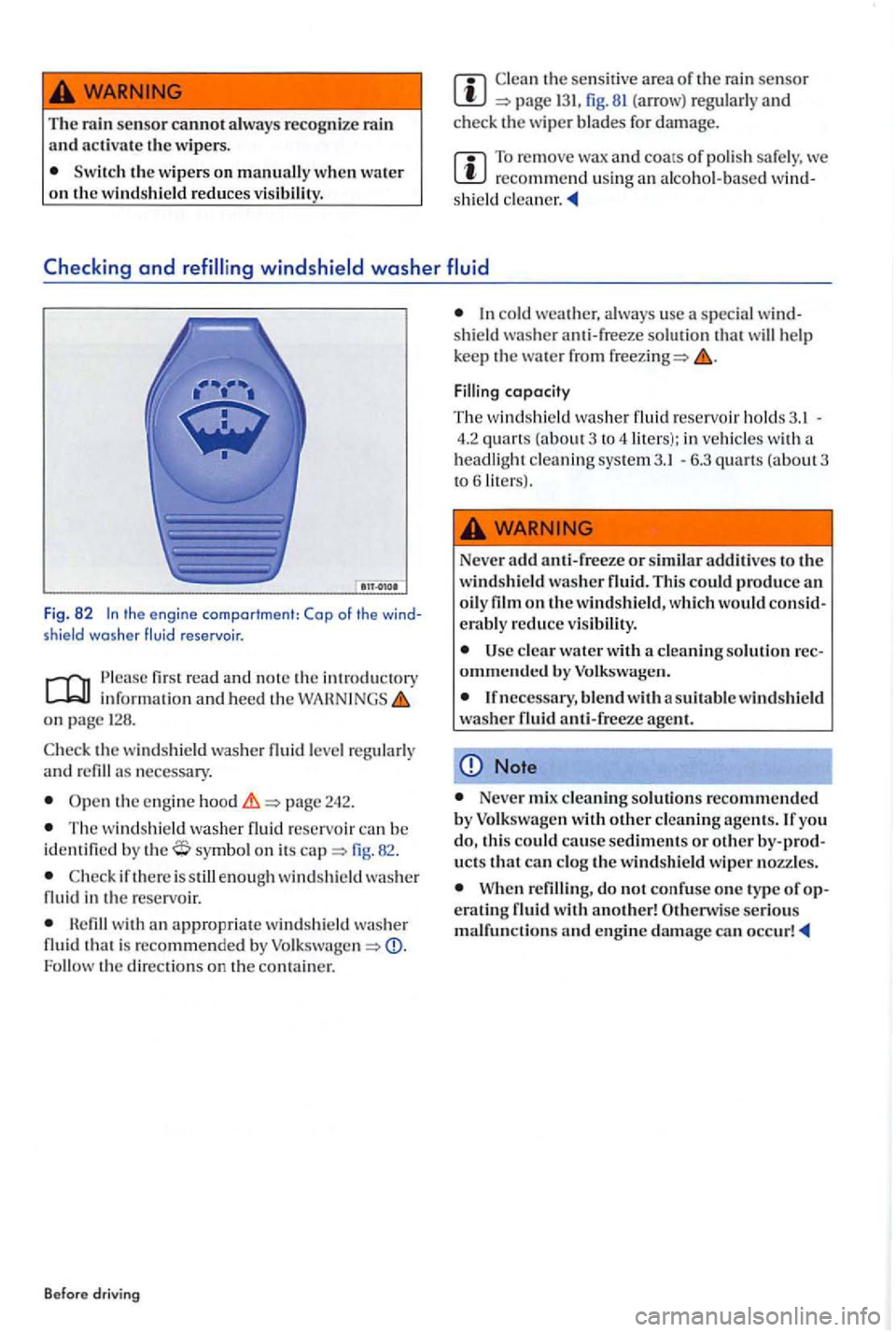
Fig. 82 the engine compartme nt: Cap of the shield washer fluid reservoir .
Ple ase first read and the int rod uctory information and heed th e on pa ge
the windshi eld was her necess ary.
page 242.
The wind shi eld washer fluid reservoi r can be identifi ed by symbol on its fig. 82.
H efill w ith an appropriat e windshie ld was he r
fluid i s recommended by Follow th e directio ns on the co ntainer.
Before driving
co ld weather. u sc a speci al
Filling capacity
The w indshi eld washer fluid reservoir holds 4.2 quarts (a bout 3 to 4 liters ): in vehicles with headlight cleaning sys te m - 6.3 quarts (about3 to 61it e rs).
Never add anti-freeze or simila r to the windshie ld was her fluid . This could produce
erabl y reduce v is ibility.
Note
Neve r mix cleaning solutions recommended by Volkswagen with other cl eaning agcnts.lfyo u
ucts that can clog the windshield wiper nozz les.
When refilling, do not confuse one type of
Page 141 of 541
Driving a
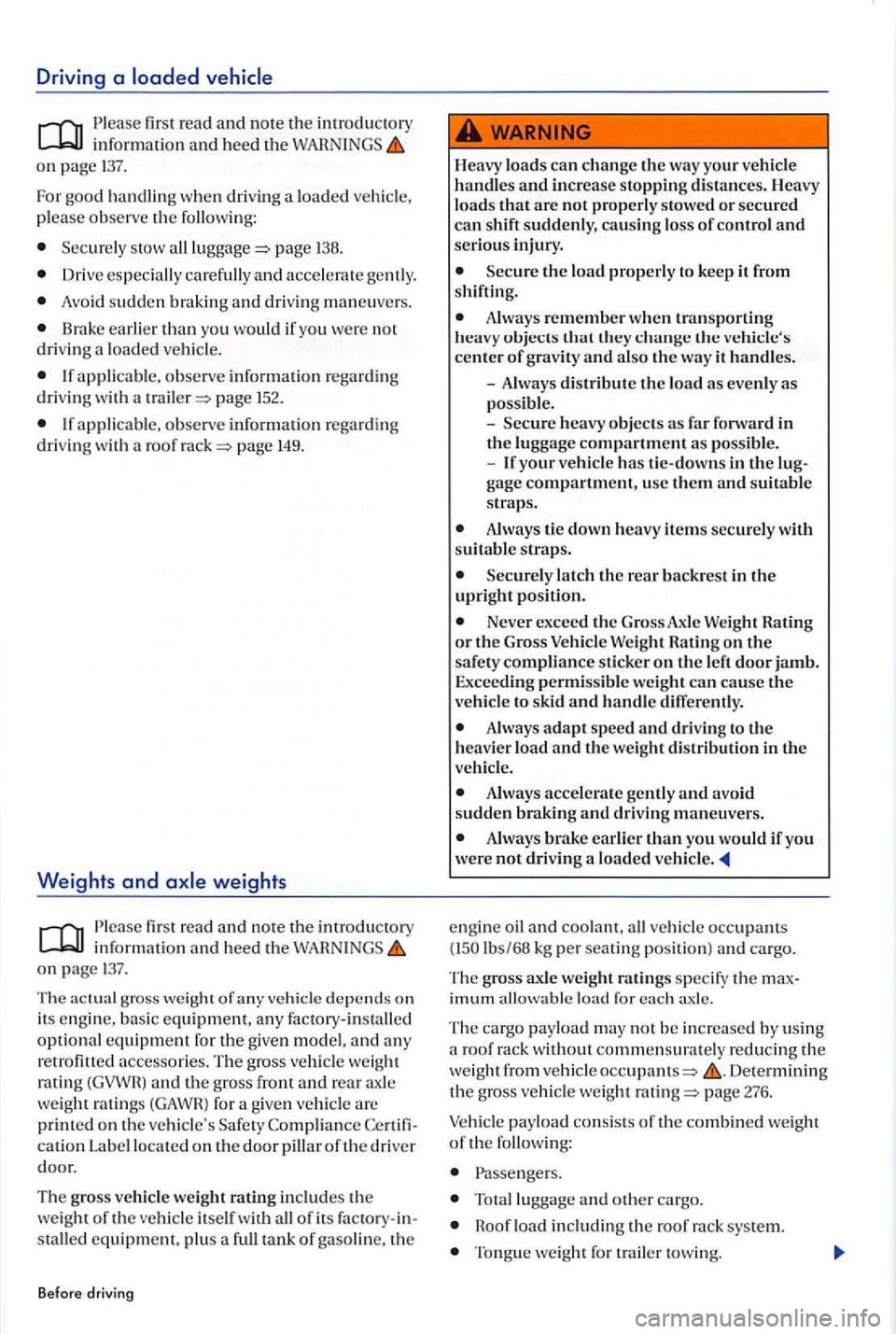
first read and note the introductory informat io n and heed the WARNINGS on page 137.
F
or good h andli ng w he n driving a loa ded ve hicl e,
please observe the following:
Secure ly stow page 138.
Dr ive especially caref ully and acce le rate gently.
Avoid sudd en braking and driv ing man eu ve rs.
Brake earlier than you wou ld if yo u were not
drivi ng a loa ded vehicle.
page 152.
If applicabl e, observe information rega rdin g driv in g w ith roof page 149.
Weights and
firs t read and no te the introductory information and heed the WARNINGS o n page 137.
The gross weight of any vehicle depends on its en gin e, basic equipment, an y factory- in stalled
optional equipment for the given model, and any retrofitted accessories. T he gross vehicle weig ht
rat ing
catio n Label loca ted on the door pillar of the dri ver
door.
The gross vehicl e we ight rating includ es the
weight of the ve hicle itself w ith of its tank of gaso line, the
Before driving
lo ads can ch ange the way your vehicle
h andles and incre ase stop ping dista nces. loads that are not properly sto wed or secured can shift suddenly, causing loss of co ntrol and serio us injury.
the load prope rly to keep it from
shifting.
A lways remember w hen tra nsp o rtin g
h eavy obje cts th at th ey vehicle's cente r of gravity and also the way it handles.
- Always dis
tribute the load as eve nly as
possible. -h eavy obj ec ts as far forward in
th e luggage compartment as poss ible. -If your ve hicle has tie-downs in the
Always tie down heavy items securely wit h
s uitable straps.
Secure ly latch th e rear backrest in the upright position .
Never excee d th e Gross Axle Weight Ratin g
o r the Gross Weight Ratin g on the safe ty compliance sti cker on the left door jamb. Exceeding permissi b le weight ca n ca use the
ve hicl e to skid and ha ndl e diff erently.
Always adapt speed and drivi ng to th e
h ea vie r load and th e we ight di stribution in the vehicle.
Always accelerate gently and avo id
s udd en braking an d drivin g maneuvers.
Always brake ea rlier than yo u wo uld if you were not drivin g a loaded ve hicle .
engine oil and coola nt, lbs/68 kg per seatin g position ) and ca rgo .
T
he gross axle weig ht ra tin gs sp ec ify th e imum allowab le load for ax le.
The cargo payload may not be increased by using
a roof rack without commen surat ely reducing th e
we ig ht from vehicle Dete rmin ing
th e gross vehicle weight page 276.
pay load cons is ts of th e co mbin ed w eight of th e following:
Passe ngers.
Tota l luggage and othe r ca rgo .
Roof load including the roof rack system.
Tong ue weig ht for trailer towing.
Page 142 of 541
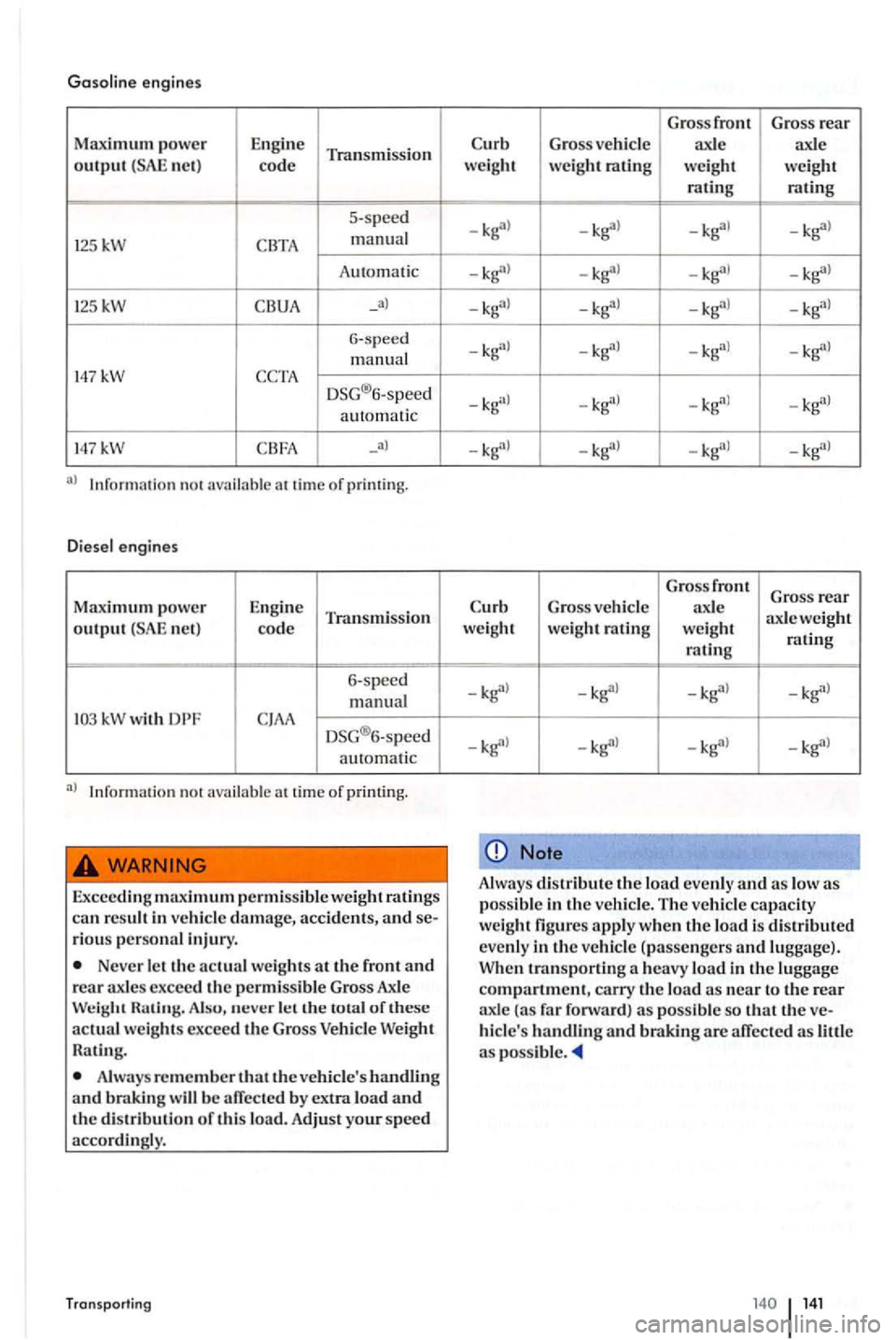
Gasoline engines
Maximum power Eng in e
Transmission output ne t)
code
5-speed
1 25kW
manual
A utomati c ---125kW _a)
6-speed
m anual
1
47kW cerA DSG® 6-speed autom atic
1 47kW
I nforma tio n not availab le
n et) code Transmission
6-speed manual
Exceed
ing m aximum permiss ibl e w eight ratin gs
ca n
Neve r let th e actual weights at the front and rea r ax les excee d th e permissible Gross Axle
remember that the ve hicle's handling and braking will be affected by extra load and the distributi on of thi s load. Adju st your s peed accordin gly.
Transporting
G ross front Gross rear
weig ht
weight ratin g weight weight
rating rating
--
---
-kg"l
Gross front
Gross rear G ross veh icle
axle
axle weight
weight weight rating weight
rating rating
-
Note
A
lwa ys distribute th e eve nly and as low as possib le in the vehicle. The ve hicl e capacity
weight figures appl y when the lo ad i s distributed
eve nly
141