steering VOLKSWAGEN GOLF PLUS 2012 User Guide
[x] Cancel search | Manufacturer: VOLKSWAGEN, Model Year: 2012, Model line: GOLF PLUS, Model: VOLKSWAGEN GOLF PLUS 2012Pages: 541, PDF Size: 98.86 MB
Page 94 of 541
Always make sure that the statu s signaled
b y the BAG light is correct
for the way that the front passenger seat is bein g
u sed.
The fine dust c reated when airbags deploy can cause breathing problems for people with asthma or other breathing conditions .
To reduce the risk of breathing probl ems , those wit h asthma or tion s should get fres h air right away by getting
o ut of th e ve hicl e or opening windows or doors.
If yo u are in a c ollision in which airbags de
ploy, wash your hands and face with mild soap and wate r b efor e eating.
Be careful not to get the dust int o your eye s, or int o any cut s or sc ratch es.
If the residue should ge t into your eyes, them with water.
Airbags that have deployed in a cras h must
b e replac ed.
Use only original equipment airbag s appro
ved by Volkswagen and installed by a train ed
technician who has the necessary tools and diagnosti c equipment to properl y re plac e any airbag on your veh icle and assure sys te m eff ec
ti ve ness in a cra sh.
Neve r pe rmit salvage d or recy cled airb ags t o
be install ed in your vehicle .
Advanced Airbag System components
first re a d and note th e introductory information and heed the
on pag e
vehicles equipped with the Adva nced Airbag Syste m , th e front passe nge r seat contains a who le
array of important Advanced Airbag compo nents
page 82. Because the front passe nger seat contains important Advanced Airbag System components. you must
take ca re to prevent it from bein g damaged . Damage to th e sea t may pre vent the Adva nced Airbag Syste m for the front passenger sea t from
doing its job in a cras h.
S ittin g properly ond solely
Alwa ys hold the s teering wheel with hands on outsid e of th e steerin g wheel rim at the 9 o 'clock and 3 o'clock positions to help re
duce
Neve r hold the steeri ng wheel at the 12 o'clock position or with your hands anywhere
inside
s ioner s are cla ssified as Material -special handlin g ma y apply.
applicable legal requir ements when
scra pping the vehicle or o f it s restraint sys tem, including airbag modules and safe ty belts
wit h pretensioner s. Auth orized Volkswage n
dealers and authorized Volksw agen Serv ice ties are familiar with the require ments, an d we rec
ommend that you have them p erform this serv ice for
The front Advanced Airbag System also includes:
sensors in the front of th e ve hicl e th at
m eas ure vehicle acce lera tion and dece leration to
p rovide informat io n to th e Advan ced Airb ag
System about the seve rity o f a crash.
An elec troni c co ntrol unit, with int egra ted
cras h sensors for front and sid e im pac ts. The con
trol unit w heth er or n ot to fire just the front air bag s ba sed on the information received
from the crash sen so rs. Th e control unit also whether the safety belt pre te n si oners
s hould be activate d.
A n Adva nced Air b ag. with gas genera tor, ins id e the steering wheel hub for th e driver.
An Adva nced Airbag. with ga s gene rator, in sid e the ins trum ent pan e l for th e front passe nger.
A we ig ht-sen sing mat unde r the upho ls tery paddin g of th e front passenge r seat cushion that
m eas ures the to tal weight on the sear. The infor
m atio n regi stered is sent co nti nuo usly to the elec-
92 93
Page 143 of 541
Luggage compartment
Introduction
In this section you'll fin d info rmation on the lowi ng:
Folding the backrest of the rear seat forward and back into place . . . . . . . . . . . . . . . . . . . . . . . . . . . . . . 143
Luggage compartment cover . . . . . . . . . . . . . . . . . . 144
Luggage compartment pass-through . . . . . . . . . . 145
. . . . . . . . . 146
bag hooks . . . . . . . . . . . . . . . . . . . . . . . . . 14 7
Luggage ne t . . . . . . . . . . . . . . . . . . . . . . . . . . .
. . . . 148
A lways stow h eavy objects in the luggage ment and mak e sure tha t th e rear se at back res ts
a re sec urely la tc h ed in their u pright positio n. strap s with the ric- dow n h ooks.
Never ove rload the ve hicle . Remember th at the hi cle load, well it is di str ibu te d , ca n
More info rmation:
A irbag pag e
page
page 137
Trail er page 152
Tires and pa ge 276
An open or unlocked luggage compartment poses sp eci al risks for children. C lose and lock the rear hatch and all doors when the vehicle is not in use. First, make certain that n o one is left insid e. Neve r leave your vehi cle unattende d or l et
childre n play around the ve hicl e, especi ally with the rear h atch left open. A child could crawl into the ve hicl e and pull the hatc h shut, b ecoming trapped and unable to ge t out. Thi s could cause severe or fatal injuries. A clo sed vehicl e can becom e very ho t or very cold, dependin g on the season. tures can quickly re ac h l eve ls that can cau se unconscio usness or death, particul arl y to sm all childr en . N eve r le t childr en play in or around the
veh icle .
Neve r let anyone ride in the lu ggag e partment.
Before driving
Unsecured or incorrec tl y stowe d item s can through the ve hicle, causing seriou s personal injury during hard brakin g or sh arp steering or in an acci dent. Loose item s can als o be s truck
and thrown throug h th e pa sse nger
Always sto w all objec ts sec ure ly in the
Always secu re objec ts prope rly w ith suit abl e
rop e or tightening s traps so that th ey cannot move into the deploy ment zo ne of the side o r
front airbag during a sudden braking or other driving maneu ve r.
Always kee p storage co mpartm ents clo sed
while driving.
Do not sto w hard , h eavy or sh arp objec ts
loo se in the vehicl e in open storage ments or o n to p of the dashboard.
A lways re m ove hard, heavy, or sharp objects
fr o m clothing and ba gs in the vehicl e int erio r
a nd sto w them secure ly in the lu ggage ment.
Tra nsportin g heavy objects causes the handling
c h arac teris tics of th e vehicl e to change and creases braking dista nces. Heavy loads wh ic h are n o t properly stowed or secured in tl1e vehicl e
can l ead to a loss of ve hicle control and cau se ri ous person injury.
T ra nsporting heavy item s ca uses the d ling characteris tic s of the vehicle to change by
s hiftin g the veh icle 's cen te r of g rav ity .
Alwa ys distribute ca rgo eve nly and as lo w as possibl e within the ve hicl e. The vehicl e capacity
we ig ht figures appl y w hen the load is distribute d
even ly in th e ve hicl e (p asse ngers and lugg age).
Alwa ys sto w lugg age and h eavy it e m s in the
lu ggage compartment as far fo n va rd of tl1e rear
axl e as poss ible and secure th em with priate strap s u sin g th e tic- dow n h ooks provided .
Page 175 of 541
Ignition key positions
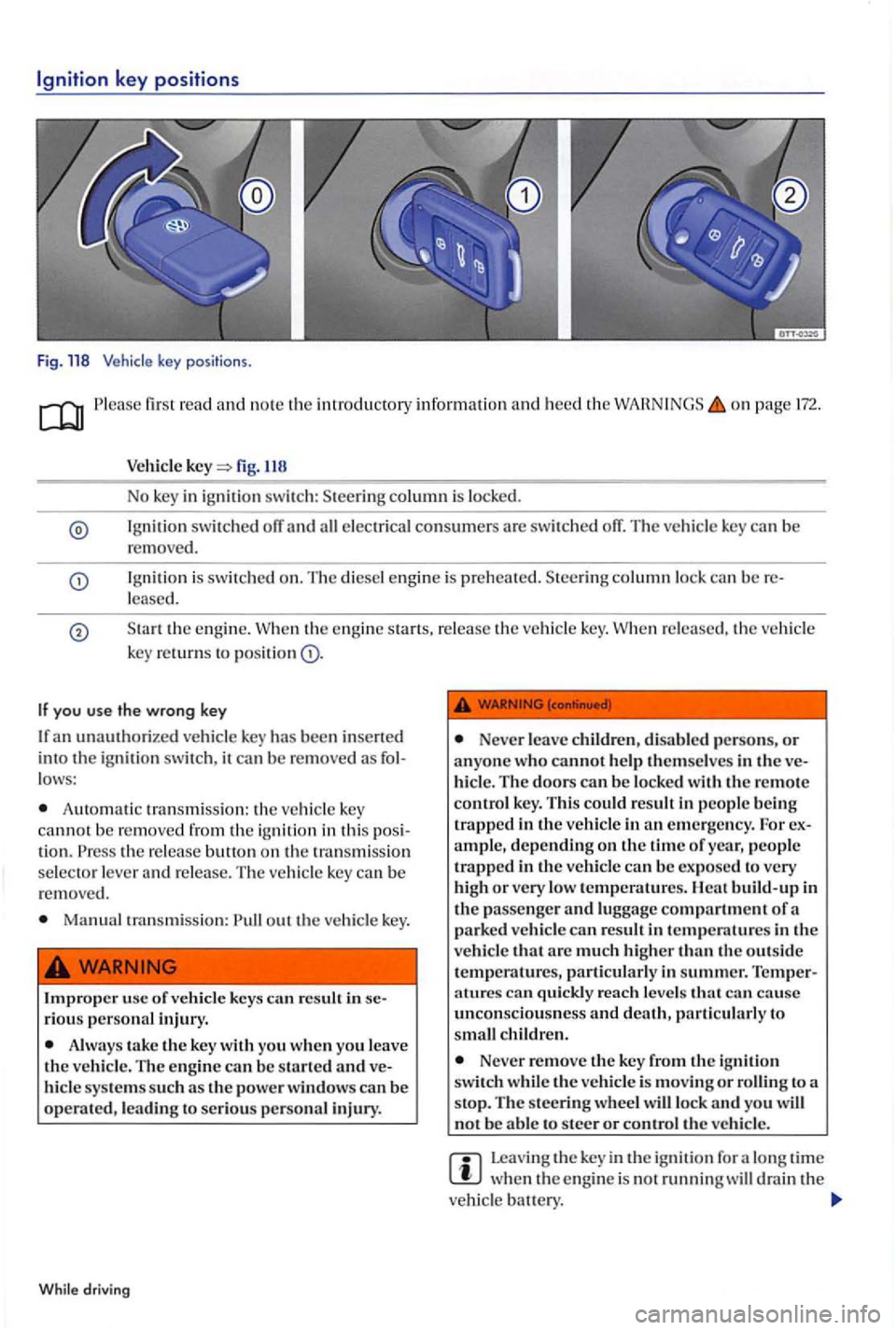
Fig. 118
Please first r ead and n o te the introduc tory information and heed th e on
fig. 118
No key in ig nitio n switch : column is lo cke d.
Ig nition switched e lec trical co nsumers T he ve hicl e key b e
r emove d.
Ig nition is switched on . Th e di ese l e n gin e is pre h eated. column lock b e leased.
th e e ng in e. the eng in e start s, relea se th e ve hicl e key. released . th e ve hicle
k ey return s to
If you use the w rong key
If an unauthorize d ve hicl e key been inserted
int o the ig niti on switch , it b e removed as lows:
transmi ssion: the ve hicle key cannot b e rem oved from the ig nit ion in thi s the rel ease button on th e transmissio n
se lec to r l eve r releas e. Th e ve hicl e ke y can be re m oved.
Manual tran smissio n: out the ve hicle key.
I
mproper usc of v e hi cle keys can result in rious perso nal injury.
the key with yo u w hen yo u leave the ve hicle . The engine can be started and hicle sy ste m s su ch a s the power windows can be operated, lea din g to serious personal injury.
Neve r lea ve ch ildren , d isabled pe rsons, or anyone who cannot h elp themselves in th e hicle. The doors can be locked with the remote
control key. This could result in peo ple being trapped in the ve hicle in
be exposed to very
hi gh or very low temperatures. eat build -up in the pas senger compartment of
atures can quickl y re ach leve ls cause unconscio usness and death , to
s mall children.
Never remove the key from the ig niti on
swi tc h w hile th e vehicle is moving or rolling to a stop. The steering wheel will lock and you will
not b e a ble to steer or control th e ve hicle.
Leavi ng the key in the ig niti on fo r a long time w hen th e en g in e is no t running will drain the
v ehicle batt ery.
Page 186 of 541
Shiftin g with Tipt ronic
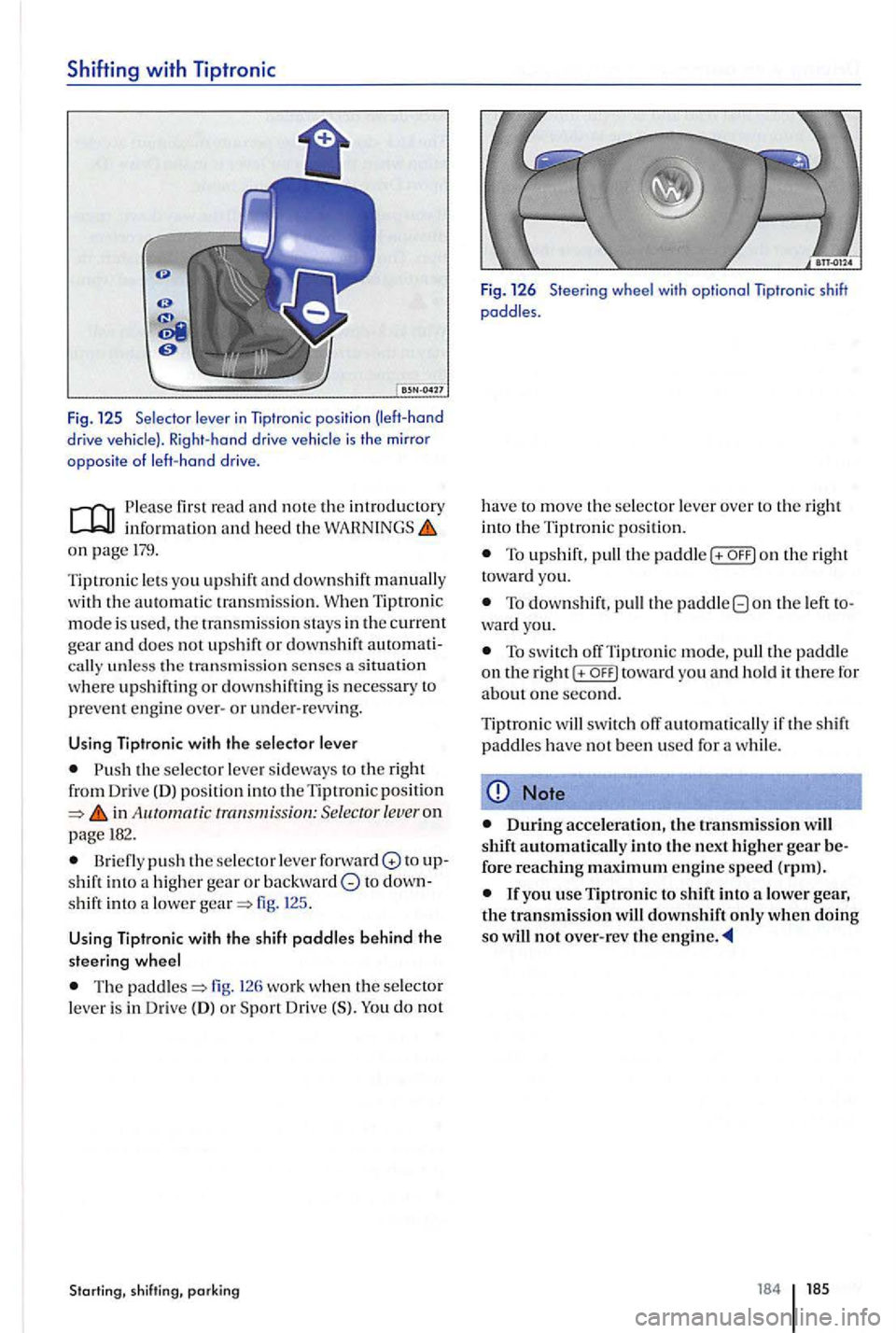
Fig . 125 Selector lever in
Please first read and note the introductory info rmati on and heed the on page 179.
Tiptronic l ets you upshi ft and down shift manu ally
w ith the automatic tran smission. W hen Tiptronic
m ode is use d, the tran smi ssion stays in the current gear and does no t upshift or downshift
Push the selector leve r sid eways to the right
fro m Drive (D) po siti on int o theTiptronic position Selector lever o n page 182 .
push th e se lector lever for ward to to fig.
Using Tip tronic with the s hift paddles behind the
steering w heel
Th e fig. wo rk whe n the selector
lever is in Dri ve (D ) o r
shift paddles.
have to move the se lector leve r over to the right int o the Tiptronic positi on.
To upshift , pull th e paddle (+ o n the right to wa rd you.
To downsh ift, pull th e paddle o n th e le ft
T o switch offTiptronic m ode, pull the paddle on the rig ht( + OFF) towa rd yo u and hold it there for about one second.
Tiptron
ic will s wi tc h off a utomatically if the s hift paddles have not been used for
Note
During acceleration, the transmission will
shif t automatically into the next higher gea r fore reaching maximum en g in e speed (rpm).
184 1 85
Page 189 of 541
Braking, stopping, and parking
Introduction
In this section yo u'll find inform ation on fo l
lowi ng:
Warning and indicator lights . . . . . . . . . . . . . . . . . 189
Park in g brake . . . . . . . . . . . . . . . . . . . . . . . . . . . .
.. . . . . . . . . . . . . . . 19 1
About t
he brakes . . . . . . . . .. . . . . . . . . . . . .. . . . 192
Bra king assistance sys tem s . . . . . . . . . . . . . . . . . . . . 194
Switching Anti-Slip Regulation (ASR) on ond off . . 196
Brake fluid . . . . . . . . . . . . . . . . . . . . . . . . . . . . . . . . . 196
T he brakin g support syste ms are Brake A ss is t E lec tro nic Differ e n tial Loc k (EDL). Anti-Slip
M ore information:
Trail er page
pag e
Tires and page 276
acce ssories, r epa ir s and modifi catio ns
brakes or worn brake pads can
ca use colli sio n and serious personal inju ry.
light s up in the
in strument cluste r di splay, w heth er a lo n e or to
ge ther with tex t message, immediat ely conta ct an authorized Volk swage n dea ler or authorized
Volkswag en Se rvi ce Faci lity to have th e brake pad s ch ecke d and , if necessary, re pl aced.
WARNING
improperly can cause se riou s pe rso nal
injury .
Never re m ove key from the ignition switch while vehicl e is m ov ing or ro llin g to a
s top. The steering w heel w ill lock and you not be
Never park the vehicle w here the ho t ex ha ust
syste m or catalyti c convert er could ignit e flam
mabl e mater ia ls, su ch as brus h , leaves , dry grass, spilled fue l, e tc .
Always apply th e parki ng brake whe n
p a rki ng your veh icle. Imprope r u sc of th e
p a rking bra ke can se rio usly injur e you and your passe nge rs.
Never use the
e m ergency . The stopping dista n ce is muc h
longer b ec au se onl y the wheels arc braked . use the foot brake to sto p the vehicle .
Never the throttl e from
th e e ng in e
th e automati c transmission is in gear. The ve hicle will start t o move as soon the e ngine speed ev en i f th e brake is on.
Never leave childr en or anyo ne w ho canno t
h elp them se lve s beh in d in the vehicl e. They could re leas e the brak e move the gear selector leve r or shift , wh ic h could cause th e vehicle to start m ov ing. Thi s ca n lea d
to a cras h and seri ous personal injuri es.
Always take the key with you when yo u
leave th e ve hicle . The engine ca n be started and ve hicl e sys te m s s uch as the power wind ows can
b e operate d , le ad ing to seri ous perso nal injury.
Neve r leave childr en , di sabled perso ns, or a nyon e who cannot h elp them se lves in the vehicl e. T he doors can b e lo cke d wit h the re mote contro l ke y, trapping passe nge rs in the
ve hicle in an emerge ncy. For exa mpl e, dep ending on th e tim e of year, people trappe d in the
ve hicle can be ex pose d to very high or very temperatures. Heat build -up in the passenger and parked vehicl e result in temperatu res in the ve hicl e th at arc much hi gher than the outsid e tempe mtu
res, partic ul arl y in summer. T emperatures ca n
qui ckly reac h le v e ls that can cause uncon
scio usn ess ch ildr en.
Page 195 of 541
Braking assistance system s
fir st read and n o te the introductory information and heed the
on page
T he and EDL braking tance system s work onl y w he n th e engine is ning. These sys te m s can sig nificantl y improve
vehicle namics to help reduce the probability of skidding and loss o f vehicl e control. works only w hen the engine is running. driving situations, including w hen the veh icle is beginning to spin (yaw) out of control.
gin e power and by providing steering assistance to help hold the ve hicle on the driver's intended
course.
has limitation s.
will not always be able to help out under all tions you m ay come up against. For example, may no t a lways be able to hel p you mas te r tions w he re there is sudde n change in the
cannot perform the sa me
way it would on a dry surface. the vehicl e
cornering. ularly on winding road s, cannot always deal as
e ffectiv ely wi th diffi cult drivin g situations it can
a t lower speed s. When towin g a is not able to help you regain control as it would if yo u were not towing a trailer.
Alway s
adjust your speed bility, road, cannot overcome the laws of phys ics, increa se the available
stead, improves the possibil ity o f keeping th e
vehi cle under control and o n th e road during treme maneuvers b y using th e driver's s teerin g puts to help keep the vehicle going in the int ended direction .lf you a re tra velin g at a speed that causes yo u to run off th e road before can provide any
EDL , and XDL syste m s (sec be lo w). is switc hed on all the tim e. certain situati ons
w he n you need less traction or additional tract ion cannot be achieved, you can swit ch off by pressing page 196, fig. l28. B e
s
ure to switch ASR on again when you no longer
need less traction.
Anti-lock
brake system (ABS)
ABS helps to keep the wheels from l ocking up and helps to maintain t h e driver's ability to steer and control the vehicle . Thi s means the vehicle is less lik ely to skid, even during hard
th e brake pedal down hard
Do not the brake pedal or letup on it!
S teer the vehicl e while pushing down hard on the brake pedal.
ABS sto ps working if you re lease or let up on th e brake.
When is doing i t s job, you will notice
noise. T he stopping di stance may even be lo nger, for instance, when dri ving on
pin g distances.lfyou press the pedal very quickly, BAS detects an e m ergency situ ation.
pedal! BAS
s w itches off automaticall y as soon
reduces en gine power d irected to spinning wheels and adjus ts power to the road conditions.
Eve n under poor ro ad conditions,
Page 200 of 541
Efficient driving
Please information and heed the on page 198.
Shifting faster
As a rule, the following applies: The higher gear is
a lways the more efficient gear. The rule of thumb for most vehicles is to drive in 3rd gear at mph f km/h, 4th gear at 25 mph f km/h, and 5th gear at mph f km /h.
If
and driving conditions permit, gears when upshifting also saves fuel.
Do
not run the gears up to their limit.
mati c transmissions .
Vehicles with gear recommendation aid in fuel fic ient dri ving by indicating the optimum time to shift gears.
livery to the engine is interrupted, which lowers
fuel consumption.
T herefore, when nearing a red stop light , for s tanc e, allow the vehicle to coast without using the accelera tor. Press the clutch pedal and release it only if the v ehicle is moving too slowly or the coasting distance is too long. The engine will then continue to run at idl e.
In situati ons
where the vehicle will be stopped for
a longer period of time, such as at a train cros sing,
physically switch off the engin e.
D efens ive driving
and with traffic
Fre
quent braking and accel eration increases fuel consumption sign ific antly. Just by driving sivel y and keeping a su fficiently large distance away fro m the vehicle in front of you can make up for the speed fluctuation s caused by taking your foot off the accelerator. Active braking and ating is then not necessarily required.
system information
The power stee ring syste m i s not hydrauli c.lt is an electro-mechanical syste m. The advantage of this
s te ering system is tha t no hydra uli c hoses, draulic oil, pumps, filters or other parts are quired . Th e e lectro-m echanica l system is more fue l effi cient. A hydraulic system requires constant oil pressure in the syste m; an electro -mechanical
s teerin g sys tem, however, needs power only whil e
s teering.
Th e el
ectro-mechanical power steering
chanical power steering works only when the gin e is running.
and smooth driving
Consistency is more important than speed. The more smoothly yo u drive, the less fuel the vehicle consumes.
When driving on the highwa y or freeway, a
stantly accelerating and braking. you can r each your destinatio n just as quickly by driving at a moderate, but steady speed.
The c rui se control syste m can a ssis t in
sciou s manner.
Some dev ices can increase fuel consumption when activated (examples):
C limate control air conditioning system:
trasting temperatures, it requires a large amount of energy, which is generated by the e ngin e. T he
tr emely different from that of the outside
windows increase fuel consumption.
Switch off seat heating once it has served its
purpose.
Sw itch off the windshield and rear window
Malfunctioning engine control.
Driving in the mountains.
Towing a trailer .
page 257
Towing and page 357
Turning the steering wheel is very hard when the power steering system is not working. This makes it harder to control the vehicle.
steering works only when the engine is running.
Never let the vehicle coast with the engine switched off.
Never remove the key from the ignition
switch while the vehicle is moving or rolling to a
stop. The steering column will lock and you will be unable to control the vehicle.
Page 201 of 541
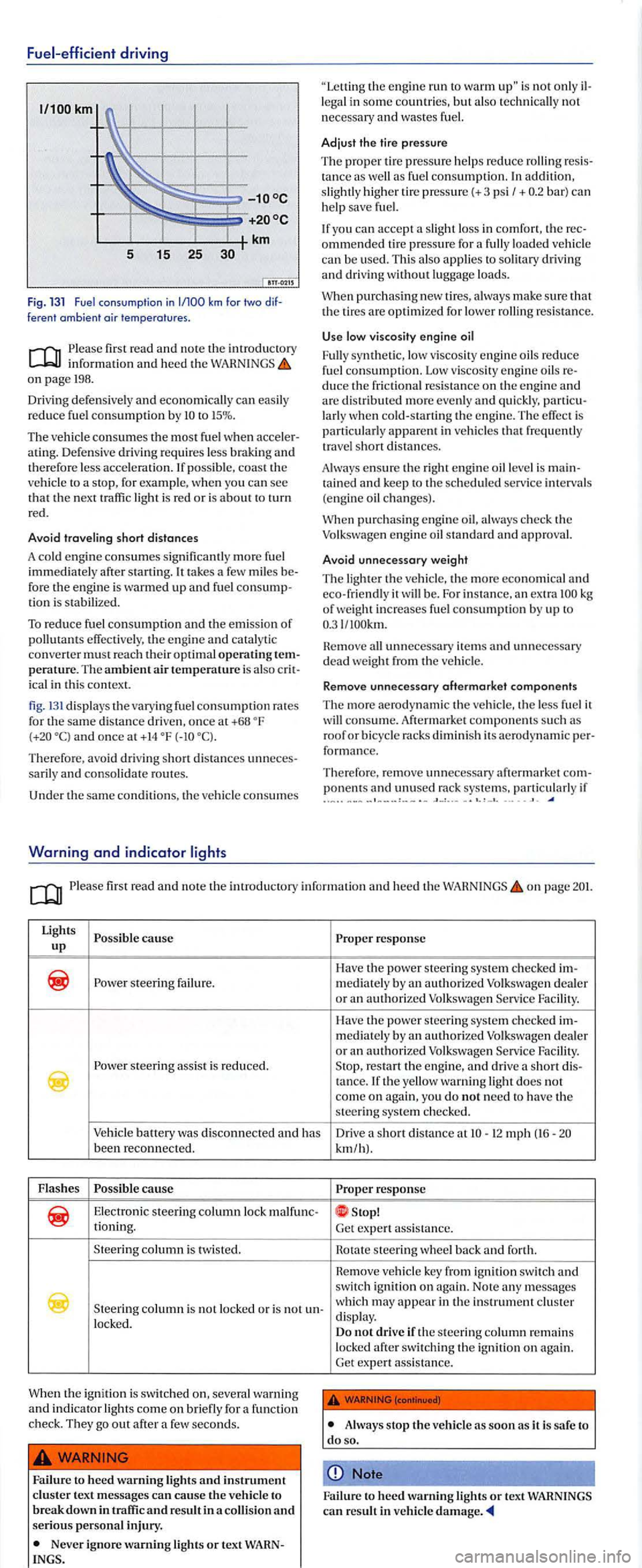
Fuel-efficient driving
Fig. 131 Fuel consumption in ferent ambient air temperatures .
info rmation and heed the on page 198.
Dri vin g defensive ly and economically can easily
r educe fuel con sumption by to 15 % .
The ve hicle consu mes the most fu el w he n atin g. D efe nsive dri vin g require s less brakin g and therefore less accelerat ion. If possib le, coast the ve hicle to a sto p, for exa mple, when yo u ca n see th a t th e next traffic ligh t is red or is about to turn
red.
Avoid traveling short distanc
es
A cold engine consumes sig nificantl y more fuel
imm ediately after sta rtin g. It take s a few miles fore the engi ne is warm ed up and fuel tion i s stabili zed.
To reduce fuel consumptio n and the emission of pollutants effect ive ly, the e ng in e and ca talytic
conve rter must reach th eir optimal operating
ica l in thi s context.
fig. 13 1 displays the v a ry ing fuel consumption rates
for the same d istance dri ven, once at +68 and once at + 14
th e e ngin e run to warm is not o nl y lega l in some co untries, but also technicall y not
n ecessary and wastes fu el.
Adjust the tire pres sure
T he prop er tir e
pressure help s reduce rollin g tance as well as fue l co nsumption. In additi on ,
slig htl y higher tire pressure(+ 3 psi I+ bar) ca n
h e lp save fuel.
If you ca n a ccept a slight los s in comfort, the ommend ed tir e pressure for a fully loade d ve hicl e
ca n be used. This als o applies to so litary dri vin g and driv ing withou t lu ggage loa ds.
When purchasing new t ires, alway s ma ke sure th at
th e tires are optimi zed for lower rollin g resis tance.
Us e low viscosity engine oil
F ull y sy nth e
tic, low viscosity e ngine oils reduce
fuel consumption. Low viscosity e ngin e oils duce the fric tional res istance on th e engine and are dis tributed m ore evenly and qui ckly, larly w hen co ld -s tarting the engine. The effect is parti c ularl y apparent in vehicles th at frequentl y
tra vel s hort dis tan ces.
A lways ens
ure th e righ t e n g in e oil leve l is ta in ed and keep to the sc h edul ed serv ice interva ls
(e ng ine oil ch an ges).
W
hen purch asing e ngine oil, always ch eck th e Volksw agen en gine oil standard and approval.
Avoid unnecessary weight
The lighter th e ve hicl e, th e more economica l and ceo-friend ly it w ill be. For in stance, an extra
H e m ove
consum e. Aftermark et co mponents s uch as
ro of or b icycle racks dimin is h its aerod yn a m ic fonnan ce.
Th erefo re, re
mov e un necessary aftermark e t ponents and unused rac k systems, parti cul arly if ....... -
fir st read and note th e introductory informa tion and h ee d th e WAHNINGS page
response
Ha ve the power stee rin g sys te m ch ec ked ste eri ng failure. mediatel y by an authori zed Volk swag en deale r
o r a n authorized Volk swagen
Fac ility. steeri ng ass is t i s reduced. re start the e n gine, and dri ve a sh ort tan ce. If th e yello w warning light does not
c o m e on again, you do not need to have th e
s te ering syste m ch ec ke d .
Vehicle battery was di sconnected and has Drive a short distan ce at 12 mph been reconnec te d . km/h).
F lashes re sponse
Elec troni c steering column lo ck malfunc -
which m ay appea r in the in strument clu ste r
di sp lay. loc ke d.
W
hen the i g nit ion is switc h ed on, seve ra l wa rnin g and indicator lights come on bri efly for a f un ction ch e ck . T hey go out after a few seconds.
Failure to
heed warning light s and in strument cluster text m essages can cause th e vehicl e to break down in t raffic and result in a collisio n and seriou s personal injury.
Neve r igno re warning lights or tex t
Do not dri ve if th e s teerin g co lumn remains
l ocke d switch in g th e ig niti on on aga in.
Ge t expert assis ta nce.
Alwa ys sto p the vehicl e as soon as it is safe to do so .
Note
Failur e to heed warning lights or tex t WARNINGS can res ult in vehicl e damage
Page 202 of 541
Steering system information
first read and note the introductory informatio n and heed the on page
To help m ake it more diffi cult to s teal your ve hicl e,
you sh ould always make sur e the steering co lumn is locked before leaving the ve hicle .
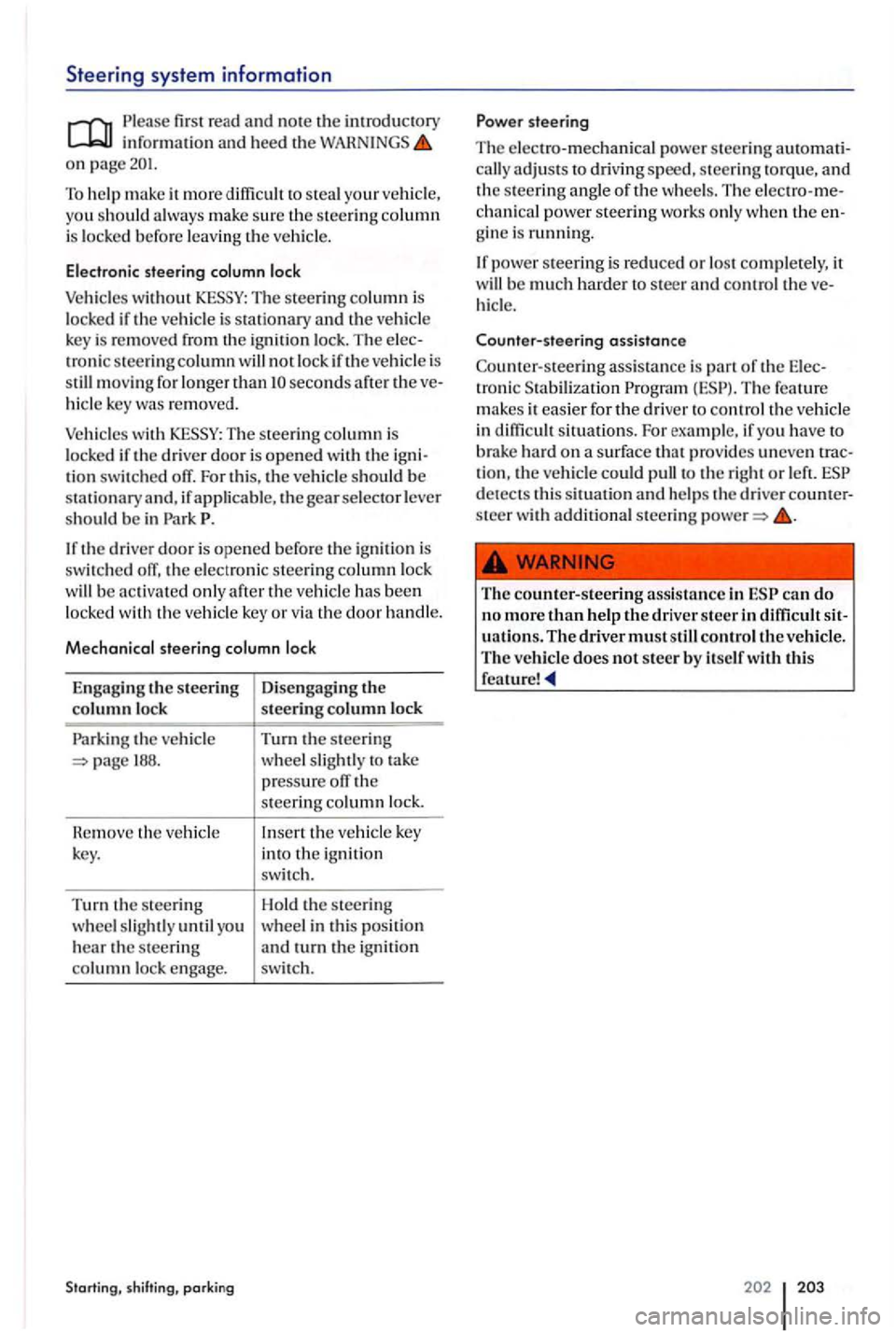
Electronic steering column lock
Vehicles with o
ut The s teering column is
l ocked if the vehicle is stationary and the vehicle
k ey is removed from the ign ition lock. The elec
tr onic s teering column will not lock if the vehicl e is
s till mov in g for longe r than seconds after the ve
hicl e key was re moved.
Vehicles with
Th e s teering column is
l ocked if the dri ver door is ope ned with the ignitio n switch ed ofT. For this, the ve hicle should be
s tationary if applic abl e, the gear selector leve r
s h ould be in
If the driver door is opened befo re the ign ition is
sw itch ed
188.
H e
move th e ve hicl e
k ey.
Turn th e s teering
w heel s lig htl y until you
hear the steering
column l oc k en gage.
Starting, shifting , parking
Disengaging the
steering column lock
Turn the s teering
whee l s lightl y to take pressure ofT the
s teerin g column lock.
In
sert the ve hicl e key
into the ignition swit ch .
Ho ld th e s teerin g
wheel in thi s pos ition
and turn the ignition switch.
steering
The e lectro-mechanical power steering auto m ati
c ally adjusts to dri ving speed, steering torque , and the steering angle of the wheels . The e lectro-me
c hanical power steering work s only w hen the en
gine is running.
If power steering is reduced or lost comple tely, it
will b e much harder to steer and co ntrol the ve
hicl e.
Counter-steering
assistance
T he feature
m akes it easier for the dri ver to control the vehicle
in difficult situation s. For exampl e, if yo u h ave to
brak e h
ard on a surface that provides uneve n t rac
tion, the ve hicle could pull to the right or l eft. detect s th is situation and h elps th e dri ver counter
s teer with additi onal steerin g
The counter-steering ass istance In
Page 218 of 541
Function and operation
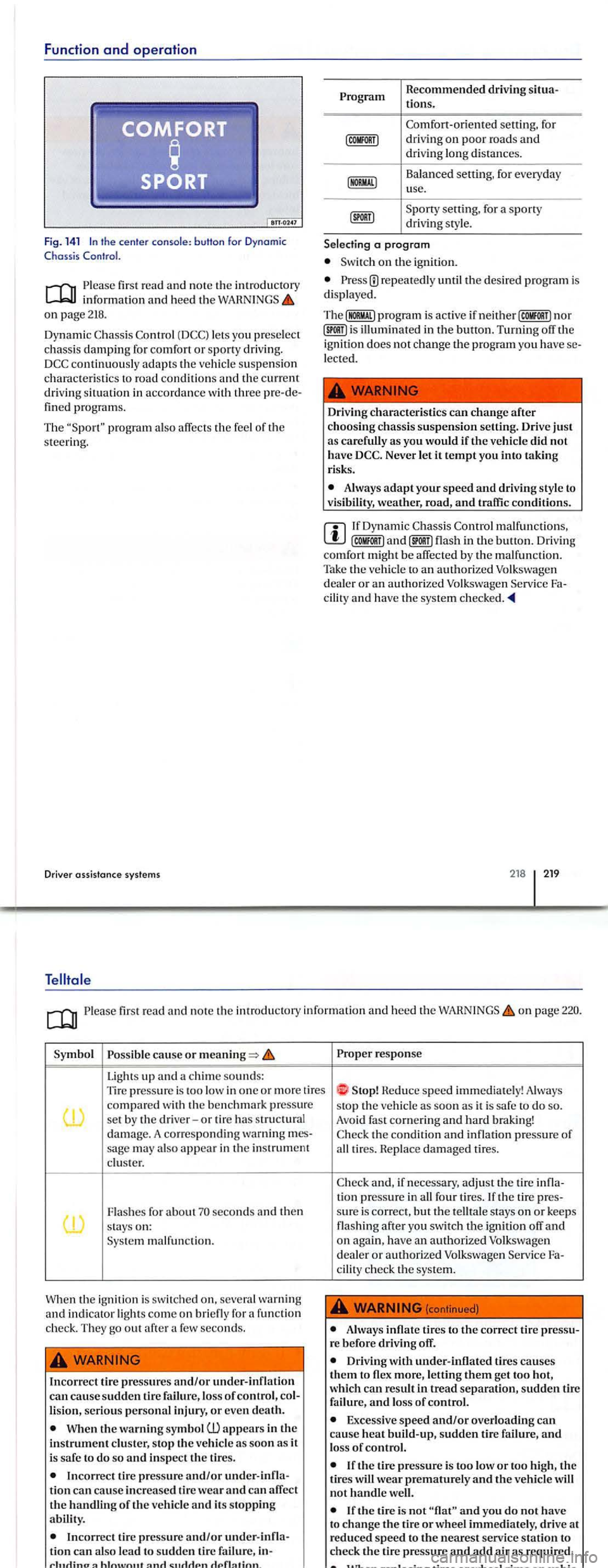
Fig. 141 In the cen te r co nsole : b uHon fo r Dynomic C hoss is
Please read and note th e introductory inf ormati on and hee d t he on page 218.
D ynamic C hassis Control lets you prese lec t
chassi s dam ping for comfo rt or sporty driving .
pro grams.
T he
program also affec ts th e feel of the steering .
Driver assis tanc e systems
Program R
ecommended driving
Comfort- oriented setting, for driving on poor roa ds and driving lon g di sta nces .
Balanced
setting, for everyday
u se.
a program
o n th e ignition.
re p ea te dl y th e des ired progra m is
disp laye d.
Th e
nor illumin ated in the button. Turning off the
i g nition does no t chan ge the program you have lec ted.
Driv ing characteristics can
change after choosing chassis suspension setting. Drive just as carefully as you would if the vehicle did not
h ave Neve r let it tempt you into takin g
risks.
Always adapt your speed and driving style to
visibil and traffic condit ions.
malfunctions , flash in the button. Driving comfo rt might be affec te d b y th e malfunction. Tak e th e ve hicl e to an authorized Volk swage n
d ea ler or an authorize d Volkswa gen
218 219
Please read and note the introdu ctory information and h eed the WARNINGS on page
Poss ible cause or
Lights up and a chime sounds: Tire pressure is too in one o r more tires compa re d wi th th e ben chmark press ure
se t by the driver-or ti re has stru ctural
damage. A co rre spo ndi ng warning
sa ge may also app ear in the instrument cluster.
Fla s hes for abo ut seconds and then stay s on: malfun ction.
W h
en the ignition i s s witched on, severa l warning
a nd ind icato r light s come on briefly fo r funct ion
c h ec k. Th ey go out after a few seco nds.
Incorrec t lire pressures and/or under- inflati on can cause sudden tire failure , loss of control , lisio n, seriou s personal injury, o r even death.
When the warning symb ol
In correc t tir e pressure a nd/or tio n can ca use incre a se d tir e wear and ca n affe ct the handling of th e ve hicle and its stoppin g
Incor rec t tir e pressure and/or ti o n can also lead t o sudden tir e fa ilu re,
Proper response
Heduc e speed imm ediately! Always
s t
op th e vehicle as soon as it is safe do so . Avoid fas t cornerin g and hard braking!
tion press ure in all four tires. If th e tir e
cilit y c heck the sys tem.
(continued)
Always inflate tires to the correct tire re befor e drivin g off .
Driv in g with under-inflat ed tire s causes them to flex more, letting the m get too hot,
which can
Excessive speed and/or over loading can
ca use heat build -up, sudden tire failure , and lo ss of control.
If the tire pressure is too low or too high , th e tires wear prematurely and the vehicl e will
not handl e we ll.
If the tire is not and yo u d o no t h ave
t o ch an ge the tire or whee l immediat ely , drive a t
reduced spee d to the nearest serv ice station to
c h eck th e tir e pressure and add