tires VOLKSWAGEN GOLF PLUS 2012 User Guide
[x] Cancel search | Manufacturer: VOLKSWAGEN, Model Year: 2012, Model line: GOLF PLUS, Model: VOLKSWAGEN GOLF PLUS 2012Pages: 541, PDF Size: 98.86 MB
Page 189 of 541
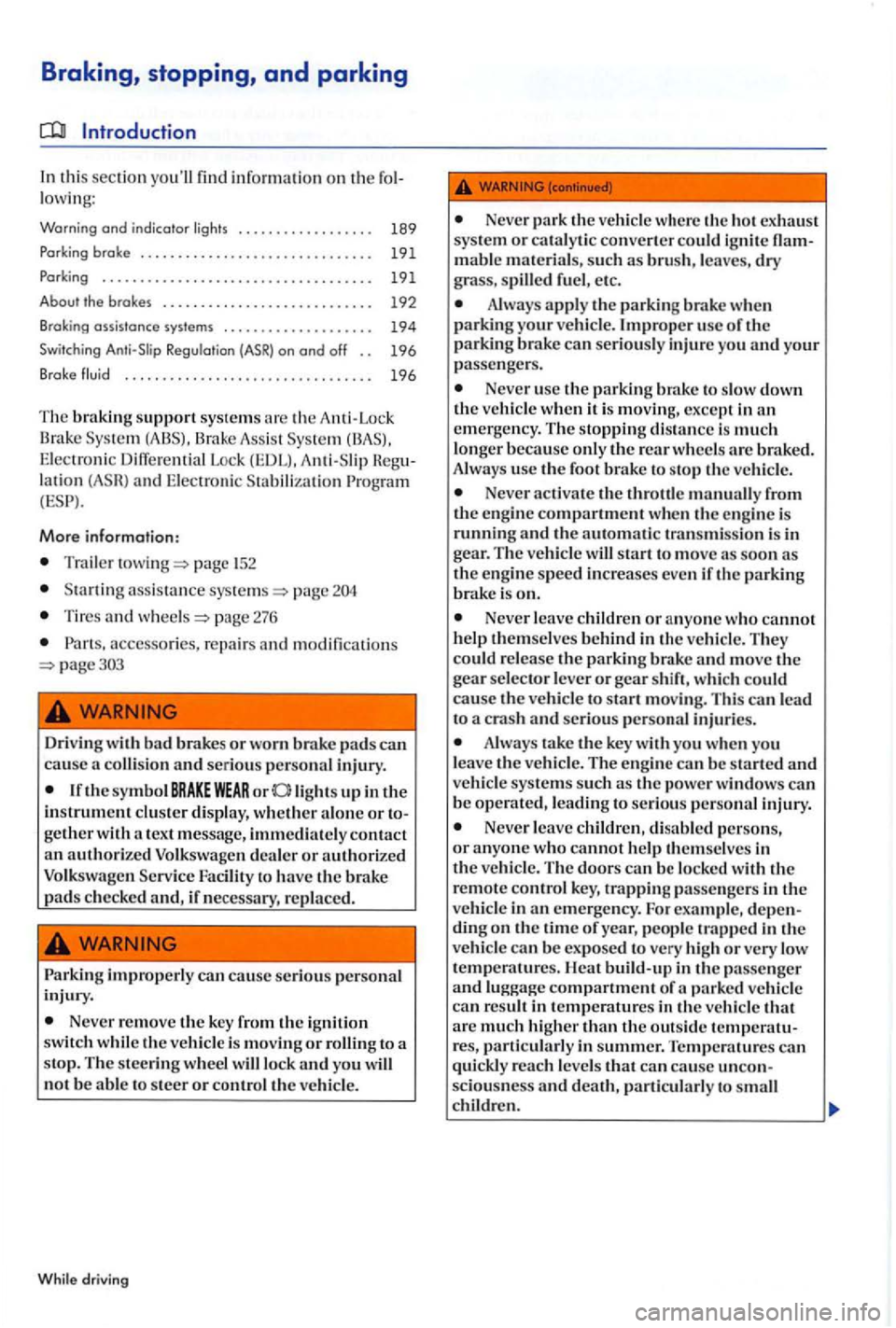
Braking, stopping, and parking
Introduction
In this section yo u'll find inform ation on fo l
lowi ng:
Warning and indicator lights . . . . . . . . . . . . . . . . . 189
Park in g brake . . . . . . . . . . . . . . . . . . . . . . . . . . . .
.. . . . . . . . . . . . . . . 19 1
About t
he brakes . . . . . . . . .. . . . . . . . . . . . .. . . . 192
Bra king assistance sys tem s . . . . . . . . . . . . . . . . . . . . 194
Switching Anti-Slip Regulation (ASR) on ond off . . 196
Brake fluid . . . . . . . . . . . . . . . . . . . . . . . . . . . . . . . . . 196
T he brakin g support syste ms are Brake A ss is t E lec tro nic Differ e n tial Loc k (EDL). Anti-Slip
M ore information:
Trail er page
pag e
Tires and page 276
acce ssories, r epa ir s and modifi catio ns
brakes or worn brake pads can
ca use colli sio n and serious personal inju ry.
light s up in the
in strument cluste r di splay, w heth er a lo n e or to
ge ther with tex t message, immediat ely conta ct an authorized Volk swage n dea ler or authorized
Volkswag en Se rvi ce Faci lity to have th e brake pad s ch ecke d and , if necessary, re pl aced.
WARNING
improperly can cause se riou s pe rso nal
injury .
Never re m ove key from the ignition switch while vehicl e is m ov ing or ro llin g to a
s top. The steering w heel w ill lock and you not be
Never park the vehicle w here the ho t ex ha ust
syste m or catalyti c convert er could ignit e flam
mabl e mater ia ls, su ch as brus h , leaves , dry grass, spilled fue l, e tc .
Always apply th e parki ng brake whe n
p a rki ng your veh icle. Imprope r u sc of th e
p a rking bra ke can se rio usly injur e you and your passe nge rs.
Never use the
e m ergency . The stopping dista n ce is muc h
longer b ec au se onl y the wheels arc braked . use the foot brake to sto p the vehicle .
Never the throttl e from
th e e ng in e
th e automati c transmission is in gear. The ve hicle will start t o move as soon the e ngine speed ev en i f th e brake is on.
Never leave childr en or anyo ne w ho canno t
h elp them se lve s beh in d in the vehicl e. They could re leas e the brak e move the gear selector leve r or shift , wh ic h could cause th e vehicle to start m ov ing. Thi s ca n lea d
to a cras h and seri ous personal injuri es.
Always take the key with you when yo u
leave th e ve hicle . The engine ca n be started and ve hicl e sys te m s s uch as the power wind ows can
b e operate d , le ad ing to seri ous perso nal injury.
Neve r leave childr en , di sabled perso ns, or a nyon e who cannot h elp them se lves in the vehicl e. T he doors can b e lo cke d wit h the re mote contro l ke y, trapping passe nge rs in the
ve hicle in an emerge ncy. For exa mpl e, dep ending on th e tim e of year, people trappe d in the
ve hicle can be ex pose d to very high or very temperatures. Heat build -up in the passenger and parked vehicl e result in temperatu res in the ve hicl e th at arc much hi gher than the outsid e tempe mtu
res, partic ul arl y in summer. T emperatures ca n
qui ckly reac h le v e ls that can cause uncon
scio usn ess ch ildr en.
Page 190 of 541
Note
Always be careful when you park in areas with parking barriers or high cmbs. These vary in h eigh t and could damage your bumper andrelated parts ifLhe front of your ve hicl e hit s a barrier or curb that is too high while you are getting into or out of a parking spot . To help prevent damage, stop before the tires of your vehicle touch a parking barrier or curb.
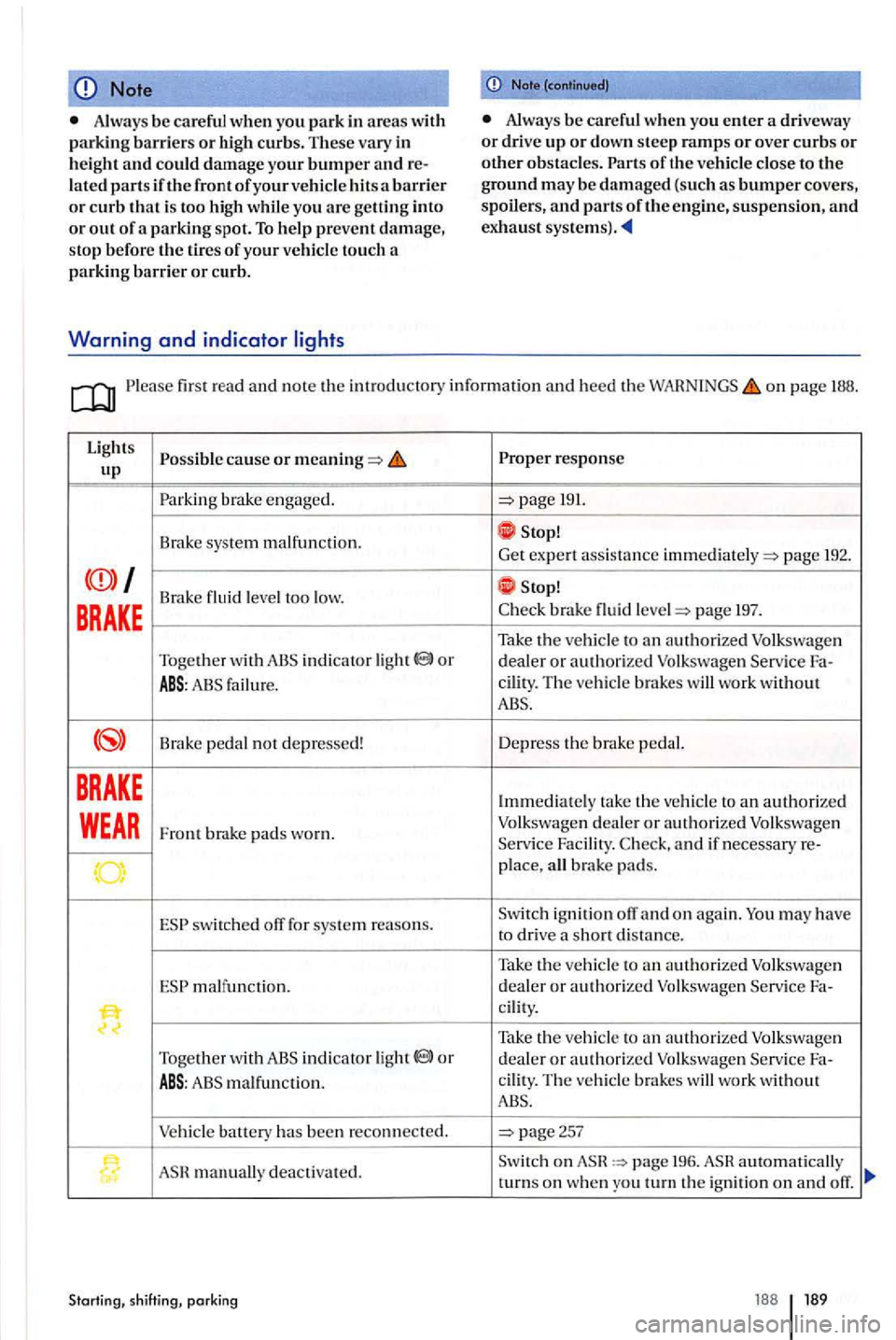
Warning and indicator
Note (continu ed)
Always be careful when you enter a driveway or drive up or down steep ramps or over curbs or obstacles. of the vehicle close to Lhe ground may be damaged (s u ch as bumper covers,
spoilers, and parts of the engine, suspen sion, and exhaust
firs t read and note Lhe introdu ctory informat io n and hee d the WAHNINGS page 188.
Lig ht s
191.
Brak e syste m malfun ction. Stop!
Get
expert assi stance pag e 192.
Brake fluid leve l too low. Stop!
BRAKE brake fluid page 197.
Take the vehicle to an au thorized indicator light or dea ler or authorize d Volksw agen Service Fa-
ABS: failure. ci
lity. Th e ve hicl e brakes will work without ABS.
Brake pedal not depressed! Depress the brake
pedal.
BRAKE Immediate ly take the vehicle to an auth orized
WEAR Front brake pads wo rn. Volkswagen dealer or authorized Volk swage n
Serv ice Facility. and if necessary re-place, all brake pads.
switc h ed off for syste m r easo ns. Switch ignit ion off an d on again . You may have
to dri ve a short dis tan ce.
Take th e ve hicle to an authori zed Volksw age n malfunc ti on. dealer or a
uthorize d Volk sw agen Service Fa-cilit y .
Tak e the vehicl e to or d ea le r or a uthori zed Volksw agen Service Fa-
ABS:
page257
manually deacti va te d. S
witch on p age 196. a ut om atically
turns on w he n you turn the ig nition on and off.
Startin g, shift ing, parking 188 189
Page 193 of 541
Befo re stopping th e en gine, turn the s teerin g
w heel so th at, if the ve hicl e sta rt s to its w heels w ill int o th e curb:
Fac ing turn the fro nt whee ls s o th a t
they point t oward the curb .
Fa c in g uphill , turn the front whee ls so that th ey
p o int away from the curb .
WARNING
The vehicl e exh aust system and the catalyt ic
co nverter or diesel particulate filter get very hot and can cause a and serious personal injury.
Never park where the ho t exhaust system could ignite flammable m aterial s, su ch as brush, leaves, dry grass , spilled fuel, etc.
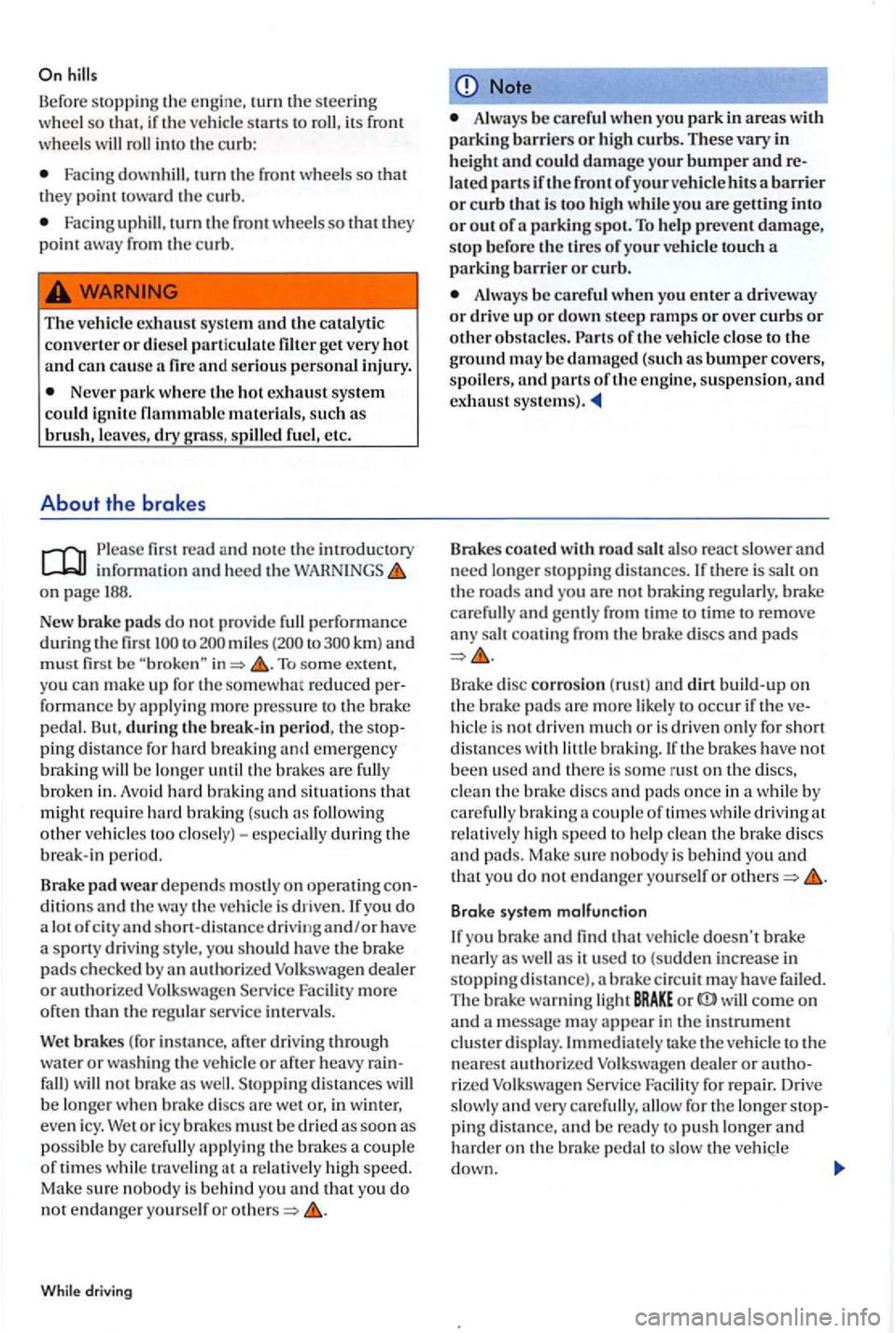
About the brakes
read and note th e introductor y information and hee d th e on page 188.
New d o not provi de to miles to km) and m ust firs t be
hard braking and situ atio ns that
mi ght re quir e hard braking (such follow in g other vehicles too closely)-during the break-in period .
pad wear depe nd s m ostly o n operatin g the vehicle is d riven.lfyou do a l ot o f ci ty and shor t-dis ta nce driv ing and/or have
a sp o rt y driv in g s ty le, yo u sh ould have th e brake
p ad s checke d by a n authorized Vol ksw age n d eal er or a u thori ze d Volkswagen Service Fa cilit y m ore
o fte n than the regula r servi ce interva ls.
Wet
r e la tive ly hi gh speed.
Mak e sure nobo dy is be hind you and that yo u do
not endanger yo urself or
Not e
Alwa ys be careful when you park in areas with parking barriers or high curbs . T hese vary in heig ht and could damage your bumper lated parts if the front of your ve hicl e hits a barrier or curb that is too high while you are getting into or out of parking spot. To help prevent dam age,
s top b efore the tires of your ve hicle touch a parking barrier or c urb.
Alwa ys be c areful when you enter a or down steep ramps or over curbs or other obstacl es. o f th e v ehicl e close to the ground be damaged (such as btm1per covers,
s p oi lers, and parts of the en gine, suspension, and exhaust sys tems).
coa ted with road sa lt also react slowe r and need lo nge r stopping dis ta n ces. there is salt o n
t h e ro ads and you are no t b raki ng reg ularly , b ra ke carefully and ge ntl y from tim e to tim e to rem ove
a n y salt coa ting from the bra ke discs an d pad s
Brake d isc corro sion (rust) and dirt buil d-up on
th e br
ake pads are m ore like ly to o ccur if th e hide is no t dri ven muc h or i s drive n only fo r sh o rt dista nces w ith littl e brakin g. th e brake s have not
been use d and th ere is so me ru st o n t he di scs, clean th e brak e discs and p ad s o nce in a whi le by carefully braking co upl e of times whi le dri v in g at
r e lati vely hi gh sp ee d to help clean the bra ke di scs
and pad s. Mak e sure n o bod y is behind you and that you do no t enda nger yo urself or
B rake system malfunction
you brake and
th e ve hicl e to the n earest authorize d Volkswage n dea ler or
p in g d is ta nce, and be ready to pus h lo nger and harder on th e brak e pedal to slow th e ve hicl e
d own.
Page 199 of 541
In thi s section yo u'll fin d information on th e lowing:
Effi cient driving style
Fuel-effici ent
driving
199
200
Fue l consumption, environmen ta l impa ct. a nd
wear and tear on engi ne, brak es and tires depend mainly on the following three factor s:
Your personal dri ving style.
Exte rnal condition s (weather, road tio n s).
While driving
Tec hnica l requir ements.
You can reduce fuel consumption by up to 25% by
u sing a few s impl e techniqu es and adjusting you r
driv ing sry le.
Always adjust your speed and the distance you
keep betwee n you and the vehi cles ahead of you to the road,
Page 201 of 541
Fuel-efficient driving
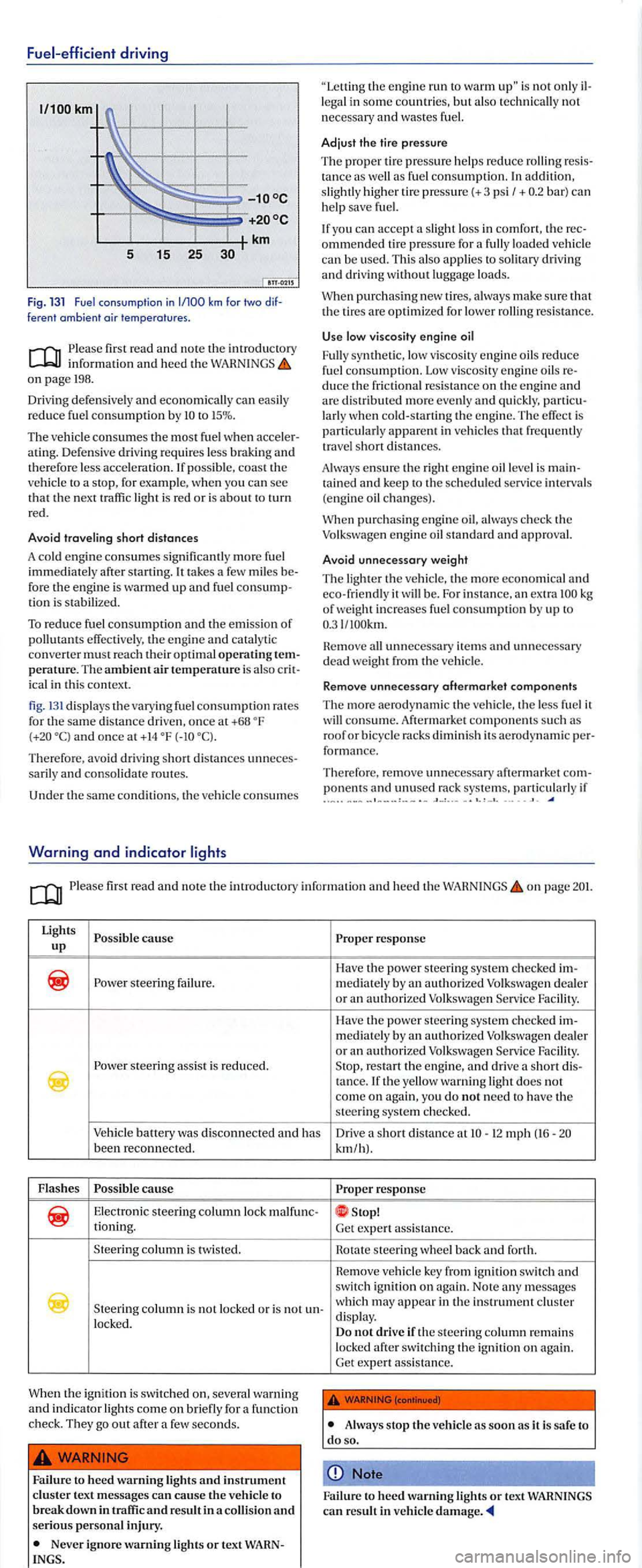
Fig. 131 Fuel consumption in ferent ambient air temperatures .
info rmation and heed the on page 198.
Dri vin g defensive ly and economically can easily
r educe fuel con sumption by to 15 % .
The ve hicle consu mes the most fu el w he n atin g. D efe nsive dri vin g require s less brakin g and therefore less accelerat ion. If possib le, coast the ve hicle to a sto p, for exa mple, when yo u ca n see th a t th e next traffic ligh t is red or is about to turn
red.
Avoid traveling short distanc
es
A cold engine consumes sig nificantl y more fuel
imm ediately after sta rtin g. It take s a few miles fore the engi ne is warm ed up and fuel tion i s stabili zed.
To reduce fuel consumptio n and the emission of pollutants effect ive ly, the e ng in e and ca talytic
conve rter must reach th eir optimal operating
ica l in thi s context.
fig. 13 1 displays the v a ry ing fuel consumption rates
for the same d istance dri ven, once at +68 and once at + 14
th e e ngin e run to warm is not o nl y lega l in some co untries, but also technicall y not
n ecessary and wastes fu el.
Adjust the tire pres sure
T he prop er tir e
pressure help s reduce rollin g tance as well as fue l co nsumption. In additi on ,
slig htl y higher tire pressure(+ 3 psi I+ bar) ca n
h e lp save fuel.
If you ca n a ccept a slight los s in comfort, the ommend ed tir e pressure for a fully loade d ve hicl e
ca n be used. This als o applies to so litary dri vin g and driv ing withou t lu ggage loa ds.
When purchasing new t ires, alway s ma ke sure th at
th e tires are optimi zed for lower rollin g resis tance.
Us e low viscosity engine oil
F ull y sy nth e
tic, low viscosity e ngine oils reduce
fuel consumption. Low viscosity e ngin e oils duce the fric tional res istance on th e engine and are dis tributed m ore evenly and qui ckly, larly w hen co ld -s tarting the engine. The effect is parti c ularl y apparent in vehicles th at frequentl y
tra vel s hort dis tan ces.
A lways ens
ure th e righ t e n g in e oil leve l is ta in ed and keep to the sc h edul ed serv ice interva ls
(e ng ine oil ch an ges).
W
hen purch asing e ngine oil, always ch eck th e Volksw agen en gine oil standard and approval.
Avoid unnecessary weight
The lighter th e ve hicl e, th e more economica l and ceo-friend ly it w ill be. For in stance, an extra
H e m ove
consum e. Aftermark et co mponents s uch as
ro of or b icycle racks dimin is h its aerod yn a m ic fonnan ce.
Th erefo re, re
mov e un necessary aftermark e t ponents and unused rac k systems, parti cul arly if ....... -
fir st read and note th e introductory informa tion and h ee d th e WAHNINGS page
response
Ha ve the power stee rin g sys te m ch ec ked ste eri ng failure. mediatel y by an authori zed Volk swag en deale r
o r a n authorized Volk swagen
Fac ility. steeri ng ass is t i s reduced. re start the e n gine, and dri ve a sh ort tan ce. If th e yello w warning light does not
c o m e on again, you do not need to have th e
s te ering syste m ch ec ke d .
Vehicle battery was di sconnected and has Drive a short distan ce at 12 mph been reconnec te d . km/h).
F lashes re sponse
Elec troni c steering column lo ck malfunc -
which m ay appea r in the in strument clu ste r
di sp lay. loc ke d.
W
hen the i g nit ion is switc h ed on, seve ra l wa rnin g and indicator lights come on bri efly for a f un ction ch e ck . T hey go out after a few seconds.
Failure to
heed warning light s and in strument cluster text m essages can cause th e vehicl e to break down in t raffic and result in a collisio n and seriou s personal injury.
Neve r igno re warning lights or tex t
Do not dri ve if th e s teerin g co lumn remains
l ocke d switch in g th e ig niti on on aga in.
Ge t expert assis ta nce.
Alwa ys sto p the vehicl e as soon as it is safe to do so .
Note
Failur e to heed warning lights or tex t WARNINGS can res ult in vehicl e damage
Page 203 of 541
Driver assistance systems
Starting assistance systems
Introduction
In thi s section find informatio n on th e lowing :
. . . . . . . . . . . . . . . . . . . . . . . . . . . . . . . . . . .
More informat ion:
Volkswagen Info rmation page 21
Brak ing, s topping and
Vehicl e page 257
Tires and
accesso ries, repairs and modifica tions page 303
p age 353
The intelligent technolo gy of the dynamic starting assis ta nce features cannot overcome t11e laws of physics. Never let th e increa se d
Uni ntended veh icle move ment ca n cause rious personal inju ry.
driving
The dynamic s tarting assistance f eatures are no s ub stitute for carefu l and att ent ive driving. Alwa ys adapt your sp ee d and driving s tyle to
v isi bilit y, weather, ro ad, and condition s. The dynamic start ing assistance features can not keep the vehicl e fro m moving in all hillstart situations (fo r exa mple, if the ground is
s lippe ry or icy). Unint ended vehicle movement ca n cause seriou s personal injury. Neve r activate the throttle m anually from the e ngine compartment whe n the e ngin e is running and th e automatic tra nsmission is in gea r. T he vehicle will start to m ove as soo n as the en gine speed in creases , eve n if th e brake is o n.
Page 218 of 541
Function and operation
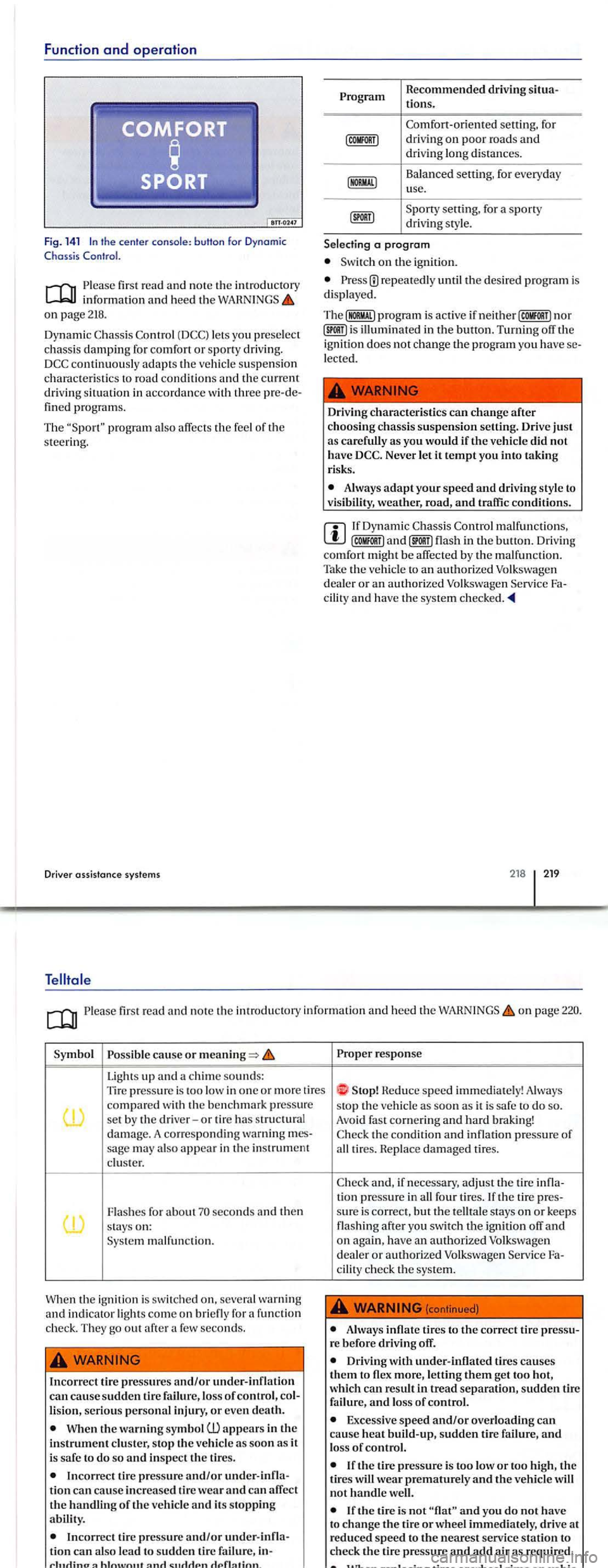
Fig. 141 In the cen te r co nsole : b uHon fo r Dynomic C hoss is
Please read and note th e introductory inf ormati on and hee d t he on page 218.
D ynamic C hassis Control lets you prese lec t
chassi s dam ping for comfo rt or sporty driving .
pro grams.
T he
program also affec ts th e feel of the steering .
Driver assis tanc e systems
Program R
ecommended driving
Comfort- oriented setting, for driving on poor roa ds and driving lon g di sta nces .
Balanced
setting, for everyday
u se.
a program
o n th e ignition.
re p ea te dl y th e des ired progra m is
disp laye d.
Th e
nor illumin ated in the button. Turning off the
i g nition does no t chan ge the program you have lec ted.
Driv ing characteristics can
change after choosing chassis suspension setting. Drive just as carefully as you would if the vehicle did not
h ave Neve r let it tempt you into takin g
risks.
Always adapt your speed and driving style to
visibil and traffic condit ions.
malfunctions , flash in the button. Driving comfo rt might be affec te d b y th e malfunction. Tak e th e ve hicl e to an authorized Volk swage n
d ea ler or an authorize d Volkswa gen
218 219
Please read and note the introdu ctory information and h eed the WARNINGS on page
Poss ible cause or
Lights up and a chime sounds: Tire pressure is too in one o r more tires compa re d wi th th e ben chmark press ure
se t by the driver-or ti re has stru ctural
damage. A co rre spo ndi ng warning
sa ge may also app ear in the instrument cluster.
Fla s hes for abo ut seconds and then stay s on: malfun ction.
W h
en the ignition i s s witched on, severa l warning
a nd ind icato r light s come on briefly fo r funct ion
c h ec k. Th ey go out after a few seco nds.
Incorrec t lire pressures and/or under- inflati on can cause sudden tire failure , loss of control , lisio n, seriou s personal injury, o r even death.
When the warning symb ol
In correc t tir e pressure a nd/or tio n can ca use incre a se d tir e wear and ca n affe ct the handling of th e ve hicle and its stoppin g
Incor rec t tir e pressure and/or ti o n can also lead t o sudden tir e fa ilu re,
Proper response
Heduc e speed imm ediately! Always
s t
op th e vehicle as soon as it is safe do so . Avoid fas t cornerin g and hard braking!
tion press ure in all four tires. If th e tir e
cilit y c heck the sys tem.
(continued)
Always inflate tires to the correct tire re befor e drivin g off .
Driv in g with under-inflat ed tire s causes them to flex more, letting the m get too hot,
which can
Excessive speed and/or over loading can
ca use heat build -up, sudden tire failure , and lo ss of control.
If the tire pressure is too low or too high , th e tires wear prematurely and the vehicl e will
not handl e we ll.
If the tire is not and yo u d o no t h ave
t o ch an ge the tire or whee l immediat ely , drive a t
reduced spee d to the nearest serv ice station to
c h eck th e tir e pressure and add
Page 219 of 541
Tire Pressure Monitoring System (TPMS)
this section you'll find informati on on th e lowing:
. . . . . . . . . . . . . . . . . . . . . . . . . . . . . . . . . . . . . 221
Monitor ing System
Monito ring Sys te m indirectly c hecks the tire pressure of all
f our tires while you are driving by us ing the lock Brake Syste m (ABS) sensor s to monitor the
tr ea d circumf erenc e and vibration ch arac te ris tics of the indi vidua l tir es. warns if there is a nifi cant loss of pres sure in one or more tires while
the vehicl e is mo vin g. loss is s ig nale d b y
the ind icato r light as by an aco usti c
wa rni ng and text warnin gs in the in strument clu ster di spla y if your ve hicle has an MFD. The
origina l b en chmark pre ssure is th e recommended
m axi mum load cold tire inflati on pressure for the tire s that come with your vehicle that is lis te d on
th e tire pressure lab el on the dri ver door pill ar. By press ing the Reset button , yo u can ch ange the
b enchmark pressure to match th e c urr ent pressure of the tir es on you r page 222.
use of the Heset butto n i s explained below 222.
More informa tion:
page 137
Bra king, stopping and page 188
Ext e rior care an d page 262
page 276
pa ge303
Whil e driving
An acoustic warni ng sounds th e first time low tire pressure is detec ted. a system
Improp er tire care can cause sudden tire sure loss,
hicle control, accidents, and serious personal
injury .
tire inflation pressure regularl y when the tires are cold and alway s maintain the scribed tire pressure . Low tire pressure can cause tires to get too hot, res ultin g in tread ration, sudden lo ss of pres sure, and blowout s.
Thi s is because tires with excessively low
sure undergo more flexi ng, which can cau se the tir e to overheat and destroy the tire.
Always maintain correct cold tire inflation pressure as listed on the tire pressure label
Check tire inflation pressure regularl y when the tires are cold. Adjust tir e press ure in the cold
tir e to the recommended tire pressure for t11e tires installed on your vehicl e as necessary.
Neve r exceed the permissi ble maximum speed and load rating of the tires on your hicl e.
Imprope r us e of the Reset button can cause the to give false warnings or to give no
warning des pite dangerou sly lo w tire pressure
page222.
Und er- inflat ion increases fue l con sumptio n and tire wear.
to ring Syste m.
bedde d in the tir e tre ad but have n o t penetrated
int o the body of tire
Driving on u npaved roads for an extended
The te lltal e
s h ows a malfunc tion but switch es orr if road dit io ns or th e drivin g sty le c han ges or if th e tio n is switch ed on and orr
Tire Pressure Monitoring System (TPMS) and reset button
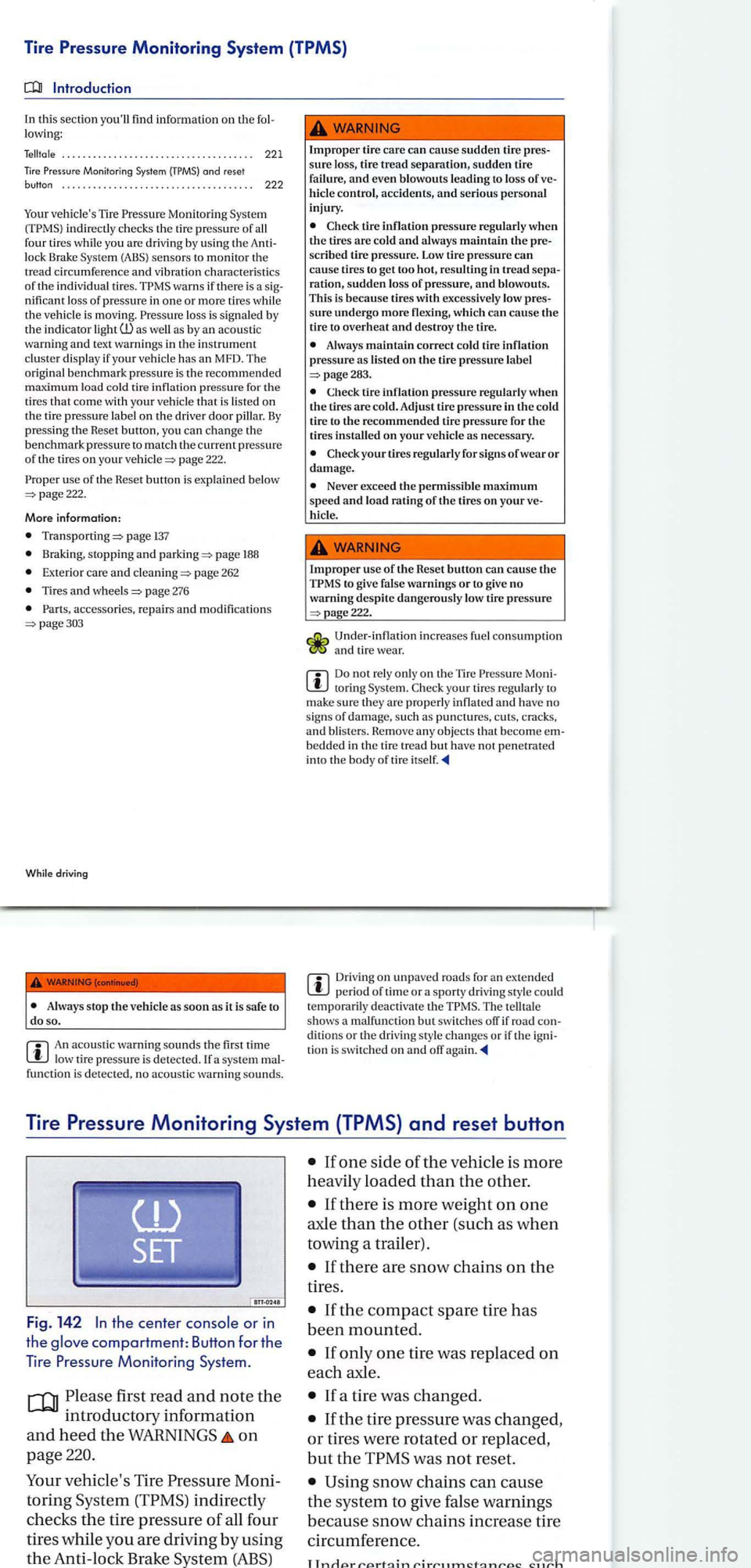
the center or in
the compartment: Button for th e
T
ire Pressure Monitoring System.
first r ead and note the
introductory informatio n
and heed the WARNINGS on
page
ve hicle's Tir e Moni
torin g
indirectly
c h ec ks
the ti re pressure of al l four
tire s while yo u are drivin g by us
ing
the Anti -loc k
If there is more weight on one
axle than the other (such as when
towin g a trailer) .
Page 220 of 541
Each tire, including the spare (if
provided),
should be checked
monthly w hen cold and inflated to
the inflation pressure recom
mended by the vehicle manufac
turer
on the vehicle placard or tire
inflation pressure label.
(If your
vehicle
has tires of a different size
than the size indicated on the ve
hicle placard
or tire inflation pres
sure label, you sho uld determine
the proper tire inflation pressure
for
those tires.)
As an added safety feature, your
vehicle
has been equipped with a
Tire
is not a
substitute for proper tire mainte
nance,
and it is the driver's re
sponsib ility to
maintain correct
tire pressure , even if under-infla
tion
has not reached the level to
trigger illumination
of the
low tire pressure telltale.
Driver assistance systems
Your vehicle has also been
equipped with a malfunc
tion indicator to indicate
when the
system is not operating properly.
The
malfunction indicator is
combined with the low tire pres
sure telltale. When
the system de
tects a malfunction, the telltale
will flash for approximate ly
one
minute and then remain continu
ously illuminated. This sequence
will continue upon subsequent ve
hicle
start-ups as long as the mal
function exists.
When
the malfunction indicator is
illuminated, th e system may not
be able to detect or signal low tire
pressure
as intended.
to continue
to function properly.
Re-setting and reconfirming the
benchmark tire pressure for TPMS
The Reset button for the Tire
sure Monitoring is in the
glove compartment=> page 222,
fig. 142. The Reset button resets the
benchmark tire pressure used by
the
to the current tire pres
sure
in the tires based on the cir
cumference
of the tires. To reset
222 223
Page 221 of 541
the benchmark tire pressure used
b y
the swi tch on the igni
tion
and then press and hold the
Reset button until you hear a con
firmation chime. The Reset button
must be pressed for at least 2 sec
onds but no more than sect ions
each time
the tire pressure in one
or more tire s has bee n adjusted or
after
one or more tires has been
changed, exchanged or r
epaired.
The new tire pressures will not be
st
ore d in the system until the ve
hicle has b
een driven at normal
s p eeds for
at leas t minutes.
If you use the Reset button to reset
the ben chmark tire pressure when
yo
ur tires do not have the corre ct
t ir e pressure, this
will prevent the
After installin g tires on your ve
hicle
that h ave recom mended co ld
driving
tire infl ation pressures that are dif
ferent from the tires that were
taken off.
After any tire on you r ve hicl e has
b
een removed and remounted,
even if t he sa me tire
and w hee l rim
that were taken off are re-insta ll ed
(for instance, after repair).
After a ny tire on you r veh icle is
changed
and r ep lace d by another
tire, even if th e rep lace me
nt tire is
th e
same type and is inflated to the
same press ure as the tir e it re
pl ace d.
After adjusting the tire pressure
of an y tire on the ve hicl e
to its cor
rect cold tire in flation pressure, ei
ther by putting air in one or more
tires
or by let tin g air out. Do this
even though air was o
nly added (or
let out)
to bring the tir e to the infl a
tion pressure it should have had all
along .
After rotating the front and rear
w he els
page 276.
After mounting th e compact
s pare tir
e.
Improper use of the Reset button
can cause the to give false
warnings
or to give no warning
d espite dangerously low tire
pressure. Make certain
the tire
inflation pressure
of all tires is
correct before using
the Reset
button.