Safety VOLKSWAGEN JETTA 2007 Owners Manual
[x] Cancel search | Manufacturer: VOLKSWAGEN, Model Year: 2007, Model line: JETTA, Model: VOLKSWAGEN JETTA 2007Pages: 477, PDF Size: 77.6 MB
Page 270 of 477
Booklet 3.1 Controls and Equipment
Raising the backrest into place
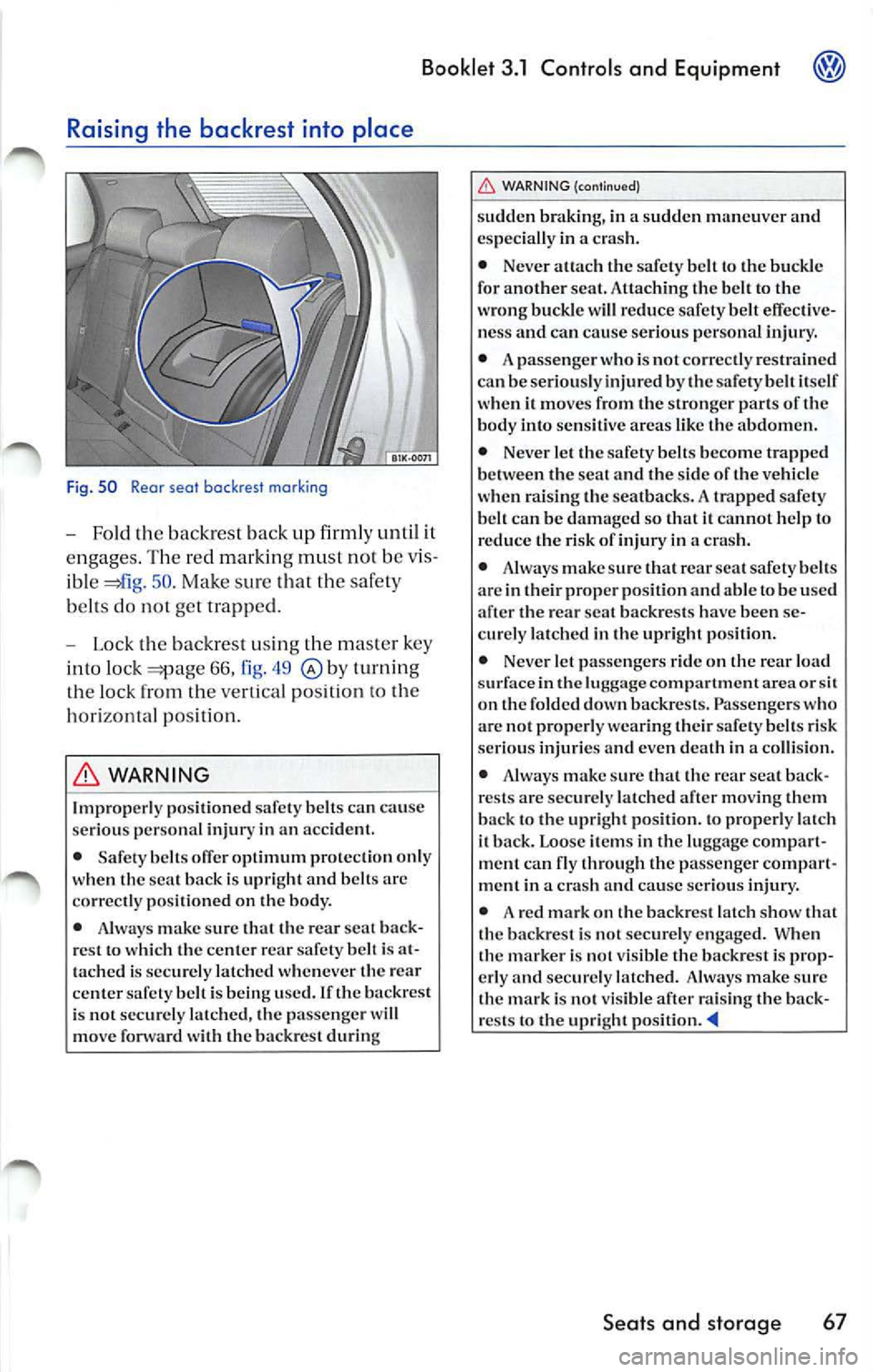
Fig. 5 0 Rear seat backrest marking
-Fold the backrest back up firmly until it
engages. The red marking must not be vis
ibl e
50. Make sure that the saf ety
bel ts do not get trapped.
- Lock the backrest using the master key
into lock
66, fig. 49 by turning
th e lock from the vertical position to the
horizonta l po sition.
WARNING
Improperl y positioned safety belts can ca use
serio us personal injury in an accident.
• Safety belts olTeroptimum protection only
w hen the scat back is upright and belts arc
correc tly positioned on the body.
• Always make sure that the rear scat back
rest to which the center rear safety belt is at
t ached is secure ly lat ch ed whenever the rear
center safe ty belt is being use d. If the backre st
is not secure ly lat ch ed, the passenger
will move forward with the backrest during
WARNING (continued)
sudde n braking, in a sudden maneuver and
es pecia lly in a cras h.
• Never attach the safety belt to the buckle
for another seat. Attac hing the belt to the
wrong buckle
will reduce safety belt effective
n ess and can cause serious persona l injury.
• A passen ger who is not correc tly re strain ed
can be ser ious ly injured by the safety belt itself
when it move s from the stronger parts of the
bod y into sensitiv e areas like th e abdomen.
• Never le t the safety belts become trapped
between the scat and the side of the ve hicle
when raising the scat back s. A trapped safety
belt can be damag ed so that it can not help to
r ed uce the risk of injury in a cras h.
• Alway s mak e sure that rear seal safe ty belts
arc in their proper positio n and able lo be used
after the rear scat backr ests have been se
c ur ely lat che d in the up right position.
• Neve r let passengers ride on the rear load
surface in the luggage compartment area or sit
on the folded clown backrests. Passengers who
are not properly wearing their safety belts risk
ser ious injuri es and even dea th in a co llisio n.
• Alwa ys make sure that the rear seat back
r es ts are securely latched after moving them
back to the upright positio n. to properly latch
it back. Loose items in the
compart
ment can fl y through th e passenger compart
ment in a crash and cause ser ious injury.
• A red mark on the backre st latch show that
the back rest is not secur ely engaged. When
th e marker i s not visible th e backrest is prop
erly and securely latched. Always make sur e
the mark i s not visi bl e after raising the back
re sts to the upri ght
Seats and storage 67
Page 278 of 477
Booklet 3.1 Controls and Equipment
WARNING
Heavy load s will influ ence the way your ve
hicle handl es and heavy loads t hat are not
properly stowe d or sec ured can cause loss of
contro l a nd se rious injury.
• Always keep in
when transporting
h eav y ob ject s, that a chan ge in th e center of
gravity can also cause c hanges in vehicle han
dling:
-Always distribute the load as evenly as
po ssib le.
- Secur e heavy object s properly as far for
ward in the lug gage compar tment as pos
sible.
- Alwa ys s ecure heavy items securely
using the tie-downs provided wit h suitable
s trap s.
• Never excee d the Gross Axle Weight
or the Gross Ve hicle Wei ght Hating on the
s afe ty compliance sticker o n th e left d oor
jamb. Exceedi ng permi ssible weig ht can ca use
the vehicle to slide and handle difTerently.
• Always read and heed a ddition al imp or
in forma tion on driving 2.1
" Safety first."
WARNING
To help p rev en t poisonou s exhaust gas from
being drawn into the vehicle , a lways ke ep the
rear lid clo sed w hile driving.
• Never transport objects larger than those
fitting completely into the luggage area be
cause t he rear lid cannot be full y closed.
• If you abso lut ely must drive with the rear
li d open, observe the following notes to reduce
th e risk of poisoning:
WARNING (continued)
-Close all wind ows,
- Close the power roof,
- Open all air outlets in the in strumen t
panel,
- Switch off the air recirculation,
- Set the fresh air fan to the highest speed.
WARNING
Always make sur e that the doors and rear lid
are secure ly clo sed and locke d to redu ce the
risk of injury when the vehicle is not being
u sed.
• Afte r clo sing the rear lid , a lways mak e sur e
that it is p roper ly closed and locked.
• Never leave yo ur vehicle unattended espe
cially with th e rear lid left open. A child could
craw l into the vehicle through the luggage
compartment a nd pull the re ar lid or window
s hut becoming trapped and unab le to get ou t.
Being trapped in a ve hicle can lead to serious
p ersona l inju ry.
• Never le t ch ildr en play in or around the ve
hicle.
• Never let passe ngers ride in the luggag e
com par tmenl. Vehicl e occupants must always
be properl y re strained in one of the veh icle's
s eat ing po siti on s.
Note
o bj ec ts o n th e hat sh elf co uld d am age the
w ires of the re a r w ind ow d efogg er.
Tips
D o no t co ve r th e ve ntilatio n slo ts in front of th e
r e ar sid e w ind ows beca use this ca n pr event sta le
a ir fr om esca ping the vehi cle.
Seats and storage 75
Page 286 of 477
Booklet 3.1 Controls and Equipment
Cooling system
When the air condit ion ing is on, not on ly th e
temperatur e, but also the air humidit y in th e ve
h icle interior is re du ced. Thi s improve s comfort
for the vehicle occupallls and preve nts th e w in
dows from fogging up when th e o utsi de a ir i s
very humid.
I f the air conditionin g does not
on, it
co uld be for one of the follow ing reasons
• the eng ine is no t running.
Applies to vehicles: with Climatic
Air recirculation mode
• th e fan is sw itch ed off.
• t he outs id e te mperatu re is lower than
rou ghly
+ 40 ( +3 °CJ .
• the air conditioner compr essor has bee n
tempor aril y sw it ched off because th e e ngi ne
coo la nt te mp erature i s too high.
• the air condition er fu se is blow n.
• have the air condit ione r ch ecked by an au
th ori ze d Vo lkswage n deale r.
Air recirculat ion mod e prevent s fum es or unpleasant smells from entering the ve
hicle.
- Pre ss the butt on 82, 68
switch air r eci rculat io n mode on or off.
When it is s witch ed on a yellow light in the
button light s up.
Air r ecircul atio n m ode pre vents stro ng out door
odors from ent erin g th e ve hicle interior, for ex
amp le when driving th rough a tunnel or in
de nse traffi c.
the out side te mp erature is low, usin g air
r e circulat io n m ode prov ides mor e effective
h ea tin g by hea ting air fr om th e ve hicle int eri o r
instead of cold air from outsid e.
W hen th e o utside te mperat ure is hi gh, usin g air
r eci rculation mode prov ides m ore effectiv e
coo ling
cooling air from th e ve hicle i111erior
in ste ad of wa rm ai r from ou ts id e.
For safety re aso ns, air re cir cu lati on is not pos
s ib le
th e colll ro l for air di stributi on i s set
t o th e® pos ition. The air reci rc ul atio n m ode ca
n b e sw itch ed back on b y pressing
bu lion .
WARNING
Stale air cau ses driver fatigue and reduces
dri ver alert ness . Thi s can lead lo acciden ts,
co llisio ns and seriou s perso nal injury.
• Neve r use air reci rculation for lo ng period s
of tim e becau se no fresh air will come into the
pa ssenger com partm ent.
• If the coo ling sys tem is sw itch ed o ff, the
w indows can fog up qui ckl y and decrease
dr ive r vis ibilit y.
• Always sw itch the recirculation mode off
wh en i t is not nee ded.
Do not s moke whil e a ir reci rc ul atio n m ode is on,
as sm oke draw n i111 0 the clim ate-co ntrol sys te m
ca n leave a re sidue on th e evaporator, producin g
perm an en t unpl easant odo r.
Air conditioning system 83
Page 294 of 477
Booklet 3.1 Controls and Equipment
WARNING (continued)
redu ce the risk of personal inju ry if the
driv er' s ai rbag infl ates.
• Neve r hold the ste er ing wheel at th e 12
o'cloc k po sition or with your hands a t other
positions insid e th e steeri ng whe el rim or on
t he steer ing wheel hub. I-foldin g th e s teerin g
whe el the wro ng way can cau se s eriou s inju-
Safety
WARNING (cont inu ed)
rics to th e han ds, a rms and head the driv er's
a irb ag inflat es.
• After adjus ting th e s teering wheel, always
pus h the stee ring wh eel a dju stment lever back
up as
as it will go. T his en sure s th e po siti on
of the st eering whee l ca nnot be alt ered unin
t e ntionally when the vehicle is moving.
Applies lo vehicles: wi th Electronic S ta biliza tion Progr am (E S P)
Electronic Stabilization Program
ESP helps mak e driving safer in certain situations.
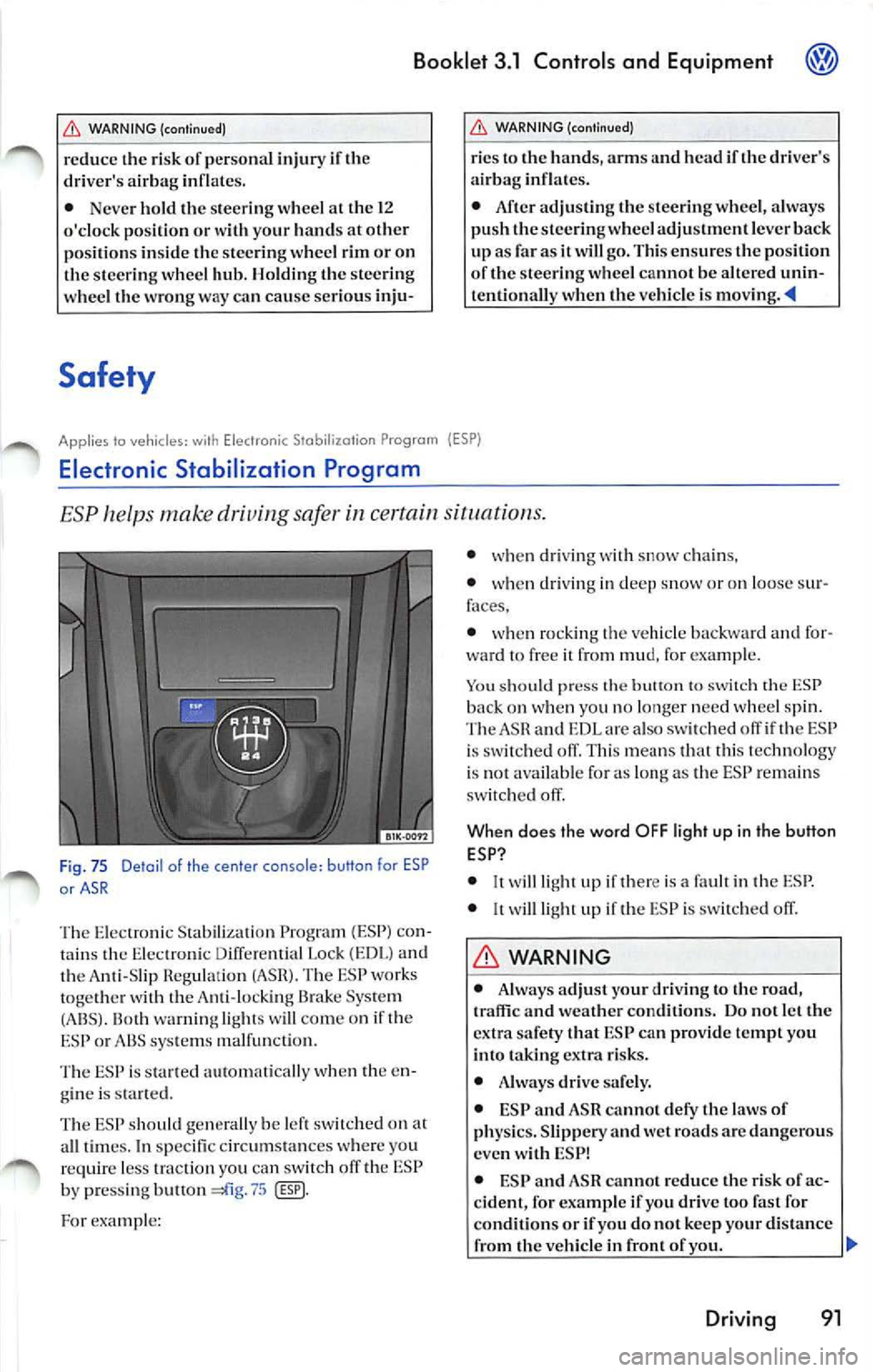
Fi g. 75 D etail of the center console: bu tto n for ES P or ASR
Th e Electro nic Sta biliza tion Program (ESP) co n
tain s th e Ele ctro ni c Diff ere ntial Lock (ED L) and
t h e Anti -Slip Regu la tio n (A SH). Th e ESP works
to ge th er with the Anti -lo ck in g Brake System
( ABS ). Both warnin g lig hts w ill come o n if the
E SP or ABS sys te m s m alfu nct io n .
T he ES P is s ta rt ed a utomat ica lly w hen th e en
g in e is sta rt ed.
The ESP s hou ld ge nerall y be lef t sw itc hed on at
a ll tim es. In sp ecifi c circ um stan ces w here you
r e quir e less tract ion you ca n sw itch off th e ES P
by press ing buu on
75
For example: •
when dri vi ng w ith snow ch ain s,
• when dri vi ng in deep snow or on loo se sur
faces .
• when ro ckin g th e ve hicle backwa rd and for
wa rd to fre e it fro m mu d, for exa mple.
Yo u sh o uld press th e
to swi tc h th e back o n when you no longer need wh ee l spin .
Th e and ED Lare also sw itch ed off if th e ESP
i s sw it c h ed off. This means th at this te chn ology
i s not ava ilab le fo r as lo ng as th e ESP re ma in s
s w itc hed off.
When does the w ord OFF l ight up in the button
ESP?
• will lig ht up if th ere is a fault in the ES P.
• It will li gh t up if the ES P is sw itc hed off.
WARNING
• Always adjust your driv in g to th e road,
t raffic a nd weat her cond itions. Do not l et th e
extra sa fety that ESP can prov ide temp t you
int o tak ing extra risks.
• Always drive safel y.
• ESP and ASR cannot defy the laws of
ph ysics . Slipp ery and wet roads arc dangero us
eve n with ESP!
• ESP and
ca nnot re du ce the risk of ac
cident, for example if you drive too fast for
co nditi ons or if you do not keep your di sta nc e
fro m the vehicle in
of you.
Driving 91
Page 297 of 477
Booklet 3.1 Controls and Equipment
&. WARNING (continued)
dows can be opera te d l eading lo serio us per
so nal inju ry.
• Neve r leave ch ildren, disa bled perso ns or
anyone who cann ot help themselves in the ve
hicle. The door s can be lo cke d using the re
mote control key. This could resu lt in people
b ein g trapped in the vehicle in an emerge ncy.
example, depend ing o n the time of year,
peo ple trapped in the vehicle ca n be expose d
t o very high or low tem pera tures.
• Never remove the key from steering lock
w hil e th e vehi cle is mo ving or wh ile it is ro lling
t o a stop . The steer ing w hee l co lumn will loc k
Applies lo vehic les: with on aulomalic lransmission
Safety interlock for ignition key
WARN ING (continued)
up and you w ill not be abl e to steer or contro l
the vehicl e.
your vehicl e (key positio n
Tips
If you ope n the dr iver's door with the ke y still in
th e igniti on l ock, a buzze r w ill so und to r emind
yo u
ta ke the ke y and lock your ve hicle. -4
The ignition key can only be taken of the ignition lock if the selector lever is in
the P position.
-Switch the ign ition.
- Mo ve the selec tor le ver
102 to P
(Pa rk).
Electronic immobilizer
- Remove the key. Thi s locks the selecto r
lever.
-4
The immobilizer helps to prevent use of the vehicle.
The re is a chip in the key that automati call y de
ac tiva tes the imm obilizer w hen you p ut th e key
into the igni tion lock.
T he electronic immobili ze r is automaticall y
tivated w hen you tak e the key out of the ignition
lu ck.
94 Driving
Th e engine can only be s tart ed using a genuin e
and correc tly co ded Volkswagen key.
Tip s
You can on ly start the e ngin e with
co rrec tly ge nuin e Volk swagen k ey. You may have
prob lems starting t he ve hicle if ge nuin e and
c orre ctl y co ded Volkswagen key is no t u sed. -4
Page 300 of 477
Booklet 3.1 Controls and Equipment
Switching off the engine
- Let the vehicle come to a complete stop.
- Turn the ignition key to position
93, 76
WARNING
Never switch off the engine before the vehicle
ha s come to a com plete stop. You can lose co n
of the vehicle, crash and be ser iously in
jured.
Manual transmission
Applies to vehicles: with monuol
WARNING (continued]
• The airbags and safety belt pretensioners will not wo rk when the ignition is switch ed off.
• The brake booster docs not work when the
engine is turned off. A lot more
pedal
pressure will be necessary to stop the vehicle.
• The power steer ing system docs not work
w hen the engine is turned off and you will
ne ed mor e force to stee r the vehicle.
• When the key is removed, lhc steering
whee l co lumn will lock up and you will not be
ab le to steer the veh icle.
engin e could ov erh eat w hen it is
s wi tc h ed off . To r edu ce the ri sk of en gine
dama ge, be sur e
to le t th e engine id le for ab out 2
minut es before yo u sw it c h it off._.
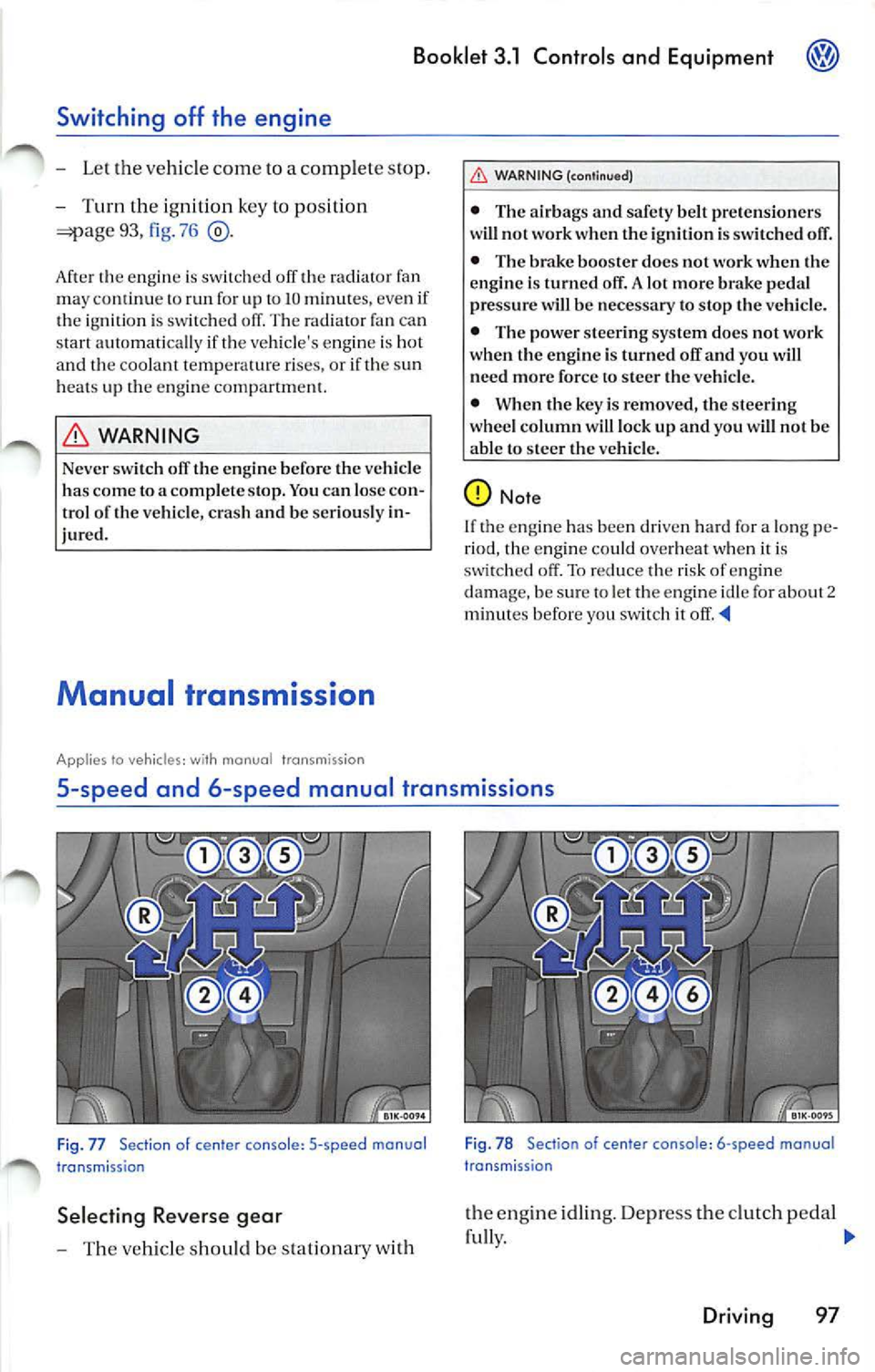
5-speed and 6-speed manual transmissions
Fig. 77 Section of center console : 5- speed manual
transm ission
Selecting Reverse gear
- The ve hicl e shou ld be stat ionary w ith
Fig. 78 Section of center console : 6 -speed manual
t ransm issio n
the eng in e idli ng. Depr ess the clutch p edal
fully. ._
Driving 97
Page 321 of 477
About this booklet
This booklet contains important information,
tip s, s uggest ions and WARN INGS on usin g yo ur
veh icle. The other booklets in the Owner's Liter
ature contain further information tha t you
sho uld be aware of for yo ur own safety and for
the sa fety of yo ur pa ssenge rs.
Make sure that you always keep the comp lete
Owner's Literature in the vehi cle. Th is is es pe
cia lly import ant whe n you lend or sell th e ve
hicl e.
Thi s manual describes the vehicle equipm ent at
th e time of publicatio n. Some of the equipmen t
d escribed w ill not be availab le until a late r date,
or is only available for certain markets.
Illustrations may slightly vary fro m you r veh icle.
Fo r tl1is reaso n yo u sh ou ld regard illus tratio ns as
a general g uide.
A t th e beginning of this booklet, you
find a
table of contents sho wing all the item s de
scr ibed in this manua l in the order they appear .
An alphabetica l ind ex is a t the end of the
booklet.
Dire ction s and positions (for example right, left,
front, rear ) are a lways re lat ive to the direction o f
travel of the vehicle unless sta ted otherwise.
Some sections of this book let do not app ly to a ll
ve hicl es. If this is the case, a text at the beginning
section indicates w hic h veh icles it appli es
to , for examp le "App lies to veh icles wit h Diese l
engi ne" .
The section i s con tinued on t he nex t page.
In dicates the end of a section.
® Registered trademarks are marked
or®·
However, the absence of this sym bol does
not const itute a wa iver of th e rights con
ce rnin g any te rm.
Cross-reference to a "WA RN ING" within
o r outside of a sect ion.
WARNING
Texts symbo l co ntain imp ortant in
formation on safety and how to reduce risk
of personal injury or d eath.
Note
T exts
sym bol dr aw your attention to potential sources of damage to your vehicle .
For th e sake of environment
Texts w ith this symbo l contain infor mation
a bo ut the environment and how you can he lp
to protect it.
Tips
Texts with thi s symbol contai n spec ia l tips and
othe r information abou t gett ing the most out of
your veh icle and its features.
Page 323 of 477
Booklet 3.2 Tips and Advic e
Smart technology
Brakes
Brake booster
The brak e boo ste r incr ea ses the brake press ure
yo u put on th e peda l. wo rk s onl y wh en
t h e engi ne is runnin g.
If th e brak e boos te r is not workin g or if th e ve
hicl e has to be towe d, yo u wi ll h ave
to push th e
brak e peda l hard er to ma ke up for th e lack of
boo ste r ass is t.
WARNING
B rak ing w ithou t t he brake boos ter needs a
mu ch l onge r bra king distance and r equir es
Brake Assist Sys tem (BAS)
In a n emerg ency, mos t d river s brake in t im e, not w ith m aximum force. This res ult s in stop
ping dis tan ces th at are lo ng er th an they have to
b e!
T he brake a ssis t sys te m h elp s: if yo u pr ess th e
brak e pedal very quickly, t he brak e ass is t sy stem
r eg is te rs an em erge ncy situatio n. It th en very
qui ckly build s up th e full brake press ure so th at
t h e A BS can be activate d more qui ckl y and
cie nt ly, r educin g th e braking di sta nce and le t
tin g you steer at the sa me tim e.
D o not reduce th e pr ess ure o n th e brak e ped al.
T he brak e ass is t sys te m sw itches o ff aut omati
ca lly as soon as you re lease th e brake. The brak e
a ss ist sys te m works onl y wh en th e en gin e is
n ing.
If th e brak e sys te m i s not fun ction in g pro perl y, a
wa rnin g lig ht will com e on =bookl et 3.1 "Co n
t rol s and Equipm ent ."
WARNING
Always ad just you r sp ee d an d driv in g s ty le to
roa d, an d weather cond iti ons. Do not
2 Smart t echnology
WARN ING (con tinued)
yo u to p ush th e bra ke ped a l d ow n ha rder th an
n or mal.
• Never let th e ve hicle coa st w ith th e eng ine
switc hed off.
• If th e brake boos te r is no t ac tive, for
ample if th e ve hicle is bein g towed , yo u w ill
have to p ush th e brake pedal down much
h ar der than n ormal.
WARN ING (continu ed)
let the extra safety afforde d b y th e Brake Ass is t
Syste m temp t yo u int o taking ex tra ri sks.
• Never let t he extra sa fety offered by t he
Brak e Ass is t Sy ste m te mpt you into ta kin g
ex tra risks.
• The B ra ke As sis t Sys te m canno t re d uce t he
r isk o f a n acci den t, fo r examp le if yo u d rive too
fas t for co nditi on s or
if yo u d o not k eep yo ur
di stance fro m th e vehicl e in fr ont of yo u.
• Slippery and
roa ds are dangero us eve n
w ith th e Brake Assis t Sys te m!
WARNING
• Always reme mber th at ve hicle a ltera tio ns
or modificatio ns ca n affec t th e fu nctio n of th e
ABS, BAS , ED L and ES P sys te m s. Exa mpl es of
these alt era tion s or mo dificatio ns includ e a
di fferen t w hee l/tir e co mbin atio n and bra ke or
chassis modifi catio ns
28, and
t echn ic al m odi ficat io ns".
• Chan ging th e ve hicle su spe nsio n or u sing
un approved tir e
I r im combin atio n ca n ch an ge the w ay the A BS, B AS, EDL a nd ESP
Page 324 of 477
WARNING (continued)
systems work and reduce their
effect iveness.
Applies to vehicles: with Driver Steering Recommenda tion
Booklet 3 .2 Tips and Advice
Driver Steering Recommendation helps to the vehicle in certain sit
uations
The Driver Stee ring R ecomm endation i s a com
pl em entar y function of the ESP. This fea ture al
low s th e driv er
stabilize ve hicl e in certain
critical situati ons. Fo r example in certai n road
s ur face conditi ons ii is necessary to brake hard.
The vehicl e will then te nd to brak e awa y to the
r ig ht or t o 1h e lef t. Th e ESP reco gnizes this situ a
tion and supp ort s the drive r to steer to the oppo-
Anti -Lock Brake System {ABS)
sit e dire cti on by in crea sing th e stee rin g
s tr ength.
WARNING
The DSH only supports the driver in cri tical
dri vin g co ndition s. The ve hicl e will not s teer
by itse lf. The dr ive r is res pon sible fo r steering
the vehicle .
The Anti-Lock Brake System prevent s th e wheels from locking when the brakes are
applied.
Th e ABS is an important part of the vehicle 's ac
ti ve safety system. The Anti-Lo ck Brake Syste m
work s onl y when the en gine is run ning.
How the ABS works
If one w he el begi ns tu t urn too s low ly in r elat io n
t o ve hicl e speed an d le n ds to lock up, t he ABS
a utom ati ca ll y
brak e pres sur e lO preve nt
that whee l fr om locking. When ABS is do ing it s
job you will notice a sli ght vibrati on throu gh the
brake pedal and hea r a noise to l et yo u know tha t
yo ur speed must be adjuste d to road, traffic and
wea ther condi tion s. T his is a warn ing 1hat on e or
mor e of the whee ls is about to lock up and that
th e AB S co ntr ol function has inter vened . In thi s
s ituati on
is important to keep the brak e peda l
fully depr essed so the ABS can help to re gul ate
th e brake applica tion. Do not "pump " th e
peda l -ABS can not do its jo b if you do.
A BS helps you 10 kee p th e ve hicl e und er control
be cause i t prev ent s th e w hee ls from locking
w hen th e brak es arc ap plied. Th is m ean s th e ve
hicl e ca n still be s teer ed and is less likely
on
g rav el o r on fresh sno w cover in g a slipp ery sur
If AB S is not functioning properl y, a wa rnin g
li ght will co me on 3.1 "Co n1rol s and
E quipm ent. "
WARNING
Always ad just yo ur dri vin g to the road, traffic
and weather conditio ns. Neve r le t th e ex tra
s afe ty that ABS can provide te mpt you into
taking extra risks.
• Always drive safely .
• ABS canno t ch ange the
of ph ysics.
S lipp ery and wet roads are dangerou s ev en
wi th ABS!
• ABS ca nnot reduce th e risk of accide nts,
f or examp le if yo u drive too
for the co ndi
ti ons or if you do not keep your distance from
th e vehicle in front of you.
Smart technology 3
Page 326 of 477
Booklet 3.2 Tips and Advice
help s th e ve hicl e to sta rt mov ing.
a cc ele rat e a nd climb a grad ient in slipp ery con
di tio ns w her e thi s m ay other wise be diffi cult or
ev en impo ssibl e.
WARNING
Alway s adj ust you r driving to the road, traffic
a nd weather condition s. Do not l et the extra
WARNING (cont inu ed)
safety that ESP and can provid e tempt
yo u into taking extra risks.
• Always drive safely .
• ESP and ASH can not defy the laws of
physics. Slipp ery and wet roads are dange rous
even with ESP!
• ESP and AS H cannot reduce the risk of ac
cident, for examp le if you drive too fast for
condi tions or if yo u do not keep your distance
from the vehicle in front of yo u.
WARNING
• Alway s remember that vehicle alterations
or modifi cations ca n the function of the
ABS, BAS, EDL and ESP sys tems. Examp les of
these altera tio ns or modifications include a
different wheel/tire combination and brake or
c h ass is modifications
28, "Repa irs and
technical modifications".
• Chan ging the vehicle suspension or usi ng
un approve d tire
I rim comb ination can
change the way the ABS, BAS, E DL and ESP
sys te ms work and red uce their effective ness.
• The elJec tivencss of ESP is also determined
b y the tires fitted
51, "Tires and
wheels ".
d iu s o f th e tir es ca n c ause the syste m to re du ce
e n gin e po we r - eve n w hen thi s is not th e bes t
thing
to d o und er th e ci rc um stan ces . '4
Smart technology 5