bat VOLKSWAGEN JETTA 2007 Owner's Guide
[x] Cancel search | Manufacturer: VOLKSWAGEN, Model Year: 2007, Model line: JETTA, Model: VOLKSWAGEN JETTA 2007Pages: 477, PDF Size: 77.6 MB
Page 370 of 477
Booklet 3.2 Tips and Advice
Vehicl e batt ery
Location of battery
The battery is mai nte nance-free is c h ecked during the inspection serv ice.
Warning note s on handling batterie s
Battery acid is very co rrosive a nd
ca usti c. Always we ar protective
g loves and eye prot ection !
Fires, s park s, open ligh ts and
s moking arc pro hibit ed!
Always kee p childr en away acid and batt eries!
WARNING
Wo rki ng on the batt eri es or the electr ical
syste m in yo ur vehicl e can result in ser ious
acid burns,
th e
batt eri es . Whe n a light bulb is c han ged, always
sw itch o!Tt he light.
• Turn o!Tt he an ti- th ert alarm by unl ockin g
the vehicl e befor e yo u disco nnect th e bat
terie s to pre vent th e ala rm rrom goin g on.
• Always kee p childr en a way
acid an d
batterie s.
• Alw ays wear eye prot ectio n. Nev er let bat
t ery acid or lead particl es contact your eyes,
and clothin g.
•
batter y acid is ve ry co rrosive and
can cause damag e to unprote cted ski n and
blindn ess. A lways wear protectiv e gloves a nd
eye protec tion. To re du ce yo ur risk o r injur y,
n eve r tilt the batt eri es, as thi s co uld spill acid
throu gh th e ve nts and burn you.
WARN ING
• Wh en disconn ecting the batt eri es from the
ve hicl e elec tr ic al sys tem , a lways disco nnect
the negative cable(- ) fir st a nd th en th e po si
ti ve ca ble(+ ).
• Alwa ys avo id fires, spark s, op en li ght s a nd
s moking. Alw ays avoid generatin g sparks a nd
e lectro static charges whe n handlin g cables
a nd elect rica l equipment. Never short-cir cuit
the battery pole s. Hi gh -energy sparks can
c au se se rious per sonal injury.
• Always swi tc h off all electrica l con sumer s
before recon nectin g the batteries. Heconncct
th e plu s ca ble( +) first and then the negative
cab le(-). Neve rrever se the polarity or the con
ne ctions. This could cause fire.
• A hi ghl y exp losive mixtur e or gases is give n
off when th e batter y is bein g ch arged.
• Never cha rge a frozen batt ery, or one that
ha s th awe d. Thi s could res ult in explos io ns
and chemical burns! A lways re pla ce
batte ry
t h at h as frozen. A discharged battery can
rr eeze a t temperatures around 32° F (0 ° CJ.
• Alwa ys make sure that t he ven t hose is co n
n ec ted to the batt eries.
• Never use dama ged batter ie s- they can ex
p lode ! Im med iately repl ace dam aged bat
terie s.
•
yo u ge t b att ery acid in yo ur eyes or on
y our imm edi ate ly rin se with co ld water
fo r sev eral minut es and see k m edi ca l att en
tion imm ed ia te ly.
yo u in ges t a ny batt ery
aci d, seek medi cal aue ntion imm ediatel y.
WARNING
California Propositi on 65 Warnin g:
• Battery posts, te rm in al s and re la te d acces
so ries contain l ead and lead compon ent s,
c hemicals kno wn to the
of Ca lifornia lo
ca use cance r and reproducti ve harm . Wash
h ands
h and ling.
Ch ecking and Filling 49
Page 371 of 477
Booklet 3.2 Tips and Advice
The electrolyte level be checked reg ularly in high-mileage vehicles, in hot
cou ntri es and in older batteries.
- Open the engine hood and open the
batt ery cover at the front.
- C heck th e co lor display in the round
w ind ow at the top of the battery.
- If there are air bubb les in the window,
tap the w indow gent ly un til they disp erse .
Th e positio n of th e battery is sh ow n in th e corre
spo ndin g engine compart ment diagram
3.3. Th
e ro und window ("magic eye '') on th e to p of
t h e batt ery chang es color, d epending on the
c harg e le vel and ele ctrolyt e le vel of the ba ttery.
I f th e c olor in the w indow i s co lor less or bri gh t
ye llow . the elec trol yte le vel of the battery is to o
I la ve the ba tte1y ch ec ked by a q ualifi ed
d eal ers hip ..
The col ors g ree n and b la ck ar c use d b y the work
s h op t o diagno se the battery.
Charging and replacing vehicle batteries
All work with the vehicle battery req uir es specia l know ledge.
Have th e batteries checked by auth orized
Vo lkswagen deale r o r qua lified workshop be
t ween regular ma inten an ce i nt erva ls if you of te n
driv e short distance s or i f th e vehicle is not
driven for lo ng peri ods.
I f the bat te ry has discharged and you have prob
l ems starting th e ve hicle, the battery might be
damaged . If thi s happens, we re comme nd you
h ave the ve hicle batte ry c hecked by an autho
ri ze d Vol kswag en dealer
it w ill he erly recha rged o r re pla ced.
C har ging vehicle batteries
T he c har ging of the vehicl e batt eri es s hould be
l ef t to an aut horized Vo lkswage n deale r o r qual
ifi ed workshop, b ecau se your ve hicle is
equipp ed w ith specia l batteri es th at mu st b e
charg ed in a contro lled e nvironm ent.
50 Checking and Filling
Rep lacing a battery
T he batt eries have been specia lly deve lo ped for
th eir lo cat io ns and they have specia l sa fe ty fea
Genui ne Volkswage n batte ries me et th e m aint e
nan ce, and safety sp ecificat io ns
fo r you r ve hicl e.
WARNING
• u se on ly maint en an ce -fr ee or
cycle -free, leak-proof batteries with the same
s pecification s and dimen sions as the ori ginal
e quipm ent batt ery. S pecifi cation s are liste d
on the batt ery hous ing.
• Before sta rtin g
work on th e batteries,
a lways rea d and heed a ll in
"Loca tion of battery" on page 49.
Page 372 of 477
c£> For the sa ke of e nvironment
Batte ries
1ox ic s ubstan ces includin g sul
furi c acid and le ad . Th ey mus! be dis posed ap
p ro pria lc ly an d 110 1
ord inary garbage.
Tires and wheels
Genera l notes
Booklet 3.2 Tips and Advice
Tips
Wh en !h e ba ttery is reconne c1e d .
warning
li gh l for 1he S1abi lization Program
(ES P). (AS RJ ma y lig ht up
a nd sla y on. go out if yo u dri ve briefly in a line al a sp eed of 15 20 km /h .
Tires may le n st appr eciated and most abus ed parts of motor vehicle.
Tire s ma y be 1h e appr eciale d and mo st
ab use d pans of rn o!O r ve hicl e. Tire s are,
ever . o ne mo s! pans ofa ve
h icl e. p arli cula rly co nsid erin g comp arasmall o f rubb er on eac h tir e th al as
s ure s all-imponanl b etwee n yo u,
your vehicl e
road.
Mainl ainin g 1h e c orr cc1 lire pressure , ma kin g
s ur e
vehicl e an d i1s 1ir es do 1101 have to
ca rry mor e !hey can safe ly hand le ,
a vo iding dam age from haz ards and regu
larl y in spec lin g !ir es fo r d am age including
slas hes ir reg ular wear and co ndi tion are
th e mos! impor lan 11hin gs you ca n do lo
h elp avoid sudd en lire f ailur e includ ing tread
se para lion and hlo wo u1s.
Avoiding damage If yo u ha ve
dri ve ove r a cu rb or sim ilar ob
s tacl e, dri ve ve ry s lowly a nd as cl ose as po ssib le
a l a rig h1 angl e 10
curb.
ke e p ch emi ca ls including g rease. o il. gas
o lin e an d brak e fluid off 1 he 1ires .
ln spe cl
1ir es regul arly fo r damag e (c ut s.
c ra cks or c1c.J. any foreign
bo dies em bed de d in ! r e ad s.
Storing tires
Mark lires when yo u r em ove th em
to indi cale dire cti on T hi s ens ures y ou 10 be hie 10 m ou nl when yo u rein sta ll
!h em .
W hen
1h e whee ls or 1ires s hou ld be
s tor ed in a cool, dry and preferab ly dark place. S
!o re tir es in
a ven ica l po sil ion if th ey are 1101
m ount ed on rim s, in a horizo ntal pos i1 ion if1h ey
are mou n1ed on rim s.
New tires
!ir es have to be broke n
The !r ea d ofn ew lir es may vary, accor ding
10 1h e 1y pe and mak e of li re an d 1h e tre ad pat
l e rn.
Hidd en damag e
!ir es rim s is 11 01 r ead ily vis
ibl e. you n olice unu sual vibral ion or !he vepull s 10 one side, !his may indi cale th al o n e or 1h e 1ires be en dama ged. The tir es mu st b e
c h ec ke d imm ediale ly by an auth ori zed Vo lk
s wag en dea ler or qua lifi ed wo rk sh op.
U nidirectiona l tires
A unidir ec1ional lir e can b e id e111 ifi ed by arro ws
o n 1h e sid ew all , 1h a1
in 1he dir ection 1h e
l ire is designe d 10 ro la!C. Yo u must fo llow 1h e
s p ecifie d direc1 io n of ro 1a 1ion. This is necessa ry
so
1h es e 1ires de velo p !heir rega rding grip , road noi se, we ar
an d hydro plan ing For m ore info rm a
lion " Unidi re c tional 1ir es".
WARNING
tir es or !ires th al arc o ld, worn or dam
aged cannol provide max imum control and
brak ing abilil y.
• New tir es len d to be s lippery a nd mu st be
broken in.
re duce !he r is k of losin g conlrol ,
a co llisio n and serious pe rso nal injur ies, dri ve
Checking and Filling 51
Page 405 of 477
Booklet 3.2 Tips and Advice
If you are un certain ab out ho w to re pla ce a d e
f e ct ive bulb, see yo u auth orize d Volk swagen
d ea le r for assis ta n ce .
Changing the bulb for the back-up light
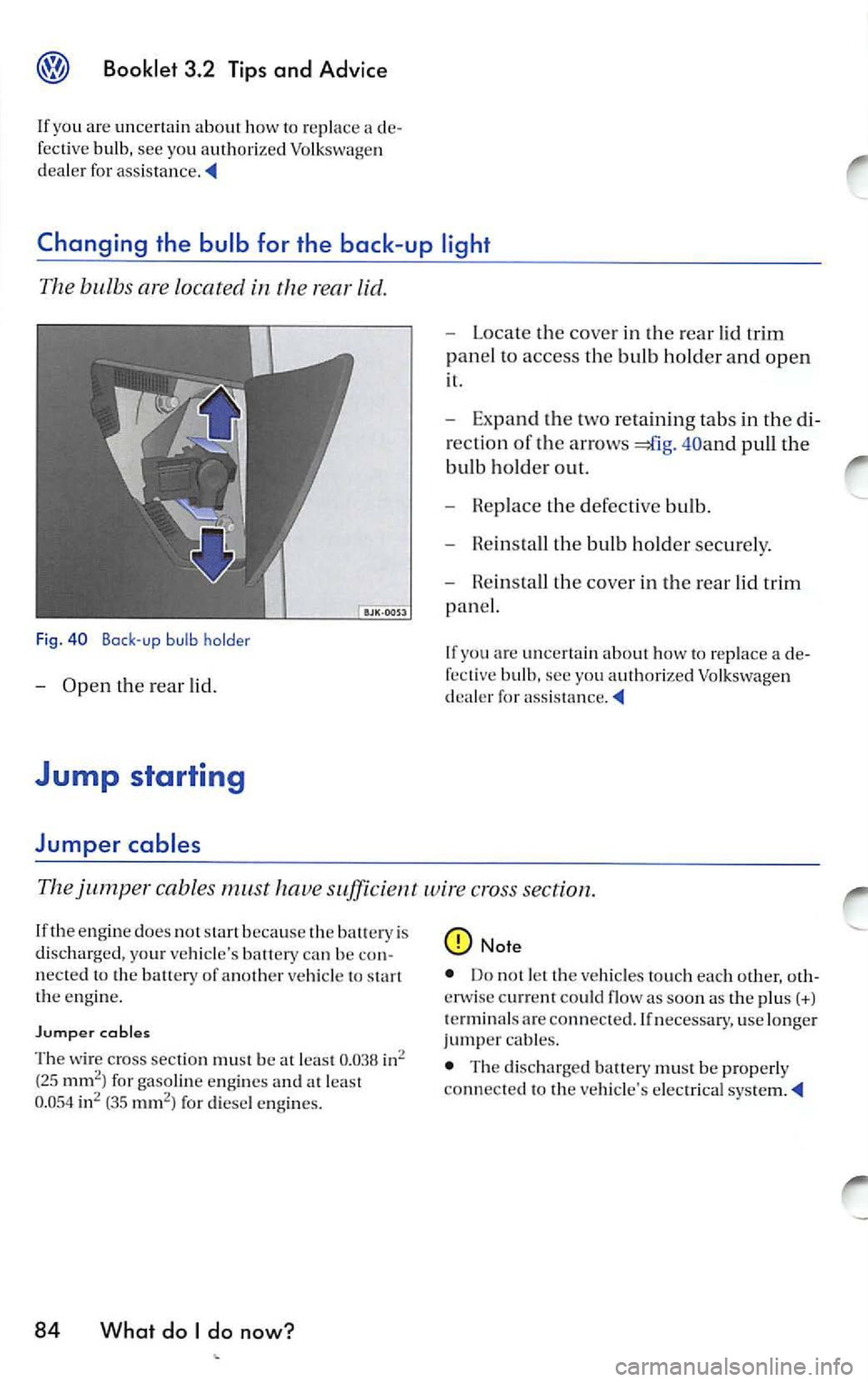
The bu.lbs are located in the rear Lid.
Fig. 40 Boc k-up bu lb ho ld er
- Open the rear lid.
Jump starting
Jumper cables
- Locat e the cover in the rea r lid trim
pan el to access the bulb holder and open
it.
- Ex pa nd th e tw o re taining tabs in the di
r e ct ion of the arrow s
40and pull the
bulb holde r out.
- Replac e th e defect iv e bu lb.
- Rein stall the bulb holder securely.
- Rein sta ll th e co ver in the rear lid trim
panel.
If you are unc ertain about ho w to re plac e a de
f ec tive bulb , see y ou auth orized Volkswa gen
d ea ler for a ssis tanc e.
The jumper cables have sufficient cro ss sec tion.
If th e engin e does not sta rt beca use the batt ery is
di scharg ed , yo ur vehicl e's batt ery b e co n
n ec te d to th e batt ery of anot her veh icl e 10 s tart
t h e e ngin e.
Jump er cab les
Th e cro ss sec tion mu st b e a t leas t 0.03B (25 111111 2
) fo r gaso line en gin es a nd at l eas t
0.0 54 (35 111111 2
) fo r di ese l en gin es.
84 What do I do now?
Note
• Do n ot le t the vehicle s tou ch eac h oth er, oth
e rw ise curr ent cou ld flow a s soo n as th e plu s(+)
t e rm inals are co nne cted. If necess ary, u se lon ger
jump er cabl es.
• The di sc ha rge d batt ery mu st be prop erl y
co nnec te d
to th e ve hicl e's elec tri ca l sys tem.
Page 406 of 477
Booklet 3.2 Tips and Advice
4.
1.
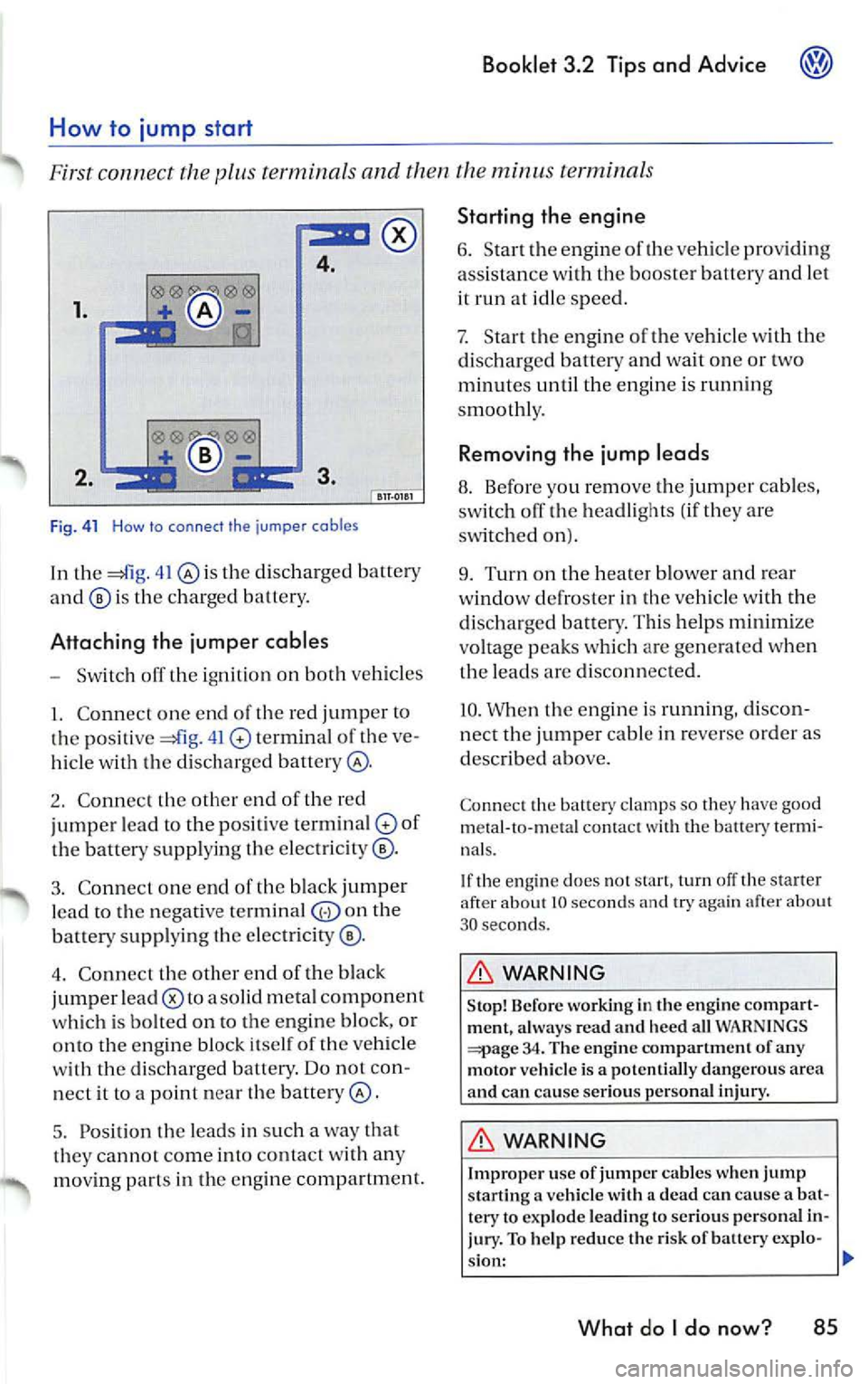
Fi g. 41 How to connect the jumper cables
In th e 41 th e di sc har ged batter y
is the c har ged battery.
Attaching the jumper cables
- Sw itch off th e igniti on on both vehicl es
I. Co nne ct one end of the red jump er to
po siti ve 41 termin al of the ve
hi cle w ith the disch arge d batter y@ .
2. Co nnect th e other end of the re d
jumper lea d
to the p ositive terminal of
th e batter y supp ly in g th e elec trici ty ® ·
3 . Co nne ct o n e end of the black jumper
l ea d to the neg ative terminal
the
batte ry sup plying th e elec tricity ®·
4 . Conn ect the othe r end of the black
jumper lead
a so lid m etal co mpon ent
w hich is bol te d on to the engin e block, or
onto the e ngin e bl ock itse lf of the ve hicle
wi th the d isc harg ed battery. Do nor con
n ect it to a po int n ear
batter y@ .
5. Position
leads in su ch a way that
they cannot come into conta ct w ith any
mo vin g part s in th e e ngine compa rtment.
Starting the engine
6 . Start en gine of vehicle providin g
ass ista nce with the booster batte ry and let
it run at id le speed .
7. Start the eng ine ofr he ve hicl e w ith the
di scharg ed batter y and wait o ne or two
m inut es unt il th e en gin e is runn ing
s mooth ly.
Removing the jump leads
8. Before yo u remov e th e jum per ca bles,
swi tch off the headli ghts ( if th ey are
on).
9. Turn on the hea te r blower and rea r
w ind ow defro ster in the ve hicle wi th th e
d isc ha rged battery . Thi s help s m inim iz e
v oltag e peaks w hich are ge ner ated when
t h e le ad s are disco nnect ed.
10 . W hen th e engin e is ru nnin g, d isco n
nect the jumper cable in reve rse order a s
desc ribed above.
Con nect th e battery clamps so the y ha ve good
metal- to- meta l co ntact w ith the battery termi
na ls.
If th e eng ine does not start , turn off th e s tarter
afte r about 10 seco nds and try aga in afce r ab out
30 seco nds.
WARNING
S to p! B efore wo rking in the engine comp art
ment, al ways read and he ed all WAR NIN GS
34 . The engin e compartment of any
motor v ehicl e is a pote ntially dan gero us area
and ca n ca use se rious per sonal inju ry.
WARNING
Improp er u se of jum per ca bles w hen jump
s tarting a ve hicl e with a dead can ca use a bat
tery to exp lode leading to seriou s perso nal i n
jury. To help reduce the risk of batt ery exp lo-
s ion:
What do I do now? 85
Page 407 of 477
Booklet 3.2 Tips and Advice
WARNING (continued)
• Always make sure that the battery pro
v idin g ass istance has the same vo ltage as the
discharged battery (12V) and approximately
the same ca pacity (see battery label).
• Neve r jump start a ve hicle with
rrozen
batt ery. 1r a battery is or has been frozen, re
pla ce it.
• Batteries giv e
explosive hydrogen gas.
A lways keep sparks, open flame and
smoking materials away from batteri es.
• Never short out the battery pole s by con
necting the positive
and nega tive po les
with eac h other .
• Always follow the jumper cab les ' manufac
turer's instruct ions.
• Never co nn ect the negati ve cab le from the
other vehicle directly to the negat ive terminal
or the discharged battery. The hydrogen gas
rrom the battery is exp losive.
Towing
WARN ING (continued)
• Never attac h the negative cable from the
ve hicl e providing starting assistance to parts
of the fuel syst em or to the brake hoses o r
brake lines.
• Never a llow the non -in sula ted parts of th e
batt ery clamps to touch. Never allow the
jumpe r cab le a ttached to the positive battery
t ermina l to contac t metal parts of the vehicle.
• Alw ays route the jumper cables so that
th ey can not ge t tangled up with moving parts
in th e engi ne c ompartment.
the vehicl e's e lec
tri cal sys te m.
• Do not l et
veh icles touch eac h oth er. Oth
e rw ise curr ent could fl ow betwee n the ve hicles
a s soo n as the plu s(+) te rminal s are
co nn ect ed.
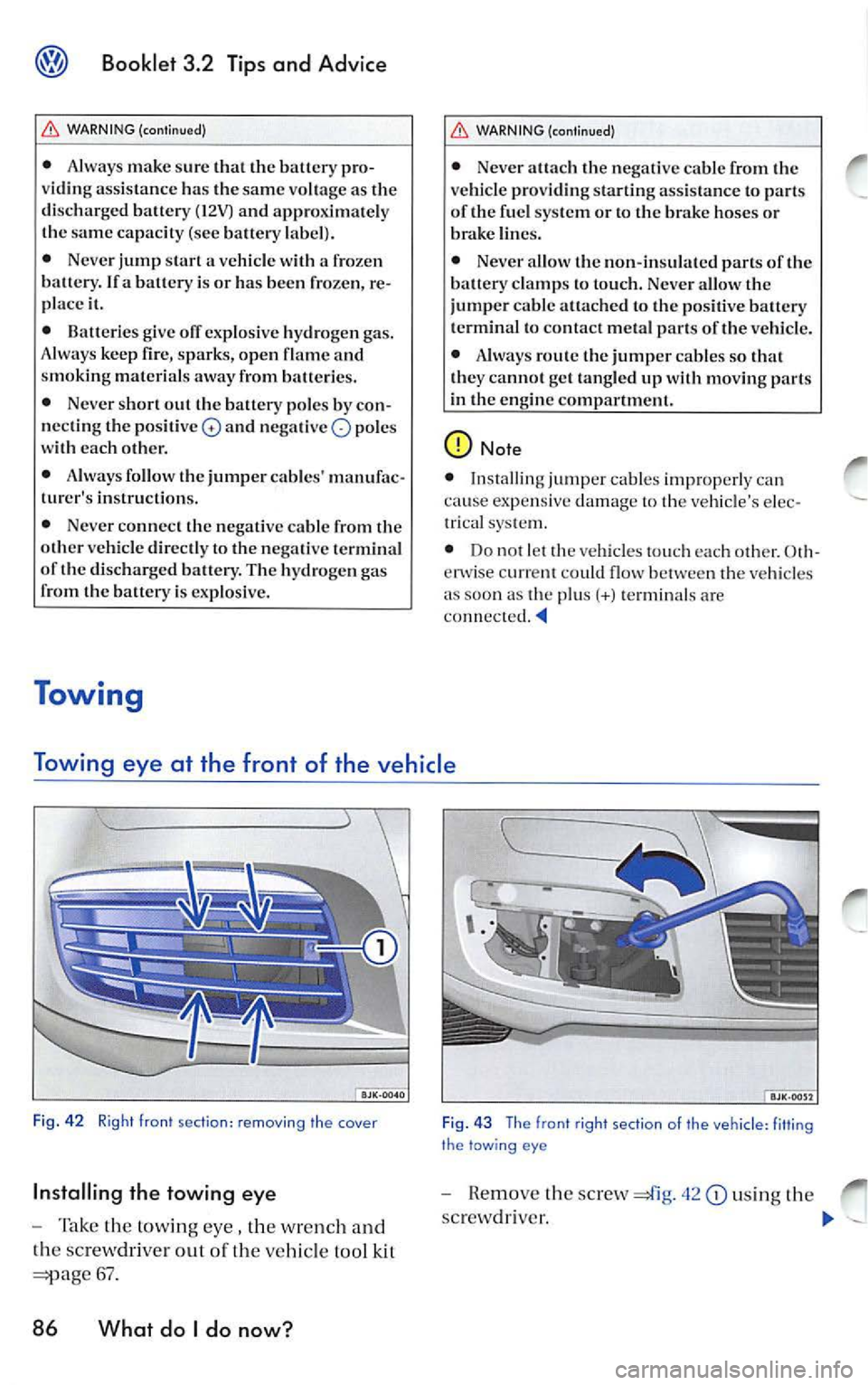
67.
86 What do I do now?
Fig. 43 The front right secti on of the vehicle: fitti ng
t he towing eye
- Rem ove the scre w 42 usin g the
sc rew dri ver.
Page 413 of 477
Booklet 3.2 Tip s and Ad vice
Alphabetical index
A
ABS 3
Accesso ries
What sh o uld I d o
I w ant to add an acces-
so ry t o m y ve hicl e? 27
A dd ress ofNHT SA 90
A ddress of T ranspo rt Ca nada 90
Af te r ch an gin g a w hee l 74
A lca nta ra
C lea nin g 25
A lloy w hee ls
C lean ing
21
A ll-w hee l drive
W int er t ir es 65
A nt i- fr eeze 43
A nt i- lock brak e sys te m
W ha t d oes it m ean whe n I feel a slig ht vi-
bra tio n on the bra ke ped al? 3
A nti -th eft w hee l bo lts
71
A ut o S afe ty Hotlin e 90
A ut oma tic ca r was hes
17
B
BAS 2
B att ery
C harg ing 50
H ow ofte n sh o uld I rep lace my e ngin e
b att ery ? 50
Imp ort an t in fo rm atio n t o kn ow
disco nnect the ba ttery 49
R ep lac in g 50
What you mu st d o a fte r rec onnec t the
b ane 1y 49
W int er co nd it io ns 49, 50
Batt ery ac id leve l
C hec kin g 50
B o nn et 36
Brak e ass ist sys te m 2
Bra ke boost er 2
92 Alphabetical inde x
Brake fluid
C han gin g 48
H ow
sh ould the bra ke flu id be
c h an ge d? 48
W hat i s th e co rrec t b rak e flui d leve l? . 47
W hat k ind of br ake flui d sh ou ld I use? 48
Bra ke pa ds 8
Bra ke servo 8
Brake system 47
B ra kes 8
H ow does mois tur e o r roa d sa lt a ff ec t th e
b rake s? 8
W hat d oes it mean when I feel a slig ht vi
brat io n on th e bra ke ped al? 3
Bra kin g dis ta n ce 8
Br ea k-in p eriod
E ng in e 7
W hat is th e rig ht way to break-in m y
ve hicl e? 7
Brea king in
B ra ke pad s 7
T ires 7
Br ea kin g in tir es 7
B ulb chan ge
8 1
Bu mp er
Cl ea ning
1 8
C
Ca lifo rn ia Prop ositi on 65 Wa rning 34, 49
Car was hes
17
Ca ta ly ti c co nverte r 10
CB ra d io 29
Ce ll pho ne 29
Ce llul ar p hone 29
Chang in g a bu lb
8 1
Cha ng in g a w hee l 73
C hang in g bra ke pad s 7
C hangin g w indshie ld w iper b la des 46
C hass is 22
Chec kin g e ngin e o il leve l 39
Chec king tir e p ress ure 56
Chro me
Cl ea ni ng
21
Page 415 of 477
Booklet 3.2 Tip s and Ad vic e
F
Fab ric trim
C lea ning 23
box 79
F u ses 77
G
Gaske ts 20
Gaso line 32
B le nd s 32
Co ntaining alcohol 32
Oc tan e rating 32
P etro l 32
Pr emium 32
R eg ular 32
U nl eaded 32
W ha t if I purc hase poor qua lity fu el? 32
W hat wou ld happ en if I put l ead ed gaso-
line in my car? 32
W in te r or summ er tip s 32
Gaso lin e addit ives 33
G lossa ry of tire and l oad ing t ermin ology 52
H
H ow could I damag e th e ca taly tic
co nverter? 10
H ow do I kno w how much oil m y eng in e is
co nslllnin g? 38
H ow do I unlo ck th e engine hood? 36
H ow doe s moi sture or road sal t affe ct the
bra kes? 8
H ow oft en sh o uld I c h ec k my tire
pr ess ures? 57
H ow of te n sh ou ld I rep lace my eng in e
battery? 50
H ow ofte n sh ould I wa x m y c ar? 19
H ow often sh ou ld th e brake fluid be
c h anged? 48
Hu bca ps 69
H ydro pla nin g 60
I mp ort ant inform ation fo r ve hicle s wi th Die
se l eng ine when addin g or changin g en
g in e oil 41
94 Alphabetical index
Impo rtan t inf ormati on to kn ow before dis
c on nec t the battery 49
I ns trum en t panel
C le aning 23
J
Jack 72
Jum p star lin g 84
Jump er cables 84
L
Lea ther
C lea nin g 23
Lifting pla tfo rm 89
Lifti ng th e ve hicle 89
Li gh t cha nge 81
L ock cy linders
21
Lo cks 21
M
Mod ificat io n s 28
N
New tires an d wheels 6 1
N HT SA 90
No tice about data r ecorded by vehicle con
trol modu les 6
0
Oil 37
O il ch an ge 42
Oil dips tick 39
Ope ratin g you r vehicl e ou ts id e th e U. S.A . o r
Ca nada 91
Outs id e mirr ors
C lea ning 19
p
Pa int
P o lishin g 19
Wax ing 19
Park ing Ass is ta nce
C le aning sensors
Page 417 of 477
Booklet 3.2 Tip s and Ad vice
V
Ve hicl e
Li ftin g 89
Ve hicl e batt ery
49
Ve hicle care
Exte rior 17
Ve hicle care prod ucts 16
Ve hicl e co ntrol m odul es
6
Vehicle phone 29
Veh icle too l kit
67
Vo lksw agen Se rv ice Repa ir Manua ls 9 1
w
Warranty covera ges L5
W as her 45
Was hing by ha nd 17
W as hin g th e veh icl e 17
Was hin g with power cl eaners
18
Wax ing
Ho w ofte n shou ld
I wax my ca r? 19
W ear indicato r 59
What do es it mea n wh en I fee l a sli ght vibra-
tio n on th e brak e peda l?
3
What if I pur ch ase poor quali ty fu el? 32
W hat is th e co rrect brak e
leve l?. 47
W hat is the right way to break- in my
ve hicl e?
7
W hat kind of brak e should 1 u se? 48
W hat kind of e ngin e oil sh ould 1 p ut in my
ve hicl e?
37
W hat sho uld 1 do afte r ch an ging a w hee l? 57,
74
What sh oul d 1 do after re p laci ng wh eels? 57
Wha t s h ould
I do if I want to add an accesso,y
to m y ve hicle ?
27
What s houl d 1 do if 1 wa nt to mod ify my
veh icl e? 28
Wh at should 1 do if I wan t to re pair m y
ve hicl e? 28
96 Alphabetical index
What sh o uld I do if t he brake warnin g light
comes o n?
47
What wo uld happ en if 1 put le ad ed gasol ine
in my ca r? 32
What you must do aft er rec onn ect th e
batt ery
49
Wheel bolt caps 69
Whee l b olt s 7 1
T orq ue 66
W hee l chan gin g
68
Whee ls 5 1 C hec kin g tire press ure 56
Co ld tire infl ati o n pre ssure 5 4
G en era l not es 51
G lossary o f tir e and loading
t e rmino logy 52
New tir es and whee ls 6 1
Tir es and veh icl e load limit s 58
Whe n ca n yo ur ve hicle not be to we d? 88
Wh en sh ould I adju st the tire press ures? 57
Whe n sh ould I ch ec k th e e ngin e o il level? 38
W hen should
I c h eck the tir e pr ess ures? 57
W hen sh ould
I ref uel the tank of the
ve hicle ?
3 1
W her e ca n I find t he tire pr essures for my
ca r?
56
Wh ere is th e oil d ipsti ck 3 9
W indo ws
Clea nin g
19
Wi ndshie ld
C lean ing
19
Win dsh ie ld wash 45
W ind sh ie ld wiper blades
C lea nin g 20
Win dsh ie ld wip ers
C hanging b lade s
46
Wint er tir es 65 All-w hee l dri ve 65
Wood en trim
C le anin g 23
Wo rking in the en gin e compartme nt 34
Page 426 of 477
Technical data
2.SL gasoline engine
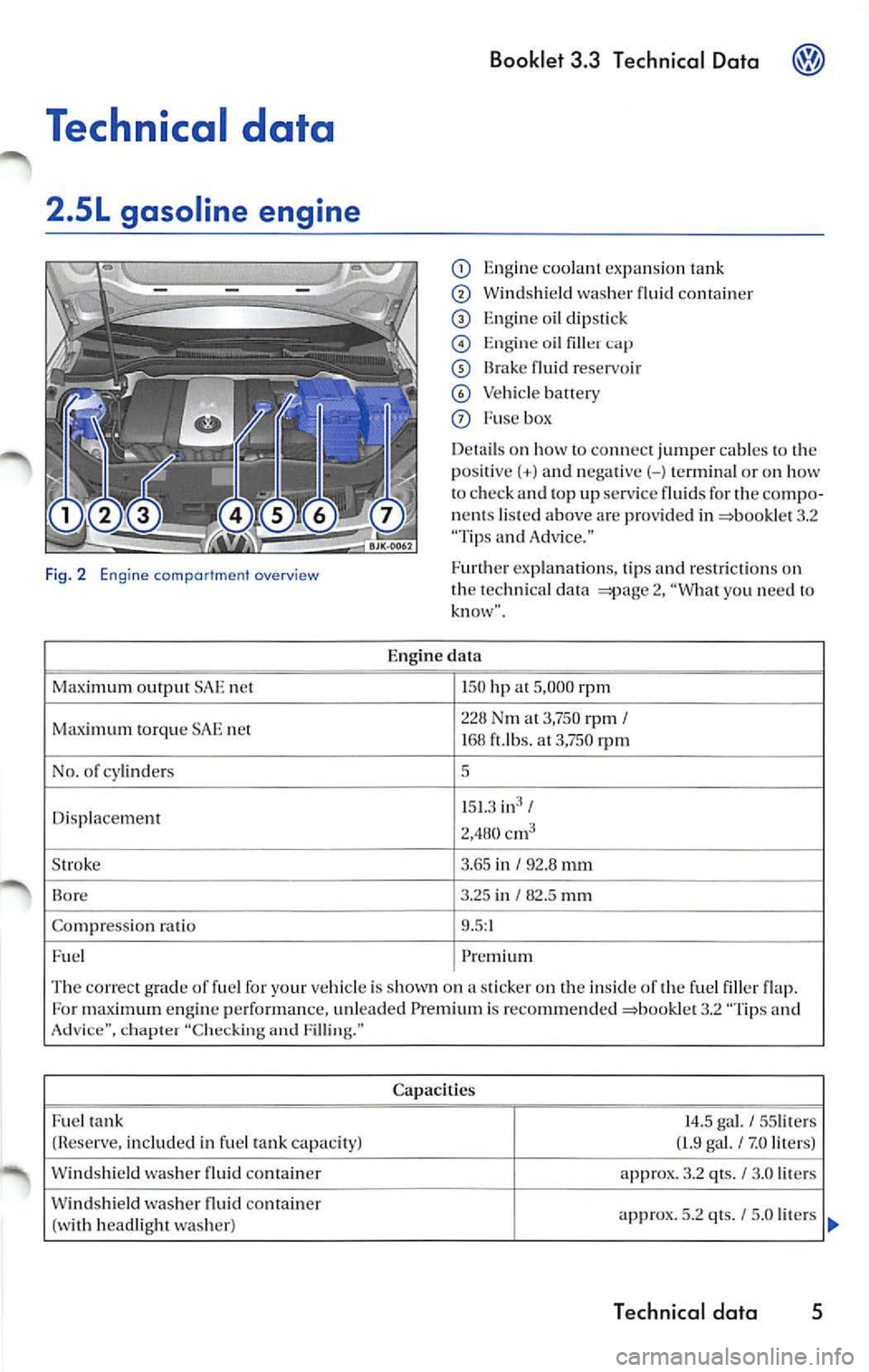
Fig . 2 Eng ine compor tme nt ov erv iew
Max imum ou tput SAE n et
Ma ximum torque SAE net
No. o f cy lin ders
Di spla cement
S troke
Bo re
Co mp ress io n ratio
Fue l
Booklet 3.3 Technical Data
E ngin e co olant expan sion tank
W ind sh ie ld was her fluid container
Engi ne o il dip stic k
E ng in e o il fille r
fluid re servoir
Vehicle batt ery
Fuse box
Deta ils o n h ow to connect jump er cab les to th e
p os itive(+) and neg ative(-) ter minal or on how
to ch eck an d to p u p serv ice fluid s for th e co mpo
n ent s listed abo ve are provided in
3 .2
"T ips and Advice."
Furth er exp lanat ions, tip s and restr ic tions o n
th e tec hni cal data
2, "What you n eed to
know ".
Engine data
1 50
a t 5,000 rpm
228 Nm at 3,750 rpm
I 168 ft. lb s. at 3,750 rpm
5
in3 I
2,480 cm3
3.6 5 in I 92.8 mm
3 .25 in
I 82.5 mm
9.5: 1
P re mium
Th e co rr ect grad e of f uel for your vehicle is sh ow n on a sticker on th e in sid e of the fu el fill er fl ap.
Fo r m ax imum eng in e perfo rm an ce, unlea ded Pre m ium i s rec omm end ed
3.2 "Tips and
Ad vic e ", c hapte r "C hec kin g and Filli ng.''
Capacitie s
Fue l tank 14.5 ga l.
I 55liters
( He serve, i nclu ded in fu el t ank capacit y) (1. 9 gal. / 7.0 lit ers)
W ind shi eld was her flu id co ntain er app rox.
qts. I 3. 0 lit ers
W ind shi eld was he r fluid conta in er
appro x. 5.2 qts.
I 5.0 lit ers
(w ith hea dli gh t was her)
Technical data 5