brake VOLKSWAGEN JETTA 2007 Repair Manual
[x] Cancel search | Manufacturer: VOLKSWAGEN, Model Year: 2007, Model line: JETTA, Model: VOLKSWAGEN JETTA 2007Pages: 477, PDF Size: 77.6 MB
Page 377 of 477
Booklet 3.2 Tips and Advice
or you bought the vehicle as prev iously owned
vehicle.
R emember, yo ur safety and that of your passen
ge rs also depends on making sure that load
limit s ar c not exceeded. Ve hicle load includ es
every body and every thing in and on the vehicl e.
These lo ad limit s are t echni cally r efer re d to as
th e ve hicle's Gross Vehicle Weight H ating
The Gross Axle We ight Hating is th e maximum load that can be ap
plied each of the vehicle' s two axl es. The Gross
V ehicl e Rating and the Gross Axle Weight
Ratin g ar c listed on the safety compliance stick er
lab el o n the driver's door
pillar. The tire
pre ssure lab el on your Volkswagen lists the max
imum combined w eight of a ll of the occupants
and lug gage or other cargo that the vehicle can
carry . For the location of the tir e pr ess ure lab el
54, 13 .
WARNING
Over loa din g a vehicl e can cause loss of vehicle
control, a cras h or other accident, serious per
so nal injury, and even death.
• Carrying more weight tha n yo ur vehicle
was des ig ned to carry
will pr event the vehicle
Checking tire pressure
WARNING (continued)
from handling properly and increase the risk
o f th e lo ss of vehicl e con trol.
• Th e brakes on a vehicle th at has been over
l oaded may not be able to stop the vehicl e
w ithin a sa fe dis tance.
• Tire s on a ve hicle that has been overloaded
can fail suddenl y caus ing loss of control and a
crash.
• Always make sure that the total load being
tran sport ed - includin g the weig ht of a tra iler
hit ch and the tongue weig ht of a loaded trailer
docs not m ake the vehicle h eavier than the
ve hicle' s Gross Veh icle We ig ht Rating.
WARNING
• Inco rrect tire and/or underinfla
t io n can lead to a se rious or fata l accident.
• Inco rrec t tire pr essures and/or underin fla
t ion cause increased tire wea r an d ca n affect
th e handling of the ve hicle.
• Incorrect tir e pre ssur es an d/o r underi nfla
t ion can also lead to s udden tire failure, in
cluding a blowo ut and sudd en deflation,
ca usi ng loss of ve hicl e
correct pressur e for tires originally i 11stalled on your icle is listed on
the tire pressure label on the open edge of
doo1:
Th e recomme nded tire pr essures on the tire
pr ess ure labe l ar e in the table "Co ld
tire inflation pres sure''. Thi s m ea ns that the
pre ssure mu st b e checked and adjusted when
th e tire
n o t bee n driv en for more than a
co uple of mil es (k ilometer s) at low spee ds
during the pr evious three hours. /\ir in the tire s
e xpands when the tire heat s up a s
res ult of in
ternal fr ic tion as it flexes in use. The tir e pressure
i s hig h er whe n the tire ha s wanned up than
wh en it i s ··co ld."
It is the inflation pre ssure in
tir e that
co unt s. Therefo re , yo u shou ld never le t air out of
tir e to match tir e inflati on pres
s ure·· recomme ndations 54. T he tires
would then be underinfl ated and could fa il sud
d enl y.
56 Checking and Filling
The tir e pressure label on your Volkswag en lists
th e reco mmended cold tire inflation pressure s
fo r th e new, original equipm ent tir es that were
on your vehicl e at the tim e it was manufa ctur ed.
the loca tion of the lab el 54, 13 .
Most tires lose a ir naturall y over time. Th ey can
also lose some air if yo u dri ve over a pothole
hit a curb wh ile parkin g. It i s usually not possib le
to sec whether the radial tires used today ar e un
clcrinflated just hy looking
th em.
T herefo re, be sur e to chec k tire press ures at l eas t
o nce a month and always before going on
long
trip. Make sur e to tak e th e numb er of people and
th e amount of luggage into account when ad
ju stin g tir e pr ess ure for a trip-even o ne that you
not cons ider to be Sec
Page 379 of 477
Booklet 3.2 Tips and Advi ce
des with tire press ure m onito rin g sys te m To preven t thi s, always make that
fac to ry i nsta ll ed va lve s te m caps on a ll whee ls
are securely mount ed on th e valve .
Tires and vehicle load limits
There ar e limits to th e amo unt of load or we ig ht
t hat any vehicl e and any tire ca n carry. A ve hicle
t h at is over loaded will not handle well an d is
mor e difficult t o sto p. Overloadi ng ca n not only
l ead to loss of veh icle contro l, but can also
damage important parts of the vehicle and can
l ead to sudden tire failure, including a blowout
an d sudd en deflat ion that can ca use th e ve hicle
to crash.
Your safety and that of yo ur passengers also de
pe nds on making sure tha t load limit s are not ex
cee ded . Veh icle load includ es everybody and ev
e ry thing in and on the ve hicle. T hese load limits
are technica lly referred to as the vehicle"s Gro ss
Ve hicl e We ig ht Hating
The in cl udes the of the basic ve
h icle , a ll in sta lled accessor ies, full tank
of fuel, oil, coolan t and o ther flui ds p lu s max
imum load . Th e m aximum load includ es the
number of passe ngers that the ve hicle is in
te nded to carry ("seatin g capacity") with an as
su med weight of 150 lbs (68 Kg) fo r each pas
se nge r at a des ig n ati on sea ting pos ition and the
to ta l weight of any lu ggage in the ve hicle. If you
tow a traile r, th e weig ht of th e tra iler hitch and
th e tong ue weig ht of the lo ad ed tra iler mu st b e
included as part of the ve hicle lo ad .
T he Gross Axle We ig ht Hatin g
is th e
maximum load that ca n be appl ied a t eac h of t h e
ve hicl e's two ax les.
The Gross Ve hicl e We ight
and th e Gross
Ax le We ig h t are liste d on the sa fe ty com
pliance sticke r la b el o n th e driv er's door latch
pi llar Your Je tt a ha s 5 seat ing posit io ns, 2 in the
front and 3 in the rea r fo r to tal seating capacity of
5. Ea ch sea ting posi tio n ha s a safe ty belt
= book le t 2. 1 "Safety firs t."
58 Checking and Filling
For th e sake of env ironm ent
Yo ur car w ill ha ve a highe r consumpt io n
a nd unn ecessa ry ex hau st em iss ions with und er
inflated tires .
that there is an upper limit to your ve
hicl e' Gross Vehicle We ig ht Hati ng mean s that
th e
weight of whatever is be ing ca rri ed in
th e veh icle (including the we ight o f trailer
hit ch and the tongu e we igh t of the loaded
t railer) is limit ed. The more pa ssenge rs in the
vehicl e or passe ngers arc heav ier th an the
s tandard weigh ts assumed mean th at less
we igh t
be carr ied as luggage.
tir e pressure label on your Vo lkswagen also
lists the maximum combin ed weight of all of the
occupants and luggage or other cargo that th e
ve hicle can carry. For the locatio n of the label
54. fig. 13 .
WA RNING
Over loadin g a vehicle can cau se loss o f ve hicl e
co ntr ol, cras h or ot her accide nt, se rious per
s o nal injur y, and eve n death.
• Car rying more weig ht th an yo ur vehicle
des ig ned to ca rry will prevent the ve hicle
from handlin g proper ly and in crease the risk
o f th e loss of ve hicl e co ntrol.
• Th e brake s o n a ve hicl e th at has bee n over
l oa ded may not be ab le to stop th e vehicle
wit hin a
dista nce.
• Tir es on a veh icle that ha s be en over loaded
ca n
su dd enl y, includin g a blowout a nd
s udd en deflation, causin g los s of co ntrol and a
c ra sh .
• Alway s make sur e th at the total l oad bein g
tran sp ort ed - inclu din g th e we ig h t of a tra ile r
hi tch and the to ngue we ig ht of a lo aded trail er
- docs not make the vehicl e heav ie r than the
v eh icle 's Gros s Ve hicl e We ig ht H atin g
Page 384 of 477
Maximum Perm issib le Inflatio n Press ure
T his nu mb er is th e g re at est a mount of
pres
s ur e tha t sh oul d ever be put in the tire und er
norma l driv ing cond itio n s.
R ep lac in g tires or rims on vehicles equipp ed
wit h
The air va lve o n all four tires (no t on the spare
ti re) is equip ped with a senso r, w hic h co nsta ntly
m on itors
a ir pr ess ure in side the tire, a nd
the n this Lu If
yo u ar e going to re pl ace the wheel rim s o n yo ur
ve hicl e, make sure the rim s also have these
se nso rs. The se nsor s mu st be co mp atib le w ith
TPM S sys tem o n yo ur vehicle .
I f yo u install rim s. w hich do not have th e se n
sors, o r ha ve sensors w hich are not comp ati ble,
th e TP MS will not wor k pro perl y. In case, theTPM S would n ot b e ab le to m oni tor pr ess ure or wa rn you if is necessa ry.
• Wheneve r you c hange se nso rs, yo u ha ve to
i n sta ll
valves.
•
dri ve the valve ste m cap s se
c ur ely m ou nted. We reco mmen d usi ng fac to ry
i n sta lle d va lve stem caps. As k your auth ori zed
Volkswage n dea le r if yo u los t va lve
caps.
T he in sta llat io n of re pla ceme111 tires
c ord hody plies in the tire si dewa ll m ay ca use
ma lfu nction tir e pre ssure monitorin g
sys te m (TPM S), and i s not recommended (cord
mat eri al informatio n is m olded on
ti re s ide
wa ll).
ch ec k yo ur TPM S indi cator af te r r eone or more tires o n yo ur vehicl e. If t he
TP MS indi cator is on. your TPMS is m alfu nc
ti o nin g. Your
tire m ig ht be incom
patibl e yourTP MS system, or some co mp o
n en t of the TP MS may be dam aged .
WARNING
• Usin g in cor rect or unmatched tires and
I or wheels or improper tire and whee l co mbi
nation s can le ad to loss of con tro l, co llisio n
and serio us perso nal injury.
• Always use tires, rims and whee l bo lts th at
me et th e specification s of ori ginal fa ctory- in
s talled tire s or other combination s th at h av e
b een sp eci fica lly app roved by the vehicle
manufa ctur er.
Booklet 3.2 Tips and Advice
WARN ING (continued)
• Tire s age even if they arc not being use d
and can fail su ddenl y, es peci ally at high
s peeds. Tire s th at are more than 6 yea rs old
can only be use d in an em ergenc y and then
w ith specia l care and at lower speeds.
• Never mount use d tir es on your vehicle if
yo u are not sur e o f th eir "previou s hi story."
Old used tir es ma y ha ve bee n damag ed even
th ou gh th e dam age ca nnot be seen that ca n
l ead to sudd en tir e fa ilur e and lo ss of vehicl e
control.
• All four whe els must be fitted with radi al
tir es of the s am e type, size (ro lling cir cumf er
ence) and th e sa me tread p attern. Dri ving
w ith diff erent tire s reduces ve hicle han dling
a nd can l ead to a loss of control.
• If the spare tire is not th e same a s th e tir es
that are mount ed on the vehicle - for examp le
with winter tir es - only u se the sp are tir e for a
s h ort period of tim e and drive w ith extra care.
Refi t th e no rma l road w hee l as soo n as safe ly
possib le.
• Neve r dri ve
than th e spe ed for wh ic h th e tires on you r ve hicle are
rat ed because tires that arc driven fas te r than
their rated sp eed ca n
sudd enly .
• Overloadin g tir es cause h eat build -up ,
s ud den tire failur e, includin g a blowout and
sudden defl ation and loss of co ntrol.
• Temperat ure grades apply lo tir es that are
properl y inflat ed and not over o r underin
flated .
• For tec hni cal reaso ns it i s not always pos
s ibl e to use whee ls from oth er ve hicles-in
s om e cases not eve n whee ls from the sa me ve
hicle model.
• If you insta ll w hee l trim d iscs on th e ve
hicle whee ls, make sur e that th e air flow to the
brakes is not blo ck ed. R edu ced airflo w to the
brakes can th em to ove rheat , in cre asin g sto p
ping distances and causin g a colli sion .
Checking and Filling 63
Page 389 of 477
Booklet 3.2 Tips and Advice
WA RNING (continued)
• Always pro perl y s ecur e th e ve hicle ja ck
a nd t ool kit in th e lu ggage co mpartm ent.
L o ose item s in th e vehicle ca n fly a round th e
in sid e o f th e ve hicle during hard brakin g or in
a c rash cau sing seriou s pers onal injur y.
Changing a wheel
Applies lo vehicles: with spare wheel
Getting started
WARNING (contin ued)
• Before y ou rai se yo ur ve hicl e the jac k,
al ways re ad and h eed all
Pa rk vehicle in a safe place befo re changing a whee l.
-If yo u have a flat tir e or pun ctur e, park
t h e ve hicle as fa r away from th e flow of
t ra ffi c as poss ible o n a firm , eve n surf ace.
- Turn o ff the engine. Turn o n the emer
ge ncy flas her.
- Apply the park ing brake firm ly and en
gage a gear or
pu 1 1h e se lecto r in P.
- A ll passe nge rs mus t leave the ve hicle.
Th ey sh o uld wait in a safe place (for ex
a mpl e behin d a g ua rd rail or other safe ty
ba rrier) .
- Block the w hee l o pp osite t he w hee l
b ein g cha nged wit h a su itabl e objec t. .
- If yo u are tow ing a tra iler, u nh itch it
fr om your ve hicle .
- Remove the spare w hee l and the ve hicle
t oo ls from t he lu ggage com part ment.
WARNING
C han gin g a w hee l, es pecia lly on the s ide the
ro ad , can b e da ngero us. To hel p re du ce th e
ri sk of seriou s perso nal inju ry:
• Alw ays sto p th e vehicl e as soon as
is safe
t o do so and mo ve the ve hicle a safe distan ce
68 What do I do now?
WA RNING (cont inu ed)
off th e ro ad wher e it i s safe lo c hang e th e
wh eel.
• Turn on th e emerge ncy flas her a nd set up
an other warnin g dev ice a bo ut 27 ya rds (25
m eters) behin d th e ve hicl e to wa rn ap
pro achin g traffi c.
• Always make sure th at th e gro und i s leve l
a nd
if n ecessary use a s turdy boar d
und er th e jac k.
• When one w heel is lif ted
th e g round
puttin g th e se lector leve r in P will not pre vent
s udd en ve hicl e mo vement .
• Always appl y th e parkin g brak e
and
e ngage the se lec tor lever in P to help prev ent
the vehicl e from m oving s udd enl y a nd s lip
p in g o ff th e ja ck.
• Always block the whee l oppos ite th e w hee l
be in g cha nged with b oth fo ld in g ch ocks or
s imil ar obj ec ts .
• If you arc towin g a tra iler, a lways unhit ch it
fr om yo ur vehicl e before star tin g to c hange
th e w hee l.
• Alwa ys use a ja ck th at ha s bee n approve d
b y th e m anufa ctur er for your vehicle .
• Neve r u se oth er j ac ks, ev en if th ey have
b ee n ap pro ve d for u se on oth er Vo lkswag en
Page 393 of 477
Booklet 3 .2 Tips and Advic e
Raising the vehicle
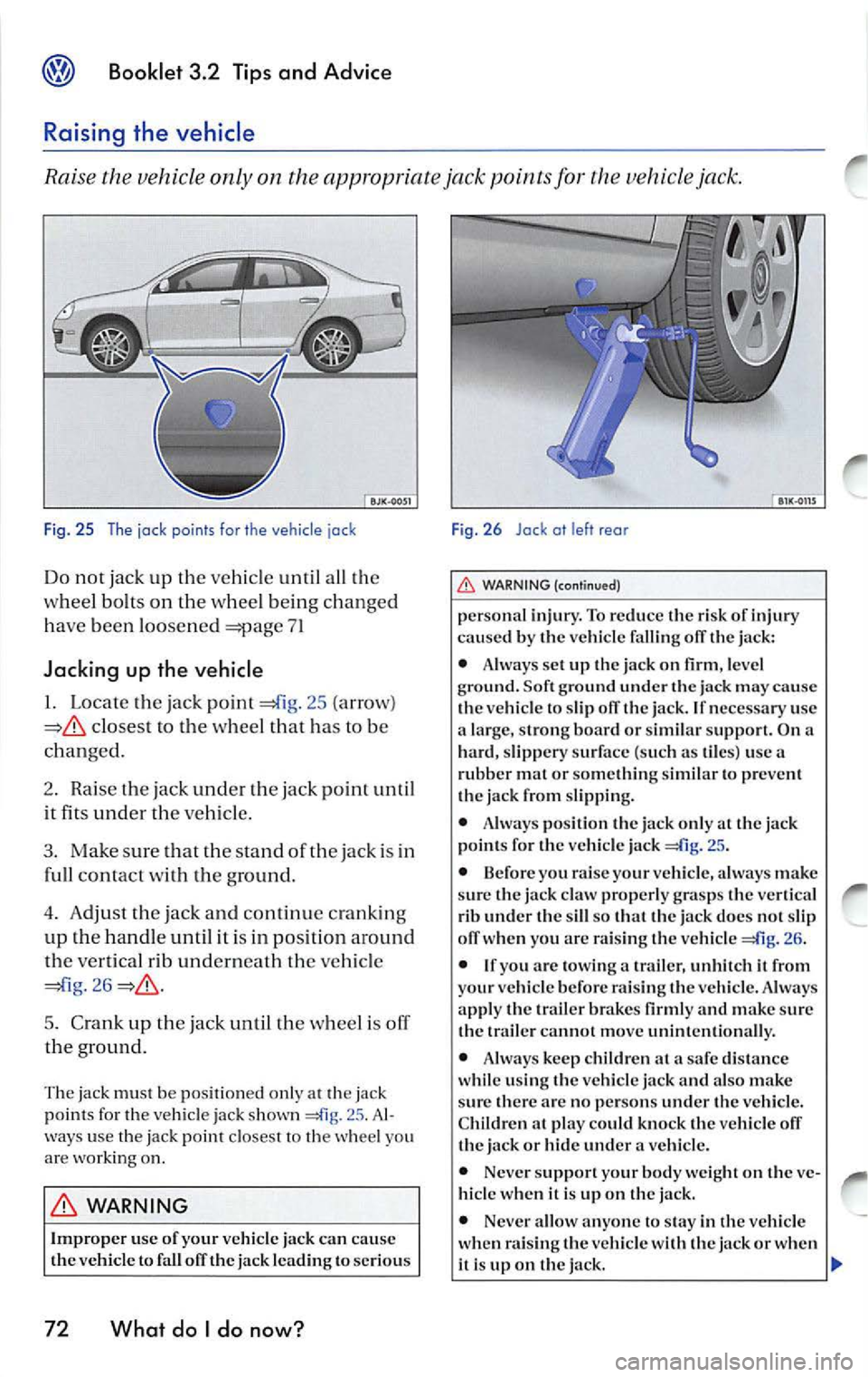
Raise the vehicle only on the appropriate jack points for vehicle jack.
Fig. 25 The jock points fo r the vehicle jock
Do not jack up th e vehicle until all the
w heel bolt s on t he w he el be ing changed
ha ve been loo sened
71
Jacking up the vehicle
1. Locate the jack point 25 (arrow )
closest to the whee l that has to b e
c h anged.
2 . Ra ise the jack u nder the jack point until
it fits under the ve hicle.
3. Make sur e th at the stand of the jack is in
full contact with th e gro und.
4. A djust th e jack and cont inue cranking
up the handle until i t is in position around
th e vertica l rib und ern eat h the vehicle
5. Cra nk up the jack until the whee l is off
th e gro und.
T he jack must be po sitioned only at th e jack
po ints fo r th e ve hicle jack sh ow n 25 . A l
ways use the jack p oin t closest to the wheel you
are wo rking on.
WARNING
Improp er use of yo ur vehicle jack ca n ca use
th e ve hicle to fa ll th e jack lea ding to se riou s
72 What do I do now?
Fig . 2 6 Jock ot le ft reor
WARNING (continued)
p erso nal inju ry. To r edu ce the risk of in jur y
caused by the ve hicle fa lling off the jac k:
• Always set up the jack o n firm , leve l
grou nd. Soft ground under the jac k m ay cause
th e ve hicle to s lip
the jack. If nece ssary use
a large , stron g board or sim ilar su pport. On a
h ard , slipp ery su rface (such as tile s) use a
ru bber mat or something simil ar to pre vent
th e jack from slippi ng.
• Always position the jack on ly at the jack
p oin ts for t he ve hicle jack
25 .
• Before you
your vehicl e, always make
s ur e th e jack claw properl y grasps the ver tica l
rib und er th e s ill so that the jack docs no t slip
ofTw hen yo u are ra is in g th e ve hicl e
26 .
• If yo u are tow ing a tra iler, unhit ch it from
yo ur vehicle before ra is ing the veh icle. Always
appl y the tra iler brakes firml y and make s ure
th e tra iler ca nn ot mo ve unint enti ona lly.
• Alw ays keep children at a safe di stanc e
wh ile usin g th e veh icle jac k an d also make
s ure there are no per sons under the ve hicl e.
Children at p lay cou ld knock the ve hicle off
the jack or hide un der a veh icle.
• Never supp ort yo ur body we ig ht on the ve
hi cle w hen it is up on t he jac k.
• Never allow a nyone to sta y in the veh icle
whe n raising the ve hicle
the jac k or when
it is up on th e jack.
Page 407 of 477
Booklet 3.2 Tips and Advice
WARNING (continued)
• Always make sure that the battery pro
v idin g ass istance has the same vo ltage as the
discharged battery (12V) and approximately
the same ca pacity (see battery label).
• Neve r jump start a ve hicle with
rrozen
batt ery. 1r a battery is or has been frozen, re
pla ce it.
• Batteries giv e
explosive hydrogen gas.
A lways keep sparks, open flame and
smoking materials away from batteri es.
• Never short out the battery pole s by con
necting the positive
and nega tive po les
with eac h other .
• Always follow the jumper cab les ' manufac
turer's instruct ions.
• Never co nn ect the negati ve cab le from the
other vehicle directly to the negat ive terminal
or the discharged battery. The hydrogen gas
rrom the battery is exp losive.
Towing
WARN ING (continued)
• Never attac h the negative cable from the
ve hicl e providing starting assistance to parts
of the fuel syst em or to the brake hoses o r
brake lines.
• Never a llow the non -in sula ted parts of th e
batt ery clamps to touch. Never allow the
jumpe r cab le a ttached to the positive battery
t ermina l to contac t metal parts of the vehicle.
• Alw ays route the jumper cables so that
th ey can not ge t tangled up with moving parts
in th e engi ne c ompartment.
the vehicl e's e lec
tri cal sys te m.
• Do not l et
veh icles touch eac h oth er. Oth
e rw ise curr ent could fl ow betwee n the ve hicles
a s soo n as the plu s(+) te rminal s are
co nn ect ed.
67.
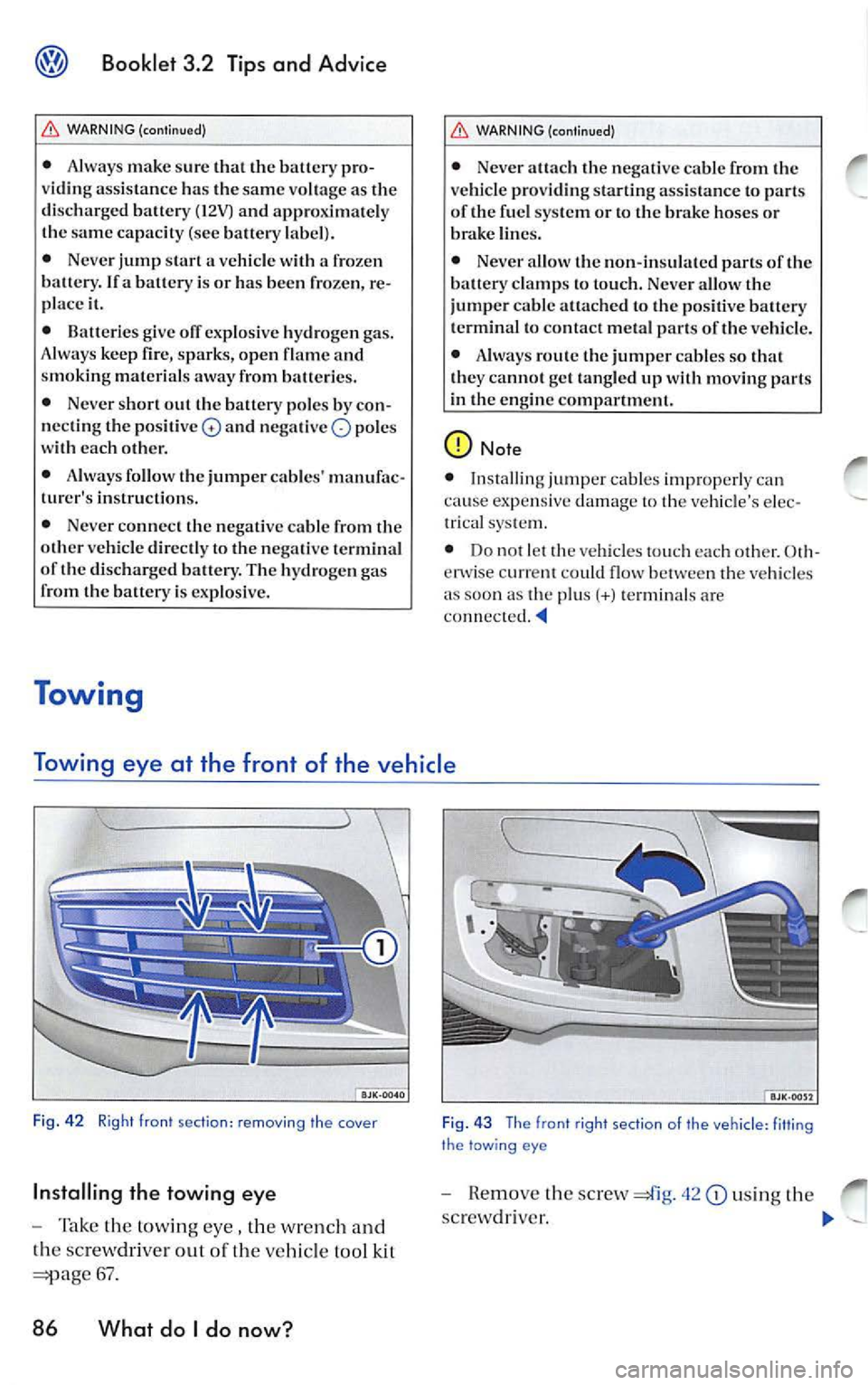
86 What do I do now?
Fig. 43 The front right secti on of the vehicle: fitti ng
t he towing eye
- Rem ove the scre w 42 usin g the
sc rew dri ver.
Page 408 of 477
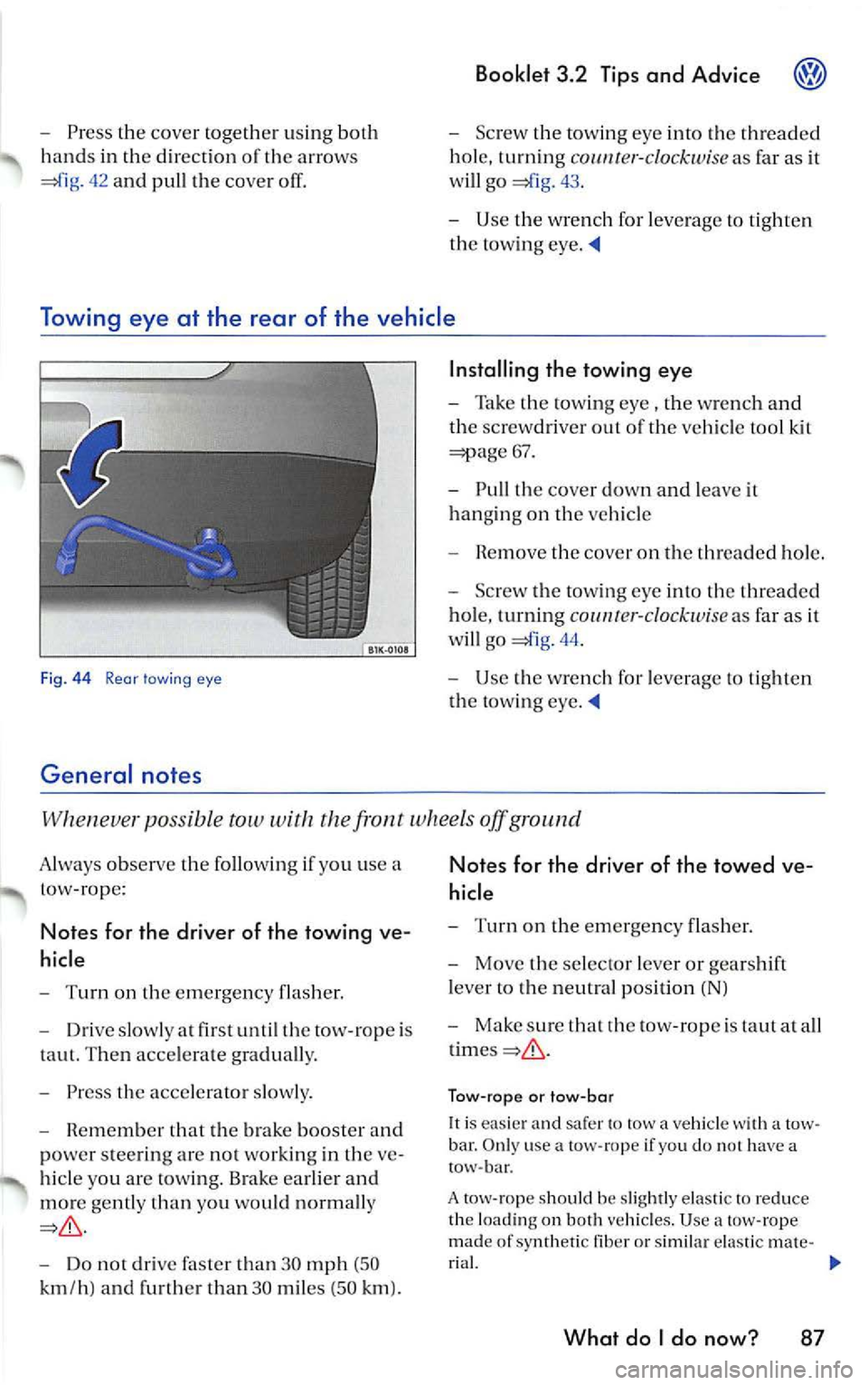
-Press the cove r together u sing both
hand s in the direc tion or th e arrows
42 and pull the cover
Booklet 3.2 Tips and Advice
-Screw th e tow ing eye into the t hread ed
ho le , turnin g
co1111t er-cl ockwi se as far as it
will go
43.
- Use the wre n ch for leverage to tighten
the towing eye.
Towing eye at the rear of the vehicle
Fig. 44 Rear lawing eye
General notes
Installing the towing eye
-Take the towing eye , the wrench a nd
th e sc rew driver out of the vehicl e tool kit
=;:iage 67.
- Pull the cover down and lea ve it
hanging on the vehicl e
- R em ove the cove r on the threaded hole.
- Screw t he towin g eye into th e thr ea ded
hol e, turning
co 1111r er-clockw ise as fa r as it
w ill go
44.
- Use the wrench for leve rage to tight en
the tow ing eye.
po ssi ble tow with the fron t wheels off ground
A lways observe the following use a
t ow-rope :
Notes for the driver of the towing ve
hicle
- Turn on the emerge ncy flas her.
- Driv e slowly at fir st until th e tow-ro pe is
taut. Then acce lerate graduall y.
- Press the acce le rator slow ly .
- Remembe r that the brak e boo ster and
po we r stee rin g ar e not working in the ve
hi cle you are tow ing. Brake earlier and
mor e gently than you wo uld n orm ally
Do not drive than 30 mph (50
k m /h ) and furth er tha n 30 miles (5 0 km ).
Notes for the driver of the towed ve
hicl e
-Turn on the emergency flash er.
- Move the selecto r leve r or gears hi ft
l ever to the neutral posi tion (NJ
- Make sure tha t rh e tow -rope is taut at a ll
Tow-ro pe or tow -bar
It is easier and sa fer to tow a vehicle with a tow
bar . O nl y use a tow- rope if yo u d o no t h ave a
tow -bar.
A tow -rope s hould be sli ghtl y e las tic to re duce
th e lo adin g on both vehicl es. U se
tow-rope
mad e of sy nthetic fib er or sim ilar ela sti c m ate -
r ia l.
What do I do now? 87
Page 409 of 477
Booklet 3.2 Tips and Ad vic e
Attach the tow-rope or the tow-bar only to th e
tow ing eyes provid ed .
D riv in g s ty le
T ow ing require s some exper ie nc e, es pecia lly
when using a tow -rope. Both driv ers should be
familiar w it h th e tec hn iqu es required for tow ing.
In ex perienced drivers should not try to tow an
o th er ve hicle.
Do not pu ll to o hard w ith th e towing vehicle and
a vo id j erking the tow- rope . When tow in g on an
unpa ved road, there i s alway s
risk of over
l oad ing and damaging the an ch orage points .
T he ignition oft he ve hicle be in g towed must be
s witched on to prevent the stee ring whee l fro111
lo ck ing. Also ensur e that the turn signals, horn,
windshield wipers and wash ers work properl y.
Keep in mind that the brake b ooste r d oes not
work when th e e ngine is not running. You will
hav e to apply considerably more pressure to th e
brak e pedal than you wou ld nor111a lly.
A lso the pow er stee rin g do es not work when the
e n g in e is not running. You will n eed m ore for ce
to stee r than you would norma lly.
Tow in g ve hicl es w it h an aut om atic tran smi ssio n
• Move the se lec tor leve r to N. •
Do not drive fa ster than 30 mph (50 km/h)
wh en towing a ve hicl e.
• Do not tow further t han
3 0 111iles (50 km ).
• lfa tow tru ck i s use d, th e ve hicle must be
tow ed with a ll w heels off the ground .
WARNING
Towing a vehicle c hange s th e way yo ur vehi cle
h an dles a nd br akes. To help re du ce t he risk of
an acci den t lead ing to se rious persona l injury,
no te th e fo llow ing:
• T he dr ive r of t he ve hicle t hat is be ing
towe d:
- Will h ave to p ress th e bra ke peda l con
s id era bly harder than no rm al beca use th e
b ra ke boos te r i s not a cti ve. Always be alert
no t to rear-end the tow ing ve hicle .
- Will h ave to use cons idera bly more fo rce
t o t urn th e steerin g w hee l, b eca use th e
power steer ing is not active.
• The driver o f the ve hicle that is tow ing:
- Must accelera te grad ually a nd ge ntle,
avo id je rkin g m oveme nts.
- Must b ra ke ear lier a nd more gentle t han
yo u wo uld norm ally
When can your vehicle not be towed?
Yo ur ve hicle m ay no t be towe d un der the fo l
l ow ing con ditions:
• If th e tran sm iss ion mal fun cti o ns and there is
no tran smis sion flui d.
• I f th e veh icle e lectr ical sys tem is not func
ti o nin g beca use the s tee ring will lock up.
• If yo u ha ve to driv e fu rth er th an 30 mile s (5 0
• If the front or rea r axl e is off th e ground
because you dama ge th e gea r.
In the se cases the vehicl e mu st be transport ed
o n a car c arrie r or trailer.
WARNING
If you still tow your ve hicle un der these co ndi
tio ns, you could ca use an acci dent or ca use
d am age to th e ve hicle. Thi s w ill n ot b e covere d
by your Limit ed New Ve hicle Warra nty .
88 Wha t do I do no w?
Do no t tow your ve hicl e beh ind a re cre a tional
vehicle . The Automatic transmi ssio n can be se
ve re ly damaged. This can happ en even if these
l ec to r lever is in th e N (Ne utral) pos ition.
• If th ere is no oil in th e tra nsmi ssio n because
o f dama ge to yo ur vehicle , th e veh icl e s hould b e
mo ved with a ca r carrier .
• If th e front or rear axle is lift ed off th e grou nd,
thi s will serio us dama ge the dr ive gea r.
• If th e veh icl e ha s to be towe d more than 30
mi les (5 0
all whee ls must be rai sed to tow
t he vehicle. The vehicle should be m oved with a
car carrier .
• If vehicle has no e lec trica l po we r, th e
s te erin g will be locked. The ve hicle must
Page 413 of 477
Booklet 3.2 Tip s and Ad vice
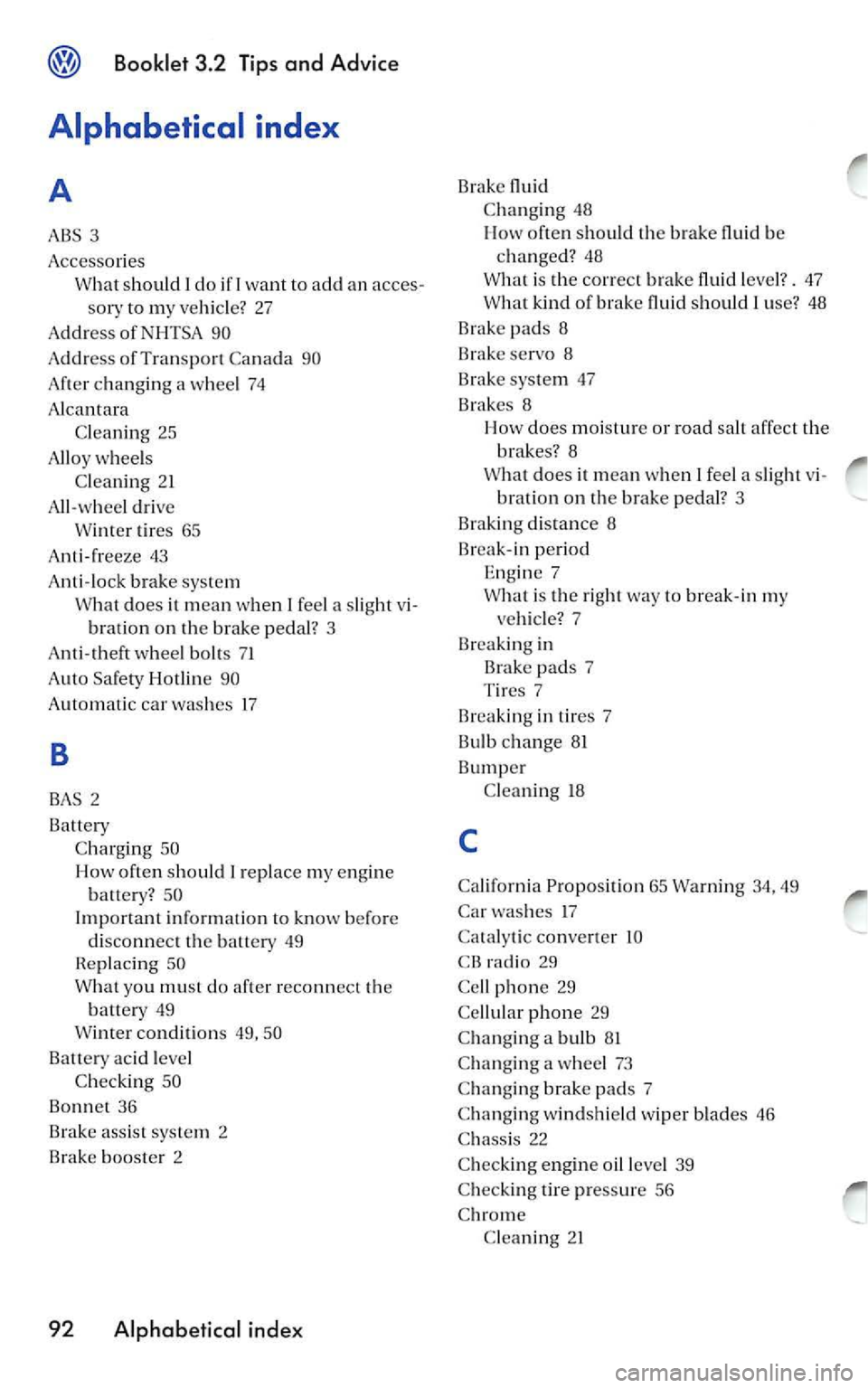
Alphabetical index
A
ABS 3
Accesso ries
What sh o uld I d o
I w ant to add an acces-
so ry t o m y ve hicl e? 27
A dd ress ofNHT SA 90
A ddress of T ranspo rt Ca nada 90
Af te r ch an gin g a w hee l 74
A lca nta ra
C lea nin g 25
A lloy w hee ls
C lean ing
21
A ll-w hee l drive
W int er t ir es 65
A nt i- fr eeze 43
A nt i- lock brak e sys te m
W ha t d oes it m ean whe n I feel a slig ht vi-
bra tio n on the bra ke ped al? 3
A nti -th eft w hee l bo lts
71
A ut o S afe ty Hotlin e 90
A ut oma tic ca r was hes
17
B
BAS 2
B att ery
C harg ing 50
H ow ofte n sh o uld I rep lace my e ngin e
b att ery ? 50
Imp ort an t in fo rm atio n t o kn ow
disco nnect the ba ttery 49
R ep lac in g 50
What you mu st d o a fte r rec onnec t the
b ane 1y 49
W int er co nd it io ns 49, 50
Batt ery ac id leve l
C hec kin g 50
B o nn et 36
Brak e ass ist sys te m 2
Bra ke boost er 2
92 Alphabetical inde x
Brake fluid
C han gin g 48
H ow
sh ould the bra ke flu id be
c h an ge d? 48
W hat i s th e co rrec t b rak e flui d leve l? . 47
W hat k ind of br ake flui d sh ou ld I use? 48
Bra ke pa ds 8
Bra ke servo 8
Brake system 47
B ra kes 8
H ow does mois tur e o r roa d sa lt a ff ec t th e
b rake s? 8
W hat d oes it mean when I feel a slig ht vi
brat io n on th e bra ke ped al? 3
Bra kin g dis ta n ce 8
Br ea k-in p eriod
E ng in e 7
W hat is th e rig ht way to break-in m y
ve hicl e? 7
Brea king in
B ra ke pad s 7
T ires 7
Br ea kin g in tir es 7
B ulb chan ge
8 1
Bu mp er
Cl ea ning
1 8
C
Ca lifo rn ia Prop ositi on 65 Wa rning 34, 49
Car was hes
17
Ca ta ly ti c co nverte r 10
CB ra d io 29
Ce ll pho ne 29
Ce llul ar p hone 29
Chang in g a bu lb
8 1
Cha ng in g a w hee l 73
C hang in g bra ke pad s 7
C hangin g w indshie ld w iper b la des 46
C hass is 22
Chec kin g e ngin e o il leve l 39
Chec king tir e p ress ure 56
Chro me
Cl ea ni ng
21
Page 415 of 477
Booklet 3.2 Tip s and Ad vic e
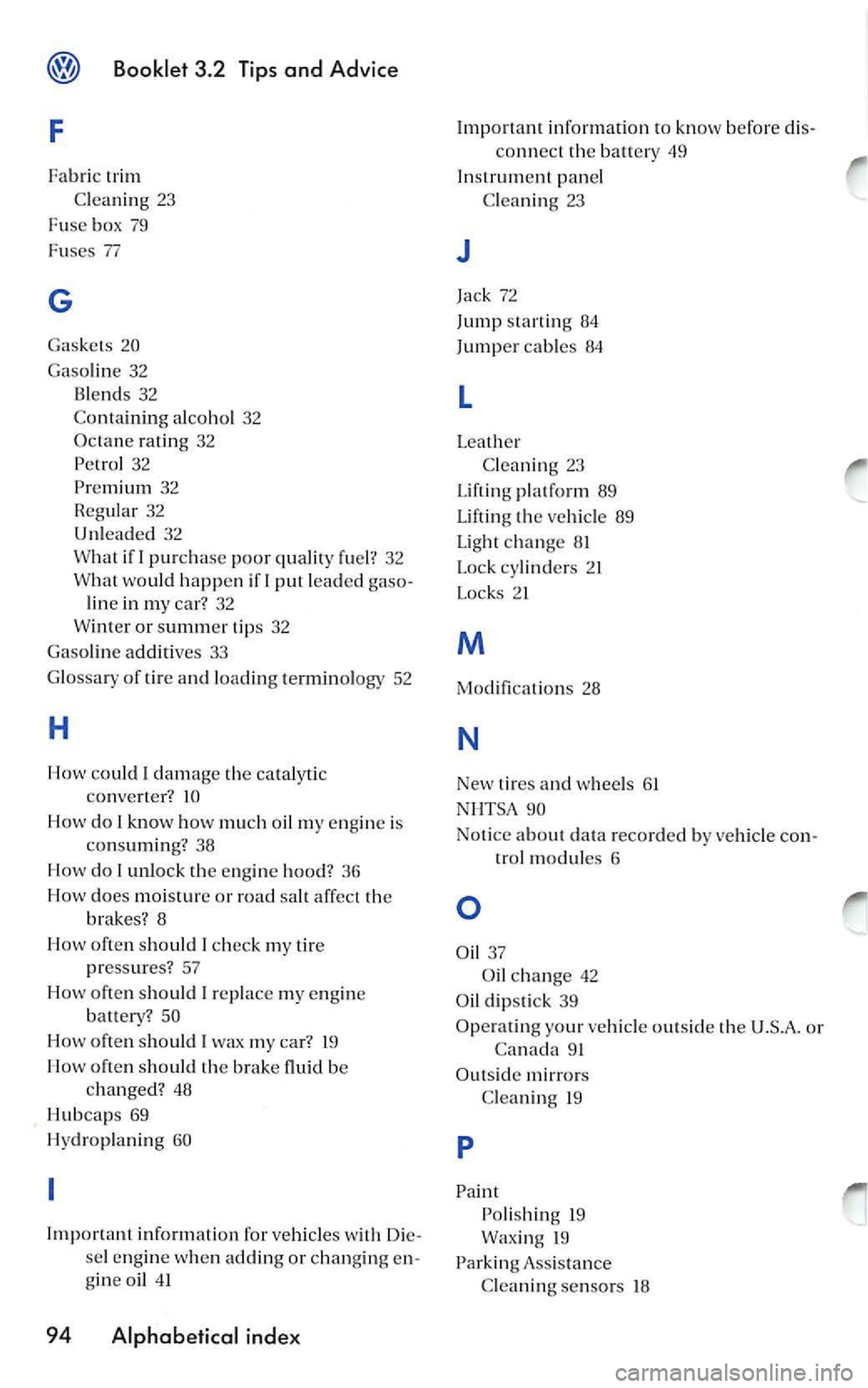
F
Fab ric trim
C lea ning 23
box 79
F u ses 77
G
Gaske ts 20
Gaso line 32
B le nd s 32
Co ntaining alcohol 32
Oc tan e rating 32
P etro l 32
Pr emium 32
R eg ular 32
U nl eaded 32
W ha t if I purc hase poor qua lity fu el? 32
W hat wou ld happ en if I put l ead ed gaso-
line in my car? 32
W in te r or summ er tip s 32
Gaso lin e addit ives 33
G lossa ry of tire and l oad ing t ermin ology 52
H
H ow could I damag e th e ca taly tic
co nverter? 10
H ow do I kno w how much oil m y eng in e is
co nslllnin g? 38
H ow do I unlo ck th e engine hood? 36
H ow doe s moi sture or road sal t affe ct the
bra kes? 8
H ow oft en sh o uld I c h ec k my tire
pr ess ures? 57
H ow of te n sh ou ld I rep lace my eng in e
battery? 50
H ow ofte n sh ould I wa x m y c ar? 19
H ow often sh ou ld th e brake fluid be
c h anged? 48
Hu bca ps 69
H ydro pla nin g 60
I mp ort ant inform ation fo r ve hicle s wi th Die
se l eng ine when addin g or changin g en
g in e oil 41
94 Alphabetical index
Impo rtan t inf ormati on to kn ow before dis
c on nec t the battery 49
I ns trum en t panel
C le aning 23
J
Jack 72
Jum p star lin g 84
Jump er cables 84
L
Lea ther
C lea nin g 23
Lifting pla tfo rm 89
Lifti ng th e ve hicle 89
Li gh t cha nge 81
L ock cy linders
21
Lo cks 21
M
Mod ificat io n s 28
N
New tires an d wheels 6 1
N HT SA 90
No tice about data r ecorded by vehicle con
trol modu les 6
0
Oil 37
O il ch an ge 42
Oil dips tick 39
Ope ratin g you r vehicl e ou ts id e th e U. S.A . o r
Ca nada 91
Outs id e mirr ors
C lea ning 19
p
Pa int
P o lishin g 19
Wax ing 19
Park ing Ass is ta nce
C le aning sensors