high VOLKSWAGEN JETTA 2007 Owners Manual
[x] Cancel search | Manufacturer: VOLKSWAGEN, Model Year: 2007, Model line: JETTA, Model: VOLKSWAGEN JETTA 2007Pages: 477, PDF Size: 77.6 MB
Page 10 of 477
Generator
Warn ing light 3.1: 24
G love compartm ent
Front pa ssenger s ide 3.1: 69
G love compartment light 3.1: 50
G low plug system
W arning light 3. l: 23
Gu ide fi xture s for lower anchorages 2.1: 68
H
H at sh el f3 .l : 79
H aza rd ligh ts 3.1: 48
H ea d re straint s
Adj ust ing 3.1: 58, 59
Correc t ad justm ent 2.1: 7
R emo ving 3.1: 59
H ea dligh t fla sh er 3. 1: 4 9
H ea dligh ts 3.1: 46
Fog light s 3.1: 46
Switching 3.1: 46
Wa sh er syste m 3.1: 55
H eat ed front seats 3. 1: 65
H ea ting 3.I: 80
H eavy clothi ng and safety belt s 2.1:
17
High b eam 3.l: 49
Warning light 3.1 : 29
High b eam leve r 3. 1: 49
Hom eLink Univer sal Tran smitter 3.1: 44
Horn 3.1 : 3
How could I dama ge the catal ytic conve rter?
3 .2:
10
Ho w do I know how much oil my engin e is
co nsumin g? 3.2: 38
How do I unlo ck th e engine hood? 3.2: 36
I-lo w does moisture or road salt affect th e
brak es'? 3.2: 8
Ho w man y airbags does my veh icl e h ave? 2.1:
34 ,44,4 9
H ow often shou ld
I c h eck my tire pr essures ?
3.2: 57
How often should I r epl ace my eng ine bat
ter y? 3. 2: 50
How often should I wax my ca r? 3.2: 19
I-l ow often sho uld the brake fluid b e
c han ged? 3. 2: 48
How to in stall the upper t eth er strap
to th e
anchorage 2.l: 66
Booklet 0.1 General Inde x
Hubcaps 3.2: 69
H ydrop laning 3.2: 60
Ignition key 3.1: 93
I gnit ion switch 3.1: 93
I mmobili zer 3.1 : 23
Warning message 3.1:
11
Imp ortance of sitting prop erl y 2.1 : 27
Imp ortance of wearing safe ty bel ts 2.1: 27
Important information for vehicles with Die-
se l e ngine when adding or changing en
gine oil 3.2: 49
Import ant information
kn ow befo re di s-
co nn ect the b att ery 3.2: 49
I mport ant thing s to do b efore dri ving 2.1: 3
Improper seating po sitions 2.1: 8
Improp erl y worn safety belt s 2.1: 25
Indicator light
A ir bag syste m 2.1: 39
Indicator light s
Airbag syste m 2.1: 49
Mi rror 3.1: 55
OFF 2.1:
Indi re ct ventilat ion 3.1: 86
Indi vidual unlockin g 3.1: 17 , 34
I nfant seats 2 .1: 56
Information t exts in the display 3.1:
11
Insid e m irr or
Indicator light 3.1: 55
In stallin g
C hi ld re straint with a safety belt 2.1: 60
CRS using th e LATCH system 2.1: 69
In strum ent clu ster 3.1 : 5
In strum ent cluster illumination 3.1 : 3 , 48
Instrument panel 3.1: 2, 71
Cleaning 3.2: 23
In strum ent s 3.
I: 5
Interior lights
Fro nt 3.1: 50
Int ermittent w ipe 3.1: 53
J
Ja ck 3.2: 72
Jump s ta rtin g 3.2: 84
J ump er cables 3.2: 84
Alphabetical index 7
Page 14 of 477
Stopping th e engine 3.1: 97
S tora ge area
Ot her stora ge a reas 3.1 : 7l
R oof 3.l : 7 1
S torage compartm ent 3 .1: 69
Fro nt ce n te r armrest 3.1: 70
R ear armrest 3.1: 70
S tor age for the vehicle literature 3.1: 69
Sto ring seat po sit ion s 3.1 :
64
Sto wing luggage in the luggage companm en t
2.1 : 10
S un visor 3.l: 52
S u nro of 3.1: 42
S un sh ade
P owe r roof3.l: 42
Switc h light in g 3.1: 3
Sw itchabl e locking feature
Act iva ting 2.1: 62
Deactivating 2.1: 63
Switc hes
Emerge ncy nasher 3. l: 48
L ig ht switches 3.1 : 46
Powe r ou tsi de m irrors 3.1: 56
Power roof3.l: 42 P owe r w indo ws 3.1: 39
Switc hing off th e e ngin e
W ith
ig n itio n ke y 3 .1: 97
T
Tachometcr3.I: 6
Tank
Fill ing the tank 3.2: 30
F uel ga uge 3. 1: 7
Op ening the fu el fi ller
3.2: 30
Technical modifications 3 .2: 28
T et her anc ho rs 2.1: 65
T et her strap 2.1: 65
Tie-down hooks 3.1 : 78
Ti e-clowns 2. 1: I I
Tire and whee ls 3.2: 5 1
Tire press ure 3.2: 56
Tir e pressure monitor in g syste m 3.1
Warn ing li ght 3.1: 30
Booklet 0 .1 Gen eral Ind ex
Tires
Service life 3.2: 59
Speed Ratin g Le tte rCode 3.2 : 62
Tire manufa cturing date 3.2 : 62
Ti re speci fica tion s 3.2: 62
Trea d depth 3.2: 59
U niform tir e qual it y grading 3.2:
W inter ti res 3.2: 65
T ir e s and wheels
Dim ensio n s 3 .2: 51
New3.2: 6 1
S now chains 3.2: 66
Wh eel b olt s 3 .2: 66
Winter tire s 3.2: 65
Tool s 3.2: 67
Torn or frayed safety belts 2 .1: 1 7
To win g 3 .2:
77
Genera l no te s 3.2: 87
When can your vehicle not be towed? 3.2:
88
To win g eye 3 .2: 86
Trailer t owing
Brak es 3.2 : 11
Dri ving tips 3.2: 13
Operating instr uctio ns 3.2: 12
Sa fety c hain s 3.2: 11, 12
Technica l requ ir eme nts 3.2: 10
Tir e press ure 3 .2: 12
Tow ing t ips 3.2: 13
Trail er lights 3.2: 11
Trailer weigh t 3.2: 12
Trail er turn sig na ls
Wa rnin g light 3.1 : 5 1
Tran sport Canad a 3.2: 90
Tran sport in g long item s 3.1: 62, 69
T read Wear Indicato r (l WI ) 3.2: 59
Tnmk 2. 1: 1
O
Trunk lid 3.1 : 37
Turn sig na l a nd high beam leve r 3.1: 50
Turn sig na ls 3 .1: 50
Wa rnin g ligh t 3 .1: 24, 5 1
u
Unde rb od y se alant 3.2: 22
Un faste ning
Safety belts 2.1 : 24
Unidir ectional tir es 3.2: 51, 73
Uniform tire qua lity g radin g 3.2: 64
Alphab etical ind ex 11
Page 138 of 477
Booklet 2 .1 Safety fir st ®
Why safety belts?
Frontal collisions and the laws of physics
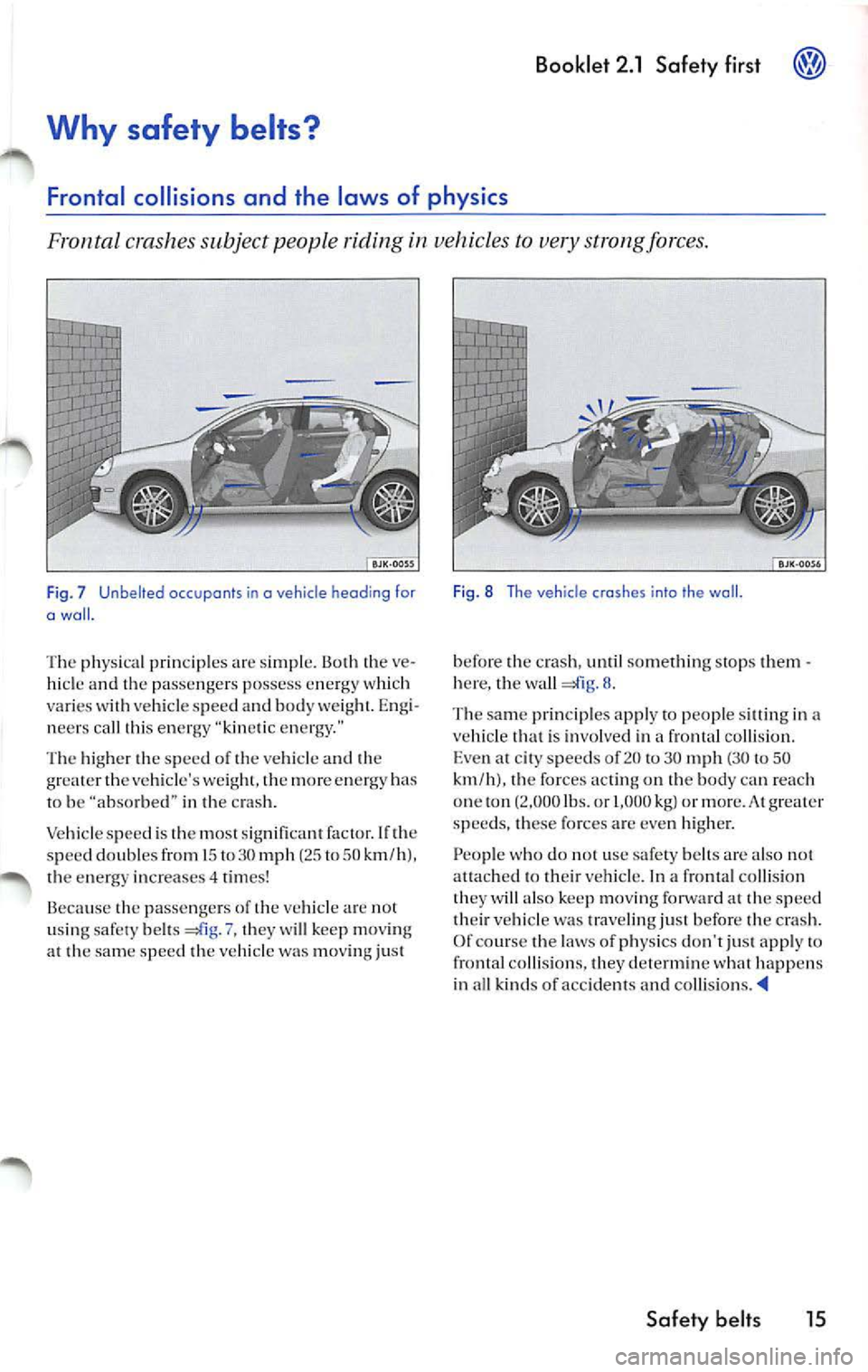
Fronta l crashe s subject people riding in vehicles to very strong force s.
F ig . 7 Unbelted occupants in a veh icle head ing for
o wal l.
The ph ysica l prin ciples ar e simpl e. Both th e hicle and th e pa sse nger s po ssess e nergy w hich
va ries with veh icl e s pee d and bod y weig ht. Engi
n eer s c all thi s en erg y " kin etic energy. "
The hi gher th e s pee d of the vehicl e and th e
gr eater t he v ehicl e's weight, th e more energy h as
to be "a b so rbed " in th e c rash .
V ehicle speed is th e m os t signifi cant factor. I f the
spe ed doubl es from 15 to 30 mph (25 to 50 km /h ),
th e e nerg y in crea ses 4 tim es !
Be ca u se th e pass eng ers of th e vehicle a re not
u sin g s afety belt s
7, th ey w ill kee p movin g th e s am e s pee d th e ve h icl e mo ving ju st
F ig . 8 The vehicle crashes into the wall.
before th e c ras h, un til somet hing stop s them h ere, t he wa ll 8.
T he s ame princip les a pply
people sit ting ve hicle tha t is in vol ve d in a frontal collision.
E ve n at spe ed s o f20 t o 30 mph (30 to 50
km /h ). t he forc es act in g on the bod y reach
on e ton (2,000 lbs. or l,000 kg) or more. Al greater
s pe ed s, these force s are ev en high er.
P eo ple wh o do not u se sa fety belt s arc al so nut
a tta ch ed to th eir ve hicl e. In a fronta l colli sion
t h ey will als o ke ep moving forwa rd a t th e sp ee d
th eir ve hicl e was tra ve lin g ju st befo re the crash.
Of cour se the law s of p hys ics don't ju st a pp ly to
fro ntal colli sion s, the y det ermine what happ en s
in all kind s of accident s
Safety belts 15
Page 148 of 477
Booklet 2.1 Safety first
Improperly worn safety belts
Inco rrec tly position ed safety bel ts can cause severe injuries.
Wearing safe ty belts impro perl y can cause
se rious injury or death. Saf ety bel ts ca n
only work when they a re co rrect ly po si
tio ned on the body. Improper seating posi
t ions redu ce th e e ffec tive ne ss o f safe ty
a nd will eve n incr ease the risk of in
j ury and dea th by mo ving the safety belt t o
c riti ca l area s of the body. Improper seating
p osition s also inc rease the risk of serious
i njury and dea th when a n airbag dep loys
a nd str ik es an occ upant who is no r in the
cor rect seating position.
dri ver is re
spo nsibl e for the safety o f all vehicl e occ u
pants and espec iall y for ch ild ren. Ther e
fore:
Safety belt pretensioners
-permit anyone to assume an in
correct sittin g posi tion in the ve hicle w hile
WARNING
I mproperly worn belt s in crease the risk
of seriou s per sonal injury and d eath whenever
a ve hicl e is being use d.
• Always make sure that all vehicle occu
pants are co rrec tly res trai ned and sta y in a
corr ect sea ting position whenever the vehicl e
i s bein g use d.
• Always read and heed all WARN INGS and
other import ant inform ation
1 7 .
How safety belt pretensioners work
In a frontal collision, the safety belts for the front and rea r outboard* seating po
s itions are tightened up automatically.
The retractor s for the driver and fron t pas seng er
po sition s (r ear o utboar d seat ing positions only
i n co mb ination
op tional sid e air ba gs for
th e ou tboa rd rear sea tin g po sit ions ) are
eq uipped with b elt pre1 ensioner s. S en sors ac ti
v at e th e belt pre te n sion ers in frontal colli sion s
whe n dec ele ra ti on is high enough. Th is tig ht ens
t h e belt and ta kes up belt sla ck.
up s lack help s to re duce forwa rd o ccup a111 mov e
m ent durin g a co llis ion .
The belt p re te n sioncr can onl y be activ at ed
o n ce.
Th e belt pr ete nsion er can be
in a frontal, s ide or rea rcn cl colli sion. It will n ot acti
va te in a ro llo ve r in which side airb ags do not
d eplo y.
Note
Neve r le t th e belt re main ov er a re a r seat back
that has been fo lded forward . T he re ar belt p re - t
en sio ne r• c an be a cti vated unn ec es sar ily in a
co llision and will then have to be rep laced .
Tips
• When the s afety b elt pre ten sion cr is acti
v at ed, a fin e du st is re lea sed . Thi s is no rm al and
i s
c ause d by fire in th e ve hicl e.
• Applicab le s afet y req uirem en ts mu st be ob
s e rved when th e veh icle or comp onents of the
sy ste m are scrapp ed .
A qualified dealers hip i s fa
mi liar w ith th es e re g ul atio ns and w ill be pl ease d IO pa ss o n informat ion to yo u.
• B e sur e
to obse rv e all saf ety , e nvironm e111al
an d other r eg ul ation s if t he v eh icl e or ind iv idual
pan s of the sys tem, particu lar ly th e s afety b elt or
a irba g. are to be dispo sed. We re co mmen d yo u
h av e yo ur auth orized Vo lkswagen pe rform thi s
s ervi ce for yo u.
Safety belts 25
Page 159 of 477
Booklet 2.1 Safety first
vanced Airbag System w ill tak e the u se of the
p assenge r saf ety belt into acco unt. If th e safety
b e lt i s being used, the a ir ba g w ill not d eplo y. If
the safety b elt is not b eing u sed, th e firs t st ag e
will d eplo y fo llow ed b y th e se co nd
lat er tim e in the c rash sequen ce.
I f th e e lectronic control unit r egis te rs a cras h of
hi gher sev erity, both stages deploy regardl ess of
w hethe r the sa fety belt is b eing u sed or not.
O n th e pa sse nger sid e, rega rdless of safe ty belt
u se , th e airbag will be turn ed offifth e weight on
th e pas senger seat is less
th e amo unt pro
gramm ed in the elec troni c contro l unit. Th e
fr ont airb ag on the pa ssenger sid e wi ll als o be
turned off if on e of th e c hild sea ts that
use d
t o ce rtify th e Advanced Airba g Sys te m und er
Federa l Mo tor Vehicl e Sa fety Standard 20 8 ha s
be en rec ogni zed on the seat. The PASSENGER
AIR BAG
OFF light com es on and sta ys on
29, "Child
r es traints on the fron t sea t - so me import an t
things to know··.
WARNING
To red uce the risk of inju ry when an airbag in
flates, alway s wear safety belts properly.
• If you arc unrestrained , lea nin g forward ,
si ttin g sideways or ou t of pos ition in any way,
yo ur ri sk of injury is much highe r.
• You will also receive serious injuri es and
co uld even be killed if you arc up aga inst the
a irba g or too close to it when it inflate s
even
with a n Advance d Airbag 27, "Impor
tance of wearing safety belts and s itting
pro perl y.".
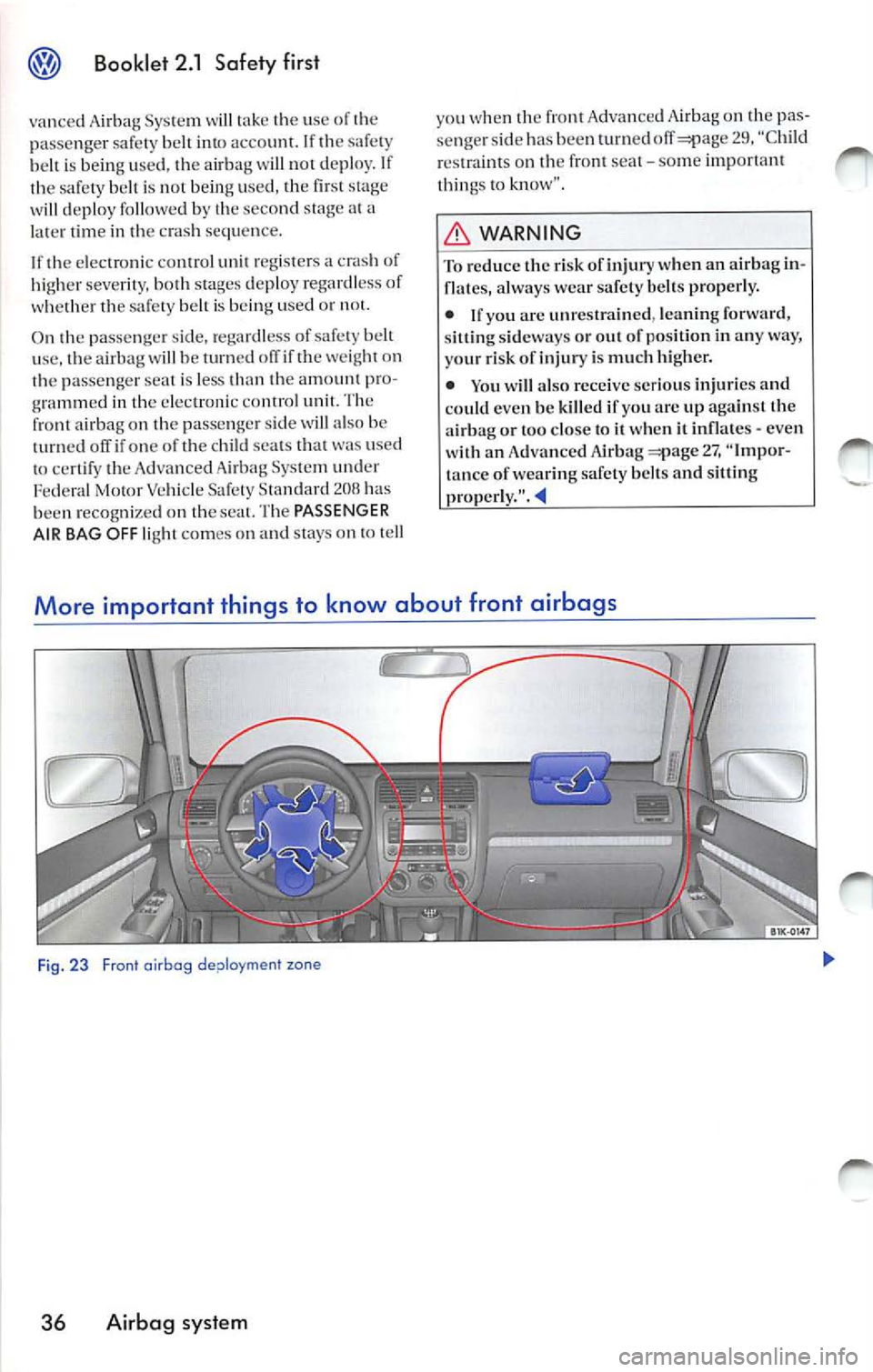
More important things to know about front airbags
Fig . 23 Front oirbog deployment zone
36 Airbag system
Page 160 of 477
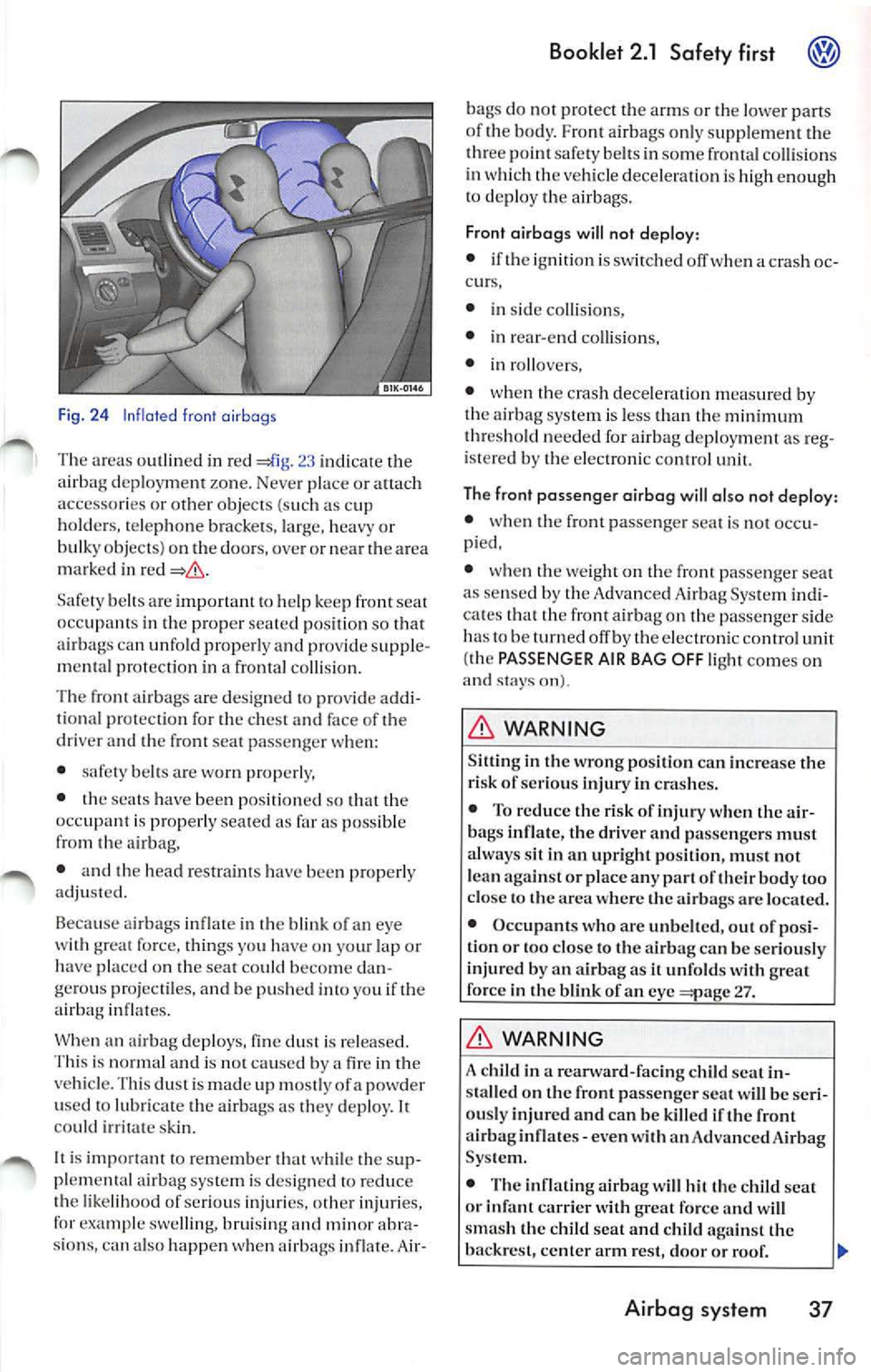
Fig . 24 In fl ated front airbags
Th e area s ou tli ned in re d 23 indi cate the
a ir bag deploy ment zone. Neve r pla ce or attach
accesso ries or other obj ects (such as cu p
h o ld ers . te lep hone bracket s, la rge. heavy o r
obje cts) on the door s, ove r or nea r area
mark ed in
Sa fe ty ar e importanl to help kee p front seat
occ upant s in th e pro per sea te d p osition so th at
airb ags ca n un fold prop erl y and provi de s uppl e
m enta l p ro tect ion in a fro ntal co llision.
Th e fron t a ir bags are desig ned to prov ide add i
t io nal prot ection for th e chest an d
of the
dr iver and the fro nt sea t passe nger
• saf ety belt s are w orn pr operl y.
•
se ats have bee n pos ition ed so th at the
occ upant i s properl y seated as far as poss ible
from the airb ag,
• and th e hea d re straint s have bee n prop erly
adjusted.
B eca use a irbags inflate in
blink of an eye grea t fo rce, things yo u have on your lap or
ha ve pla ced on the seat could become dan
gerous pro jec tiles, a nd be pus hed into you if
a irb ag inflat es.
W hen an airb ag deplo ys, fine du st is rel ea sed .
Th is is norm al a nd i s not cause d by a fire i n th e
v ehicl e. Thi s du st is m ade up m ostly of a pow der
u sed
10 lub ricate the airba gs as they deplo y. I t
co uld irritate skin.
It is imp orta nt to remem ber
w hil e sup
pl em ental airbag syste m is desig ned to re duce
t h e lik elih ood of serio us inju ries, oth er injurie s,
for exampl e swe lling, brui sin g a nd minor ab ra
s io n s, can also happe n when ai rbags inflate. Ai r-
Booklet 2.1 Safety first
ba gs do not protect th e ar ms or th e lo we r part s
of th e bod y. Front airbags on ly sup ple m ent th e
thr ee poin t sa fety be lts in some front al co llision s
in whic h th e ve hicle dece lerati on is high enough
t o de plo y th e airbags.
Front airbags will not deploy:
• if ig nition is sw itch ed off when a cras h oc
c ur s,
• in sid e co llision s,
• in rea r-end co lli sion s.
• in rollo ve rs,
• when th e cra sh d ece lera tion m eas ured by
ai rba g sys te m is les s th an the minimum
thr eshold nee ded for air bag d epl oy ment as reg
i s te re d b y th e e lec troni c con trol unit.
Th e front passenger airbag wi ll also not deploy :
• when th e front passe nge r sea t is not occ u
p ied .
• when th e we ig ht on the front passe nger se at
as sensed by the Adva nce d Airba g Sys te m indi
c a tes
fron t a irb ag o n th e pas se n ge r side
h as to be turn ed off by th e electro nic co ntro l unit
( th e PASSENGER AIR BAG
OFF ligh t comes o n
a nd sta ys on) .
WARNING
Sittin g in the wrong posit ion can in crease the
ri sk of serio us inju ry in cra she s.
• To reduce the risk of injur y when the air
ba gs inflate, the driver and passengers must
a lwa ys sit in an upright po sition , mu st n ot
l e an again st or pla ce any part of their bod y too
clo se to th e area where the airb ags are located.
• Occupa nts who are unb elt ed , out of posi
tion or too clo se to the a irbag can be seriou sly
injured by an a irbag as it unfold s wit h grea t
force in the blink of an eye
27.
WARNING
A child in a rea rward -facin g child scat in
s talled on the front pa ssen ger seat w ill be se ri
o usly injur ed and can be kill ed if th e front
airba g inflat es -even with an Advanc ed A irbag
Sys te m.
• Th e infl ating airba g
hit th e child seat
or infant carrier w ith great for ce and w ill
s mas h the child scat and child again st th e
ba ckre st, ce nter arm rest, door or roof.
Airbag system 37
Page 166 of 477
&, WARNING (contin ue d)
or strength or material so that the
airbag cannot deploy and protect properl y.
• Neve r rep air, ad just, or change any parts or
the airbag system .
• All work on the stee ring whe el, instrument
panel , front seats o r ele ctri ca l system (in
cluding th e in sta llat ion or a udio equipment,
ce llul ar te lep hon es and CB ra dios, etc.) must
b e performed by a
tec hnician who
has th e trainin g and specia l equipment ne ces
sary.
•
an y work on the air bag system , stron gly rec omm end that you sec yo ur autho
rized Vo lkswagen dealer or qualified work
s hop.
• Neve r modif y the front bumper or part s or
th e ve hicl e body.
• Alwa ys make sur e that the side a irbag can
without intcrrcrence:
Booklet 2.1 Safety first
&, WARNING (continu ed)
Neve r install seat covers or replacemen t
uphol stery over the front scatback s th at
h ave not been specifica lly approved by
Vo lkswagen .
Never use additional seat cushions that
cover the areas w here the sid e air bags in
nat e.
Damage to the or ig in al scat covers or to
th e sca m in the area or the s ide a irbag
modul e mu st a lway s be repaired immedi
at ely by an auth oriz ed Volk swagen dealer.
• The airbag system can be activated o nly
once.
a n airbag has it mu st be
re place d
• Us e on ly original equipment airbag s ap-
1>roved by Volkswagen and in stall ed by a
tra ined techn ician who has the nece ssary
too ls a nd dia gno sti c eq uipment to properl y
r e pla ce a ny airba g in yo ur ve hicle and assure
s ystem effectiveness in a cra sh.
• Neve r permit sa lvage d or recy cled airb ags
to be in sta lled in your vehicl e.
Other things that can affect Advanced Airbag performance
Chan ging th e su sp en sio n sys te m can
c h an ge th at the Adva nce d Airba g
Sys te m p erfo rm s in For e xampl e, usin g
tir e-rim combinati ons no t appro ved by V OLK
S W AG EN. lowe ring th e v ehi cle, c hangin g th e
the
c han ges had not b een m ad e. Oth er kind s of
c h ang es ma y re du ce th e fo rce le vel s mea sur ed
the se nsor s and preve nt th e a irbag from de
p lo yin g w hen it sh o uld .
Th e Adv anced Airb ag Sys te m in th e fro nt pas
s en ger sea t w ill not wo rk lhe way it sh o uld i f th e
opti onal saf ety be lt ex te nd er i s not r em oved
fr om the
belt lat ch w hen th e se at is oc cu
p ied and the s afe ty belt is no t b eing use d.
L eav ing th e ex tend er a u ac hed to the safe ty belt bu
ck le w hen the f ront sea t is occ upie d and th e
belt is no t b eing u sed w ill sign al th e airba g
c ontro l unit that the front passe nger scat i s oc
c upi ed and th at th e sa fe ty belt is bein g use d. T he
e lec troni c contr ol unit fo r th e ai rba g sys te m will
t h en re c eiv e in co rrec t in form ation that will
c au se th e s afet y belt pret en sio ncr and front pas
se ng er airb ag to depl oy la te r in collision s th at
wo uld n orm ally tr igge r th ese syste m s e arli er in
th e co llision to help prote ct an unre strained
sea t occupant. In addit io n , th e belt
ex te nd er mu st n eve r b e use d to sec ure child re
s traint s to the fro nt p asse nger
Fo r th at
r e as on , a lw ays re mo ve th e sarety belt exte n der
w hen it is not needed and stow it sa fel y
22.
Th e se nsor s in th e s arety belt bu ckle for th e
drive r and front pa ssenger se at te ll th e ele c
t ro nic co ntrol m odul e if th e s afe ty belt is la tc h ed
o r n ot. I f th e s afet y belt is being u sed, th e f ront
airbag will dep lo y at
slightly high er rat e or ve
hi cle decele ration than if th e saf ety b elt i s no t
b ein g use d. Therefo re , in a parti cul ar colli sio n, it
Airbag system 43
Page 168 of 477
The airbag system is monitored electronically 10 make cenain i t is functio ning properly all
t ime s. Each time you turn o n th e ig ni tion,
airbag system indica to r lig ht w ill co me on for a
few seco nds (self diagnost ics).
T he side airbag syste m sup pleme nts rhe safety
be lts and can help to reduce the risk of inj ur y
the dr iv er's a nd front passe nger's upper torso on sid e of th e vehicle that is stru ck in a sid e co l
li sion. The airbag inflate s on ly in sid e impa cts
and onl y when the veh icle acce leration reg is
t e red b y the control unit is high en ough. If
rate is below reference value programm ed
i n to co ntr ol u ni t, t he side airbag s not be
trigg ere d , eve n though the ca r ma y be badly
damag ed as a r esult of the co llision. It is
pos
s ible d efin e an airbag trigger ing rang e th at
w ill cover eve ry possible ang le of impact, sin ce
t h e ci rc u ms ta n ces will vary co nsiderably be
twee n one collision and anot her. lrnpona nl fac
include, for example, the na tu re (har d or
s oft ) of th e impacting objec t, a ngle of im
pact, vehicle speed, etc. 46, "Impo rta nt
s afet y in structio ns for the side a irbag system ".
As ide from th eir normal safety function, saf ety
belts
to h elp k eep the dri ver or front pas
senger in posit io n in a side colli sio n so th e
s id e airb ags can prov ide prot ection whe n
inflate. Safe ty belt s also help to keep rear seat
pas seng ers in po sition so that optional rear seat
s id e airbag s can prov ide protection in a sid e co l
li sio n i n w hic h th e side air b ag inflates.
T he a irbag syste m is not a subst itute for your
safety belt. Rather, it is part of t he overa ll occu
pant re straint syste m in your vehicle. A lways re
memb er
the airbag syste m can only help to
pro tec t yo u if you are wearing your safe ty b elt
and wearing
properly. This is an other rea son
why you sho uld alwa ys wear your safe ty belt s,
n o t ju st b ecau se th e
re quir es you do so 13 , bel ts" .
It is im portant 10 re mem be r that wh ile th e su p
p lemen tal side airbag system is designed to help
Booklet 2.1 Safety first
reduce the likelih ood of seriou s injuri es, other
injuries, for example, swelling, bruising, and
mi nor abra sions can a lso be associated w it h
th ese airbags. Remember t oo , side airbags w ill
dep loy o nly once an d on ly in certai n kinds of ac
ciden ts - your safety belt s are always th ere to
offer protec tion.
Ve hicle dam age, repa ir cost s or even
lack of
ve hicle da mag e is no t necessa rily a n indicatio n
of prope r airbag operation. In some collis ions,
both front and side airbag s may inflate. Re
mem ber too, tha t airbag s w ill dep loy only once
a n d only in certain kind s of collis io ns - your
safety belt s ar e always there to offer protection in
t h ose acciden ts in whic h ai rb ags a re not sup
po sed to deploy or whe n
have al ready de
p loye d.
Th e side airbag sy stem
will not b e trigg ere d
• if th e igni tion is sw itc hed off,
• in side collisions when
accelerat ion mea
s ured by th e sensor is too low ,
• in front-en d co llisio ns,
• in rear -end collisions,
• in rollove rs.
In some types of accidents
Sid e Cur
tain Pro tection and sid e airbag s may be tr ig
gered together.
WARNING
• Safety belt s a nd lh e a irb ag sys te m will onl y
p rov ide prot ectio n when occ upant s a re in the
co rrec t se atin g po sition
13, "Safety
b elt s" .
• If the air b ag in dicator light comes o n when
the vehicl e is bein g use d, h ave the sys te m in
spec te d imm edi ate ly by yo ur Vol kswage n
d eal er. Th e side a irb ag sys te m m ay not wor k
prop erl y eve n wh en th e vehicle acce le ratio n
in a side colli sion i s high en ough
10 ac tiva te
th e a irbag
Airbag system 45
Page 171 of 477
Booklet 2.1 Safety first
Side Curtain Protection
provide supplemental protection to properly restrained oc
cupants.
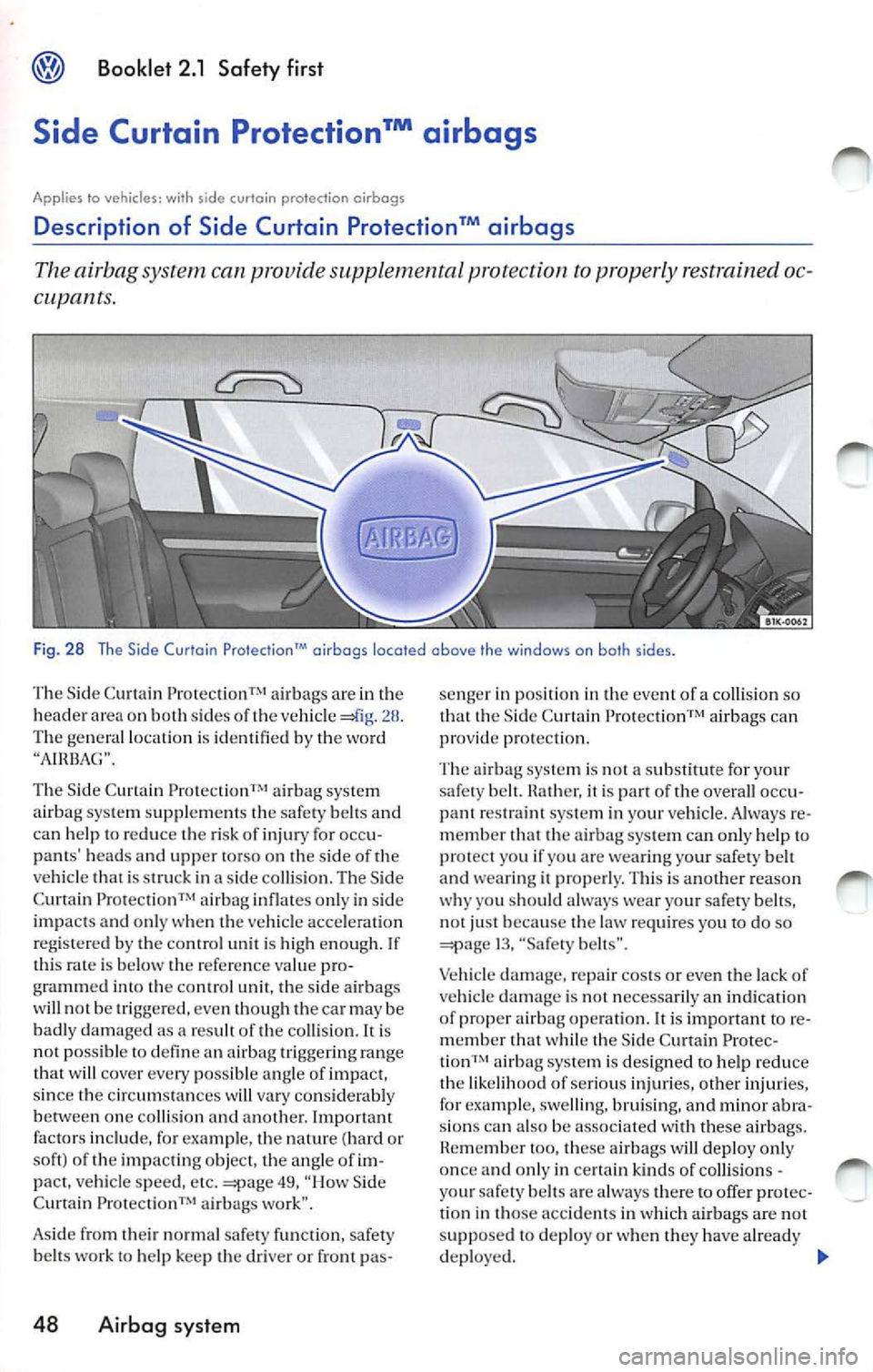
Fi g. 28 Th e Side Curtain Pro tec tio n™ a irba gs loca ted above the w indows on bo th s ides .
The S ide Curt ain airbags are in th e
header area on both side s of the veh icle 28 .
Th e general loca tion is iden tified by the word
The Side Curtain Protec tion airbag system
a irba g sys te m suppl eme nts the safe ty belts and
ca n help to r educe the risk of injury for occu
pant s' heads and upper tor so on the sid e of the
ve hicl e th at is s tru ck in a side collisio n . The Side
C urtain
airbag inflates only in sid e
impa cts and only when the veh icle acce le ration
regi stere d by the control unit i s high enough. If
thi s rate is below the refe rence value pro
grammed into th e co ntrol unit, the side airba gs
w ill not be tri gge re d , eve n though the car may be
badly damag ed as a resu lt of th e co llision. It is
not pos sib le to define an airbag triggering range
that will cover eve ry po ssible ang le of impact ,
s inc e th e circum stanc es will vary co nsidera bly
be tween o ne co llisio n and another. Important
fa ctors include , for example, the nat ure {hard or
so ft) o f the impactin g
the ang le of im
pa ct, vehicle speed, etc. 49, "How Sid e
Curtain Protectio n airbags work" .
As ide fr om the ir nor mal sa fe ty function , safety
b elt s wo rk to he lp keep the dr iver or front pas -
48 Airbag syste m
senge r in po sit io n in the event of a co llision so
that t he S ide Curta in Protectio n™ a irbags ca n
provid e prot ection .
Th e airbag syste m is not a subs titut e for your
safe ty belt. Hath er, it is part of the overall occu
pant r estraint system in you r ve hicle. Always re
memb er that the airbag system can only help to
protect you if you are wearing your safety belt
and wearing it prop erl y. This is another reaso n
you sh ould alwa ys wear your safety belt s,
n o t ju st becau se the law r equir es you to do so
13, "Safety belts".
Veh icle damage, repair costs or eve n the lack of
vehicle damage is not necessa rily an indi cation
of prop er airbag operation. lt is imp orta nt to re
m emb er that while the Side Curtain Protec-
ti on
airbag system is de sig ned to help reduce
the like lihood of se rious injuries, oth er injuri es,
for examp le, swe lling, bruis ing, and minor abra
s ions can als o be assoc iated w it h th ese a irbags.
too, these airba gs w ill deploy onl y
once and on ly in certain kinds of collisions
yo ur safet y belt s are a lways there to offer prote c
ti on in thos e accide nts in whi ch airbags are not
s upp osed
depl oy or when they hav e al rea dy
d eployed .
Page 177 of 477
Booklet 2.1 Safety first
8. Rear facing child restraint systems, manufac
tured on or alter December l, 1999.
( W hen the res tra in t sys te m comes e quipp ed
w ith a re mo vable ba se, co mpli ance ha s to be
ce rtified with or wit hout the ba se).
• Britax Hand le wit h Care
191
• Centur y Ass ura 4553
• Centu ry Sm art Fit 4 543
• Cosco Arriva 02727
• Eve nflo Disc overy A dju st 212
• Evenflo Fir st Ch oice
204
• Gra co Infant 8 11 57
C. For war d-facing convertible child res trai nt
systems, manufactured on or after Dece mber l ,
1999:
• Brit ax Rou ndabou t
161
• Brit ax Expressway J SOFIX
• Centur y Enco re
• Century 1000
• Cosco Ol ymp ia n 0280 3
• Cosco Touriv a 02519
• Even flo Horizon V 425
• Evenfl o Meda llion 25 4
• Saf ety 1s t Co mfort Ride 22-400
D. Forward-fac ing toddler /be lt po sitioning
booster systems, manufactur ed on or after D e
cember l, 1999 :
• Brita x Roadster
9004
• Century Next Step 4920
• Cosco High Back Booste r
• Eve nfl o Hig ht Fit 2 45
L'.0, WARNING
To redu ce the ri sk of serio us inju ry, mak e sur e
that the PASSENGER AIR BAG OFF li ght comes
on and sta ys on when eve r a child restraint is
in stall ed on the front pa ssenger sea t and the
ignition is switched on.
• Take the child res traint
the front pa s
s enger seat a nd install it properl y at one of the
rear seat position s if th e PASSENGER AIR BAG
OFF light does not sta y o n.
• Have the airbag system insp ec ted by yo ur
aut hori zed Volkswag en dealer immediately.
Important safety instructions for using child seats
Correct use of chil d seat s substant ially reduce s the risk of injury in an ac cident!
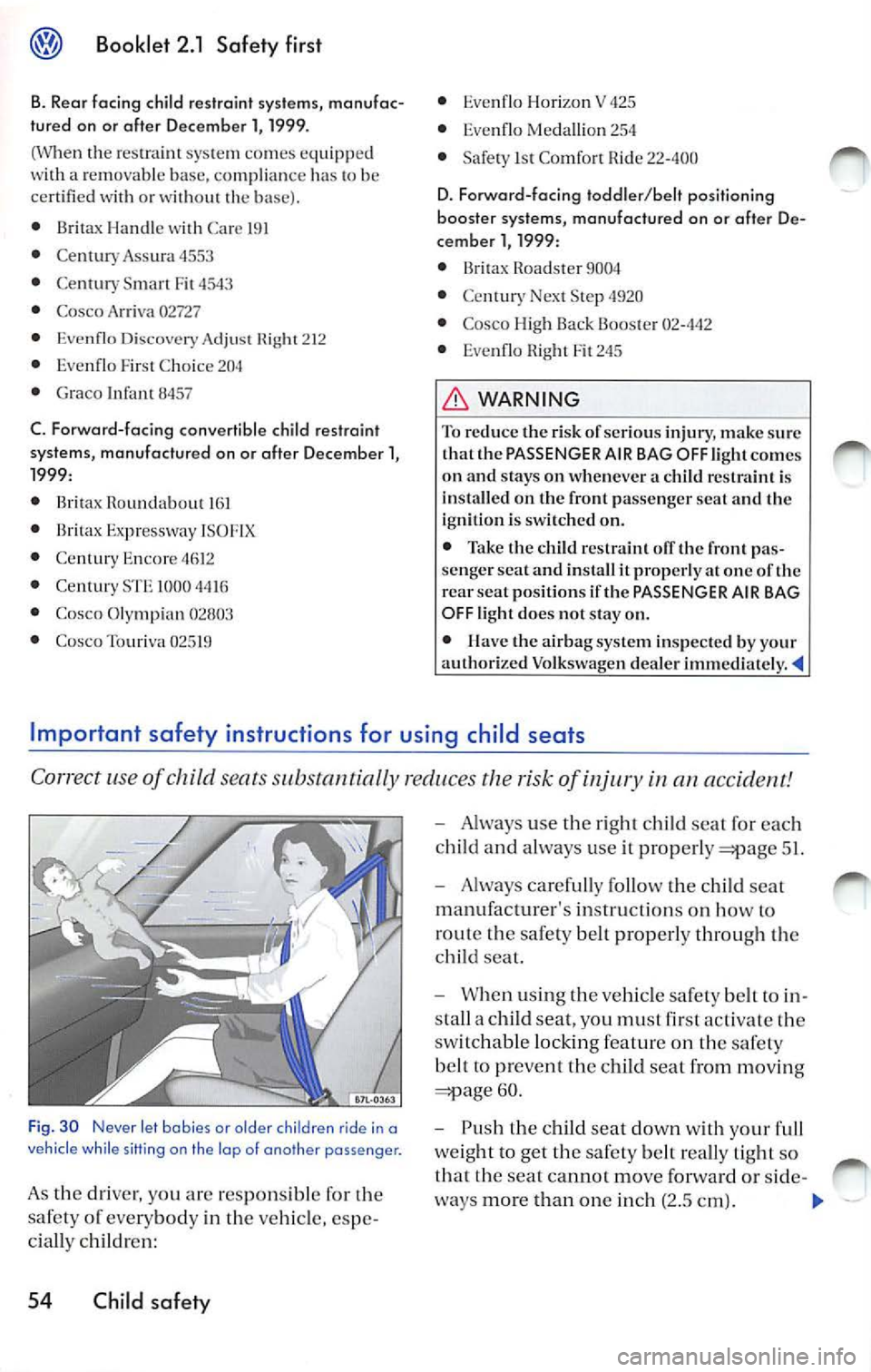
Fi g. 3 0 Neve r le t babi es or older c hildren rid e in a
v ehicl e wh ile s itting on th e lop o f a no th er passenge r.
As the driver, yo u ar e res pon sible for th e
s a fety of eve ry bod y in th e ve hicle , espe
ci all y chil dren:
54 Child safety
-Alway s use the right child seat for each
c hi ld and alwa ys use it prop erly
51.
- Alw ays caref ully foll ow the child seat
m anu fac turer 's in stru ction s on how to
rou te the sa fe ty bel t pr oper ly throu gh
child seat.
- When usin g th e ve h icle safety belt
10 in
s ta ll a child seat, you must fir st a ctivat e
sw itchab le lock ing fea tur e on th e safe ty
b elt
p reven t th e child seal from mov ing
60.
- Push th e c hild sea t d ow n with yo ur full
weig ht to get the sa fe ty belt re all y light so
th at the seat cannot mov e for ward or side -
w ays more th an one inch (2.5 cm ).
»,,