air VOLKSWAGEN JETTA 2008 Manual PDF
[x] Cancel search | Manufacturer: VOLKSWAGEN, Model Year: 2008, Model line: JETTA, Model: VOLKSWAGEN JETTA 2008Pages: 477, PDF Size: 77.6 MB
Page 127 of 477
Booklet 2.1 Safety first
Proper occupant seating positions
Proper seating position for the driver
The proper driver seating position is important for safe, relaxed driving.
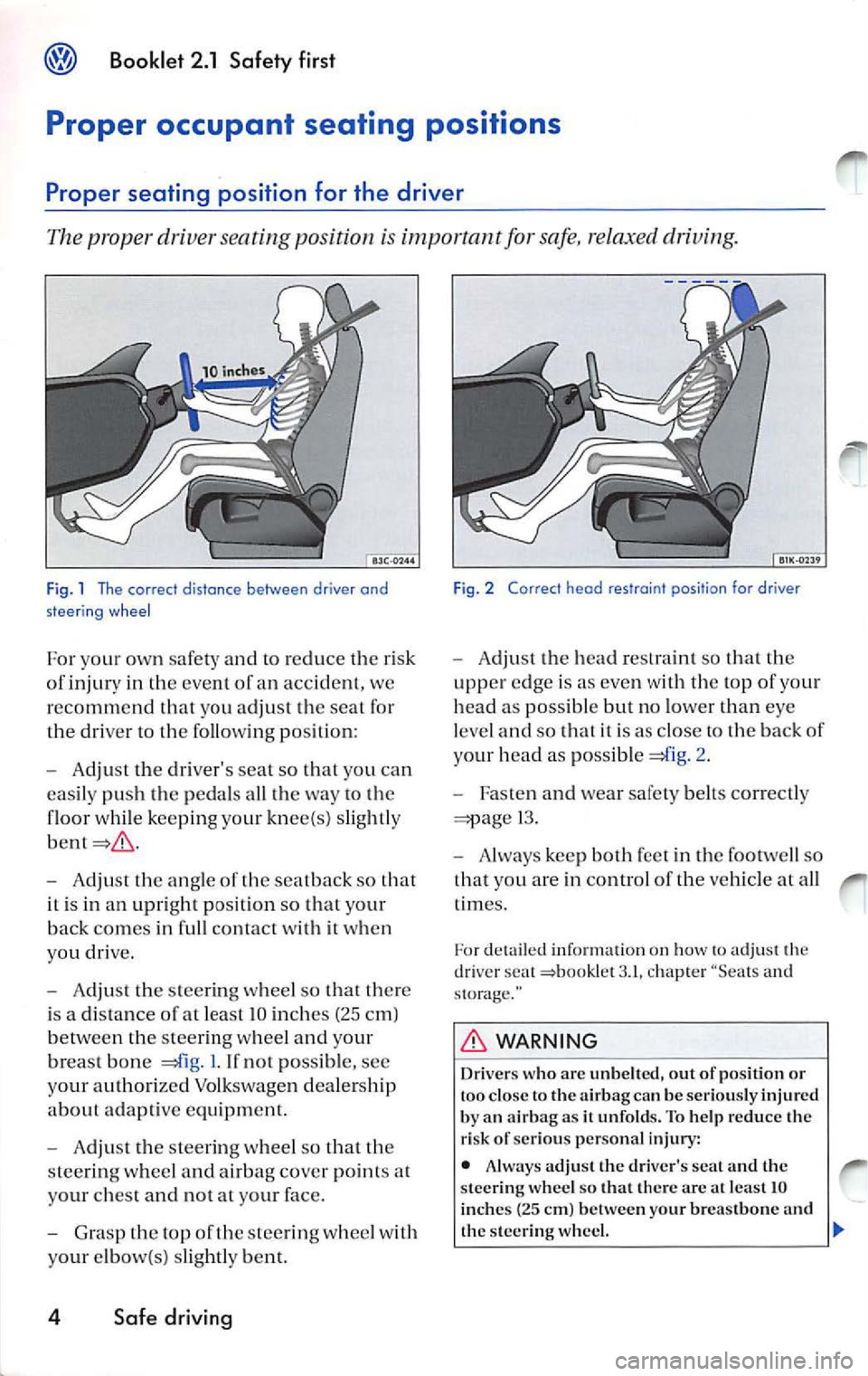
Fi g. 1 The correct distance between driver and
steering wheel
For yo ur own safety and Lo reduce the risk
of injur y in th e eve nt of a n accid ent, we
recommend that y ou adju st th e se al
the dri ver to the fo llowi ng po sition:
- A djust th e dri ver's se at so that you can
eas ily push the pedal s all th e way
10 th e
floor while k eeping you r kn ec(s) s light ly
- Adj ust the a ngl e of the sea t b ac k so that
it i s in an upri ght p osition so that your
back comes in full contact with it when
yo u dri ve.
- Adjust th e stee rin g w hee l so that there
i s a di sta nce of at le a st 10 in ch es (25 cm)
b etween the s tee rin g w hee l and your
breast bone
1. I f n ot possib le, see
yo ur authori zed Volkswagen dealership
about adapti ve equipm ent.
- Adju st th e steerin g w hee l so that the
s tee ring whee l a nd airbag cove r point s at
y our ch es t and not at your fa ce.
- Grasp the top of the ste erin g wheel with
yo ur clbow(s) sli ghtl y be nt.
4 Safe driving
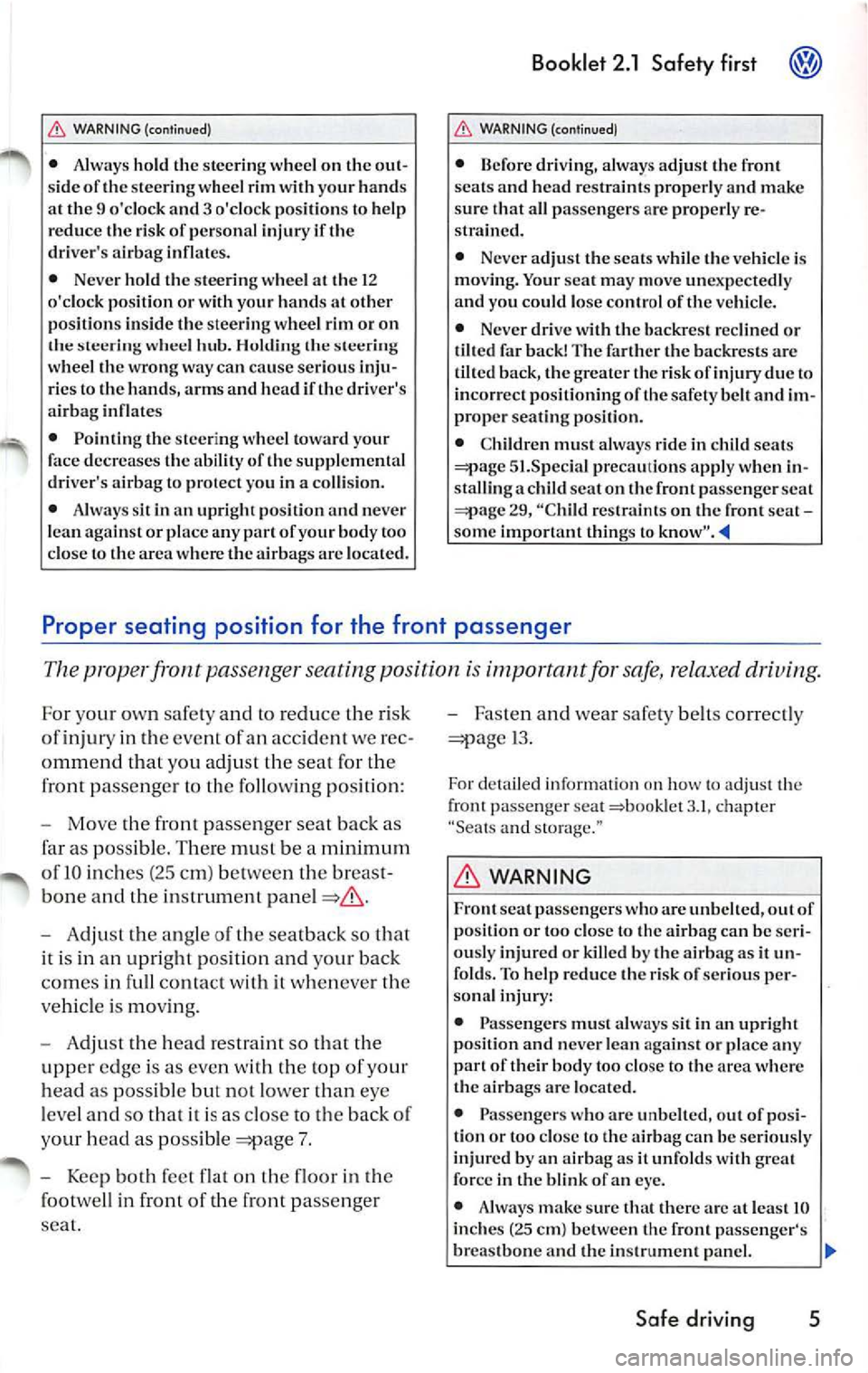
Fig. 2 Correct head restraint position for driver
- Adjust t he hea d r estra int so that the
upper edge is as eve n with the to p of your
h ea d as possibl e but n o lower than eye
l eve l and so that it i s as close
to th e ba ck of
yo ur head as possible
2.
- Faste n and wear safe ty belt s co rrectl y
13 .
- Always keep both feet in the footwe ll so
that you are in control of th e ve hicle at all
tim es.
For detail ed in format io n on h ow 10 adj ust drive r 3.1, c hap te r "Sea ts an d
s torage ."
WARNING
Drivers who arc unb elted , o ut of position or
too clo se to the airbag can be seriously injured
b y an airbag as
it unfold s. To help reduc e th e
ri sk of serious p ers onal injury:
• Always adju st
driv er's scat and the
s te ering whe el so that there are al least 10
inches (25 cm) between your brea stbone and
the steer ing wheel.
Page 128 of 477
,&. WARNING (continued)
• Always hold th e steerin g w hee l o n th e out
s ide or the stee ring w heel rim with your h and s
at th e 9 o'clock and 3 o'cloc k p ositions to h elp
redu ce the risk or p erson al injury
• Neve r hold th e s tee rin g w hee l a t th e 12
o 'clo ck p osition or with your hand s at oth er
pos ition s in sid e th e stee ring w hee l rim or on
hub. ste erin g
w hee l th e wron g way c an cause ser ious inju
ri es to th e hand s, arm s and h ead
• P ointin g th e s tee rin g w hee l to war d your d ec reases the ability or the suppl em ental
driver's a irbag to p rotec t yo u in a collision.
• Always s it in an upri gh t p os ition and n ever
l e an a gainst or pla ce any part or y our bod y too
clo se to th e area w here t he a irbags are loc ated.
Booklet 2.1 Safety first
,&. WARNING (continu ed)
• B efor e dri vin g, a lways a djust the front
sea ts and h ead r est ra int s prop erl y a nd m ake
s ur e th at all passe nger s are properly re
s train ed.
• Neve r adju st th e sea ts w hil e th e vehicl e is
m ov ing. Y our seat m ay move unexpec tedly
a n d y ou could lose co ntrol of th e ve hicl e.
• Neve r drive w ith th e ba ckre st r eclin ed or
tilt ed
ba ck! Th e fa rth er the bac kres ts are
tilt ed b ack, th e g reater t he risk du e to
in co rrec t p ositionin g or the sa fe ty belt and im
prop er sea ting pos ition.
• Childr en mu st always ride in child seat s
51. Specl al p reca utio ns ap ply w hen in
s ta llin g a c hild sca t on th e fr ont passe nge r sca t
29, "C hild res trai nts on th e front scat some imp ort ant thin gs to
Proper seating position fo r the front passenger
The p roperf ront passenge r seating position is important for safe, relaxed driving.
For your own saf ety and to reduce th e r is k
of i njury in th e eve nt of an accide nt we rec
o mm end that you adjust the seat fo r th e
front pa ssenge r to th e fo llow ing po sitio n:
- Mo ve the front pas senge r sea t back a s
far as po ssibl e. There mu st be a mi nim um
of IO in ch es (25 c m) betw een the breast
bone and the in str um ent
- Adj ust th e ang le of th e s eatba ck so th at
it is in an upr ight pos it ion a nd your back
comes in full contact with it when ever the
ve hicle i s movin g.
- Adju st th e head restra int so th at the
uppe r edge is as e ven wit h th e top of yo ur
head as possible but not lower t han eye
le ve l and so that it is as close
the back of
yo ur h ead as po ssible
7 .
- Keep both fe et fl at on th e floo r in the
foorw ell in fro nt of the front pas senger
s eat. -
Faste n and wear safety be lts co rrec tly
13.
For d etai led informa tion on how to adju st th e
front passe nger seat 3.1 , chapter
"Sea ts and storage. "
WARNING
Front sea t passe ngers w ho arc unbelt ed, out or
p os ition or t oo close to the a ir b ag c an b e ser i
ou sly inju re d or kill ed by th e a ir ba g as i t un
fo lds. To h elp re du ce the r is k or se rio us p er
so nal inj ury :
• P assenge rs mu st a lways si t in an u pri ght
p os ition and n ever le an aga inst o r p lace any
p art o r th eir b ody too close to th e a rea w here
th e air ba gs arc locat ed .
• Passe ngers who a rc unb elt ed , o u t o r posi
ti on or t oo cl ose to t he a irbag can be se riously
in jur ed by a n airb ag as
it unfold s w ith grea t
for ce in the b link or a n eye .
• Always make s ure th at th ere a rc at leas t 10
in ch es (25 cm) bet wee n t he front p assenge r's
br eas tbone and th e ins trum ent p anel.
Safe driving 5
Page 129 of 477
Booklet 2 .1 Safet y fir st
WARN ING (con tinu ed)
• Eac h pa ssen ger mu st a lwa ys s it on a scat of
t h eir ow n and proper ly fasten and we ar the
be lt b elo nging to t hat seat .
• Before d rivin g, alwa ys adju st th e fron t pa s
s e nger seal a nd hea d re stra int p roperly .
• Alwa ys kee p yo ur f ee l o n
in fro nt
o f th e sc at. Neve r rest them on th e seat , in stru
m en t p anel, o ut o f t he wi ndow, et c. T he air bag
sy ste m and safet y belt w ill n ot be ab le to pro -
WARN ING (c on tinu ed)
tec t y ou p roperly and can eve n in cre a se t he
r is k of in jur y in a cra sh .
• Never drive w ith the backre st re clined o r
tilted far ba ck! The fa rth er t he b ackre sts arc
t il te d ba ck, t he g re at er the r is k of i njur y du e to
in cor rec t pos itio nin g of 1h c safet y bell an d im
prop er seat in g po siti on.
• Child ren m ust al way s ri de in chil d sca ts
5 1. Specia l pre ca uti ons ap p ly wh en in
s ta lli ng a c hild sea t o n th e fro nt p asse nge r se at
29, " Ch ild res tra in ts on t he fron t sca t -
s om e import an t thin gs to know ".
Proper seating position for passengers in rear seats
R ea r seat passe ngers s it u prig ht bot h feet on the floo r con sistent with
ph ysi cal siz e and be pr ope rly rest ra ined whe never t he ve hicle is
7 .. If a passe nge r is sit tin g in
t h e re a r ce nter sea tin g pos iti on , th is co m
pact hea d r estra int is no t h eig ht adju st
a bl e, b ut it mu st alwa ys bee n ra ised when
eve r the cen te r rear seating pos ition is oc
cupied .
- Keep both fee l fla t in th e foo twe ll in
fro nt o f rh e rea r se a t.
- Fas te n an d wea r sa fe ty be lts prop erly
13 .
6 Saf e dr iving
- Ma ke sur e th at chil dre n ar e always
p roper ly res tra ined i n a c hild rest raint th at
is ap propria te for their size an d age
51.
W ARNING
Passe nge rs w ho are im prope rly s ea te d o n th e
re ar s eal can be seriou sly inj ure d in a crash.
• Each pa ssen ge r m ust a lwa ys s it o n a s eal o f
th eir ow n and prop erl y fas te n and wea r t he
be lt b elo nging to th at sea t.
• Safe ty belts onl y
m axim um pro tec
ti on w hen th e sea tback is sec urely la tc h ed i n
th e upri gh t posit ion an d the
belt s are
p rop erl y p ositi oned on th e bo dy. B ynol sittin g
upri gh t, a r ear se al passe nge r incre as es th e
r is k of pers o n al i njur y from i mpro perl y po si
tio ned sa fet y belt s!
• Alw ays adju st t he head res tra in t p ro pe rly
s o th at it can give
pro tec tio n.
Page 131 of 477
Booklet 2.1 Safety first
Active head restraints for the front seats
During a rea r e nd collisio n the passenge rs
in th e vehicle are pressed against th e sea t
back rest. The res ultin g pressu re th at the
body exe rts aga in st th e bac kres t ac tivates
t h e ac tive head rest raint s in the front seats .
Th e front hea d res train ts wi ll mo ve fo r
w ard and upwa rd at the sa me tim e to help
r e duce the risk o f n eck injuri es.
WARNING
Driving without hea d re stra ints or with im
properl y ad justed head r estraint s in creases
th e risk or seriou s injuri es in a collision . To
help reduce th e risk or injury:
• Always drive
th e hea d r estra ints in
place and prop erl y a dju sted. Remember that
th e rear center he ad r estraint is not h eight ad
ju stabl e and that it mu st be rai sed up all th e
w ay w hen eve r the center rear seat is occ upied .
• Every per son in the vehicle must have a
properly adjuste d head restraint.
• Always make su re each perso n in the ve
hicl e prop erl y adju sts th eir head r estraint.
WA RNING (continue d)
Eac h head restraint mu st be adju ste d ac
cord ing to oc cupants ' size so that the upper
edge is as eve n with the top or the person' s
h ead, but no lo wer than eye level and so it is as
clo se to th e back or to the h ead as possibl e.
• Nev er attempt to adjust head res traint
whil e dri vin g. Ir you have driven
and must
adju st the driver h eadr est any reaso n, stop the vehicl e attempting to
adju st the hea d re straint.
• Children mu st always b e properl y re
strained in a c hild restraint that is appropriat e
their age a nd size 5 1, " C hild
Tips
The acti ve head res train ts ca n also ac tivate
w hen p assenger push es up agains t th e ba ck
r es t wi th en ough force exa mpl e yourse lf ju st into th e seat abr uptly) or if th e
h ea d res train t is push ed from behind. This is
n orm al and will not da m age th e head res traint.
I t w ill go back t o its o riginal pos itio n rig h t
Examples of improper seating positions
The occupant rest raint system ca n on ly redu ce th e risk of if v eh icle
pa nts ar e prop erly sea ted .
Improp er se atin g po siti ons ca n cause se
r io us injur y or deat h. Safe ty belts ca n on ly
wo rk whe n th ey are prop erl y pos ition ed
o n th e body . Impr oper seati ng posit ions
r e du ce the e ffect ive ne ss of sa fe ty belt s a nd
w ill eve n inc rease the ris k or injury and
d ea th by m ov ing t he sa fety belt to criti cal
a reas of the body. Imp roper seating posi
ti ons a ls o in crease the risk of seriou s injur y
and d eath when a n airb ag de plo ys and
s trikes an occ upant who is not in the
prop er sea ting po sition.
driver is res pon
s ibl e for the sa fe ty of all vehicl e occ upant s
a nd especiall y for childr en. There for e:
8 Safe driving
-Never a llow anyone to ass um e an im
proper seating pos it ion when th e ve hicl e is
bei ng
lists onl y so me or the pos itions
that will increase the risk or ser io us injury and
d ea th. Our h ope is
th ese ex amples will help
mak e you more awa re of sea ting po siti ons that
ar e da ngero us.
Therefore, whenever the vehic le is moving:
• neve r sta nd up in the vehicle
• neve r stand on the seats
• neve r kneel on th e seats
• neve r rid e with the seat back recl ined
• never lie clown on th e re ar sea t
Page 132 of 477
• never up again st th e in strument panel
• neve r sit on the ed ge of t he sea t
• never sit sideway s
• neve r lean out the wi ndow
• never put your feet o ut the w indow
• never put your fee t o n th e in strument panel
• never rest yo ur f eet on the
cu shi on or
back of the se at
• never rid e in th e footwe ll
Pedal area
Pedals
Booklet 2 .1 Safety first
• never ride in th e lu ggage comp artment.
WARNING
Improper seating position s in crease the risk of
se rious personal injury and death whenever a
ve hicle is bein g used.
• Alway s mak e sure that all vehicl e occu
pant s stay in a proper seat ing position and arc
properly re strained wheneve r the vehicl e is
be ing used
The pedals must always be free to move and mu st neve r be inte1f ered with by a
floor mat or any other object .
Make sure that a ll pedals move freel y w ith out in
t e rf er enc e and that nothing pre vents them from
r e turnin g to th eir orig inal po siti ons.
Onl y use floo r mat s th at l eav e the pedal area free
a nti can
sec ured with floor faste n ers.
l fa brak e cir cuit fai ls, in cre ase d brake pedal
t ra ve l is re qu ire d to b ring th e ve hicle to a full
Floor mats on the driver side
WARNING
Pedal s that cannot mov e fre ely can cause loss
of vehicle contro l a nd increase the risk of se
riou s inj ury.
• Neve r p lace any ob jects in the driver' s foot
we ll. An object cou ld get into the pedal area
and interfe re wit h pedal function. In case o f
s udden braking or an accident, you wo uld not
be abl e to brake or accelera te!
• Always make sure that nothing can fa ll or
mov e into the d river's foo t we ll.
Always floor mats that can be securely attached to floor mat fasteners and
do not int e,f ere
free movement of th e peda ls.
Mak e su re that the floor mat s are prop
e rl y sec ured and can not mo ve and inter
fe re w ith th e
Use onl y flo or m ats that leave the pedal area unand that fi rmly secured so that
th ey ca nnot slip out o f po sition . Prop erly se
c urin g th e floor ma ts w ill pre vent th em from
s lidin g in to po siti ons th at co uld int erf ere wit h
th e pedal s or imp air saf e o perati on of yo ur ve
hicl e in oth er w ays . You
can ob tain suitabl e floo r mat s fro m your au
th orized Volk swa gen dea ler.
WARNING
Peda ls that cannot mo ve freel y can result in a
l oss o f vehicle control and increase the risk of
ser ious pe rs on al in jury.
• Always make sure that floor mats are prop -
erly secured.
Safe driving 9
Page 134 of 477
WARNING
To help preven t poiso nous ex haust gas bei ng draw n in to the ve hicle, always kee p th e
r ea r li d closed w hile dri vin g.
• Never tra nspo rt objec ts la rger than those
fill ing co mplete ly i nto
lu ggage area be
ca use re ar lid cann ot be full y close d.
• If you abso lutely m usl d rive
th e rear
li d ope n, obse rve fo llow ing notes to red uce ris k of poiso ning:
C lose a ll win dows,
C lose the power
Ope n all ai r o ut lets i n the instrume nt
panel,
Swi tc h olT air reci rc ul ati on,
Se t th e fr esh air fan lo h ig hes t speed .
WARNING
Always make su re that doo rs, the power all w indows a nd rea r lid a re secure ly
closed an d locked lo re du ce the r is k of injur y
w hen
ve hicl e is no t be ing used.
Tie-downs
Bo oklet 2 .1 Safety fir st
WARN ING
• Afte r clo sin g th e rea r lid, always make sure il i s proper ly closed a nd locked.
• Never leave your vehicle u nattended espe
cia lly
rear lid open. A chil d co uld
craw l in to ve hicle thro ugh th e lu ggage
com partmen t a n d cl ose t he rear lid o r wi ndow
b eco min g tra pp ed a nd un abl e to get ou l.
Be ing trapped in a ve hicle ca n lea d lo se rious
p ersona l injury.
• Neve r lei c hild ren play in or around th e ve
hi cle.
• Never le t p assenge rs ride in the lu ggage
co mp artm ent. Vehicle occ upan ts
a lways
be proper ly re stra ined in one of the veh icle's
sea ting positions ..
Mak e sure heat in g w ires in re a r
w indo w ca nnot b e scraped and damaged b y
in ve hi cle .
Tip s
Air ci rc ula tion h elps redu ce window fogg ing.
D o not co ver slot s becaus e can
pre vent stal e air from escap ing the vehicl e.
The lu ggag e compartm ent is equipped w ith Jou r ti e-downs to secure luggage and
other items.
U se 10 sec ure y our cargo prop erl y IO , " Loadin g th e lu gg age compa rtm ent ".
l n a collis ion ,
laws of p hys ics mean even
s m alle r are lo ose in veh icle w ill
b ecome hea vy mi ssiles can cause se rious
injur y. h em s in v ehicl e po ssess e nerg y which
v ar y ve hicl e spee d and wei gh t of the
i t em. Veh icl e s peed is s ignifi cant facto r.
Fo r ex amp le. in a
co lli sion at a sp eed of 30
mph (48 km /h ). th e fo rces ac tin g o n a IO lb s. (4 .5
kg )
arc 2 0 l ime s norma l of item. Thi s m ea ns o f th e
i t e m wo uld sudd en ly be ab out 200 lb s. (9 0 kg) .
You can im agine
inju ries a 200 lbs. (90
kg ) flyin g free ly th rou gh pa sse nger
c ompar tm ent cou ld cau se in a colli sion like thi s.
WARNING
Weak, damaged or im pro per stra ps use d l ose
c u re item s lo lie -d owns can fail durin g hard
braking or i n collisio n an d cause se rious pe r
so nal injur y.
• A lways use suit abl e m ountin g str aps a nd
p ro per ly se cur e ite ms lo the lie-downs in
lu ggage compartment lo he lp preven t items
from or flying forwa rd as dangero us
m issi le s.
• When th e rear seal backres t is fo lded down,
a lway s use sui tab le mo unt ing stra ps an d
proper ly sec ure items to the tie- downs in the
lu ggage compa rtme nt l o help prevent item s
Saf e drivin g 11
Page 136 of 477
Safety belts
General not es
Always wear safety belts!
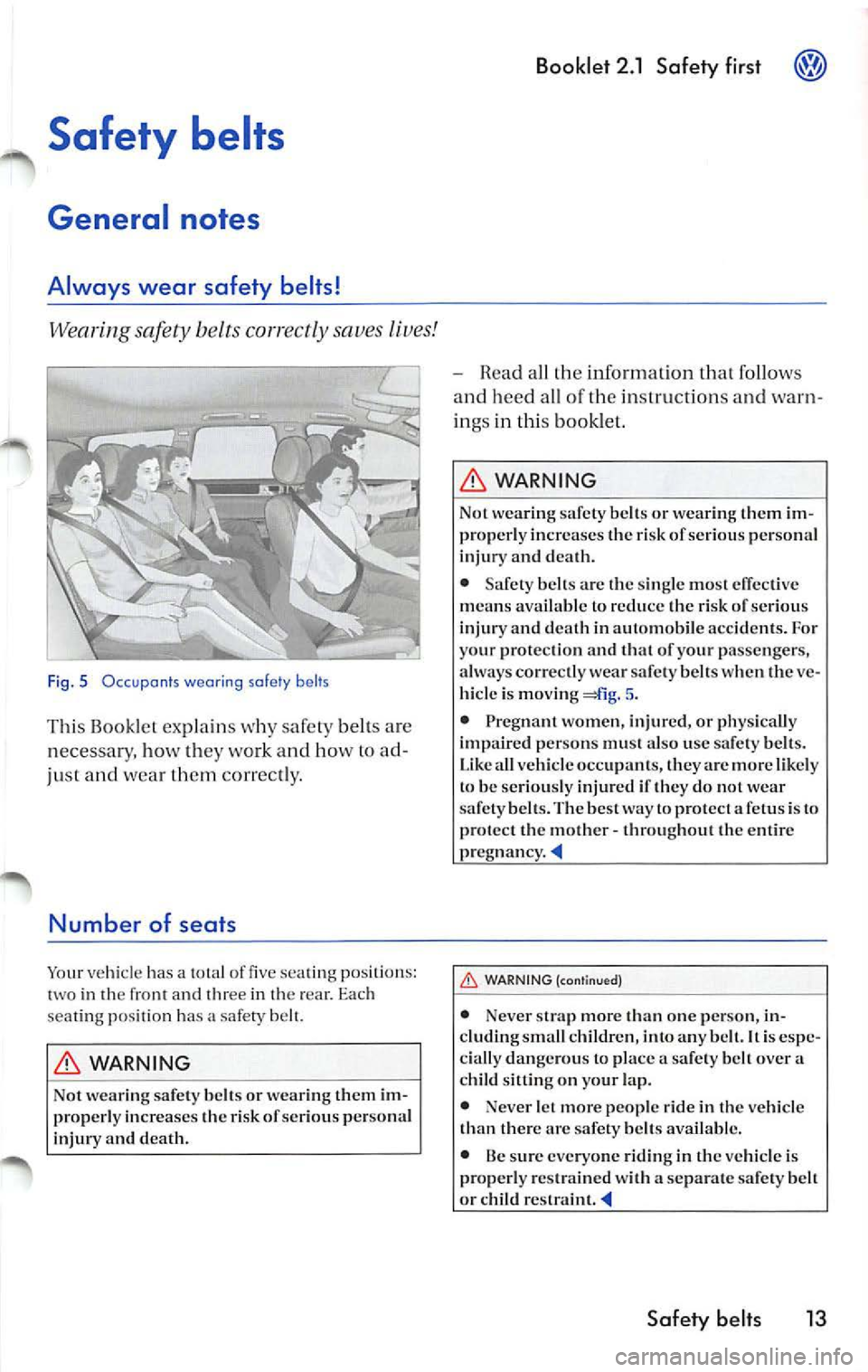
Wearing safety b elt s correctly saves lives!
Fig . 5 Occ upan ts wear ing safety belts
This Bookl et explain s why safet y belt s are
nece ssary, ho w the y work and how to ad
ju st and wear them correc tly.
Number of seats
Yo ur vehicl e has a tota l of five se ating position s: in the fro nt and three in th e rear. Each
sea tin g p ositio n ha s a sa fety b elt.
WARNING
Not wearing safety belts or wearing them im
properly increases the risk of seriou s per sona l
injury and d eat h.
Booklet 2.1 Safety first
- Read all the information th at follows
and heed all of th e in struction s and warn
in gs in thi s booklet.
WARNING
Not wearing safety belts or wearing them im
properly increases the risk of seriou s personal
injury and death.
• Safety belts are t he sin gle mo st efTec tive
means available to reduce the risk of se rious
injur y and death in automobile accidents.
your protection and that of your passengers,
a lwa ys corre ctl y wear safety belts when the ve
hicle is moving =;fig. 5.
• Pregnant women, injured, or physically
impaired per sons mu st
use safe ty belts.
l..ik eall vehicle occupant s, they arc more likely
to be seriou sly injur ed if the y do not wear
safety bel ts. The best way to protect
fet us is to
protect the mother -throughout the entire
pregnancy.
WAR NING (con tinued)
• Never strap more than one person, in
cluding small children, into any belt. It is espe
cially dangerous to pla ce a sa fety belt over a
c hild sittin g on yo ur lap.
• Never let more people ride in the vehicle
than ther e arc safe ty belt s available.
• Be sure eve ryone riding in the vehicle is
properly res train ed with a separat e safety belt
or child restraint.
Safety belts 13
Page 139 of 477
Booklet 2.1 Safety first
What happens to occupants not wearing safety belts?
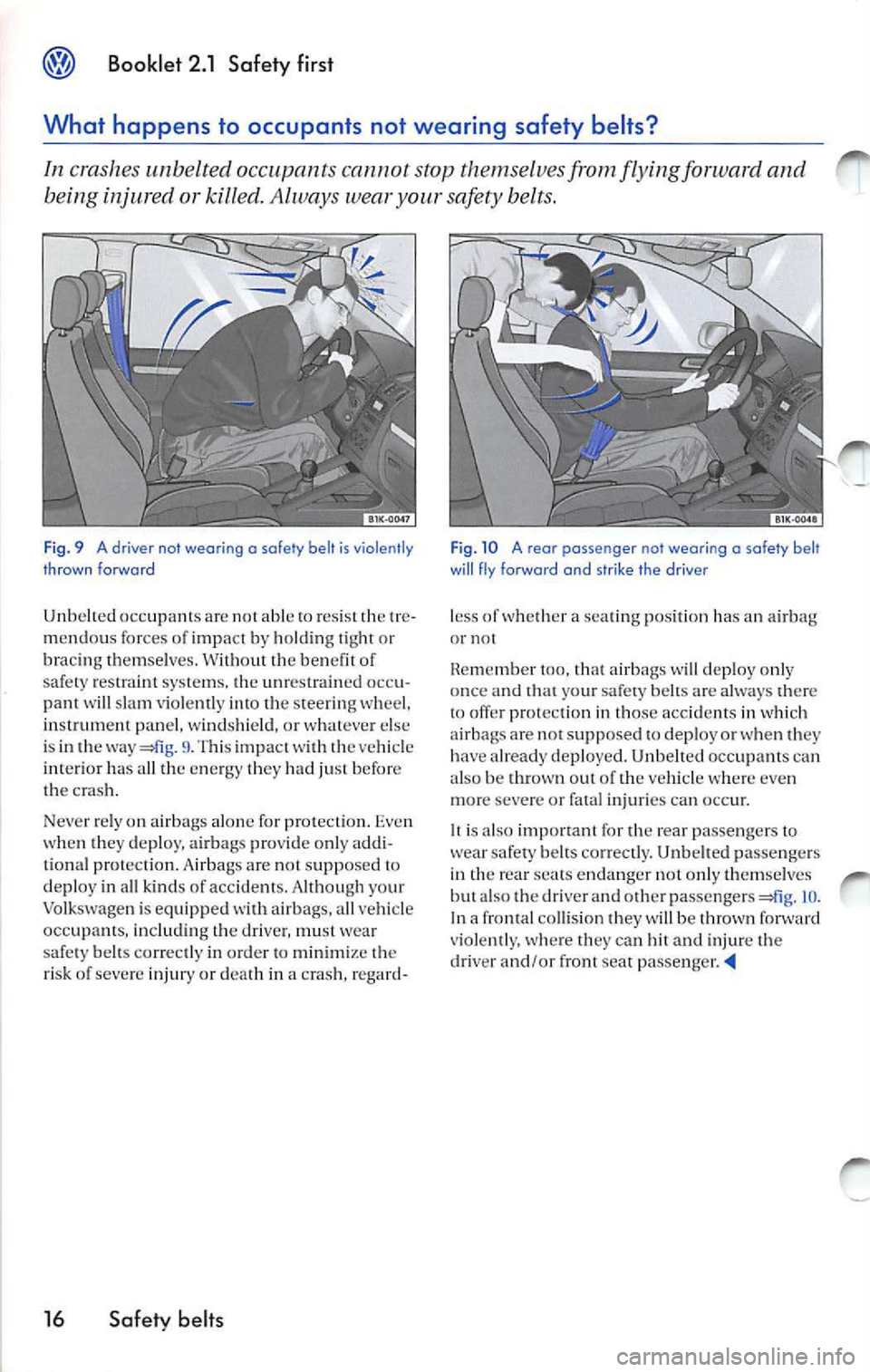
In crashes unbelted occupant s cannot stop themselve s from flying forward and
being injured or killed. Always wear your safety belts.
Fig. 9 A driver not wearing o safety belt is violently
thrown forward
Un belted occ upants ar e not abl e to res ist the tre
m endo us fo rces o f imp act by holdin g tig ht or
bra cing themse lves . W ith ou t th e ben efit of
s af etv res traint systems. th e unr estrai ned o ccu
slam vio le ntl y into t he steering wheel,
in strnm ent panel, win dshi eld , o r w hate ve r else
is in the way
9. T his impac t w ith the ve hicle
inte rior has a ll th e e nergy the y had just before
the cras h.
Neve r re ly on airb ags alone for pro tec tion. Eve n
wh en th ey deplo y, air ba gs provide onl y a ddi
t io n al prot ection. Airb ags are not su pposed
depl oy in all kin ds of a cci den ts. Alt hough your
Volk swag en i s eq uipped with airbags, all vehicl e
occ upant s, inclu ding th e dr ive r, mu st wear
sa fety belt s co rrectl y in order to min imize th e
ri sk of seve re injur y or d eath in a cras h, regard-
16 Safety belts
Fig . 10 A rear passenger not wearing o sa fety belt
will fly forward and strike the drive r
less of wheth er a se atin g pos ition has a n or no t
R em emb er too, that ai rbags w ill dep loy o nly
once a nd t hat your sa fery be lts are always there
to offe r pro tec tion in th ose acci dent s in whi ch
a irba gs are not supp osed to dep loy o r w hen they
h ave already deployed. Unbelt ed occ upan ts can
a lso be thro wn out of th e ve hicle w here e ven
more severe or fa ta l in jur ies can occur.
I t i s a lso important for the rear passe ngers to
wea r sa fety belts correct ly. Unb elt ed pas se nge rs
in th e re ar sea ts endanger no t on ly th emse lves
b u t a ls o th e driver an d oth er pa ssenge rs
JO .
In a fron tal collisio n th ey w ill be thrown forward
v io len tly, whe re they ca n hi t a nd injure the
driver and /or front seat
Page 140 of 477
Booklet 2.1 Safety first
it 's po ssibl e to use the to brace the body a ,ninor collision.
It 's simp ly not
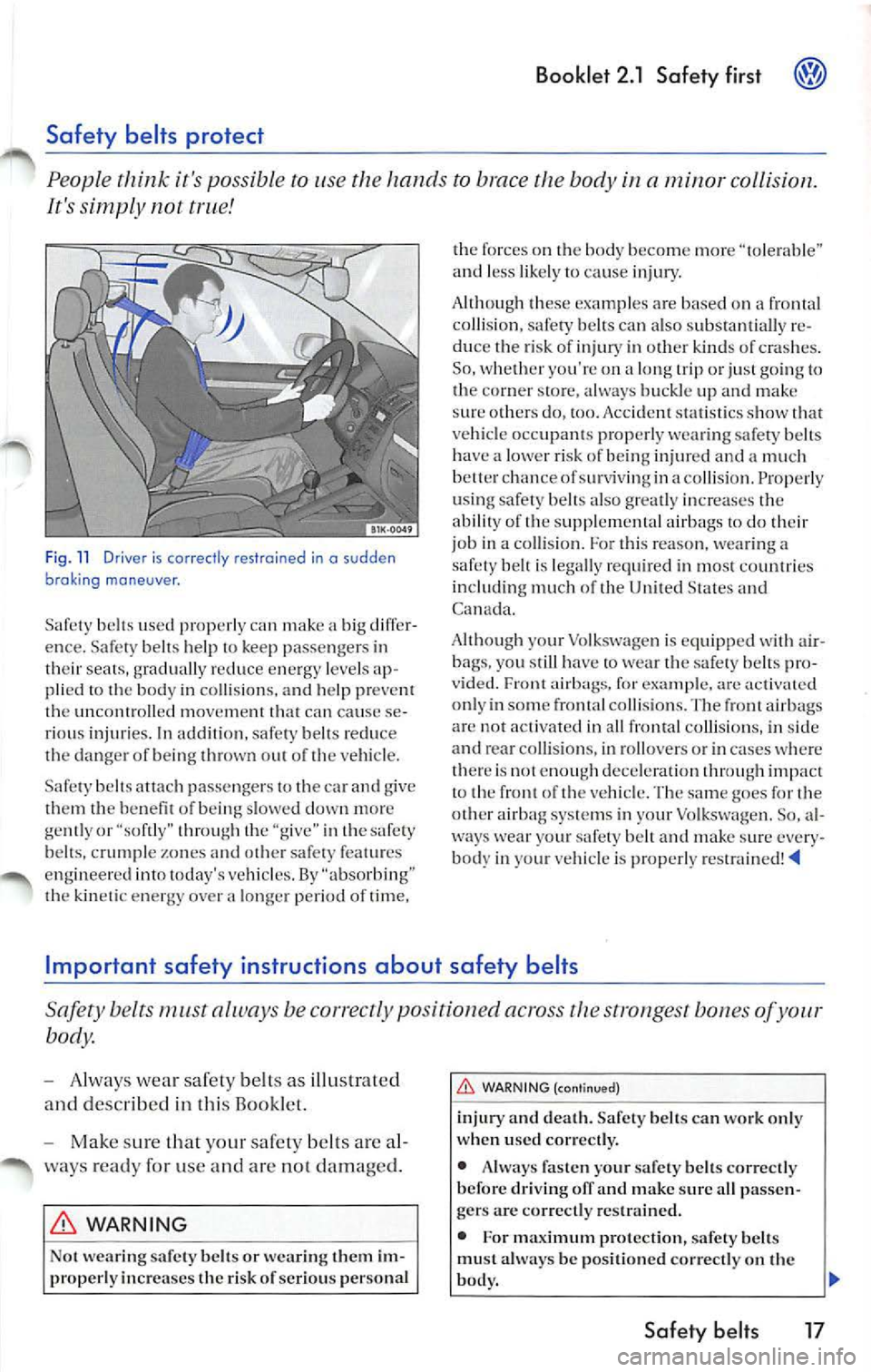
Fi g. 11 Driver is co rrectly re strained in o s udden
broki ng ma neuver .
Safely belt s used prop erl y can make a big diff er
ence. Safet y belts help to keep passe ngers in
the ir sea ls , gra dually r edu ce e nergy levels ap
pli ed
to the body in co llision s. and help preve nt
th e unc ontroll ed mo veme nl tha t can cause se
riou s injur ies. In ad di1i on, safe ty belt s redu ce
th e clang er of being thro wn ou1 o f th e ve hicl e.
Safe ty belt s atta ch passengers 10 the car and giv e
th em t he ben efi t of b eing
down more
ge nll yor "sof tly" through lhe "g ive" in the saf ety
b e lts, cru mp le zo ne s
other saf ely fea1 ures
e n gin ee re d into toda y's vehicl es. By "ab sorb ing"
t h e kinet ic ener gy ov er
longe r per iod of lime , th
e fo rces o n 1h e body be come more "tolerable "
and less likely to c ause injur y.
A lthoug h 1hese exa mples are ba sed on a frontal
co llision,
belt s can also sub sla nt ially re
duc e the risk of inju ry in 01h er kin ds of crash es.
So . w heth er yo u're on a long 1rip or ju sl go ing to
lh e c orner stor e, always buckle up and make
s ur e oth ers do, too. Acci denl statist ics sh ow 1h at
ve hicle occ upan 1s prop erl y wea ring sa fe ty
ha ve lower risk of bein g in jur ed and a much
b elie r ch an ce of in collis io n. Properl y
u sin g safe ty bell s also great ly in cre a ses the
abili 1y of 1 he s uppl em ent al a irbags 10 do their
job in a collisio n . Fo r thi s rea son, wea ring a
safe ty belt is lega lly re quir ed in mo sl cou ntries
includin g mu ch of th e Un ited
and
Canada .
A lth ough your Volk swage n i s eq uipped wilh a ir
ba gs. yo u still have to we ar th e safe ly be lts pro
v id ed. Fro nt a irba gs, for examp le,
a cti va ted
on ly in some frontal collisio ns. Th e front airb ags
a re no t acli vated in all fron ta l co lli sio ns, in sid e
and rea r co llisio ns. in rollo vers o r in cas es wh ere
is no t e nou gh de celeration through impac t
to the front of the vehicle. Th e sa me go es for the
01 hcr airbag sys1ems in yo ur Volk sw agen. So, al
w ays
you r saf ety belt and mak e sure ev ery
bo dy in ve hicle is prop erly
Impo rtant safety instructions about safety belts
Safety bel ts must alway s be cor rect ly pos i ri on ed across the strongest bones of you r
body.
- Always wea r saf ety bells as ill ustra ted
and descr ibed in thi s Bookl et.
- Make su re th at yo ur sa fet y be lts a rc a l
ways rea dy fo r u se and arc no t da ma ged.
WARNING
Not wea ring sa fe ty belt s or wearing t hem im
prop erl y inc re as es the ri sk of se rious per sona l
WAR NING (continued)
injury and death. Safety belts ca n w ork onl y
w hen u sed correct ly.
• Always fas te n yo ur safety belt s cor rect ly
before dri vin g o ff and make sure all pa sse n
ge rs are cor rec tly res tra in ed.
•
m ax imum protection, sa fel y belt s
mu st be po sitione d cor rectly on th e
body.
Safety belts 17
Page 141 of 477
Booklet 2.1 Safety first
WARN ING (continued)
• Neve r strap m ore than one perso n, in
cluding small ch ildr en, into belt.
• Neve r p lace a safety belt over a child sitting
o n your lap.
• Always keep fee t in the foot we ll in front of
th e scat w hile th e ve hicl e is being driven.
• Neve r let a n y perso n r ide with feet on the
instrument panel or sticking out th e window
or on th e sca t.
• Never remove a safety be lt whil e th e ve
hicle i s mo ving. Do ing so w ill increase yo ur
ri sk of being injur ed or kill ed.
• Neve r wear be lts twi sted.
• Never wear bel ts over rigid o r breakable
ob jects in or on your clothing, su ch as eye
glasses, pen s, keys, etc., as these may cause in
jur y.
• Neve r allo w sa fet y belts to become dam
aged by being caugh t in door or sea t hardware.
• Neve r wear t he s hou lder part of the be lt
und er you r ar m or otherwi se ou t of posi tion.
• Severa l layers of heavy clothing may inter
fere w ith correc t position ing of belt s and re
duce the overa ll eff ect ive ness of t he sys tem.
18 Safety belt s
WARNING (continued)
• Alwa ys keep b elt buckles free of a nyt hing
that may prevent th e buckl e from latc hing se
cure ly.
• Never use comfor t clips or dev ices that
crea te slac k in the sh ould er bel t. Howeve r,
s pecial clips may be required for the correc t
u se of some child restraint systems.
• Torn o r frayed safety belt s can tear a nd
damag ed belt hardw are can break in a colli
s ion. In spect belts reg ularl y. lf webb ing, bind
in gs, buckl es, or retractors are damaged, h ave
b elt s rep laced by an authorized Volkswage n
dealer or qualifi ed worksho p.
• Safety be lts that have been worn and
l oaded in an accident must b e re pl ace d w ith
the correct re placement safety belt by a n au
t h orized Volkswage n dea le r. Replacement
may be necessary even if damage canno t be
clea rly see n. Anchorages t hat were loaded
mu st a lso be inspecte d.
• Neve r remove, modify, disassembl e, or try
t o repa ir th e safe ty belts yourse lf.
• Always keep the belts clean. Dirty belts
m ay not work co rrectl y and can impair the
fun ction o f th e in erti a ree l
3.4 "Ti ps
an d Adv ice", c hap te r "C lea nin g and
Pro tect ion."