tow VOLKSWAGEN JETTA 2009 Owner's Manual
[x] Cancel search | Manufacturer: VOLKSWAGEN, Model Year: 2009, Model line: JETTA, Model: VOLKSWAGEN JETTA 2009Pages: 477, PDF Size: 77.6 MB
Page 256 of 477
Booklet 3.1 Controls and Equipment @j)
Windshield wipers
Windshield wiper s
s hi eld washin g syste ms.
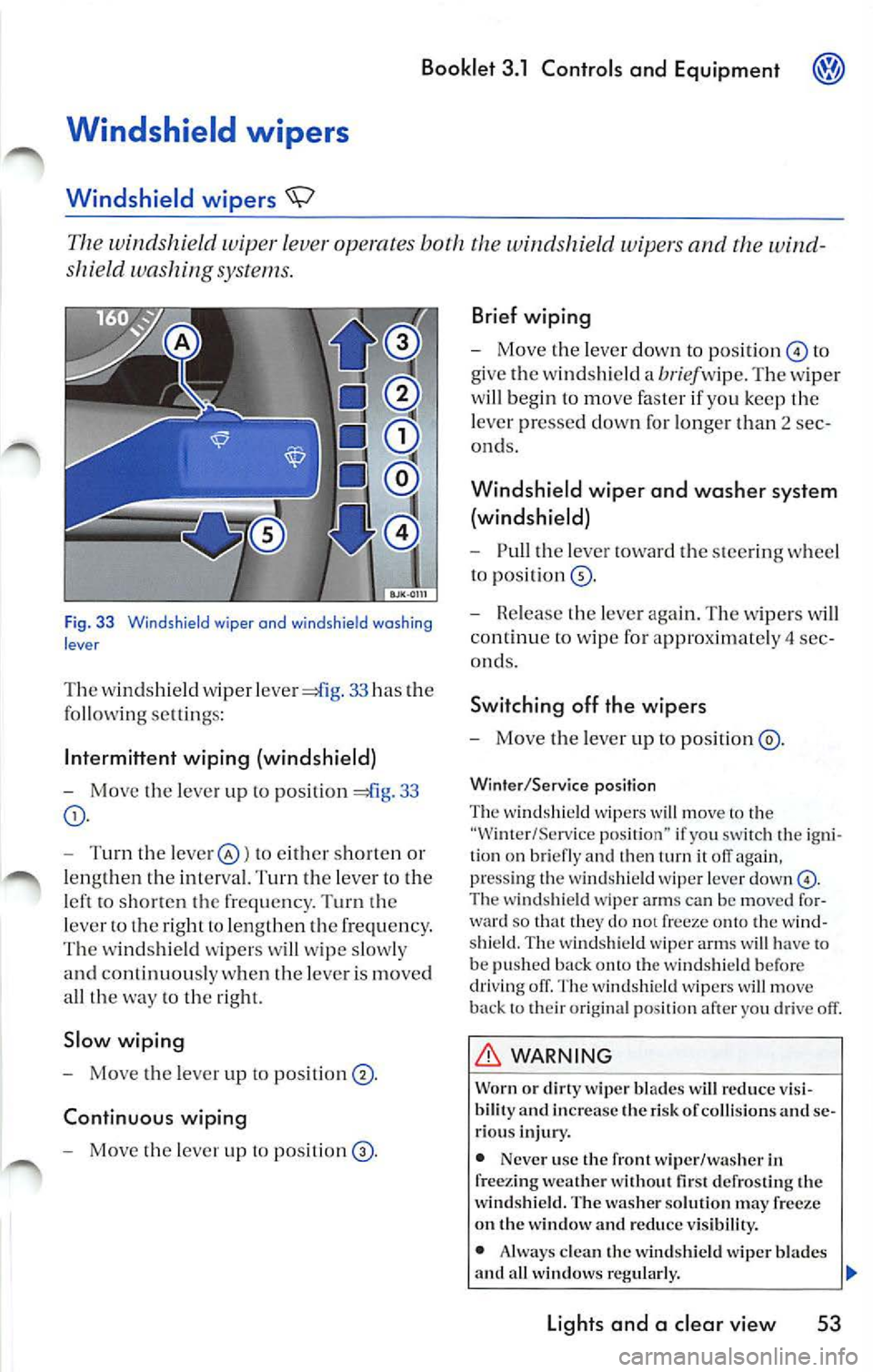
Fig. 33 Windshie ld wiper and wind sh ield washing
lever
T he w in dshield wiper 33 has the
fo llow ing se ltin gs:
Int ermi ttent wiping (windshield)
-Move t he lever up to positi on 33
- Turn th e leve r@ ) to e ither sh or te n or
l e ng th en the int erva l. Turn th e leve r to t he
l e ft t o sh o rt en the freq uen cy . T urn th e
l eve r ro th e right to le n gth en th e frequ en cy .
Th e w inds hield wip er s w ill wip e slo w ly
a nd continuou sly w hen th e leve r is m oved
a ll th e w ay
to th e rig ht.
Slow wiping
- Move the lever up to positi on ® ·
Continuous wiping
- Move the leve r up t o po siti on
Brief wiping
- Move the leve r down to position © to
give t he wind shi eld a
bri ef w ip e. T he w ip er
w ill be gin t o m ove faste r if you ke ep th e
l eve r pr esse d down for lo nge r th an 2 sec
ond s.
Windshield wiper and washer system
(windshield)
- Pull the lever towa rd the steerin g w heel
t o pos ition®·
- Rele ase the leve r ag ain. Th e wipers w ill
co ntinu e to w ipe for approx imate ly 4 sec
ond s.
Switching off the wipers
- Mo ve th e leve r up to po sition ®·
Winter /Service position
Th e wind shi eld wip ers will move to the
"Wi nter/Serv ice pos ition" if yo u sw itch th e ig ni
ti on on br iefly and th en
T he wi ndshi eld wipe r arm s can be moved fo r
w ard so that they do not freeze o nto the w ind
s hi eld. Th e wi nds hie ld wip er arms w ill have to
be pus hed b ack
the w indsh ie ld befo re
dri vin g o ff. T he w in d shi eld w ipe rs w ill m ove
b ack to th eir or ig ina l posit io n af ter yo u drive off.
WARNING
Worn or dirty wip er bl ad es w ill reduc e vis i
bilit y and incre ase the risk or co llis ion s and se
ri ous inju ry.
• Nev er u se the front wip er /wa sher in
fr ee zin g w eather without
defro stin g the
w indshield . The wa sh er solut io n ma y
on t he w indow and reduc e vis ibilit y.
• Alw ays clea n the win dshi eld wip er bl ades
and a ll w in dow s regularly.
Light s and a clear view 53
Page 258 of 477
Booklet 3.1 Controls and Equipment
Appl ies to vehicles: wi th headlight washer sys tem
Headlight washer system
The headlight washer system cleans the headlights.
The head lig h t was he rs are activated automati
cally when th e sw itch for the headlig hts is in an y
o th er posit io n th an O and th e windshie ld wip er
l eve r
53, fig. is pull ed toward the
s tee ring whee l for a t le as t 1. 5 sec onds. H oweve r,
yo u sh ou ld reg ularl y remove any hard or drie d
o n dirt or in sec ts from
hea dli ght s, for ex
ample when ever yo u are refu eling your vehicl e.
Mirrors
Tips
Mak e sure th at t he hea dlight washers wo rk
p ro perl y in wint er, keep the nozz le in th e
bump er fre e of sn ow and re m ove any ice with a
d e- ice r spra y
Self-dimming inside day-night mirror
It is important for safe driving that you have good vision to the rear .
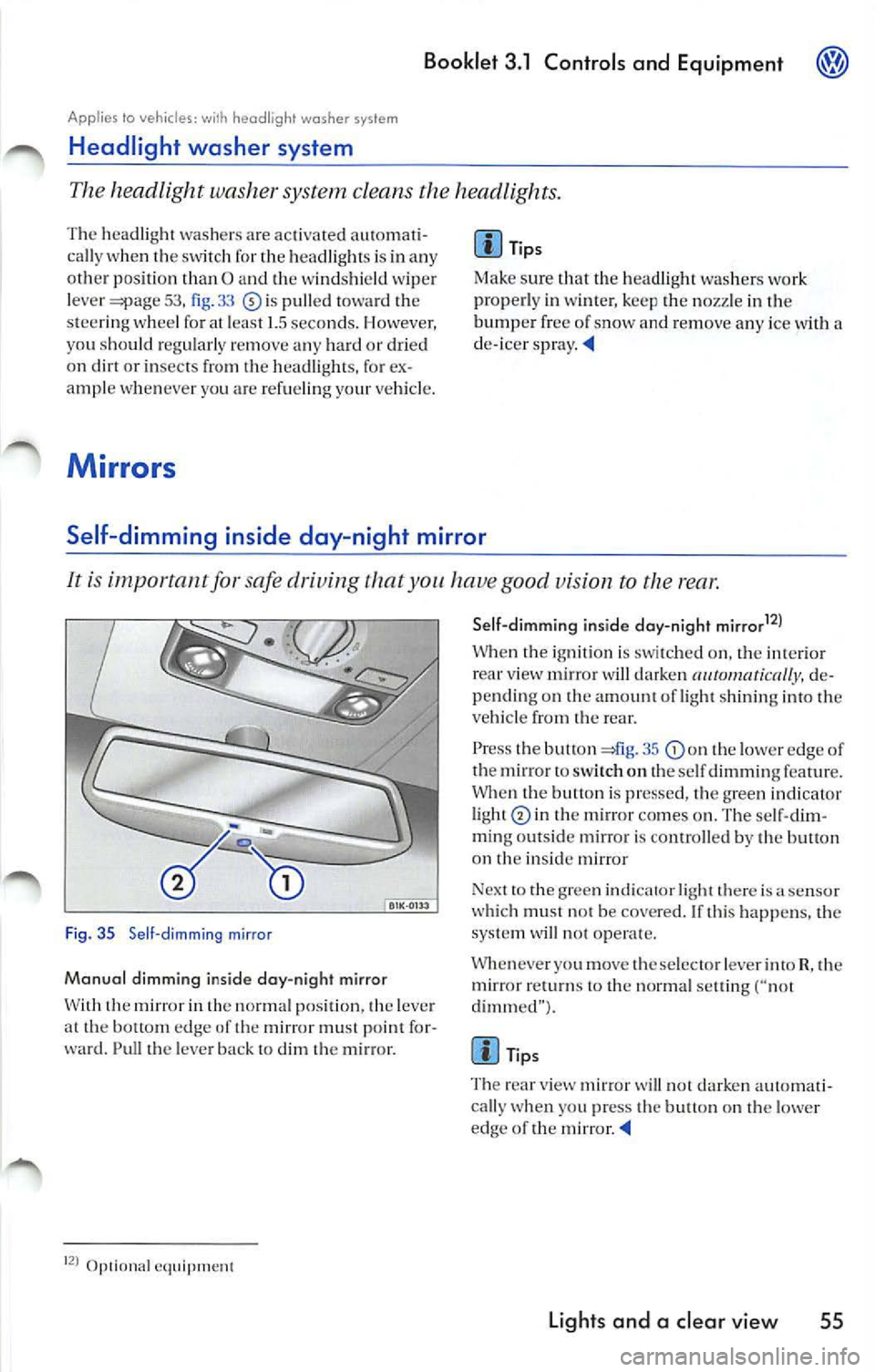
Fig. 35 Se ll-dimming mirror
Manual dimming inside day-night mirror
W ith th e mir ror in th e normal p ositi on, the leve r
a t th e bottom edge of th e mirror must point fo r
ward. Pull th e leve r ba ck t o dim
m ir ro r.
Op1ional eq uipment Sell-dimmi
ng inside day-night mirrar
12
)
W hen igni tion is swi tched o n, the int eri or view mirror w ill darken de
pending on amount of light shinin g into veh icle from rear.
P ress the butt on 41g . 35
th e lower edge of
th e mirror to sw itch o n th e se lf dimming featur e.
Whe n the butt on is pr esse d, th e gree n indicat or
li ght
in the m ir ro r co mes on . The se lf-dim
m in g ou ts id e mirror i s conrro lled by th e butl on
on
in side m irror
Nex t to th e g ree n indi cator light there is
sensor
w hi ch mu st not be cove red. If thi s happe ns, the
sys te m will not oper ate.
Whenever you move th e se lec to r le ver into R, th e
mirror
to the normal settin g ("not
dimm ed" ).
Tips
T he rea r view mirror
will not da rken aut oma ti
cally w hen you press the bu tton on t he lowe r
edge of the mirror
Lights and a clear vie w 55
Page 271 of 477
Booklet 3.1 Controls and Equipment
Applies lo vehicles: with an opening in the rear backrest lo transport long objects
Transporting long items
Your vehicle has an opening in the center of the rear back rest, which ena bles y ou
to t ra n spor t long ob jects, which do not fi t in th e luggage c om partme nt.
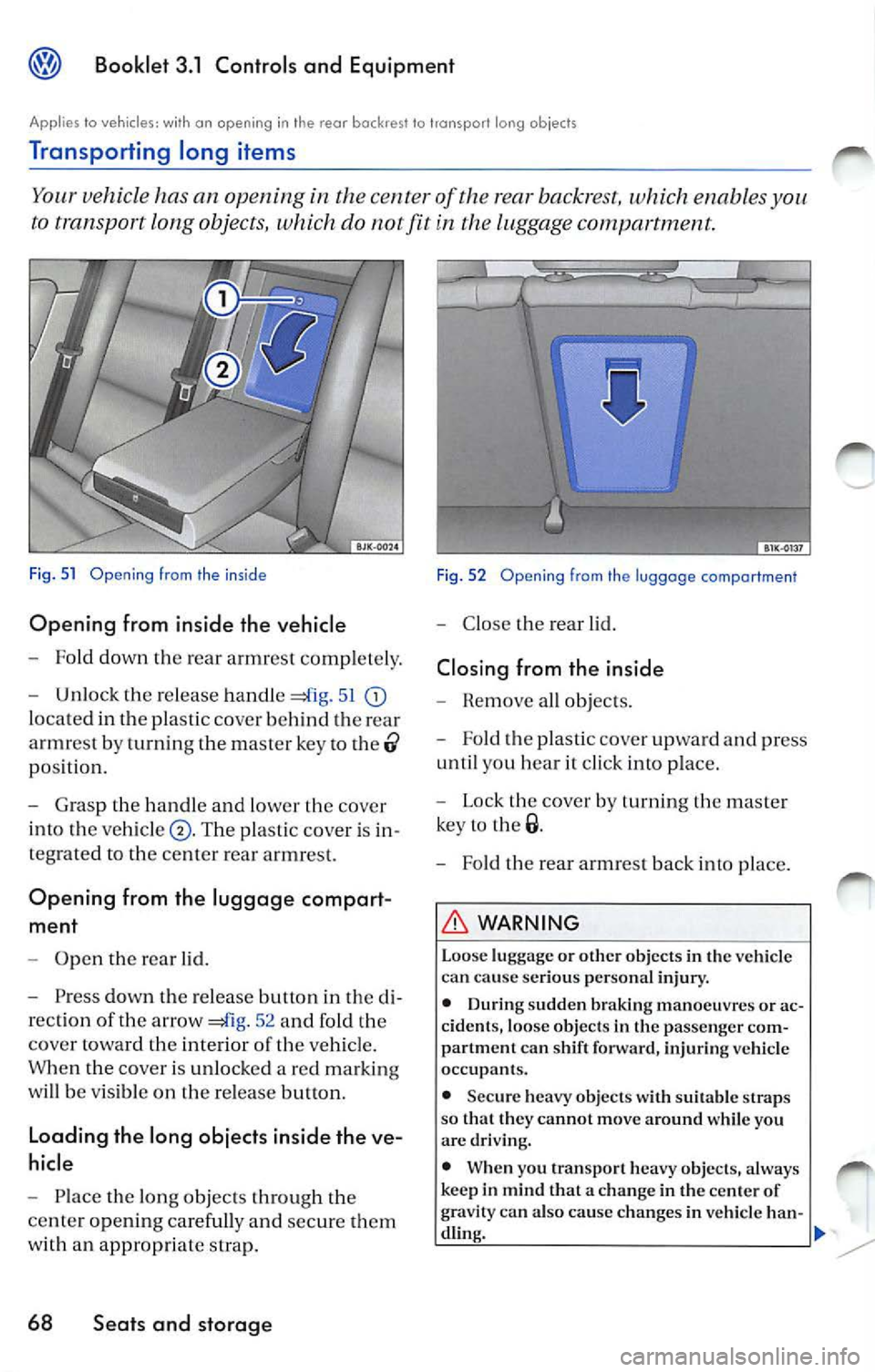
Fig. 51 Opening from the inside
Opening from inside the vehicle
-Fold d own t he rear arm rest comp le te ly.
- Unl ock t he re lease han dle ::::)f1 g. 51
loca te d in th e plas tic cover be hind th e rear
a rmre st by turn ing the master key to th e
pos itio n.
- Gras p the hand le a nd lowe r the cove r
in to t he
The p last ic cover is in
tegra te d t o t he ce nte r rea r arm rest.
Opening from the luggage compart
ment
- Ope n the rea r li d.
- Press d ow n th e re lease button in th e di-
r ec tion o f th e a rrow
an d fold th e
cove r towa rd th e int erior of th e ve hicle.
W hen th e cove r is unlo cked a red mark ing
w ill be vis ib le on t he re lease button .
Loading the long objects inside the ve
hicle
- Place t he lo ng o bjec ts th roug h the
cente r open ing ca re full y and sec ure them
w ith an app ropriate strap .
68 Seats and storage
Fig. 52 Opening from the luggage c ompar tme nt
- Close th e rear lid .
Closing from the inside
- R em ove a ll objects.
- Fo ld the plast ic cover upward and press
u ntil you h ear it click into place.
- Lock t he co ver by tu rn ing the m aste r
key to the
- Fold t he rea r arm res t back into p lace .
WARNING
Loose luggage or oth er obj ect s in th e vehicle
ca n ca use se rious pers on al inju ry.
• Durin g sudd en braking mano euv res or ac
cident s, loo se obje cts in th e passe nge r com
partm ent can
for ward, injurin g vehicle
occ upant s.
• Sec ure heavy objects w ith suit abl e s trap s
s o that th ey cannot mo ve around while you
arc driving.
• When you tr an sport heavy o bjec ts, a lways
k ee p in mind that a chan ge in th e ce nter of
g rav ity ca n als o cau se chan ges in vehicle han-
dlin g.
Page 278 of 477
Booklet 3.1 Controls and Equipment
WARNING
Heavy load s will influ ence the way your ve
hicle handl es and heavy loads t hat are not
properly stowe d or sec ured can cause loss of
contro l a nd se rious injury.
• Always keep in
when transporting
h eav y ob ject s, that a chan ge in th e center of
gravity can also cause c hanges in vehicle han
dling:
-Always distribute the load as evenly as
po ssib le.
- Secur e heavy object s properly as far for
ward in the lug gage compar tment as pos
sible.
- Alwa ys s ecure heavy items securely
using the tie-downs provided wit h suitable
s trap s.
• Never excee d the Gross Axle Weight
or the Gross Ve hicle Wei ght Hating on the
s afe ty compliance sticker o n th e left d oor
jamb. Exceedi ng permi ssible weig ht can ca use
the vehicle to slide and handle difTerently.
• Always read and heed a ddition al imp or
in forma tion on driving 2.1
" Safety first."
WARNING
To help p rev en t poisonou s exhaust gas from
being drawn into the vehicle , a lways ke ep the
rear lid clo sed w hile driving.
• Never transport objects larger than those
fitting completely into the luggage area be
cause t he rear lid cannot be full y closed.
• If you abso lut ely must drive with the rear
li d open, observe the following notes to reduce
th e risk of poisoning:
WARNING (continued)
-Close all wind ows,
- Close the power roof,
- Open all air outlets in the in strumen t
panel,
- Switch off the air recirculation,
- Set the fresh air fan to the highest speed.
WARNING
Always make sur e that the doors and rear lid
are secure ly clo sed and locke d to redu ce the
risk of injury when the vehicle is not being
u sed.
• Afte r clo sing the rear lid , a lways mak e sur e
that it is p roper ly closed and locked.
• Never leave yo ur vehicle unattended espe
cially with th e rear lid left open. A child could
craw l into the vehicle through the luggage
compartment a nd pull the re ar lid or window
s hut becoming trapped and unab le to get ou t.
Being trapped in a ve hicle can lead to serious
p ersona l inju ry.
• Never le t ch ildr en play in or around the ve
hicle.
• Never let passe ngers ride in the luggag e
com par tmenl. Vehicl e occupants must always
be properl y re strained in one of the veh icle's
s eat ing po siti on s.
Note
o bj ec ts o n th e hat sh elf co uld d am age the
w ires of the re a r w ind ow d efogg er.
Tips
D o no t co ve r th e ve ntilatio n slo ts in front of th e
r e ar sid e w ind ows beca use this ca n pr event sta le
a ir fr om esca ping the vehi cle.
Seats and storage 75
Page 293 of 477
Booklet 3.1 Controls and Equipment
Driving
Steering
Applies lo vehicles: with manually adju stab le steering column
Adjusting the steering wheel position manually
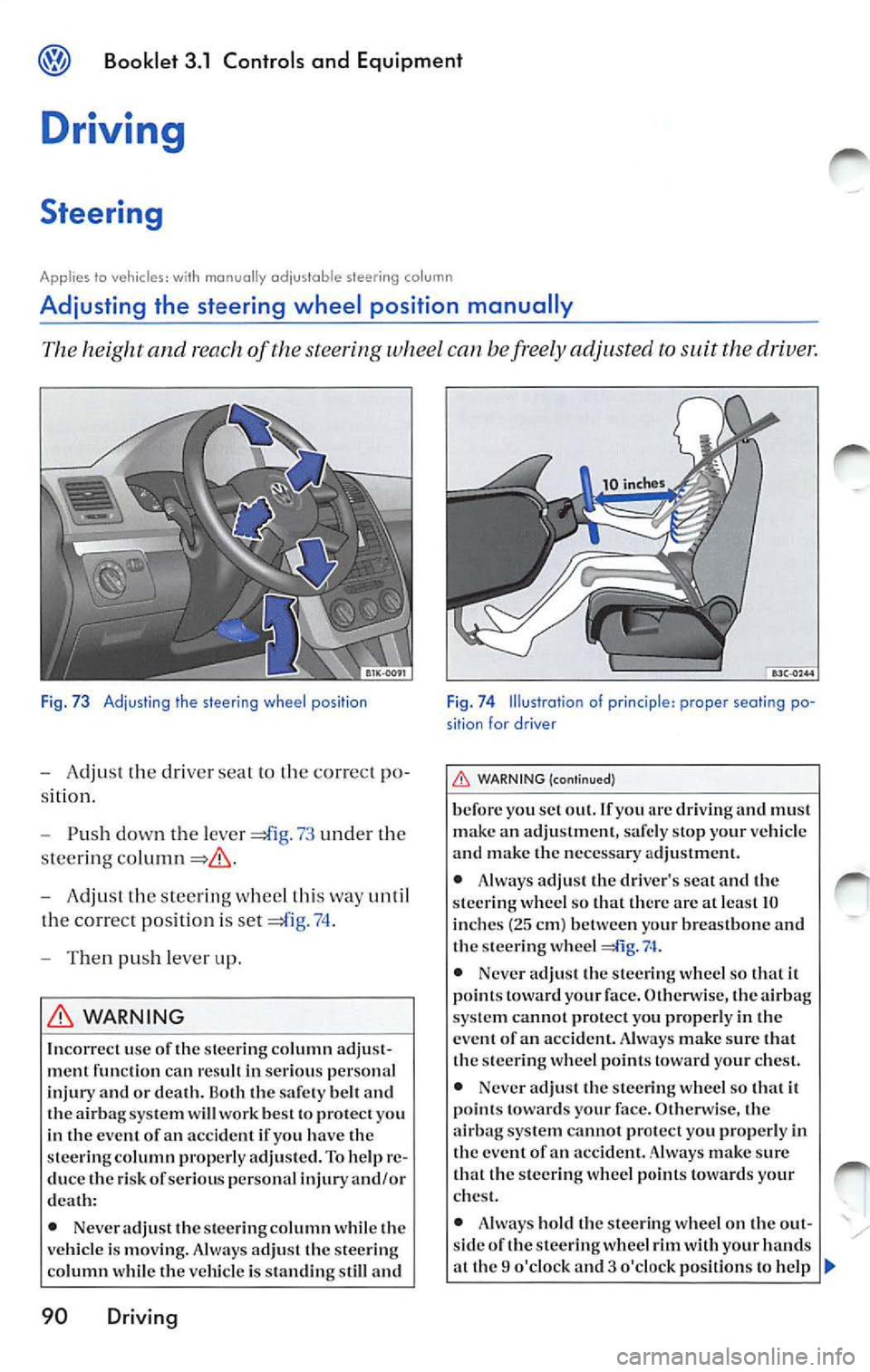
The and reach of the steering whe el can be freely adjusted to suit the driver.
Fi g. 73 Adjusting the stee ring wheel position
- Adj ust the d river sea t to th e cor rect po
s it ion.
- Push dow n the leve r
73 und er th e
s tee rin g
- Adju st th e s teerin g w hee l thi s way until
the corre ct po siti on is se t
74 .
- Then push le ver up .
WARNING
Incorrect use of the steer ing co lumn adjust
ment function can in seriou s per sonal
in ju ry and or death. the sa fety bell and sys tem w ill work best to protec t yo u
in the event of an accident if yo u have the
s teering column properly adjusted. To help re
duce
ri sk of seriou s perso nal injury and /or
death:
• Neve r adjust
steering column whil e vehicle i s moving. Always ad just steering
co lumn whil e the vehicle is standing still and
90 Driving
Fig. 74 Illustratio n of prin ciple: proper seating po
sition for d river
WARN ING (continu ed)
b efore you se t out . If yo u are driving and must
ma ke an adju stment, safely slop your vehicl e
and make
necessary adjustment.
• Always adjust the dri ver 's s cat and the
s teer ing wheel so that there are at leas t 10
in che s (2 5 cm) between your brea stb one and
ste ering whee l
• Neve r adjust the stee ring wheel so Iha! ii points toward your face. Otherw ise, the a irb ag
syste m cann ot prote ct yo u proper ly in
eve nt of an accident. A lway s make sure that steer ing wh eel point s toward your chest .
• Neve r ad just the stee ring whee l so
points towards your face. O then vise, airbag system canno t p ro tect you properl y in eve nt of an accid ent . Always make sure
that the steerin g whe el po int s toward s your
c h es t.
• Alw ays hold
stee ring w heel on out
s id e of steering wheel rim with your hands
a t th e 9 o 'clock 3 o'clock posit ions to help
Page 308 of 477
Booklet 3.1 Controls and Equipment
Parking
The parking brake can be us ed to pr eve nt the vehicle from moving uninten tion
ally.
A lways apply th e parking brake fully when
yo u leave y our vehicl e a nd when you p ark
yo ur vehicl e.
- Use the foo t brake to stop the veh icle.
- Appl y th e parking brake full y.
- On a ma nual tran smi ssion engage
gea r. On a n aut omatic tra nsmi ssion move
the selector lever to P.
- Switch off the engine and r emo ve the
key from the ignition lock. Turn th e
s tee rin g w he el s li ghtl y to en gage the
stee ring loc k.
- Always take you ve hicle keys w ith you
whe n yo u leave the
When parking on slopes
Before turnin g off the engin e, turn the steer ing
w hee l so if th e vehicle sta rt s to ro ll, it will roll
i nt o th e c urb:
• If th e ve hicle is faci ng
turn the whee ls so that they poilll toward the cur b.
• If th e vehicle is faci ng
turn the front
w heels so t hat they poi nt away from the curb .
• As a lways, appl y th e pa rking
full y and
m ove the se lector lever to P.
WARNING
Improp er parking procedures can lead to se
ri ous perso nal injury for you or your passen
gers.
• Never remove the key from steering lock
whil e th e ve hicle is movin g or rollin g to a stop .
The steer ing wheel
will lock up and you will not be able to stee r or control the vehicle.
WARNING
• Never park where the hot exha ust sys te m
co uld ignit e flammabl e material s, such as
bru sh, l eave s, dry grass, sp illed fuel etc.
• Alw ays apply the parking brak e fuJly wh en
parking your vehicle.
• Never leave anyone in your vehicl e to pre
ven t the ve hicle from moving if the parking
br ake is r elease d or selector lever is moved.
• Alwa ys tak e the key w ith you when you
l e ave the vehicle. The engine can be started
and vehicl e sy stems su ch as the power win
d ows can be operated leading to seriou s per
s onal injury .
• Never leave children , disabl ed p erson s or
anyone who cannot help th emselves in the ve
hicl e. The doors can b e lock ed u sing th e re
mot e co ntrol trappin g passenger s in the ve
hicle in an emergenc y. Depending on the time
of year, people tr app ed in
vehicle can be
expose d to v ery high or very low temperatures.
Note
• Please exercise care when yo u pa rk your ve
hicl e in parkin g are as w ith p arkin g barri ers or
cu rb s. Parking barriers and curb s vary in heig ht
an d co uld damage yo ur bump er and re la te d
compo nents as th e fron t of yo ur vehicl e moves
over
b arri er or curb that is too high . as you park
or as you back out of parking spot. In order to
be sur e th at no su ch d ama ge ca n occ ur, yo u m ay
wish to s top sh or t o f h av ing th e front tires o f yo ur
ca r touc h parking barri er o r curb.
• Please a lso exe rcise exce ptiona l ca re when
yo u drive up or d own steep ramp s or drive over
cu rbs or oth er obsta cles, fo r w hi ch lhe ve hicle is
not d esign ed , b ec au se compone nts of th e ve
hicl e close lo th e groun d su ch as bump er cove rs,
s poil ers , suspensio n and exhaust syste m com
ponent s, m ay beco me
Driving 105
Page 310 of 477
Booklet 3.1 Controls and Equipment
Cruise control
Applies to with co ntro l
Description
The control can be set to keep vehicle speed from about 18 mph to
110
(30 km/h to 180 km/h).
When yo u have re ached the ve hicle speed that
yo u want, yo u can set the crui se co ntrol and take
yo ur fo ot off th e accelerato r pedal.
The crui se co ntrol does
1101 wor k if the selec tor
l ever is in P , N orn.
WARNING
Using the crui se control it is not po ssible
to dri ve safe ly at a co nstan t sp eed is dan
ge rou s.
• Never use the c rui se control when driv in g
in h eavy o r vary ing traffi c, on steep, w inding
or s lippery roads (for examp le snow, ice,
s tr ee ts cove re d with water or gravel).
• To prevent unintended operation of th e
cru ise co ntro l, sw itch the syste m o!Twhcn it is
not being used.
L[:. WARNING (continued)
• It is dangero us to u se the resume feature
w hen the previou sly set speed is too high for
th e existi ng road , traffic or weathe r co ndi
tions.
Not e
• When tra vellin g downhill, the cru ise control
may not maintain cons tant s peed . The vehicle
wi ll accel erate as a resu lt of its ow n weig ht.
Downshift and/or use the foot brake
to slow the
ve hicl e.
• For ve hicles wi th a manual transmission, do
not mo ve the gea rsh ift l ever into n eutral without
d epre ssing the clut ch fully when the cru ise con
t ro l is activated. Othe rw ise the engine cou ld rev
up and be damaged.
Applies to vehicles: with independent lever for Cruise control
Using the cruise control
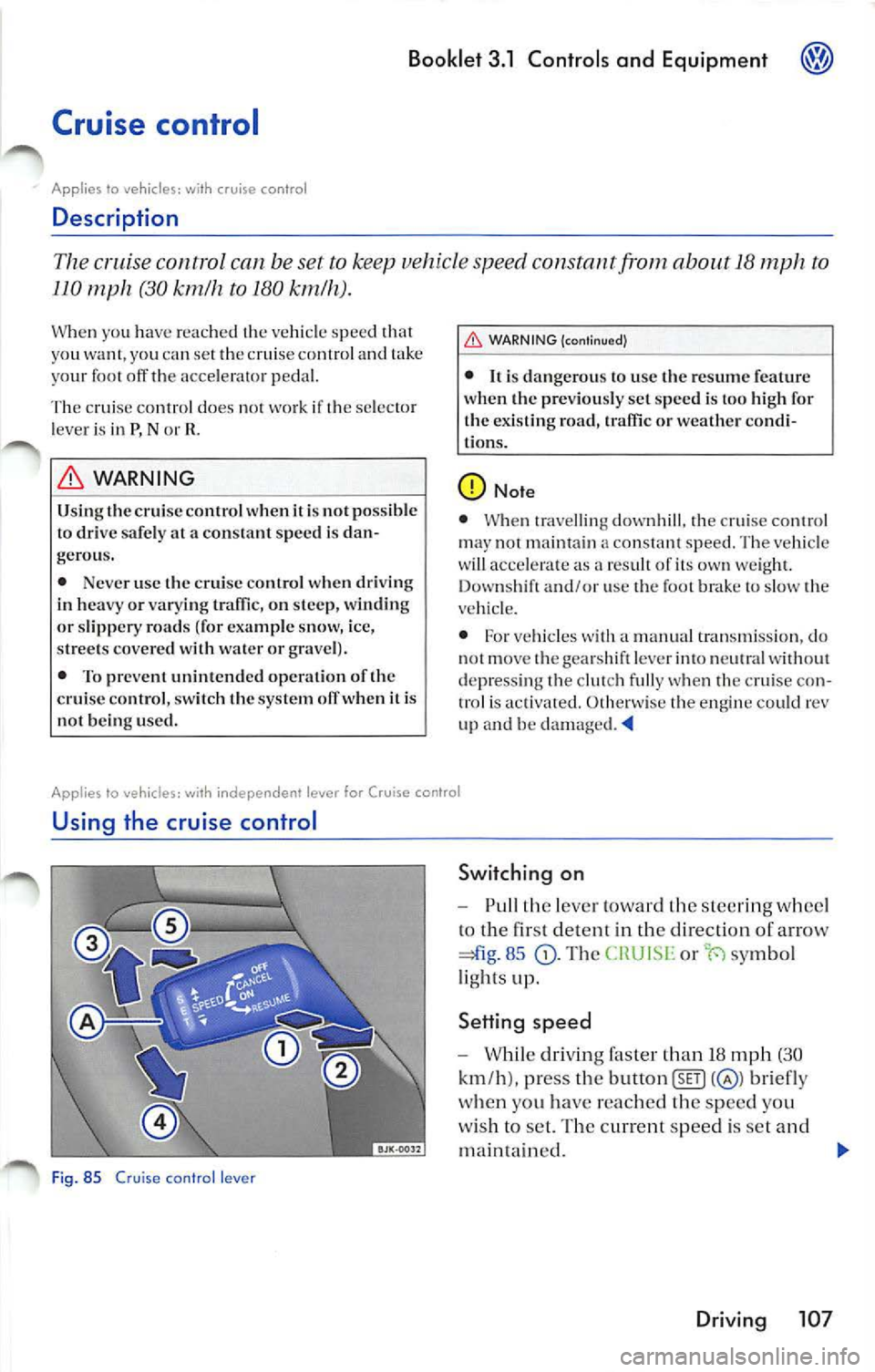
Fig. 85 C ruise con tro l lever
Switch ing on
Pull th e lever toward the steeri ng whee l
lo th e first detenl in the direction of arrow
85 Th e or symbo l
li ghts up.
Setting speed
Whil e dr iv in g faster than 18 mph (30
km /h ). press the button
briefly
w hen you have reac hed the speed yo u
w is h t o se t. Th e cu rrent speed is se t and
ma intained.
Driving 107
Page 311 of 477
Booklet 3.1 Controls and Equ ipment
Accelerating
- Pull th e lever upward in direction
to th e+ position to increase the
s peed by about 0.5 mph
(I km/h ).
Decelerating
- Pull the lever downward in direction of
a rrow © to the - positio n to lowe r the
s peed b y 0.5 mph (about I km/h).
Switching off
-Push the leve r in the direction of arrow
all the way to the OFF position whil e
d rivi ng. The CHU ISE or
symbo l goes off .
- Sw itch th e ignit ion off when the v ehicle
i s standing still.
WARNING
Using the crui se cont ro l whe n it i s not possib le
to dri ve sa fely at a constant speed is dangerous
in "Desc ription".
Tip s
• If th e cruise con trol is switc hed on th e
( or ·t-i sy mbol in the in stru ment cluster
li g ht s up .
• If th e c ruise co ntrol i s
the or symb ol goes o ut. The syste m is
swi tc h ed off compl etely when the selec tor leve r
is in P, Nor
• If yo u increase vehicl e speed with th e accel
erato r pedal, the prev ious ly programmed sp eed
will be re sum ed when the acce le rator p edal is re
leased . T hi s w ill not be the case. however, ifche
vehicle s peed is mo re than 6 mph (10 km/h)
hi gh er than the s tored speed fo r long er
5
minut es. The speed will then have to be store d
again .
• The set speed can be sw itche d off te mpo
rarily if you p ress the brake peda l or the clutch
pedal. Pull th e lever briefly towa rd th e steering
whee l to the point where you can start to fee l re
s is tance
107, fig. 85 to r esum e the
speed again. "'4
App lies to vehic les: with independent lever for Cruise cont·ol
Turning off control temporarily
You can turn off the control temporar ily as
follow s:
- Depress the brake pedal,
- Dep re ss th e clutch pedal, or
- Pu sh the l ever briefly to the point where
yo u can star t to feel r esis tanc e in the dir ec
t ion of a rrow
10 7, 85
Th e set sp ee d re mains in th e mem ory , but it is
not maintain ed. To res um e the spee d previo usly
se lected, re lease the brak e pedal and pull th e
l e ver bri efly coward the stee ring wheel to the
108 Driving
point whe re yo u ca n start to f eel resi stan ce 107, fig. 85
If you drive faster than about 1 10 mph (180 km/h)
the cru ise co ntrol is sw itch ed off automati cally
a nd you cann ot ac tivate the cruise contro l. To
ac tivate the cru ise control again, drive s lower
than about 110 mph (180 km/ h).
WARNING
Us ing the cruise contro l when it is not possib le
to drive safely at a constant spee d is dangerous
in "Descrip tion" on page 107. "'4
Page 323 of 477
Booklet 3.2 Tips and Advic e
Smart technology
Brakes
Brake booster
The brak e boo ste r incr ea ses the brake press ure
yo u put on th e peda l. wo rk s onl y wh en
t h e engi ne is runnin g.
If th e brak e boos te r is not workin g or if th e ve
hicl e has to be towe d, yo u wi ll h ave
to push th e
brak e peda l hard er to ma ke up for th e lack of
boo ste r ass is t.
WARNING
B rak ing w ithou t t he brake boos ter needs a
mu ch l onge r bra king distance and r equir es
Brake Assist Sys tem (BAS)
In a n emerg ency, mos t d river s brake in t im e, not w ith m aximum force. This res ult s in stop
ping dis tan ces th at are lo ng er th an they have to
b e!
T he brake a ssis t sys te m h elp s: if yo u pr ess th e
brak e pedal very quickly, t he brak e ass is t sy stem
r eg is te rs an em erge ncy situatio n. It th en very
qui ckly build s up th e full brake press ure so th at
t h e A BS can be activate d more qui ckl y and
cie nt ly, r educin g th e braking di sta nce and le t
tin g you steer at the sa me tim e.
D o not reduce th e pr ess ure o n th e brak e ped al.
T he brak e ass is t sys te m sw itches o ff aut omati
ca lly as soon as you re lease th e brake. The brak e
a ss ist sys te m works onl y wh en th e en gin e is
n ing.
If th e brak e sys te m i s not fun ction in g pro perl y, a
wa rnin g lig ht will com e on =bookl et 3.1 "Co n
t rol s and Equipm ent ."
WARNING
Always ad just you r sp ee d an d driv in g s ty le to
roa d, an d weather cond iti ons. Do not
2 Smart t echnology
WARN ING (con tinued)
yo u to p ush th e bra ke ped a l d ow n ha rder th an
n or mal.
• Never let th e ve hicle coa st w ith th e eng ine
switc hed off.
• If th e brake boos te r is no t ac tive, for
ample if th e ve hicle is bein g towed , yo u w ill
have to p ush th e brake pedal down much
h ar der than n ormal.
WARN ING (continu ed)
let the extra safety afforde d b y th e Brake Ass is t
Syste m temp t yo u int o taking ex tra ri sks.
• Never let t he extra sa fety offered by t he
Brak e Ass is t Sy ste m te mpt you into ta kin g
ex tra risks.
• The B ra ke As sis t Sys te m canno t re d uce t he
r isk o f a n acci den t, fo r examp le if yo u d rive too
fas t for co nditi on s or
if yo u d o not k eep yo ur
di stance fro m th e vehicl e in fr ont of yo u.
• Slippery and
roa ds are dangero us eve n
w ith th e Brake Assis t Sys te m!
WARNING
• Always reme mber th at ve hicle a ltera tio ns
or modificatio ns ca n affec t th e fu nctio n of th e
ABS, BAS , ED L and ES P sys te m s. Exa mpl es of
these alt era tion s or mo dificatio ns includ e a
di fferen t w hee l/tir e co mbin atio n and bra ke or
chassis modifi catio ns
28, and
t echn ic al m odi ficat io ns".
• Chan ging th e ve hicle su spe nsio n or u sing
un approved tir e
I r im combin atio n ca n ch an ge the w ay the A BS, B AS, EDL a nd ESP
Page 328 of 477
Booklet 3.2 Tips and Advice
Driving and protecting the
environment
Break-in Period
B reak-in for a new engine
The en gine needs to be broken i n during the first 1000 miles (1500 km ).
For the first 600 miles (1000 km)
- Do n ot dri ve faste r than three q uarters
or top speed shown on th e speedo mete r.
- Do not u se full th rott le .
- Avo id high eng ine speeds.
- Do not tow a tra iler.
From 600 to 1000 miles (1000 to
1500 km)
- Speeds ca n be grad ually increased to
the maximu m vehic le speed or max imum
perm iss ibl e en gine spee d (rpm ).
Breaking in tires and brake pads
Durin g first few hou rs of driv in g, the e n
g ine 's in te rn al fri cti on is hi gh er than it will be
all th e m ov in g pan s ha ve bee n
broken in.
For the sake of en vironment
lfth c engine is brok en i n ge ntl y, the life of the
e ngin e w ill b e in crease d and it s oil cons umptio n
New tires s hou ld be b roken in ca refu lly fo r the first 350 mi les (560 km). New b rake
pads s houl d be broken in ca refu lly fo r
first 150 miles (240
WARNING
Ne w tir es and brak e pad s do no t pro vid e m ax
imum grip , co ntrol or b rakin g abilit y.
W ARNING ( continue d)
• T o reduce th e ris k of los ing co ntrol, a colli
s io n and serious perso nal injuri es, drive w ith
s p ecial car e for the fir st 35 0 mil es (560 km ).
• New brake pads do not have th e be st stop
pin g powe r for the fir st 1 50 mil es (24 0 km) and
mu st b e bro ken in. You ca n comp en sa te for
th e sli ghtl y re du ced brakin g
by apply in g
mor e pr ess ure o n th e bra ke p ed al.
• Never fo llow other vehicle s to o clo sely or
put your se lf into oth er situ ation s th at mi ght
re quir e sudd en, hard br akin g es peci all y w hen
th e b rak e pads have not b ee n brok en
Driving and protecting the environment 7