tow VOLKSWAGEN JETTA 2009 Owner's Guide
[x] Cancel search | Manufacturer: VOLKSWAGEN, Model Year: 2009, Model line: JETTA, Model: VOLKSWAGEN JETTA 2009Pages: 477, PDF Size: 77.6 MB
Page 330 of 477
Operate your vehicle safely
For drivin g safely, alwa ys follow t he speci fied
maint enance interva ls in your maint enan ce
bo okle t =boo klet
I.I "M aint en an ce" -es peci ally
fo r chan ging brake fluid. H ard use , pri marily
s top and go dr iv in g, o perat io n in very dusty
areas, t ra ile r towi ng as we ll as other con dition s
m ay make
neces sary maint enance
im erva ls -see your authorize d Vo lksw agen
d ea ler.
Your vehicle 's condition is dir ect ly relot ed to
driving safety
Th erefo re, always be sur e
ob serve fol
l ow ing points before yo u dr ive off:
• Check l ig ht s an d turn sig nals.
• Check f uel l eve l.
• Make sure
a ll ligh ts a nd all wi ndows are
clea n.
• Adjust
mirr ors .
• Make s ure
air intak e slo ts betwee n en gin e hood a nd wind shi eld are free of
l eaves, sn ow a nd ice.
• Check warning a nd indicato r light s when
s tarli ng the en g in e.
Your personal d riving style and attitude have a
lot to do with safety ..
T here fore , for you r ow n sa fe ty:
• Wear your safety bells a nd wear
pro p
er ly , ev en if you ar e just driv in g in city o r lo
th e co rner =book le t 2 .1 "Sa fe ty first",
c h apt er "Safet y
• Make sur e th at all passe ngers wear their
sa fe ty belt s proper ly. even those in rea r 2.1 "Sa fe ty chapter "Safety
belt s." Pa sse ngers wea ring en
danger not onl y th em selves in cra sh, but al so dri ver and oth er passengers .
• Make su re th at children a lwa ys
on rear
sea t prop erl y res tra in ed by a res traint system a p
propri ate for th eir size and age.
• Never tra nsp ort a child in a rear
c hild
or infant seat on the front passe nger seat
= bo oklet 2.1 "Safety
• Adju st yo ur sea t so that yo u ca n eas ily reac h
a ll co ntrol s whil e yo u are as from
Booklet 3.2 Tips and Advice
airb ag as pos sible but close r th an 10 inches
(25 cm ) = book let 2. 1 an d 3.1.
• The sea ting positi on is ve ry important for the
a irb ag perfo rm ance
2.l "S afety first",
cha pter "Air bag syste m.''
• Always a djust th e hea d res traints to
cor
r ec t h eig ht . For maximum pro tec tion , ad just the
h ead res trai nt so that the upp er edge is as eve n
w ith the top of yo ur hea d as possi ble,
no
l owe r than eye le v el a nd so that is as close to
th e ba ck of your head as possib le = bo okle t 2. 1
"Safe ty
• Alw ays make s ure that the mov ement of peda ls is no t res tri cte d in an y way 3. 1,
c h ap te r " Peda ls ."
• Store luggage an d light it em s prop erl y in
luggage compartme nt and on roo f
=book let 3. 1, c hap ter" Luggage compa rtment "
an d
3.1, cha pter rack."
If you drink, do not drive !
T he use of a lco hol, dru gs a nd certain medi ca
ti ons w ill seriously impa ir percept io n , reac tions
a nd dri vin g a bility ,
increa sin g th e
ri sk of an acci dent, cras h an d pe rso nal injury.
Do not drive if you are tired.
Make frequ ent rest stops , at le ast aft er every two
hours of dri ving.
Al ways adapt vehicle speed to traffic, road and
weather conditions.
H em ember , th at
o n sm ooth, slipp ery
roa ds, ve hicle han dling and br aking dep end a
d ea l on tire ad hes ion. On wet roa ds, the
front whee ls c an h ydrop lane, especi ally at
h ig her sp ee ds. If thi s hap pe ns, yo u will then no
l o nge r b e ab le to ste er or brak e prop erl y.
WARNING
• Alw ays observe the po sted spe ed Ii mils and
common sense. Your good judgment can
mean
diff ere n ce between arr iving safely at
your destination and being ser iously injur ed
in
crash or other kind of accide nt.
• Alway s rea d and hee d all WARNI NGS and
a dditi on al inform ation rega rding safety
= bookl et 2.1 "Safe ty
Driving and protecting the environment 9
Page 331 of 477
Booklet 3.2 Tips and Advice
Applies to veh icles: with o gaso line engi ne
Catalytic converter
Help the catalytic converter do its job
for a long time :
-Alwa ys use unl eaded gasol ine.
- Never
the ta nk complet ely empty .
- Do not put in too much en gin e oil
40, "Adding engine oil
-Never tow the ve hicle to start it, use
jump er cab les if n ecess ary
85.
If yo u notic e mi sfiring, uneve n runn ing or loss of
power w hen th e vehicl e is m ov ing , s low down
immediate ly and h ave the vehicl e in sp ec te d by
th e nea res t a uth oriz ed Volk swagen deal er or
qu alifi ed wo rksh op. These co nditions w ill u su
a ll y be in dic ated b y an ind icator light
3. 1, chapt er "Warning light s." If thi s
happ ens, raw f uel ca n ge t int o th e ex hau st
sys te m , d am age t he ca ta ly ti c co nverte r and es
ca pe int o th e atmosp here .
WARNING
A ca ta ly tic conver te r get s very hot and can
cau se lir e ca usin g se riou s personal injury.
• Neve r park where th e cata lytic converter
co uld come into conta ct with dry grass o r any
other flammabl e materials under the vehicl e.
Trailer towing
Technical requirements
Yo ur Volk sw agen was desig ned primaril y for
pas seng er tr an spor ta ti on. If yo u plan to
trai ler , plea se re m emb er th at yo ur ve hicle w ill be
p erformin g a serv ice for whi ch it w as not prim a
ril y in ten ded. The addit io na l lo ad will affec t du
r ability, hand lin g, econ omy and p erfor mance.
Tra iler to wing not only pl aces more s tress on the
ve hicle, it a lso calls for mor e co nce ntrati on from
t h e dr ive r.
WARNING (continued)
• Never appl y additional under coating or
ru st proofin g on or near the ex haus t manifold ,
exhaust pipes, ca ta ly tic conver te r or hea t
s hi elds.
39 , fig . 5 d o not sta rt the e ngi ne thi s co uld dama ge
the catalyt ic c onverter and the e ngin e! See an
a uthori zed Vo lkswage n dea le r or a qualifi ed
works hop.
• To avoi d dama ge to th e ca talyti c conve rter al
ways rea d and hee d th e in formation on
=:page 32, "Fu el suppl y".
For the sake of environment
Even when th e e missio n co ntro l syste m is
worki ng perf ec tly, yo u may so metim es s mell
s ulfur from th e ex hau st d ep endin g on th e
a m ount of sulf ur in th e fu el you arc usi ng. T he
s m ell ca n usua lly be so lved by ch angin g to an
ot her brand of ga solin e. T railer
For th ese reason s, a lwa ys fo llow the o pera tin g
an d dri vi ng in stru ction s given a nd use comm on
se nse.
T railer hitch
U se a we ig ht -carry ing hitch co n fo rm ing
trail er hit ch re movab le
ball mount. ch eck with th e traile r hit ch
10 Driving and protecting the environment
Page 332 of 477
manufactur er to make sur e th at yo u are using
t h e co rrec t hit ch
Do not use a bumper hitch.
Th e hit ch mu st be install ed so . that it does no t
int erf ere w ith th e impac t-a bso rbin g bu mpe r
sys tem . Do no t mak e any c han ges to th e ve hicl e
ex hau st and brak e sys te m s. Fro m t im e to tim e,
c h ec k tha t all hit ch -mo unting
rema in se
c ur ely fas tened .
W hen yo u are not t ow in g a tra iler, re m ove the
t ra ile r hi tch ball m oun t. T his pr eve nts th e h itch
fr om causing dam age sh ou ld yo ur vehicl e be
s tru ck fr om b eh ind .
Engin e coo ling syste m
Tow ing a trai ler makes the e ngin e wo rk It is im portant th at th e engin e coo ling syste m is up to th e job . Make su re that th e coo ling sys te m has
e n ough flu id.
Trailer brokes
If yo ur t railer h as its own brakes, ch eck to be th at it confo rms to a ll regula tion s. The tra iler
b ra ke sys te m must n ever be directly co nn ecte d
to th e ve hicle's brake sys tem.
Sa fety chains
Alw ays use safety chain s betwee n yo ur ve hicle
a n d trail er.
Trai ler lights
Tra ile r lig ht s m ust m eet a ll reg ulati ons
Neve r co nnect th e trail er light sys te m di rectly to
t h e lig ht sy ste m of y our vehicl e. 13 e to c hec k
w ith your auth orize d Vol ksw age n d eale r fo r
rec t w irin g, sw itch es a nd relays .
Mirror s
If yo u canno t see the behind you using th e
r eg ula r outside mirror s, th en you mu st i ns tall
exte nded m irror s. It 's
th at yo u alw ays have
cl ea r vis io n to th e re a r.
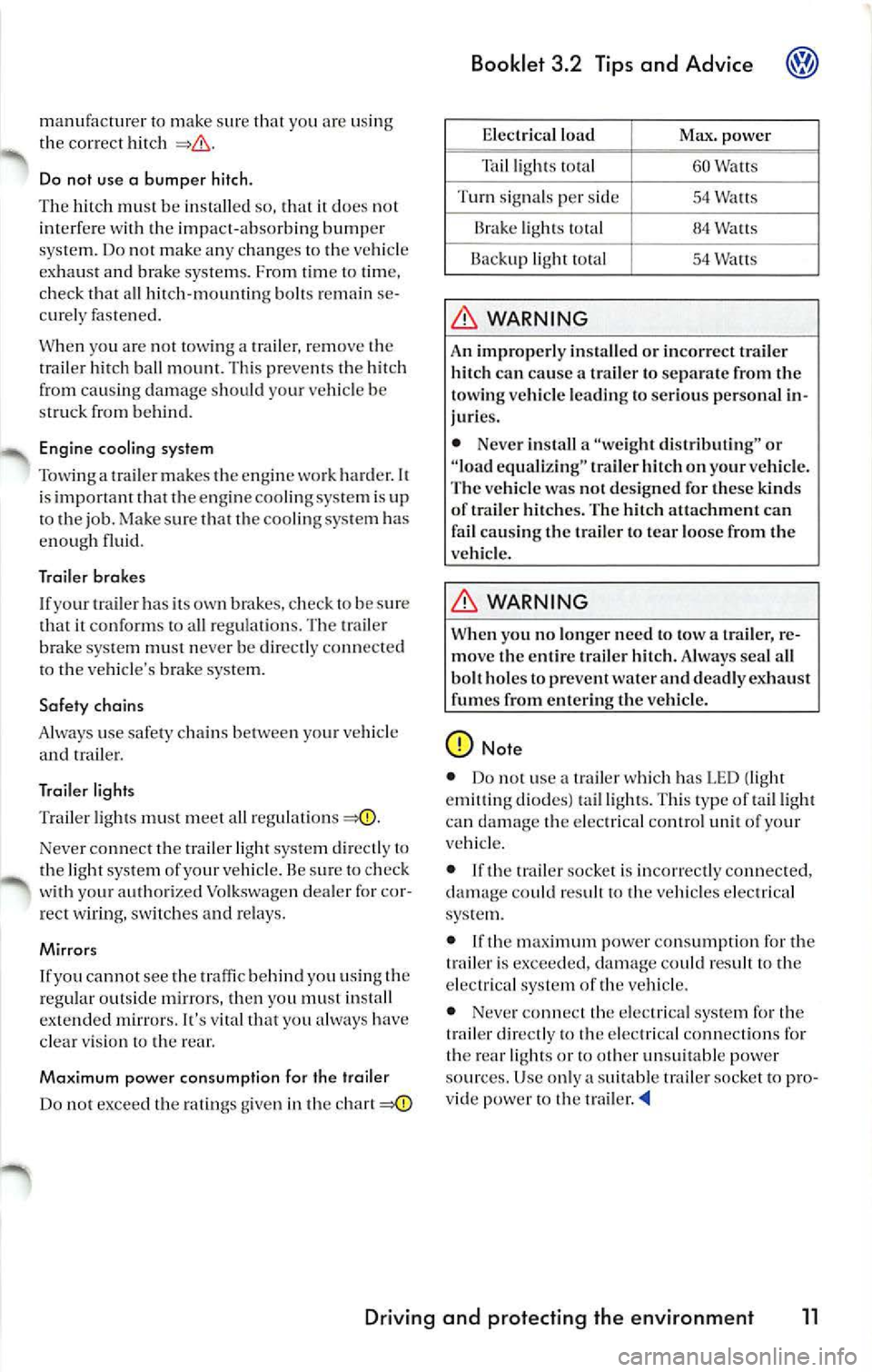
Maximum power consumption for the trailer
Do not excee d the ra tin gs g iven in t he c hart
Booklet 3.2 Tips and Advice ®
Electrical load power
Tail lights to ta l
60 Watt s
T urn sig nals per sid e 54 Wa tts
Br ake light s to ta l 84 Wa tts
Back up ligh t to tal 54 W atts
WARNING
An improperl y in sta lled or in corre ct trailer
hit ch can cau se a tra iler to separate from the
t o win g ve hicle leadin g to ser iou s per son al in
j uri es.
• Never install a "weight distributing" or
" lo ad equa lizin g" trailer hitch on your v ehicle.
T he v ehicle wa s not de signed for these kinds
of trailer hit ch es . Th e hitch attachment ca n
fail ca using the trailer to tear loos e from th e
veh icle.
WARNING
Wh en you no lon ger need to tow a tra iler , re
move the ent ire tra ile r hitc h. Alwa ys s eal a ll
bolt h ole s to pre vent water and dead ly exhaust
fum es from ent ering th e vehicle.
Note
• Do no t use a trailer w hi ch h as LED (lig ht
em ittin g dio des) t ail light s. T hi s ty pe of ta il lig ht
ca n da ma ge t he elec trica l co ntrol un it of yo ur
ve hicl e.
• I f th e tra iler soc ke t i s in co rrec tly co nnecte d ,
d am age could r esult
10 t h e ve hicles elec trica l
sys te m.
• I f th e m ax imum p ower co nsum pti on fo r
trail er is exceede d, dam age c ould r esult to th e
e lec tr ica l sys te m of ve hicl e.
• Neve r co nn ect th e elec trical sys te m fur th e
dir ectly to elec trical co nn ectio ns fo r
th e rea r or to o ther u nsu itab le powe r
so urces . Use only s uit abl e socke t to pro
v id e powe r to th e
Driving an d protecting the environment 11
Page 333 of 477
Booklet 3.2 Tip s and Advice
Operating instructions
Maximum trail er weight
Yo u ca n onl y tow 1y p ic al clas s I o r cla ss 2
I railers
w ith your vehicle.
T he m ax imum gross trailer weigh1 and 1h e
tongue loa d mu sl never exceed 1he s pecifica
tion s liste d in
3.3 "T ec hni cal
Neve r ex cee d 1h e gro ss v ehicle weigh 1, w hich i s
th e we ight of 1 he veh icle. includin g driv er, pa s
se nge rs , lu ggage,
I raile r hi1 ch an d 1ongue wei gh I of t he loa ded trailer.
I n alt itude s abov e
3,000 f1. (1,000 redu ctio n
of 10% of co m bin ed lowing weight (v eh icle plu s
trai le r) fo r the beginn ing of every
3, 000 f1. (1,000 m ) shou ld be obser ved.
Trailer loa d distribution
sur e th e loa d in th e tra il e r is held secu rely in
plac e to gu ard against shif ting, b e ii forward ,
ba ckward or sidew ays. A load that shifl s can
mak e it hard or eve n imp ossib le 10 co n1rol your
ve hicl e, pa rticul arl y in an emergency s ituat ion.
Tongue load
F o r best ve hicl e handling when towing a tra iler,
adju st th e traile r load so
the tongue lo ad i s
at the maximum allow abl e or slightl y lo w er. You
ca n get an approxim ation o f th e tongu e load
wit h a bathroom scale or yo u can m ea sure the
load at a 1 rucking com pany or weig hing stat io n.
Th e to ngue lo ad in cre ases the we ig h t of t he rear
ax le and corres po ndingl y re du ces the oth er l oa d
that your vehicl e ca n
pressure
towing a trailer, inflat e th e tir es o fyourv e
hicle to th e co ld tir e pre ss ure liste d on th e stic ker
on th e op en edg e of the dr ive r's door . Inflat e
tra iler tires to traile r and tire
s p ec ification s.
Light s
Al way s che ck th e head lig ht se 1tin gs wit h th e
tra iler hooked up befo re dri vin g off. A djust a s
n ecessary so
you can see th e road ahead but
n ot b lind oncom ing traffic .
C hec k and make sur e tha t all vehicl e and
light s are wo rki ng properl y-esp ec iall y the light s. S
af ety chains
sur e tr ailer safet y cha ins are properl y co n
n ect ed from t he tra iler to the hi tch on th e ve
h icl e. Leave e nou gh slack in the c hain s 10 turn
co rner s. Whe n yo u in s1a ll safery cha ins, m ake
s ur e th ey will not drag o n the road w hile you are
d ri vin g.
T he chains shuultl
u ntler t he traile r to prevent it from dropping to th e grou nd in cas e
of sepa rat ion from the hitch.
Electronic Stabilizat ion Program (ESP )
A lwa ys leave th e ES P swi1ched on w hen you tow
a trail er. The ES P makes it easi er to stab ilize the
trailer sh ould it start to swerve o r sw ay.
WARNING
A lways adjust your dri ving lo th e road, traffi c
and weather condition s. Do not let the extra
s af ety that ESP/AS R can provid e te mpi you
i nto laking extra risks.
WARNING
Ridin g in a trail er i s da ng erous and may be il
leg al.
• A person who is not properly re str ain ed in
a m ov ing ve hicle ri sk ser iou s perso nal inju ry
a nd even death in a cras h.
• Nev er let anyone rid e in your vehicle
witho ut bein g prop erly restr ain ed.
• Never all ow
pa ssenger lo ride in trailer .
WARNING
Exceeding th e permi ssible weig ht
rat ings and permis sible trail er
we ig ht s ca n result in accident s leadi ng to se
r ious persona l injury.
• Neve r le t th e ac tual Gross Axle Weight
Ratin g at th e front and rear
exceed the
pe rmi ssibl e we ig ht s. Also neve r le t th eir com
b in atio n excee d th e Gross Vehicle Weig ht
Ra ting.
• Alw ays re member that the vehicle' s han
dli ng will be
by the extra load. There-
fo re, adju st yo ur spee d accordin gly .
12 Driving and protecting the environment
Page 334 of 477
WARN ING (continu ed)
• Exceed ing permi ssibl e weig ht ratings can
r es ult in ve hicl e da m age, accide nts, and per
sona l
Driving tips
For th e best handlin g of ve hicle and trailer,
p lease note th e fo llowing:
• A "bala nce d" rig is easie r
operate and con
trol. This m ean s th a t th e tow vehicl e should b e
loaded to th e extent p ossible and p ermi ssible
whil e keep ing th e trailer as light as po ssibl e
und er th e circum stanc es. Wh eneve r po ssib le,
tran sfe r som e cargo to the
co mpar tment
of the tow vehicl e w hile obs ervin g tongu e loa d
req uirem ents and vehicle loa ding consid er
a tion s.
• The high er th e s pee d, the more
it be
come s fo r the drive r to control th e rig. Do not
dr ive at the maximum permis sibl e
• Always appl y br akes earl y. When driving
d ow nhill, d ownshi ft into a lower gear to u se the
e ng in e brak in g eff ec t to slo w down the ve hicle.
U se of the brake s alo ne ca n ca use them to ove r
h ea t an d fail.
• The coo ling effect of the rad iator fan cann ot
b e in crease d by dow nsh ifti ng beca use fan sp ee d
i s ind epend ent of engine sp ee d. The re for e,
Trailer towing tips
Your vehicle handles diff ere nt ly wh en t ow in g a
t ra iler b ecause of the a ddit io na l weight and
weig ht d is tribut ion. S af ety. perform ance and
e conomy will gr ea tly depend on how car efull y
yo u load your tra iler
yo ur rig.
B efor e y ou actua lly
your tra iler, practice
t urn ing. stoppin g and backing up in an ar ea
away from
until yo u l earn the feel of your
ve hicle and trailer unit.
Backing up is
r e quir es prac tice .
S teer ing w hile backing up is generall y opposite
of th at wh en backing your vehicl e w ith out a
tra iler.
Booklet 3.2 Tip s and Advice
wh en dr iving uphill , yo u can alwa ys dri ve in the
hi gh est po ssible gea r wit h low e ngin e sp ee d. If
th e coo lant te mp erature warning light in the in
s trument cluste r start s fla shin g in red , p ull off
the road , stop and le t th e e ngin e id le for abou t
minute s to pre vent hea t bu ildup and engin e
damag e.
WARNING
• Reduce you r speed even more under unfa
vora ble load, wea ther or w ind condi tions
p artic ular ly w hen goi ng dow nhill.
• Be especia lly carefu l w hen passing o ther
veh icles. Redu ce ve hicle sp eed immediate ly if
the tra iler sh ow s the sli ghtest sig n of sway ing.
• Neve r try to stop the sway ing by acceler
ating.
• Always heed speed lim its. In some a reas
speed lim its for vehicl es tow ing tra ilers are
l ower than for reg ular
Keep more di stan ce between your vehicl e and
th e one in front of you. will nee d m ore roo m
to stop.
To compens ate fo r th e traile r, yo u w ill n eed a
l a rger than normal tu rning
When passing , reme mber that you can not acce l
erate as fast as you normall y wou ld because of
t h e added load. Make sur e yo u ha ve enough
room to pas s. After passing, allow plen ty of room
fo r yo ur tr aile r befor e changing la nes aga in.
Avoid jerk y s tart s, sharp turns or rapid lan e
c h ange s.
Driving and protecting the env ironment 13
Page 335 of 477
Booklet 3.2 Tips and Advice
Parking Restarting
Afte r park ing, a lw ays block w hee ls o f ve hicl e and trail er. D o 1101 park a trail er on
a s lo pe. If ca n no 1 b e avo ided, do so onl y doi ng follo win g:
• App ly foo 1 brak e.
• Have so meo ne pl ace c hoc ks und er bo 1h ve
hi cle and ,railer w hee ls .
•
c h oc ks in p lace, s low ly re le ase
br akes until whee l bl ocks ab so rb lo ad .
• Turn w hee ls 10 c urb (v e hicl e fa ci ng d ow nh ill)
o r to 1h e s tr ee t (w hen facin g uphi ll) .
• App ly par kin g bra ke firm ly .
• Place a u1om a1ic
in P.
If you move
se lecto r leve r of tran smi ssion to P befo re app ly in g park ing
b rak e and befor e blo ckin g 1h e w hee ls . yo u ma y
ne ed mor e for ce to m ove
leve r of th e P
p os ition. W
hen resta rt in g a fter p ark ing on a slo pe, reve rse
pro cedur e:
• Start
e n gin e.
•
t ran smi ssio n int o gea r.
• Release
p arkin g bra ke a nd slo wly m ove from th e w hee l bl ock s.
•
h ave so meon e re 1r ieve 1he wh eel
b loc ks.
Note
• Never tow a traile r during the br ea k-in p erio d
o f yo ur vehicl e.
• If yo u to w a tr a ile r, your V olk swage n may re
qui re mor e frequ ent mainte nance due 10
lo ad . .
• Always c heck loca l re gula tion s reg ard in g
t rail er
dep end s on y our pers onal driving sty le .
Fu el eco no m y. imp act a nd on th e engin e, brak es and tir es dep end la rge ly
o n th ree thing s:
• Perso nal dri vin g s 1y le
• Condilions of use (wea th er. roa d su rface)
• Tec hni cal co ndi 1io n s
Think ahead when driving
A ve hicl e uses fu el w hen acce le ra1in g. If
y o u think ah ea d when dri vin g, yo u will n ee d to
brak e less and acce le ra 1e less. Whereve r po s- 13
y a do ptin g an e conom ic a l d riv in g sty le and an
tici patin g th e traffi c ahead, you can eas ily re
du ce fuel con sump tio n by 10 -15 % . T hi s sec tion
s u ggests some wa ys to re duc e th e imp act o n th e
e n viro nm ent whil e re ducin g opera tin g cos ts a l
th e sa me sibl e, vehicl e roll slowl y to a s top , for in
s tan ce when yo u ca n se e the next light is
14 Driving and protecting the environment
Page 341 of 477
Booklet 3.2 Tips and Advice
Use windo w clean er o r a s ilicon e re mo ver to re
mo ve rubb er, oil , gre a se and sili con e depo sit s.
Wax d epo sit s have to be re m ove d w it h a sp ecial
cl ea ner.
d ep os its o n th e w indshi eld co uld
cau se the w ip er bl ad es to rub. windo w clea ner
s p ec ifica lly fo r re m ov ing w ax w ill stop th e bla d es
fr om rubbin g if add ed to the w in dshi eld was h
wa te r. Gr ease re m ov ing cl ea ners w ill n ot re m ove
depo sit s.
WARNING
P oor v isib ility in creases the risk of co lli sion s
a nd other acciden ts.
Cleaning windshi eld wiper blades
Wiper bl ades b e clean ed re gularly.
C le an wip e r b lad es a re important so th at
y ou ca n see .
Use a so ft clot h to r em ove dust and dirt
from the w in dsh ie ld wip er blad es.
Care of rubber gaskets
WARNING (continued)
• Always make s ure a ll wind ows are clear of
i ce, s now, and cond ensatio n for good visib ility
out the wind shi eld , s ide and rear wind ows.
pr eve nt dirt from bein g ground a gainst th e gl ass
when you pu ll the scrap er ba ck tow ard s yo u ...
U se wi ndow clean er to clea n th e wind
s h ie ld wiper blade s. U se a sponge or a
cloth to remo ve stubborn dirt.
46. _,.
If g ask ets a re w ell maintain ed, the y will not fre eze as e asily .
Use a sof t cloth to r emove du st and dirt
f rom the rubber gaske ts.
Spra y rubb er gasket s wi th ur
u se anoth er ve hicle care produ ct to k eep
th em sof t an d pr eve nt fr e ezin g.
20 Cleaning and protection
The ru bber sea ls on the d oors, wi ndows etc. will
r e m ain pli ab le and la st lon ger if trea te d
with a sui table produ ct (fo r ex ample sili
co ne spra y).
C ar in g for rub ber se als w ill also preve nt pr ema
ture a gin g and lea ks. T he doors w ill be eas ie r lo
o pe n. If ru bb er sea ls are we ll ma intain ed ,
w ill n ot free ze a s eas ily in wint er._,.
Page 379 of 477
Booklet 3.2 Tips and Advi ce
des with tire press ure m onito rin g sys te m To preven t thi s, always make that
fac to ry i nsta ll ed va lve s te m caps on a ll whee ls
are securely mount ed on th e valve .
Tires and vehicle load limits
There ar e limits to th e amo unt of load or we ig ht
t hat any vehicl e and any tire ca n carry. A ve hicle
t h at is over loaded will not handle well an d is
mor e difficult t o sto p. Overloadi ng ca n not only
l ead to loss of veh icle contro l, but can also
damage important parts of the vehicle and can
l ead to sudden tire failure, including a blowout
an d sudd en deflat ion that can ca use th e ve hicle
to crash.
Your safety and that of yo ur passengers also de
pe nds on making sure tha t load limit s are not ex
cee ded . Veh icle load includ es everybody and ev
e ry thing in and on the ve hicle. T hese load limits
are technica lly referred to as the vehicle"s Gro ss
Ve hicl e We ig ht Hating
The in cl udes the of the basic ve
h icle , a ll in sta lled accessor ies, full tank
of fuel, oil, coolan t and o ther flui ds p lu s max
imum load . Th e m aximum load includ es the
number of passe ngers that the ve hicle is in
te nded to carry ("seatin g capacity") with an as
su med weight of 150 lbs (68 Kg) fo r each pas
se nge r at a des ig n ati on sea ting pos ition and the
to ta l weight of any lu ggage in the ve hicle. If you
tow a traile r, th e weig ht of th e tra iler hitch and
th e tong ue weig ht of the lo ad ed tra iler mu st b e
included as part of the ve hicle lo ad .
T he Gross Axle We ig ht Hatin g
is th e
maximum load that ca n be appl ied a t eac h of t h e
ve hicl e's two ax les.
The Gross Ve hicl e We ight
and th e Gross
Ax le We ig h t are liste d on the sa fe ty com
pliance sticke r la b el o n th e driv er's door latch
pi llar Your Je tt a ha s 5 seat ing posit io ns, 2 in the
front and 3 in the rea r fo r to tal seating capacity of
5. Ea ch sea ting posi tio n ha s a safe ty belt
= book le t 2. 1 "Safety firs t."
58 Checking and Filling
For th e sake of env ironm ent
Yo ur car w ill ha ve a highe r consumpt io n
a nd unn ecessa ry ex hau st em iss ions with und er
inflated tires .
that there is an upper limit to your ve
hicl e' Gross Vehicle We ig ht Hati ng mean s that
th e
weight of whatever is be ing ca rri ed in
th e veh icle (including the we ight o f trailer
hit ch and the tongu e we igh t of the loaded
t railer) is limit ed. The more pa ssenge rs in the
vehicl e or passe ngers arc heav ier th an the
s tandard weigh ts assumed mean th at less
we igh t
be carr ied as luggage.
tir e pressure label on your Vo lkswagen also
lists the maximum combin ed weight of all of the
occupants and luggage or other cargo that th e
ve hicle can carry. For the locatio n of the label
54. fig. 13 .
WA RNING
Over loadin g a vehicle can cau se loss o f ve hicl e
co ntr ol, cras h or ot her accide nt, se rious per
s o nal injur y, and eve n death.
• Car rying more weig ht th an yo ur vehicle
des ig ned to ca rry will prevent the ve hicle
from handlin g proper ly and in crease the risk
o f th e loss of ve hicl e co ntrol.
• Th e brake s o n a ve hicl e th at has bee n over
l oa ded may not be ab le to stop th e vehicle
wit hin a
dista nce.
• Tir es on a veh icle that ha s be en over loaded
ca n
su dd enl y, includin g a blowout a nd
s udd en deflation, causin g los s of co ntrol and a
c ra sh .
• Alway s make sur e th at the total l oad bein g
tran sp ort ed - inclu din g th e we ig h t of a tra ile r
hi tch and the to ngue we ig ht of a lo aded trail er
- docs not make the vehicl e heav ie r than the
v eh icle 's Gros s Ve hicl e We ig ht H atin g
Page 380 of 477
Determining correct load limit
Use the examp le below to calcula te the
total weigh t of the pa sse ngers and luggage
o r ot her thing s that you plan to transport
so that you can make s ure that your vehicl e
w ill not be overload ed .
Steps for Determining Correct Load
Limit
I. Locate the sta te m en t "TH E COMBIN ED
WE IG HT OF OCC UPA NTS AND CARGO
S HOULD NEVER EXCEED
XXX KG OR XXX
LB S" from the st ic ker
54, fi g. 13 .
2. Determine the combined weig ht of the
d ri ve r and passen gers chac w ill be riding in
your ve hicle.
3 . S ubtract the combined weight of the
driver and passengers "XXX" kilograms or
"XXX" po unds
4. Th e re sultin g figu re equa ls the ava ilab le
amount of cargo and luggage load ca
paci ty.
ex ample , if th e "XXX " am ou nt
equa ls
1400 lbs . and there w ill b e five 150
lb s. passengers in your vehicle , th e
amount of avai lab le ca rgo and luggage
lo ad capac ity is
650 lb s. (14 00- 750 ( 5 x 15 0 )
650 lb s.)
5. Determine the combined we ight of lu g
gag e and ca rgo bein g load ed on the ve
hicl e. Th at we ight may no t sa fely excee d
the ava ilable cargo and luggag e load ca
pa cit y ca lc ulat ed in Step
4.
6. your ve hicle will be towing a trailer,
load from your trailer will be transferred to
yo ur vehicle. Consult thi s manual to d eter
mine ho w this re d uces the ava ilable carg o
a n d luggage load capacit y of your vehicle.
- C heck the ti re sid ew all
fig. 16 ) to de te rmin e the de signated load
ratin g for a spec ific tire.
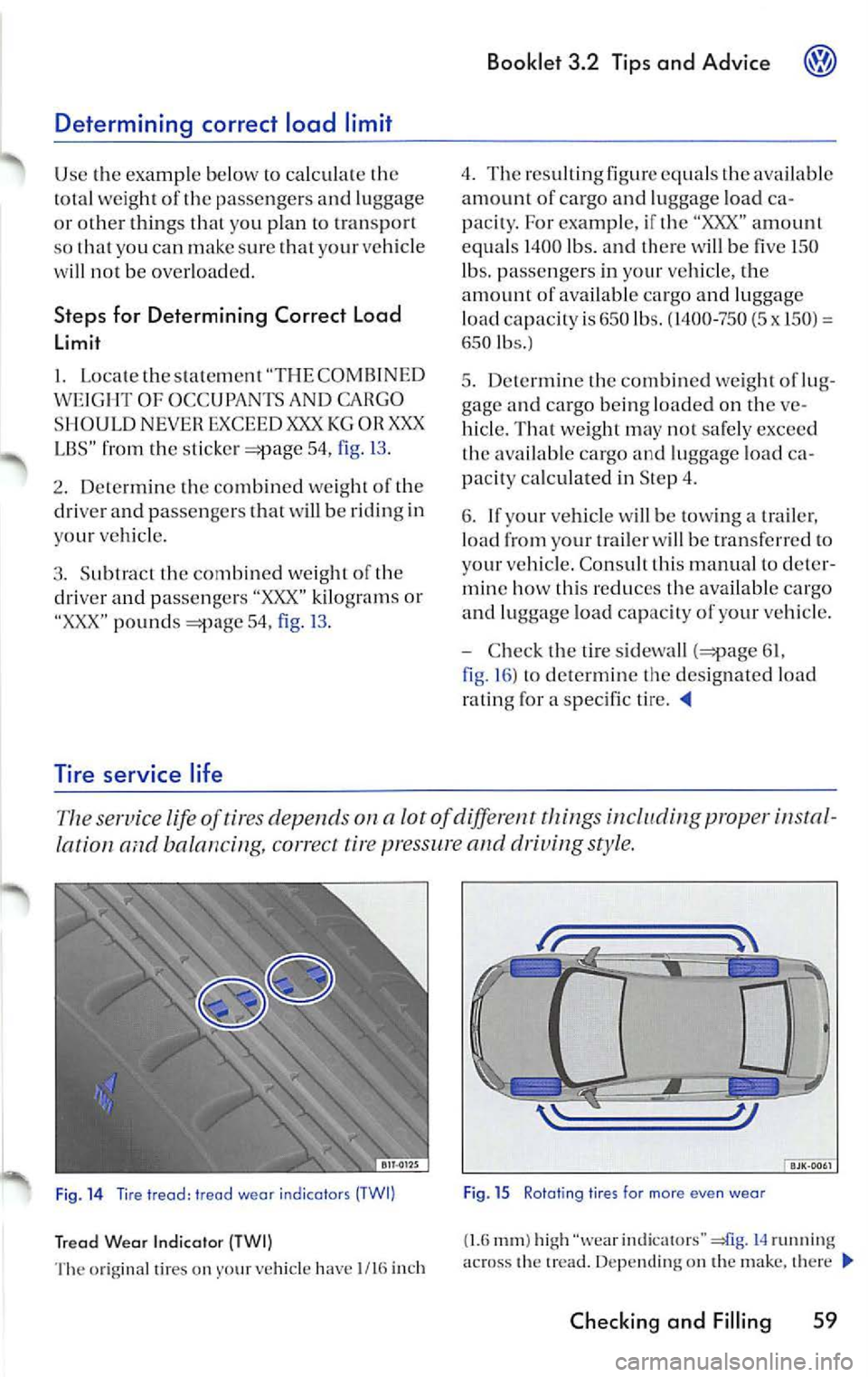
se rvice lif e of tires depend s on a lot of diffe rent inc/11di11g proper instal
balanc ing, correc t tir e pressu re and driv ing style .
Fig. 14 Tire tread: tr ead wear ind icators (TW I)
Tread Wear Indicator {TWI)
Th e ori gina l ti re s on yo ur veh icle have I /16 in ch
Fi g. 15 Rotating t ires for more even we ar
(1. 6 mm ) hi gh indi cator s" 14 runn in g
a cro ss the Depending on th e m ak e, th ere
Checking and Filling 59
Page 388 of 477
Booklet 3.2 Tips and Advice
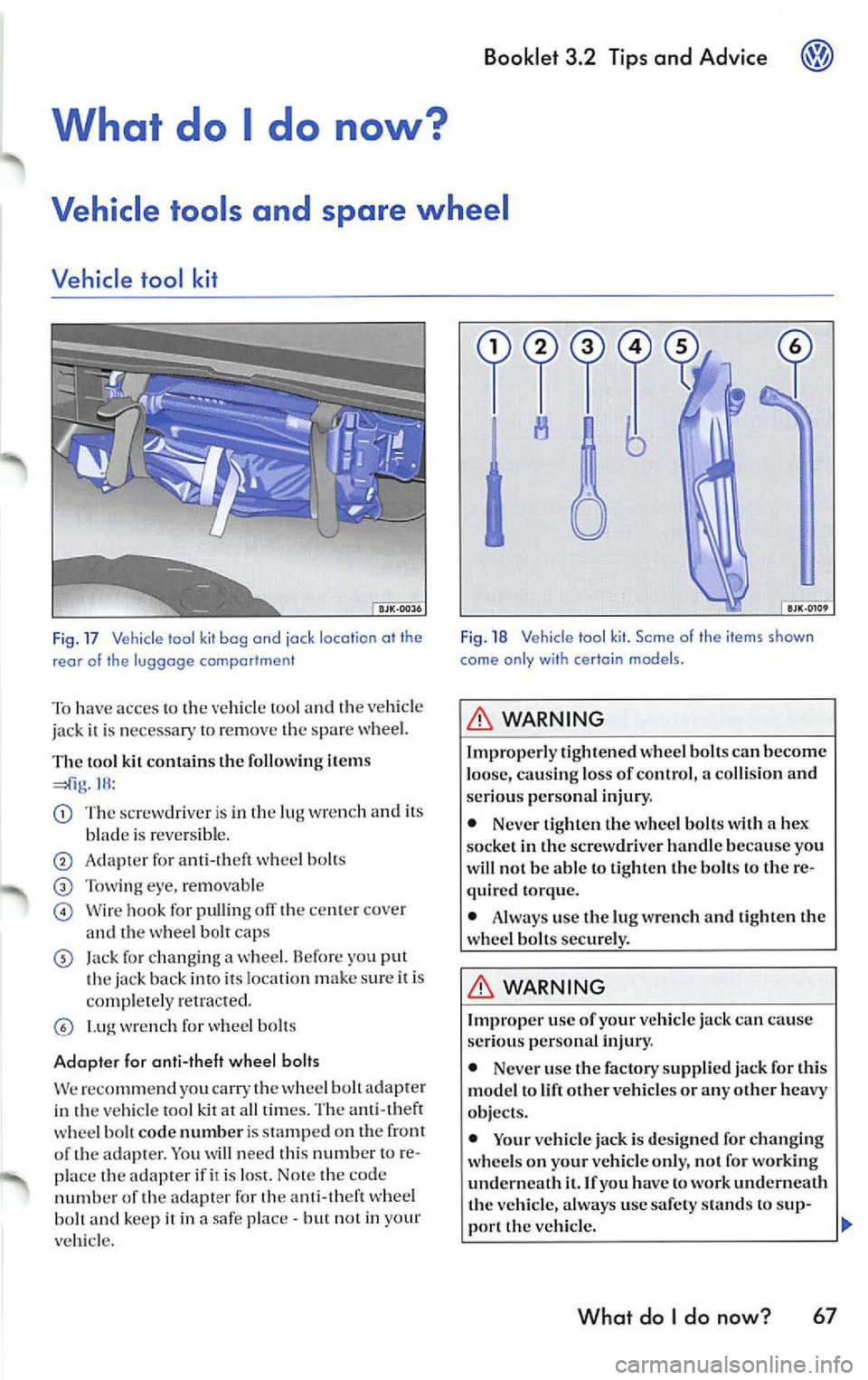
tool and th e vehicl e
jack
con tains th e follow ing items 18 :
Th e sc rew driv er is in th e lu g w re nch and its
b lad e is re ve rs ib le .
A dap ter for ant i-th eft wh eel bo lts
Tow ing eye, re movab le
W ire hook for pulling off the ce nte r co ve r
a nd th e w he el b olt cap s
Jack f or changing a wheel. B efor e yo u put
th e jack back in to i ts loca tion make sur e it is
co mp le te ly re tr a cted.
wr en ch for wheel bolts
Ad opter for anti-th eft w hee l baits
We reco mmend yo u carry t he wh eel bolt adap te r
in th e ve hicle tool kit at all times. The a nti-theft
w hee l bo lt code numbe r is sta mp ed on th e front
of th e ada pter. Yo u will need this numb er to re
p lace t he ada pter if it is lo st. No te th e c ode
numb er o f th e adapt er fo r th e an ti- th ef t whee l
b olt and kee p it in a safe pla ce
but not in your
veh icle.
Fig . 18 Vehicle too l kit. Some of th e it e m s sh own
come o nly w it h certa in models .
WARNING
Improper ly t ighte ned whee l bo lts can become
l oose, ca usi ng loss of contro l, a co llisio n an d
ser ious perso nal i nju ry.
• Neve r tig h te n th e w hee l bo lts wit h a hex
socke t in th e sc rew driver h and le because yo u
w ill n ot be ab le to tig hte n th e bo lts to t he re
qu ired torque.
• Always use t he lug wrench and tig ht en th e
wh eel bolts secure ly.
WARNING
Imp roper use of your ve hicle jack can ca use
ser io u s pe rso nal in jury .
• Never use the fac tory sup plied jac k for t his
mod el to lift othe r ve hicles o r any other heavy
ob jec ts.
• Your vehicle jac k i s des igned for ch ang in g
w hee ls on your vehicle on ly, not fo r working
un dernea th
it. If you have to wo rk un derneat h
t h e ve hicle , a lways use safe ty s ta nds to s up-
p or t th e veh icle.
What do I do now ? 67