brakes VOLKSWAGEN JETTA 2010 User Guide
[x] Cancel search | Manufacturer: VOLKSWAGEN, Model Year: 2010, Model line: JETTA, Model: VOLKSWAGEN JETTA 2010Pages: 477, PDF Size: 77.6 MB
Page 377 of 477
Booklet 3.2 Tips and Advice
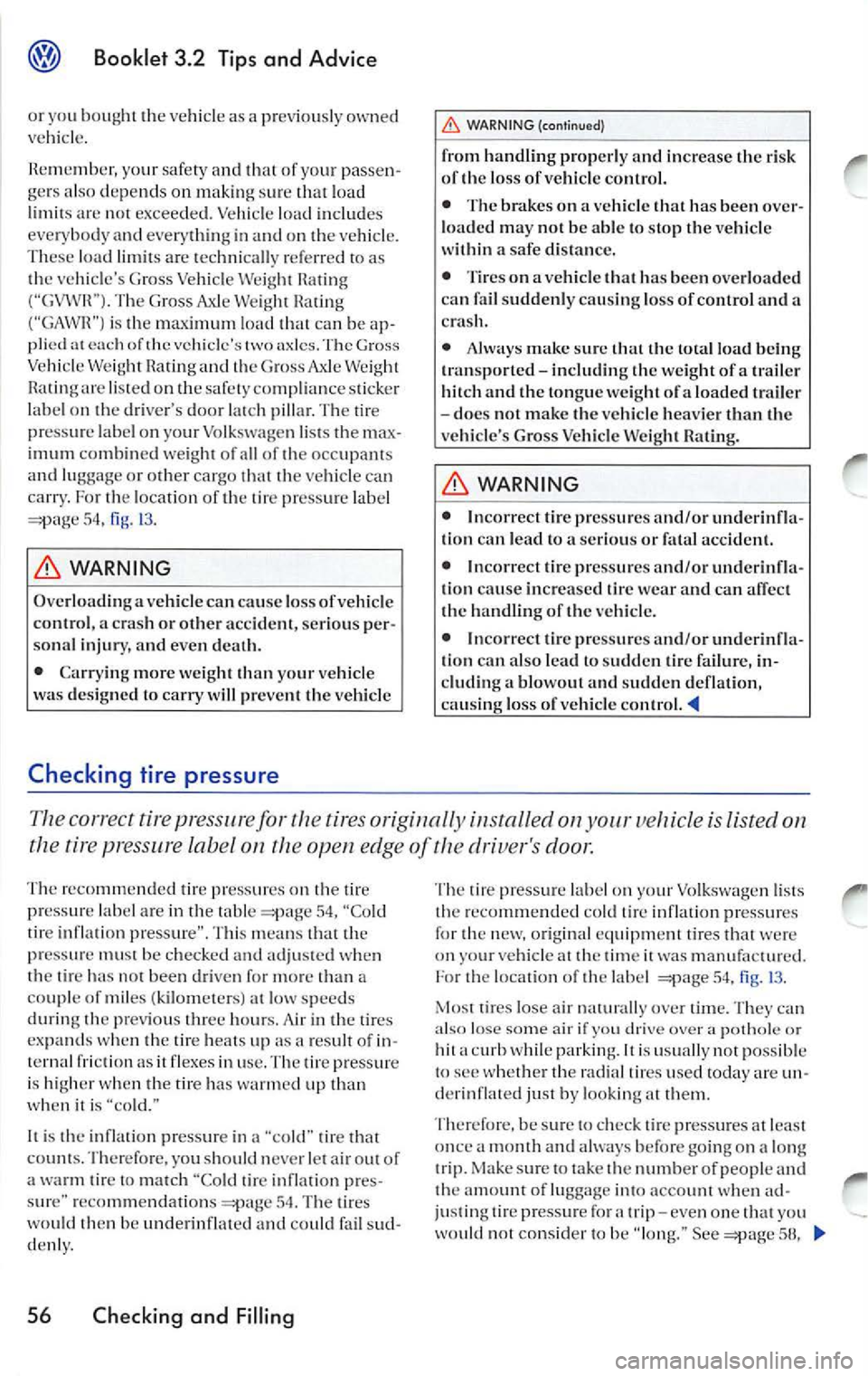
or you bought the vehicle as prev iously owned
vehicle.
R emember, yo ur safety and that of your passen
ge rs also depends on making sure that load
limit s ar c not exceeded. Ve hicle load includ es
every body and every thing in and on the vehicl e.
These lo ad limit s are t echni cally r efer re d to as
th e ve hicle's Gross Vehicle Weight H ating
The Gross Axle We ight Hating is th e maximum load that can be ap
plied each of the vehicle' s two axl es. The Gross
V ehicl e Rating and the Gross Axle Weight
Ratin g ar c listed on the safety compliance stick er
lab el o n the driver's door
pillar. The tire
pre ssure lab el on your Volkswagen lists the max
imum combined w eight of a ll of the occupants
and lug gage or other cargo that the vehicle can
carry . For the location of the tir e pr ess ure lab el
54, 13 .
WARNING
Over loa din g a vehicl e can cause loss of vehicle
control, a cras h or other accident, serious per
so nal injury, and even death.
• Carrying more weight tha n yo ur vehicle
was des ig ned to carry
will pr event the vehicle
Checking tire pressure
WARNING (continued)
from handling properly and increase the risk
o f th e lo ss of vehicl e con trol.
• Th e brakes on a vehicle th at has been over
l oaded may not be able to stop the vehicl e
w ithin a sa fe dis tance.
• Tire s on a ve hicle that has been overloaded
can fail suddenl y caus ing loss of control and a
crash.
• Always make sure that the total load being
tran sport ed - includin g the weig ht of a tra iler
hit ch and the tongue weig ht of a loaded trailer
docs not m ake the vehicle h eavier than the
ve hicle' s Gross Veh icle We ig ht Rating.
WARNING
• Inco rrect tire and/or underinfla
t io n can lead to a se rious or fata l accident.
• Inco rrec t tire pr essures and/or underin fla
t ion cause increased tire wea r an d ca n affect
th e handling of the ve hicle.
• Incorrect tir e pre ssur es an d/o r underi nfla
t ion can also lead to s udden tire failure, in
cluding a blowo ut and sudd en deflation,
ca usi ng loss of ve hicl e
correct pressur e for tires originally i 11stalled on your icle is listed on
the tire pressure label on the open edge of
doo1:
Th e recomme nded tire pr essures on the tire
pr ess ure labe l ar e in the table "Co ld
tire inflation pres sure''. Thi s m ea ns that the
pre ssure mu st b e checked and adjusted when
th e tire
n o t bee n driv en for more than a
co uple of mil es (k ilometer s) at low spee ds
during the pr evious three hours. /\ir in the tire s
e xpands when the tire heat s up a s
res ult of in
ternal fr ic tion as it flexes in use. The tir e pressure
i s hig h er whe n the tire ha s wanned up than
wh en it i s ··co ld."
It is the inflation pre ssure in
tir e that
co unt s. Therefo re , yo u shou ld never le t air out of
tir e to match tir e inflati on pres
s ure·· recomme ndations 54. T he tires
would then be underinfl ated and could fa il sud
d enl y.
56 Checking and Filling
The tir e pressure label on your Volkswag en lists
th e reco mmended cold tire inflation pressure s
fo r th e new, original equipm ent tir es that were
on your vehicl e at the tim e it was manufa ctur ed.
the loca tion of the lab el 54, 13 .
Most tires lose a ir naturall y over time. Th ey can
also lose some air if yo u dri ve over a pothole
hit a curb wh ile parkin g. It i s usually not possib le
to sec whether the radial tires used today ar e un
clcrinflated just hy looking
th em.
T herefo re, be sur e to chec k tire press ures at l eas t
o nce a month and always before going on
long
trip. Make sur e to tak e th e numb er of people and
th e amount of luggage into account when ad
ju stin g tir e pr ess ure for a trip-even o ne that you
not cons ider to be Sec
Page 384 of 477
Maximum Perm issib le Inflatio n Press ure
T his nu mb er is th e g re at est a mount of
pres
s ur e tha t sh oul d ever be put in the tire und er
norma l driv ing cond itio n s.
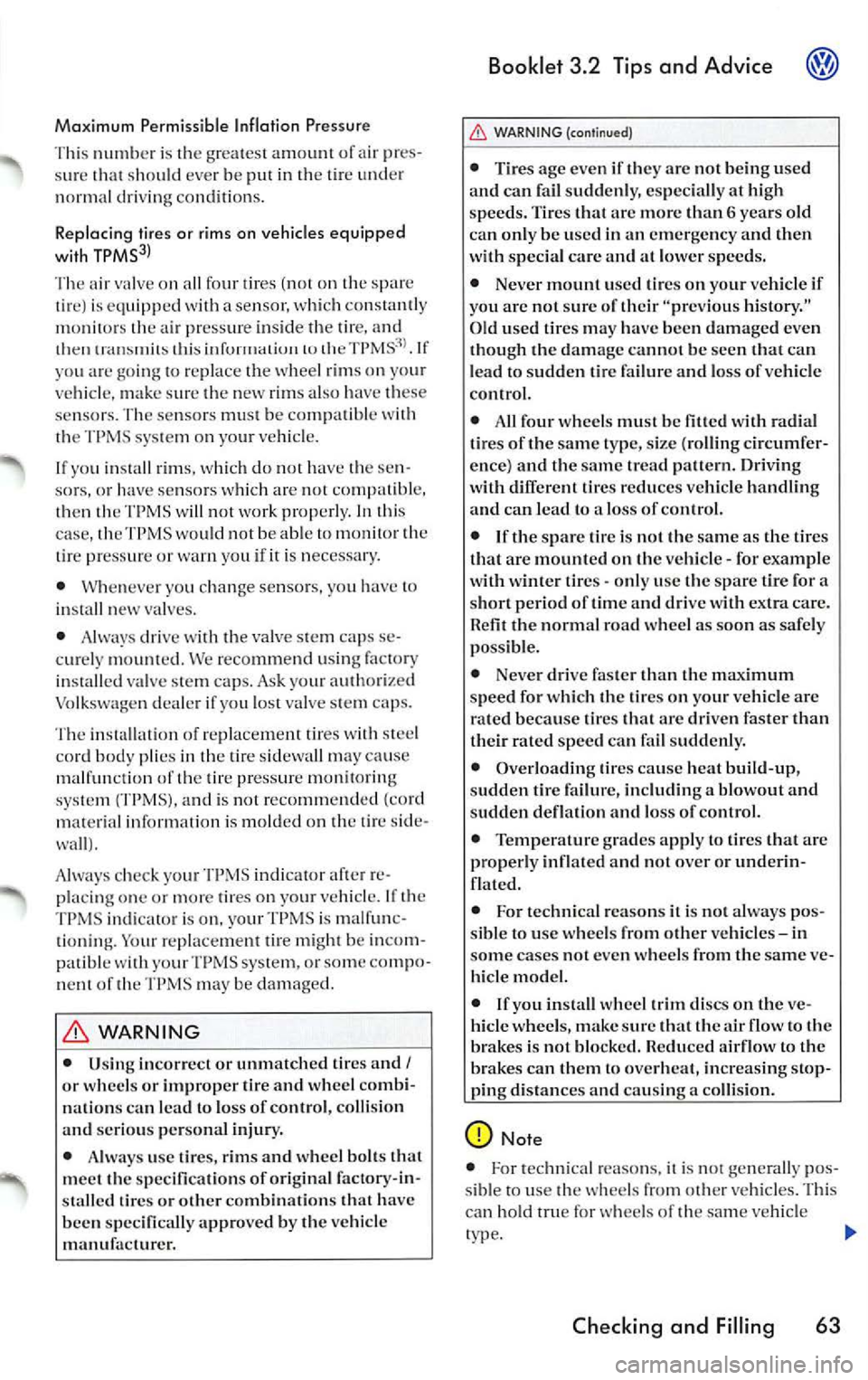
R ep lac in g tires or rims on vehicles equipp ed
wit h
The air va lve o n all four tires (no t on the spare
ti re) is equip ped with a senso r, w hic h co nsta ntly
m on itors
a ir pr ess ure in side the tire, a nd
the n this Lu If
yo u ar e going to re pl ace the wheel rim s o n yo ur
ve hicl e, make sure the rim s also have these
se nso rs. The se nsor s mu st be co mp atib le w ith
TPM S sys tem o n yo ur vehicle .
I f yo u install rim s. w hich do not have th e se n
sors, o r ha ve sensors w hich are not comp ati ble,
th e TP MS will not wor k pro perl y. In case, theTPM S would n ot b e ab le to m oni tor pr ess ure or wa rn you if is necessa ry.
• Wheneve r you c hange se nso rs, yo u ha ve to
i n sta ll
valves.
•
dri ve the valve ste m cap s se
c ur ely m ou nted. We reco mmen d usi ng fac to ry
i n sta lle d va lve stem caps. As k your auth ori zed
Volkswage n dea le r if yo u los t va lve
caps.
T he in sta llat io n of re pla ceme111 tires
c ord hody plies in the tire si dewa ll m ay ca use
ma lfu nction tir e pre ssure monitorin g
sys te m (TPM S), and i s not recommended (cord
mat eri al informatio n is m olded on
ti re s ide
wa ll).
ch ec k yo ur TPM S indi cator af te r r eone or more tires o n yo ur vehicl e. If t he
TP MS indi cator is on. your TPMS is m alfu nc
ti o nin g. Your
tire m ig ht be incom
patibl e yourTP MS system, or some co mp o
n en t of the TP MS may be dam aged .
WARNING
• Usin g in cor rect or unmatched tires and
I or wheels or improper tire and whee l co mbi
nation s can le ad to loss of con tro l, co llisio n
and serio us perso nal injury.
• Always use tires, rims and whee l bo lts th at
me et th e specification s of ori ginal fa ctory- in
s talled tire s or other combination s th at h av e
b een sp eci fica lly app roved by the vehicle
manufa ctur er.
Booklet 3.2 Tips and Advice
WARN ING (continued)
• Tire s age even if they arc not being use d
and can fail su ddenl y, es peci ally at high
s peeds. Tire s th at are more than 6 yea rs old
can only be use d in an em ergenc y and then
w ith specia l care and at lower speeds.
• Never mount use d tir es on your vehicle if
yo u are not sur e o f th eir "previou s hi story."
Old used tir es ma y ha ve bee n damag ed even
th ou gh th e dam age ca nnot be seen that ca n
l ead to sudd en tir e fa ilur e and lo ss of vehicl e
control.
• All four whe els must be fitted with radi al
tir es of the s am e type, size (ro lling cir cumf er
ence) and th e sa me tread p attern. Dri ving
w ith diff erent tire s reduces ve hicle han dling
a nd can l ead to a loss of control.
• If the spare tire is not th e same a s th e tir es
that are mount ed on the vehicle - for examp le
with winter tir es - only u se the sp are tir e for a
s h ort period of tim e and drive w ith extra care.
Refi t th e no rma l road w hee l as soo n as safe ly
possib le.
• Neve r dri ve
than th e spe ed for wh ic h th e tires on you r ve hicle are
rat ed because tires that arc driven fas te r than
their rated sp eed ca n
sudd enly .
• Overloadin g tir es cause h eat build -up ,
s ud den tire failur e, includin g a blowout and
sudden defl ation and loss of co ntrol.
• Temperat ure grades apply lo tir es that are
properl y inflat ed and not over o r underin
flated .
• For tec hni cal reaso ns it i s not always pos
s ibl e to use whee ls from oth er ve hicles-in
s om e cases not eve n whee ls from the sa me ve
hicle model.
• If you insta ll w hee l trim d iscs on th e ve
hicle whee ls, make sur e that th e air flow to the
brakes is not blo ck ed. R edu ced airflo w to the
brakes can th em to ove rheat , in cre asin g sto p
ping distances and causin g a colli sion .
Checking and Filling 63
Page 393 of 477
Booklet 3 .2 Tips and Advic e
Raising the vehicle
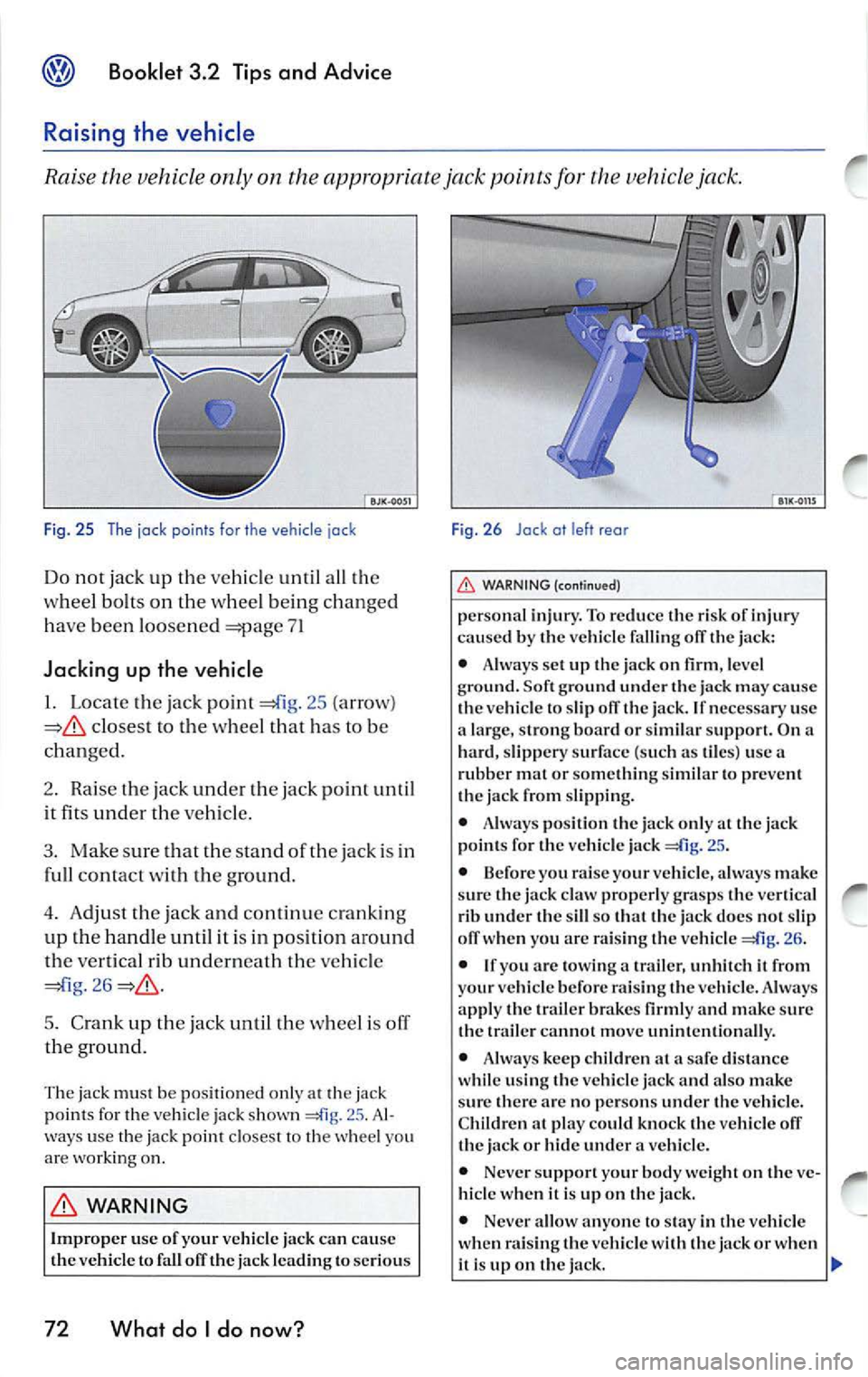
Raise the vehicle only on the appropriate jack points for vehicle jack.
Fig. 25 The jock points fo r the vehicle jock
Do not jack up th e vehicle until all the
w heel bolt s on t he w he el be ing changed
ha ve been loo sened
71
Jacking up the vehicle
1. Locate the jack point 25 (arrow )
closest to the whee l that has to b e
c h anged.
2 . Ra ise the jack u nder the jack point until
it fits under the ve hicle.
3. Make sur e th at the stand of the jack is in
full contact with th e gro und.
4. A djust th e jack and cont inue cranking
up the handle until i t is in position around
th e vertica l rib und ern eat h the vehicle
5. Cra nk up the jack until the whee l is off
th e gro und.
T he jack must be po sitioned only at th e jack
po ints fo r th e ve hicle jack sh ow n 25 . A l
ways use the jack p oin t closest to the wheel you
are wo rking on.
WARNING
Improp er use of yo ur vehicle jack ca n ca use
th e ve hicle to fa ll th e jack lea ding to se riou s
72 What do I do now?
Fig . 2 6 Jock ot le ft reor
WARNING (continued)
p erso nal inju ry. To r edu ce the risk of in jur y
caused by the ve hicle fa lling off the jac k:
• Always set up the jack o n firm , leve l
grou nd. Soft ground under the jac k m ay cause
th e ve hicle to s lip
the jack. If nece ssary use
a large , stron g board or sim ilar su pport. On a
h ard , slipp ery su rface (such as tile s) use a
ru bber mat or something simil ar to pre vent
th e jack from slippi ng.
• Always position the jack on ly at the jack
p oin ts for t he ve hicle jack
25 .
• Before you
your vehicl e, always make
s ur e th e jack claw properl y grasps the ver tica l
rib und er th e s ill so that the jack docs no t slip
ofTw hen yo u are ra is in g th e ve hicl e
26 .
• If yo u are tow ing a tra iler, unhit ch it from
yo ur vehicle before ra is ing the veh icle. Always
appl y the tra iler brakes firml y and make s ure
th e tra iler ca nn ot mo ve unint enti ona lly.
• Alw ays keep children at a safe di stanc e
wh ile usin g th e veh icle jac k an d also make
s ure there are no per sons under the ve hicl e.
Children at p lay cou ld knock the ve hicle off
the jack or hide un der a veh icle.
• Never supp ort yo ur body we ig ht on the ve
hi cle w hen it is up on t he jac k.
• Never allow a nyone to sta y in the veh icle
whe n raising the ve hicle
the jac k or when
it is up on th e jack.
Page 431 of 477
Booklet 3.3 Technical Data
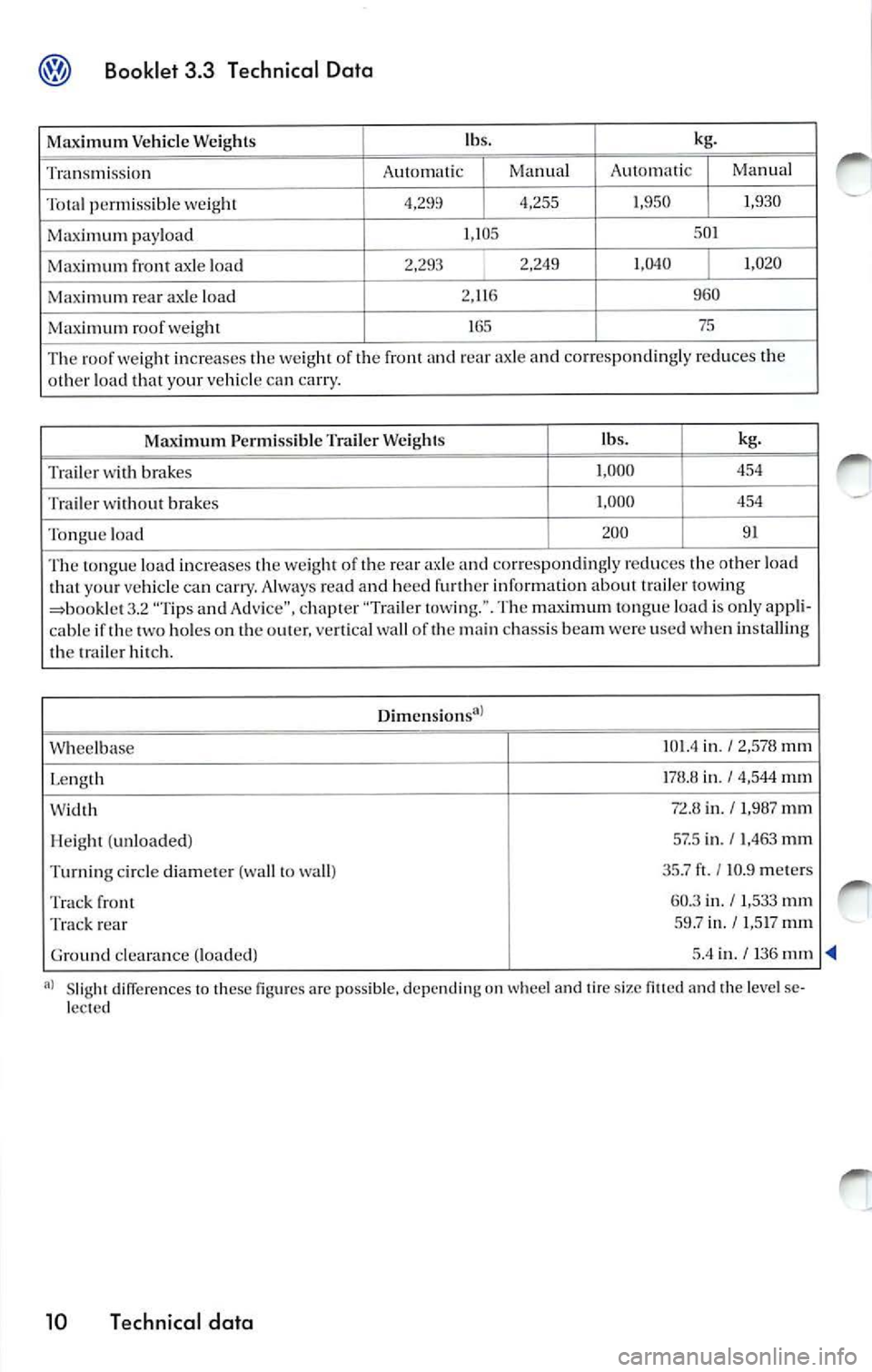
Maximum Vehicl e Weight s lb
s. kg.
Tra nsm iss ion A
utomatic
I Ma nua l A
utom atic I Manua l
Tota l p ermi ssibl e weig ht
I 4,255 1
,950 I 1 ,930
Maxim um payload 1,105
50
1
Maximum front axle load 2,293
2,249
1,040
I 1,020
Maxi mum re a r ax le load 2,
116 960
Maximum roof weight 1
65 75
Th e roof weig ht in creases the we igh t of t he front and
axle and correspo ndingly red uces th e
ot her th at yo ur veh icle can car ry.
Maxim um Permissible Trailer Weig hts lb
s. kg.
Trailer with brakes 1,0
00 454
Tra iler w itho ut brakes 1.
000 454
Tongu e load 200
91
Th e tong ue load increa ses the we ight of th e rear axle and correspon dingly reduces the ot her load
th at yo ur vehicl e can carry. Always rea d and heed fu rther information about trailer towing
3.2 " Tips and Adv ice", chapter "Trai le r tow ing.". The maxi mum tongue loa d is o nly app li-
cab le if th e two holes o n th e out er, ve rtical wall of the mai n ch assis beam were use d when in sta lling
th e tra iler hi tc h.
W hee lbase 1
0 1.4 in ./ 2,578111111
Le ngt h 1
78 .8 in .
I 4,544 mm
W idth
in . / !,9 87 mm
H eig ht (unloaded ) 57.5
in.
I 1.463 mm
T urni ng ci rcle diame te r (wall to wall ) 35.7 ft.
I 10.9 me
te rs
Tra ck front 60.3
in./ I,533111111
Track re ar 59.7
in.
I 1,517 111111
Grou nd clearance (loaded) 5.4
in.
I 136 111111
Slight diff erences th ese arc possible , depending on whee l and tire size and the leve l se
lect ed
10 Technical data