brakes VOLKSWAGEN JETTA 2010 Owners Manual
[x] Cancel search | Manufacturer: VOLKSWAGEN, Model Year: 2010, Model line: JETTA, Model: VOLKSWAGEN JETTA 2010Pages: 477, PDF Size: 77.6 MB
Page 6 of 477
Automatic belt retractor 2.1: 19
Automatic car washes 3.2: 17
Automatic mode Climatronic 3 .1: 85
A utomatic switch-off of electrica l compo
nents 3.1: 93
A utoma tic transm iss ion
D irec t shif t gearbox 3.1: 98
Safety interlock for ignition key 3.1 : 94
Se lector lever lock 3.1: 99
Tiptro nic 3.1: 98
Automatic transmission with Tiptronic 3.1:
IOI
Average fuel consum ption 3.1: 9
Average speed 3.1: 9
B
Background lighting 3.1: 521
BAS3.2: 2
Batt ery
Charging 3.2: 50
How often should
I replace my engine
battery? 3.2: 50
I m portant information to kn ow before
disconnect the batt ery 3.2: 49
Repla cin g 3.2: 50
What you must do afte r r eco nnect the bat
tery 3.2: 49
Winter condi tions 3.2: 49, 50
Battery acid level
C hec kin g 3.2: 50
Before d riv in g 2.1: 3
Belt pretensioner
Disposa l 2. 1: 26
Serv ice 2.1: 26
Bonnet 3.2: 36
Booster seats 2.1 : 59
Brake assis t sys tem 3.2: 2
Brake booster 3.2: 2
Brak e flu id
C hangin g 3.2: 48
How of ten s hould the brak e fluid be
changed? 3.2: 47
Warning light 3.1: 11
What is the correc t brake fluid level?. 3.2:
47
What kind of brake fluid should
I u se? 3 .2:
48
Booklet 0.1 General Index ®
Brake pad
Warning message 3.1 :
ll
Brak e pad wear indicator
Warn ing light 3.1: 26
Brak e pads 3.2: 8
Brak e servo 3.2: 8
Brak e system
Warn ing light 3.1: 28
Brake system 3.2: 47
Brakes 3.2: 8
H ow does moisture or road salt aff ec t the
brakes? 3.2: 8
What does it mea n when I fee l a s ligh t vi
bration o n the brake peda l? 3.2: 3
Braking distance 3.2: 8
Br eak-in peri od
Engine 3.2: 7
W hat is the rig h t way to break- in my vehi
cle? 3.2:
7
Breaking in
Brake pads 3.2: 7
Tire s 3.2: 7
Breaking in tires 3.2: 7
Bulb c hange 3.2: 8 1
Bulb defective Warning light 3.1: 24
Bumper Clean ing 3.2: 18
Bumper cover Caut ion w hen parking n ear a parking bar
rier or curb 3.1: 105
B uzzer 3.1: 50, 93
C
Ca libratin g the co mpa ss 3.1 : 18
California Propos ition 65 Wa rning 3.2 : 34 , 49
Car washes 3.2: 17
Cata ly tic converter 3.2:
10
CB radio 3 .2: 29
Ce ll phone 3.2 : 29
Cellu lar phone 3.2: 29
Ce ntral lo cking
I ndiv idua l un locking 3.1 : 34
Ce ntral locking button 3.1: 34
Ce ntral locking syste m 3.1: 34
C han gi ng a bu lb 3.2: 8 1
C hanging a wheel 3.2: 73
Alphabetical inde x 3
Page 230 of 477
Booklet 3.1 Controls and Equipment
Anti-lock brake system
The warning light monitors th e ABS and the integrated electronic differential lock
(EDL).
The warn ing light or sh ould li ght up for a
few seco nds whe n th e ign ition is swi tc h ed on .
T he lig ht goes out again after the sys te m has run
th roug h an auto matic test sequ en ce.
Ther e is a fault in the ABS if:
• The wa rning light ABS d oes not lig ht up
whe n th e igniti on is swi tc h ed on.
• The warn ing li ght does not t urn off agai n
af te r a few seconds.
• The warn ing lig ht light s up when the ve hicle
i s moving .
The vehicle ca n st ill b e braked in the normal
(exce pt that the ABS is not ac tive). Con tact an
author ized Vo lkswagen dealer or a qualified
wo rksh op as soo n as possib le. Fu rth er infor ma
ti on on ABS =book let 3.2 'Tips and Advice",
c hapt er ··smart tec hnolog y."
)fa fault occu rs in the ABS . th e ES P/ASH warning
lig ht w ill also light up.
Fault in the main brake system
I f the ABS warn ing lig ht A BS lights up together
w ith the bra ke warning light ABS, thi s ind icates
n ot o nly a fault in the
func tion, but a lso a
possible fault in the brake
The fo llow ing text is disp layed on th e in stru
ment cluster: Brake fault Own er' s
El ectronic differential lock (EDL) fault
Th e ED L wor ks in con junct ion w ith th e ABS. A
ma lfun cti o n in th e ED L is indi cate d by the ABS
wa rnin g lig ht ABS. Conta ct a n authorized Vo lk
swage n dealer or a qualified works hop as soon
as poss ible. Fur ther info rma tion on EDL
3.2 "Tips a nd Adv ice", ch apter "S m art
t ec hnolo gy."
WARNING
S top! Befo re working in the e ngin e compart
m ent, alwa ys read and hee d all WARN INGS
3 .2 "Tip s and Advice", c hapter
"Wo rking in the e ngin e co mpa rtm ent." The
eng ine co mpartment of any motor vehicle i s a
p ote ntia lly dange rou s ar ea and can ca use se
riou s persona l injury.
WARNING
Dri ving wit h bad brakes can cause a co llisio n
and serio us per sonal injury.
• If th e brake wa rning symbol BRAKE or(D)
d ocs no t g o out , o r if it li ght s up when driving
t h e brak e fluid le vel in the reservo ir is to o lo w
o r the re is a fau lt in the brake system . Imm edi
at ely s top dri vin g and get profess iona l help
= bookl et 3.2 " Tips and Advice", c hapt er
"B rake fluid. "
• If the brake warning sy mbol BRAKE or
lig ht s up a t th e sa me time as the ABS warning
li g ht ABS or , the ABS may not be workin g
prop erly and the rea r w hee ls co uld lo ck up
first under hard brak ing. Hear wheel bra ke
lo ck- up can ca use loss of vehicle control. I f
yo u b elieve that it is sa fe to do so , go immedi
a tel y
low s pee d to the nearest au thorized
Volk swagen dea ler or qu alifi ed wo rksh op and
h ave the
sy stem ins pec ted . Dri ve slow ly
and avoid sudd en, hard brake application.
• If th e AB S warning light ABS docs not go
o ut , o r if il comes o n while dri vin g, the A BS
syste m is not work ing pro perly. The vehicl e
ca n then be s topp ed onl y with the standard
brake s (with out ABS). You will not have the
protection AB S pro vid es. Contact your autho
ri ze d Vo lk swa gen deal er or
work
s h op a s soo n as possib le.
Instrument panel 27
Page 307 of 477
@ Booklet 3.1 Controls and Equipment
Parking brake
Applying the parking brake
pa rking brake can b e use d to prevent the uehicle from moving
ally .
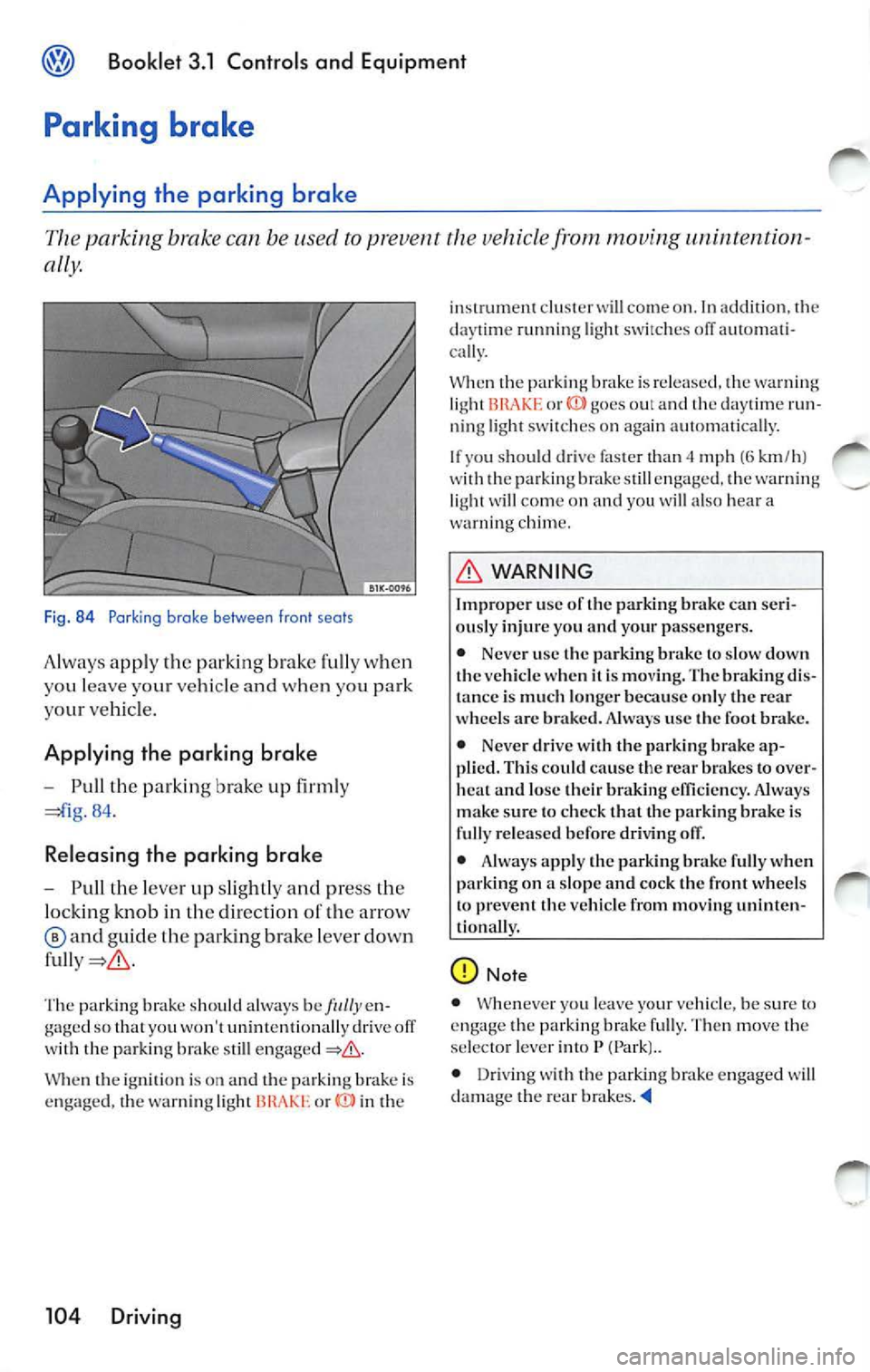
Fig . 84 Parking brake between front seats
Always app ly th e par kin g brak e fu lly w hen
you le ave your ve hicle w hen yo u pa rk
yo ur ve hicle.
Applying the parking brake
- Pull the parking brak e up firm ly
84 .
Rele a sing th e parking bra ke
-Pull the leve r up slig htly and pre ss the
lo cki ng kn ob in the dir ec tion of the arrow
a nd guide th e park ing brak e leve r down
T he park ing bra ke sh ou ld always be /111/ yen
gage d so that you won' t u ni nt enti ona lly dr ive off
wit h th e pa rk in g brake sti ll
W hen th e ignition is on t h e parking brake is
e n gaged, th e wa rnin g ligh t or in th e
104 Driving
instrum ent clust er w ill co me o n. In addit ion. the
daytime running light swi tch es olT a utomati
ca lly.
When the park ing brake is re leased, th e wa rning
li g h t
or goes o ut and the da ytim e run
ning ligh t sw itch es on again automatica lly.
If yo u shou ld dr ive faste r than 4 mph (6 k m/h )
w ith th e parkin g brak e still engaged, th e wa rning
lig ht will co me on
you w ill also hea r a
wa rnin g chim e.
WARNING
Imprope r use of the parki ng brak e ca n se ri
ou sly in jur e yo u and yo ur passe ngers.
• Never use th e parki ng brake to slow down
t h e veh icle when it is mov ing. T he braking dis
tanc e is mu ch l on ge r because on ly th e rea r
whee ls arc brak ed . A lways use the foo t brak e.
• Neve r drive with th e parki ng bra ke ap
pl ied. This cou ld cause t he rear brakes to o ver
h eat and l ose their b raking e fficie ncy . A lways
m ake sure to ch eck th at the parki ng bra ke is
f ull y re lea sed befo re dri ving olT.
• Alwa ys app ly th e par king brake f ully w hen
p arki ng o n a s lope and coc k the fron t w hee ls
to prevent t he ve hicle fro m movin g unin ten
ti onall y.
N ote
• Wheneve r yo u lea ve you r ve hicle, be sur e to
e ngage th e park in g b rake full y. Th en m ove the
lever int o P (Park ) ..
• Drivi ng wi th the parking brak e engaged will
damage the rear
Page 322 of 477
Table of contents
Smart technology ........... ... .. .. .
Brakes .............. .. .. ..... .. .. .• .....
Po we r stee ring ....... .. ..... ... .. ...... .
Notice about data recorded b y vehicle
contro l modu les ....... ........ .... ..... .
Driving and protecting the
environment ..... ... .... ..... ...... ..
Break-in Pe riod ... ... ........ ......... . ..
Catalytic converter ....... .. .. .. ....... ..
T ra ile r t owi ng . . . . . . . . ... ............ .. .
D riv ing economically o nd respecti ng the
environmen t ... .... ..... ............. ... .
Cleaning and protection ........ . .
General notes .... .... ... ....... .. ...... .
Car e of veh icle exte rior ....... ..• ...... ..
C ore of the vehicle interior ... ..... ..•. ..
Accessories, new parts, repairs
and modifications .......... ...... ..
Accesso ries and pa rts .......... .... .... .
R epa irs and technica l modifications ..... .
Cellu lar phones a nd CB radi os ........ . .
2
2
6
6
7
7
10
10
14
16
16
17
23
27
27
28
29
Booklet 3 .2 Tip s and Advice
Checking and Filling 30
Fill ing the tank . . . . . . . . . .. .. . . .. . . .. . • . . . . 30
Fu el supp ly . .. . . .. . . . . . . . . . . . . . . . . . . . . . . . 32
Working in the eng ine compa rtment . . . . . 34
Engine oil . . . . . . . . . . .. . . .. .. . . . .. .. . . .. . . 37
Coo lant ....... .... .... ...... ... ......... 43
Wos he r fluid and wind shie ld wiper blade s 45
Brok e fluid . . . . . . .. . .. . . . . . . . . . . . .. . . . . . . 47
Vehicle battery . . . . . . . . . .. . .. .. .. . .. . . .. . 49
T ir es and wheels . . . . . . . . . . . . • . . . . . . . . . . . . 51
What do I do now? . .. .. . . .. . . . . .. . 67
Vehicle tools and spore whee l . . . . . . • . . . . . 67
Changing a whe el . . . . . . . . . . . . . .. .. • . . . . . 68
Em erg ency closing or opening . . . • . . . . . . . 7 5
F use s . . . . . . . .. .. . .. .. . . . .. . . . . . . .. . . .. . . . 77
Cha nging a light bulb . .. .. . . . .. .. . • .. . . . 81
Jump start ing . . . . . . . . . . . . . . . . • . . . . . . . . . . . 84
To wing .... ... . . .. . .. .... ....... ... . . .•. . 86
Lifting th e ve hicle .. . .. . . . . . . . . . . . . . .. . . . . 89
C onsumer Info rmat ion . . . . . • . . . . . . 90
Alphabetical index . . . . . . . . . 92
Table of contents
Page 323 of 477
Booklet 3.2 Tips and Advic e
Smart technology
Brakes
Brake booster
The brak e boo ste r incr ea ses the brake press ure
yo u put on th e peda l. wo rk s onl y wh en
t h e engi ne is runnin g.
If th e brak e boos te r is not workin g or if th e ve
hicl e has to be towe d, yo u wi ll h ave
to push th e
brak e peda l hard er to ma ke up for th e lack of
boo ste r ass is t.
WARNING
B rak ing w ithou t t he brake boos ter needs a
mu ch l onge r bra king distance and r equir es
Brake Assist Sys tem (BAS)
In a n emerg ency, mos t d river s brake in t im e, not w ith m aximum force. This res ult s in stop
ping dis tan ces th at are lo ng er th an they have to
b e!
T he brake a ssis t sys te m h elp s: if yo u pr ess th e
brak e pedal very quickly, t he brak e ass is t sy stem
r eg is te rs an em erge ncy situatio n. It th en very
qui ckly build s up th e full brake press ure so th at
t h e A BS can be activate d more qui ckl y and
cie nt ly, r educin g th e braking di sta nce and le t
tin g you steer at the sa me tim e.
D o not reduce th e pr ess ure o n th e brak e ped al.
T he brak e ass is t sys te m sw itches o ff aut omati
ca lly as soon as you re lease th e brake. The brak e
a ss ist sys te m works onl y wh en th e en gin e is
n ing.
If th e brak e sys te m i s not fun ction in g pro perl y, a
wa rnin g lig ht will com e on =bookl et 3.1 "Co n
t rol s and Equipm ent ."
WARNING
Always ad just you r sp ee d an d driv in g s ty le to
roa d, an d weather cond iti ons. Do not
2 Smart t echnology
WARN ING (con tinued)
yo u to p ush th e bra ke ped a l d ow n ha rder th an
n or mal.
• Never let th e ve hicle coa st w ith th e eng ine
switc hed off.
• If th e brake boos te r is no t ac tive, for
ample if th e ve hicle is bein g towed , yo u w ill
have to p ush th e brake pedal down much
h ar der than n ormal.
WARN ING (continu ed)
let the extra safety afforde d b y th e Brake Ass is t
Syste m temp t yo u int o taking ex tra ri sks.
• Never let t he extra sa fety offered by t he
Brak e Ass is t Sy ste m te mpt you into ta kin g
ex tra risks.
• The B ra ke As sis t Sys te m canno t re d uce t he
r isk o f a n acci den t, fo r examp le if yo u d rive too
fas t for co nditi on s or
if yo u d o not k eep yo ur
di stance fro m th e vehicl e in fr ont of yo u.
• Slippery and
roa ds are dangero us eve n
w ith th e Brake Assis t Sys te m!
WARNING
• Always reme mber th at ve hicle a ltera tio ns
or modificatio ns ca n affec t th e fu nctio n of th e
ABS, BAS , ED L and ES P sys te m s. Exa mpl es of
these alt era tion s or mo dificatio ns includ e a
di fferen t w hee l/tir e co mbin atio n and bra ke or
chassis modifi catio ns
28, and
t echn ic al m odi ficat io ns".
• Chan ging th e ve hicle su spe nsio n or u sing
un approved tir e
I r im combin atio n ca n ch an ge the w ay the A BS, B AS, EDL a nd ESP
Page 324 of 477
WARNING (continued)
systems work and reduce their
effect iveness.
Applies to vehicles: with Driver Steering Recommenda tion
Booklet 3 .2 Tips and Advice
Driver Steering Recommendation helps to the vehicle in certain sit
uations
The Driver Stee ring R ecomm endation i s a com
pl em entar y function of the ESP. This fea ture al
low s th e driv er
stabilize ve hicl e in certain
critical situati ons. Fo r example in certai n road
s ur face conditi ons ii is necessary to brake hard.
The vehicl e will then te nd to brak e awa y to the
r ig ht or t o 1h e lef t. Th e ESP reco gnizes this situ a
tion and supp ort s the drive r to steer to the oppo-
Anti -Lock Brake System {ABS)
sit e dire cti on by in crea sing th e stee rin g
s tr ength.
WARNING
The DSH only supports the driver in cri tical
dri vin g co ndition s. The ve hicl e will not s teer
by itse lf. The dr ive r is res pon sible fo r steering
the vehicle .
The Anti-Lock Brake System prevent s th e wheels from locking when the brakes are
applied.
Th e ABS is an important part of the vehicle 's ac
ti ve safety system. The Anti-Lo ck Brake Syste m
work s onl y when the en gine is run ning.
How the ABS works
If one w he el begi ns tu t urn too s low ly in r elat io n
t o ve hicl e speed an d le n ds to lock up, t he ABS
a utom ati ca ll y
brak e pres sur e lO preve nt
that whee l fr om locking. When ABS is do ing it s
job you will notice a sli ght vibrati on throu gh the
brake pedal and hea r a noise to l et yo u know tha t
yo ur speed must be adjuste d to road, traffic and
wea ther condi tion s. T his is a warn ing 1hat on e or
mor e of the whee ls is about to lock up and that
th e AB S co ntr ol function has inter vened . In thi s
s ituati on
is important to keep the brak e peda l
fully depr essed so the ABS can help to re gul ate
th e brake applica tion. Do not "pump " th e
peda l -ABS can not do its jo b if you do.
A BS helps you 10 kee p th e ve hicl e und er control
be cause i t prev ent s th e w hee ls from locking
w hen th e brak es arc ap plied. Th is m ean s th e ve
hicl e ca n still be s teer ed and is less likely
on
g rav el o r on fresh sno w cover in g a slipp ery sur
If AB S is not functioning properl y, a wa rnin g
li ght will co me on 3.1 "Co n1rol s and
E quipm ent. "
WARNING
Always ad just yo ur dri vin g to the road, traffic
and weather conditio ns. Neve r le t th e ex tra
s afe ty that ABS can provide te mpt you into
taking extra risks.
• Always drive safely .
• ABS canno t ch ange the
of ph ysics.
S lipp ery and wet roads are dangerou s ev en
wi th ABS!
• ABS ca nnot reduce th e risk of accide nts,
f or examp le if yo u drive too
for the co ndi
ti ons or if you do not keep your distance from
th e vehicle in front of you.
Smart technology 3
Page 329 of 477
Booklet 3.2 Tips and Advice
Braking power and braking distance
Braking power and braking distance are influenced by driving situations and
road
Worn brake pads will not provide good braking.
The amount of wear and tear on the brake pads
depends to a great extent on the cond itions
und er which the vehicle is opera ted and the way
the vehicle is dr iven. If you do a lot of city
driv ing, drive short distances or have a sporty
driving style, we reco mm end th at you have the
thickness of your brake pad s checked by an au
thor ized Volkswagen dea ler more frequently
than r ecommend ed in the service schedule.
I f you dr ive witJ1 wet brakes , for example after a
dri ving through water,
heavy rainfall or
after washing the vehicle, brakin g power will be
reduced and sto pping distances w ill be longer
because the brake d iscs will be wet or in winter
ma ybe even frozen
the brakes must be dried
with severa l ca reful brake applications.
Brake fluid absorbs water and must be c hanged
every two years. Heavy use of the brakes can
cause vapor lock if the brake fl uid is too old.
Va por lock reduces braking power, increases
stopp ing distances and can even cause total
brake failure.
WARNING
• New tires and new brake pads do not pro
v id e maximum grip, control or braking abilit y.
• To reduce the risk of losing control, a colli
s ion and se rious persona l injuries, drive with
special ca re for the first
350 mil es (560 km).
• New brake pads do not have the best stop
ping power for the first
150 mil es (240 km) and
must be broken in. You can com pensate for
the slightly reduced braking ability by drivin g
w ith care and applying more pressure on the
brak e pedal.
• Never fo llow other vehicle s too close ly or
put yourse lf into other situ ations that might
r equ ire s udden , hard brakin g especially when
th e brake pads have not been broken in.
WARNING
Wet brake s or brak es coa ted ice or road
sa lt react slower and need longer stopping dis
tanc es.
• Carefully apply brakes for a lest.
• Alwa ys dry brake s and clean olT ice coa t
ings and salt coa tings with a few cautiou s
brake app lica tions.
• Always read and hee d all
in "Break ing in tir es and brake pads" on
page 7.
WARNING
Overheated brakes will reduce the vehicle's
s topping power and increase stoppin g di s
tances.
• Always avoid over hea tin g the brakes!
• When driving downhill, the brakes have to
work hard and hea t up quickly .
• Before driving clown a long, steep hill, al
ways red uce spee d and downshift to a lower
gea r. This will let th e ve hicle use engine
braking and reduce the load on the brakes.
• Always c han ge the brake fluid at least
every two years. Hard braking with old brake
fluid may cause a va por lock. Vapor lock re
duces brakin g power, increases s topping dis
tan ces and can even ca use to tal brake failure.
• A damaged front spoiler or new non stan
dard spoile r ca n reduce the airflo w to the
brake s and cause them to overheat.
• Always sec an au thorized Vo lkswage n
dealer or qualil1ed workshop if yo u think th at
you may have damaged the front spoiler.
• Be sure to read and heed all WARNINGS
and the information =-page 27, "Accessories
and part s" before buying accessorie s.
8 Driving and protecting the environment
Page 332 of 477
manufactur er to make sur e th at yo u are using
t h e co rrec t hit ch
Do not use a bumper hitch.
Th e hit ch mu st be install ed so . that it does no t
int erf ere w ith th e impac t-a bso rbin g bu mpe r
sys tem . Do no t mak e any c han ges to th e ve hicl e
ex hau st and brak e sys te m s. Fro m t im e to tim e,
c h ec k tha t all hit ch -mo unting
rema in se
c ur ely fas tened .
W hen yo u are not t ow in g a tra iler, re m ove the
t ra ile r hi tch ball m oun t. T his pr eve nts th e h itch
fr om causing dam age sh ou ld yo ur vehicl e be
s tru ck fr om b eh ind .
Engin e coo ling syste m
Tow ing a trai ler makes the e ngin e wo rk It is im portant th at th e engin e coo ling syste m is up to th e job . Make su re that th e coo ling sys te m has
e n ough flu id.
Trailer brokes
If yo ur t railer h as its own brakes, ch eck to be th at it confo rms to a ll regula tion s. The tra iler
b ra ke sys te m must n ever be directly co nn ecte d
to th e ve hicle's brake sys tem.
Sa fety chains
Alw ays use safety chain s betwee n yo ur ve hicle
a n d trail er.
Trai ler lights
Tra ile r lig ht s m ust m eet a ll reg ulati ons
Neve r co nnect th e trail er light sys te m di rectly to
t h e lig ht sy ste m of y our vehicl e. 13 e to c hec k
w ith your auth orize d Vol ksw age n d eale r fo r
rec t w irin g, sw itch es a nd relays .
Mirror s
If yo u canno t see the behind you using th e
r eg ula r outside mirror s, th en you mu st i ns tall
exte nded m irror s. It 's
th at yo u alw ays have
cl ea r vis io n to th e re a r.
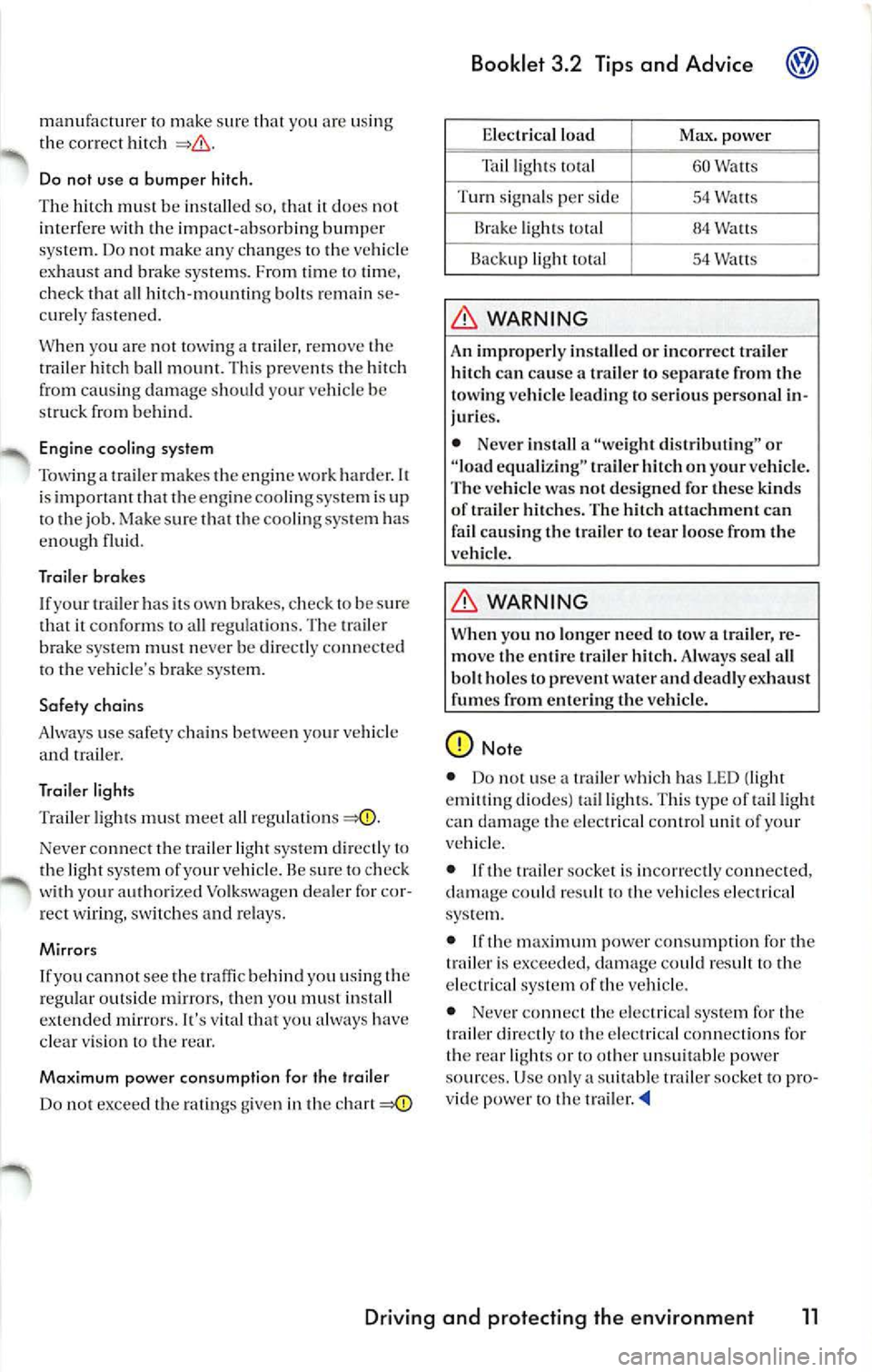
Maximum power consumption for the trailer
Do not excee d the ra tin gs g iven in t he c hart
Booklet 3.2 Tips and Advice ®
Electrical load power
Tail lights to ta l
60 Watt s
T urn sig nals per sid e 54 Wa tts
Br ake light s to ta l 84 Wa tts
Back up ligh t to tal 54 W atts
WARNING
An improperl y in sta lled or in corre ct trailer
hit ch can cau se a tra iler to separate from the
t o win g ve hicle leadin g to ser iou s per son al in
j uri es.
• Never install a "weight distributing" or
" lo ad equa lizin g" trailer hitch on your v ehicle.
T he v ehicle wa s not de signed for these kinds
of trailer hit ch es . Th e hitch attachment ca n
fail ca using the trailer to tear loos e from th e
veh icle.
WARNING
Wh en you no lon ger need to tow a tra iler , re
move the ent ire tra ile r hitc h. Alwa ys s eal a ll
bolt h ole s to pre vent water and dead ly exhaust
fum es from ent ering th e vehicle.
Note
• Do no t use a trailer w hi ch h as LED (lig ht
em ittin g dio des) t ail light s. T hi s ty pe of ta il lig ht
ca n da ma ge t he elec trica l co ntrol un it of yo ur
ve hicl e.
• I f th e tra iler soc ke t i s in co rrec tly co nnecte d ,
d am age could r esult
10 t h e ve hicles elec trica l
sys te m.
• I f th e m ax imum p ower co nsum pti on fo r
trail er is exceede d, dam age c ould r esult to th e
e lec tr ica l sys te m of ve hicl e.
• Neve r co nn ect th e elec trical sys te m fur th e
dir ectly to elec trical co nn ectio ns fo r
th e rea r or to o ther u nsu itab le powe r
so urces . Use only s uit abl e socke t to pro
v id e powe r to th e
Driving an d protecting the environment 11
Page 338 of 477
Care of vehicle exterior
Automatic car washes
If yo u h ave accesso ries on vehicle, check
w ith th e c ar wash operator before washing your
ve hicle. We reco mm end though, t hat you fold
th e o uts id e mirror s to avoi d damage.
Veh icle paint is durab le e nough that the vehicle
ca n norma lly be wa sh ed with out pr obl ems in an
a ut omat ic ca r wash. However, the effec t o n th e
pa int mainly depen ds o n the type of ca r was h,
the brush es use d. the filteri ng of t he was h water,
and the type of detergen ts and wax solut ions
u se d, etc. If the pa int is sc ra tc hed or ap pears dull
af te r go ing th rough th e ca r was h, imm ediat ely
brin g thi s to the attention of the car was h op er
ato r.
Af te r th e ve hicle has bee n was hed, the brak e
dis cs and pad s w ill be
(th ey co uld even be
i cy in the w int er) and stoppin g di sta nces w ill be
Wa shing by hand
- Fi rs t so ften th e dirt with water and rinse
off.
- U sin g a so ft sponge , a was h glo ve or a
was h bru sh, wip e th e ve hicl e in a do wn
ward motion usin g ge ntl e pre ssur e.
- Rin se out th e s pong e or wash glo ve reg
ul arl y.
- Use s pecia l cl ean ers onl y o n h ard to re
mo ve dirt or grim e.
- Use a seco nd spon ge or wash glove
to
w ip e down the whee l rim s and und er th e
doo r sill s.
- Rin se the ve hicle thoro ugh ly w ith
wate r.
- Dry caref ully th e paint ed sur faces w it h
a c ham ois.
Booklet 3.2 Tips and Advice @
long er. B e su re to "dry" the brakes with sever al
ca ref ul brak e applica tions befo re dri ving off
8.
WARNING
W et brak es or bra kes coated with ice or road
sa lt rea ct slower a nd need longer stopping dis
tance s.
• Caref ully app ly brak es for a test.
• Always dry brake s and clean off ice coat
in gs and salt coatings with a few c autious
appli cations .
• Alw ays re ad and heed all WARNINGS
8, powe r and braking
- Wh en it is cold outside, make sur e you
w ip e all rubb er sea ls and their contact sur
fa ces dry so that they do not freeze. Use a
s ili co ne spray to kee p rubb er sea ls pliabl e.
- After washing your vehicl e, avo id
s udd en stops or maneuvers. T he brakes
ha ve to be " dri ed out " firs t by gen tly ap
p ly ing the br akes a few tim es
WARNING
Wet brakes or brak es coated wit h ice or road
sa lt reac t slower and need lon ger stopping dis
tan ces.
• Care fully apply brake s fo r a test.
• Always dry brakes and clean off ice coa t
in gs a nd salt coa ting s with a few cauti ous
brake application s.
• Alw ays read and heed all WARNINGS
8, pow er and braking dis-
t a n ce".
Cleaning and protection 17
Page 339 of 477
Booklet 3.2 Tips and Advice
WARNING
Sharp edg es und er th e ve hicle can cut exposed
s kin.
• Always protect your hands and ar ms from
cuts on sh arp metal edges when cleaning the
und erb ody, the in sid e of the whe el h ousin gs
etc.
Note
• Neve r 10 re mo ve mud or du st if the
ve hicle s urf ace is dr y. U sin g a dry cloth or
s pong e for cleanin g co uld dam age the paint or g
la ss on yo ur vehicle. Soa k
mud or du st
w ith pl en ty of wa ter before re m ov ing it.
• When rin sing th e vehicle, do not le t w at er get
i nt o t he loc k cy lind ers or point the hose
at ga ps
aro und th e doors, hoo d or r ea r li d. The water
cou ld fre eze and make it
to op en th e ve
hicl e.
• To help pr evenl dama ge to th e painl, do not
was h the vehicle in dir ect sunli ght.
o nl y in sp ecia l was h ba ys th at ca n handl e oily
din that is was hed off th e ca r.
Washing the vehicle with a power washer
B e very careful when using a power washer!
- Alwa ys follow the in stru cti ons for t he
p ower washer, parti cularl y tho se about th e
pr ess ure and the spray ing distanc e.
- Increa se the spr ayi ng di sta nc e fo r soft
m ater ia ls and p aint ed bump ers
- Do not use a powe r was her to remo ve
i ce or sn ow from win dows
19.
- Never use concen trat ed je t no zzles or
so-ca lled "d irt b lasters" es peciall y on ti res
- Afte r the veh icle ha s be en wash ed , th e
b rake discs and pad s w ill b e wet (t hey
co uld even be icy in the w inte r) and stop
pin g di sta n ce s w ill be lo nger. Be s ure to
the brak es with seve ral care ful brake
app lica ti ons before dri vin g off
8.
WARNING
W et br ake s or br ake s coa te d with ice or road
sal t reac t slower an d need lo nge r stoppin g di s
t a n ce s.
• Care full y appl y brake s for a tes t.
• Alwa ys dry brakes and clean
ice coat -
in gs and salt coatin gs with a few cauti ous
brake application s.
18 Cleaning and protection
WAR NING (continued )
• Alw ays rea d and heed a ll 8, " Braking power and braking di stance".
WARNING
Improp er u se o f power wash ers can ca use se
riou s, invi sible and perman ent tire dama ge
l ea din g to tir e failur e and lo ss of v ehicl e co n
tr ol.
• Never was h tires w ith a jct that sprays the
wa te r out in a dir ect str ea m eve n at a di stan ce
ev en for a very short am ount of tim e.
Note
• Water sh o uld no t be more th an 14 0' F (60 ' CJ .
• If yo u use powe r wa sh er, b e sur e to ke ep it a
safe fr om the Park As sis t se nsors in th e
f ront and rear bump ers. If yo u ho ld it too clo se to
th e se nsors, you could dama ge th em.
• To pr event pos sibl e dam age
10 yo ur ve hicle,
h old t he po we r w ash er fro m soft mate
rial s, su ch as ru bb er hoses , plas tic e tc .
T his a lso app lies 10 b ump ers . Th e closer
yo u h old th e power wash er to th ese mat erials ,
th e greater is th e force again st them.