Gas VOLKSWAGEN JETTA 2010 Owner's Guide
[x] Cancel search | Manufacturer: VOLKSWAGEN, Model Year: 2010, Model line: JETTA, Model: VOLKSWAGEN JETTA 2010Pages: 477, PDF Size: 77.6 MB
Page 357 of 477
Booklet 3.2 Tips and Advice
WARNING (continued)
- Neve r wo rk near heate rs, wate r heaters
o f o th er open flames.
Always have an approved fire extin
g ui sh er nearb y.
• To avoid e lect rica l sho ck and per sonal in
ju ry
the engi ne is running or being
s tarted:
n ever touch ignition cab les,
- neve r touch oth er com ponen ts of the
hi gh vo ltage e lectronic ig nition sys tem ,
never 1oucl1 the gas discharged (Xenon)
headli ght s w ir in g.
Opening the engine hood
in se riou s malfunctions and engine
damage!
<£> For th e sake of environment
Service fluid leaks are harmful to th e environ
me nt. Regularly ch ec k th e ground underneath
yo ur vehicl e. If yo u find spot s of oil or othe r
fluids. have your veh icle c hec ke d b y you r autho
ri zed Vo lkswage n dealer or a qualified
wo rksh op.
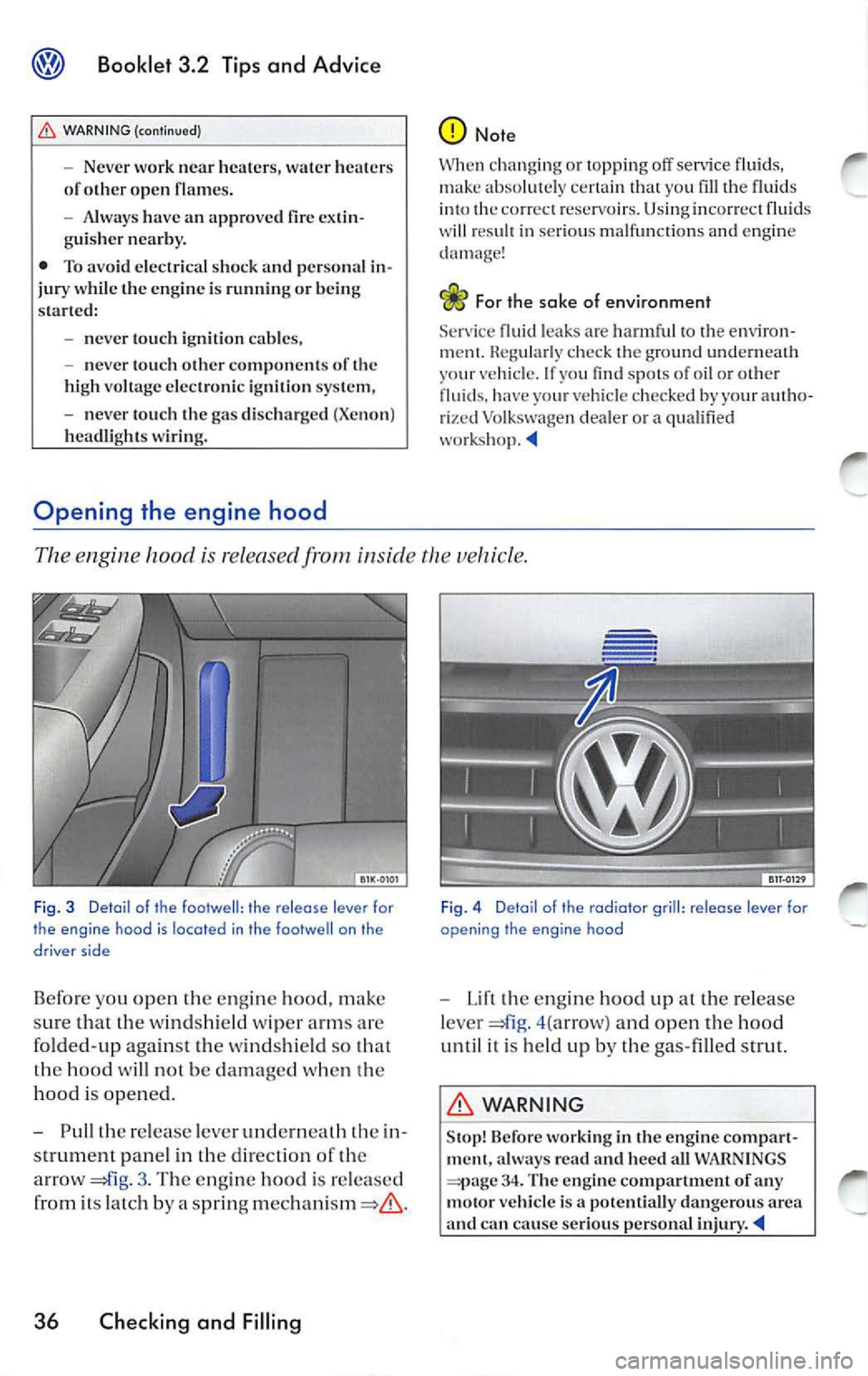
The engine hood is released from inside the
Fig . 3 Deta il of the footwe ll: the re lease lever far
t h e engine hood is loca ted in the loa twell an ihe
dr iver side
Before you open the engine hood, make
s u re that the windshield wiper arm s are
folded-up against the w indshie ld so that
the hood will not be damag ed when the
hood is opened .
Pull the release lev er underneath the in
s trum ent panel in the directio n of the
arrow
3 . The engine hood is rele ased
from its latch by a spring
36 Checking and Filling
Fig. 4 Detail of the radia to r grill : release leve r fa r
opening the engine hood
Lift the engin e hood up at the release
l ever
4 (arrow ) and open the hood
until it is he ld up by the gas-filled strut.
WARN ING
Stop! Before working in the engine compart
ment, a lways read and heed a ll WARN INGS
34. The engine compartm ent of any
motor vehicle is a potentially dangerous area
ca n cause serious p erso nal injury.
Page 370 of 477
Booklet 3.2 Tips and Advice
Vehicl e batt ery
Location of battery
The battery is mai nte nance-free is c h ecked during the inspection serv ice.
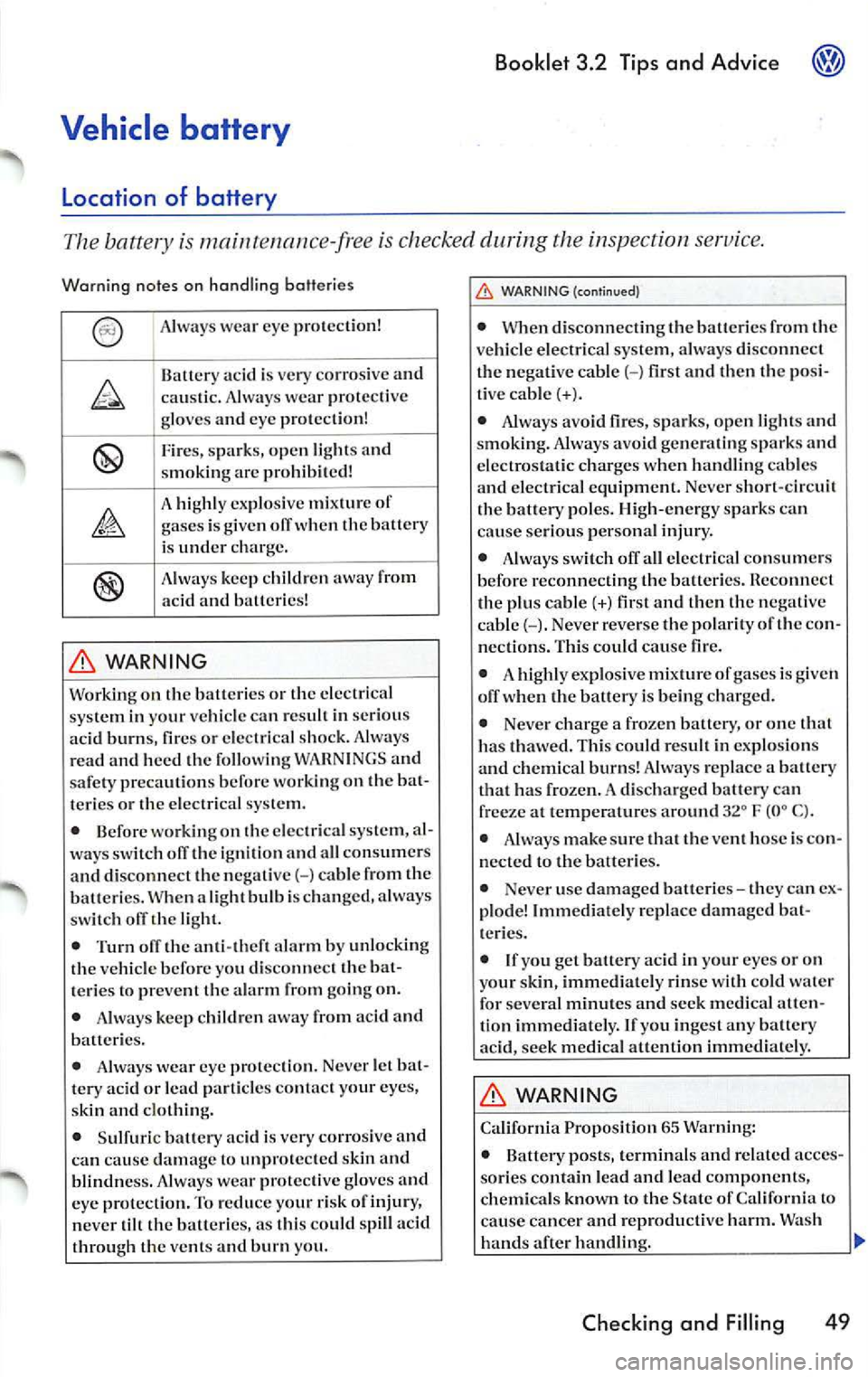
Warning note s on handling batterie s
Battery acid is very co rrosive a nd
ca usti c. Always we ar protective
g loves and eye prot ection !
Fires, s park s, open ligh ts and
s moking arc pro hibit ed!
Always kee p childr en away acid and batt eries!
WARNING
Wo rki ng on the batt eri es or the electr ical
syste m in yo ur vehicl e can result in ser ious
acid burns,
th e
batt eri es . Whe n a light bulb is c han ged, always
sw itch o!Tt he light.
• Turn o!Tt he an ti- th ert alarm by unl ockin g
the vehicl e befor e yo u disco nnect th e bat
terie s to pre vent th e ala rm rrom goin g on.
• Always kee p childr en a way
acid an d
batterie s.
• Alw ays wear eye prot ectio n. Nev er let bat
t ery acid or lead particl es contact your eyes,
and clothin g.
•
batter y acid is ve ry co rrosive and
can cause damag e to unprote cted ski n and
blindn ess. A lways wear protectiv e gloves a nd
eye protec tion. To re du ce yo ur risk o r injur y,
n eve r tilt the batt eri es, as thi s co uld spill acid
throu gh th e ve nts and burn you.
WARN ING
• Wh en disconn ecting the batt eri es from the
ve hicl e elec tr ic al sys tem , a lways disco nnect
the negative cable(- ) fir st a nd th en th e po si
ti ve ca ble(+ ).
• Alwa ys avo id fires, spark s, op en li ght s a nd
s moking. Alw ays avoid generatin g sparks a nd
e lectro static charges whe n handlin g cables
a nd elect rica l equipment. Never short-cir cuit
the battery pole s. Hi gh -energy sparks can
c au se se rious per sonal injury.
• Always swi tc h off all electrica l con sumer s
before recon nectin g the batteries. Heconncct
th e plu s ca ble( +) first and then the negative
cab le(-). Neve rrever se the polarity or the con
ne ctions. This could cause fire.
• A hi ghl y exp losive mixtur e or gases is give n
off when th e batter y is bein g ch arged.
• Never cha rge a frozen batt ery, or one that
ha s th awe d. Thi s could res ult in explos io ns
and chemical burns! A lways re pla ce
batte ry
t h at h as frozen. A discharged battery can
rr eeze a t temperatures around 32° F (0 ° CJ.
• Alwa ys make sure that t he ven t hose is co n
n ec ted to the batt eries.
• Never use dama ged batter ie s- they can ex
p lode ! Im med iately repl ace dam aged bat
terie s.
•
yo u ge t b att ery acid in yo ur eyes or on
y our imm edi ate ly rin se with co ld water
fo r sev eral minut es and see k m edi ca l att en
tion imm ed ia te ly.
yo u in ges t a ny batt ery
aci d, seek medi cal aue ntion imm ediatel y.
WARNING
California Propositi on 65 Warnin g:
• Battery posts, te rm in al s and re la te d acces
so ries contain l ead and lead compon ent s,
c hemicals kno wn to the
of Ca lifornia lo
ca use cance r and reproducti ve harm . Wash
h ands
h and ling.
Ch ecking and Filling 49
Page 372 of 477
c£> For the sa ke of e nvironment
Batte ries
1ox ic s ubstan ces includin g sul
furi c acid and le ad . Th ey mus! be dis posed ap
p ro pria lc ly an d 110 1
ord inary garbage.
Tires and wheels
Genera l notes
Booklet 3.2 Tips and Advice
Tips
Wh en !h e ba ttery is reconne c1e d .
warning
li gh l for 1he S1abi lization Program
(ES P). (AS RJ ma y lig ht up
a nd sla y on. go out if yo u dri ve briefly in a line al a sp eed of 15 20 km /h .
Tires may le n st appr eciated and most abus ed parts of motor vehicle.
Tire s ma y be 1h e appr eciale d and mo st
ab use d pans of rn o!O r ve hicl e. Tire s are,
ever . o ne mo s! pans ofa ve
h icl e. p arli cula rly co nsid erin g comp arasmall o f rubb er on eac h tir e th al as
s ure s all-imponanl b etwee n yo u,
your vehicl e
road.
Mainl ainin g 1h e c orr cc1 lire pressure , ma kin g
s ur e
vehicl e an d i1s 1ir es do 1101 have to
ca rry mor e !hey can safe ly hand le ,
a vo iding dam age from haz ards and regu
larl y in spec lin g !ir es fo r d am age including
slas hes ir reg ular wear and co ndi tion are
th e mos! impor lan 11hin gs you ca n do lo
h elp avoid sudd en lire f ailur e includ ing tread
se para lion and hlo wo u1s.
Avoiding damage If yo u ha ve
dri ve ove r a cu rb or sim ilar ob
s tacl e, dri ve ve ry s lowly a nd as cl ose as po ssib le
a l a rig h1 angl e 10
curb.
ke e p ch emi ca ls including g rease. o il. gas
o lin e an d brak e fluid off 1 he 1ires .
ln spe cl
1ir es regul arly fo r damag e (c ut s.
c ra cks or c1c.J. any foreign
bo dies em bed de d in ! r e ad s.
Storing tires
Mark lires when yo u r em ove th em
to indi cale dire cti on T hi s ens ures y ou 10 be hie 10 m ou nl when yo u rein sta ll
!h em .
W hen
1h e whee ls or 1ires s hou ld be
s tor ed in a cool, dry and preferab ly dark place. S
!o re tir es in
a ven ica l po sil ion if th ey are 1101
m ount ed on rim s, in a horizo ntal pos i1 ion if1h ey
are mou n1ed on rim s.
New tires
!ir es have to be broke n
The !r ea d ofn ew lir es may vary, accor ding
10 1h e 1y pe and mak e of li re an d 1h e tre ad pat
l e rn.
Hidd en damag e
!ir es rim s is 11 01 r ead ily vis
ibl e. you n olice unu sual vibral ion or !he vepull s 10 one side, !his may indi cale th al o n e or 1h e 1ires be en dama ged. The tir es mu st b e
c h ec ke d imm ediale ly by an auth ori zed Vo lk
s wag en dea ler or qua lifi ed wo rk sh op.
U nidirectiona l tires
A unidir ec1ional lir e can b e id e111 ifi ed by arro ws
o n 1h e sid ew all , 1h a1
in 1he dir ection 1h e
l ire is designe d 10 ro la!C. Yo u must fo llow 1h e
s p ecifie d direc1 io n of ro 1a 1ion. This is necessa ry
so
1h es e 1ires de velo p !heir rega rding grip , road noi se, we ar
an d hydro plan ing For m ore info rm a
lion " Unidi re c tional 1ir es".
WARNING
tir es or !ires th al arc o ld, worn or dam
aged cannol provide max imum control and
brak ing abilil y.
• New tir es len d to be s lippery a nd mu st be
broken in.
re duce !he r is k of losin g conlrol ,
a co llisio n and serious pe rso nal injur ies, dri ve
Checking and Filling 51
Page 381 of 477
Booklet 3.2 Tips and Advice
will be s ix 10 eight of them evenly pla ced aroun d tire. Marks on the tire s idewa ll (fo r ex amp le o r oth er symbols) indicate the p ositions
of the tread w ear in dica tor s. Wo rn tires mu st be
rep laced . Different figu res may apply in oth er
Tir e pressure
In co rrec t lir e pr ess ure cause s pr ematur e wear
and can cause s udden tire blow -out. F or thi s
r easo n, tir e pressure must be c hec ke d at leas t
o nce a m ont h
56.
Driving style
Drivin g fast around cu rves, heavy acce lera tio n
and hard braking increase t ir e w ear.
Rotating tir es for more even wear
I f th e front tires are worn consid era bly m ore
than t he re ar ones, rotate th em as sh own
59, fig. 15 . All the tir es will then last for
about sa me of tim e.
A ll
tir es s hou ld have th e sam e am ount of
wear. All four w heels must have the sa me ro lling
ci rc umf ere nce.
Wheel balancing
Th e wh eels on ne w ve hicl es are balan ced. H ow
eve r. various situations during every d ay driv ing
can cause them
b ecom e unbalan ced, r e
s ultin g in vib rat io ns y ou can usuall y fe el throug h
th e steering wheel.
Unbalan ced w hee ls mu st be reb alan ced to avoid
e x cessive wear on stee ring, suspen sion and
60 Checking and Filling
tire s. A wheel also be rebalan ced w hen a
new lire i s in stalled .
In correct whee l alignment
Incorr ect whee l alignment can cause exc ess ive
ti re wea r, impa ir in g
safe ty of the ve hicle. If
t ir es s how excess ive wear, have wheel align
m en t ch ecke d by an authori zed Vol ksw age n
d ea le r or qualifi ed work sh op.
WARNING
Sud den tir e fa ilur e ca n le ad to lo ss of con trol ,
a cra sh and serious persona l injury!
• Neve r drive a vehicle wh en th e trea d on
any tire is wo rn dow n to the wea r indicator s.
• Worn tires a rc a sa fety hazar d, the y do not
gr ip we ll on wet roads and increase y our risk
of "h yd ropl anin g" and lo ss of contro l.
• Always kee p ch emi cals that can ca use tir e
d amage, s uch as g rease, oil , gaso line and
brak e fluid away from tire s.
• Tire s age even if th ey a rc not b ein g use d
and can fail sudd enl y, es pecially al high
s pe eds . Tir es that a re more than 6 year s old
can onl y be use d in an emergen cy and th en
w ith sp ecia l care a nd at lowe r sp eeds.
• Neve r mount u sed tire s on your vehicl e if
you a rc not sur e of their "pr ev iou s hi stor y."
Old use d tir es ma y ha ve been d amaged eve n
th ough the d am age ca nnot b e seen that can
lead t o sudd en tir e failure and loss of vehicle
Page 402 of 477
contain the in se rt loca tio n, the figur es in
bra cket s indi ca te th e a mp ere rating for th e fuse.
O ne c on sum er mi ght re quir e seve ral fu ses (also
in separat e fu se boxes) .
• Seve ral con su m ers cou ld
over on e sin gle
fu se .
Changing a light bulb
Changing light bulbs
Booklet 3.2 Tips and Advice
• T he fuse b ox in the dash pan el h as spa ce fo r
r ep lace ment fuses .
• There a re o th er fu se s in th e vehicle. Th ese
s h ould be chan ged by a qua lified d ealer ship .
Light bulbs should be changed by a qualified t echnician only.
Light bulb s should b e chan ged onl y by qu alifie d
t ec hni cian s. In man y cases c han ging a light bulb
in vo lves re m ov ing oth er
of th e vehicl e to
ge t to the burnt- out ligh t bulb, pa rticularl y tho se
i n th e front of the v ehicl e th at can on ly be
r eac hed th rough th e eng in e co mp artm ent.
We reco mm end that light bulb s o nly be c ha nge d
b y an auth ori ze d Vo lksw agen deale r or qua lified
w ork sh op.
Before ch an ging a light bulb , you mu st s wi tc h off
th e light (light switch in Op osition ). and th e turn
s igna l lev er must b e in the neutra l p os iti on.
A lw ays rep la ce burnt- out light bulb s with id en
ti cal light bul bs w ith same spe cificatio ns. Th e
spe cifica tio ns are printed on th e light bul b, ei
th er on th e g lass bu lb or on th e m etal base. /\!
wa ys mak e sure th at th e c olo r of th e new bulb s is
th e sa me as th e re p lac ed ones.
It is ad visa ble to always carry a box o f rep lace
m ent light bulb s in yo ur ve hicl e at all tim es. The
box s hould co nt ain at l eas t th ose light bulb s th at
ar e import ant fo r traffi c
See your V olk
sw age n deale r f or rec omm end ed light bulb s.
WARNING
Slop ! Before working in th e e ngi ne comp art
ment, alway s read a nd heed all WARNINGS
34. The engine compartmen t of any
motor vehicl e is a potentially dangerous area
and c an cau se ser ious personal injury.
WARN ING (continu ed )
• Gas discharge lam ps (Xeno n) get pow er
from a high voltage so urce that can cause se
ri ous personal injury and even death
ways have a qualified tec hni cian replace
burnt-out ligh t bulbs, especia lly gas discharg e
l amps (Xenon) a nd 1-17 light bulbs.
WARNING
Neve r remove the hea dlight unless yo u know
exact ly ho w to carry out the job and have the
co rrec t tool and light bulb s.
• If you a re un cer ta in about what t o do , h ave
th e work performed by a n auth ori zed Volk
swage n dealer or a qualified worksho p. Se
rious per sonal injury may result from improp
e rl y perfor med work.
• Do not tou ch glass bul b w ith b are hand s. Fin
ge rprint s can cloud the out er surfa ce of th e bulb
w hen hea ted, thu s aff ec tin g th e refl ectio n, and
th us re duci ng th e powe r of illumin ati on.
•
b ulb can on ly be repl aced by a bulb of the
s am e ty pe. T he m odel i dent ifi cat io n is e ith er on
t h e bulb base o r on t he bul b itse lf.
What do I do now? 81
Page 405 of 477
Booklet 3.2 Tips and Advice
If you are un certain ab out ho w to re pla ce a d e
f e ct ive bulb, see yo u auth orize d Volk swagen
d ea le r for assis ta n ce .
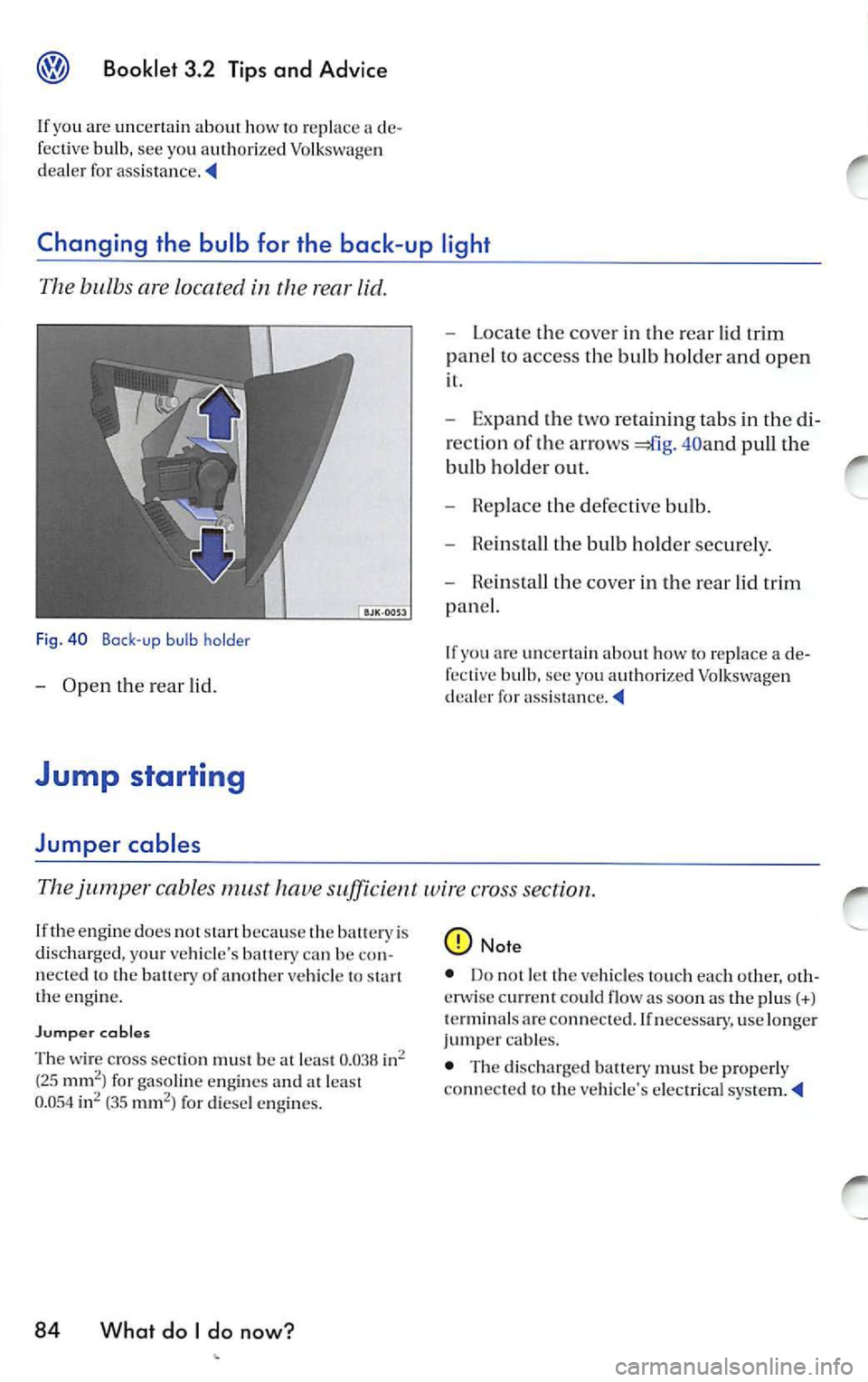
Changing the bulb for the back-up light
The bu.lbs are located in the rear Lid.
Fig. 40 Boc k-up bu lb ho ld er
- Open the rear lid.
Jump starting
Jumper cables
- Locat e the cover in the rea r lid trim
pan el to access the bulb holder and open
it.
- Ex pa nd th e tw o re taining tabs in the di
r e ct ion of the arrow s
40and pull the
bulb holde r out.
- Replac e th e defect iv e bu lb.
- Rein stall the bulb holder securely.
- Rein sta ll th e co ver in the rear lid trim
panel.
If you are unc ertain about ho w to re plac e a de
f ec tive bulb , see y ou auth orized Volkswa gen
d ea ler for a ssis tanc e.
The jumper cables have sufficient cro ss sec tion.
If th e engin e does not sta rt beca use the batt ery is
di scharg ed , yo ur vehicl e's batt ery b e co n
n ec te d to th e batt ery of anot her veh icl e 10 s tart
t h e e ngin e.
Jump er cab les
Th e cro ss sec tion mu st b e a t leas t 0.03B (25 111111 2
) fo r gaso line en gin es a nd at l eas t
0.0 54 (35 111111 2
) fo r di ese l en gin es.
84 What do I do now?
Note
• Do n ot le t the vehicle s tou ch eac h oth er, oth
e rw ise curr ent cou ld flow a s soo n as th e plu s(+)
t e rm inals are co nne cted. If necess ary, u se lon ger
jump er cabl es.
• The di sc ha rge d batt ery mu st be prop erl y
co nnec te d
to th e ve hicl e's elec tri ca l sys tem.
Page 407 of 477
Booklet 3.2 Tips and Advice
WARNING (continued)
• Always make sure that the battery pro
v idin g ass istance has the same vo ltage as the
discharged battery (12V) and approximately
the same ca pacity (see battery label).
• Neve r jump start a ve hicle with
rrozen
batt ery. 1r a battery is or has been frozen, re
pla ce it.
• Batteries giv e
explosive hydrogen gas.
A lways keep sparks, open flame and
smoking materials away from batteri es.
• Never short out the battery pole s by con
necting the positive
and nega tive po les
with eac h other .
• Always follow the jumper cab les ' manufac
turer's instruct ions.
• Never co nn ect the negati ve cab le from the
other vehicle directly to the negat ive terminal
or the discharged battery. The hydrogen gas
rrom the battery is exp losive.
Towing
WARN ING (continued)
• Never attac h the negative cable from the
ve hicl e providing starting assistance to parts
of the fuel syst em or to the brake hoses o r
brake lines.
• Never a llow the non -in sula ted parts of th e
batt ery clamps to touch. Never allow the
jumpe r cab le a ttached to the positive battery
t ermina l to contac t metal parts of the vehicle.
• Alw ays route the jumper cables so that
th ey can not ge t tangled up with moving parts
in th e engi ne c ompartment.
the vehicl e's e lec
tri cal sys te m.
• Do not l et
veh icles touch eac h oth er. Oth
e rw ise curr ent could fl ow betwee n the ve hicles
a s soo n as the plu s(+) te rminal s are
co nn ect ed.
67.
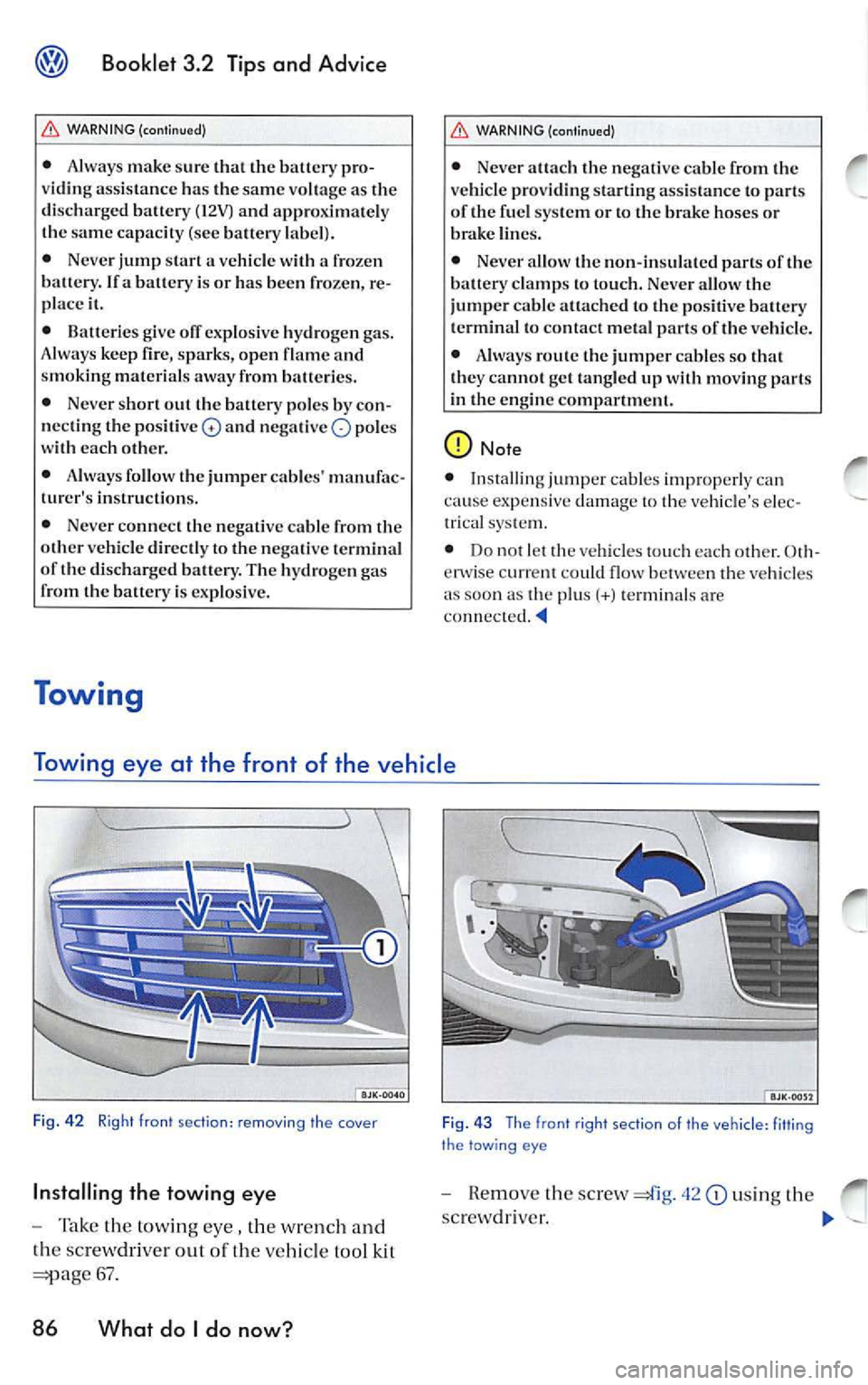
86 What do I do now?
Fig. 43 The front right secti on of the vehicle: fitti ng
t he towing eye
- Rem ove the scre w 42 usin g the
sc rew dri ver.
Page 414 of 477
Cleani ng
A llo y whee ls
2 1 A ut omati c car was h 17
Bump er
18
chassis 22 C lo th sea t cove rs 23
E n gin e co mpartm ent 22
Ex ter ior 1 7
trim 23
In stru ment panel 23
L ea th er 23 Out side mir rors 19
P las tic 23
bel ls 26
W ashin g the ve hic le 1 7
W ind ows 19
Wind sh ie ld 19 W ind shie ld wip er blad es 20
W ooden trim
23
Cle an ing and pro tec tio n 16
C lot h sea t cove rs
C le an ing
23
Code number
Fo r
whee l bolt s 67
Cold tire inflation pressure 54
Coo la nt 43 Le ve l 44
Loss 44
Cra sh recorder s 6
D
Deter minin g corre ct load limil 59
D iese l e ngine
Ad din g en gi ne oil 41
C hang ing engin e oil 41
En gin e oil 4 1 Engin e oi l 37
Die se l fu el 33 Wi nte r operat io n 33
D iffe re nti al loc k 4
Drive r Stee ring Recomme ndati on 3
Dr iv in g eco nomi cally 14
Driv ing ou1 sid e o f !h e U.S. A. or Canada
P rec au1io ns
9 1
Driv ing wit h respec t for th e en vironme nt 14
Booklet 3.2 Tip s and Advice
ing in sid e 1h e e ng in e c om pa rtm en t 34
Wo rkin g in th e engin e com partmen t 34
Engin e coola nt 43
Add iti ves 43
Can I acid p la in wate r the engi ne
coo lan t?
44 Coola n! losses 45
Eng ine hoo d 36
How do I unlock !he en gin e hoo d? 36
Eng ine oil 37
Add ing 40
Addit ives 40
C he ck in g leve l 39
Consu mplion 38
Die sel e n gine 4 1
Dips!i ck 39 H ow do I kn ow how much oil m y eng in e is
co nsum ing?
38
Oi l cha nge 42
Specifica tions 37 Spec ifi ca tions Diese l eng in e 37 , 4 1
Spec ifica !io ns gaso li n e e ngi ne 37 W hal kind of e n gin e oi l s h o uld I p u ! in my
v eh icl e?
37
W hen sh o ul d I ch eck !he e ngin e oi l
l eve l? 38 W here is th e oil dip stick 3 9
E nvironm en t
Avo iding polluti on 31
C le anin g th e e ngine compa rtment 22 Driving economically 14
V ehi cle care produ cts 16
ES P 5
Eve nt Dat a Reco rde r 6
Ex terna l ae rial 29
Alphabetical index 93
Page 415 of 477
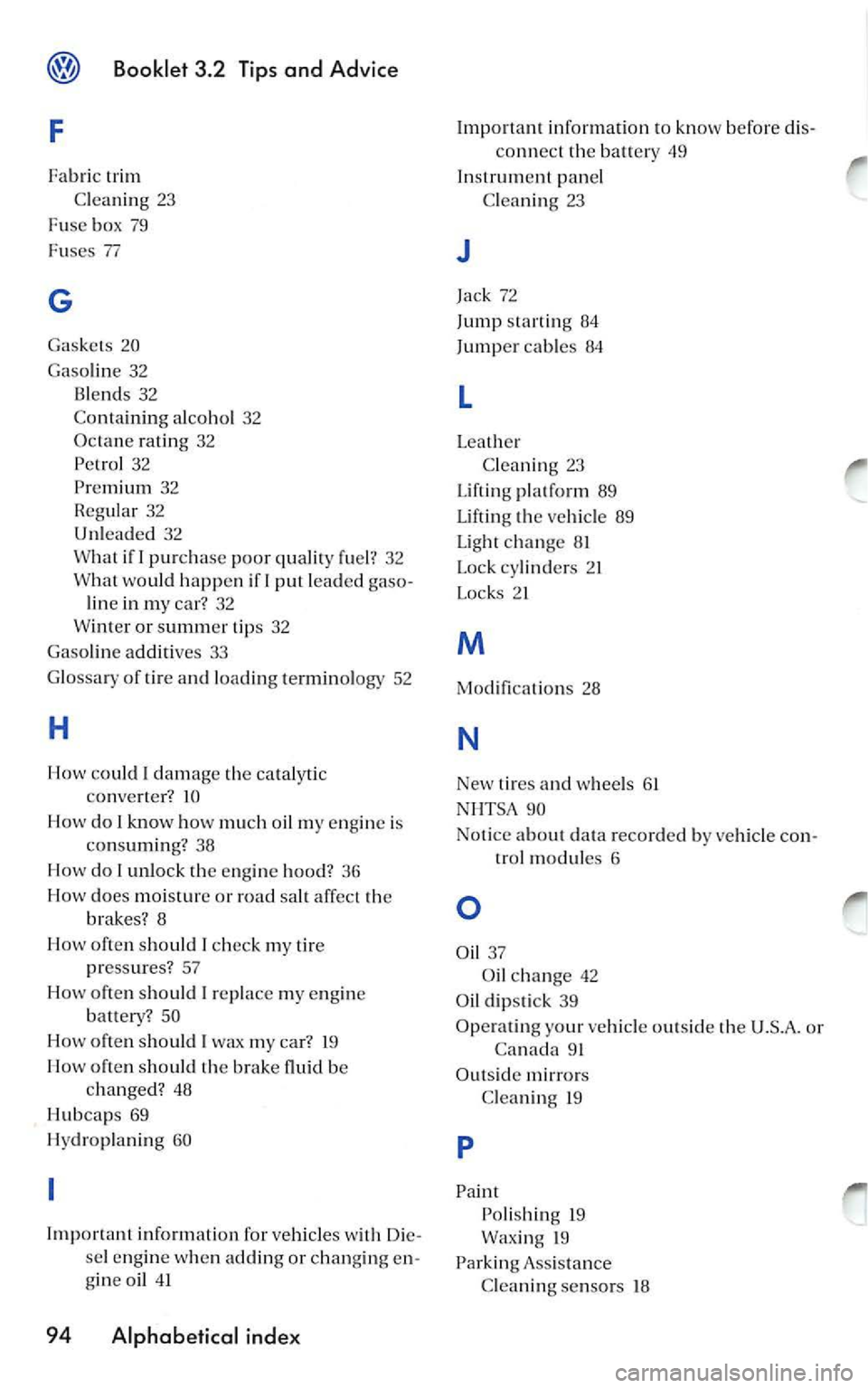
Booklet 3.2 Tip s and Ad vic e
F
Fab ric trim
C lea ning 23
box 79
F u ses 77
G
Gaske ts 20
Gaso line 32
B le nd s 32
Co ntaining alcohol 32
Oc tan e rating 32
P etro l 32
Pr emium 32
R eg ular 32
U nl eaded 32
W ha t if I purc hase poor qua lity fu el? 32
W hat wou ld happ en if I put l ead ed gaso-
line in my car? 32
W in te r or summ er tip s 32
Gaso lin e addit ives 33
G lossa ry of tire and l oad ing t ermin ology 52
H
H ow could I damag e th e ca taly tic
co nverter? 10
H ow do I kno w how much oil m y eng in e is
co nslllnin g? 38
H ow do I unlo ck th e engine hood? 36
H ow doe s moi sture or road sal t affe ct the
bra kes? 8
H ow oft en sh o uld I c h ec k my tire
pr ess ures? 57
H ow of te n sh ou ld I rep lace my eng in e
battery? 50
H ow ofte n sh ould I wa x m y c ar? 19
H ow often sh ou ld th e brake fluid be
c h anged? 48
Hu bca ps 69
H ydro pla nin g 60
I mp ort ant inform ation fo r ve hicle s wi th Die
se l eng ine when addin g or changin g en
g in e oil 41
94 Alphabetical index
Impo rtan t inf ormati on to kn ow before dis
c on nec t the battery 49
I ns trum en t panel
C le aning 23
J
Jack 72
Jum p star lin g 84
Jump er cables 84
L
Lea ther
C lea nin g 23
Lifting pla tfo rm 89
Lifti ng th e ve hicle 89
Li gh t cha nge 81
L ock cy linders
21
Lo cks 21
M
Mod ificat io n s 28
N
New tires an d wheels 6 1
N HT SA 90
No tice about data r ecorded by vehicle con
trol modu les 6
0
Oil 37
O il ch an ge 42
Oil dips tick 39
Ope ratin g you r vehicl e ou ts id e th e U. S.A . o r
Ca nada 91
Outs id e mirr ors
C lea ning 19
p
Pa int
P o lishin g 19
Wax ing 19
Park ing Ass is ta nce
C le aning sensors
Page 416 of 477
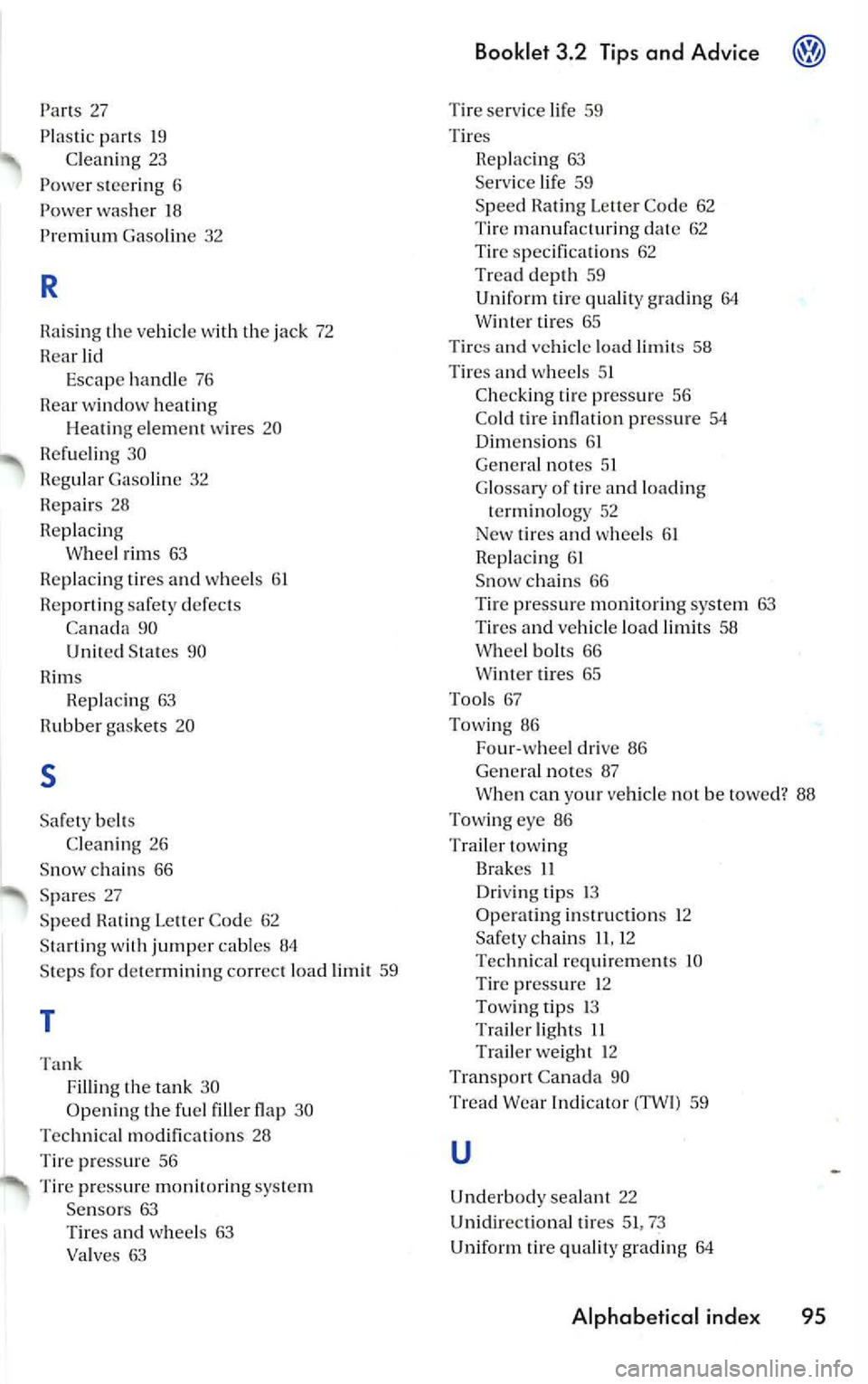
Parts 27
Plastic parts 19
Clean ing 23
Power steering 6
Power wa sh er 18
Prem ium Gaso line 32
R
Rai sing th e veh icle wit h th e jac k 72
Hear lid
Escape handle 76
wind ow heat ing
Heatin g element wires 20
Refue ling 30
H eg ular Gaso line 32
Repair s 28
Hep lacin g
Whee l rim s 63
Rep lacing tires and wheels 6 1
He por ting safety de fects
Ca nada 90
Unit ed States 90
Rims Replacing 63
gas kets 20
s
Safery belt s
Cleaning 26
S now chains 66
Spa res 27
Speed Hating Letter Code 62
Sta rtin g w ith jum per ca bles 84
Ste ps fo r dete rmining correc t load lim it 59
T
Tank
Fillin g
tank 30
Openi ng the fu el filler
30
Tec hnical m od ifica tions 28
T ire pressu re 56
T ir e pressure monitoring system
Se nso rs 63
Tir es and whee ls 63
Va lves 63
Booklet 3.2 Tips and Advice @
Tire service life 59
T ir es
Rep la cing 63
Se rv ice life 59
Speed Hating Leller Code 62
Ti re manufa cturing dale 62
Ti re specificat ions 62
Tread depth 59
Uni form tire qua lity gradi ng 64
Win te r tires 65
Tir es and vehicle load limit s 58
Tir es and whe els 5 1
C hec king tir e press ure 56
Co ld tire innation pre ssure 54
D imens ions 6 1
General notes 51
Glo ssary of
and loadin g
t e rm inology 52
New tires and whee ls 61
Rep lacing 6 1
Snow cha ins 66
T ire pressu re mon ito rin g sys tem 63
Tir es and vehicle load limit s 58
Whee l bolts 66
W int er tire s 65
Tools 67
Towing 86
Four-wheel dr ive 86
General notes 87
When can yo ur vehicl e not be towed? 88
Towing eye 86
Tra iler tow ing
Brak es ll
Dr iv in g tips 13
Operating instru ction s 12
Safety chain s 11, 12
Tec hnical requir ements IO
Tire press ure 12
T ow ing tips 13
Trailer lights 11
Tra iler weigh t 12
Tra nspo rt Ca nada 90
Tread Wea r Ind ica to r (TWI) 59
u
Underbody sea lant 22
Unidir ectiona l tires 51, 73
Uniform lir e qu alit y g rading 64
Alphabetical index 95