engine VOLKSWAGEN JETTA SPORTWAGEN 2012 Workshop Manual
[x] Cancel search | Manufacturer: VOLKSWAGEN, Model Year: 2012, Model line: JETTA SPORTWAGEN, Model: VOLKSWAGEN JETTA SPORTWAGEN 2012Pages: 324, PDF Size: 3.91 MB
Page 227 of 324
slightly with light pressure to open the misfueling guard. If the misfueling guard cannot be opened this
way, see the nearest authorized Volkswagen dealer or authorized Volkswagen Service Facility and
have the fuel system checked.
WARNING
Spilled fuel can cause fires, explosions, burns, and other severe injuries.
x Do not refuel from devices other than correct, undamaged standard diesel fuel pump
nozzles.
x Always stop refueling once the pump nozzle switches off so that the tank does not
overflow.
NOTICE
x It is your responsibility to put the right fuel in your vehicle and any damage that results is
not covered under the Emissions warranties or any other Volkswagen Limited Warranty.
x If you put any amount of the incorrect fuel in the fuel tank, do not start the engine under any
circumstances. Immediately contact the nearest authorized Volkswagen dealer or authorized
Volkswagen Service Facility for assistance.
x If diesel fuel should get on any rubber hose, it must be wiped off immediately. The same
applies if diesel fuel gets onto other parts of the vehicle, especially paint, tires, or a plastic
part. Wash the contaminated vehicle parts right away with soap and warm water to help
prevent leaks and serious damage.
x Never force a fuel nozzle in the misfueling guard. If you have problems inserting a fuel
nozzle, first check to make sure you are using the correct diesel fuel. If you are, go to a pump
with the standard diesel nozzle. Forcing a fuel nozzle in the misfueling guard can damage it so
that it can no longer help prevent misfueling.
Fuel capacities
Page 228 of 324

Checklist
If you are uncertain in any way, have the work done by an authorized Volkswagen dealer or
authorized Volkswagen Service Facility. Serious personal injury may result from improperly performed
work. Make sure that you check the following items regularly. The best thing is to check them every
time you refuel:
d Windshield washer fluid level
d Engine oil level
d Engine coolant level
d Brake fluid level
d Tire pressure
d Vehicle lighting necessary for driving safety:
– Turn signals
– Low beams and high beams
– Taillights
– Brake lights
– License plate lights
Information regarding changing light bulbs .
WARNING
Disregarding the safety-related checklist may lead to accidents and injuries.
x Please note and follow the points listed in the checklist.
Page 230 of 324

Volkswagen recommends TOP TIER Detergent Gasoline. For more information on TOP TIER
Detergent Gasoline, please go to the official Web site http://www.toptiergas.com.
If quality gasoline with additives that do not contain metal is not available or engine malfunctions
occur, you should add the required additives while refueling ⇒ .
Not all gasoline additives are effective. Using the wrong additives can cause significant and expensive
damage to the engine and the catalytic converter. Never use additives that contain metal. Please note
that metal can be included in some aftermarket gasoline additives that are available to be added to
gasoline during or after refueling to help improve knock resistance or increase the octane rating.
Volkswagen recommends using only additives approved by Volkswagen. Appropriate additives as well
as instructions on how to use them are available from your authorized Volkswagen dealer or
authorized Volkswagen Service Facility. Do not add any other gasoline additives.
NOTICE
You can damage the engine by using incorrect additives.
x Using incorrect gasoline additives can cause extensive engine damage as well as damage
to the catalytic converter.
x If you must fuel your vehicle with gasoline whose octane rating is too low, only drive with
the engine speed in the middle of the rpm range and with low engine load. Avoid high rpm and
heavy engine load. Otherwise, the engine could be damaged. Refuel your vehicle with gasoline
with the required octane rating as soon as possible.
x Do not use fuel that is labeled at the pump as containing metal. Lead replacement fuel
contains high concentrations of metallic additives. Engine damage could result.
x Fueling your vehicle just one time with leaded fuel or fuel that contains other metallic
additives can affect the performance of the catalytic converter and cause extensive damage to
it.
Diesel fuel
Page 231 of 324
If non-winterized or insufficiently winterized diesel fuel has already thickened to the point that the
engine will not start, move the vehicle to a heated garage or workshop until it has warmed up.
Cold diesel engines normally produce louder noises during winter conditions than during warmer
periods. In addition, the exhaust gases may be light blue in color until the engine has warmed up. The
exhaust gas volume varies depending on the outside temperature.
Do not let your diesel engine idle unnecessarily after a cold start. Driving off slowly will shorten the
warm-up period.
WARNING
Starting fluids can explode and cause a run-away vehicle condition.
x Never use starting assist fluids.
NOTICE
x The vehicle's diesel engine was designed solely for use with ULSD fuel. For this reason,
never use gasoline, heating oil, or other fuels that have not been expressly approved for use
with the diesel engine. These fuels contain substances that will severely damage the fuel
system and the engine. Such damage will not be covered by any Volkswagen Limited Warranty.
x If you put any amount of the incorrect fuel in the fuel tank, do not start the engine under any
circumstances. Immediately contact the nearest authorized Volkswagen dealer or authorized
Volkswagen Service Facility for assistance.
x If diesel fuel should get on any rubber hose, it must be wiped off immediately. The same
applies if diesel fuel gets onto other parts of the vehicle, especially paint, tires, or a plastic
part. Wash the contaminated vehicle parts right away with soap and warm water to help
prevent leaks and serious damage.
x The vehicle is designed to run on diesel fuel containing methyl ester biodiesel in
concentrations of 5% or less. Never use methyl ester biodiesel in blend levels higher than 5%
(5% methyl ester blends are sometimes designated or labeled as B5). The properties of methyl
ester biodiesel blends in levels greater than 5% may cause serious damage to the fuel injection
system and to the engine. This could lead to expensive repairs that will not be covered by any
Volkswagen Limited Warranty.
x Damage to the engine and fuel system and performance problems caused by using fuels
that are different from those specified above or by using “starting assist fluids” are not the
responsibility of Volkswagen and are not covered under the Emission warranties or any other
Volkswagen Limited Warranty.
Page 232 of 324
Preparations for working in the engine compartment
Page 233 of 324

WARNING
The engine compartment of any motor vehicle is a potentially dangerous area and can cause
serious personal injury.
x Always use extreme caution when doing any work in the engine compartment. Always
follow commonly accepted safety practices and use common sense. Never risk personal
injury.
x Never perform any work in the engine compartment unless you know exactly how to carry
out the job and have the correct technical information and the correct tools.
x If you are uncertain about what to do, have the work performed by an authorized
Volkswagen dealer, an authorized Volkswagen Service Facility, or another qualified
workshop. Serious personal injury may result from improperly performed work.
x We strongly recommend that you always have HID – High Intensity Discharge (Xenon)
headlights and H7 bulbs replaced by a qualified technician. Serious personal injury may
result from improperly performed work.
x Never open or close the engine hood if steam or coolant is escaping. Hot steam or coolant
can cause serious burns. Always wait until you no longer see or hear steam or coolant
escaping from the engine.
x Always let the engine cool down completely before carefully opening the hood.
x Hot parts of the engine and the exhaust system will burn skin on contact.
x When the engine has cooled down and you are ready to open the hood:
– Firmly apply the parking brake and shift the transmission into Park (P) (automatic) or
Neutral (manual only).
– Take the vehicle key out of the ignition.
– On vehicles with Keyless Access, make sure that the remote control vehicle key is out
of range of the vehicle and that the vehicle cannot be started by depressing the starter
button
– Always keep children and others away from the engine compartment and never leave
them unsupervised.
x The engine coolant system is under pressure when the engine is hot. Never unscrew the
coolant expansion tank cap when the engine is hot. Hot coolant can spray out and cause
severe burns and other serious injuries.
– Turn the cap slowly and very carefully in a counterclockwise direction while applying
light downward pressure on the top of the cap.
– Always protect your face, hands, and arms from hot escaping coolant or steam by
covering the cap with a large, thick rag.
x Never spill fluids on the engine or exhaust system when refilling. Spilling fluids onto hot
parts of the engine or exhaust system can cause a fire.
Page 234 of 324
WARNING
High voltage systems in the engine compartment can cause electrical shocks or even
electrocution, severe burns, other serious injuries, and even death!
x Never short-circuit the electrical system. Be especially careful when using jumper cables.
The vehicle's battery could explode!
x To reduce the risk of electrical shock and personal injury while the engine is running or
being started:
– Never touch ignition cables. Never touch other components of the high voltage
electronic ignition system.
– Never touch the wiring of the HID – High Intensity Discharge (Xenon) headlights.
x Read and heed the important information and warnings on cleaning the engine
compartment., Cleaning the engine compartment
WARNING
Moving parts in the engine compartment can cause serious personal injury on contact.
x Never reach into the area around or touch the radiator fan. Contact with the blades can
cause serious personal injury. Always remember that the radiator fan is temperature-
controlled and can come on suddenly even when the engine has been switched off for a while
and the key has been removed from the ignition.
x If you have to perform a check or repair when the engine is running, there are more risks
from the rotating parts, such as the drive belts, alternator, radiator fan, etc., and from the
high-voltage ignition system. Always use extreme care.
– Always make sure that jewelry, loose clothing and long hair do not get caught in
rotating engine parts. Before starting any work remove your jewelry, take off your necktie,
tie back and cover your hair, and do not wear clothing that can hang down and get caught
in moving engine parts.
– Always use extreme caution if the accelerator pedal has to be depressed to perform a
check. The vehicle will start to move even if the parking brake is on.
x Never leave any objects in the engine compartment, for example cleaning rags and tools.
Objects left behind can cause malfunctions, engine damage, and even fires.
WARNING
Operating fluids and some materials in the engine compartment can catch fire easily, causing
burns and other serious personal injuries!
x Never smoke near the engine compartment.
x Never work next to open flames or sparks.
x Never pour or spill operating fluids or other flammable liquids on the engine. These fluids
can ignite on hot engine parts and cause injuries.
x If work on the fuel system or the electrical system is necessary:
– Always disconnect the 12 Volt vehicle battery. Make sure the vehicle is unlocked when
you disconnect the battery, or the alarm will go off. Never touch the electrical wiring of the
ignition system.
– Never work near heaters, water heaters, or other open flames.
x Always have a functional, approved fire extinguisher nearby.
Page 235 of 324
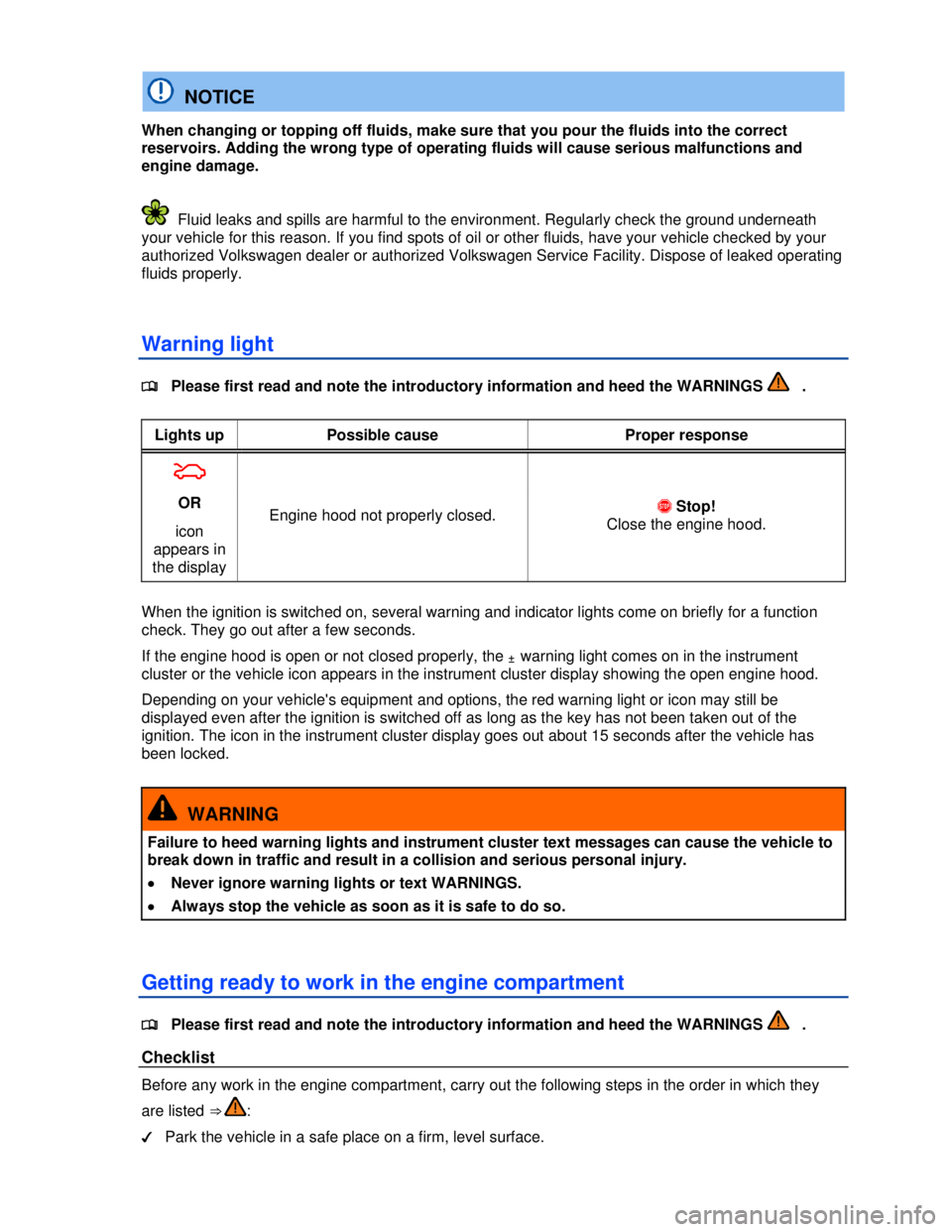
NOTICE
When changing or topping off fluids, make sure that you pour the fluids into the correct
reservoirs. Adding the wrong type of operating fluids will cause serious malfunctions and
engine damage.
Fluid leaks and spills are harmful to the environment. Regularly check the ground underneath
your vehicle for this reason. If you find spots of oil or other fluids, have your vehicle checked by your
authorized Volkswagen dealer or authorized Volkswagen Service Facility. Dispose of leaked operating
fluids properly.
Warning light
Page 236 of 324
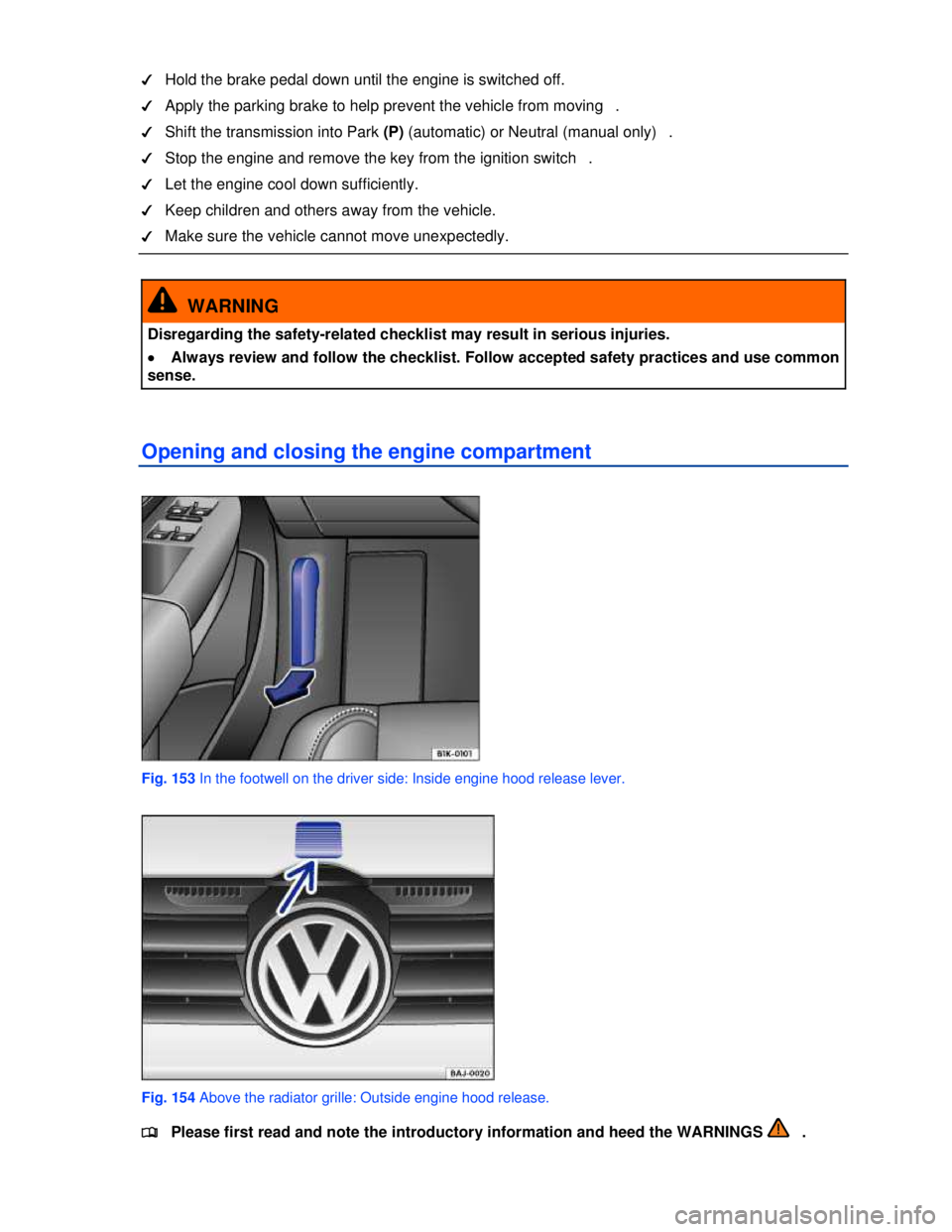
d Hold the brake pedal down until the engine is switched off.
d Apply the parking brake to help prevent the vehicle from moving .
d Shift the transmission into Park (P) (automatic) or Neutral (manual only) .
d Stop the engine and remove the key from the ignition switch .
d Let the engine cool down sufficiently.
d Keep children and others away from the vehicle.
d Make sure the vehicle cannot move unexpectedly.
WARNING
Disregarding the safety-related checklist may result in serious injuries.
x Always review and follow the checklist. Follow accepted safety practices and use common
sense.
Opening and closing the engine compartment
Fig. 153 In the footwell on the driver side: Inside engine hood release lever.
Fig. 154 Above the radiator grille: Outside engine hood release.
Page 237 of 324
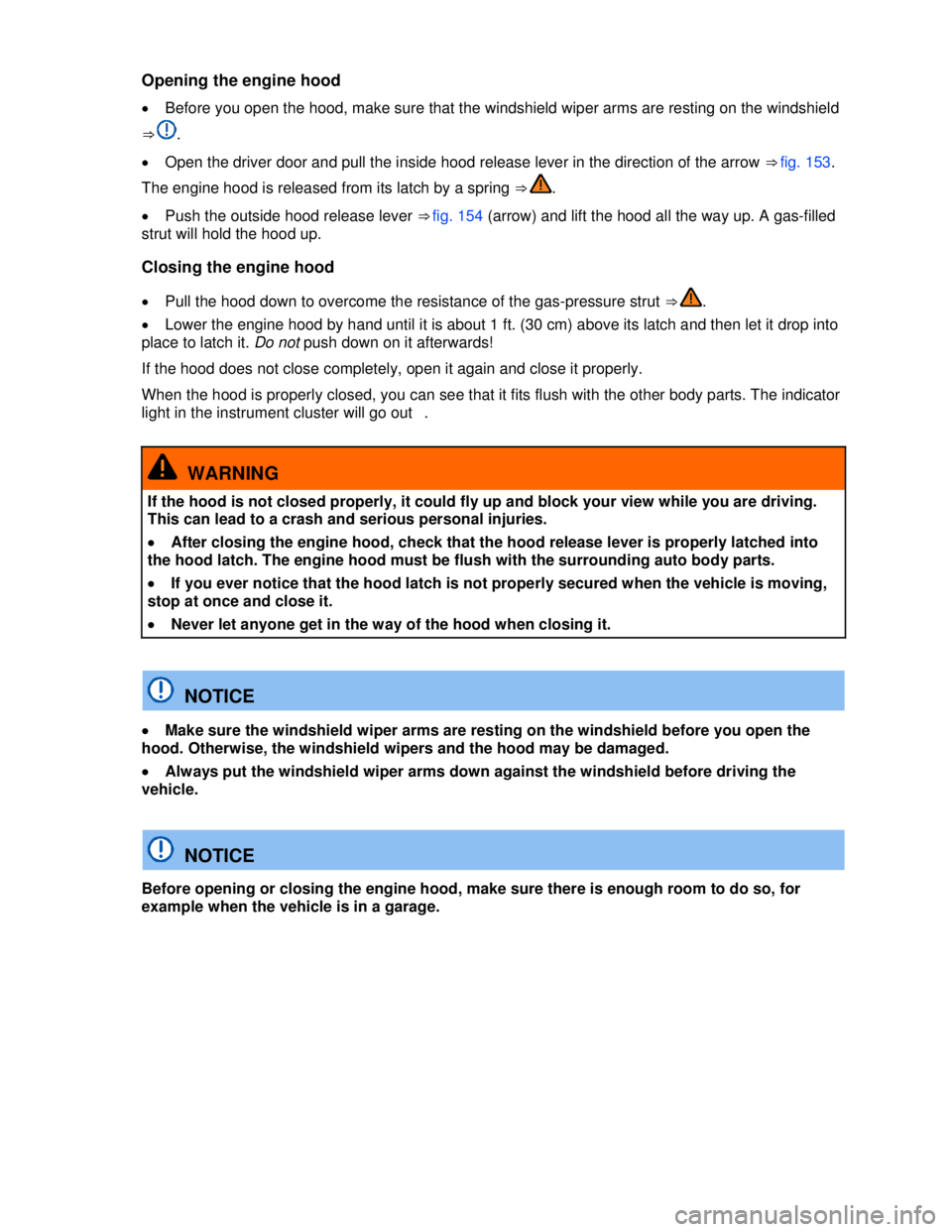
Opening the engine hood
x Before you open the hood, make sure that the windshield wiper arms are resting on the windshield
⇒ .
x Open the driver door and pull the inside hood release lever in the direction of the arrow ⇒ fig. 153.
The engine hood is released from its latch by a spring ⇒ .
x Push the outside hood release lever ⇒ fig. 154 (arrow) and lift the hood all the way up. A gas-filled
strut will hold the hood up.
Closing the engine hood
x Pull the hood down to overcome the resistance of the gas-pressure strut ⇒ .
x Lower the engine hood by hand until it is about 1 ft. (30 cm) above its latch and then let it drop into
place to latch it. Do not push down on it afterwards!
If the hood does not close completely, open it again and close it properly.
When the hood is properly closed, you can see that it fits flush with the other body parts. The indicator
light in the instrument cluster will go out .
WARNING
If the hood is not closed properly, it could fly up and block your view while you are driving.
This can lead to a crash and serious personal injuries.
x After closing the engine hood, check that the hood release lever is properly latched into
the hood latch. The engine hood must be flush with the surrounding auto body parts.
x If you ever notice that the hood latch is not properly secured when the vehicle is moving,
stop at once and close it.
x Never let anyone get in the way of the hood when closing it.
NOTICE
x Make sure the windshield wiper arms are resting on the windshield before you open the
hood. Otherwise, the windshield wipers and the hood may be damaged.
x Always put the windshield wiper arms down against the windshield before driving the
vehicle.
NOTICE
Before opening or closing the engine hood, make sure there is enough room to do so, for
example when the vehicle is in a garage.