transmission VOLKSWAGEN PASSAT 2004 User Guide
[x] Cancel search | Manufacturer: VOLKSWAGEN, Model Year: 2004, Model line: PASSAT, Model: VOLKSWAGEN PASSAT 2004Pages: 483, PDF Size: 78.54 MB
Page 172 of 483
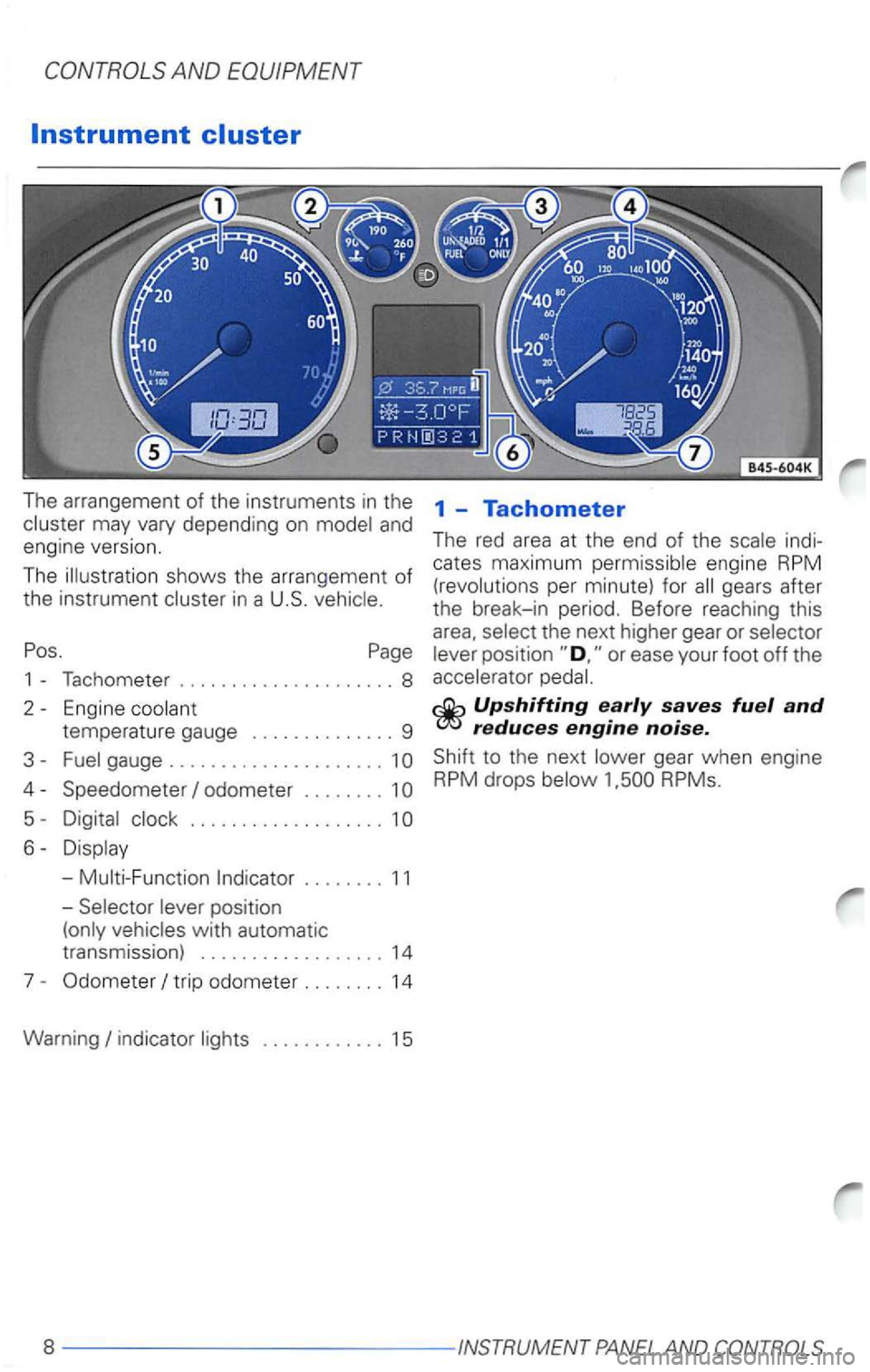
may vary depending on
shows the arrangement of
the instrument
Pos. Page
1 - Tachomete r ..................... 8
2 -
Engine temperature gauge ............ .. 9
3-gauge .....................
odometer ........ 1
5 -
-........ 11
-with automatic
transmission) .......... ... ..... 14
7 - Odometer
indicator ............ 15
1 -Tachometer
The red area at the end of the cates maximum
the next higher gear or position or ease your foot off the
Upshifting early saves fuel and reduces engine noise.
gear when engine RPMs.
8 -------------INSTRUMENT PANEL AND
Page 178 of 483
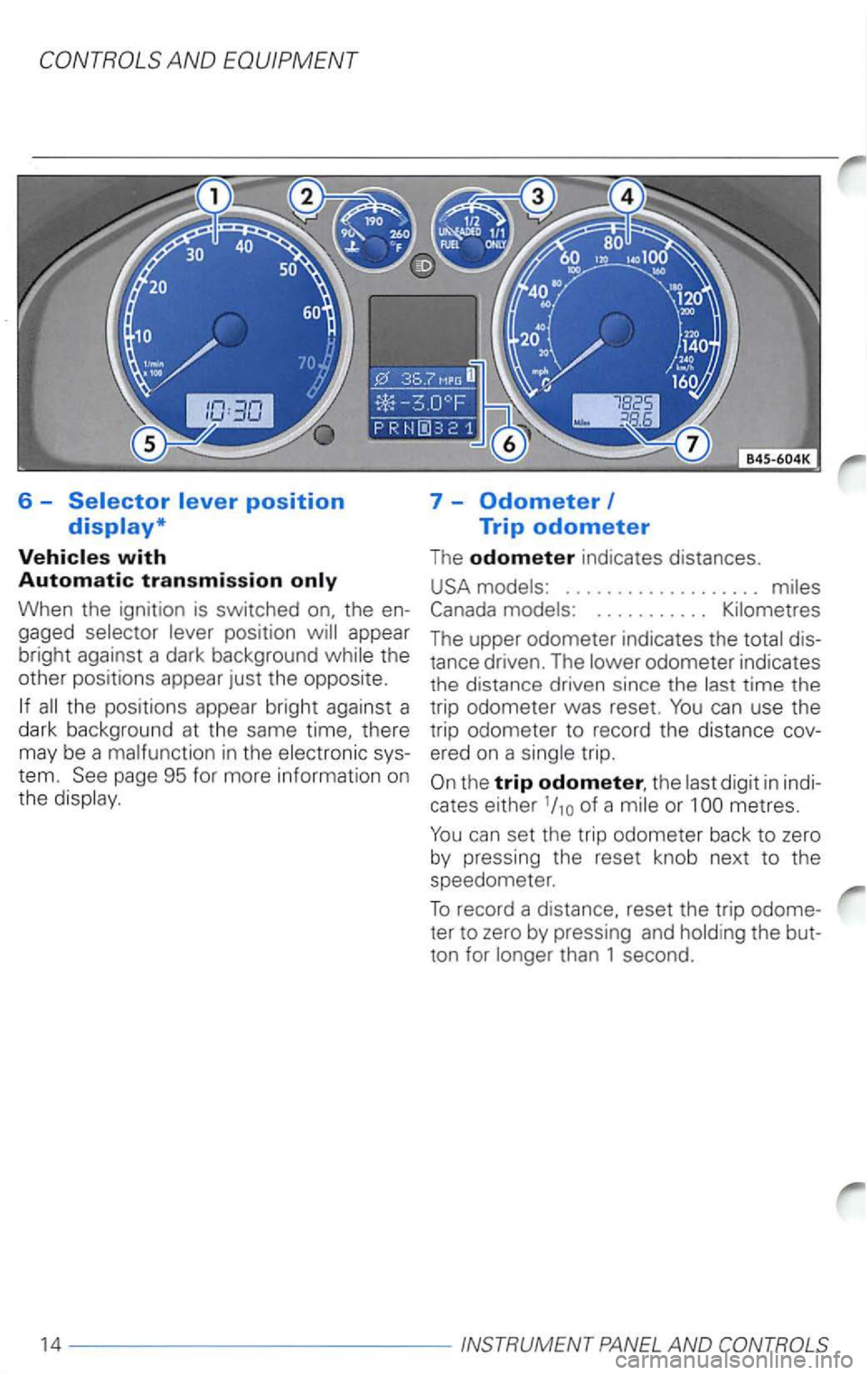
Vehicles with Automatic transmission only
When the ignition is switched the
all the positions appear bright against a
dark background at the same
page 95 for more information on
the display .
7 -Odometer
models: . . . . . . . . . . . Kilometres
The upper odometer indicates the total
the trip odometer, the last digit in indi
cates either
of a mile or metres.
Page 257 of 483
Automatic transmission (Tiptronic®)*
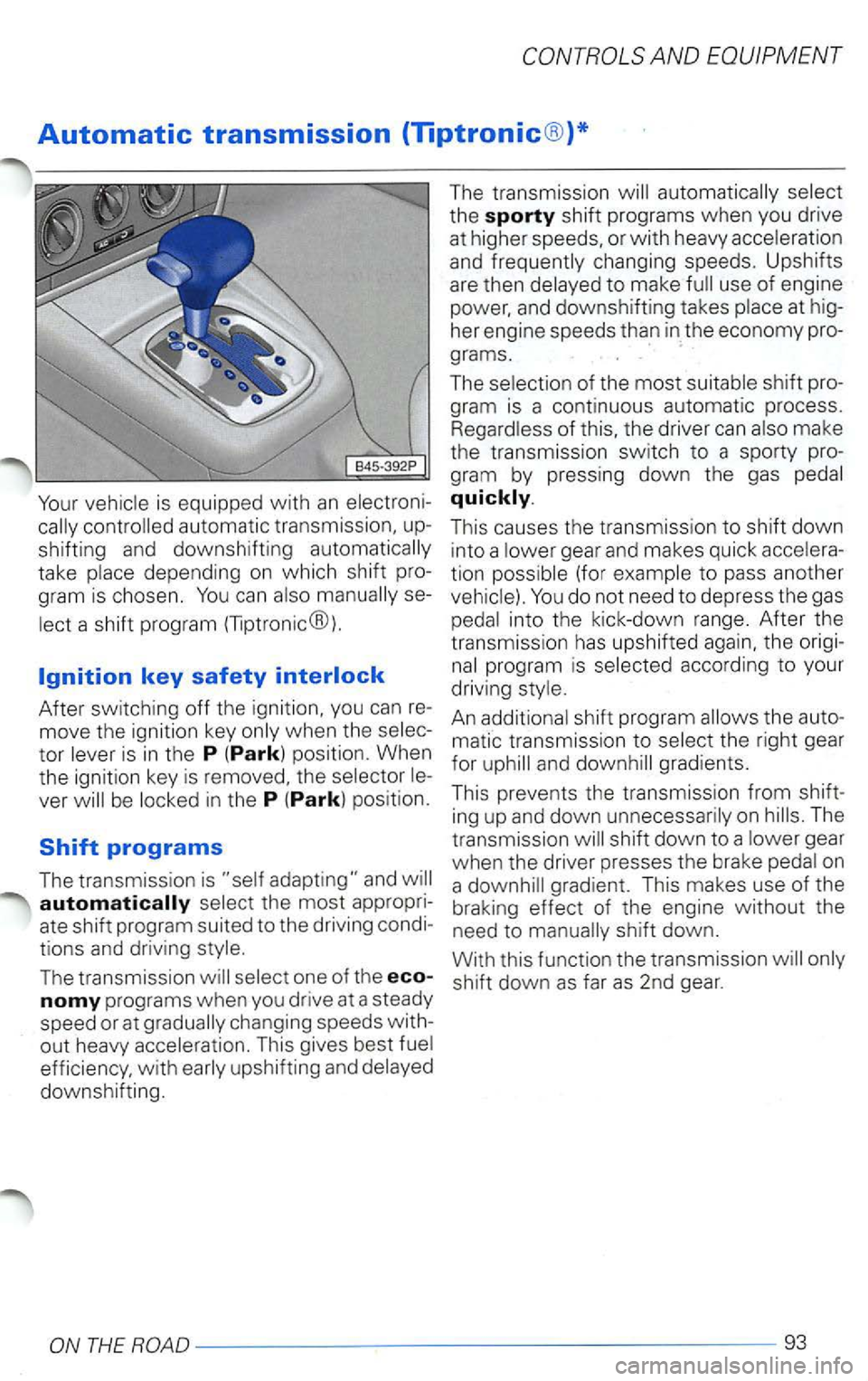
Your
take
After switching off the ignition, you can re
move the ignition key
in the P (Park) position.
The transmission
changing speeds with
out heavy This gives best
efficiency, with
and
This causes the transmission to shift down
into a gear and makes quick
tion (for
into the kick-down range. After the
transmission has upshifted again, the origi
the auto
matic transmission
to and
The
transmission
shift down to a on
a gradient. This makes use of the
braking effect of the engine without the
need to
shift down as far as 2nd gear.
ONTHEROAD---------------------------------------93
Page 262 of 483
AND EQUIPMENT
Maneuvering
When
stop and the engine is running at
speed.
Parking
Engage P (Park) when the is
not moving. When parking your
to position P. To do
To move the
When stoppin g for
it is not necessary to move theseto N (Neutral).
The driving positions must never be used
for
the
when the engine is running.
and turn. Emergency starting
Before you move the selector lever from the P (Park) position, you must always apply the brake pedal before
and while depressing the button in the handle of the selector lever.
the parking brake.
When the
is parked on a steep
harder. This is due to the weight ex
erted on the transmission.
Always heed
Your with automatic trans
mission cannot be started by pushing
or towing.
Refer to
to
start.
Towing
To tow the Booklet 3.2.
98 ---- ----------------ON THE
Page 264 of 483
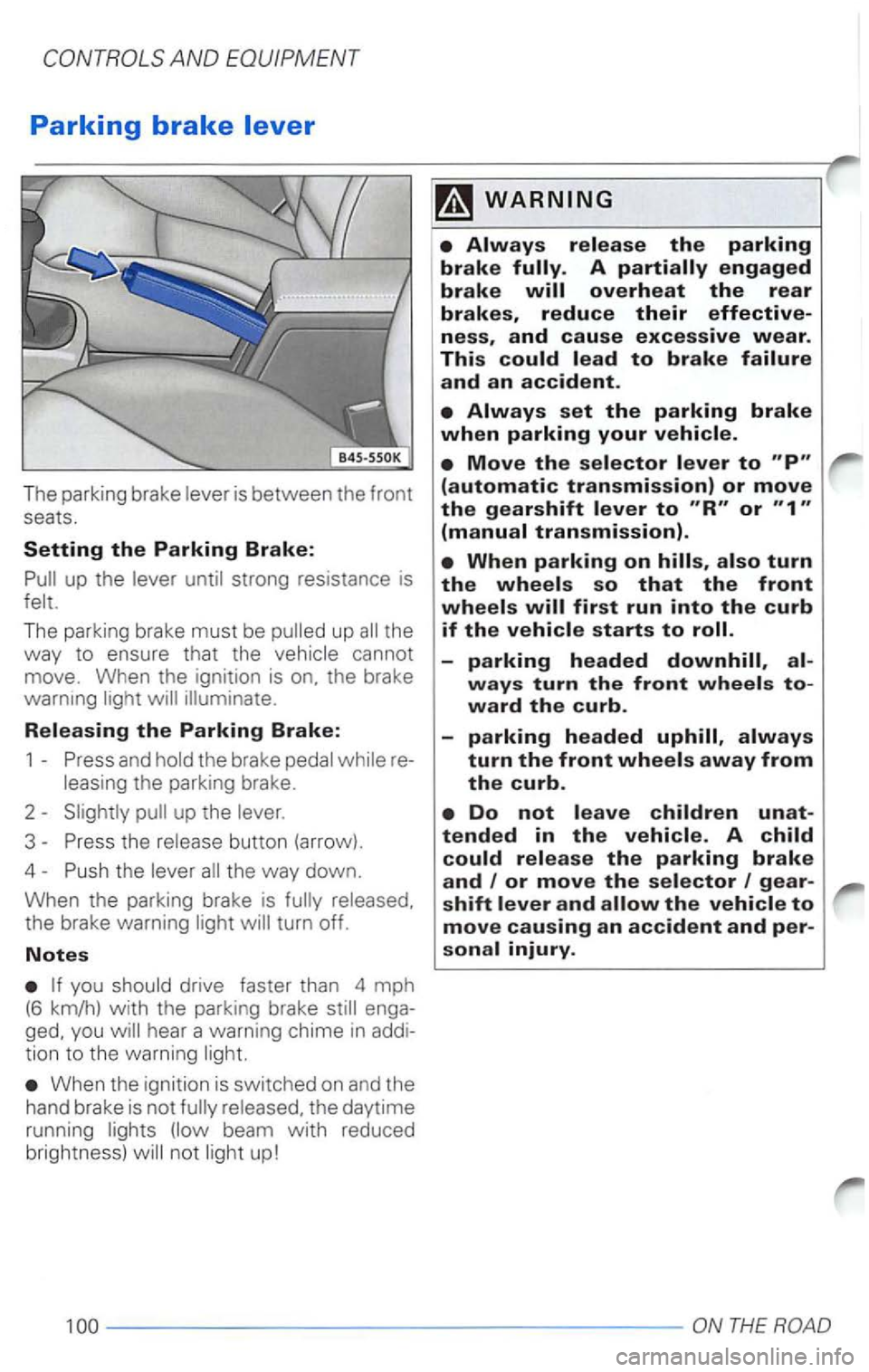
The parkin g brake
re-
enga
When the ignition is switched on and the hand br ake is not
up!
engaged
brake
and cause excessive wear.
This
set the parking brake when parking your
Move the
(automatic transmission) or move the gearshift to or
When parking on so that the front
starts to
-parking headed ways turn the front toward the curb.
-
parking headed
away from
the curb.
Do not unattended in the
the parking brake
and I or move the and the to move causing an accident and perinjury.
--------------- ----
Page 270 of 483
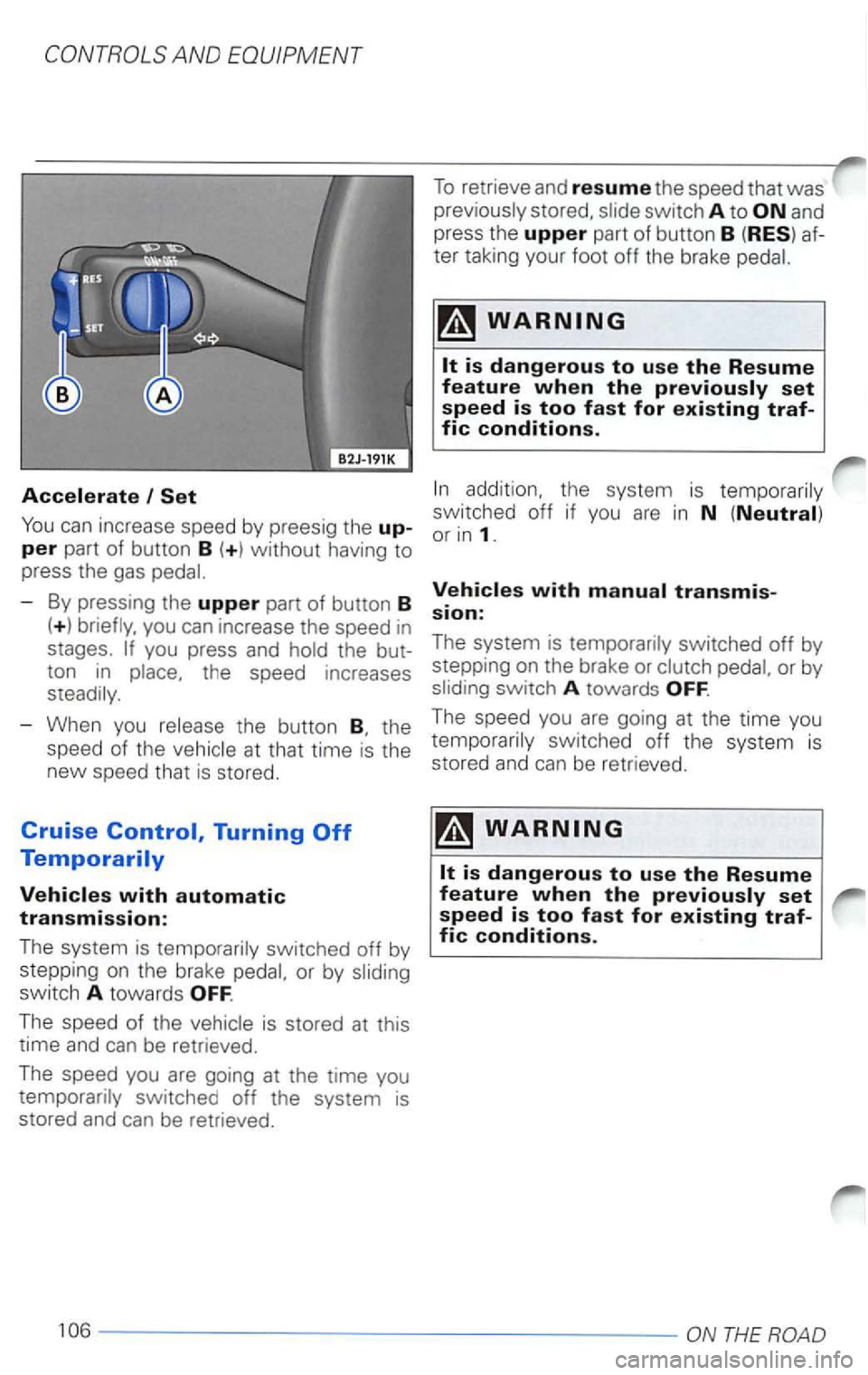
and
press the upper part of button B (RES) af
ter taking your foot
off the brake
switched off if you are in N (Neutral) can increase speed by preesig the up-or in 1. per part of button B (+ ) without having to
Accelerate I
press the gas
-By pressing the upper part of button B
you press and
-When you
Vehicles with automatic transmission:
The system is
switch A towards
The speed of the
switcheo off the system is
stored and can be retrieved.
Vehicles with manual transmis-sion:
The system is
The speed you are going at the time you switched off the system is
stored
and can be retrieved.
-------------------ON THE ROAD
Page 272 of 483
A
Adjustable steering column .......... 68 Alternator/Generator
.. .............. 19
Adjusting Anti-lock
braking system (ABS) ...... 17
-controls ............. .. . Anti-Slip regulation (ASRl
- Head Restraints .
............... 56 -
..................
.. See a/so Alarms
Air circulat ion -luggage compartment . 72 Armrest ........................... 66
Air conditioning
....................
cooling ...... ............ 85 -
Storage bin . . . . . . . . . . . . . . . . .
..................... 89 -Tiptronic ....................... 94
Air vents
-Towing ........................ 98
- Air conditioning
................. 82 Auto matic transmission (5-speed) .... 93
-
..................... 91 - Back-up lights .................. 96
Airbag
............ See also Bookl et 2.1 -Igni tion key safety interlock ...... 93
-
safe ty .................... 34 Average driving speed indicator ...... 11
-Indicator light ................... 16 Average fuel consumption indicator ... 11
Airbag indi cator light ................ 16
Alarm system
........ ..............
Page 280 of 483
s
............. 19
................... 44 Safety ............ See
.................. 35 Adjustment , Bac krest .. ... 61
R em ote
. . . . . . . . . . . . . . . .
............. See
. .................. 2 8 Seatback adjustment ............... 59
- Locki ng
....................... 28 Seating position
-
....................... 28 -Dr ive r ......................... 57
-Resetting ...................... 28
-
..................... 28
Remote
.......... 27
Remote Transmitter
................ 53
Remov ing the Roof Rack ............ 74
of keys ............... 26
-Batteries, remote
.............. See
batteries, -Remote . 25
Restraint
Head Restraint ..... 5 6
Restraint systems
...... See 2.1
Reverse
-Automatic transmission .......... 96
-
....................... 74
-Loading ........................ 73
- Removing ...................... 74
-Front passenger ................ 58
-.............. See 2.1
-2.1
Adjustment .............
.. .................... 69
Head Restraint
............... 56
-Foreward and backward adjustmen 59
-
Height adjustment ............... 59
adjustment ........ ...... 59
-Seatba ck adjustment
............. 59
Secondary key .
................. ... 26
Sec uring Luggage
.................. 72
............... 95
........ 14
mirror ................
INDEX
Page 281 of 483
Settings
-Odometer . . . . . . . . . . . . . . . . . . . . . . 1
- O utside Mirrors ......... ...... .. 62
-Memory ............. ...... 62
Turn . . . . . . . . . . . . . . . . . . .
. . . . . . . . . . . . . . . . . . . . . . . . 76. 77
Spec ificat ion s,
3.3
Speedometer . . . . . . . . . . . . . . . . . . . . . . 1
-engine ......... 1
Starting procedures ................ 1
....... ........... 24
- Light
ing ........................ 24
Steer ing
............ .. ........
Steer ing
-. .... ......... 49
-
roof
.......... .... 43
- Fog
switch ............ 33
-
Rear window defogger ......... . 43
Synchronised mirror adjustment .. .... 51
T
Tachometer ......................... 8
Tag, Key .......................... 26
Tem peratur e
-Air conditioning .................
-......... ............ 87
Temperature indi cator , outside
....... 12
The ft protection -
and Steering .... 68
driven indicator ............... . 13
t iptronic .
.............. ....... ..... 94
-
Top speed ........... ........... 96
Towing ..
.......................... 98
Transmis sion
........ ... Automatic tran smission . . . . . . . . . . . . . transmission
Transporting heavy objects .......... 71
Trip odometer . . . . . . . . . . . . . . . . . . . . . . 14
Trun k - Light ....................... 49
Turn . . . . . . . . . . . . . . . . . . . . 45
-
Page 376 of 483
Various factors influence fuel consumption:
engine wear. brakes
and tires, environmen
tal impact.
T his chapter addresses some of these
points.
Your
warm up.
When the engine is idling, it takes a very
long time to warm
up. Moreover. during
warm-up, both engine wear and exhaust
gas emissions are very high. Therefore, be
ready to drive
off immediately after starting
the engine and avoid high engine speeds.
Avoid
Upshift as early as possible -do not drive at unnecessarily high engine speeds.
The highest fuel economy and the least di
sturbance to the environment are attained
when you drive at l
ow engine speeds and in
the highest possible gear.
For example , fuel consumption is twice
as high in 2nd gear as it is in the highest gear.
Downshift only when the engine is no longer running smoothly.
Depending on the transmission you have.
you can normally drive in the highest gear at
25 to 37 mph
(40 to km
Avoid driving at high speed.
Fuel consumption, exhaust emissions and
engine noise increase disproportionately at
high speeds.
you drive at approximately
three quarters of top speed, fuel consump
tion
be reduced by one half. Never drive
faster than the posted speed limit and wea
ther condit ions permitting.
Drive as smoothly as possible and keep a lookout ahead.
Unnecessary accelerating and braking in
crease fuel consumption and disturb the en
vironment.
Switch off your engine if you are caught in a traffic jam. This sa
ves fuel and reduces emissions.
The
Heavy traffic, especially in large cities
w ith many traffic lights.
Stop-and-go driving, especially short di
stances so that the engine never warms up as it should.
Driving in heavy, slow moving traffic in low gear so that the engine speed is relati
vely high when compared to the distance
driven.
Plan your trips ahead of time. Organize your trips to include several errands and to avoid heavy traffic.
course. there are some conditions that affect fuel consumption that you can't
control.
For example, fuel consumption increases in
the wint er or under difficult conditions
(bad roads. towing a trailer. etc.).
DRIVING AND