light VOLKSWAGEN PASSAT CC 2013 1.G Owners Manual
[x] Cancel search | Manufacturer: VOLKSWAGEN, Model Year: 2013, Model line: PASSAT CC, Model: VOLKSWAGEN PASSAT CC 2013 1.GPages: 353, PDF Size: 5.56 MB
Page 340 of 353
Only perform these steps in the specified order:
11. Check if the bulb is installed securely.
12. Connect the connector (1) on the bulb so that it clicks into place.
13. Insert the light into the bumper.
14. Install the screws ⇒ fig. 190 (2).
15. Insert the cover in the bumper opposite the direction indicated by the arrow . The cover
must click into place securely.
16. Make sure the cover is installed securely.
The illustrations show the right fog light. The left fog light is arranged as a mirror image of the
right.
Replacing the taillight bulbs in the luggage compartment lid
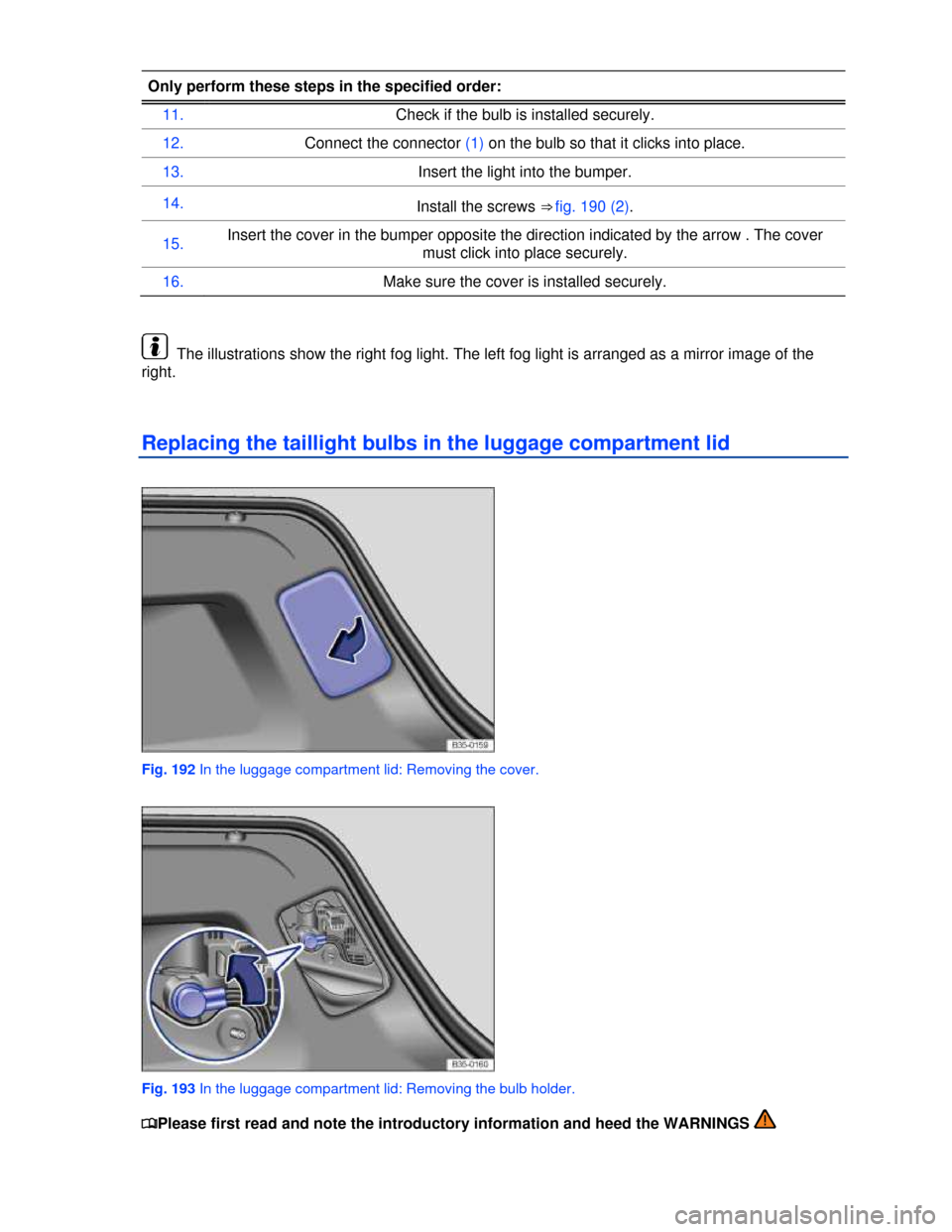
Fig. 192 In the luggage compartment lid: Removing the cover.
Fig. 193 In the luggage compartment lid: Removing the bulb holder.
Page 341 of 353

Only perform these steps in the specified order:
1. Follow the checklist and perform the steps.
2. Open the luggage compartment lid
3. Carefully pry the cover off ⇒ fig. 192 using the flat screwdriver blade from the vehicle tool
kit ⇒ fig. 170.
4. Turn the bulb holder approximately 30° counterclockwise and remove it with the bulb.
5. Replace burned out bulbs with new bulbs that are identical to the ones being replaced.
6. Insert the bulb holder in the taillight and turn it approximately 30° clockwise. The bulb
holder must click into place.
7. Insert the cover. The cover must lock into place and be secure.
LEDs in the taillights in the luggage compartment lid
LEDs cannot be replaced. Contact your authorized Volkswagen dealer or authorized Volkswagen
Service Facility for assistance.
Different models may have different lights, and the location and design of covers, bulb holders,
and bulbs may be in a different location than shown in the illustrations.
Page 346 of 353
Attaching jumper cables
1. Switch off the ignition in both vehicles
2. Open the battery cover in the engine compartment if the battery has a cover or flip open the cap
on the positive jump-start terminal11 , ⇒ fig. 196 (+).
3. Attach one end of the red jumper cable to the positive terminal (+) of the dead battery: (1) ⇒ .
4. Attach the other end of the red jumper cable to the positive terminal (+) of the good battery
(booster battery): (2).
5. Attach one end of the black jumper cable to the negative terminal (-) of the booster battery: (2) .
6. Attach the other end of the black jumper cable (3) to a bare metal part of the vehicle with the
dead battery. This part should be connected directly to the engine block. You may also attach the
cable to the engine block itself. Attach the clamp to a point that is as far away as possible from the
dead battery (1) ⇒ .
7. Route the jumper cables so that they cannot get caught in any moving parts in the engine
compartment of either vehicle.
Starting the engine
x Start the engine of the vehicle with the good battery that is providing help and let it run at idle
speed.
x Turn on the ignition of the vehicle with the dead battery. If the engine starts, wait 2 to 3 minutes
until it “runs smoothly” before removing the jumper cables as described below ⇒ . If the engine
does not start within about 10 seconds, turn off the ignition and wait at least 1 minute; then try again.
Before removing the jumper cables
x Switch off the headlights (if they are on).
x In the vehicle with the dead battery, switch on the heater fan and the rear window defroster. This
helps to minimize voltage spikes when the cables are disconnected.
Removing jumper cables
With the engine running, remove the jumper cables in reverse order to the way they were connected.
1. Disconnect the black (-) cable from the vehicle with the dead battery.
2. Disconnect the black (-) cable from the other vehicle (vehicle with the good battery).
3. Disconnect the red (+) cable from the other vehicle (vehicle with the good battery).
4. Disconnect the red (+) cable from the vehicle with the dead battery.
5. Close the battery cover or snap shut the cap on the positive jump-start terminal11, as the case may
be.
6. If necessary, unscrew the towing eye on the front of the vehicle
11 For vehicles without a battery in the engine compartment, see ⇒ page 330
Page 347 of 353

WARNING
Improper use of jumper cables when jump-starting a vehicle with a dead battery can cause
the battery to explode, leading to serious personal injury. To help reduce the risk of battery
explosion:
x All work on the batteries or the electrical system in your vehicle can cause serious acid
burns, fires, or electrical shocks. Always read and heed the following WARNINGS and safety
precautions before working on the batteries or the electrical system 260, Vehicle battery.
x Always wear proper eye protection. Never lean over the vehicle battery.
x Attach the jumper cables in the correct order: first the positive cable, then the negative
cable.
x Never connect the negative cable from the vehicle providing starting assistance to parts
of the fuel system or to the brake hoses or brake lines.
x Never allow the non-insulated parts of the battery clamps to touch.
x Never allow the jumper cable attached to the positive battery terminal to contact metal
parts of the vehicle.
x Check the battery acid level indicator window on the vehicle battery. Use a flashlight,
never a match, cigarette lighter, or other open flame. If you cannot see the color of the
window clearly, or if it is light yellow or colorless, do not jump-start the vehicle. Get expert
assistance.
x Avoid electrostatic discharge in the vicinity of the vehicle battery. Sparks may cause the
hydrogen gas escaping from the vehicle battery to ignite.
x Never jump-start a vehicle with a battery that is damaged or frozen or that was frozen and
has thawed. The battery can explode. Replace the battery instead.
x Always follow the instructions of the jumper cable manufacturer.
x Always make sure that the battery providing starting assistance has the same voltage as
the dead battery (12 V) and about the same capacity (see battery label).
x Batteries give off explosive hydrogen gas. Always keep fire, sparks, open flame and
smoking materials away from batteries.
x Never connect the negative cable from the other vehicle directly to the negative terminal
of the dead battery. The hydrogen gas from the battery is explosive.
x Never short out the battery terminals by connecting the positive (+) and negative (-)
terminals with each other.
Page 352 of 353

Abbreviations
Abbreviation Meaning
5S man 5-speed manual transmission
6S auto 6-speed automatic transmission
6S man 6-speed manual transmission
ABS Anti-lock Brake System
AFS Adaptive Front Lighting System
AKI Anti-Knock Index
ANSI American National Standards Institute
ASR Anti-Slip Regulation
ATA Anti-Theft Alarm system
BAS Brake Assist System
ccm Cubic centimeter – metric unit of measure for engine displacement
CCS Cruise Control System
CID Cubic inch displacement – unit of measure for engine displacement
cm Centimeter – metric unit of measure for length
CO2 Carbon dioxide
DIN Deutsches Institut für Normung (German Institute for Standardization)
DRL Daytime Running Lights
DSG® Direct Shift Gearbox automatic transmission
EDL Electronic Differential Lock
EN European Norm
EPC Engine control (Electronic Power Control)
ESC Electronic Stability Control
g/km Generated carbon monoxide amount in grams per kilometer driven
GAWR Gross Axle Weight Rating
GVWR Gross Vehicle Weight Rating
HID High Intensity Discharge headlights (Xenon)
hp Horsepower – unit of measure for engine power
kg Kilogram – metric unit of measure for weight
kN Kilonewton – a unit of measure for force
kp Kilopond – unit of measure for force
kPa Kilopascal – unit of measure for tire pressure
kW Kilowatt – engine rating
LED Light Emitting Diode
m Meter – metric unit of measure for length