warning VOLKSWAGEN PASSAT CC 2013 1.G Owners Manual
[x] Cancel search | Manufacturer: VOLKSWAGEN, Model Year: 2013, Model line: PASSAT CC, Model: VOLKSWAGEN PASSAT CC 2013 1.GPages: 353, PDF Size: 5.56 MB
Page 277 of 353

Tires and wheel rims approved by Volkswagen have been matched precisely to your vehicle model
and contribute considerably to good handling and safe vehicle performance.
Tightening torque
Wheel bolts must always be installed with the correct tightening torque . The required tightening
torque for your vehicle's wheel bolts is 88 ft-lbs (120 Nm). After changing a wheel, the bolt torque
must be checked as soon as possible with an accurate torque wrench. See an authorized Volkswagen
dealer or an authorized Volkswagen Service Facility.
Wheel rims with bolted rim rings
Wheel rims with bolted rim rings have several parts. The parts are bolted together with special screws
in a special process. This helps to ensure that they will work properly, prevent leaks, run true and
safely. Damaged wheel rims must be replaced, and you must never take them apart or try to repair
them yourself. Have an authorized Volkswagen dealer or an authorized Volkswagen Service Facility
repair them for you ⇒ .
Wheel rims with bolted decorative covers
Light-alloy wheels may have interchangeable decorative covers attached to the rim with self-locking
screws. If you want to replace damaged wheel covers, contact your authorized Volkswagen dealer or
authorized Volkswagen Service Facility.
WARNING
Using improper or damaged wheel rims can affect driving safety, cause accidents and severe
personal injury.
x Use only wheel rims approved for the vehicle.
x Regularly check wheel rims for damage and replace them if necessary.
WARNING
Improper loosening and tightening of the bolts on wheel rims with bolted rim rings can cause
accidents and severe personal injury.
x Never loosen bolted connections on wheel rims with bolted rim rings.
x Have all work on wheel rims with bolted rim rings performed by an authorized Volkswagen
dealer or authorized Volkswagen Service Facility.
Page 279 of 353

Under- or over-inflation significantly shortens the service life of your tires and affects the handling of
the vehicle ⇒ . The correct tire pressure is very important, particularly when the vehicle is driven at
higher speeds. Incorrect tire pressure causes increased wear and even sudden tire failure and
blowouts.
Therefore, tire pressure should be checked at least once a month and always before long trips.
The specified tire inflation pressure applies to a cold tire. When tires are warm, the pressure will be
higher than when the tires are cold.
Do not reduce the tire pressure on warm tires to match the required cold tire inflation pressure. The
tire inflation pressure would then be too low and could cause sudden tire failure and blowout.
Checking tire inflation pressure
Always check the tire pressure only on “cold” tires when the vehicle has not been driven more than a
couple of miles (kilometers) at low speed within the last 3 hours.
x Check tire inflation pressure regularly and on cold tires. Check all the tires, including the compact
spare, if any. In colder climates tire pressure should be checked more often, but only when the tires
are cold. Always use an accurate tire pressure gauge.
x Adjust the tire pressure for heavy loads accordingly.
x After adjusting the tire inflation pressures, make sure to screw the valve caps back on; replace
missing valve caps immediately. Please read and heed the information on resetting the Tire Pressure
Monitoring System, if necessary
x Remember that the vehicle manufacturer, not the tire manufacturer, determines the correct tire
pressure for the tires on your vehicle. Never exceed the maximum inflation pressure listed on the tire
sidewall for any reason.
Inflate a spare wheel to the pressure specified for the vehicle's road wheels on the tire pressure label;
inflate a compact spare wheel to the pressure specified for the compact spare on the tire pressure
label or on a separate label for the compact spare, if there is one.
WARNING
Incorrect tire pressure can cause a sudden tire failure or blowout, loss of control, collision,
serious personal injury, and even death.
x Always inflate tires to the recommended and correct cold tire pressure before driving off.
x Low tire pressure can cause tires to get too hot, resulting in tread separation, sudden loss
of pressure, and blowouts. Tires with excessively low pressure flex (bend) more, which can
cause the tire to overheat and fail suddenly without warning.
x Excessive speed and/or overloading can cause heat build-up, sudden tire failure including
a blowout and sudden deflation and loss of control.
x If the tire pressure is too low or too high, the tires will wear prematurely and the vehicle
will not handle well.
x Regularly check tire inflation pressure, at least once a month, and also especially before a
long trip.
x Check the pressure in all 4 tires when the tires are still cold. Never reduce air pressure in
warm tires to match cold tire inflation pressure.
NOTICE
x Make sure not to jam the tire pressure gauge into the valve stem. Otherwise, you can
damage the tire valves.
x Driving without valve caps, with the wrong valve caps, or with valve caps that are not
properly screwed on can damage the tire valves. To help prevent damage, always use valve
Page 283 of 353

WARNING
Worn tires are dangerous and can cause loss of vehicle control including serious personal
injuries.
x Never drive a vehicle when the tread on any tire is worn down to the wear indicators,
replace them sooner.
x Worn tires do not grip the road properly, especially on wet roads, increasing your risk of
“hydroplaning” and loss of control.
x Worn tires reduce the ability of your vehicle to handle well in normal and difficult driving
situations and increase braking distances and the risk of skidding.
Tire wear and damage
Page 284 of 353
WARNING
Unusual vibrations or pulling to one side can indicate tire damage.
x Reduce speed immediately and stop when it is safe to do so.
x Check tires and wheel rims for damage.
x Never drive with a damaged tire or rim. Get expert assistance instead.
x If no external damage is visible, slowly and carefully drive to the nearest authorized
Volkswagen dealer, authorized Volkswagen Service Facility, or other qualified workshop and
have the vehicle checked.
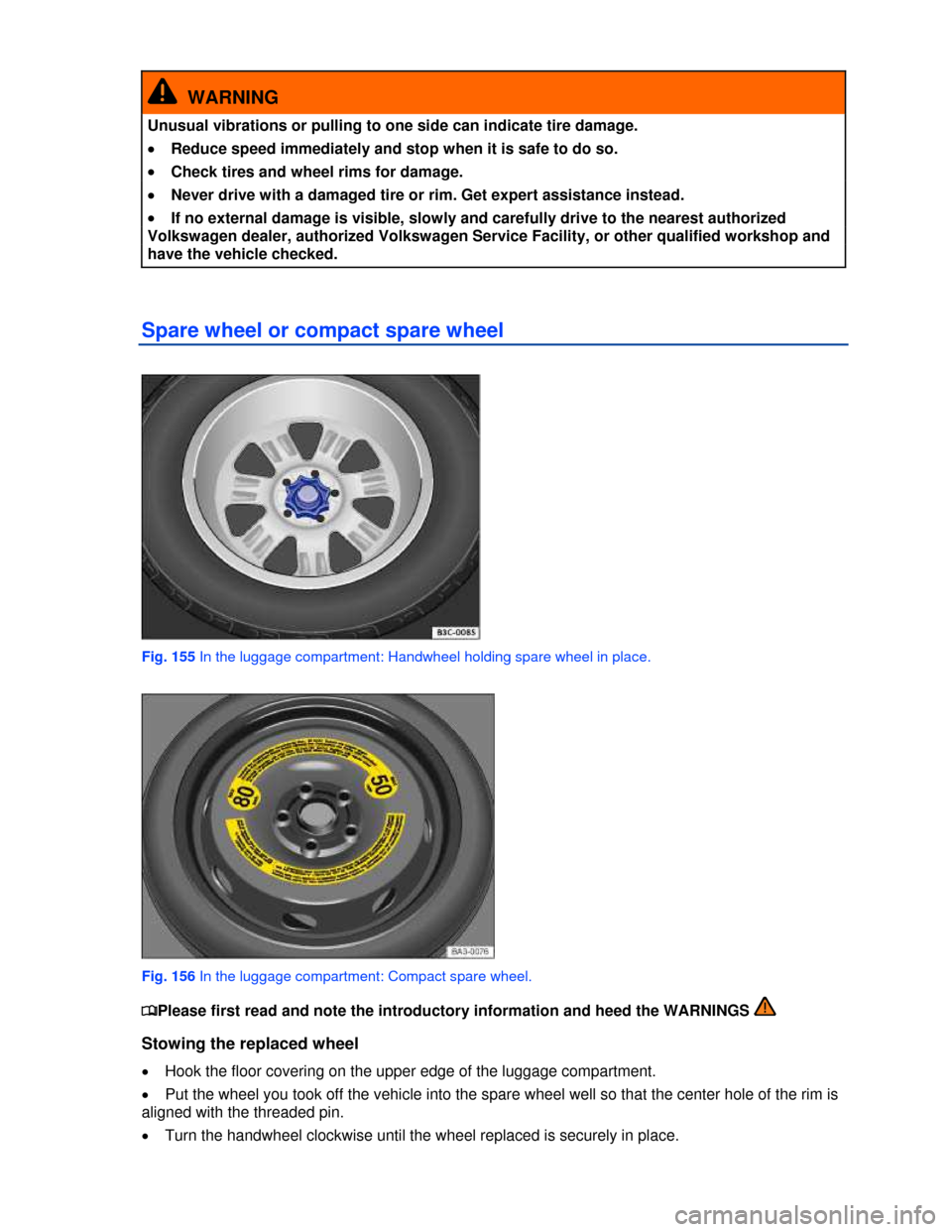
Spare wheel or compact spare wheel
Fig. 155 In the luggage compartment: Handwheel holding spare wheel in place.
Fig. 156 In the luggage compartment: Compact spare wheel.
Page 285 of 353

x If necessary, return the vehicle tool kit to its location in the luggage compartment.
x Unhook the floor covering and fold it back down onto the floor of the luggage compartment.
x Close the luggage compartment lid.
If the spare wheel is different from the road wheels
If the spare is different from the road wheels, a compact spare wheel, for example, or if the road
wheels are winter tires, the spare wheel must be used only in the event of a flat tire, only for a brief
time, and only when driving with extra caution ⇒ .
Replace it with a tire matching the others on your vehicle as soon as possible.
Please heed the following:
x Do not drive faster than 50 mph (80 km/h)!
x Avoid full-throttle acceleration, hard braking and fast cornering!
x Do not use snow chains on the compact spare wheel
x After installing the spare wheel or compact spare wheel, check the tire pressure as soon as
possible
Check the tire inflation pressure of the spare or compact spare whenever you check the tire pressure
of the road wheels, at least once a month. Inflate a spare wheel to the cold tire pressure specified for
the vehicle's road wheels on the tire pressure label; inflate a compact spare wheel to the cold tire
pressure specified for the compact spare on the tire pressure label or on a separate label for the
compact spare, if there is one.
WARNING
Improper use of a spare wheel or a compact spare wheel can cause loss of vehicle control, a
crash or other accident, and serious personal injury.
x Never use a spare wheel or compact spare wheel if it is damaged or worn down to the
wear indicators.
x In some vehicles, the spare wheel or compact spare wheel is smaller than the original tire.
A smaller compact spare wheel is identified with a sticker and the words “50 mph” or
“80 km/h”. This is the maximum permissible speed when driving with this tire.
x Never drive faster than 50 mph (80 km/h) with a compact spare wheel. Avoid full-throttle
acceleration, heavy braking, and fast cornering!
x Never drive more than 125 miles (200 km) if a compact spare wheel is installed on the front
axle (drive axle).
x Replace the compact spare with a normal wheel and tire as soon as possible. Compact
spare tires are designed for brief use only.
x Regularly check the U.S. DOT Tire Identification Number (TIN) to determine the age of the
compact spare wheel Tires age even if they are not being used and can fail suddenly,
especially at higher speeds.
x Tires that are more than 6 years old can only be used in an emergency and then with
special care and at lower speeds.
x The compact spare wheel must always be secured with the wheel bolts provided by the
factory.
x Never drive using more than one compact spare wheel.
x After installing the compact spare wheel, the tire pressure must be checked as soon as
possible
x Snow chains cannot be used on the compact spare wheel. If you must use snow chains
and have a compact spare wheel mounted, move the compact spare wheel to the rear axle if a
front tire has to be replaced. The tire taken off the rear axle can then be used to replace the
flat front tire. Be sure you do not change the tire's direction of rotation. Install the snow
chains on the full-sized road tire.
Page 289 of 353

WARNING
Using incorrect or unmatched tires and/or wheels or improper tire and wheel combinations
can lead to loss of control, collision and serious personal injury.
x Always use tires, wheels and wheel bolts that meet the specifications of the original
factory-installed tires or other combinations that have been specifically approved by the
vehicle manufacturer.
x All 4 wheels must be fitted with radial tires of the same type, the same size (tread
circumference), and the same tread pattern. Driving with different tires reduces vehicle
handling and can lead to a loss of control.
x Never drive faster than the maximum speed for which the tires installed on your vehicle
are rated because tires that are driven faster than their rated speed can fail suddenly.
x Overloading tires can cause heat build-up, sudden tire failure, including a blowout and
sudden deflation and loss of control.
x Temperature grades apply to tires that are properly inflated and not over- or underinflated.
Winter tires
Page 290 of 353

All-wheel drive (4MOTION)
Vehicles with all-wheel drive and standard road wheels have good forward motion and traction even
under wintery road conditions. However, Volkswagen recommends installing winter tires or all season
tires on all four wheels to improve handling as well as braking performance.
If you use snow chains, please read and heed information and directions
WARNING
Driving faster than the maximum speed for which the winter tires on your vehicle were
designed can cause sudden tire failure including a blowout and sudden deflation, loss of
control, crashes and serious personal injuries.
x Winter tires have a maximum speed rating that may be lower than your vehicle's maximum
speed.
x Never drive faster than the maximum speed for which the winter tires installed on your
vehicle are rated because tires that are driven faster than their rated speed can fail suddenly.
x Never exceed the maximum load rating for the winter tires installed on your vehicle.
Install summer tires promptly in the spring. Summer tires offer better handling characteristics for
temperatures above +45 °F (+7 °C). They are quieter, do not wear as quickly, and reduce fuel
consumption.
If new tires are not identical to those that were removed and require different cold tire inflation
pressure, the tire inflation pressure values must be reprogrammed for the TPMS. Please see your
authorized Volkswagen dealer or authorized Volkswagen Service Facility 229.Whenever you remove
and remount or change any wheel or tire on the vehicle, the Tire Pressure Monitoring System must be
recalibrated, even if the reinstalled or replacement wheels and tires are identical to those that were
removed and even if the tire pressure does not change 231.
If necessary, ask your authorized Volkswagen dealer or authorized Volkswagen Service Facility
about permissible winter tire dimensions.
Snow chains
Page 291 of 353
If you must use snow chains and have a compact spare wheel mounted, move the compact spare
wheel to the rear axle if a front tire has to be replaced. The tire taken off the rear axle can then be
used to replace the flat front tire. Be sure to install the unidirectional tires so that they will run in the
proper direction. Volkswagen recommends installing the snow chains before mounting the wheel to
the vehicle.
WARNING
Using the wrong snow chains or installing snow chains improperly can cause accidents and
severe personal injuries.
x Always use the proper snow chains.
x Follow the installation instructions provided by the snow chain manufacturer.
x Never exceed the permissible speed limit when driving with snow chains.
NOTICE
x Remove snow chains when roads are free of snow. Otherwise, the chains can damage the
tires, impair vehicle handling and can be quickly worn down.
x Snow chains can scratch or damage wheel rims if they have direct contact with the rims.
Volkswagen recommends using coated snow chains.
Glossary of tire and loading terminology
Page 294 of 353

Section width
The linear distance between the exteriors of the sidewalls of an inflated tire, excluding elevations due
to labeling decoration, or protective bands.
Sidewall
The portion of a tire between the bead and the tread.
Sidewall separation
The parting of the rubber compound from the cord material in the sidewall.
Speed rating (letter code)
A standardized letter code indicating the maximum speed at which a tire is designed to be driven for
extended periods of time. The ratings range from 93 mph or 150 km/h (“P”) to 186 mph or (300 km/h)
“Y”.
The speed rating letter code, where applicable, is molded on the tire sidewall , Tire labeling. You may
not find this information on all tires because it is not required by law.
Tire Pressure Monitoring System
A system that detects when at least one of a vehicle's tires is underinflated and illuminates a low tire-
pressure warning light.
Tread
The portion of a tire that normally touches the road.
Tread rib
A tread section running circumferentially around a tire.
Tread separation
Tire failure caused by the tread pulling away from the tire carcass.
Tread wear indicators (TWI)
Raised areas within the main tread grooves that show, visually, when tires are worn and near the end
of their useful life 278, Tread depth and tread wear indicators.
Uniform Tire Quality Grading (UTQG)
A tire information system developed by the U.S. National Highway Traffic Safety Administration
(NHTSA) that is designed to help buyers compare tires. UTQG is not a safety rating, nor is it a
guarantee that a tire will last for a certain number of miles or perform a certain way. It gives tire buyers
more information to compare with factors such as price, brand loyalty and dealer recommendations.
Under UTQG, tires are graded by the tire manufacturers in 3 areas: tread wear, traction and
temperature resistance. UTQG information is molded into the tire sidewalls.
U.S. DOT Tire Identification Number (TIN)
A tire's serial number. It begins with the letters “DOT” (“Department of Transportation”) and indicates
that the tire meets all federal standards. The next 2 numbers or letters indicate the plant where the tire
was manufactured. The last 4 numbers represent the week and year of manufacture.
For example, the numbers 1709 mean that the tire was produced in the 17th week of 2009. Any other
numbers are marketing codes used by the tire manufacturer. This information is used to help identify
affected consumers if a tire defect requires a recall.
Vehicle capacity weight
The total rated cargo, luggage and passenger load. Passenger load is 150 lbs (68 kilograms) times the
vehicle's total seating capacity (as listed on the label inside the driver door).
Page 296 of 353
WARNING
Overloading a vehicle can cause loss of vehicle control, a crash or other accident, serious
personal injury, and even death.
x Carrying more weight than your vehicle was designed to carry will prevent the vehicle
from handling properly and increase the risk of the loss of vehicle control.
x The brakes on a vehicle that has been overloaded may not be able to stop the vehicle in a
safe distance.
x Tires on a vehicle that has been overloaded can fail suddenly, including a blowout and
sudden deflation, causing loss of control and a crash.
x Always make sure that the total load being transported – including the weight of a trailer
hitch and the tongue weight of a loaded trailer – does not make the vehicle heavier than the
vehicle's Gross Vehicle Weight Rating.
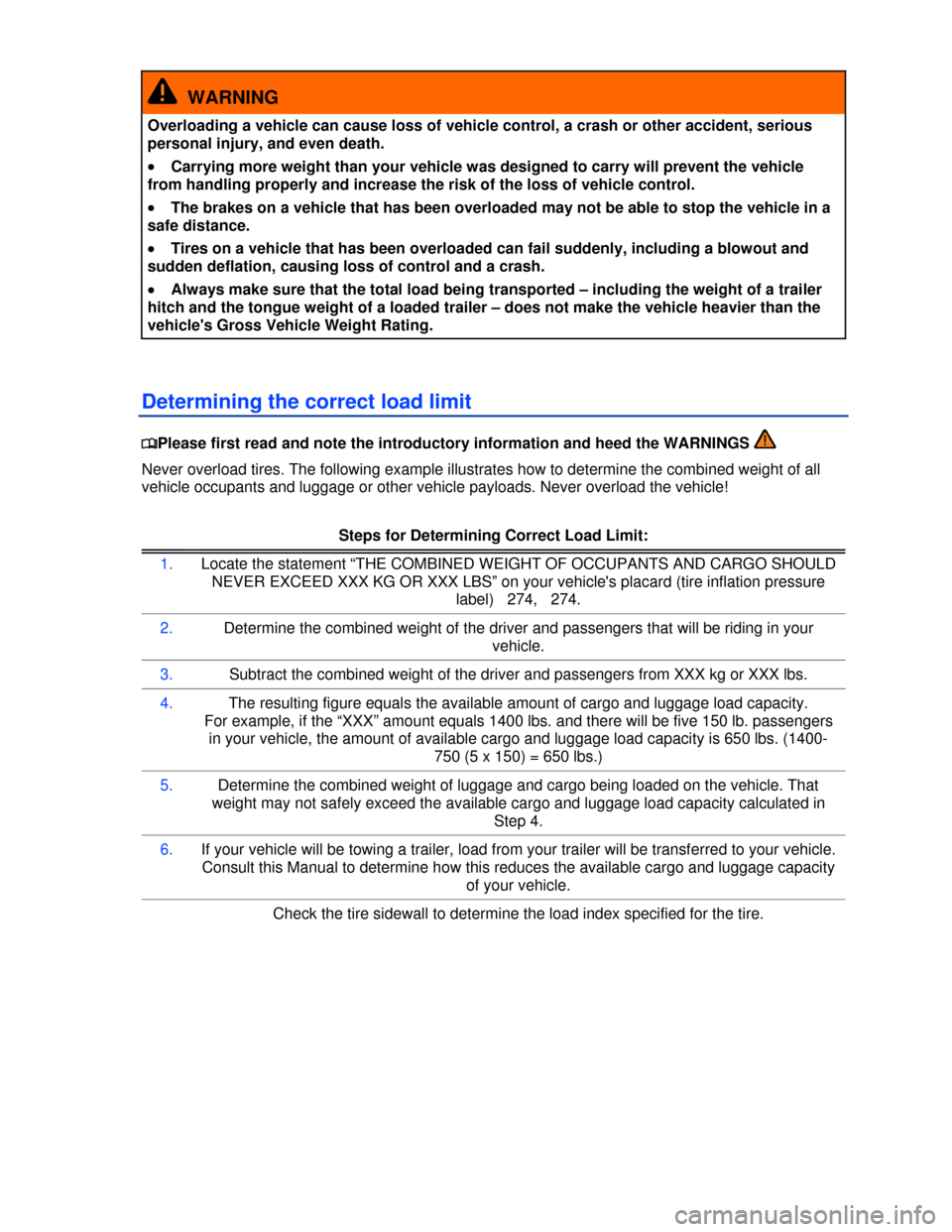
Determining the correct load limit