wheel VOLKSWAGEN PASSAT CC 2013 1.G Workshop Manual
[x] Cancel search | Manufacturer: VOLKSWAGEN, Model Year: 2013, Model line: PASSAT CC, Model: VOLKSWAGEN PASSAT CC 2013 1.GPages: 353, PDF Size: 5.56 MB
Page 291 of 353
If you must use snow chains and have a compact spare wheel mounted, move the compact spare
wheel to the rear axle if a front tire has to be replaced. The tire taken off the rear axle can then be
used to replace the flat front tire. Be sure to install the unidirectional tires so that they will run in the
proper direction. Volkswagen recommends installing the snow chains before mounting the wheel to
the vehicle.
WARNING
Using the wrong snow chains or installing snow chains improperly can cause accidents and
severe personal injuries.
x Always use the proper snow chains.
x Follow the installation instructions provided by the snow chain manufacturer.
x Never exceed the permissible speed limit when driving with snow chains.
NOTICE
x Remove snow chains when roads are free of snow. Otherwise, the chains can damage the
tires, impair vehicle handling and can be quickly worn down.
x Snow chains can scratch or damage wheel rims if they have direct contact with the rims.
Volkswagen recommends using coated snow chains.
Glossary of tire and loading terminology
Page 293 of 353

Outer diameter
The diameter of a new, properly inflated tire.
Overall width
Total width measured at the exterior sidewalls of an inflated tire, including the additional width of
labeling, decorations, or protective bands or ribs.
Passenger car tire
A tire intended for use on passenger cars, multipurpose passenger vehicles, and trucks, that have a
gross vehicle weight rating (GVWR) of 10,000 pounds or less.
Ply
A layer of rubber-coated parallel cords.
Ply separation
A parting of rubber compound between adjacent plies.
Pneumatic tire
A mechanical device made of rubber, chemicals, fabric, and steel or other materials, that, when
mounted on an automotive wheel, provides the traction and contains the gas or fluid that sustains the
load.
Production options weight
The combined weight of installed regular production options weighing over 5 lbs (2.3 kg) more then the
standard items they replace, and not previously considered as curb weight or accessory weight. These
include, for example, heavy-duty brakes, ride levelers, roof rack, heavy-duty battery, and special trim.
Radial ply tires
A pneumatic tire in which the ply cords that extend to the beads are laid at substantially 90 degrees to
the centerline of the tread.
Recommended inflation pressure
The tire pressure recommended by the vehicle manufacturer for a tire of a specified size that has not
been driven for more than a couple of miles (kilometers) at low speeds in the 3 hour period before the
tire pressure is measured or adjusted.
Reinforced tire
A tire designed to operate at higher loads and at higher inflation pressures than the corresponding
standard tire.
Rim
The outer edge of a wheel upon which the tire beads are seated.
Rim diameter
The nominal diameter of the wheel's tire bead seating surface. If you change your wheel size, to
wheels of a different diameter, you will have to purchase new tires to match the new wheels.
Rim size
Designation means rim diameter and width.
Rim type designation
The industry or manufacturer's designation for a rim by style or code.
Rim width
The nominal distance between wheel rim flanges.
Page 295 of 353
Vehicle maximum load on the tire
The load on an individual tire that is determined by taking each axle's share of the maximum loaded
vehicle weight (GAWR) and dividing by 2.
Vehicle normal load on the tire
The load on an individual tire that is determined by taking each axle's share of the curb weight,
accessory weight, and normal occupant weight (distributed according to the table below) and dividing
by 2.
Wheel size designation
Wheel rim diameter and width.
Occupant loading and distribution for vehicle normal load for various designated seating
capacities
Designated seating capacity,
number of occupants
Vehicle normal load, number
of occupants
Occupant distribution in a
normally loaded vehicle
2, 3, or 4 2 2 in front
5 3 2 in front, 1 in back
Tires and vehicle load limits
Page 298 of 353

WARNING
Inappropriate spare parts and accessories as well as improperly performed work,
modifications and repairs can cause vehicle damage, accidents and serious personal
injuries.
x Volkswagen strongly recommends to only use accessories approved by Volkswagen and
Genuine Volkswagen Parts®. These parts and accessories have been evaluated by
Volkswagen for their suitability, reliability and safety.
x Have repairs and vehicle modifications performed by an authorized Volkswagen dealer or
authorized Volkswagen Service Facility. Authorized Volkswagen dealers and authorized
Volkswagen Service Facilities have the required tools, diagnostic equipment, repair
information, and trained personnel to properly replace any airbag in your vehicle and assure
system effectiveness in a crash.
x Only install parts on the vehicle that are consistent with factory-installed parts with
respect to design and characteristics.
x Never store, mount, or attach objects, such as cup holders or phone cradles, on or next to
the airbag module covers or within the airbags deployment zones.
x Only use wheel rim/tire combinations approved by Volkswagen for the respective vehicle
type.
Break-in period
Page 302 of 353

WARNING
A mobile phone on the seat, instrument panel or in other places can be thrown around the
inside of the vehicle during a sudden braking maneuver, a crash or other accident and injure
vehicle occupants.
x Never place or attach accessories or other objects (such as cup holders, telephone
brackets, note pads, navigation systems, large, heavy or bulky objects) on the doors, on the
windshield, over or near the area marked “AIRBAG” on the steering wheel, instrument panel,
backrests or between these areas and the occupant. Such objects could cause serious injury
in a collision, especially if an airbag inflates.
WARNING
Using a mobile phone or CB radio inside the vehicle without a properly installed and separate
outside antenna can be dangerous to your health and that of your passengers because the
electromagnetic radiation energy that cell phones and CB radios emit may be above
established limits. This also applies if the outside antenna is not installed properly.
x Always keep the mobile phone antenna at least 8 in. (20 cm) away from pacemakers. Heart
specialists advise that cell phones can adversely affect the way pacemakers work.
x Never carry a mobile phone that is switched on in the breast pocket directly over a
pacemaker.
x If you suspect there may be interference with a pacemaker or other medical device, switch
the mobile phone off immediately.
Page 311 of 353

Frequently asked questions
If you suspect a malfunction or vehicle damage, read and follow the following advice before contacting
an authorized Volkswagen dealer or an authorized Volkswagen Service Facility. You may also find
helpful information under “Special considerations” or “Checklist” in the index.
Description Possible causes, among
others Possible remedy
Engine does not start.
Vehicle battery dead. – Perform jump-start
– Charge vehicle battery
The wrong vehicle key is used. Use a valid vehicle key
Fuel level too low. Refuel
Vehicle cannot be locked
or unlocked using vehicle
key.
– Battery in the remote control
vehicle key is dead.
– Too far away from the
vehicle (out of range).
– Buttons have been pressed
too many times.
– Replace the battery in the remote
control vehicle key
– Move closer to vehicle.
– Synchronize vehicle key .
– Lock or unlock vehicle manually
Unusual noises.
Cold engine, braking assist
systems, electronic steering
column lock.
Check the “Noises” entry in the index.
Odd driving behavior.
Assistance systems activated. Check the “Assistance systems” entry
in the index.
DSG® Direct Shift Gearbox too
hot.
Stop vehicle as soon as you can safely
do so.
Driver seat and outside
mirrors move when
vehicle is unlocked.
Convenience settings are
stored. Correct convenience settings
Memory-seat settings are
stored.
– Reassign seat setting.
– Clear memory-seat memory
Front seats cannot be
adjusted with power
controls.
Vehicle battery dead. Charge vehicle battery
Fuse blown. Check fuse and replace if necessary
No jack, spare wheel, or
compact spare wheel in
the vehicle.
Equipment differs depending
on the vehicle.
No direct corrective action possible;
depends on the vehicle equipment.
Contact an authorized Volkswagen
dealer or an authorized Volkswagen
Service Facility for assistance.
Vehicle has run-flat tires
(mobility tires).
Features do not work as
described in this manual.
Settings were adjusted in the
Volkswagen Information
System.
Check and reset to factory settings if
necessary
Headlights do not light up
the road as they should.
– Headlights incorrectly
adjusted.
– Light bulbs burned out.
– Low beams not switched on.
– Have the headlight range adjusted by
an authorized Volkswagen dealer or an
authorized Volkswagen Service
Facility.
– Change light bulbs
– Switch on low beams
Electrical consumers do
not work.
Vehicle battery charge too low. Charge vehicle battery
Remaining fuel level too low. Refuel
Page 325 of 353
Wheel covers
Page 327 of 353
Wheel covers
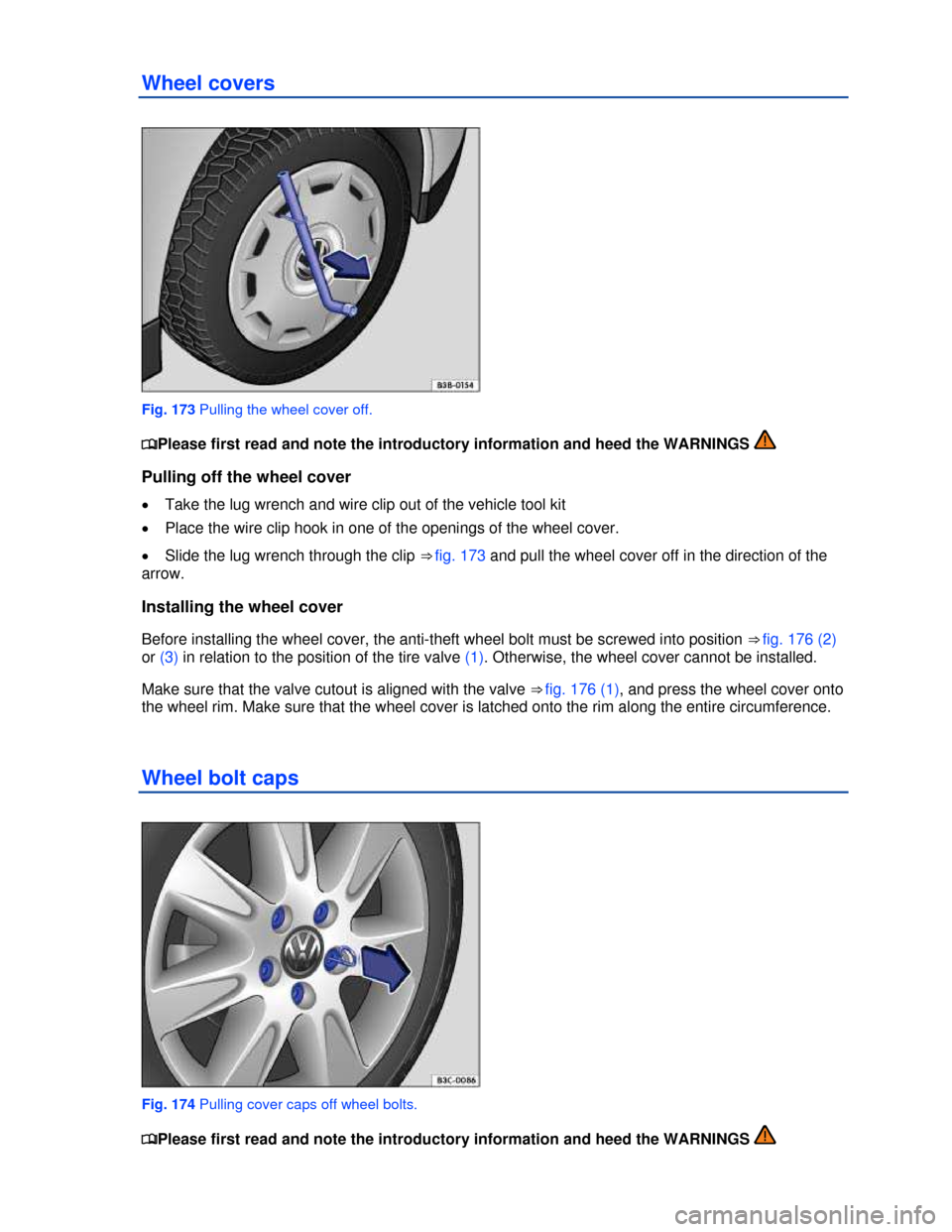
Fig. 173 Pulling the wheel cover off.
Page 328 of 353

x Take the wire clip out of the vehicle tool kit
x Insert the wire clip through the opening of the cover cap ⇒ fig. 174 and pull off in the direction of
the arrow.
The caps are designed to protect the wheel bolts and should be installed again after the wheel
change.
The anti-theft wheel bolt has a separate cap. This only fits the anti-theft wheel bolt, but not the
standard wheel bolts.
Page 350 of 353
NOTICE
The drive axle rotates while the vehicle is being towed with its rear wheels off the ground. This
can damage the automatic transmission.
x Never tow automatic transmission vehicle with the rear wheels off the ground.
x Tow manual transmission vehicles with the rear wheels off the ground only if it is certain
that no transmission fluid can leak out.
Tips on towing