center VOLKSWAGEN PASSAT CC 2014 1.G User Guide
[x] Cancel search | Manufacturer: VOLKSWAGEN, Model Year: 2014, Model line: PASSAT CC, Model: VOLKSWAGEN PASSAT CC 2014 1.GPages: 429, PDF Size: 6.46 MB
Page 164 of 429
WARNING
Improper use of the trailer hitch can cause accidents and injuries. An improperly installed, incorrect, or damaged trailer hitch can cause the trailer to separate from the towing vehicle and cause serious personal injuries.
x Only use an undamaged, properly mounted trailer hitch.
x Never repair or modify the trailer hitch.
x To reduce the risk of injury in rear-end collisions, and the risk to pedestrians and cyclists when the vehicle is parked, always remove the ball mount when you are not towing a trailer.
x Never install a “weight distributing” or “load equalizing” trailer hitch on your vehicle. The vehicle was not designed for these kinds of trailer hitches. The trailer hitch attachment can fail, causing the trailer to tear loose from the vehicle.
WARNING
Improper trailer towing can cause loss of vehicle control and serious personal injury.
x Driving with a trailer and carrying heavy or large things can change the way the vehicle handles, increase the distance it needs to stop safely, and cause accidents.
x Always secure the load properly with suitable and undamaged straps so that the load will not shift.
x Always adapt your speed and driving to the heavier load and the weight distribution in the vehicle. Take road, weather, traffic, and visibility conditions into account as well.
x Reduce your speed even more than you otherwise would when going downhill and under unfavorable load, weather, or wind conditions.
x Trailers with a high center of gravity tip more easily than trailers with a low center of gravity.
x Always avoid sudden maneuvers and hard braking.
x Be especially careful when passing other vehicles.
x Reduce speed immediately if the trailer shows the slightest sign of swaying.
x Never try to stop the swaying by accelerating.
x Always obey speed limits. In some areas, the speed limits for vehicles towing trailers are lower than for vehicles without trailers. Never drive faster than 50 mph (80 km/h; under exceptional circumstances 60 mph - 100 km/h) when towing a trailer. This applies even if the local speed limit is higher.
If you are driving a new vehicle or a vehicle with a new or rebuilt engine, do not tow a trailer during the break-in period, about 600 miles (1000 km), Parts, accessories, repairs, and modifications.
If you tow a trailer, your vehicle may need maintenance more often because of the extra load it has to move.
When you are not towing, remove the trailer hitch ball. This helps keep the trailer hitch from causing damage to your vehicle and to others if your vehicle is hit from behind.
Some models need a trailer hitch to tow or tow-start other vehicles. You may want to always carry the ball mount in the vehicle after it has been removed. Be sure to stow it securely.
Page 170 of 429
These dimensions are important because they help determine the way that the forces that arise during towing are applied to the receiver and its attachments to the vehicle. If you buy a ball mount and ball, make sure that they meet the following specifications.
Ball mount dimensions
x The drop height (A) from the center of the ball to the center of the hole for the securing pin on the ball mount must be at least 1 inch (25.4 mm) and at most 27 /8 inches (73 mm).
x The pin-to-ball distance (B) from the center of the ball to the center of the hole for the securing pin on the ball mount must be no more than 7 inches (178 mm).
x The ball diameter must be no more than 11/4 inches (32 mm).
A ball mount and ball combination that does not meet these specifications can damage your vehicle
and may even fail in use ⇒ .
Never install a “weight distributing” or “load equalizing” trailer hitch on your vehicle. The vehicle is not
designed for this kind of trailer hitch ⇒ .
WARNING
An improperly installed or unsuitable trailer hitch can cause the trailer to separate from the towing vehicle and result in a major accident with serious personal injuries.
x Have any trailer hitch retrofit or other work on a trailer hitch done by a qualified workshop.
CAUTION
The ball mount sticks out behind the rear bumper and can cause injury to pedestrians and cyclists.
x To reduce the risk of injury in rear-end collisions, and the risk to pedestrians and cyclists when the vehicle is parked, always remove the ball carrier when you are not towing a trailer.
NOTICE
x Never use a ball larger than 11/4 inches (32 mm) on your vehicle. The vehicle was not designed to tow heavier trailers with a receiver larger than the specified ball. The increased loads can damage the attachment points for the trailer hitch.
x Never use an adapter to increase the size of the trailer hitch receiver from 11/4 inches (32 mm) to 2 inches (50.8 mm) or more to tow a trailer that is heavier than the maximum permissible trailer weight that your vehicle can tow.
x You can use an adapter if required for the proper installation of a bicycle rack or other similar carrier as long as the maximum weight limits are observed. When using bicycle racks or similar carriers, make sure that the rear lights are not blocked.
x Only use trailer hitches that are approved by the hitch manufacturer for your vehicle and model.
Page 195 of 429
Remove center hubcaps and decorative rim rings before installing snow chains ⇒ . However, for safety reasons, caps must be installed on the wheel bolts. These are available from authorized Volkswagen dealers and authorized Volkswagen Service Facilities.
Compact spare wheel
For technical reasons, snow chains cannot be used on the compact spare, Spare wheel or compact spare wheel.
If you must use snow chains and have a compact spare wheel mounted, move the compact spare wheel to the rear axle if a front tire has to be replaced. The tire taken off the rear axle can then be used to replace the flat front tire. Be sure to install the unidirectional tires so that they will run in the proper direction. Volkswagen recommends installing the snow chains before mounting the wheel to the vehicle.
WARNING
Using the wrong snow chains or installing snow chains improperly can cause accidents and severe personal injuries.
x Always use the proper snow chains.
x Follow the installation instructions provided by the snow chain manufacturer.
x Never exceed the permissible speed limit when driving with snow chains.
NOTICE
x Remove snow chains when roads are free of snow. Otherwise, the chains can damage the tires, impair vehicle handling and can be quickly worn down.
x Snow chains can scratch or damage wheel rims if they have direct contact with the rims. Volkswagen recommends using coated snow chains.
Glossary of tire and loading terminology
Page 197 of 429
Maximum (permissible) inflation pressure
The maximum cold inflation pressure to which a tire may be inflated. Also called “maximum inflation pressure.”
Normal occupant weight
Means 150 lbs (68 kilograms) times the number of occupants seated in the vehicle up to the total seating capacity of your vehicle.
Occupant distribution
The placement of passengers in a vehicle.
Outer diameter
The diameter of a new, properly inflated tire.
Overall width
Total width measured at the exterior sidewalls of an inflated tire, including the additional width of labeling, decorations, or protective bands or ribs.
Passenger car tire
A tire intended for use on passenger cars, multipurpose passenger vehicles, and trucks, that have a gross vehicle weight rating (GVWR) of 10,000 pounds or less.
Ply
A layer of rubber-coated parallel cords.
Ply separation
A parting of rubber compound between adjacent plies.
Pneumatic tire
A mechanical device made of rubber, chemicals, fabric, and steel or other materials, that, when mounted on an automotive wheel, provides the traction and contains the gas or fluid that sustains the load.
Production options weight
The combined weight of installed regular production options weighing over 5 lbs (2.3 kg) more then the standard items they replace, and not previously considered as curb weight or accessory weight. These include, for example, heavy-duty brakes, ride levelers, roof rack, heavy-duty battery, and special trim.
Radial ply tires
A pneumatic tire in which the ply cords that extend to the beads are laid at substantially 90 degrees to the centerline of the tread.
Recommended inflation pressure
The tire pressure recommended by the vehicle manufacturer for a tire of a specified size that has not been driven for more than a couple of miles (kilometers) at low speeds in the 3 hour period before the tire pressure is measured or adjusted.
Reinforced tire
A tire designed to operate at higher loads and at higher inflation pressures than the corresponding standard tire.
Rim
The outer edge of a wheel upon which the tire beads are seated.
Page 220 of 429
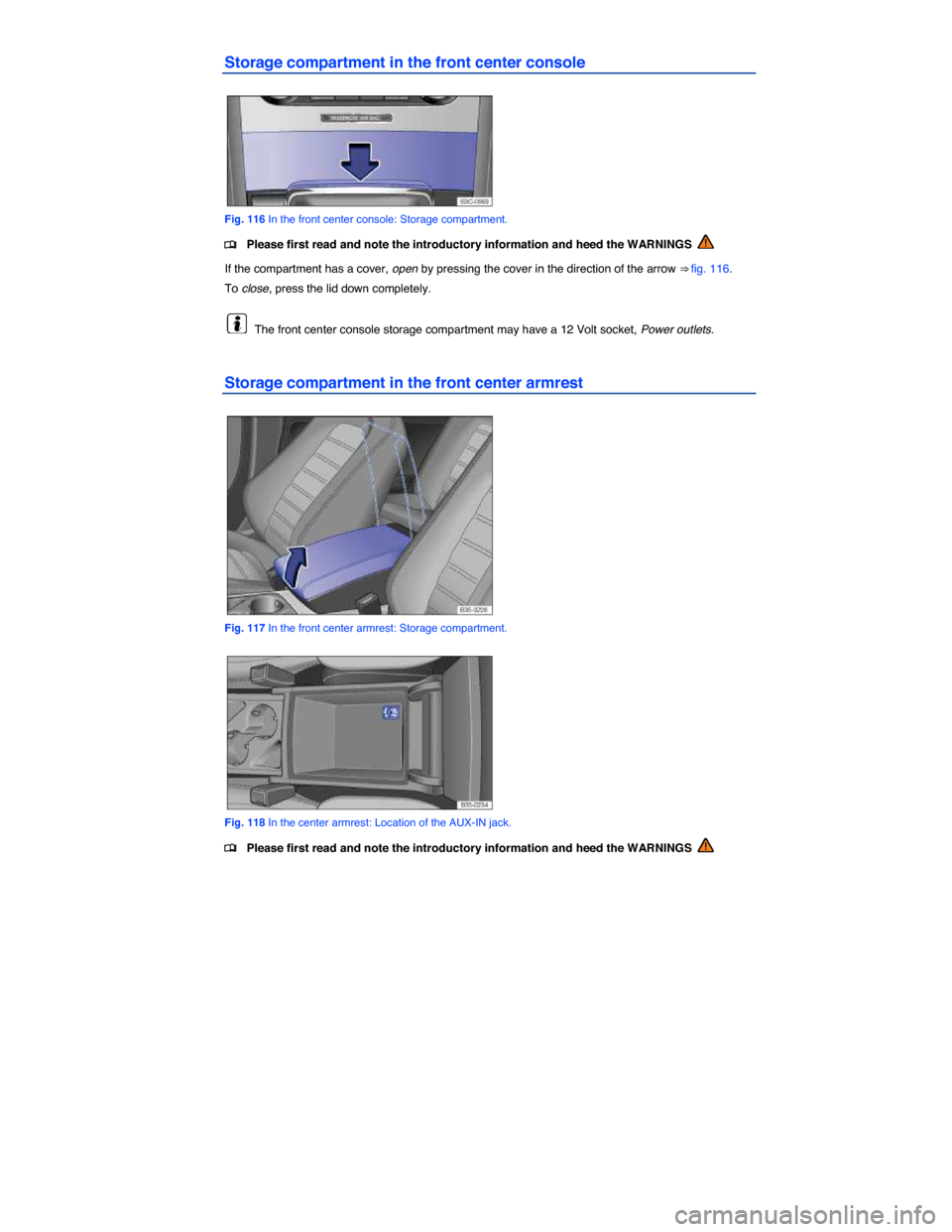
Storage compartment in the front center console
Fig. 116 In the front center console: Storage compartment.
Page 221 of 429
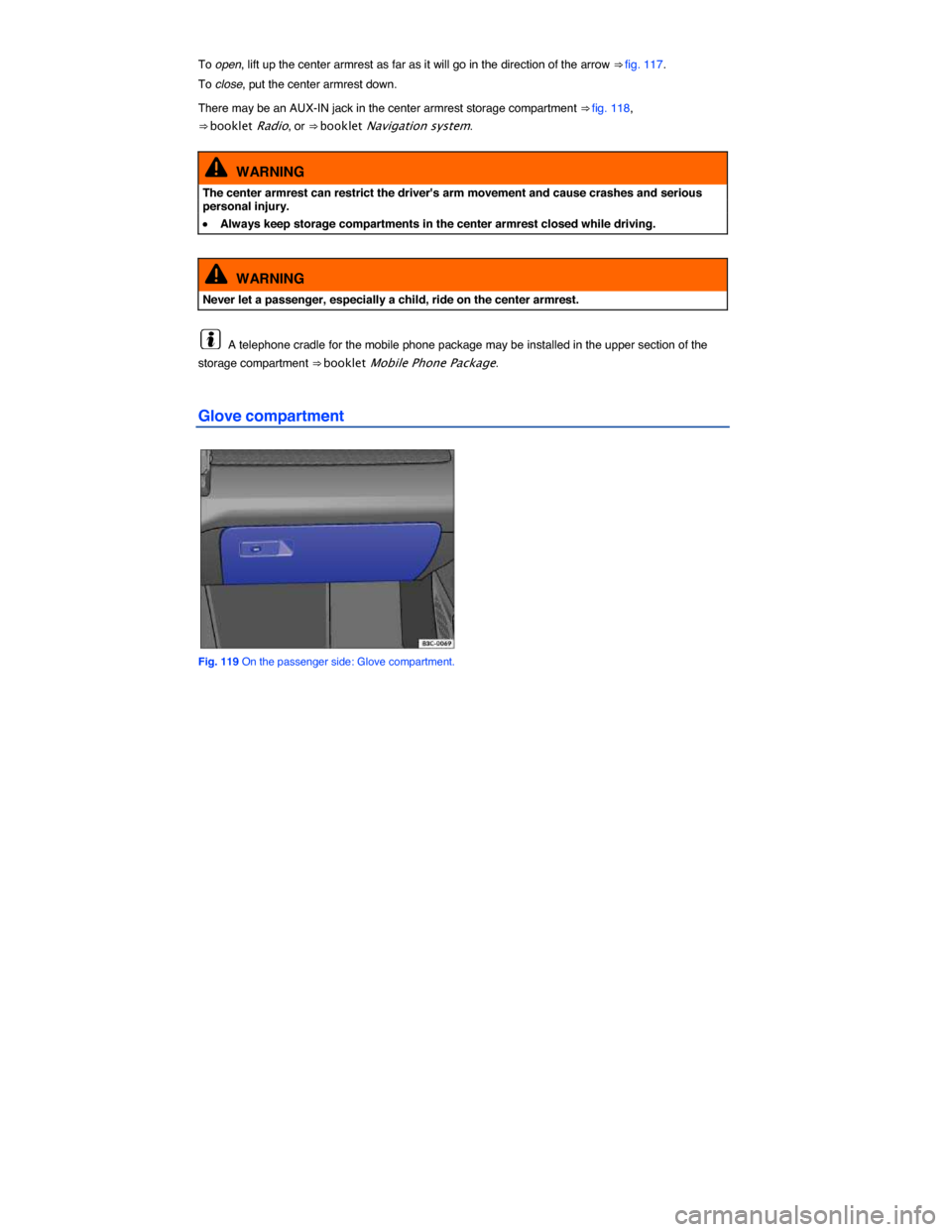
To open, lift up the center armrest as far as it will go in the direction of the arrow ⇒ fig. 117.
To close, put the center armrest down.
There may be an AUX-IN jack in the center armrest storage compartment ⇒ fig. 118,
⇒ booklet Radio, or ⇒ booklet Navigation system.
WARNING
The center armrest can restrict the driver's arm movement and cause crashes and serious personal injury.
x Always keep storage compartments in the center armrest closed while driving.
WARNING
Never let a passenger, especially a child, ride on the center armrest.
A telephone cradle for the mobile phone package may be installed in the upper section of the
storage compartment ⇒ booklet Mobile Phone Package.
Glove compartment
Fig. 119 On the passenger side: Glove compartment.
Page 223 of 429
NOTICE
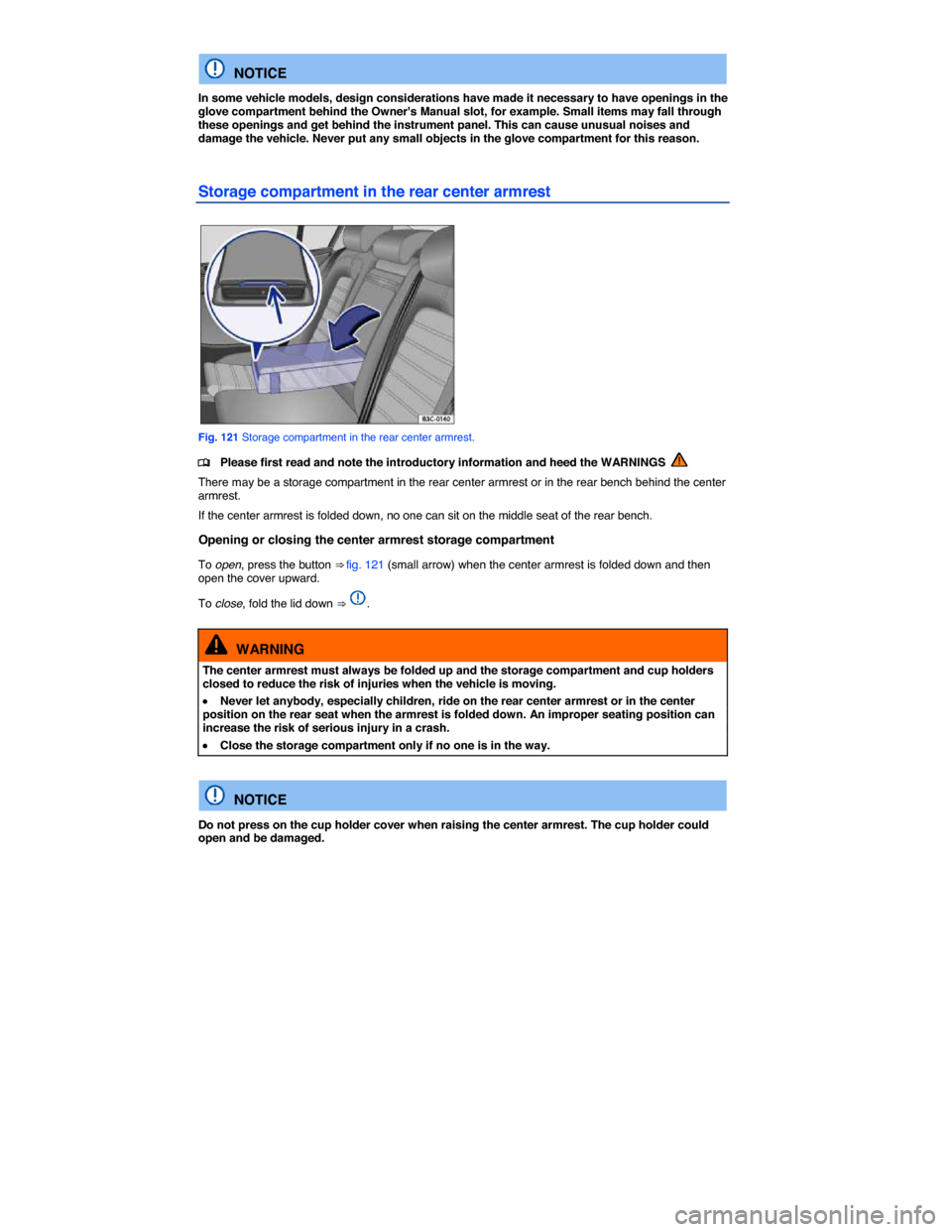
In some vehicle models, design considerations have made it necessary to have openings in the glove compartment behind the Owner's Manual slot, for example. Small items may fall through these openings and get behind the instrument panel. This can cause unusual noises and damage the vehicle. Never put any small objects in the glove compartment for this reason.
Storage compartment in the rear center armrest
Fig. 121 Storage compartment in the rear center armrest.
Page 226 of 429
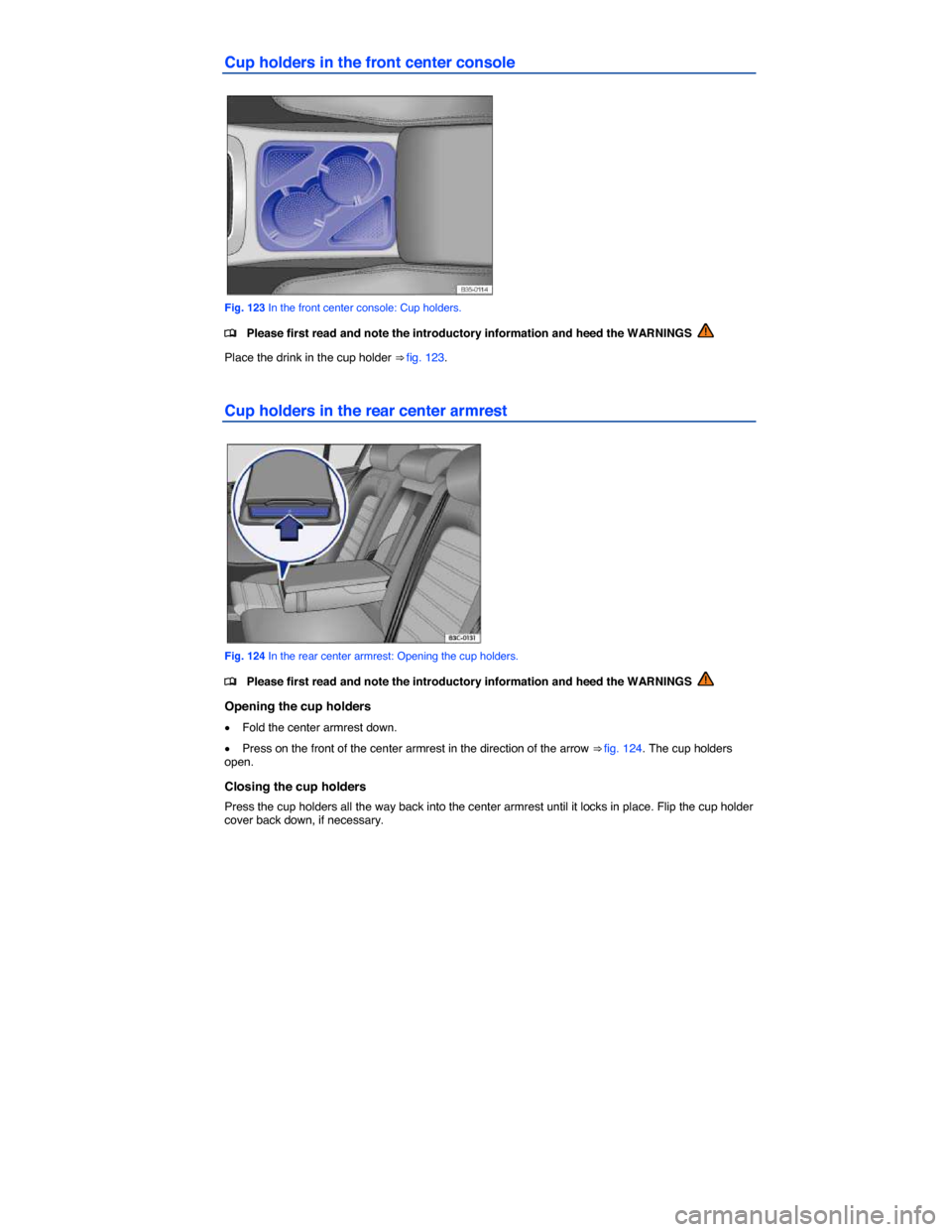
Cup holders in the front center console
Fig. 123 In the front center console: Cup holders.
Page 227 of 429

WARNING
Always keep the armrest folded up when the vehicle is moving to reduce the risk of injury.
x Never let anybody, especially children, ride on the rear center armrest or in the center position on the rear seat when the armrest is folded down. An improper seating position can increase the risk of serious injury in a crash.
NOTICE
Do not press on the cup holder cover when raising the center armrest. The cup holders could open and be damaged.
Page 230 of 429
Unshielded devices may interfere with radio reception or the vehicle's electrical system.
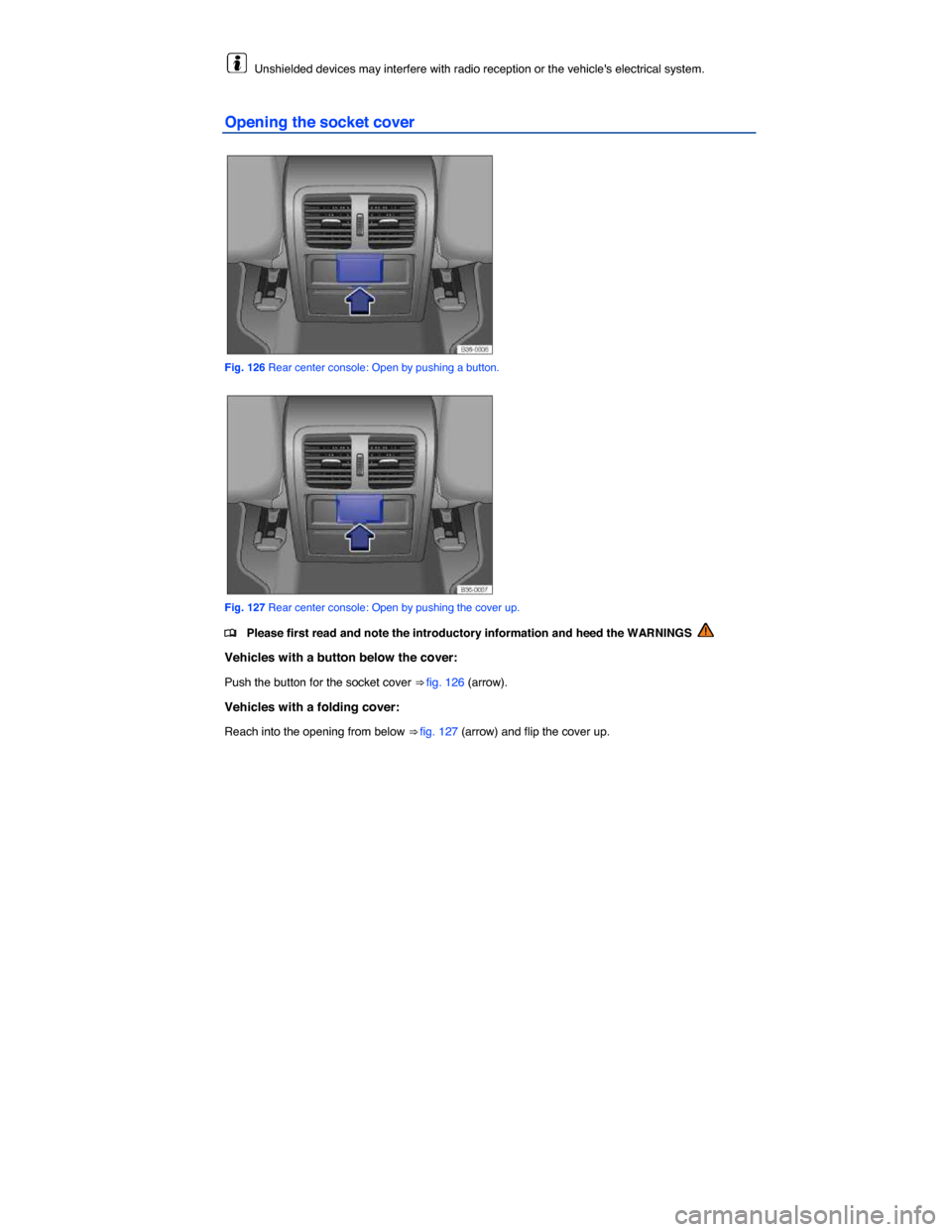
Opening the socket cover
Fig. 126 Rear center console: Open by pushing a button.
Fig. 127 Rear center console: Open by pushing the cover up.