light VOLKSWAGEN PASSAT CC 2014 1.G Manual PDF
[x] Cancel search | Manufacturer: VOLKSWAGEN, Model Year: 2014, Model line: PASSAT CC, Model: VOLKSWAGEN PASSAT CC 2014 1.GPages: 429, PDF Size: 6.46 MB
Page 263 of 429
Brakes coated with road salt also react slower and need longer stopping distances. If there is salt on the roads and you are not braking regularly, brake carefully and gently from time to time to remove any
salt coating from the brake discs and pads ⇒ .
Brake disc corrosion (rust) and dirt buildup on the brake pads are more likely to occur if the vehicle is not driven much or is driven only for short distances with little braking. If the brakes have not been used and there is some rust on the discs, clean the brake discs and pads once in a while by carefully braking a couple of times while driving at relatively high speed to help clean the brake discs and pads.
Make sure nobody is behind you and that you do not endanger yourself or others ⇒ .
Brake system malfunction
If you brake and find that the vehicle doesn't brake nearly as well as it used to (sudden increase in stopping distance), a brake circuit may have failed. The brake warning light H or "2!+% will come on and a message may appear in the instrument cluster display. If you believe the vehicle is safe to drive, immediately take it to the nearest authorized Volkswagen dealer or authorized Volkswagen Service Facility for repair. Drive slowly and very carefully, allow for the longer stopping distance, and be ready to push longer and harder on the brake pedal to slow the vehicle down.
Brake booster
The brake booster works only when the engine is running. It increases the force on the brakes above and beyond the pressure put on the brake pedal by the driver.
If the brake booster is not working, or if the vehicle has to be towed, you will have to push the brake pedal harder to make up for the lack of booster assistance and the resulting longer stopping distance
⇒ .
WARNING
New brake pads do not provide maximum braking performance.
x New brake pads do not have the best stopping power for the first 200 miles (320 km) and must be “broken in.” You can compensate for the slightly reduced braking force by putting more pressure on the brake pedal.
x Drive with extra care while the new brake pads are being broken in. This reduces the risk of collisions and serious personal injuries due to a loss of control over the vehicle.
x Never follow other vehicles too closely or put yourself into other situations that might require sudden, hard braking, especially when the brake pads have not been broken in.
WARNING
Overheated brakes will reduce the vehicle's stopping power and increase stopping distances considerably.
x When driving downhill, the brakes have to work especially hard and heat up quickly.
x Before driving downhill, especially on hills that are long or steep, always reduce speed and shift into lower gear (manual or automatic transmission). This will let the vehicle use engine braking and reduce the load on the brakes. Otherwise, the brake system could overheat and possibly fail. Only use the brakes when you need them to slow the vehicle down more or to stop.
x A damaged front spoiler or a non-standard spoiler can reduce airflow to the brakes and make them overheat.
Page 268 of 429

Brake fluid specifications
Volkswagen has developed a special brake fluid that is optimized for the brake system in your Volkswagen. Volkswagen recommends that you use brake fluid that expressly conforms to quality standard VW Standard 501 14 for optimum performance of the brake system. Check the information on the container for the brake fluid you want to use to make sure it meets the requirements for your vehicle.
Brake fluid that complies with VW Standard 501 14 can be purchased from your authorized Volkswagen dealer or authorized Volkswagen Service Facility.
If this special brake fluid is not available you may – under these circumstances – use another high quality brake fluid that complies with U.S. Federal Motor Vehicle Safety Standard (FMVSS) 116 DOT 4
⇒ .
Please note, however, that not all brake fluids that comply with U.S. Federal Motor Vehicle Safety Standard FMVSS 116 DOT 4 have the same chemical composition. Some of these brake fluids can contain chemicals that could, over time, degrade or damage internal parts of the vehicle’s brake system.
Volkswagen therefore recommends that you use brake fluid that expressly complies with VW Standard 501 14 for optimum brake system performance over the long term.
Brake fluid level
The fluid level in the transparent brake fluid reservoir must always be between the MIN and MAX
marking ⇒ .
On some vehicles, engine components block the view of the brake fluid reservoir and make it impossible to see the brake fluid level. If you cannot clearly see the brake fluid level in the brake fluid reservoir, please see an authorized Volkswagen dealer or authorized Volkswagen Service Facility.
The brake fluid level drops slightly when the vehicle is being used as the brake pads wear and the brakes are automatically adjusted.
Changing brake fluid
Brake fluid must be changed according to the service schedule in your ⇒ booklet Warranty and
Maintenance. Have the brake fluid checked by an authorized Volkswagen dealer or an authorized Volkswagen Service Facility. Refill only with new brake fluid that meets the standards listed above.
WARNING
Brake failure and reduced brake performance can be caused by not having enough brake fluid in the reservoir or by old or incorrect brake fluid.
x Check the brake system and brake fluid level regularly.
x Always change the brake fluid according to the service schedule in your
⇒ booklet Warranty and Maintenance.
x Hard braking with old brake fluid may cause vapor lock. Vapor lock reduces braking performance, increases stopping distances and can even cause total brake failure.
x Always make sure that only the correct brake fluid is used. Only use brake fluid that expressly conforms to VW Standard 501 14 or, if it is not available, only use a high-quality brake fluid that conforms to U.S. Standard FMVSS 116 DOT 4 requirements.
x Using another brake fluid, or one that is not of high quality, can impair the function of the brake system and reduce its effectiveness. If the container does not say that the brake fluid complies with VW Standard 501 14, or U.S. Standard FMVSS 116 DOT 4, do not use it.
x The brake fluid must be new.
Page 273 of 429

Adjust the tire pressure
The proper tire pressure helps reduce rolling resistance as well as fuel consumption.
When purchasing new tires, always make sure that the tires are optimized for lower rolling resistance.
Use low viscosity engine oil
Fully “synthetic,” low viscosity engine oils that expressly comply with Volkswagen oil quality standards reduce fuel consumption. Low viscosity engine oils reduce the frictional resistance on the engine and are distributed more evenly and quickly, particularly when cold-starting the engine. The effect is particularly apparent in vehicles that frequently travel short distances.
Always ensure the right engine oil level is maintained and keep to the scheduled service intervals (engine oil changes).
Make sure the engine oil that you purchase expressly complies with Volkswagen oil quality standards and is the oil approved by Volkswagen for your vehicle.
Avoid unnecessary weight
The lighter the vehicle, the more economical and eco-friendly it will be. For example, an extra 220 lbs (100 kg) of weight increases fuel consumption by up to 1 pint per 60 miles (0.3 l/100 km).
Remove all unnecessary items and unnecessary dead weight from the vehicle.
Remove unnecessary aftermarket components
The more aerodynamic the vehicle, the less fuel it will consume. Aftermarket components such as bicycle racks reduce its aerodynamic performance.
Therefore, remove unnecessary structures and unused rack systems, particularly if planning to drive at higher speeds.
Page 277 of 429
Applicable only in the United States
Indicator lights
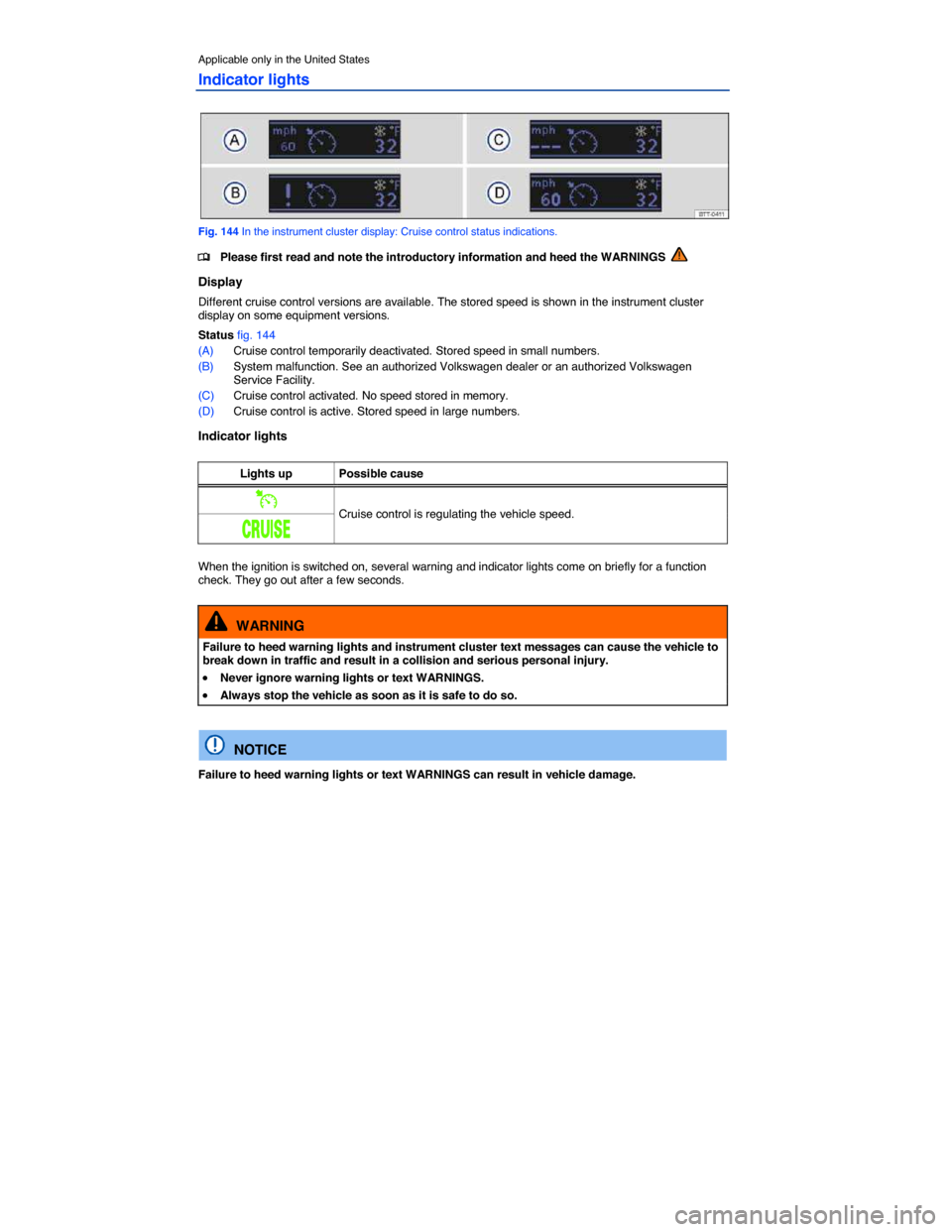
Fig. 144 In the instrument cluster display: Cruise control status indications.
Page 278 of 429
Applicable only in Canada
Indicator lights
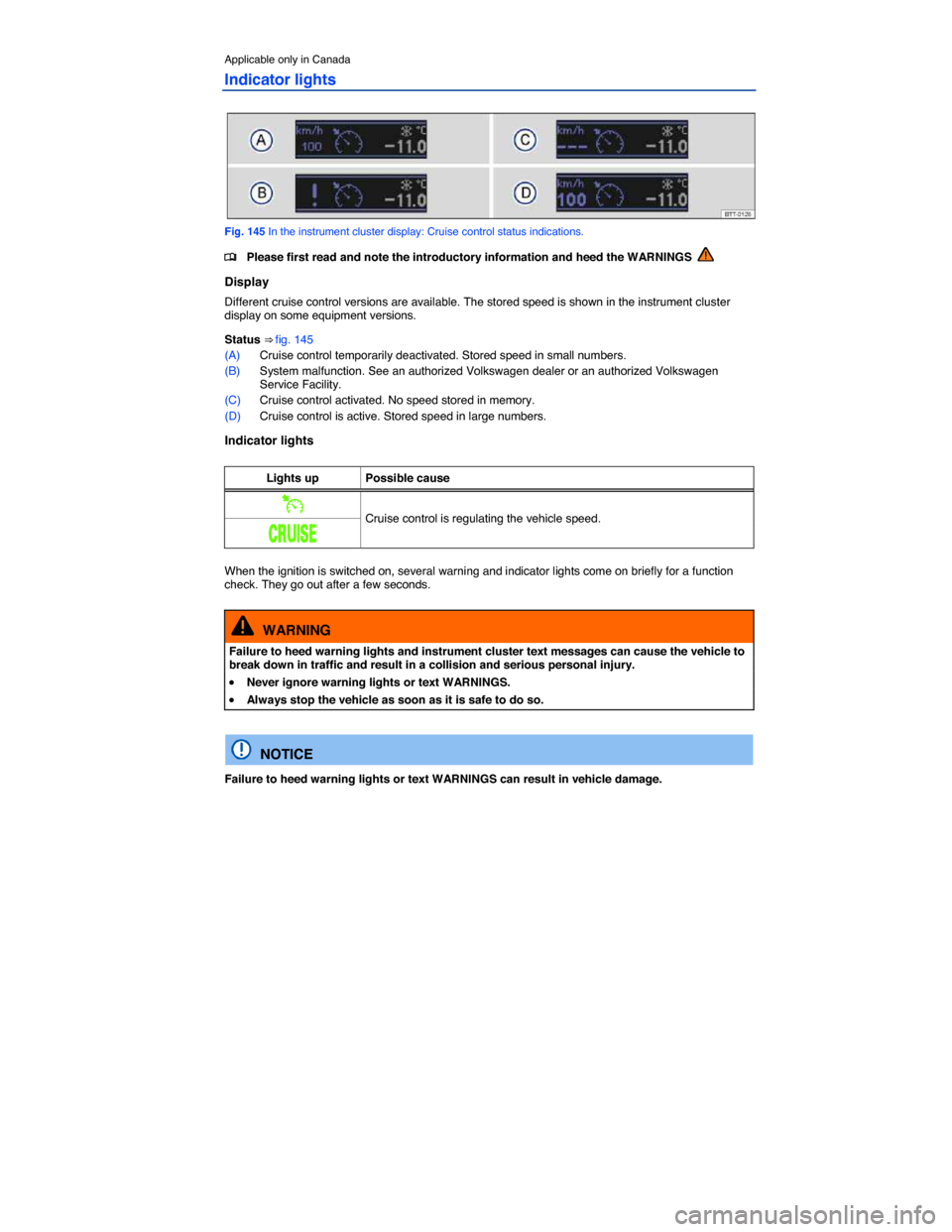
Fig. 145 In the instrument cluster display: Cruise control status indications.
Page 290 of 429

Muting the Park Distance Control volume
You can mute the PDC beeping signals by tapping the + function key on the Radio or Navigation system screen (if applicable). Tap the function key again to reactivate the acoustic signals.
Switching Park Distance Control back on after it was switched off reactivates the volume. System malfunction warning signals cannot be switched off.
If you manually deactivate the display, PDC remains on and the sound is reactivated.
WARNING
Never rely completely on the PDC for information about people and objects that might be in the way of the vehicle and could be struck by the vehicle causing serious personal injury.
x The PDC sensors have blind spots where they cannot detect people or objects.
x Always watch for people, especially small children and animals, because the sensors may not always be able to detect them.
If you hear a long beep lasting about 3 seconds when you first turn PDC on or the indicator light in the button starts blinking, this means there is a malfunction in the Park Distance Control system. Switch off the Park Distance Control system with the button and have it immediately checked by an authorized Volkswagen dealer or an authorized Volkswagen Service Facility.
Page 297 of 429

The right indicator light under the button comes on: automatic air recirculation is switched on.
The air recirculation mode Û helps prevent outside air from entering the vehicle interior.
In very hot outside temperatures, temporarily switch to air recirculation in order to cool the vehicle interior faster.
For safety reasons, air recirculation is switched off if you push the button ⇒ .
Switching manual air recirculation on and off
Page 301 of 429
Indicator lights and fuel gauge
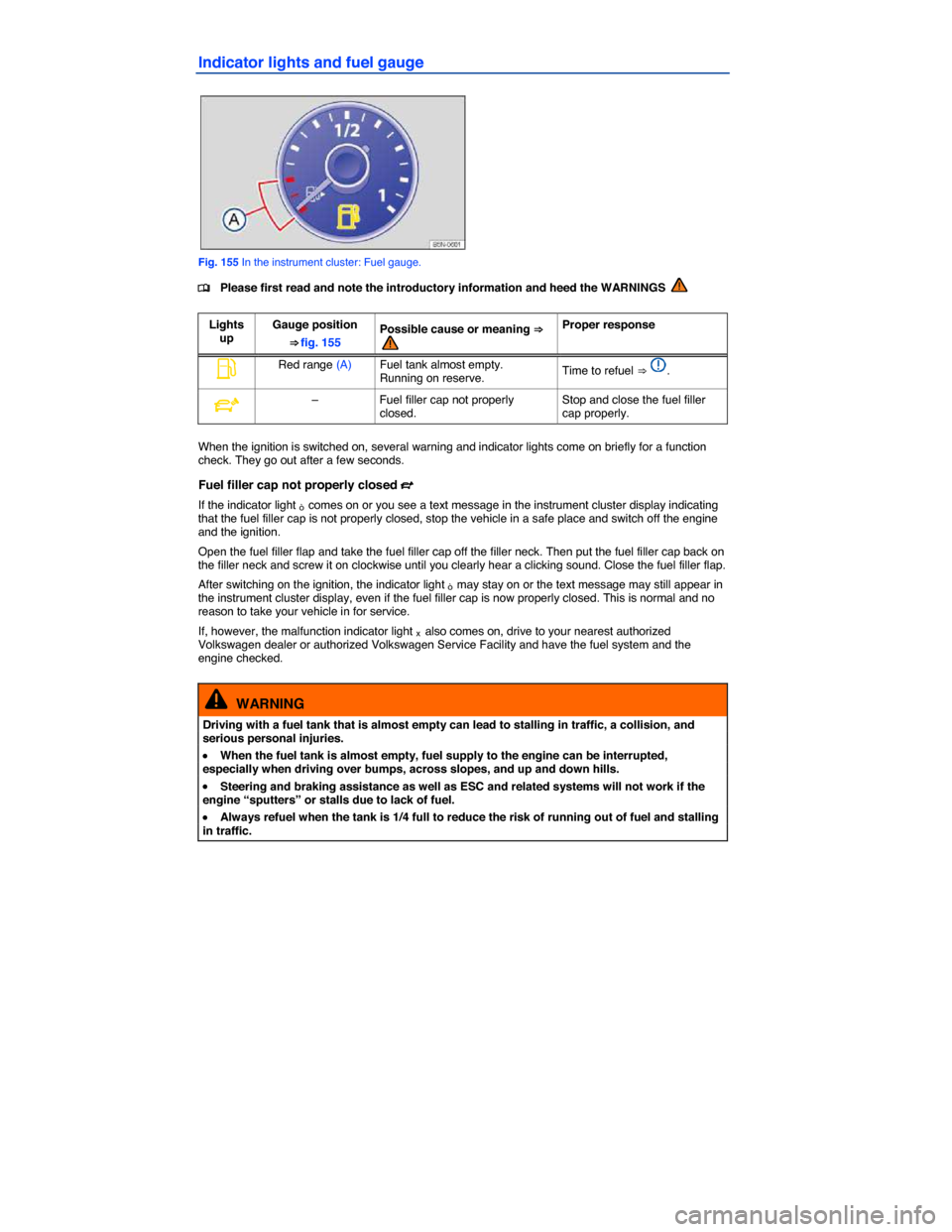
Fig. 155 In the instrument cluster: Fuel gauge.
Page 302 of 429
NOTICE
x Failure to heed warning lights or text WARNINGS can result in vehicle damage.
x Never drive until the fuel tank is completely empty. The irregular fuel supply can cause the engine to misfire. This allows unburned fuel to get into the exhaust system and damage the catalytic converter.
The small arrow next to the gas pump symbol in the fuel gauge shows the side of the vehicle with the fuel filler flap.
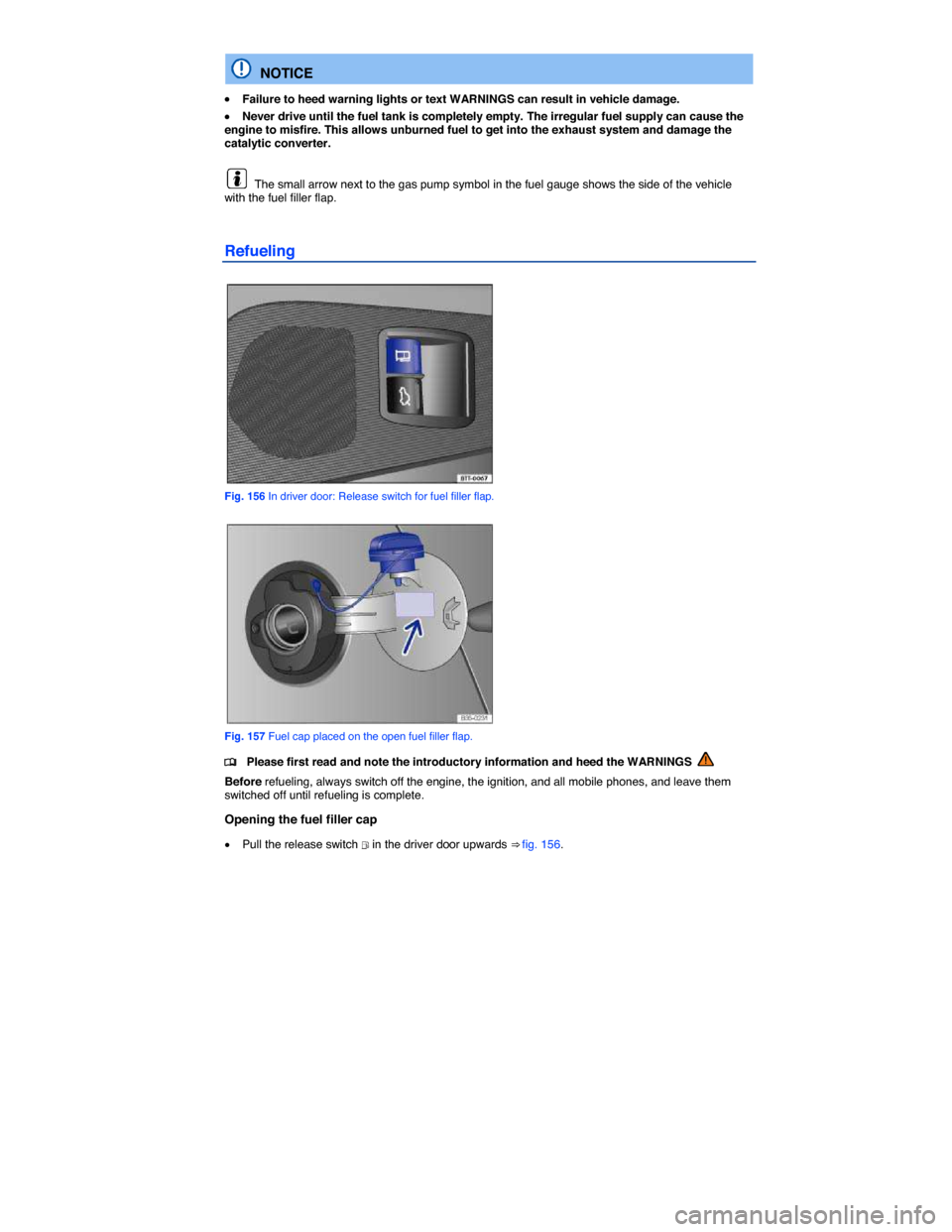
Refueling
Fig. 156 In driver door: Release switch for fuel filler flap.
Fig. 157 Fuel cap placed on the open fuel filler flap.
Page 304 of 429

The engine compartment of any motor vehicle is a hazardous area. Never do any work on the engine or in the engine compartment unless you
x know exactly how to carry out the job,
x have the correct technical information and the proper tools and supplies, and
x are familiar with the necessary safety precautions ⇒ page 310, Working in the engine compartment.
Checklist
If you are uncertain in any way, have the work done by an authorized Volkswagen dealer or authorized Volkswagen Service Facility. Serious personal injury may result from improperly performed work. Make sure that you check the following items regularly. The best thing is to check them every time you refuel:
d W i n d s h i e l d w a s h e r f l u i d l e v e l , Windshield wipers and washer
d E n g i n e o i l l e v e l , Engine oil
d E n g i n e c o o l a n t l e v e l , Engine coolant
d B r a k e f l u i d l e v e l , Braking and parking
dTire pressure, Tires and wheels
Vehicle lighting necessary for driving safety:
– Turn signals
– Low beams and high beams
– Taillights
– Brake lights
– License plate lights
Information on replacing light bulbs:, Replacing light bulbs.
WARNING
Disregarding the safety-related checklist may lead to accidents and injuries.
x Please note and follow the points listed in the checklist.