warning VOLKSWAGEN T-ROC 2020 Owners Manual
[x] Cancel search | Manufacturer: VOLKSWAGEN, Model Year: 2020, Model line: T-ROC, Model: VOLKSWAGEN T-ROC 2020Pages: 502, PDF Size: 8.58 MB
Page 297 of 502

Place heavy objects as far forward in the luggage compartment as possible.
Observe gross axle weight ratings and the gross vehicle weight rating Technical data
Secure luggage to the fastening rings in the luggage compartment using suitable lashing, fixing and
securing straps Luggage compartment equipment
Also stow small objects safely.
If necessary, fold back the rear seat backrest and engage it securely.
If necessary, adjust the headlight range Headlights
Adjust the tyre pressure according to the vehicle load. Observe the tyre pressure sticker Tyre
pressure
In vehicles with a tyre monitoring system, set the new vehicle load level as necessary Tyre
monitoring system
WARNING
Objects that are not secured, or are secured incorrectly, can cause serious injuries in the event of a
sudden driving or braking manoeuvre or accident. This applies particularly if objects are struck by an
airbag when activated and then flung through the vehicle interior. Please observe the following rules
to reduce the risk of accidents:
Always stow all objects in the vehicle securely.
Small and light objects should also be secured.
Objects should be stowed in the vehicle interior in such a way that they can never enter the airbag
deployment zones while the vehicle is in motion.
Always keep stowage compartments closed while the vehicle is in motion.
Stowed objects must never cause passengers to assume an incorrect sitting position.
If an item is being stowed on a seat, this seat must not be used by any passengers.
Do not stow any hard, heavy or sharp objects loose in any of the vehicle's open stowage areas, on
the surface behind the rear seat backrest or on the dash panel.
Remove any hard, heavy or sharp objects from items of clothing and bags inside the vehicle and
stow them securely.
WARNING
Transporting heavy objects changes the vehicle's handling and increases the braking distance. Heavy
loads that are not properly stowed or secured in the vehicle can lead to a loss of vehicle control and
can cause serious injury.
Page 299 of 502
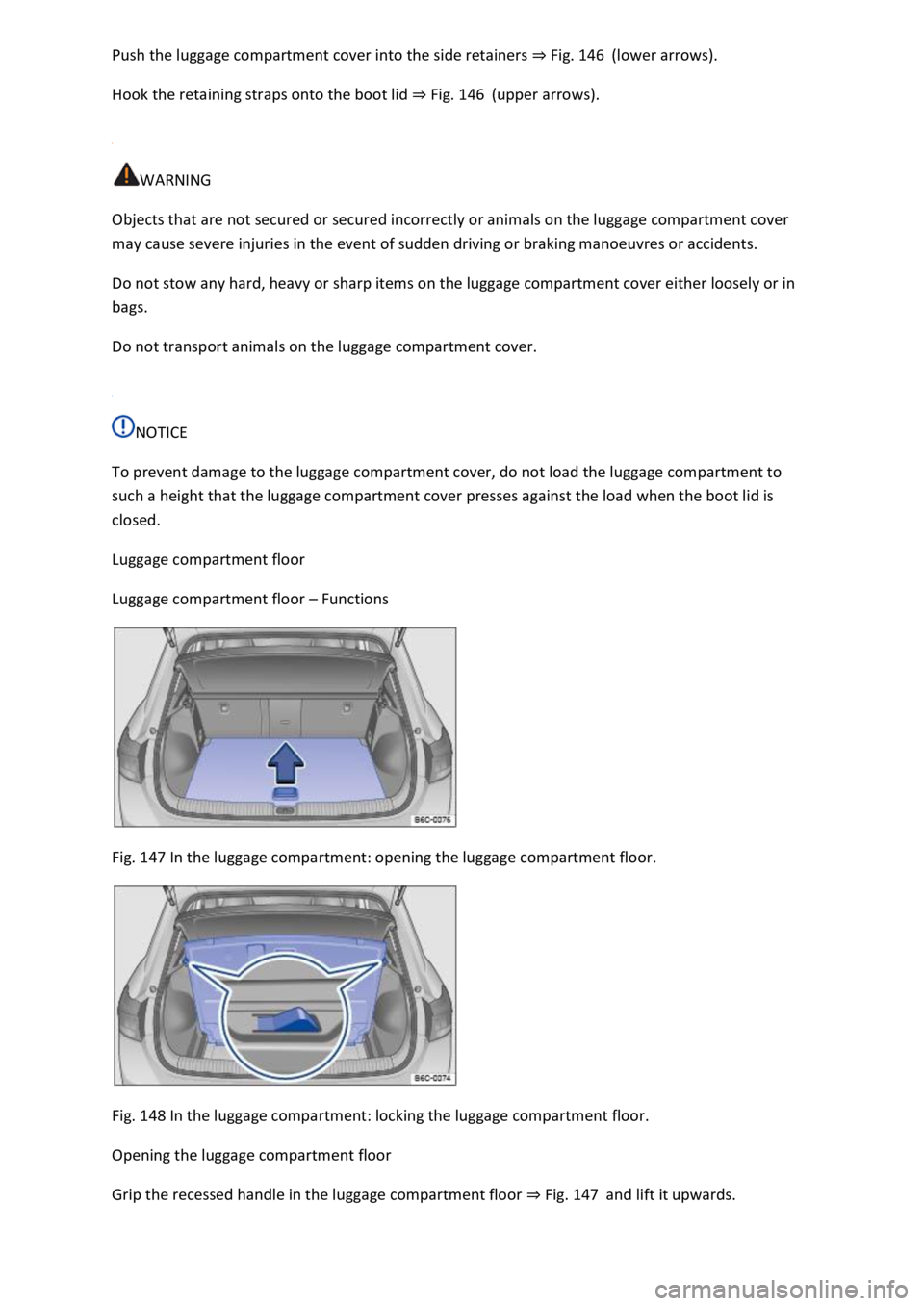
Fig. 146(lower arrows).
Hook the retaining straps onto the boot lid Fig. 146(upper arrows).
WARNING
Objects that are not secured or secured incorrectly or animals on the luggage compartment cover
may cause severe injuries in the event of sudden driving or braking manoeuvres or accidents.
Do not stow any hard, heavy or sharp items on the luggage compartment cover either loosely or in
bags.
Do not transport animals on the luggage compartment cover.
NOTICE
To prevent damage to the luggage compartment cover, do not load the luggage compartment to
such a height that the luggage compartment cover presses against the load when the boot lid is
closed.
Luggage compartment floor
Luggage compartment floor Functions
Fig. 147 In the luggage compartment: opening the luggage compartment floor.
Fig. 148 In the luggage compartment: locking the luggage compartment floor.
Opening the luggage compartment floor
Grip the recessed handle in the luggage compartment floor Fig. 147and lift it upwards.
Page 301 of 502
NOTICE
Never drop the luggage compartment floor; guide it slowly back down. The trims or the luggage
compartment floor could otherwise be damaged.
NOTICE
In the upper position, the variable luggage compartment floor has a maximum load capacity of
120 kg.
Depending on the vehicle equipment, there may be compartments for stowing small items under
the luggage compartment floor.
Luggage compartment equipment
Fastening rings
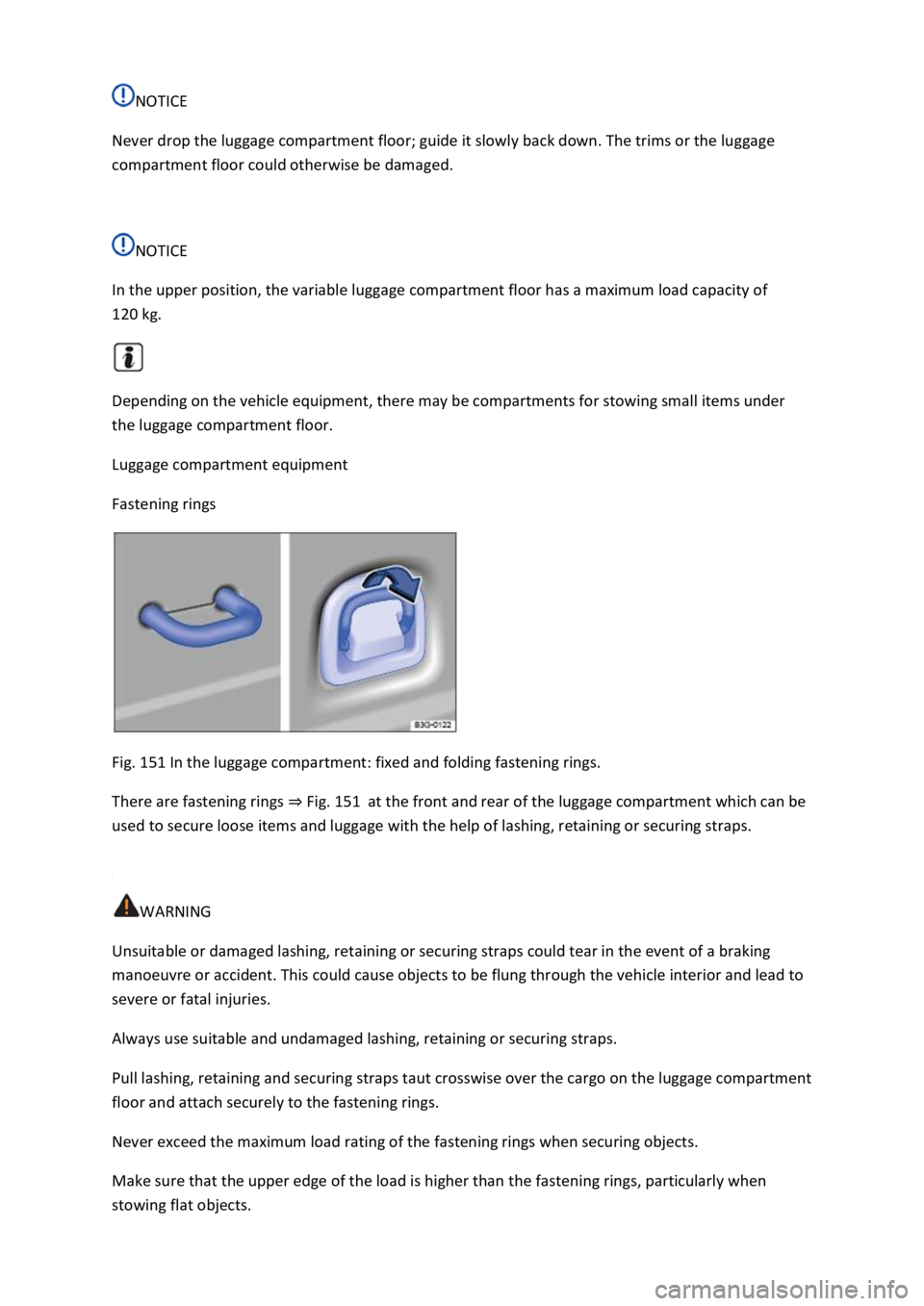
Fig. 151 In the luggage compartment: fixed and folding fastening rings.
There are fastening rings Fig. 151at the front and rear of the luggage compartment which can be
used to secure loose items and luggage with the help of lashing, retaining or securing straps.
WARNING
Unsuitable or damaged lashing, retaining or securing straps could tear in the event of a braking
manoeuvre or accident. This could cause objects to be flung through the vehicle interior and lead to
severe or fatal injuries.
Always use suitable and undamaged lashing, retaining or securing straps.
Pull lashing, retaining and securing straps taut crosswise over the cargo on the luggage compartment
floor and attach securely to the fastening rings.
Never exceed the maximum load rating of the fastening rings when securing objects.
Make sure that the upper edge of the load is higher than the fastening rings, particularly when
stowing flat objects.
Page 302 of 502
luggage compartment.
Never secure a child seat to the fastening rings.
The maximum load rating of the fastening rings is approximately 3.5 kN.
Suitable lashing, retaining or securing straps and luggage securing systems are available from
qualified workshops. Volkswagen recommends using a Volkswagen dealership for this purpose.
Bag hooks
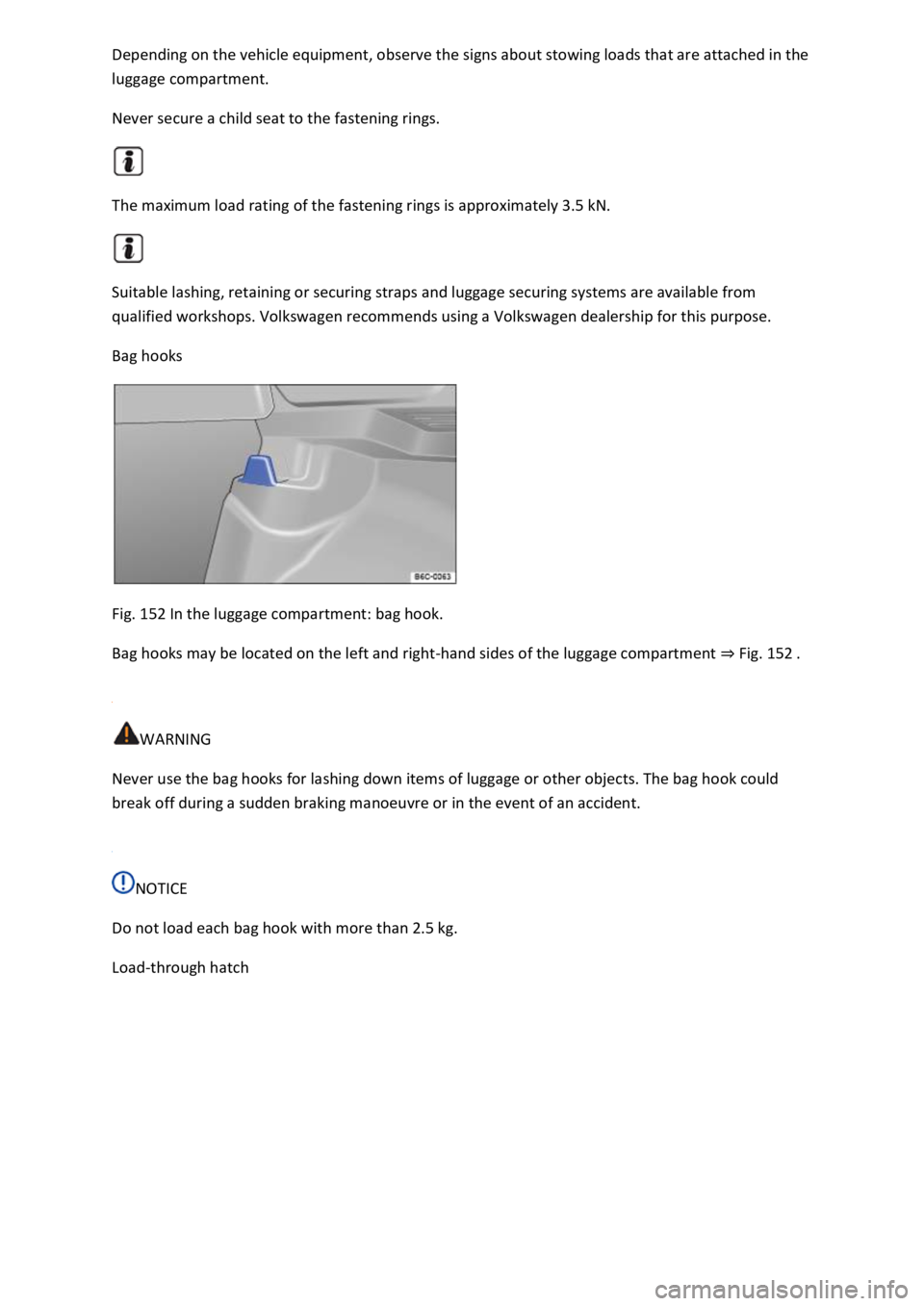
Fig. 152 In the luggage compartment: bag hook.
Bag hooks may be located on the left and right-hand sides of the luggage compartment Fig. 152
WARNING
Never use the bag hooks for lashing down items of luggage or other objects. The bag hook could
break off during a sudden braking manoeuvre or in the event of an accident.
NOTICE
Do not load each bag hook with more than 2.5 kg.
Load-through hatch
Page 303 of 502
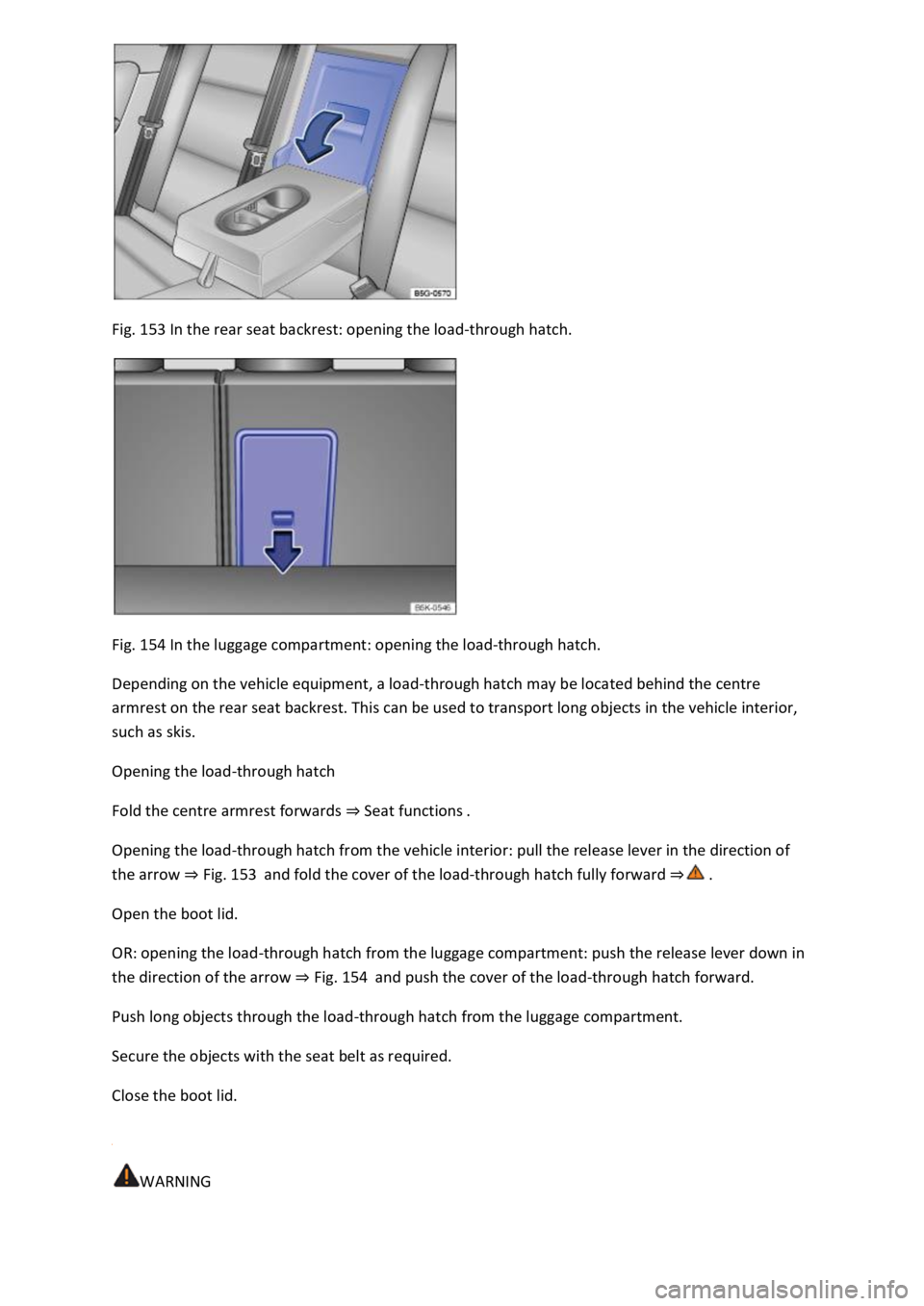
Fig. 153 In the rear seat backrest: opening the load-through hatch.
Fig. 154 In the luggage compartment: opening the load-through hatch.
Depending on the vehicle equipment, a load-through hatch may be located behind the centre
armrest on the rear seat backrest. This can be used to transport long objects in the vehicle interior,
such as skis.
Opening the load-through hatch
Fold the centre armrest forwards Seat functions
Opening the load-through hatch from the vehicle interior: pull the release lever in the direction of
the arrow Fig. 153and fold the cover of the load-through hatch fully forward
Open the boot lid.
OR: opening the load-through hatch from the luggage compartment: push the release lever down in
the direction of the arrow Fig. 154and push the cover of the load-through hatch forward.
Push long objects through the load-through hatch from the luggage compartment.
Secure the objects with the seat belt as required.
Close the boot lid.
WARNING
Page 304 of 502

-through hatch is folded forwards or backwards carelessly or in an
uncontrolled way.
Never fold the load-through hatch forwards or backwards while the vehicle is in motion.
Ensure that the seat belt is not trapped or damaged when folding back the load-through hatch.
Always keep hands, fingers, feet and other body parts away from the swivel area when folding the
load-through hatch forwards and backwards.
The load-through hatch has not been secured properly if the red marking can still be seen on the
locking indicator. Always ensure that the red marking is never visible when the load-through hatch is
in the upright position.
Passengers (children in particular) must not use this seat if the load-through hatch is folded forward
or is not engaged securely into place.
Roof carrier
Introduction
This chapter contains information on the followingsubjects:
Securing roof carriers
Loading roof carriers
Notes on use
Depending on the model, the vehicle may be designed for fitting a roof carrier.
Roof carriers can be used to transport bulky items on the roof of the vehicle.
If you are unsure whether a roof carrier can be fitted on your vehicle, please contact a specialist
workshop. Volkswagen recommends using a Volkswagen dealership for this purpose.
Only roof carriers that have been approved by Volkswagen for the vehicle must be used.
If the vehicle is not approved for use with a roof carrier, do not use or retrofit a roof carrier.
WARNING
When transporting heavy or bulky objects on the roof carrier, the vehicle's handling will change due
to a shift in the centre of gravity and an increased susceptibility to crosswinds.
Always secure loads properly using suitable and undamaged lashing, retaining or securing straps.
Loads that are large, heavy, bulky, long or flat will have a negative effect on the vehicle
aerodynamics, centre of gravity and overall handling.
Avoid abrupt and sudden driving and braking manoeuvres.
Always adapt your speed and driving style to suit visibility, weather, road and traffic conditions.
Page 305 of 502

WARNING
A roof carrier that has not been approved for the vehicle or a roof carrier that is fitted to a vehicle
that is not approved for use with a roof carrier may cause accidents or injuries.
Use only roof carriers that have been approved by Volkswagen for your vehicle type.
Never use a roof carrier on a vehicle that has not been approved for use with a roof carrier.
A roof carrier that is fitted nevertheless may become loose whilst the vehicle is in motion and fall
from the vehicle roof.
NOTICE
Securing a roof carrier of any kind to a vehicle that is not approved for use with a roof carrier may
lead to severe damage to the vehicle.
Securing roof carriers
First read and observe the introductoryinformation and safety warnings
Special roof carriers must be used to transport luggage, bicycles, skis, surfboards or boats safely
Attaching the roof bars and load carrier
Mount roof bars to the roof railing according to the installation instructions provided.
Once you have fitted the roof bars, you can then secure the respective carrier system on them.
WARNING
Incorrectly attaching and using the roof bars and load carrier could cause the whole roof carrier to
fall off the roof. This could cause accidents and injuries.
Only use roof bars and load carriers when they are undamaged and fitted correctly.
Always fit roof bars and load carriers correctly. Always observe the installation instructions provided
by the manufacturer.
Attach the roof bars only at the specified mounting points.
Special roof carriers for items such as bicycles, skis, surfboards etc. should always be properly
installed. Always observe the installation instructions provided by the manufacturer.
Check that the roof carrier is secured before starting your journey and tighten as necessary after
driving a short distance. During a long trip, check all screw connections and fasteners at each stop.
Do not carry out any modifications or repairs to the roof bars or the load carrier.
Page 306 of 502
First read and observe the introductoryinformation and safety warnings
Maximum permitted roof load
The maximum permitted roof load is 75 kg.
The roof load limit refers to the combined weight of the roof carrier and the load carried on the roof
Make sure you are aware of the weight of the roof carrier system and the load to be transported.
Weigh the load if necessary.
However, you will not be able to carry the maximum permitted roof load if you are using a roof
carrier with a lower load rating. In this case, do not exceed the maximum weight limit for the load
carrier system which is specified in the manufacturer's installation instructions.
Distributing the load
Distribute the load evenly and secure it correctly
WARNING
Accidents and significant vehicle damage can occur if the maximum permitted roof load is exceeded.
Never exceed the stated roof load, the maximum permissible axle loads, and the permissible gross
vehicle weight for the vehicle.
Do not exceed the load rating of the roof carrier, even if the maximum roof load has not been
reached.
WARNING
Loose and incorrectly secured loads can fall off the roof carrier and cause accidents and injuries.
Always use suitable and undamaged lashing, retaining or securing straps.
NOTICE
When opening the boot lid, take care not to let it hit the roof load.
Notes on use
First read and observe the introductoryinformation and safety warnings
Remove the roof carrier in the following situations
The roof carrier is no longer needed.
Page 308 of 502

DANGER
It is dangerous to transport people in a trailer and it may also be illegal.
WARNING
Improper use of the towing bracket can lead to a loss of vehicle control, accidents and serious
injuries.
Only use the towing bracket if it is fitted properly and is not damaged.
Do not carry out any alterations or repairs to the towing bracket.
Wherever possible, swivel in or remove the ball head when a trailer is not being used in order to
reduce the risk of injury in rear-end collisions, and the risk of injury to pedestrians and cyclists when
the vehicle is parked.
Never install a weight-distributing or load-balancing towing bracket to the vehicle. The vehicle is not
designed for these kinds of towing brackets. The towing bracket can fail, causing the trailer to tear
loose from the vehicle.
WARNING
Towing a trailer and transporting heavy or bulky items can change the vehicle handling and increase
the braking distance. This can lead to accidents.
Always secure loads properly using suitable and undamaged lashing, retaining or securing straps.
Always adapt your speed and driving style to suit visibility, weather, road and traffic conditions.
Reduce your speed, particularly when going downhill.
Trailers with a high centre of gravity are more likely to tip over than trailers with a low centre of
gravity.
Always drive carefully and think ahead. Accelerate very carefully and gently. Avoid abrupt and
sudden driving and braking manoeuvres.
Take special care when overtaking. Reduce your speed immediately if the trailer shows even the
slightest sign of snaking.
Never drive faster than 80 km/h (50 mph) when towing a trailer, also 100 km/h (60 mph) in
exceptional cases. This also applies to countries where higher speeds are permitted. Keep to
country-specific speed limits, which may be lower for vehicles with trailers than for vehicles without
trailers.
Never try to stop a trailer from snaking by increasing your speed.
Never install a weight-distributing or load-balancing towing bracket on the vehicle.
Page 309 of 502

WARNING
The start/stop system must always be switched off manually when towing a trailer using towing
brackets that have not been retrofitted by Volkswagen. Otherwise faults can occur in the brake
system, possibly resulting in accidents and serious injuries.
NOTICE
Observe the instructions and information for vehicles with an N1 approval Information about
vehicles wit
Always switch off the anti-theft alarm before a trailer is hitched or unhitched or a bicycle carrier is
loaded or unloaded Anti-theft alarm
unintentionally.
With a new engine, do not tow a trailer during the first 1,000 km Running in the engine
Some retrofitted towing brackets may cover the aperture for fitting the towing eye. If so, the towing
eye cannot be used for towing or tow-starting other vehicles. For this reason, the removed ball head
of a retrofitted towing bracket should be kept in the vehicle at all times.
Technical requirements
First read and observe the introductoryinformation and safety warnings
Cooling system
There is an increased load on the engine and the cooling system when towing a trailer. The cooling
system must contain sufficient coolant and be able to cope with the extra load due to trailer towing.
Trailer brake
If the trailer is equipped with its own brake system, comply with the relevant regulations.
Trailer tail light clusters
The trailer tail light clusters must work correctly and meet legal requirements. Do not exceed the
maximum power consumption for the trailer.
Exterior mirrors
If you are unable to see the traffic behind the trailer using the vehicle's standard exterior mirrors,
additional exterior mirrors should be fitted in accordance with any country-specific regulations.
Before setting off, adjust the exterior mirrors so that you have a sufficient view towards the rear.