warning VOLKSWAGEN T-ROC 2020 Owners Manual
[x] Cancel search | Manufacturer: VOLKSWAGEN, Model Year: 2020, Model line: T-ROC, Model: VOLKSWAGEN T-ROC 2020Pages: 502, PDF Size: 8.58 MB
Page 348 of 502
the holder and push it upwards until it audibly clicks into place. Carefully push the stowage
compartment forwards beyond the resistance of the catches Fig. 171
NOTICE
e the covers of the fuse boxes carefully and install them again properly so as to avoid
damage to the vehicle.
boxes can damage the electrical system.
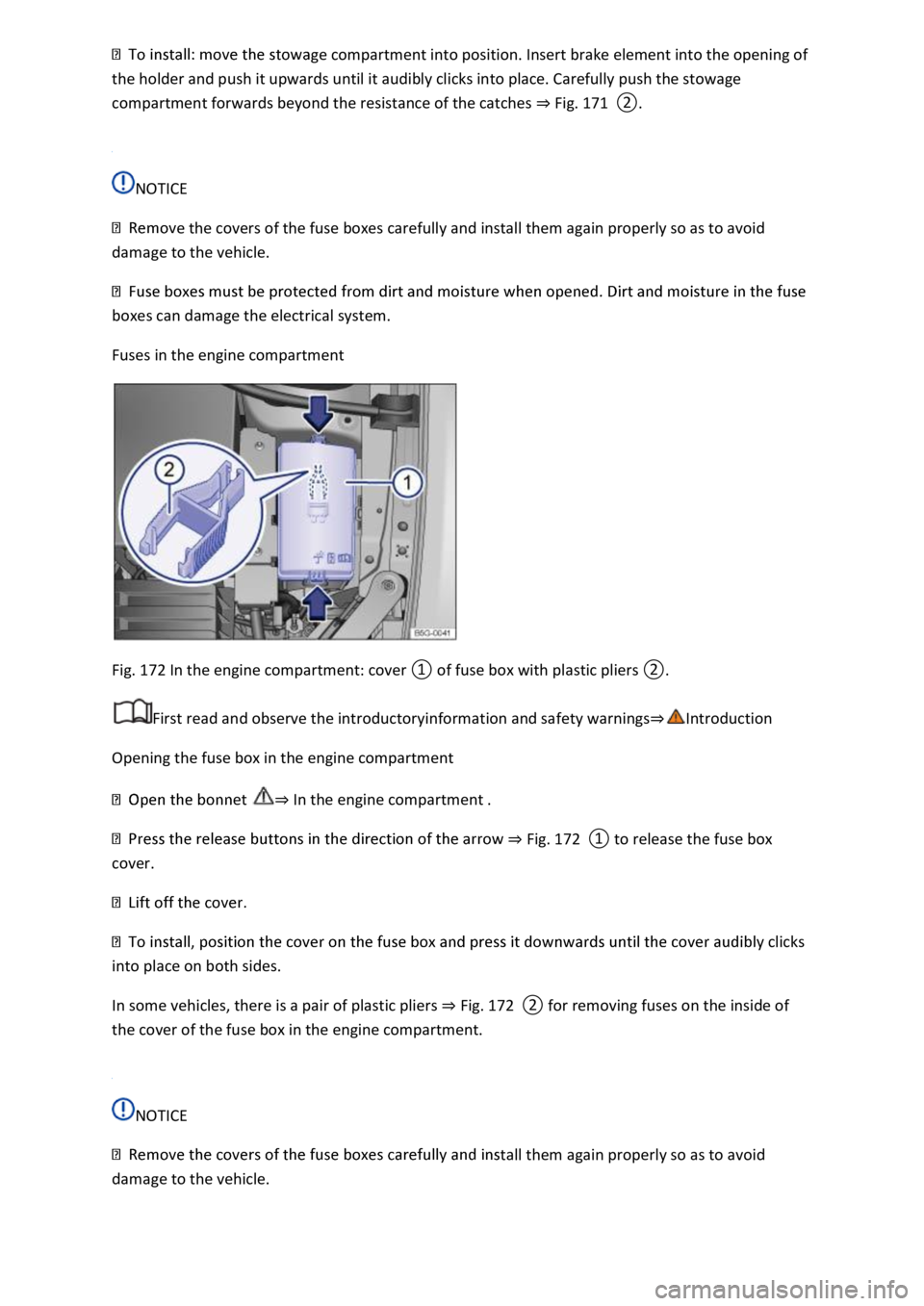
Fuses in the engine compartment
Fig. 172
First read and observe the introductoryinformation and safety warnings
Opening the fuse box in the engine compartment
et In the engine compartment
Fig. 172
y clicks
into place on both sides.
In some vehicles, there is a pair of plastic pliers Fig. 172
NOTICE
tall them again properly so as to avoid
damage to the vehicle.
Page 349 of 502
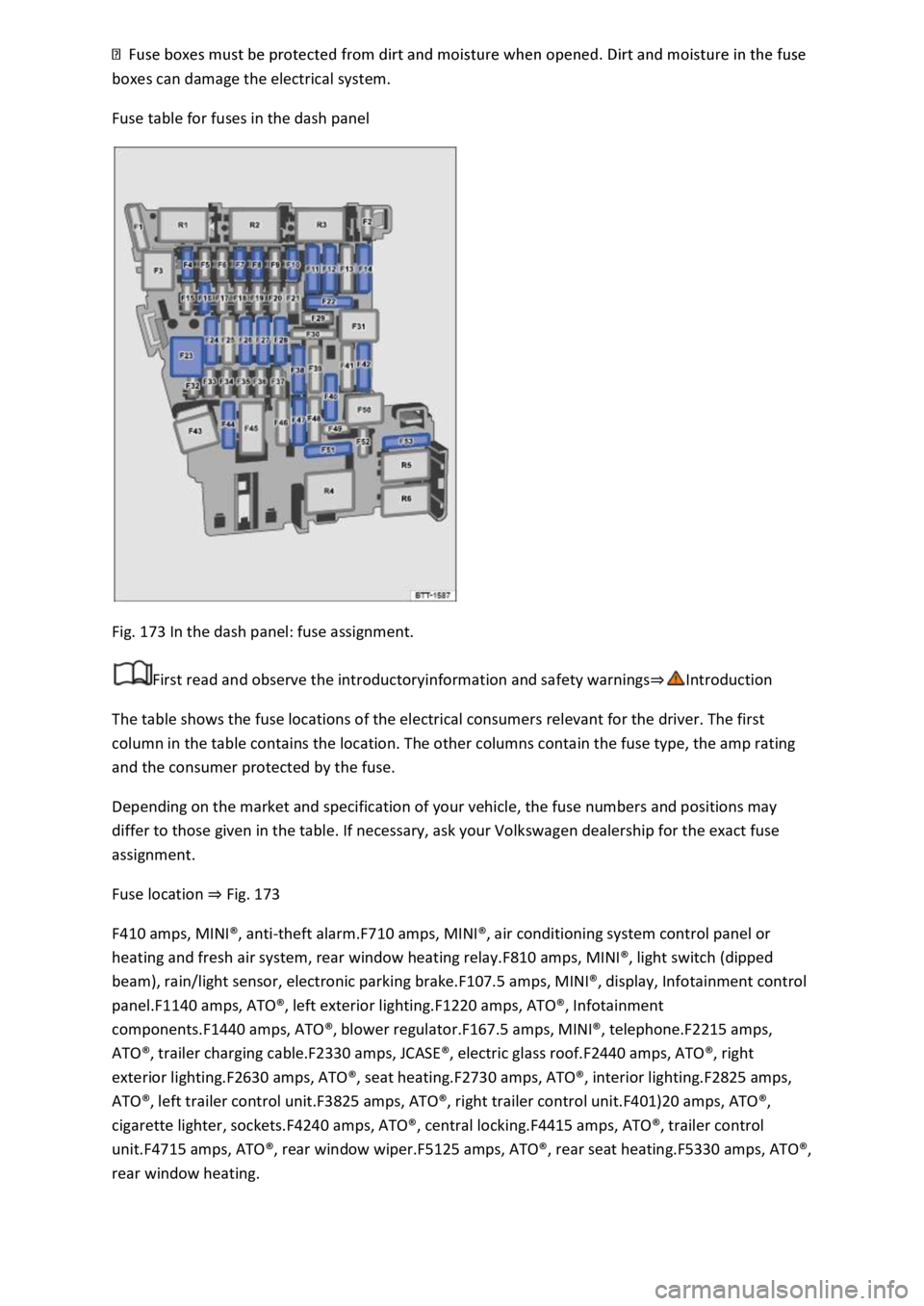
Fuse table for fuses in the dash panel
Fig. 173 In the dash panel: fuse assignment.
First read and observe the introductoryinformation and safety warnings
The table shows the fuse locations of the electrical consumers relevant for the driver. The first
column in the table contains the location. The other columns contain the fuse type, the amp rating
and the consumer protected by the fuse.
Depending on the market and specification of your vehicle, the fuse numbers and positions may
differ to those given in the table. If necessary, ask your Volkswagen dealership for the exact fuse
assignment.
Fuse location Fig. 173
F410 amps, MINI
Page 350 of 502
-fitted fuse location as shown in illustration Fig. 173
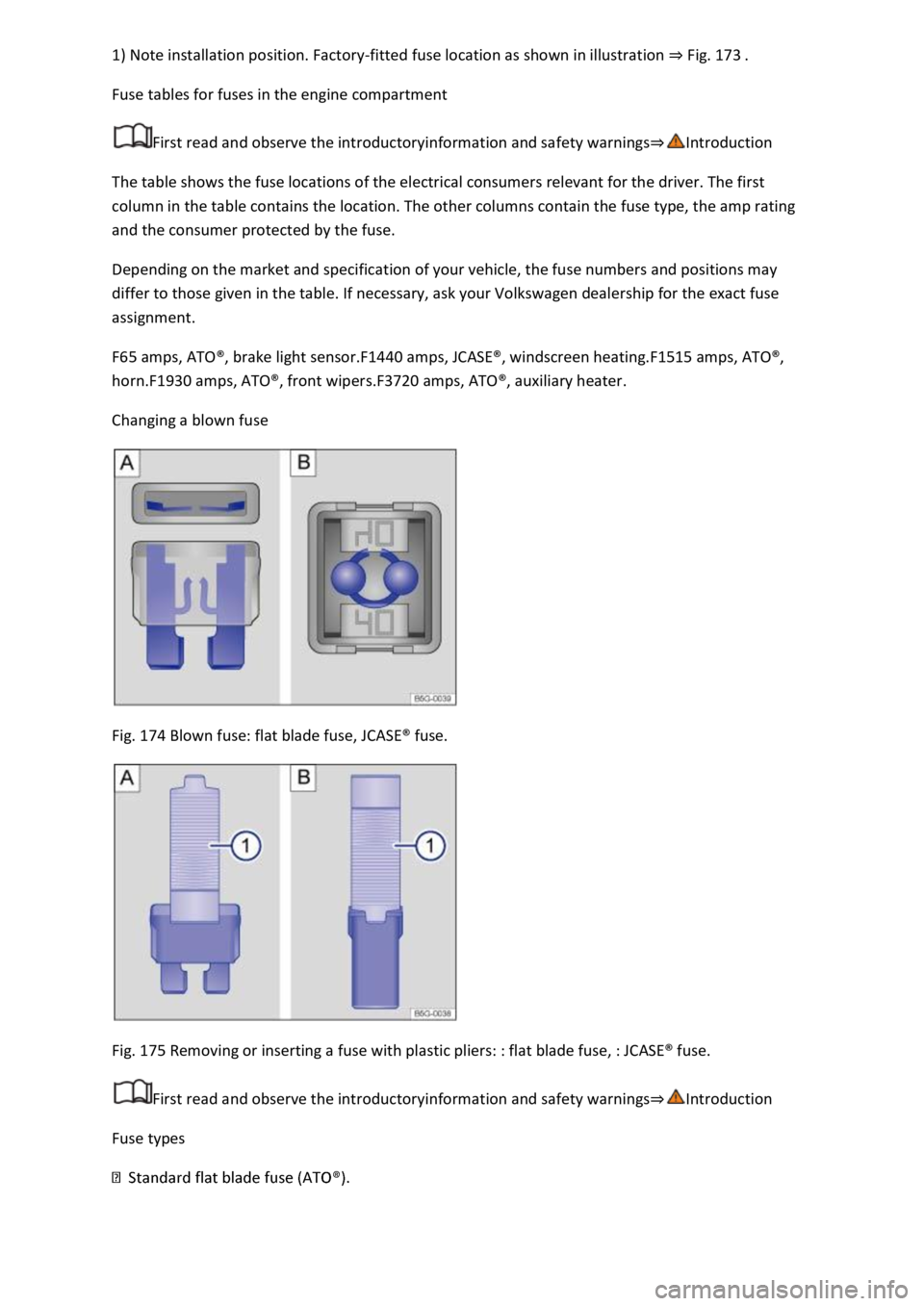
Fuse tables for fuses in the engine compartment
First read and observe the introductoryinformation and safety warnings
The table shows the fuse locations of the electrical consumers relevant for the driver. The first
column in the table contains the location. The other columns contain the fuse type, the amp rating
and the consumer protected by the fuse.
Depending on the market and specification of your vehicle, the fuse numbers and positions may
differ to those given in the table. If necessary, ask your Volkswagen dealership for the exact fuse
assignment.
F65 amps, ATO
Page 352 of 502
Introduction
This chapter contains information on the followingsubjects:
Jump lead connection point (earth connection)
Jump starting the vehicle
If the engine fails to start because the 12-volt vehicle battery is flat, the discharged battery can be
connected to the 12-volt battery of another vehicle to start the engine.
Suitable jump leads are needed for jump starting.
2 for vehicles with petrol engines.
WARNING
Using the jump leads incorrectly or performing the jump start procedure incorrectly can cause the
12-volt vehicle battery to explode, which can lead to severe injuries. Please note the following in
order to reduce the risk of the 12-volt vehicle battery exploding:
-volt vehicle battery and the electrical system can cause serious chemical burns,
fire or electric shocks. Always read the warnings and safety information before carrying out any kind
of work on the 12-volt vehicle battery 12-volt vehicle battery
volts) and approximately
the same capacity (see label on battery) as the flat 12-volt vehicle battery.
-volt vehicle battery. Discharged 12-volt vehicle batteries can
already freeze at temperatures of around 0
Page 353 of 502
soon as the positive terminals are connected.
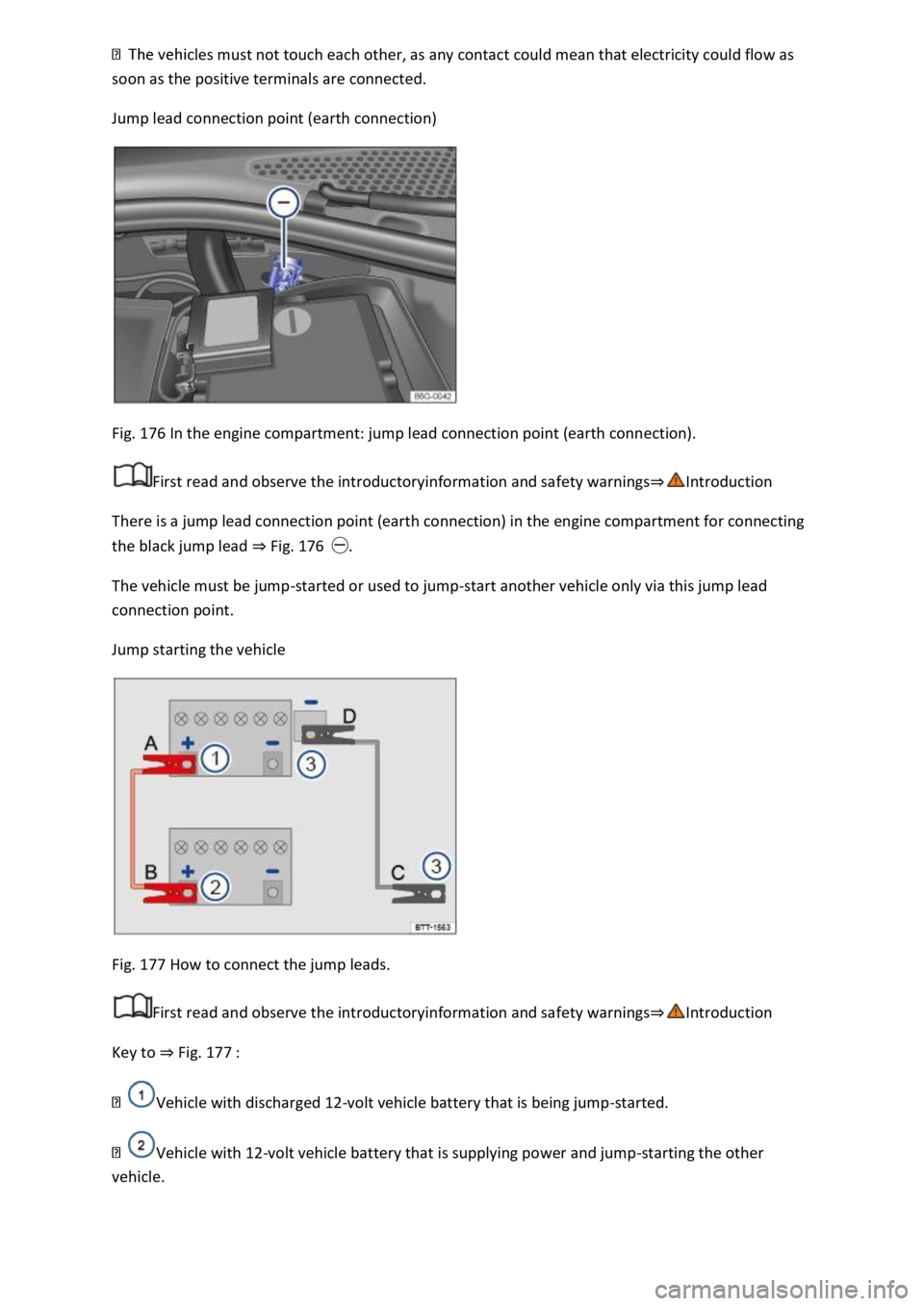
Jump lead connection point (earth connection)
Fig. 176 In the engine compartment: jump lead connection point (earth connection).
First read and observe the introductoryinformation and safety warnings
There is a jump lead connection point (earth connection) in the engine compartment for connecting
the black jump lead Fig. 176
The vehicle must be jump-started or used to jump-start another vehicle only via this jump lead
connection point.
Jump starting the vehicle
Fig. 177 How to connect the jump leads.
First read and observe the introductoryinformation and safety warnings
Key to Fig. 177
Vehicle with discharged 12-volt vehicle battery that is being jump-started.
Vehicle with 12-volt vehicle battery that is supplying power and jump-starting the other
vehicle.
Page 355 of 502
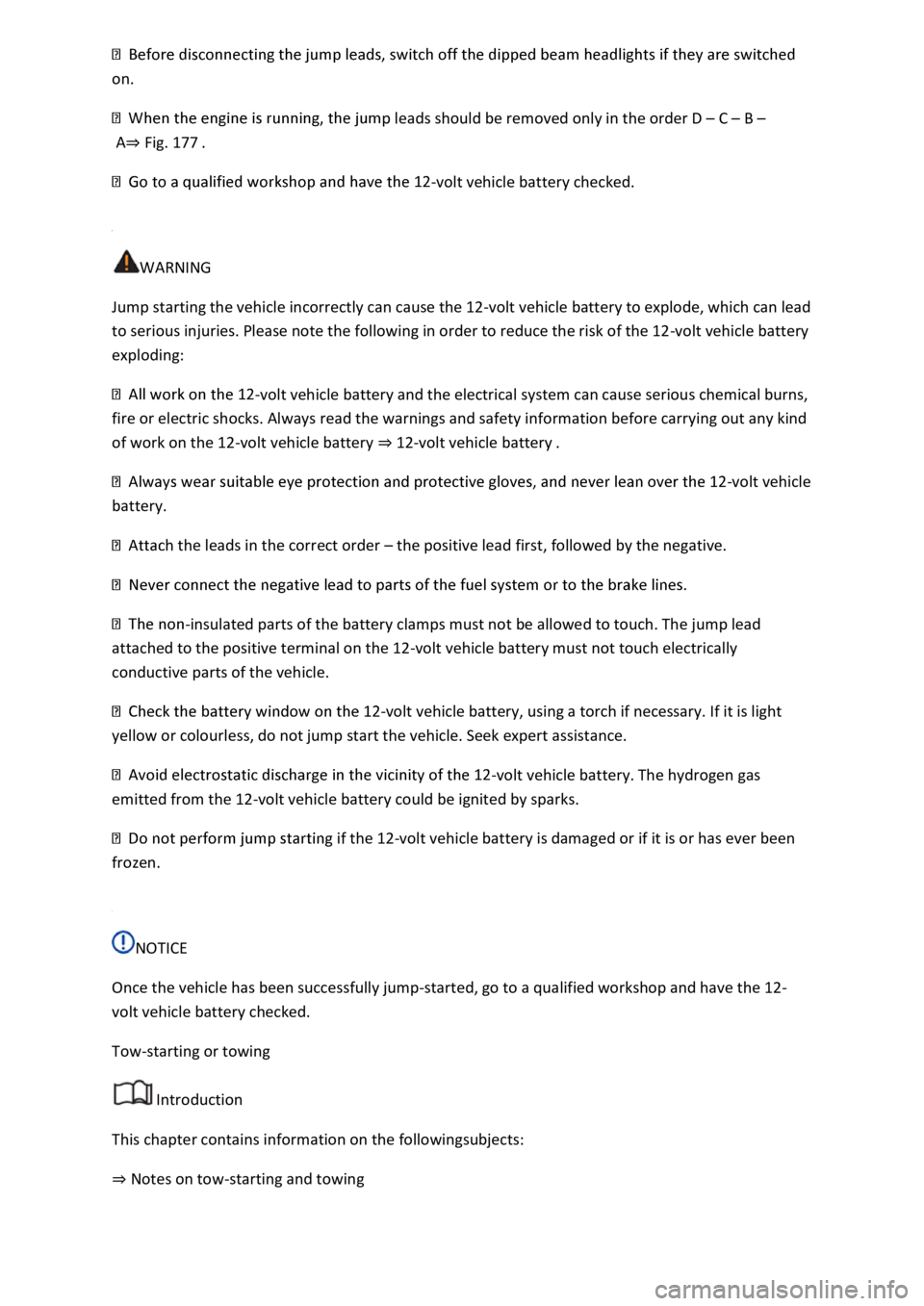
p leads should be removed only in the order D C B
AFig. 177
-volt vehicle battery checked.
WARNING
Jump starting the vehicle incorrectly can cause the 12-volt vehicle battery to explode, which can lead
to serious injuries. Please note the following in order to reduce the risk of the 12-volt vehicle battery
exploding:
-volt vehicle battery and the electrical system can cause serious chemical burns,
fire or electric shocks. Always read the warnings and safety information before carrying out any kind
of work on the 12-volt vehicle battery 12-volt vehicle battery
-volt vehicle
battery.
h the leads in the correct order the positive lead first, followed by the negative.
-insulated parts of the battery clamps must not be allowed to touch. The jump lead
attached to the positive terminal on the 12-volt vehicle battery must not touch electrically
conductive parts of the vehicle.
-volt vehicle battery, using a torch if necessary. If it is light
yellow or colourless, do not jump start the vehicle. Seek expert assistance.
-volt vehicle battery. The hydrogen gas
emitted from the 12-volt vehicle battery could be ignited by sparks.
g if the 12-volt vehicle battery is damaged or if it is or has ever been
frozen.
NOTICE
Once the vehicle has been successfully jump-started, go to a qualified workshop and have the 12-
volt vehicle battery checked.
Tow-starting or towing
Introduction
This chapter contains information on the followingsubjects:
Notes on tow-starting and towing
Page 356 of 502

Tow-starting
Towing
Fitting the rear towing eye
Fitting the front towing eye
Towing requires some experience, especially when using a tow rope. Both drivers should be familiar
with the technique required for towing. Inexperienced drivers should not attempt to tow.
Ensure that no excessive pulling forces occur and take care to avoid jerking movements. When
towing offroad, there is always a risk of overloading the anchorage points.
Observe any legal requirements when towing or tow-starting.
Tow-starting
Tow-starting describes the procedure for starting the vehicle by moving it using another towing
vehicle.
The vehicle can be tow-started with a tow-bar or a tow-rope.
Towing
Towing is where a vehicle that cannot be driven is pulled with the aid of another vehicle.
The vehicle can be towed with a tow-bar or a tow-rope. When the engine is stopped, the gearbox is
not lubricated sufficiently at higher speeds and over long distances:
km/h (30 mph).
km.
Tow rope, tow bar
It is easier and safer to tow a vehicle with a tow bar. Use a tow rope only if you do not have a tow
bar.
The tow rope should be slightly elastic to reduce the strain on both vehicles. It is advisable to use a
tow rope made of synthetic fibre or similarly elastic material.
Towing with a tow truck
If your vehicle is to be raised on one axle for towing, this may only be done using the following axles
according to the gearbox/drive combination:
Front-wheel drive
Manual gearboxFront or rear axleAutomatic gearboxFront axle
WARNING
If a vehicle is being towed, the vehicle handling and braking efficiency will change significantly.
Page 357 of 502
WARNING
Never tow a vehicle that has no power supply.
assistance.
NOTICE
When pushing the vehicle by hand, do not press on the tail light clusters, the side spoilers on the
rear window, the rear spoiler or large panels. This could damage the vehicle and the rear spoiler
could become detached.
NOTICE
Remove and install the cover and the towing eye carefully so as to avoid damage to the vehicle, e.g.
the paintwork.
Notes on tow-starting and towing
First read and observe the introductoryinformation and safety warnings
It is still possible to activate the turn signals in a vehicle that is being towed, even if the hazard
warning lights are switched on. To do this, operate the turn signal lever in the required direction
while the ignition is switched on. The hazard warning lights will not flash while the turn signal is
being used. The hazard warning lights will start flashing again automatically as soon as the turn
signal lever is moved back to the neutral position.
When should your vehicle not be tow-started or towed?
an 50 km.
accident.
If the vehicle cannot be towed on its own four wheels due to one of the above conditions, seek
expert assistance and have the vehicle transported on a recovery vehicle if necessary.
Tow-starting
First read and observe the introductoryinformation and safety warnings
Preparations for tow-starting
Vehicles with an automatic gearbox:
Page 358 of 502
e tow-started. Attempt to start the engine by jump
starting Jump starting
Vehicles with a manual gearbox:
Tow-starting is generally not recommended. If the engine does not start, first attempt to start the
engine by jump starting Jump startingease note that the maximum tow-starting distance for
petrol engines is 50 m.
-rope or the tow-bar only to the towing eyes provided Fitting the rear towing
eyeor Fitting the front towing eye
warning lights.
utral to prevent
driving into the towing vehicle.
NOTICE
When tow-starting, unburnt fuel can enter the catalytic converter and damage it.
Towing
First read and observe the introductoryinformation and safety warnings
Preparations
h the tow-rope or the tow-bar only to the towing eyes provided Fitting the rear towing
eyeor Fitting the front towing eyeor to the towing bracket Trailer towing
-rope is not twisted. Otherwise a towing eye may become unscrewed
during towing.
regulations to the contrary.
Pulling vehicle (front)
tow-rope must be taut before you drive off properly.
Page 359 of 502
Pulled vehicle (rear)
Ensure that the ignition is switched on so that the steering wheel is not locked and so that you can
indicate, sound the horn and operate the wipers if necessary.
the
ignition is switched on and the vehicle is rolling. Otherwise you must press the brake pedal with
significantly more force and also use more effort for steering.
-rope is always taut.
ox in neutral or select the selector lever position N.
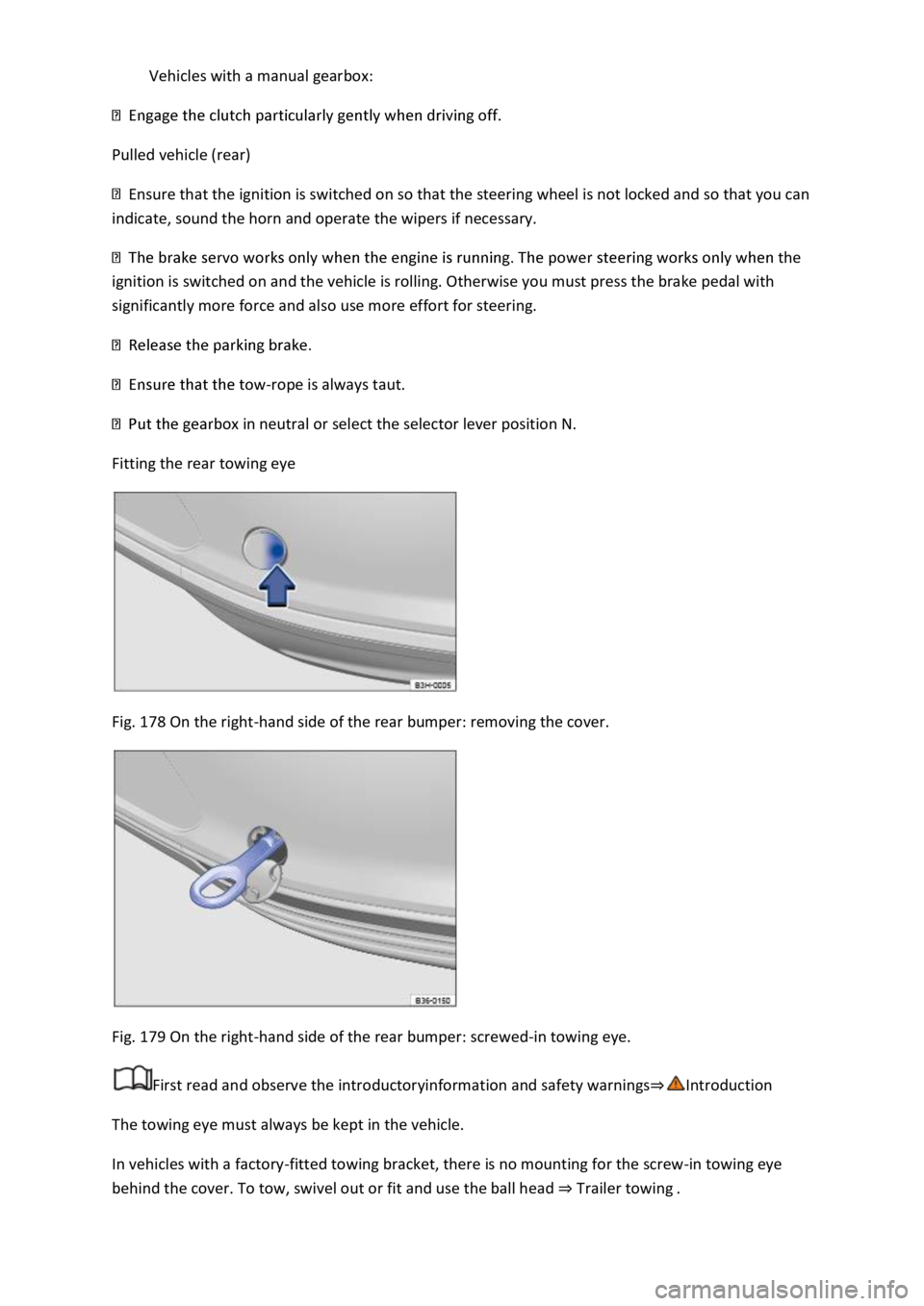
Fitting the rear towing eye
Fig. 178 On the right-hand side of the rear bumper: removing the cover.
Fig. 179 On the right-hand side of the rear bumper: screwed-in towing eye.
First read and observe the introductoryinformation and safety warnings
The towing eye must always be kept in the vehicle.
In vehicles with a factory-fitted towing bracket, there is no mounting for the screw-in towing eye
behind the cover. To tow, swivel out or fit and use the ball head Trailer towing