ESP VOLKSWAGEN T-ROC 2021 Owner´s Manual
[x] Cancel search | Manufacturer: VOLKSWAGEN, Model Year: 2021, Model line: T-ROC, Model: VOLKSWAGEN T-ROC 2021Pages: 502, PDF Size: 9.42 MB
Page 52 of 502

deploying airbag strikes a vehicle occupant who has assumed an incorrect sitting position. The driver
is responsible for all occupants transported in the vehicle, especially children.
The following list contains examples of sitting positions that can be dangerous for all vehicle
occupants.
Whenever the vehicle is in motion:
Never stand in the vehicle.
Never stand on the seats.
Never kneel on the seats.
Never tilt the backrest too far to the rear.
Never lean against the dash panel.
Never lie on the seats in the passenger compartment and on the rear bench seat.
Never sit on the front edge of a seat.
Never sit sideways.
Never lean out of a window.
Never put your feet out of a window.
Never put your feet on the dash panel.
Never place your feet on the seat cushion or seat backrest.
Never travel in a footwell.
Never sit on the armrests.
Never travel on a seat without wearing the seat belt.
Never travel in the luggage compartment.
WARNING
Every incorrect sitting position in the vehicle increases the risk of severe or fatal injuries in the event
of an accident or sudden driving or braking manoeuvre.
All vehicle occupants must maintain a correct sitting position and wear their seat belt properly while
the vehicle is in motion.
Sitting in an incorrect position, not fastening the seat belt, or not leaving adequate space between
the occupants and the airbags could inflict critical or fatal injuries, especially if the airbags deploy
and strike an occupant who has assumed an incorrect sitting position.
Correct sitting position
Page 55 of 502

Before every trip, each vehicle occupant must adopt the correct sitting position, correctly fasten the
seat belt belonging to their seat and keep it fastened properly throughout the trip. This applies to all
vehicle occupants and also in urban traffic.
While the vehicle is in motion, secure all children travelling in the vehicle in a restraint system
suitable for their weight and height. They must also wear correctly fastened seat belts ⇒ Safe
transport of children .
Drive off only when all passengers have correctly fastened their seat belts.
Never insert the latch plate into a buckle which does not belong to the corresponding seat and
always ensure it engages properly. Using a buckle which does not belong to the seat you are
occupying reduces the level of protection and can lead to severe injuries.
Never let any foreign bodies or liquids get into the slots for the belt buckles. This could prevent the
belt buckle and seat belt from working properly.
Never unfasten the seat belt while the vehicle is in motion.
Never allow more than one person to share the same seat belt.
Never travel when children or babies are being carried on somebody's lap and fastened with the
same belt.
Never travel wearing loose, bulky clothing (such as an overcoat over a jacket). This could prevent the
seat belts from fitting and functioning properly.
WARNING
Damaged seat belts are very dangerous and could cause severe or fatal injuries.
Never damage the belt by trapping it in the door or in the seat mechanism.
If the belt webbing or any other part of the seat belt becomes damaged, the seat belts may tear
during an accident or sudden braking manoeuvre.
Have damaged seat belts immediately replaced by new seat belts that have been approved by
Volkswagen for the vehicle. Seat belts subjected to stress and stretched during an accident must be
replaced by a qualified workshop. Renewal may be necessary even if there is no apparent damage.
The belt anchorage should also be checked.
Never try to repair, modify or remove the seat belts yourself. All repairs to the seat belts, belt
retractors and buckles must be carried out by a qualified workshop.
Warning lamp
Page 69 of 502
Fine dust particles or steam may be released when the airbags trigger. This is normal and does not
mean there is a fire in the vehicle.
The fine dust can cause irritation to the skin and eye membranes as well as cause breathing
difficulties, particularly for those people suffering from asthma or other respiratory health problems.
In order to reduce breathing difficulties, get out of the vehicle or open the windows or doors in
order to breathe fresh air.
If you should come into contact with the dust, you should wash your hands and face with a mild
soap and water before eating.
Do not rub the dust into your eyes or into open wounds.
If dust has entered your eyes, rinse them with water.
WARNING
Cleaning agents that contain solvents cause the surface of the airbag modules to become porous. In
an accident that triggers the airbag, loose plastic parts can cause serious injury.
Never clean the dash panel or the airbag covers with cleaning agents that contain solvents.
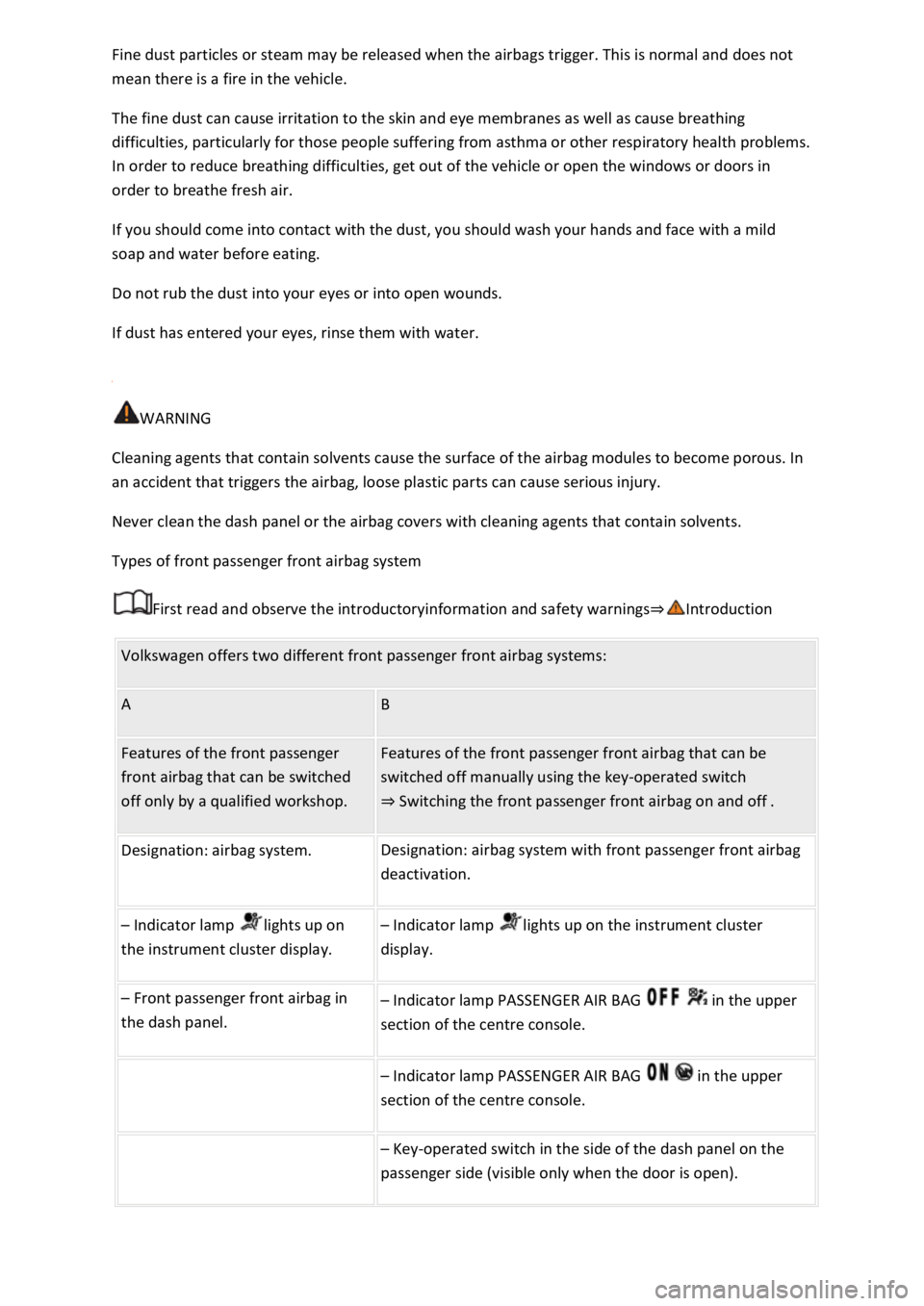
Types of front passenger front airbag system
First read and observe the introductoryinformation and safety warnings⇒Introduction
Volkswagen offers two different front passenger front airbag systems:
A B
Features of the front passenger
front airbag that can be switched
off only by a qualified workshop.
Features of the front passenger front airbag that can be
switched off manually using the key-operated switch
⇒ Switching the front passenger front airbag on and off .
Designation: airbag system. Designation: airbag system with front passenger front airbag
deactivation.
– Indicator lamp lights up on
the instrument cluster display.
– Indicator lamp lights up on the instrument cluster
display.
– Front passenger front airbag in
the dash panel.
– Indicator lamp PASSENGER AIR BAG in the upper
section of the centre console.
– Indicator lamp PASSENGER AIR BAG in the upper
section of the centre console.
– Key-operated switch in the side of the dash panel on the
passenger side (visible only when the door is open).
Page 75 of 502

WARNING
The front passenger front airbag should be switched off only in exceptional circumstances.
To prevent damage to the airbag system, switch the front passenger front airbag on and off only
when the ignition is switched off.
It is the driver's responsibility to ensure that the key-operated switch is set to the correct position.
Switch off the front passenger front airbag only if in exceptional circumstances a child seat is fitted
on the front passenger seat.
Switch the front passenger front airbag back on again as soon as the child seat on the front
passenger seat is no longer being used.
WARNING
Do not leave the vehicle key in the key switch while driving.
Strong vibrations may cause the vehicle key to turn in the key switch, which could cause the front
passenger front airbag to be activated.
Untimely inflation of the front passenger front airbag could lead to serious or fatal injuries.
NOTICE
If the key bit is not inserted far enough, the key switch could be damaged when the key is turned.
NOTICE
Do not leave the vehicle key in the key switch, as this could result in damage to the interior door
trim, dash panel, key switch or vehicle key when the front passenger door is closed.
Safe transport of children
Introduction
This chapter contains information on the followingsubjects:
⇒ Types of child seat
⇒ Fitting and using child seats
⇒ Securing systems
⇒ Securing a child seat with ISOFIX
⇒ Securing child seats with a seat belt
Page 83 of 502
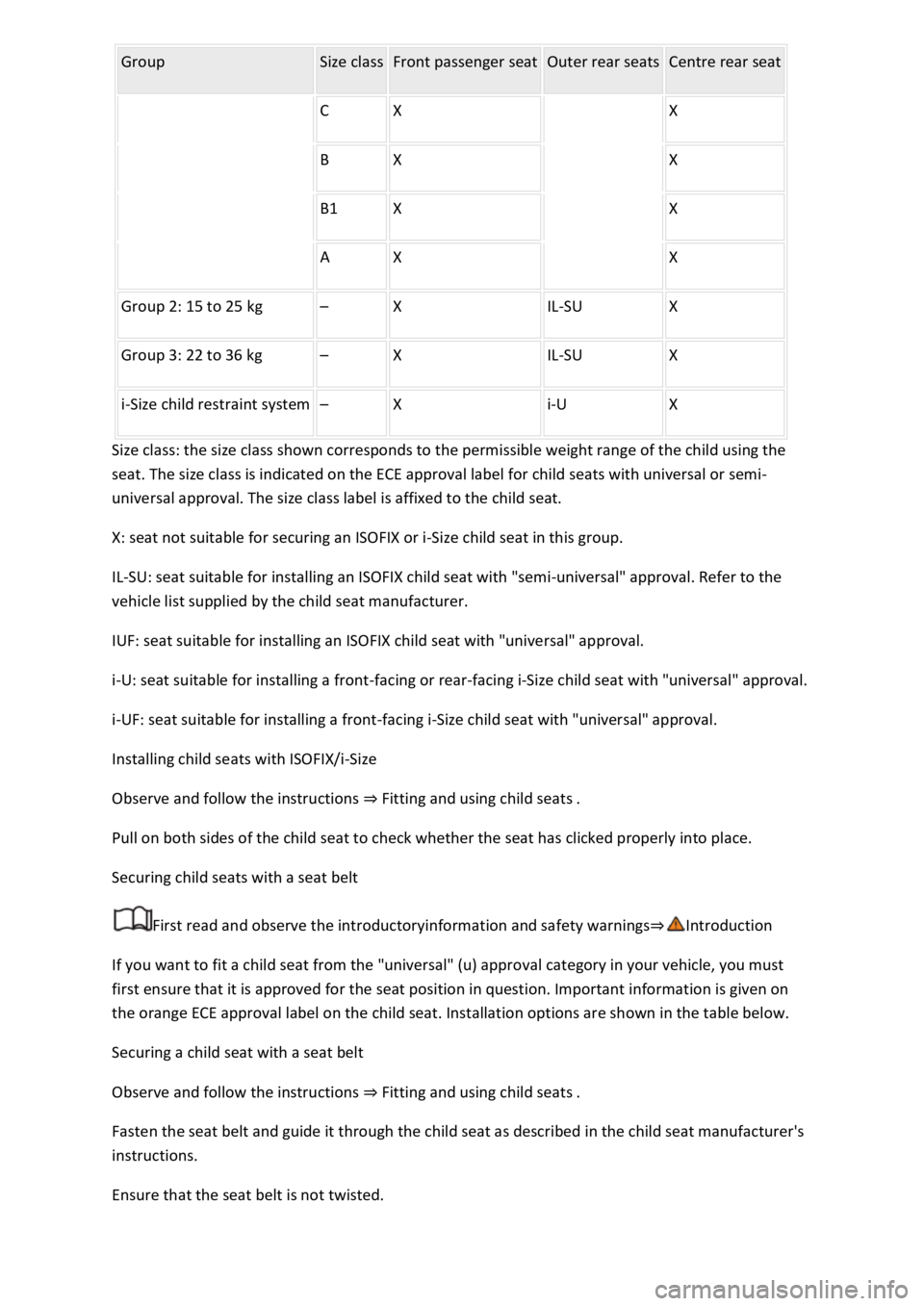
Group Size class Front passenger seat Outer rear seats Centre rear seat
C X X
B X X
B1 X X
A X X
Group 2: 15 to 25 kg – X IL-SU X
Group 3: 22 to 36 kg – X IL-SU X
i-Size child restraint system – X i-U X
Size class: the size class shown corresponds to the permissible weight range of the child using the
seat. The size class is indicated on the ECE approval label for child seats with universal or semi-
universal approval. The size class label is affixed to the child seat.
X: seat not suitable for securing an ISOFIX or i-Size child seat in this group.
IL-SU: seat suitable for installing an ISOFIX child seat with "semi-universal" approval. Refer to the
vehicle list supplied by the child seat manufacturer.
IUF: seat suitable for installing an ISOFIX child seat with "universal" approval.
i-U: seat suitable for installing a front-facing or rear-facing i-Size child seat with "universal" approval.
i-UF: seat suitable for installing a front-facing i-Size child seat with "universal" approval.
Installing child seats with ISOFIX/i-Size
Observe and follow the instructions ⇒ Fitting and using child seats .
Pull on both sides of the child seat to check whether the seat has clicked properly into place.
Securing child seats with a seat belt
First read and observe the introductoryinformation and safety warnings⇒Introduction
If you want to fit a child seat from the "universal" (u) approval category in your vehicle, you must
first ensure that it is approved for the seat position in question. Important information is given on
the orange ECE approval label on the child seat. Installation options are shown in the table below.
Securing a child seat with a seat belt
Observe and follow the instructions ⇒ Fitting and using child seats .
Fasten the seat belt and guide it through the child seat as described in the child seat manufacturer's
instructions.
Ensure that the seat belt is not twisted.
Page 90 of 502
Never leave children or people requiring assistance alone in the vehicle. They could become trapped
in the vehicle in an emergency and may not be able to get themselves to safety. For example, locked
vehicles may be subjected to very high or very low temperatures depending on the season. This can
cause serious injuries and illness or fatalities, especially in the case of small children.
Never switch off the ignition while the vehicle is in motion. The steering column lock or steering lock
mechanism may be activated and you will no longer be able to steer the vehicle.
NOTICE
Every electric vehicle key contains electronic components. Protect the key from damage, moisture
and excessive vibration.
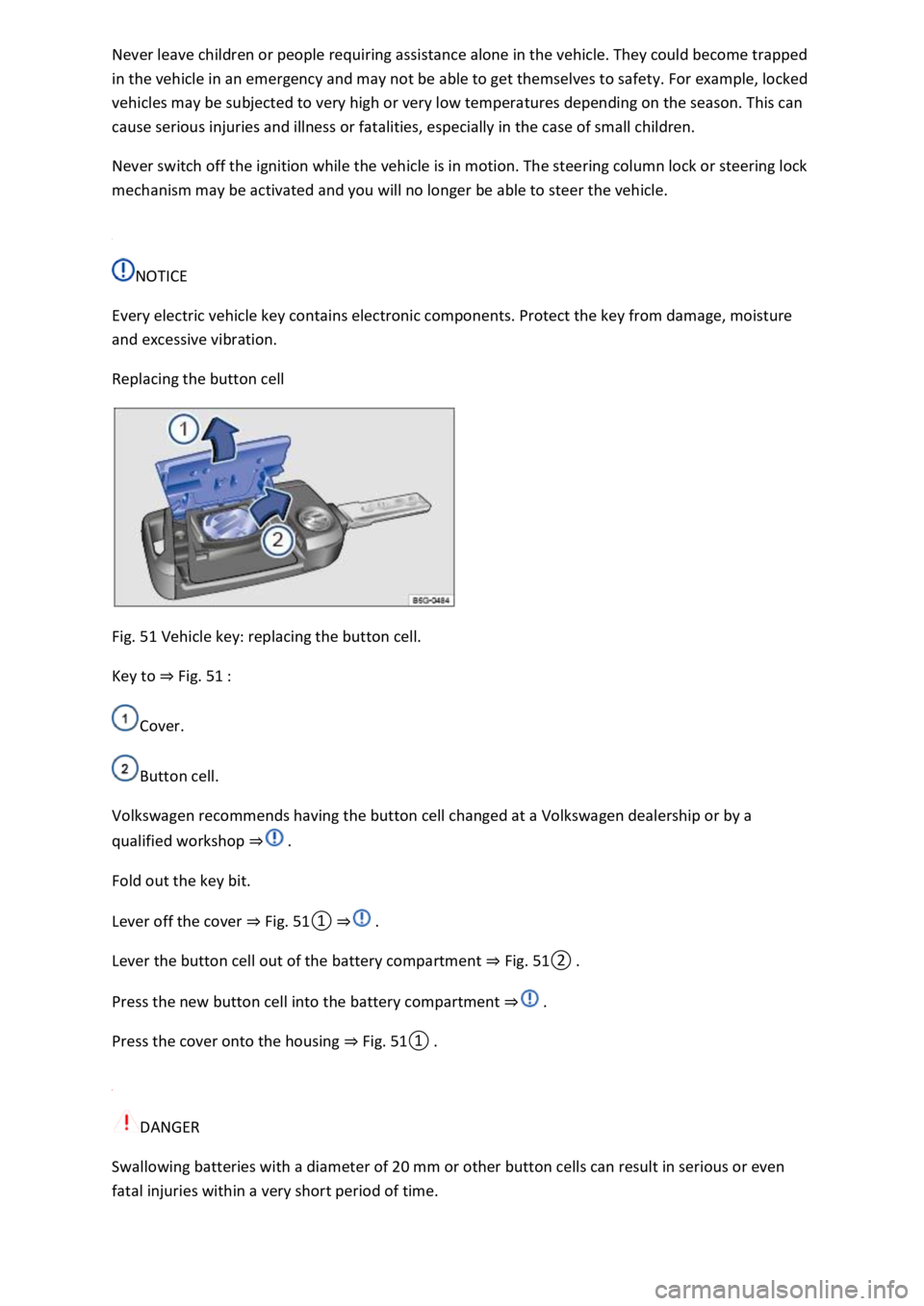
Replacing the button cell
Fig. 51 Vehicle key: replacing the button cell.
Key to ⇒ Fig. 51 :
Cover.
Button cell.
Volkswagen recommends having the button cell changed at a Volkswagen dealership or by a
qualified workshop ⇒ .
Fold out the key bit.
Lever off the cover ⇒ Fig. 51① ⇒ .
Lever the button cell out of the battery compartment ⇒ Fig. 51② .
Press the new button cell into the battery compartment ⇒ .
Press the cover onto the housing ⇒ Fig. 51① .
DANGER
Swallowing batteries with a diameter of 20 mm or other button cells can result in serious or even
fatal injuries within a very short period of time.
Page 96 of 502
Never leave children or people requiring assistance alone in the vehicle. All doors can be locked from
the inside using the central locking button. This may mean that people lock themselves in the
vehicle. People locked in the vehicle may be subjected to very high or very low temperatures.
Temperatures inside a locked vehicle may become extremely hot or cold, depending on the season.
This can cause serious injuries and illness or fatalities, especially in the case of small children.
Never leave anyone inside a locked vehicle. People in the vehicle could become trapped in an
emergency and will not be able to get themselves to safety.
NOTICE
When carrying out manual opening or closing, remove parts carefully and install them again
correctly in order to avoid damage to the vehicle.
Indicator lamp in the driver door
First read and observe the introductoryinformation and safety warnings⇒Introduction
The central locking indicator lamp is located in the driver door ⇒ Vehicle overviews .
Vehicle is locked: a red LED flashes for approximately two seconds, firstly at short intervals and then
more slowly. The indicator lamp does not flash if the vehicle was locked with the central locking
button in the driver door ⇒ Central locking button .
Automatic locking and unlocking
First read and observe the introductoryinformation and safety warnings⇒Introduction
Settings for central locking can be made in the Vehicle settings menu in the Infotainment system
⇒ Infotainment system controls and displays .
Automatic locking (Auto Lock)
The vehicle can lock itself automatically at speeds above approximately 15 km/h (9 mph). The
indicator lamp in the central locking button will light up yellow when the vehicle is locked.
Automatic unlocking (Auto Unlock)
If one of the following conditions applies, all doors and the boot lid will be automatically unlocked:
The vehicle is at a standstill and the vehicle key has been removed.
In vehicles with DSG® dual clutch gearbox: the selector lever is in position P and the ignition has
been switched off.
OR: the vehicle is stationary and the button has been pressed.
OR: the door release lever has been operated.
OR: in an accident where the airbags have been triggered ⇒ Troubleshooting .
Automatic unlocking provides access to the vehicle if assistance is required.
Page 100 of 502
The doors can be unlocked and opened from inside by pulling the door release handle.
Childproof lock
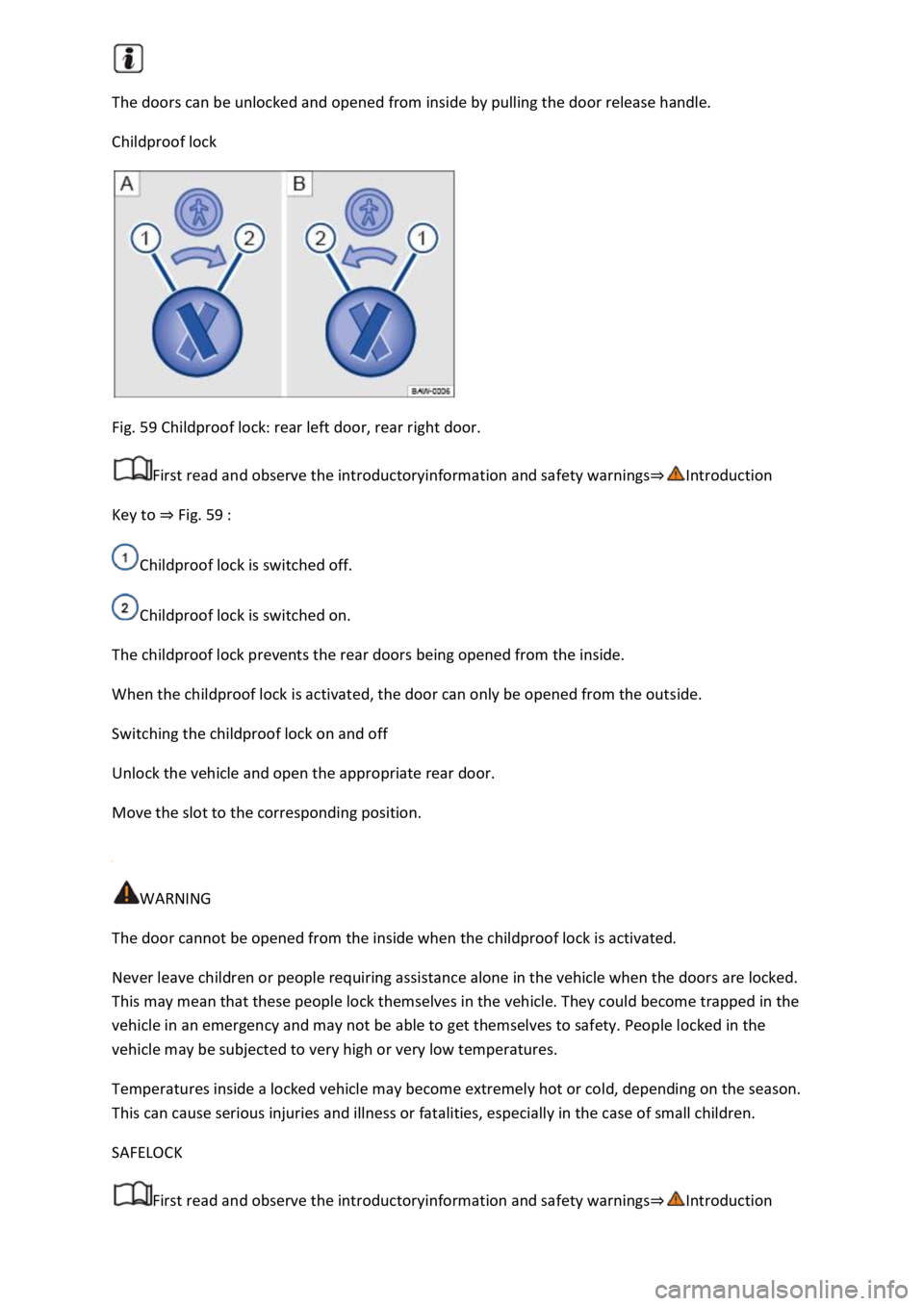
Fig. 59 Childproof lock: rear left door, rear right door.
First read and observe the introductoryinformation and safety warnings⇒Introduction
Key to ⇒ Fig. 59 :
Childproof lock is switched off.
Childproof lock is switched on.
The childproof lock prevents the rear doors being opened from the inside.
When the childproof lock is activated, the door can only be opened from the outside.
Switching the childproof lock on and off
Unlock the vehicle and open the appropriate rear door.
Move the slot to the corresponding position.
WARNING
The door cannot be opened from the inside when the childproof lock is activated.
Never leave children or people requiring assistance alone in the vehicle when the doors are locked.
This may mean that these people lock themselves in the vehicle. They could become trapped in the
vehicle in an emergency and may not be able to get themselves to safety. People locked in the
vehicle may be subjected to very high or very low temperatures.
Temperatures inside a locked vehicle may become extremely hot or cold, depending on the season.
This can cause serious injuries and illness or fatalities, especially in the case of small children.
SAFELOCK
First read and observe the introductoryinformation and safety warnings⇒Introduction
Page 102 of 502

There is a fault in the locking system.
Go to a qualified workshop. Volkswagen recommends using a Volkswagen dealership for this
purpose.
Turn signals do not flash
If the turn signals do not flash as confirmation when the vehicle is locked:
At least one of the doors or the boot lid is not closed.
OR: convenience closing is in progress and not all windows and the glass roof have been closed.
Vehicle locks itself automatically
The vehicle will lock itself again automatically after approx. 45 seconds if one of the following
conditions applies:
The vehicle has been unlocked but not opened.
The ignition has not been switched on.
The boot lid has not been opened.
The vehicle has been unlocked using the lock cylinder.
The vehicle has been locked using the central locking button in the vehicle interior.
Response when locking the vehicle with a second vehicle key
Keyless Access: the vehicle key located inside the vehicle will be blocked from starting the engine if
the vehicle has been locked from the outside using a second vehicle key. Press the button on the
vehicle key in the vehicle interior to enable it to start the engine ⇒ Starting and stopping the
engine .
Locking the vehicle after airbags have been triggered
The entire vehicle is unlocked if the airbags are activated in an accident. Depending on the extent of
the damage, the vehicle can be locked as follows after an accident:
Switch the ignition off and then back on again.
Automatic deactivation of the sensors
The vehicle is not unlocked or locked for an extended period.
A sensor has been triggered an excessive number of times.
Reactivating the sensors:
Unlock the vehicle with the button in the vehicle key.
NOTICE
Page 103 of 502

Please note that the sensors in the door handles can be activated by a powerful jet of water or
steam if a valid vehicle key is simultaneously within the operating range. If at least one window is
open and sensor surfaces on the door handles are continuously activated, all windows will close. All
windows could open if the jet of water or steam is moved away from the door handle sensors briefly
and then moved back again ⇒ .
It may not be possible to lock or unlock the vehicle using the Keyless Access if the 12-volt vehicle
battery or button cell in the vehicle key is weak or discharged. The vehicle can be locked or unlocked
manually ⇒ .
If there is no valid vehicle key in the vehicle or if it is not detected, a corresponding message will be
shown on the instrument cluster display. This may occur if the vehicle key is exposed to interference
from another radio signal or is covered by another item, e.g. an aluminium case ⇒ Starting and
stopping the engine .
Anti-theft alarm
Depending on the vehicle equipment level, the vehicle may have an anti-theft alarm.
The anti-theft alarm is activated automatically when the vehicle is locked using the vehicle key.
The anti-theft alarm outputs acoustic and visual warning signals for up to five minutes.
When does the system trigger an alarm?
If a door is opened.
If the bonnet is opened.
If the boot lid is opened.
If the ignition is switched on with a valid vehicle key. (The alarm may sound briefly.)
If the 12-volt vehicle battery is disconnected.
If there is movement inside the vehicle (in vehicles with interior monitoring) ⇒ Interior monitoring
system and anti-tow alarm .
If the vehicle is lifted or towed (vehicles with anti-tow alarm) ⇒ Interior monitoring system and anti-
tow alarm .
If the vehicle is transported on a car ferry or by rail (vehicles with anti-tow alarm or interior
monitoring) ⇒ Interior monitoring system and anti-tow alarm .
If a trailer that is connected to the anti-theft alarm system is removed ⇒ Trailer towing .
Switching off the alarm
Unlock the vehicle using the unlocking button on the vehicle key.