Profile VOLKSWAGEN T-ROC 2021 Owner´s Manual
[x] Cancel search | Manufacturer: VOLKSWAGEN, Model Year: 2021, Model line: T-ROC, Model: VOLKSWAGEN T-ROC 2021Pages: 502, PDF Size: 9.42 MB
Page 193 of 502
If the start/stop system is used in very high outside temperatures over a long period, the 12-volt
vehicle battery can be damaged.
The engine stop function may be deactivated automatically if the temperature is above around 38°C
(100°F).
In some cases, it may be necessary to restart the engine manually. Follow any corresponding
messages on the instrument cluster display.
The start/stop function is activated automatically if the Eco driving profile is selected on vehicles
with driving profile selection ⇒ Driving profile selection and 4MOTION Active Control .
Always deactivate the start/stop system manually when driving through water.
Troubleshooting
Engine no longer starts automatically
Vehicles with DSG dual clutch gearbox and coasting function: if the engine does not start
automatically, the warning Error: vehicle power system. Please visit workshop can be displayed in
the instrument cluster.
Start the engine manually ⇒ Starting the engine .
Deactivate the start/stop system manually.
Go to a qualified workshop immediately.
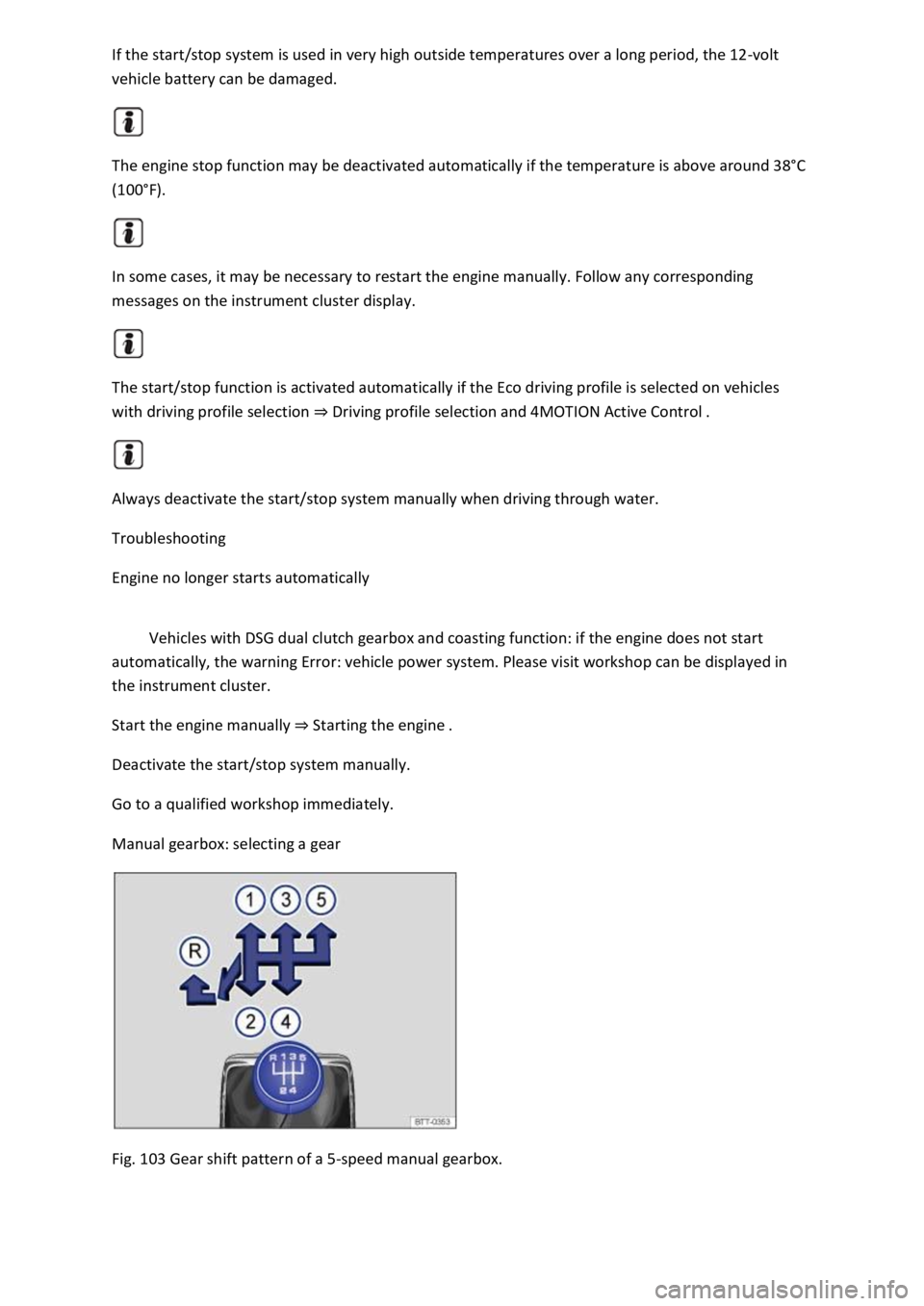
Manual gearbox: selecting a gear
Fig. 103 Gear shift pattern of a 5-speed manual gearbox.
Page 197 of 502
gearbox the clutch can be opened at idling speed, thus saving fuel. Thanks to its efficiency, low
weight and intelligent control system, the DSG® dual clutch gearbox usually enables fuel
consumption that is equal to or lower than a manual gearbox.
However, just like the manual gearbox, the clutch in the DSG® dual clutch gearbox is subject to wear.
Regular maintenance is necessary depending on the type of DSG® dual clutch gearbox; further
information ⇒ Scope of service . In the event of a fault in one gear train half, the DSG® dual clutch
gearbox also allows one gear train half to be deactivated and the journey to be continued using the
other gear train half ⇒ Troubleshooting . The gearbox must then be checked as soon as possible by a
qualified workshop.
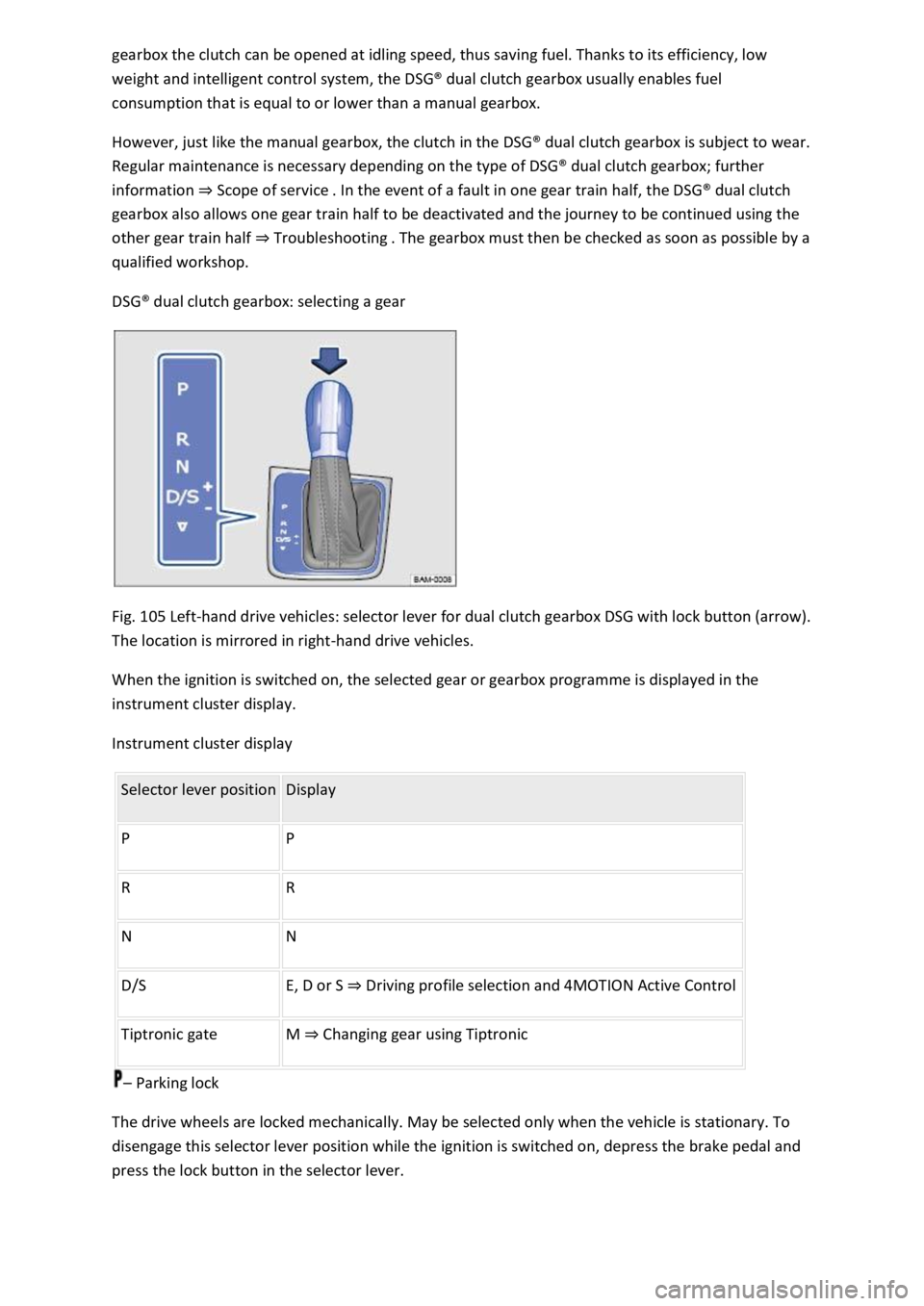
DSG® dual clutch gearbox: selecting a gear
Fig. 105 Left-hand drive vehicles: selector lever for dual clutch gearbox DSG with lock button (arrow).
The location is mirrored in right-hand drive vehicles.
When the ignition is switched on, the selected gear or gearbox programme is displayed in the
instrument cluster display.
Instrument cluster display
Selector lever position Display
P P
R R
N N
D/S E, D or S ⇒ Driving profile selection and 4MOTION Active Control
Tiptronic gate M ⇒ Changing gear using Tiptronic
– Parking lock
The drive wheels are locked mechanically. May be selected only when the vehicle is stationary. To
disengage this selector lever position while the ignition is switched on, depress the brake pedal and
press the lock button in the selector lever.
Page 201 of 502

Driving down hills
The steeper the gradient, the lower the gear you will need. Lower gears increase the braking effect
of the engine. Never allow the vehicle to roll down mountains or hills in the neutral position N.
Reduce your speed.
Push the selector lever from position D/S to the right into the Tiptronic gate ⇒ Changing gear using
Tiptronic .
Tap the selector lever to the rear to change down gear.
OR: shift down a gear using the paddles on the steering wheel ⇒ Changing gear using Tiptronic .
Stopping and pulling away on an uphill gradient
The steeper the uphill gradient, the lower the gear you will need.
If you wish to stop the vehicle or pull away when driving uphill, you should use the Auto Hold
function ⇒ Electronic parking brake .
When you stop the vehicle on an uphill gradient with a selected position, the vehicle must always be
prevented from rolling by depressing the brake pedal or by applying the electronic parking brake. Do
not release the brake pedal or switch off the electronic parking brake until you are about to pull
away.
Coasting with DSG® dual clutch gearbox
In coasting mode, the momentum of the vehicle can be used to save fuel in conjunction with an
anticipatory driving style. The engine no longer brakes the vehicle – the vehicle can roll for a longer
distance. The function is available only in the selector lever position D and at speeds of
approximately 40 – 130 km/h (25 mph – 80 mph).
Initiating coasting
Select the Eco driving profile in the driving profile selection menu ⇒ Driving profile selection and
4MOTION Active Control .
Take your foot off the accelerator. The engine will be disengaged and run at idling speed. The vehicle
rolls without the braking effect of the engine.
If the speed falls below 130 km/h (80 mph).
Depress the accelerator briefly.
Cancelling coasting mode
Depress the brake pedal forcefully.
OR: depress the accelerator or brake pedal briefly.
OR: pull a paddle towards the steering wheel.
OR: press the selector lever to the Tiptronic position.
OR: change the driving profile from Eco.
Page 202 of 502

Kickdown function
The kickdown function enables maximum acceleration in the selector lever position D/S or in the
Tiptronic position.
If the accelerator is depressed fully, the gearbox will automatically shift to a lower gear, depending
on the speed and engine speed. This will make use of the full vehicle acceleration.
With the kickdown function, the gearbox does not shift up to the next gear until the engine reaches
the maximum engine speed for the gear.
When the Eco driving profile is selected in vehicles with driving profile selection ⇒ Driving profile
selection and 4MOTION Active Control and the accelerator is depressed fully beyond the pressure
point, the engine output is automatically regulated to ensure maximum vehicle acceleration.
WARNING
Rapid acceleration can cause loss of traction and skidding, particularly on slippery roads. This can
cause you to lose control of the vehicle, which can lead to accidents and serious injuries.
Always adjust your driving style in accordance with the flow of traffic.
Use the kickdown function or fast acceleration only if visibility, weather, road and traffic conditions
permit, and if other road users are not put at risk due to the acceleration and the driving style.
Please note that the driven wheels could start to spin and the vehicle could skid if the TCS is
switched off and especially if the road is slippery.
WARNING
Never let the brakes rub too often and for too long or operate the brake pedal too often or for too
long. Constant braking will cause the brakes to overheat. This will considerably reduce the braking
power, significantly increase the braking distance and could cause the brake system to fail
completely.
NOTICE
Never let the brakes rub by applying light pressure when it is not necessary. This will increase levels
of wear.
Troubleshooting
Page 207 of 502

The downhill speed control cannot hold the vehicle on the gradient in all situations or brake it
sufficiently on all slopes going downhill (e.g. if the ground is slippery or icy).
WARNING
Always be prepared to brake the vehicle. Accidents and injuries could occur if you are not prepared
to brake.
The downhill speed control is only a support function and may not be able to brake the vehicle
sufficiently in all situations when driving downhill.
The vehicle may become faster despite the downhill speed control being in operation.
Steering
Information on steering
The steering should be locked every time you leave the vehicle to make it more difficult for the
vehicle to be stolen.
The steering
The power steering is not hydraulic, but is an electromechanical system. The advantage of this
steering system is that no hydraulic hoses, hydraulic oil, pumps, filter or other parts are required.
The electromechanical system reduces fuel consumption. A hydraulic system requires constant oil
pressure in the system, whereas an electromechanical steering system only needs an energy supply
while steering.
In vehicles with driving profile selection, the selected driving profile can affect the behaviour of the
power steering ⇒ Driving profile selection and 4MOTION Active Control .
Electronic steering column lock in vehicles with a starter button
The steering column will be locked if the driver door is opened when the ignition is switched off. For
this, the vehicle should be stationary and, if necessary, the gear selector lever should be in position
P.
If the ignition is not switched off until after the driver door is opened, the electronic steering column
will only be locked when the vehicle is locked using the sensor in the door handle or the vehicle key.
Mechanical steering column lock (steering lock) in vehicles with an ignition lock
The steering column is locked if the vehicle key is removed from the ignition lock when the vehicle is
stationary. Turn the steering wheel slightly until the steering lock audibly engages.
Insert the vehicle key into the ignition lock to unlock the steering lock. Turn the steering wheel
slightly to relieve the load on the steering lock mechanism. Hold the steering wheel in this position
and turn the ignition on.
Electromechanical steering
Page 209 of 502

The indicator lamp lights up yellow.
The steering should be checked by a qualified workshop as soon as possible.
If the yellow warning lamp remains off after the engine has been restarted and you have driven a
short distance, you do not need to consult a qualified workshop.
Fault in steering
The indicator lamp lights up yellow.
The 12-volt vehicle battery was disconnected.
Drive a short distance at a speed of 15 – 20 km/h (9 – 12 mph).
If the yellow warning lamp is still lit after the engine has been restarted, have the steering checked
by a qualified workshop immediately.
Fault in steering
The indicator lamp flashes yellow.
Turn the steering wheel back and forth.
Switch the ignition off and then on again.
Observe the messages on the instrument cluster display.
Do not continue your journey if the indicator lamp still flashes when the ignition is switched on.
Seek expert assistance.
Steering column is not unlocked or locked
The indicator lamp flashes yellow.
Follow any messages that are on the instrument cluster display.
Switch the ignition off and then on again.
Do not continue your journey if the steering column remains locked when the ignition is switched
on.
Seek expert assistance.
Steering requires increased force
The warning lamp lights up red.
The electromechanical steering has failed.
Do not drive on!
Seek expert assistance.
Driving profile selection and 4MOTION Active Control
Page 210 of 502
Introduction
This chapter contains information on the followingsubjects:
⇒ Setting a driving profile
⇒ Individually adapting a driving profile
⇒ Troubleshooting
By selecting different driving profiles, the driver can adapt the characteristics of the vehicle systems
to the current driving situation, the desired ride comfort and an economical driving style. The
adaptable vehicle systems include the running gear, engine management system or the air
conditioning system.
Different driving profiles can be selected depending on the vehicle equipment level. The effect on
the vehicle setup in the individual driving profiles varies according to the vehicle equipment.
The Comfort driving profile is available only for vehicles with adaptive chassis control (DCC).
The setting options available depend on the type of drive. Vehicles with front-wheel drive have
onroad driving profiles, while vehicles with all-wheel drive have additional offroad driving profiles
⇒ Setting a driving profile .
The driving profile can be changed when the vehicle is stationary or while driving ⇒ . After
selecting a driving profile, the vehicle settings (excluding engine settings) are switched to the new
driving profile immediately. When traffic conditions allow, briefly take your foot off the accelerator
to activate the newly selected driving profile for the engine also.
WARNING
Selecting a driving profile while the vehicle is in motion can distract you from the road and cause
accidents.
Some settings can be stored in the user accounts of the personalisation function and therefore
change automatically when the user account changes ⇒ Personalisation .
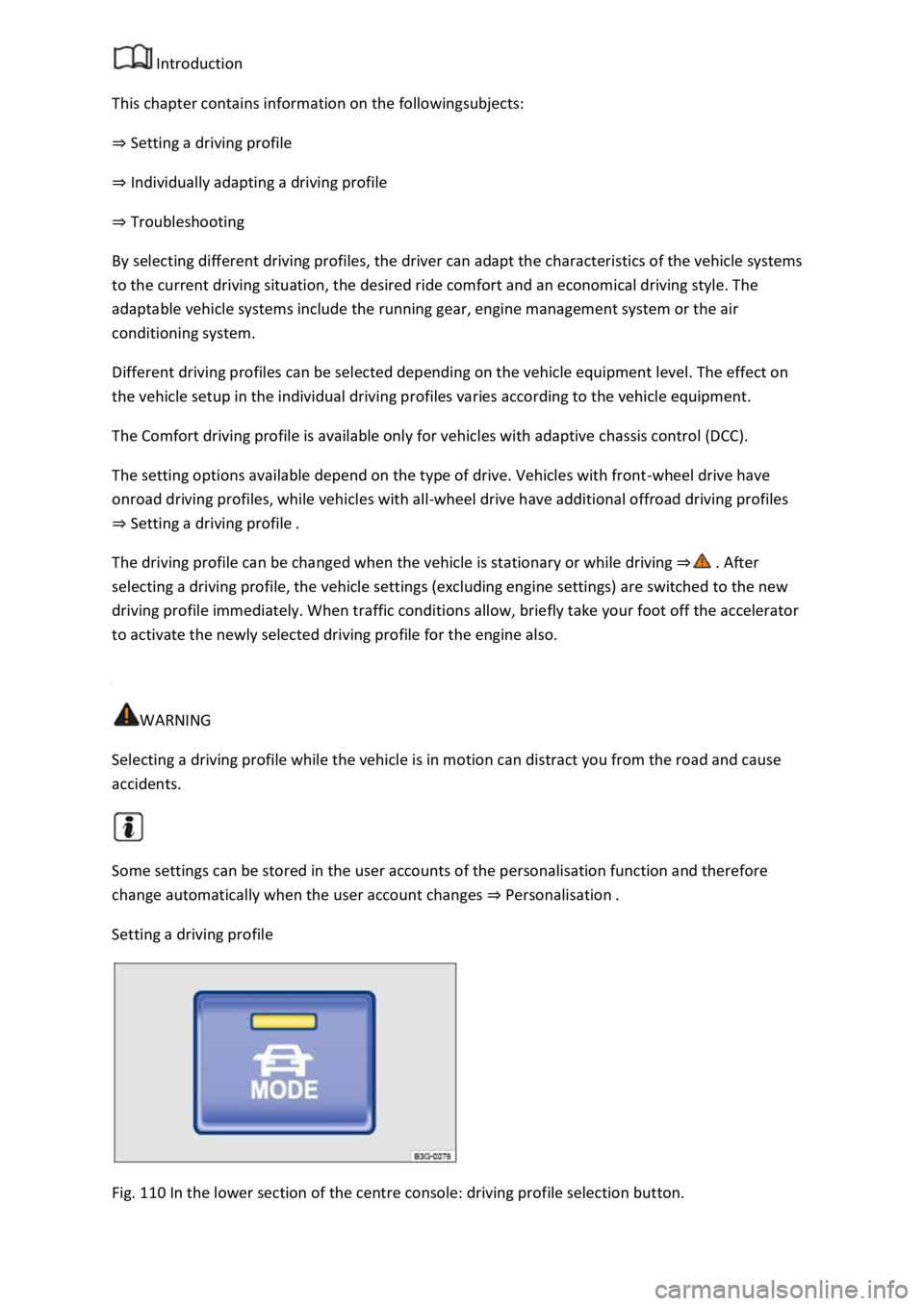
Setting a driving profile
Fig. 110 In the lower section of the centre console: driving profile selection button.
Page 211 of 502
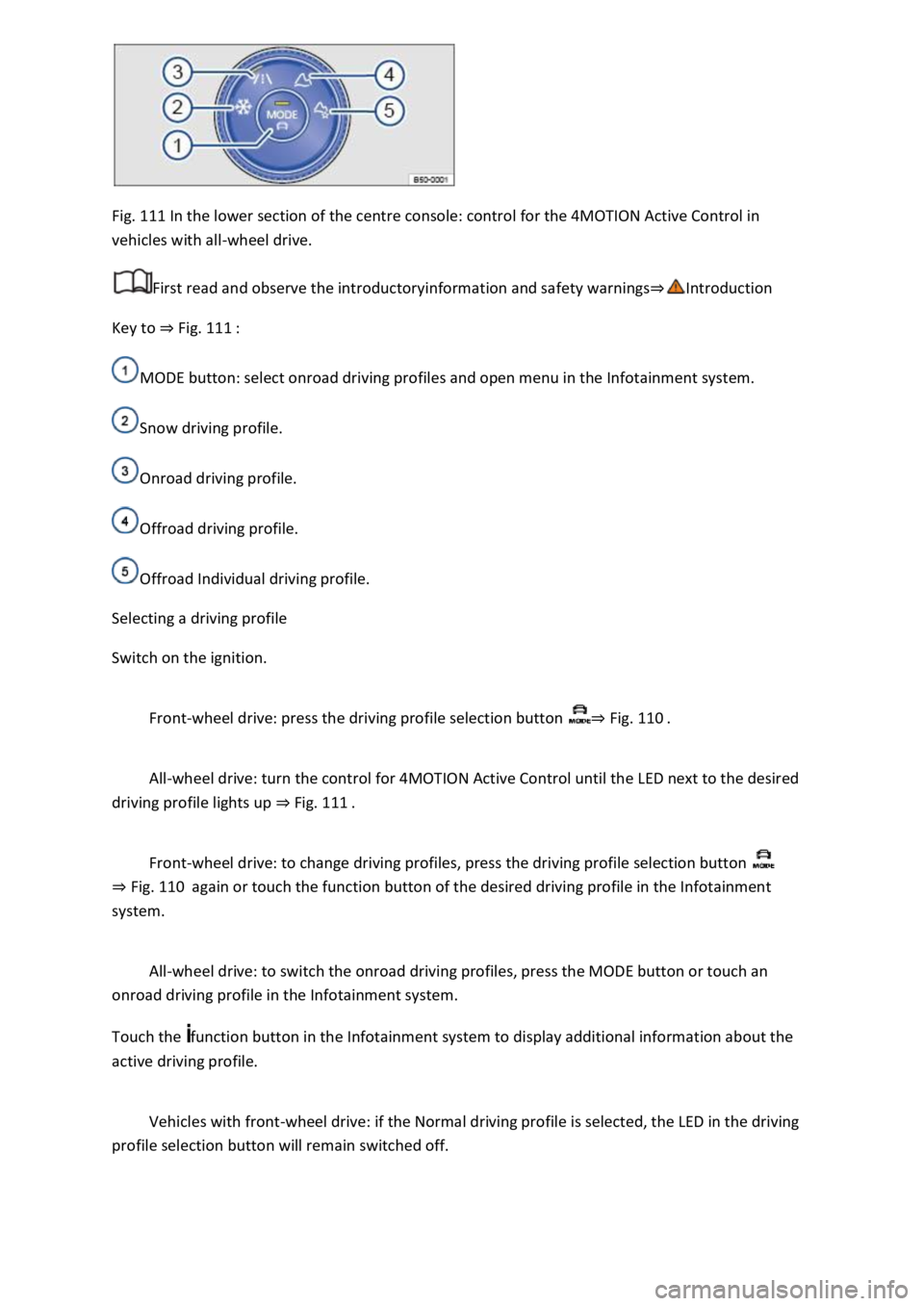
Fig. 111 In the lower section of the centre console: control for the 4MOTION Active Control in
vehicles with all-wheel drive.
First read and observe the introductoryinformation and safety warnings⇒Introduction
Key to ⇒ Fig. 111 :
MODE button: select onroad driving profiles and open menu in the Infotainment system.
Snow driving profile.
Onroad driving profile.
Offroad driving profile.
Offroad Individual driving profile.
Selecting a driving profile
Switch on the ignition.
Front-wheel drive: press the driving profile selection button ⇒ Fig. 110 .
All-wheel drive: turn the control for 4MOTION Active Control until the LED next to the desired
driving profile lights up ⇒ Fig. 111 .
Front-wheel drive: to change driving profiles, press the driving profile selection button
⇒ Fig. 110 again or touch the function button of the desired driving profile in the Infotainment
system.
All-wheel drive: to switch the onroad driving profiles, press the MODE button or touch an
onroad driving profile in the Infotainment system.
Touch the function button in the Infotainment system to display additional information about the
active driving profile.
Vehicles with front-wheel drive: if the Normal driving profile is selected, the LED in the driving
profile selection button will remain switched off.
Page 212 of 502

When the ignition is switched off, the set driving profile and the individual settings will remain
selected.
Vehicles with all-wheel drive: if the Snow, Offroad or Offroad Individual driving profile was
selected last, the onroad driving profile that was last active will be activated after the ignition has
been switched off for a long period.
Vehicles without starter button: as soon as the vehicle key is removed from the ignition lock.
Vehicles with starter button: as soon as the driver door is opened when the ignition is switched
off.
Sport functions: select Sport driving profile again.
OR: tap the selector lever of the DSG® dual clutch gearbox backwards to the position S⇒ DSG® dual
clutch gearbox .
Eco functions: select Eco driving profile again.
Characteristics of the driving profiles
Snow: the Snow driving profile makes it easier to control the throttle on icy or snowy roads. It is not
possible to select the S position in the Snow driving profile.
Onroad: under Onroad, you can choose between Eco, Comfort, Normal, Sport and Individual driving
profiles.
Offroad: the Offroad driving profile makes it easier to control the throttle when driving offroad. The
engine brake is always available and gearshifts can be prevented in critical situations. Hill Start Assist
and Hill Descent Control are active in the Offroad driving profile. It is not possible to select the S
position in the Offroad driving profile. When the driving profile is active, the instrument cluster
displays the symbol .
Offroad Individual: enhanced version of the offroad driving profile that can be adapted to the
driver's needs ⇒ Individually adapting a driving profile . When the driving profile is active, the
instrument cluster displays the symbol .
Eco: switches the vehicle into economical mode and helps the driver to drive the vehicle in a fuel-
efficient manner. Depending on the vehicle equipment level, coasting mode is available in the Eco
driving profile.
Comfort: the driving profile creates a comfort-oriented vehicle setup and is suited to poor roads or
long motorway journeys, for example.
Normal: the driving profile has a balanced setup, e.g. for everyday use.
Sport: this setting gives the driver a sporty driving feeling.
Page 213 of 502
Individual: individual vehicle systems can be adjusted to suit personal requirements ⇒ Individually
adapting a driving profile .
WARNING
The vehicle handling may change as a result of the different driving profiles. Never allow driving
profile selection to tempt you into taking any risks when driving.
Always adapt your speed and driving style to the current visibility, weather and road or traffic
conditions.
In vehicles with a DSG® dual clutch gearbox, the system automatically changes to gear position S
when the Sport driving profile is selected. The system automatically change to gear position D when
the Eco driving profile is selected. Since coasting is active in the Eco driving profile, the gearbox
programme E is additionally displayed on the instrument cluster display.
Individually adapting a driving profile
First read and observe the introductoryinformation and safety warnings⇒Introduction
Selecting the Individual driving profile
Switch on the ignition.
Switch on the Infotainment system.
Press the driving profile selection button or turn the control for 4MOTION Active Control until
the LED next to the Onroad driving profile ⇒ Fig. 111 ③ lights up.
Touch the Adjust function button to open the Individual menu.
Selecting the Offroad Individual driving profile
Switch on the ignition.
Switch on the Infotainment system.
Turn the control for the 4MOTION Active Control until the LED next to the Offroad Individual driving
profile ⇒ Fig. 111 ⑤ lights up.
If the Offroad Individual driving profile is already selected, press the MODE button on the
control ⇒ Fig. 111 .
Touch the Adjust function button to open the Individual menu.
Troubleshooting
First read and observe the introductoryinformation and safety warnings⇒Introduction
Fault in the adaptive chassis control (DCC)