height VOLKSWAGEN T-ROC 2021 Owner´s Manual
[x] Cancel search | Manufacturer: VOLKSWAGEN, Model Year: 2021, Model line: T-ROC, Model: VOLKSWAGEN T-ROC 2021Pages: 502, PDF Size: 9.42 MB
Page 81 of 502
There is a risk of injury if a front-facing child seat is on the front passenger seat.
Move the front passenger seat as far back as possible and adjust to its highest position to create the
largest possible distance between the child seat and the front passenger front airbag.
Move the backrest to the upright position.
Adjust the seat belt height adjuster to the highest position.
Use only child seats that have been approved by the child seat manufacturer for use on a front
passenger seat with front and side airbags.
WARNING
To help avoid injuries caused by inflation of a curtain airbag or side airbag:
Ensure that no children are seated within the airbag deployment zones ⇒ Airbag system .
Do not place any objects in the side airbag deployment zones.
Securing systems
First read and observe the introductoryinformation and safety warnings⇒Introduction
Different countries use different securing systems for safely fitting child seats in the vehicle.
Overview of securing systems
ISOFIX: ISOFIX is a standardised securing system for fitting child seats in the vehicle quickly and
safely. The ISOFIX attachment system creates a rigid connection between the child seat and the
vehicle body.
Compatible child seats have two rigid attachment arms that engage in ISOFIX attachment points at
the bottom of the backrest (on the outer rear seats). The ISOFIX securing system as described here is
specific to Europe ⇒ Securing a child seat with ISOFIX . An upper strap (top tether) and/or support
foot may sometimes have to be used in addition to the ISOFIX anchor points described above.
Three-point automatic seat belt. It is preferable to secure child seats using the ISOFIX system, if
available, rather than with a three-point automatic seat belt ⇒ Securing child seats with a seat belt .
Additional securing points:
Recommended child seat securing systems
Volkswagen recommends that child seats are secured as follows:
Infant carrier or rear-facing child seat: ISOFIX and support foot.
Front-facing child seat: ISOFIX and top tether and possibly also support foot.
WARNING
Page 118 of 502

⇒ Mechanically adjusting the front seat
⇒ Folding the front passenger seat backrest forwards
The following section describes the options for adjusting the front seats. Always ensure that you
adjust the correct sitting position ⇒ Sitting position .
WARNING
Always adjust the front seats to their correct position before any journey and ensure that all
passengers have fastened their seat belts.
Push the front passenger seat as far back as possible.
Adjust the driver seat so that there is at least 25 cm between your breastbone and the hub of the
steering wheel. Adjust the driver seat by moving it forwards or backwards so that you are able to
press the pedals to the floor with your knees still slightly angled and the distance to the dash panel
in the knee area is at least 10 cm. If your build makes it impossible to fulfil this requirement, you
must contact a qualified workshop so they can make any necessary modifications.
Never travel with the backrest tilted far back. The further back the backrest is tilted, the greater the
risk of injury caused by incorrect seat belt routing or an incorrect sitting position.
Never travel with the backrest tilted far forwards. When a front airbag is triggered, it could force the
seat backrest backwards and injure vehicle occupants on the rear seats.
Adopt and maintain the greatest possible distance from the steering wheel and dash panel.
You should always sit upright with your back against the seat backrest with the front seats properly
adjusted. Do not position any body part too close to where the airbags are fitted.
The risk of serious injury is increased for passengers on the rear seat if they are not sitting upright
because the seat belts are incorrectly positioned.
WARNING
Incorrect adjustment of the seats can cause accidents and serious injuries.
The seats must be adjusted only when the vehicle is stationary, or else the seat could change
position unexpectedly while the vehicle is in motion, leading to a loss of control of the vehicle.
Furthermore, an incorrect seating position is adopted while adjusting the seat.
Adjust the height and tilt of the seat or move it forwards and backwards only when the area around
the seat is clear.
The adjustment range of the seats must not be restricted by any items.
Adjust the tilt angle of the rear seats or move them forwards and backwards only when the area
around the seats is clear.
The adjustment and locking areas of the seats must not be soiled.
Page 120 of 502
Operate the lever to adjust the lumbar support.
Take your weight off the backrest and turn the handwheel to adjust the backrest position.
Front passenger seat: take your weight off the backrest and operate the lever to adjust the backrest
position (depending on equipment).
Move the lever up or down, several times if necessary, to adjust the seat height.
Pull the lever to push the front seat forwards or backwards. The front seat must engage after the
lever has been released.
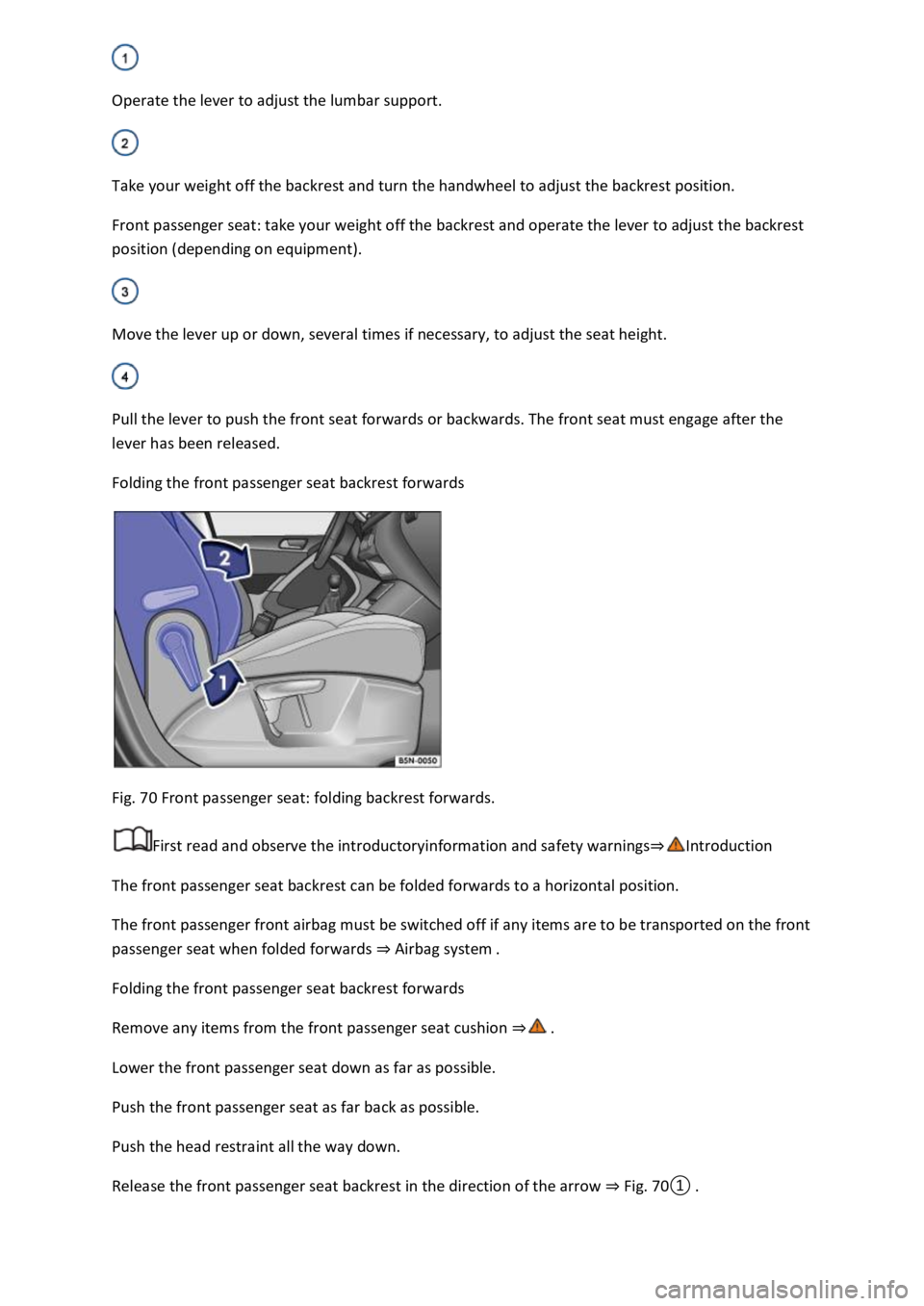
Folding the front passenger seat backrest forwards
Fig. 70 Front passenger seat: folding backrest forwards.
First read and observe the introductoryinformation and safety warnings⇒Introduction
The front passenger seat backrest can be folded forwards to a horizontal position.
The front passenger front airbag must be switched off if any items are to be transported on the front
passenger seat when folded forwards ⇒ Airbag system .
Folding the front passenger seat backrest forwards
Remove any items from the front passenger seat cushion ⇒ .
Lower the front passenger seat down as far as possible.
Push the front passenger seat as far back as possible.
Push the head restraint all the way down.
Release the front passenger seat backrest in the direction of the arrow ⇒ Fig. 70① .
Page 125 of 502
Correct head restraint adjustment
Adjust the head restraint so that its upper edge is at the same height as the top of the head, but not
lower than eye level. Position the back of your head as close to the head restraint as possible.
Head restraint adjustment for small people
Push the head restraint all the way down, even if the head is then located underneath the top edge
of the head restraint. There may be a small gap between the head restraint and backrest in the
lowest position.
Head restraint adjustment for tall people
Push the head restraint up as far as it will go.
WARNING
Driving without head restraints or with incorrectly adjusted head restraints increases the risk of
serious or fatal injuries in the event of an accident or sudden driving or braking manoeuvre.
If a seat is occupied, the head restraint for that seat must be fitted and adjusted correctly.
Each vehicle occupant must adjust the head restraint to suit their body size in order to reduce the
risk of neck injuries in an accident. The upper edge of the head restraint must, as far as possible, be
level with the top of the head, but no lower than eye level. Position the back of your head in the
middle and as close to the head restraint as possible.
Never adjust the head restraint when the vehicle is in motion.
NOTICE
When removing or fitting head restraints, make sure that they do not hit the roof, the front seat
backrest or other vehicle parts. This will prevent damage from occurring.
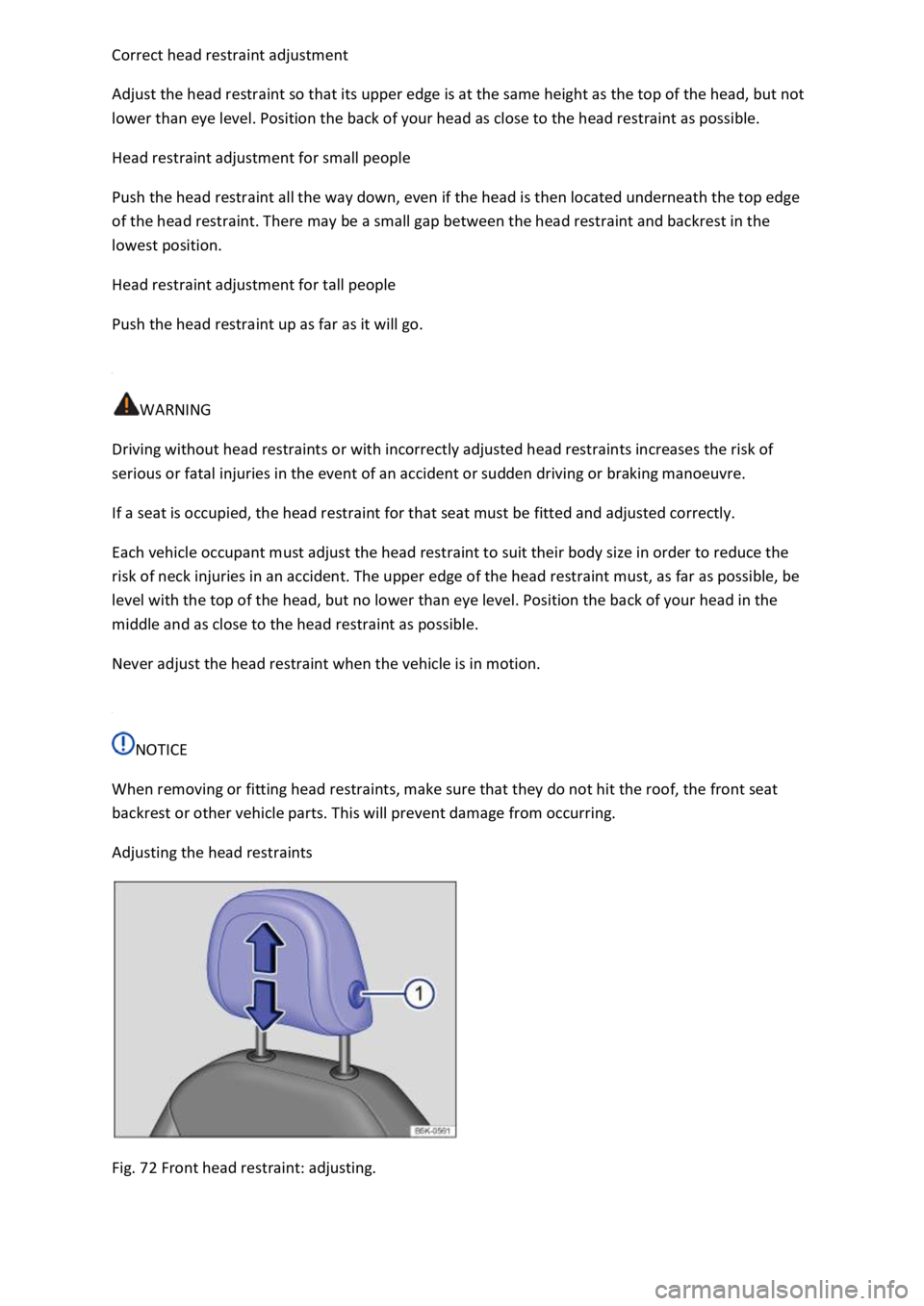
Adjusting the head restraints
Fig. 72 Front head restraint: adjusting.
Page 126 of 502
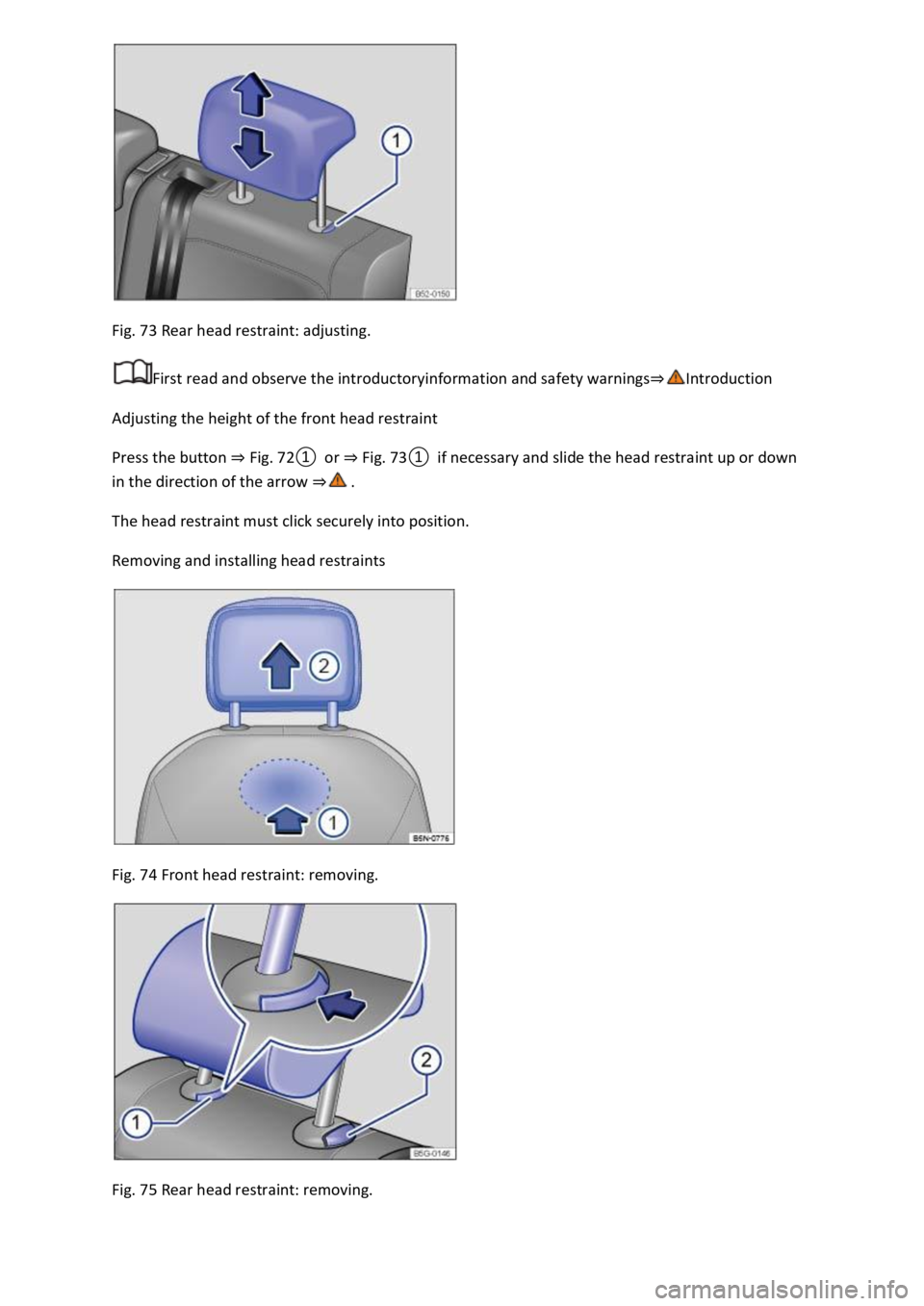
Fig. 73 Rear head restraint: adjusting.
First read and observe the introductoryinformation and safety warnings⇒Introduction
Adjusting the height of the front head restraint
Press the button ⇒ Fig. 72① or ⇒ Fig. 73① if necessary and slide the head restraint up or down
in the direction of the arrow ⇒ .
The head restraint must click securely into position.
Removing and installing head restraints
Fig. 74 Front head restraint: removing.
Fig. 75 Rear head restraint: removing.
Page 178 of 502

Avoid any abrupt or sudden driving and braking manoeuvres as this could cause the open boot lid to
move unpredictably.
Any objects protruding from the luggage compartment must be marked to ensure that they are
visible to other road users. Comply with legal regulations.
If items protrude out of the luggage compartment, never use the boot lid to wedge them into place
or hold them in position.
If you have to drive with the boot lid open, you must remove any carriers and the loads attached to
them from the boot lid.
WARNING
Poisonous exhaust fumes could enter the vehicle interior when the boot lid is open. This could result
in loss of consciousness, carbon monoxide poisoning, serious injury and accidents.
You should always drive with the boot lid closed in order to prevent poisonous exhaust fumes from
entering the vehicle.
If exceptional circumstances require you to drive with an open boot lid, you must do the following to
reduce the amount of poisonous exhaust fumes that could enter into the vehicle:
Close all windows and the glass roof.
Switch off the air recirculation mode of the heating and fresh air system or air conditioning system.
Open all vents in the dash panel.
Switch the blower for the heating and fresh air system or for the air conditioning system to the
highest setting.
NOTICE
The vehicle height, and possibly the length, are different when the boot lid is open.
Driving through water
Please follow these points in order to prevent damage to your vehicle when driving through water,
for example on flooded streets:
Check how deep the water is before driving through it. The water may be no higher than the lower
edge of the body ⇒ .
Do not drive faster than walking speed.
Never stop the vehicle, reverse or switch off the engine while in water.
Oncoming vehicles will create waves that could increase the water level for your vehicle to such an
extent that it is not safe to drive through the water.
Always deactivate the start/stop system manually when driving through water ⇒ Start/stop system .
Page 214 of 502
The indicator lamp lights up yellow.
Go to a qualified workshop and have the system checked.
Fault in Hill Start Assist
Go to a qualified workshop and have the system checked.
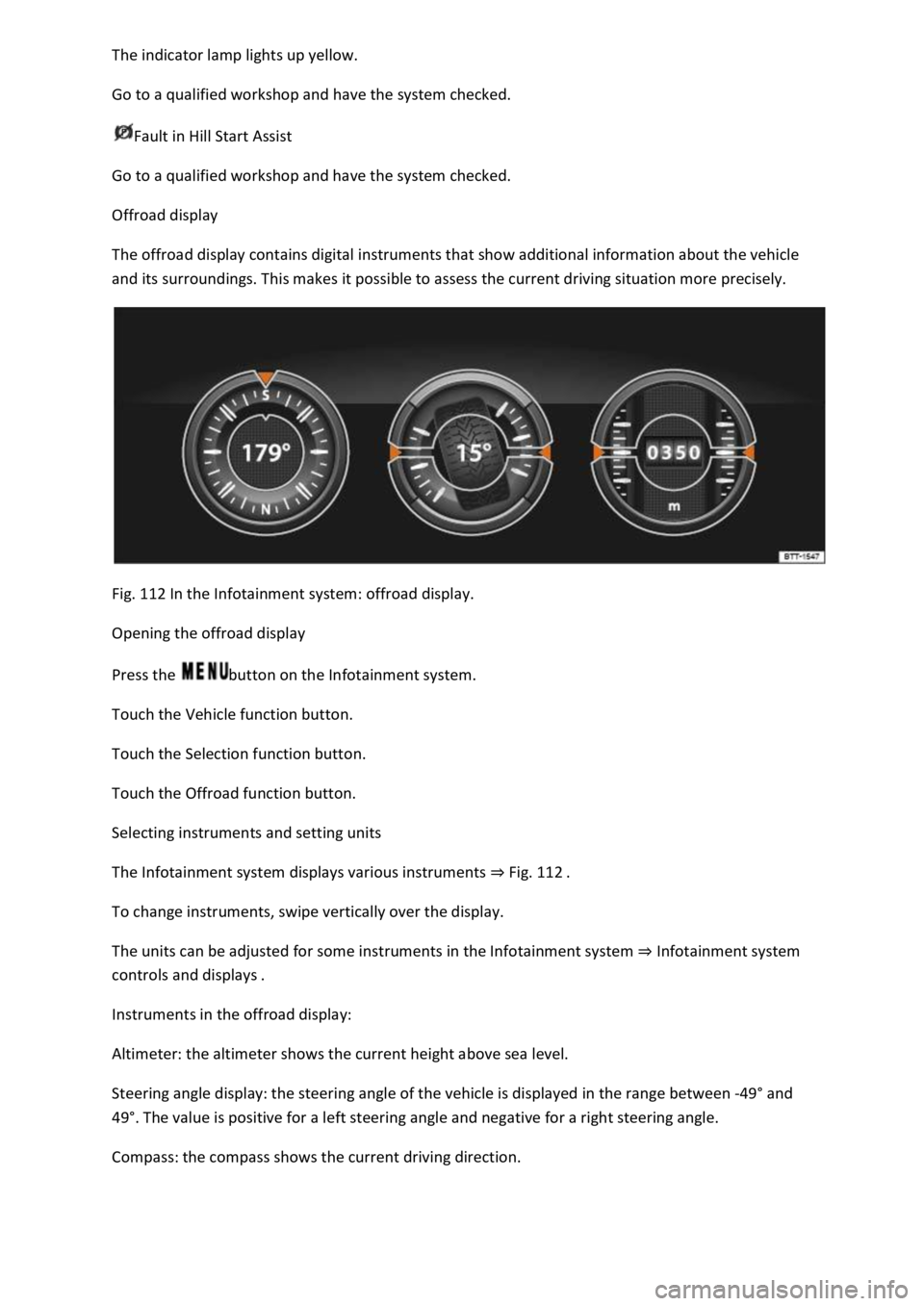
Offroad display
The offroad display contains digital instruments that show additional information about the vehicle
and its surroundings. This makes it possible to assess the current driving situation more precisely.
Fig. 112 In the Infotainment system: offroad display.
Opening the offroad display
Press the button on the Infotainment system.
Touch the Vehicle function button.
Touch the Selection function button.
Touch the Offroad function button.
Selecting instruments and setting units
The Infotainment system displays various instruments ⇒ Fig. 112 .
To change instruments, swipe vertically over the display.
The units can be adjusted for some instruments in the Infotainment system ⇒ Infotainment system
controls and displays .
Instruments in the offroad display:
Altimeter: the altimeter shows the current height above sea level.
Steering angle display: the steering angle of the vehicle is displayed in the range between -49° and
49°. The value is positive for a left steering angle and negative for a right steering angle.
Compass: the compass shows the current driving direction.
Page 219 of 502
Any rain entering the vehicle when the windows or glass roof are open can soak the interior
equipment and cause damage to the vehicle. Always keep the windows and glass roof closed when
driving offroad.
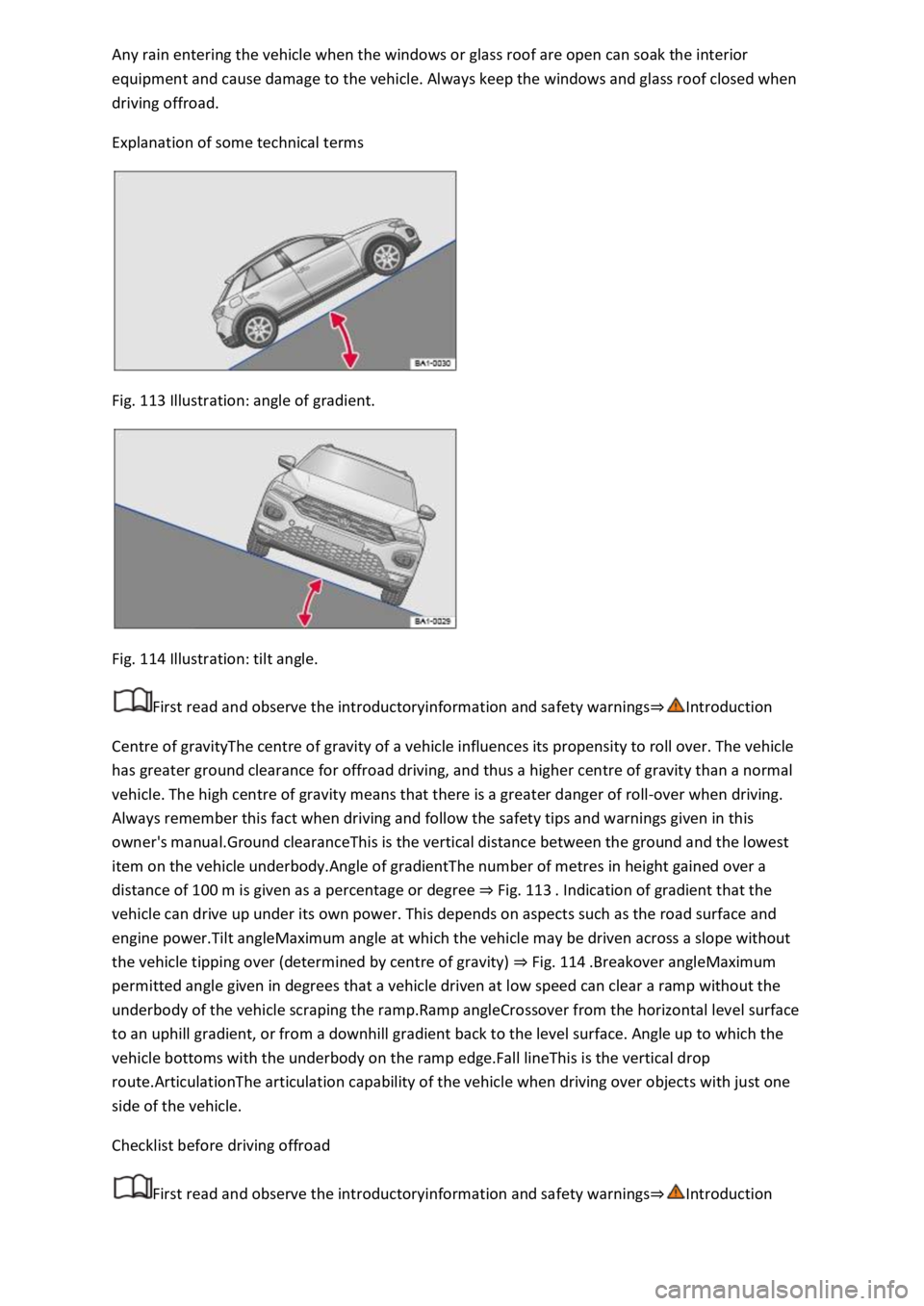
Explanation of some technical terms
Fig. 113 Illustration: angle of gradient.
Fig. 114 Illustration: tilt angle.
First read and observe the introductoryinformation and safety warnings⇒Introduction
Centre of gravityThe centre of gravity of a vehicle influences its propensity to roll over. The vehicle
has greater ground clearance for offroad driving, and thus a higher centre of gravity than a normal
vehicle. The high centre of gravity means that there is a greater danger of roll-over when driving.
Always remember this fact when driving and follow the safety tips and warnings given in this
owner's manual.Ground clearanceThis is the vertical distance between the ground and the lowest
item on the vehicle underbody.Angle of gradientThe number of metres in height gained over a
distance of 100 m is given as a percentage or degree ⇒ Fig. 113 . Indication of gradient that the
vehicle can drive up under its own power. This depends on aspects such as the road surface and
engine power.Tilt angleMaximum angle at which the vehicle may be driven across a slope without
the vehicle tipping over (determined by centre of gravity) ⇒ Fig. 114 .Breakover angleMaximum
permitted angle given in degrees that a vehicle driven at low speed can clear a ramp without the
underbody of the vehicle scraping the ramp.Ramp angleCrossover from the horizontal level surface
to an uphill gradient, or from a downhill gradient back to the level surface. Angle up to which the
vehicle bottoms with the underbody on the ramp edge.Fall lineThis is the vertical drop
route.ArticulationThe articulation capability of the vehicle when driving over objects with just one
side of the vehicle.
Checklist before driving offroad
First read and observe the introductoryinformation and safety warnings⇒Introduction
Page 299 of 502
Push the luggage compartment cover into the side retainers ⇒ Fig. 146 (lower arrows).
Hook the retaining straps onto the boot lid ⇒ Fig. 146 (upper arrows).
WARNING
Objects that are not secured or secured incorrectly or animals on the luggage compartment cover
may cause severe injuries in the event of sudden driving or braking manoeuvres or accidents.
Do not stow any hard, heavy or sharp items on the luggage compartment cover either loosely or in
bags.
Do not transport animals on the luggage compartment cover.
NOTICE
To prevent damage to the luggage compartment cover, do not load the luggage compartment to
such a height that the luggage compartment cover presses against the load when the boot lid is
closed.
Luggage compartment floor
Luggage compartment floor – Functions
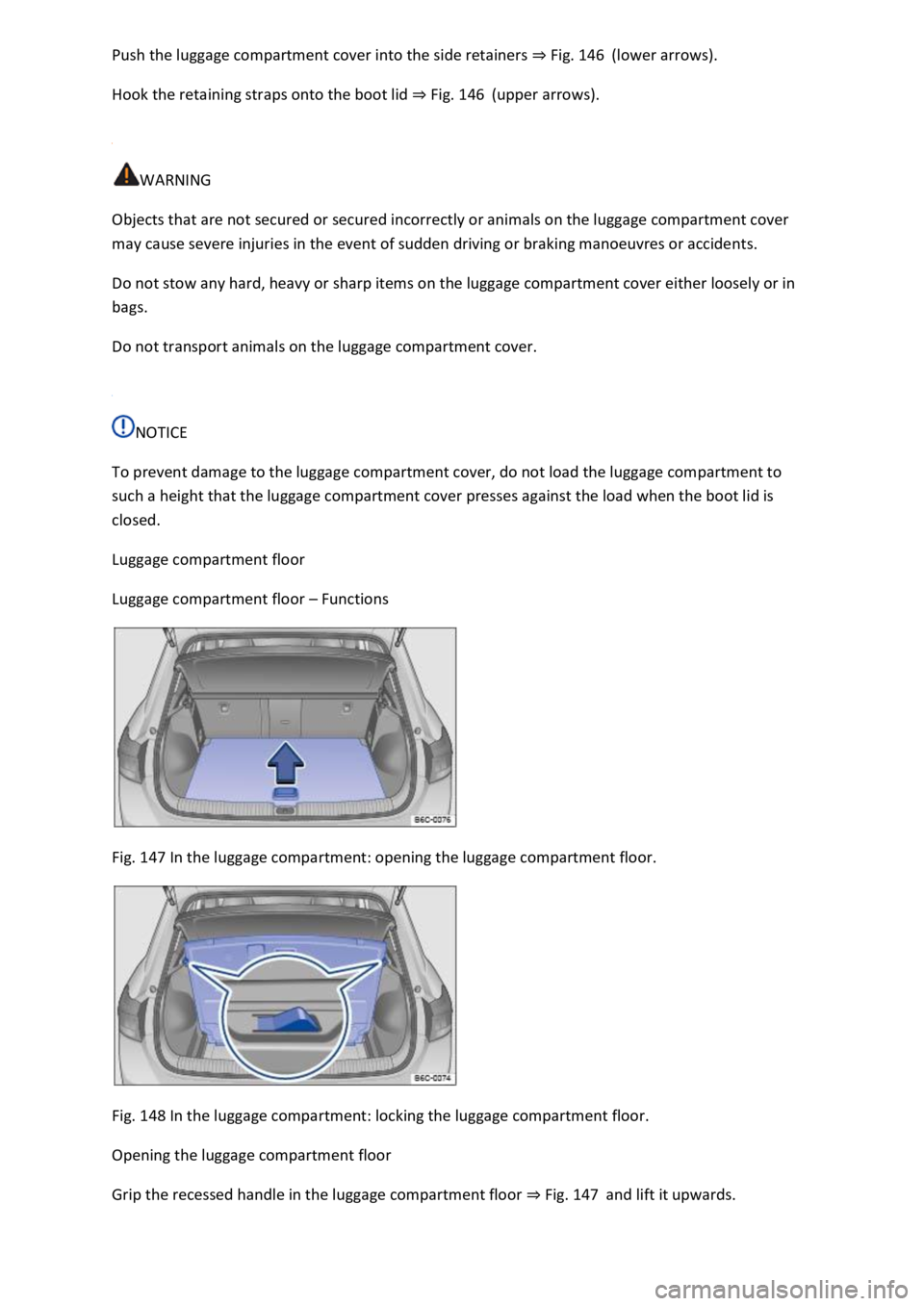
Fig. 147 In the luggage compartment: opening the luggage compartment floor.
Fig. 148 In the luggage compartment: locking the luggage compartment floor.
Opening the luggage compartment floor
Grip the recessed handle in the luggage compartment floor ⇒ Fig. 147 and lift it upwards.
Page 307 of 502

Before driving through an automatic car wash.
The vehicle height exceeds the required clearance height, e.g. in a garage.
NOTICE
Always remove the roof carrier before driving through an automatic car wash.
The height of the vehicle is changed by the installation of a roof carrier and the load secured to it.
Check and compare the height of the vehicle with clearance heights, e.g. for underpasses and garage
doors.
The roof carrier and its load must not obstruct you from opening and closing the glass roof and the
boot lid. The roof aerial must also remain unaffected.
Driving with a fitted roof carrier will increase air resistance and thus increase fuel consumption.
Trailer towing
Introduction
This chapter contains information on the followingsubjects:
⇒ Technical requirements
⇒ Fitting the removable ball head
⇒ Removing the ball head
⇒ Notes on towing a trailer
⇒ Loading the trailer
⇒ Driving with a trailer
⇒ Trailer stabilisation
⇒ Retrofitting a towing bracket
The vehicle can be used to tow a trailer if it has the required technical equipment for this. The
additional trailer load will affect the amount of wear, fuel consumption and performance of the
vehicle and, in certain circumstances, could shorten the service intervals.
Driving with a trailer not only places an extra load on the vehicle, but also requires increased
concentration on the part of the driver.
Vehicles with start/stop system
When using towing brackets that were not retrofitted by Volkswagen, the start/stop system must be
deactivated manually using the button in the centre console before towing a trailer, and it must
remain deactivated for as long as a trailer is being towed ⇒ .