sport VOLKSWAGEN T-ROC 2021 Owner´s Manual
[x] Cancel search | Manufacturer: VOLKSWAGEN, Model Year: 2021, Model line: T-ROC, Model: VOLKSWAGEN T-ROC 2021Pages: 502, PDF Size: 9.42 MB
Page 79 of 502
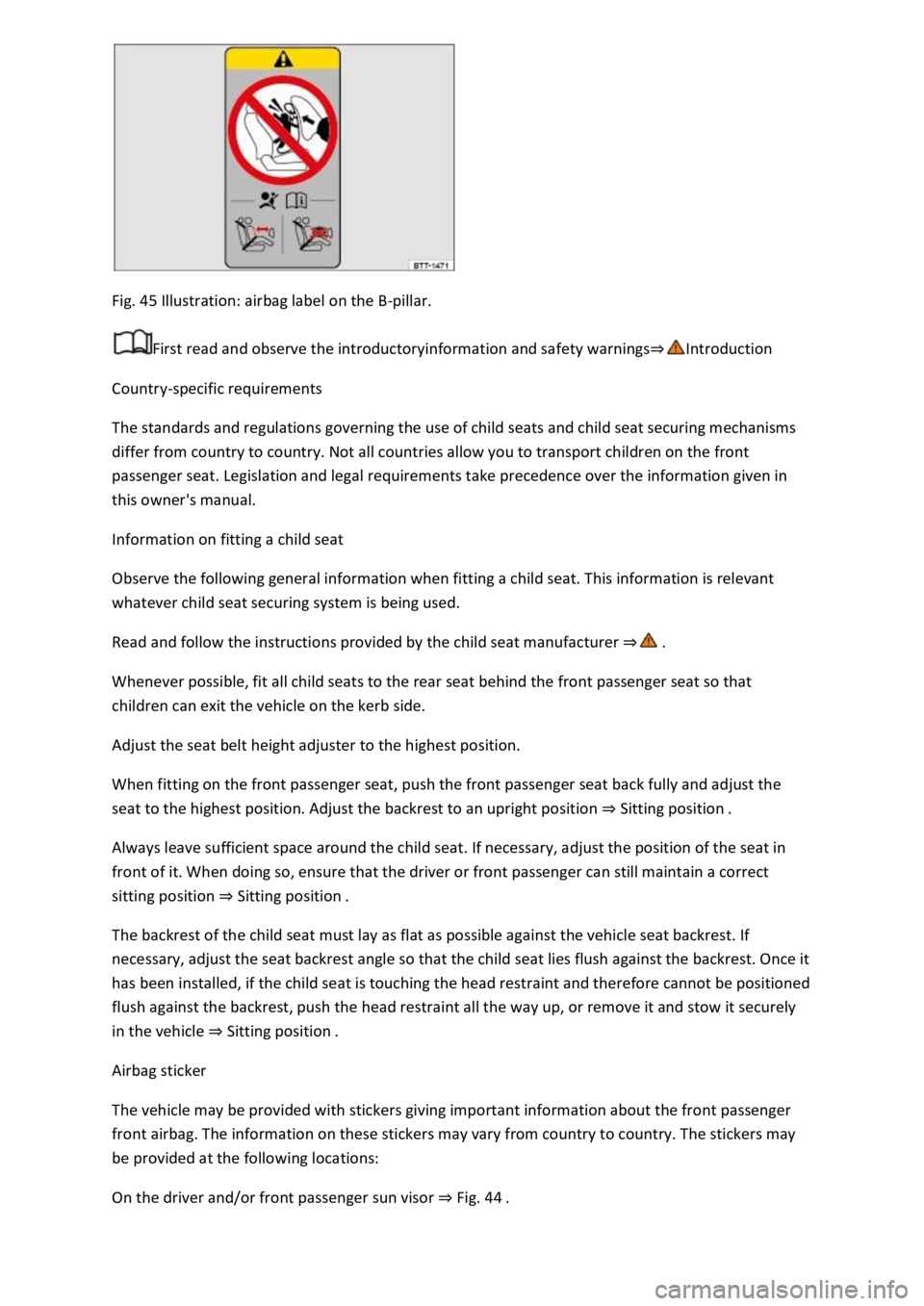
Fig. 45 Illustration: airbag label on the B-pillar.
First read and observe the introductoryinformation and safety warnings⇒Introduction
Country-specific requirements
The standards and regulations governing the use of child seats and child seat securing mechanisms
differ from country to country. Not all countries allow you to transport children on the front
passenger seat. Legislation and legal requirements take precedence over the information given in
this owner's manual.
Information on fitting a child seat
Observe the following general information when fitting a child seat. This information is relevant
whatever child seat securing system is being used.
Read and follow the instructions provided by the child seat manufacturer ⇒ .
Whenever possible, fit all child seats to the rear seat behind the front passenger seat so that
children can exit the vehicle on the kerb side.
Adjust the seat belt height adjuster to the highest position.
When fitting on the front passenger seat, push the front passenger seat back fully and adjust the
seat to the highest position. Adjust the backrest to an upright position ⇒ Sitting position .
Always leave sufficient space around the child seat. If necessary, adjust the position of the seat in
front of it. When doing so, ensure that the driver or front passenger can still maintain a correct
sitting position ⇒ Sitting position .
The backrest of the child seat must lay as flat as possible against the vehicle seat backrest. If
necessary, adjust the seat backrest angle so that the child seat lies flush against the backrest. Once it
has been installed, if the child seat is touching the head restraint and therefore cannot be positioned
flush against the backrest, push the head restraint all the way up, or remove it and stow it securely
in the vehicle ⇒ Sitting position .
Airbag sticker
The vehicle may be provided with stickers giving important information about the front passenger
front airbag. The information on these stickers may vary from country to country. The stickers may
be provided at the following locations:
On the driver and/or front passenger sun visor ⇒ Fig. 44 .
Page 103 of 502

Please note that the sensors in the door handles can be activated by a powerful jet of water or
steam if a valid vehicle key is simultaneously within the operating range. If at least one window is
open and sensor surfaces on the door handles are continuously activated, all windows will close. All
windows could open if the jet of water or steam is moved away from the door handle sensors briefly
and then moved back again ⇒ .
It may not be possible to lock or unlock the vehicle using the Keyless Access if the 12-volt vehicle
battery or button cell in the vehicle key is weak or discharged. The vehicle can be locked or unlocked
manually ⇒ .
If there is no valid vehicle key in the vehicle or if it is not detected, a corresponding message will be
shown on the instrument cluster display. This may occur if the vehicle key is exposed to interference
from another radio signal or is covered by another item, e.g. an aluminium case ⇒ Starting and
stopping the engine .
Anti-theft alarm
Depending on the vehicle equipment level, the vehicle may have an anti-theft alarm.
The anti-theft alarm is activated automatically when the vehicle is locked using the vehicle key.
The anti-theft alarm outputs acoustic and visual warning signals for up to five minutes.
When does the system trigger an alarm?
If a door is opened.
If the bonnet is opened.
If the boot lid is opened.
If the ignition is switched on with a valid vehicle key. (The alarm may sound briefly.)
If the 12-volt vehicle battery is disconnected.
If there is movement inside the vehicle (in vehicles with interior monitoring) ⇒ Interior monitoring
system and anti-tow alarm .
If the vehicle is lifted or towed (vehicles with anti-tow alarm) ⇒ Interior monitoring system and anti-
tow alarm .
If the vehicle is transported on a car ferry or by rail (vehicles with anti-tow alarm or interior
monitoring) ⇒ Interior monitoring system and anti-tow alarm .
If a trailer that is connected to the anti-theft alarm system is removed ⇒ Trailer towing .
Switching off the alarm
Unlock the vehicle using the unlocking button on the vehicle key.
Page 104 of 502
OR: switch on the ignition using a valid vehicle key. A short alarm lasting around one second may
sound.
On vehicles with Keyless Access: grip the door handle ⇒ Unlocking or locking the vehicle with
Keyless Access .
The anti-theft alarm will not function correctly if the 12-volt vehicle battery is weak or discharged.
Interior monitoring system and anti-tow alarm
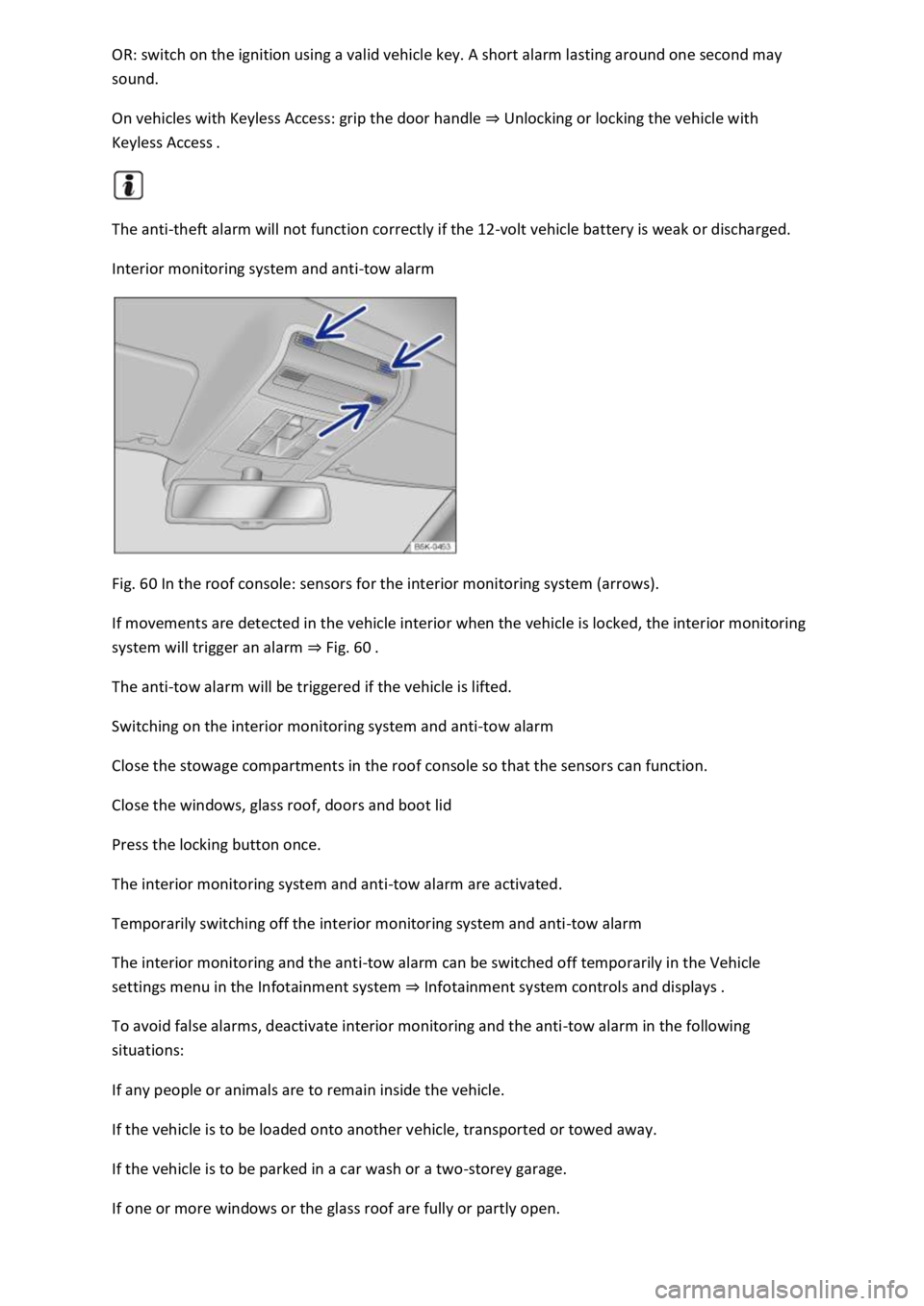
Fig. 60 In the roof console: sensors for the interior monitoring system (arrows).
If movements are detected in the vehicle interior when the vehicle is locked, the interior monitoring
system will trigger an alarm ⇒ Fig. 60 .
The anti-tow alarm will be triggered if the vehicle is lifted.
Switching on the interior monitoring system and anti-tow alarm
Close the stowage compartments in the roof console so that the sensors can function.
Close the windows, glass roof, doors and boot lid
Press the locking button once.
The interior monitoring system and anti-tow alarm are activated.
Temporarily switching off the interior monitoring system and anti-tow alarm
The interior monitoring and the anti-tow alarm can be switched off temporarily in the Vehicle
settings menu in the Infotainment system ⇒ Infotainment system controls and displays .
To avoid false alarms, deactivate interior monitoring and the anti-tow alarm in the following
situations:
If any people or animals are to remain inside the vehicle.
If the vehicle is to be loaded onto another vehicle, transported or towed away.
If the vehicle is to be parked in a car wash or a two-storey garage.
If one or more windows or the glass roof are fully or partly open.
Page 112 of 502
Always take all vehicle keys with you every time you leave the vehicle. The windows can still be
opened or closed using the buttons for a short time after the ignition has been switched off,
provided the driver door and the front passenger door are not opened.
When transporting children on the rear bench seat, the rear electric windows should always be
deactivated using the safety button so that they cannot be opened or closed.
NOTICE
If windows are open when it starts to rain, water can soak the interior equipment of the vehicle and
cause damage to the vehicle.
One-touch opening and closing and the roll-back function will not work if there is a malfunction in
the electric windows. Go to a qualified workshop.
Convenience opening and closing only works when one-touch opening and closing is activated for all
electric windows.
Some settings can be saved in the user accounts for personalisation and therefore change
automatically when the user account is changed ⇒ Personalisation .
Electric window roll-back function
The roll-back function for the electric windows can reduce the risk of injuries when the windows are
closing.
If the window is not able to close because it is stiff or because of an obstruction, the window will
immediately open again ⇒ .
Check to see why the window has not closed.
Try to close the window again.
If the window closing process is interrupted again, the roll-back function will be disabled for a few
seconds.
If the window still cannot close, it will come to a stop at this point. To close the window without the
roll-back function, press the button again within a few seconds ⇒ .
WARNING
Closing the electric windows without the roll-back function can lead to serious injuries.
Always close the window carefully.
Page 120 of 502
Operate the lever to adjust the lumbar support.
Take your weight off the backrest and turn the handwheel to adjust the backrest position.
Front passenger seat: take your weight off the backrest and operate the lever to adjust the backrest
position (depending on equipment).
Move the lever up or down, several times if necessary, to adjust the seat height.
Pull the lever to push the front seat forwards or backwards. The front seat must engage after the
lever has been released.
Folding the front passenger seat backrest forwards
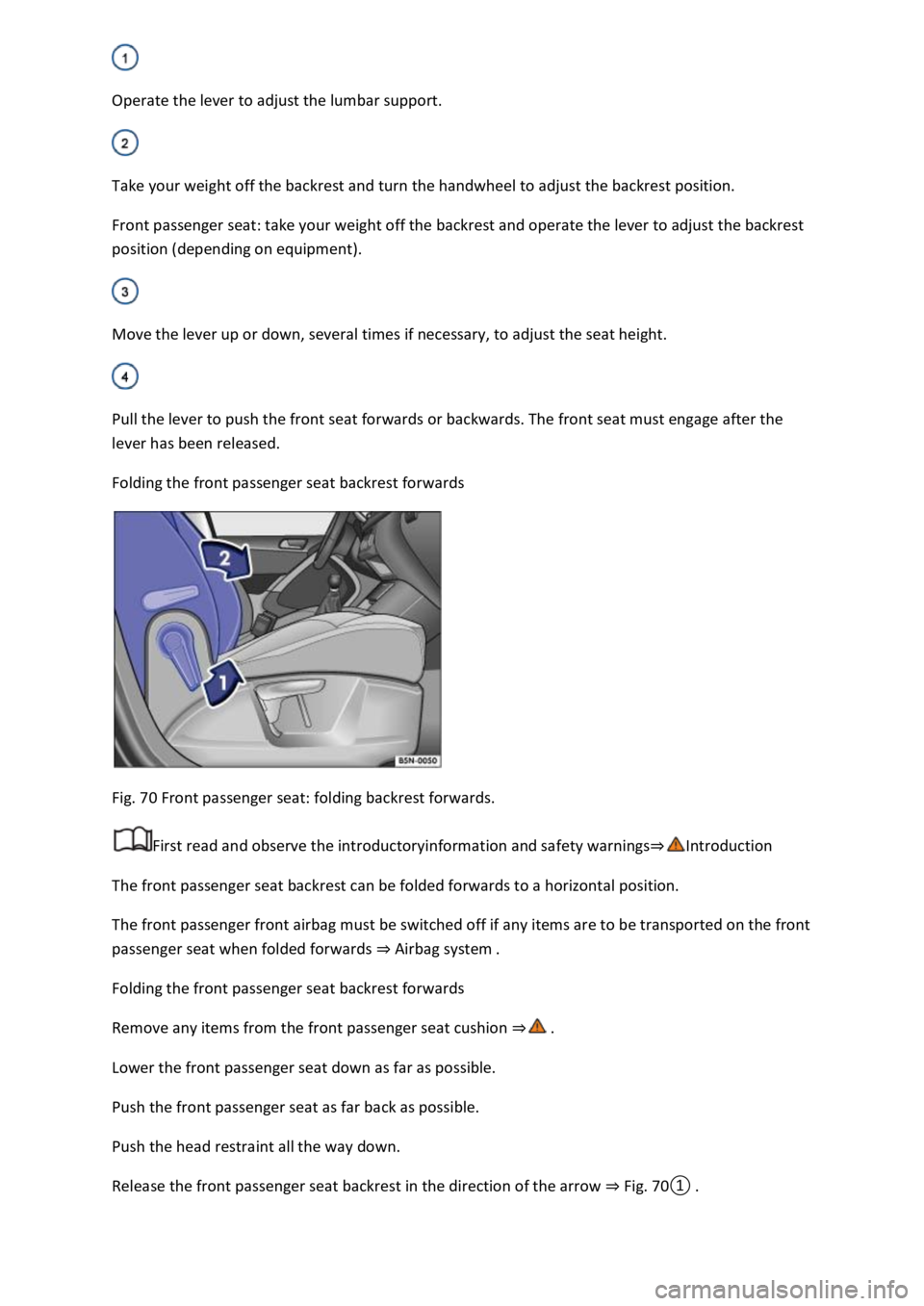
Fig. 70 Front passenger seat: folding backrest forwards.
First read and observe the introductoryinformation and safety warnings⇒Introduction
The front passenger seat backrest can be folded forwards to a horizontal position.
The front passenger front airbag must be switched off if any items are to be transported on the front
passenger seat when folded forwards ⇒ Airbag system .
Folding the front passenger seat backrest forwards
Remove any items from the front passenger seat cushion ⇒ .
Lower the front passenger seat down as far as possible.
Push the front passenger seat as far back as possible.
Push the head restraint all the way down.
Release the front passenger seat backrest in the direction of the arrow ⇒ Fig. 70① .
Page 121 of 502
Fold the front passenger seat backrest forwards in the direction of the arrow ⇒ Fig. 70② until it is
horizontal.
When it is folded down, the front passenger seat backrest must engage securely into place.
Folding back the front passenger seat backrest
When folding back, make sure that there are no items or body parts in the area of the hinges.
To fold back, release the front passenger seat backrest again ⇒ Fig. 70① .
Fold back the front passenger seat backrest so that it is upright.
When it is folded up, the front passenger seat backrest must engage securely into place.
WARNING
Serious injuries could be caused if the front passenger seat backrest is folded forwards and
backwards in an uncontrolled way and without taking due care.
Fold the front passenger seat backrest forwards and backwards only when the vehicle is stationary.
When folding the front passenger seat backrest forwards, always make sure that there are no
people, animals or objects in its path.
The front airbag must be switched off and the PASSENGER AIR BAG indicator lamp must be
lit for as long as the front passenger seat backrest is folded forwards.
When folding forwards and backwards, keep all hands, fingers, feet and other body parts away from
the seat hinges and seat release mechanism.
Floor mats or other objects could get caught in the hinges on the front passenger seat backrest. This
could cause the front passenger seat backrest to fail to engage securely when it is returned to the
upright position.
When being folded back, the front passenger seat backrest must be securely locked in the upright
position. If the front passenger seat backrest is not locked properly, it could move suddenly and
cause serious injuries.
WARNING
The open seat anchorages and hinges of the folded front passenger seat backrest can cause serious
injuries in the event of a sudden braking manoeuvre or accident.
Never transport either adults or children on the front passenger seat if the front passenger seat
backrest is folded forwards.
If the front passenger seat backrest is folded forwards, you must use only the rear seat behind the
driver seat. This also applies to children in child seats.
Rear seats
Page 122 of 502
Introduction
This chapter contains information on the followingsubjects:
⇒ Folding the backrests on the rear bench seat forwards and backwards
The following section describes the options for adjusting the rear seats. Always ensure that you
adjust the correct sitting position ⇒ Sitting position .
WARNING
Incorrect adjustment of the rear seat can cause accidents and serious injuries.
The rear seat should be adjusted only when the vehicle is stationary as the rear seat could otherwise
move unexpectedly while the vehicle is in motion. Furthermore, an incorrect seating position is
adopted while adjusting the seat.
Adjust the rear seat only when there is no one in the adjustment area of the rear seats.
WARNING
Cigarette lighters left in the vehicle can become damaged or may ignite unnoticed. This can cause
serious burns and vehicle damage.
Before adjusting the seats, always make sure that there is no lighter on or near the moveable parts
of the seat.
Before closing stowage areas or compartments, always make sure that there is no lighter in the way.
Never stow lighters in stowage areas, compartments or on other surfaces in the vehicle. Cigarette
lighters may self-ignite as a result of high surface temperatures, particularly in summer.
WARNING
In order to reduce the risk of injury while the vehicle is in motion, the centre armrest must always be
folded up and the stowage compartment must be closed.
The middle seat on the rear bench seat must never be used when the centre armrest is folded down
– neither by adults nor children. An incorrect sitting position can cause serious injuries.
Never transport an adult or child on the centre armrest.
Close the stowage compartment only when there is no one in its closing path.
NOTICE
Page 128 of 502
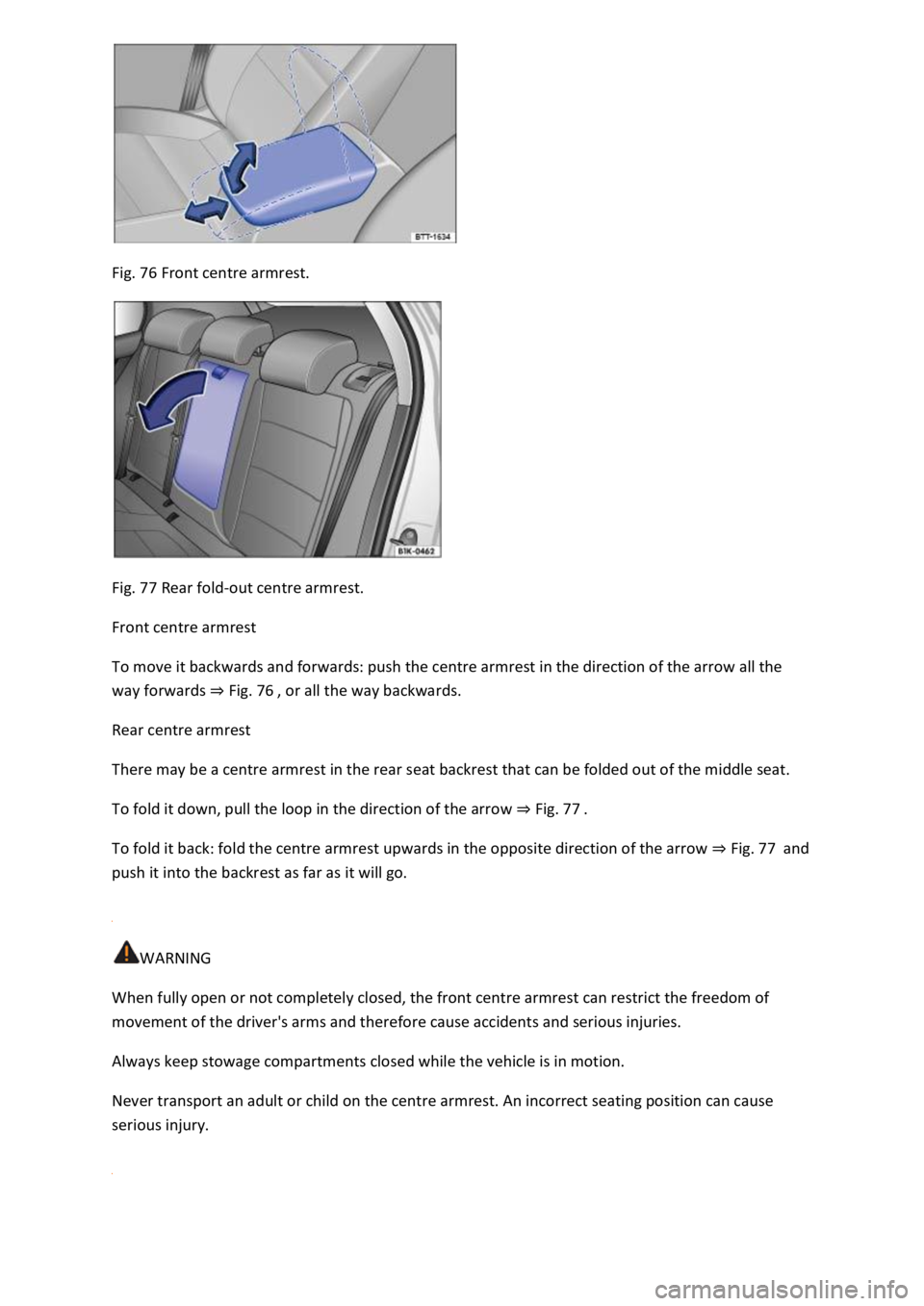
Fig. 76 Front centre armrest.
Fig. 77 Rear fold-out centre armrest.
Front centre armrest
To move it backwards and forwards: push the centre armrest in the direction of the arrow all the
way forwards ⇒ Fig. 76 , or all the way backwards.
Rear centre armrest
There may be a centre armrest in the rear seat backrest that can be folded out of the middle seat.
To fold it down, pull the loop in the direction of the arrow ⇒ Fig. 77 .
To fold it back: fold the centre armrest upwards in the opposite direction of the arrow ⇒ Fig. 77 and
push it into the backrest as far as it will go.
WARNING
When fully open or not completely closed, the front centre armrest can restrict the freedom of
movement of the driver's arms and therefore cause accidents and serious injuries.
Always keep stowage compartments closed while the vehicle is in motion.
Never transport an adult or child on the centre armrest. An incorrect seating position can cause
serious injury.
Page 175 of 502
Accidents and injuries can occur if the driver is distracted. Operating the Infotainment system can
distract you from the road.
Always drive carefully and responsibly.
Information on the brakes
New brake pads cannot generate the full braking effect during the first 200 to 300 km and must first
be run in ⇒ . The slightly reduced brake pressure can however be compensated for by increasing
pressure on the brake pedal. During the run-in period, the braking distance is longer for full or
emergency braking than when the brake pads have been run in. In the run-in period, full braking
should be avoided and also situations that create a heavy load on the brakes, e.g. when driving up
close to the vehicle ahead.
The wear of the brake pads depends to a great extent on the conditions under which the vehicle is
operated and the way the vehicle is driven. If the vehicle is used for regular urban trips, short
journeys, and is driven with a sporty driving style, the brake pads must be regularly checked by a
qualified workshop.
When driving with wet brakes, for example after driving through water, after heavy rainfall or after
washing the vehicle, the braking effect may be delayed as the brake discs will be wet, or possibly
iced up (in winter). The brakes must be dried as quickly as possible by careful braking at higher
speed. Please ensure that no following vehicle and no other road user is put at risk as a result of this
action ⇒ .
A layer of salt that accumulates on the discs and pads will reduce the braking effect and increase the
braking distance. If the vehicle has not been braked for a long time on roads which have been gritted
with salt, the layer of salt must be reduced through careful braking ⇒ .
Corrosion on the brake discs and dirt in the brake pads are facilitated through long standstill times,
low mileage and low load levels. If the brake pads have been hardly used or if they are corroded,
Volkswagen recommends that the brake discs and brake pads be cleaned by braking strongly several
times from high speed. Please ensure that no following vehicle and no other road user is put at risk
as a result of this action ⇒ .
Brake servo
The brake servo will function only when the engine is running and reinforces the pressure applied by
the driver on the brake pedal.
If the brake servo does not function or the vehicle is being towed, the brake pedal will have to be
depressed more forcefully as the braking distance will be increased due to the lack of assistance for
the brake system ⇒ .
WARNING
Driving with worn brake pads or with a faulty brake system can cause accidents and serious injuries.
If the warning lamp lights up either alone or together with a text message in the instrument
cluster display, go to a qualified workshop immediately to have the brake pads checked and the
worn brake pads replaced.
Page 198 of 502

– Reverse gear
Reverse gear is selected. May be selected only when the vehicle is stationary.
– Neutral
The gearbox is in the neutral position. No force is transmitted to the wheels and the braking effect of
the engine is not available.
– Standard forward driving position
Position : Normal programme.
All forward gears are shifted up and down automatically. The timing of the gear shift is determined
by the engine load, your individual driving style and the speed of the vehicle.
Position : Sport programme.
The forward gears are automatically changed up later and down earlier than in selector lever
position D. This exploits the engine’s full power reserves. The timing of the gear shift is determined
by the engine load, your individual driving style and the speed of the vehicle.
To change between positions D and S, move the selector lever to the rear ⇒ Fig. 105 .
The selector lever will always return to selector lever position D/S. That also works in the Tiptronic
gate ⇒ Changing gear using Tiptronic .
Selector lever lock
P
N
To release the selector lever lock, switch on the ignition and depress the brake pedal. Then press the
lock button in the selector lever handle in the direction of the arrow ⇒ Fig. 105 .
The selector lever lock is not engaged if the selector lever is moved quickly through position N, e.g.
when shifting from reverse to D/S. This makes it possible, for instance, to rock the vehicle backwards
and forwards if it is stuck in snow or mud. The selector lever lock engages automatically if the lever is
in position N for more than approximately one second without the brake being pressed and when
the vehicle is travelling no faster than approximately 5 km/h (3 mph).
WARNING
Selecting the wrong position can cause you to lose control of the vehicle, which can lead to accidents
and serious injuries.
Never depress the accelerator when selecting a position.
When the engine is running and a position is engaged, the vehicle will start moving as soon as the
brake pedal is released.
Never shift to reverse or selector lever position P while the vehicle is moving.