weight VOLKSWAGEN T-ROC 2021 Owner´s Manual
[x] Cancel search | Manufacturer: VOLKSWAGEN, Model Year: 2021, Model line: T-ROC, Model: VOLKSWAGEN T-ROC 2021Pages: 502, PDF Size: 9.42 MB
Page 105 of 502
If lightweight items such as loose pieces of paper or items hung from the interior mirror are left in
the vehicle.
If there is a mobile phone in the vehicle with the vibration alarm switched on.
Permanent deactivation of interior monitoring and the anti-tow alarm is not possible.
If doors or the boot lid are still open when the anti-theft alarm is activated, only the anti-theft alarm
will be activated. Interior monitoring and the anti-tow alarm are not activated until all doors and the
boot lid are closed.
SAFELOCK is also deactivated when the interior monitoring and anti-tow alarm are switched off
⇒ SAFELOCK .
Boot lid
Introduction
This chapter contains information on the followingsubjects:
⇒ Opening and closing the boot lid
⇒ Opening and closing the boot lid electrically
⇒ Unlocking the boot lid manually
⇒ Troubleshooting
The boot lid is locked and unlocked at the same time as the doors.
WARNING
Incorrect and unsupervised unlocking, opening or closing of the boot lid can cause accidents and
serious injuries.
The boot lid should be opened or closed only when you are sure that nobody is in its path.
Always check that the boot lid is closed properly once it has been closed. The closed boot lid must be
flush with the surrounding body panels.
Always keep the boot lid closed while the vehicle is in motion.
Never open the boot lid when loads, e.g. bicycles, are attached to it. The boot lid may close under its
own weight due to the additional load. Support the boot lid as necessary or remove the load from
the boot lid beforehand.
Page 106 of 502

Close and lock the boot lid and all vehicle doors when the vehicle is not in use. Ensure that no one
remains in the vehicle.
Never leave children playing unattended in or around the vehicle, especially when the boot lid is
open. Children could climb into the luggage compartment and shut the boot lid, thereby trapping
themselves inside. Temperatures inside a locked vehicle may become extremely hot or cold,
depending on the season. This can cause serious injuries and illness or fatalities, especially in the
case of small children.
WARNING
Serious injuries could occur if the boot lid is unlocked or opened incorrectly or without due care and
attention.
The boot lid may not always be detected as being unlocked if there is a carrier and items attached to
it. The boot lid may open suddenly while the vehicle is in motion if it is unlocked.
WARNING
If heavy snow or heavy items are located on the boot lid, the additional weight could cause the boot
lid to close on its own and cause severe injuries.
Never open the boot lid if it is covered by a large amount of snow or a load is attached to it, e.g. on a
luggage carrier.
Remove the snow or load before opening the boot lid.
WARNING
Do not push down the boot lid with your hand on the rear window. The rear window could shatter
and cause injuries.
NOTICE
Never use the opening mechanism to fix or hold a load. This could lead to damage that makes it
impossible to close the boot lid.
NOTICE
Never use the rear window wiper or the rear spoiler to fix or hold a load. This could cause damage
which results in the rear window wiper or rear spoiler being torn off.
Opening and closing the boot lid
Page 120 of 502
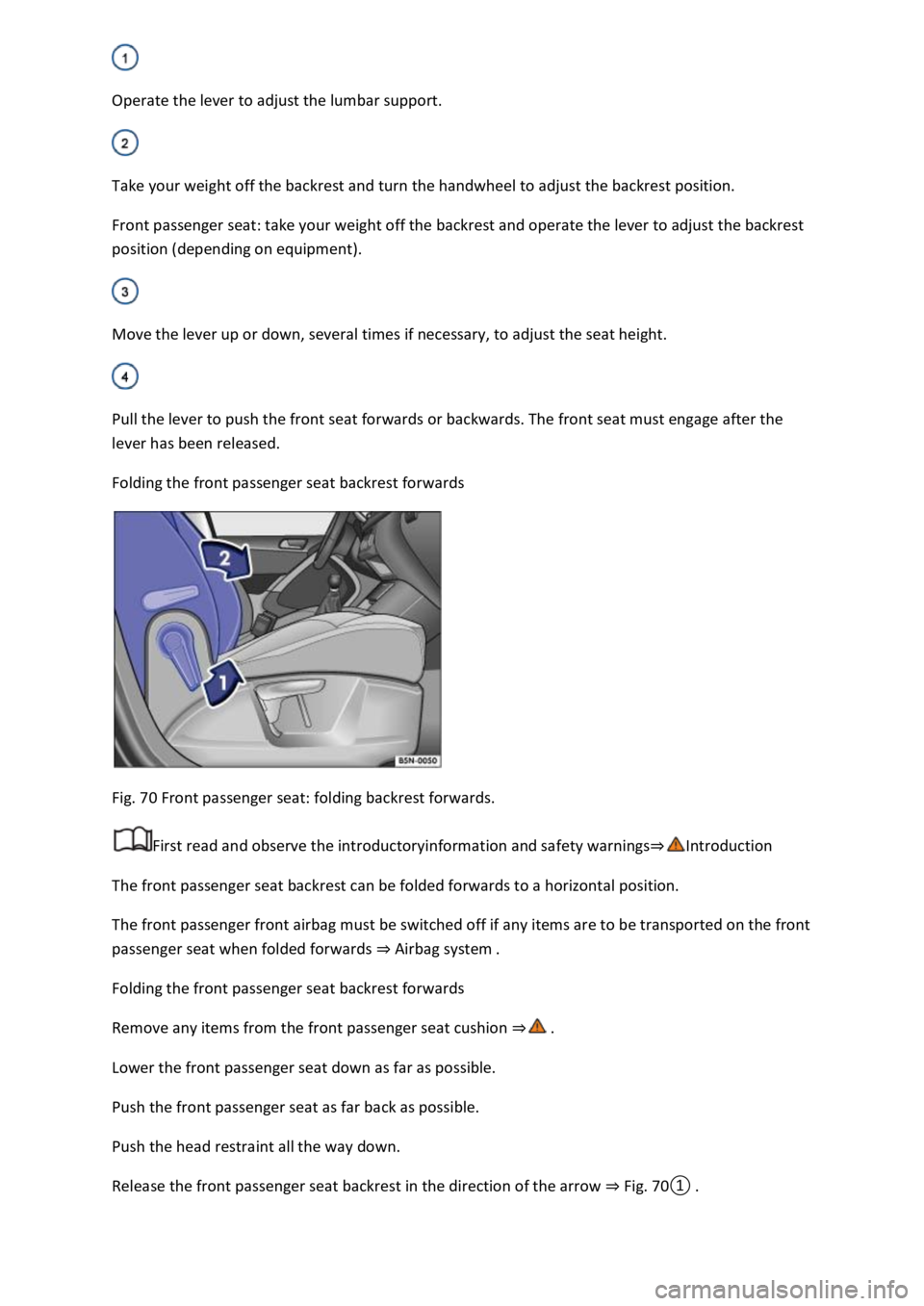
Operate the lever to adjust the lumbar support.
Take your weight off the backrest and turn the handwheel to adjust the backrest position.
Front passenger seat: take your weight off the backrest and operate the lever to adjust the backrest
position (depending on equipment).
Move the lever up or down, several times if necessary, to adjust the seat height.
Pull the lever to push the front seat forwards or backwards. The front seat must engage after the
lever has been released.
Folding the front passenger seat backrest forwards
Fig. 70 Front passenger seat: folding backrest forwards.
First read and observe the introductoryinformation and safety warnings⇒Introduction
The front passenger seat backrest can be folded forwards to a horizontal position.
The front passenger front airbag must be switched off if any items are to be transported on the front
passenger seat when folded forwards ⇒ Airbag system .
Folding the front passenger seat backrest forwards
Remove any items from the front passenger seat cushion ⇒ .
Lower the front passenger seat down as far as possible.
Push the front passenger seat as far back as possible.
Push the head restraint all the way down.
Release the front passenger seat backrest in the direction of the arrow ⇒ Fig. 70① .
Page 172 of 502

Eco driving profile ⇒ Driving profile selection and 4MOTION Active Control .
Avoid driving at full throttle
Never drive the vehicle at its top speed. The drag coefficient increases at excessively high speeds.
This in turn increases the force needed to move the vehicle.
Reduce idling
Pull away immediately with low engine speeds. If you are stopped for a long period, do not allow the
engine to idle but switch it off, e.g. when in a traffic jam or at a railway crossing.
In vehicles with an activated start/stop system, the engine can switch off automatically when the
vehicle is stopping and when the vehicle is stationary ⇒ Start/stop system .
Refuel moderately
A full fuel tank increases the weight of the vehicle. A fuel tank that is half or two thirds of the way
full is sufficient for journeys in urban traffic in particular.
Avoid short journeys
A cold engine has very high fuel consumption. The optimum operating temperature is reached only
after driving a few kilometres. The fuel consumption is above average at very low ambient
temperatures, e.g. in winter ⇒ Fig. 97 . Plan journeys economically and combine short journeys.
Carry out regular maintenance
Regular maintenance is an essential prerequisite for economical driving and increases the service life
of the vehicle.
Observe the tyre pressures
Low tyre pressures does not just mean greater wear, but also increase the rolling resistance of the
tyres and thus the fuel consumption. Use optimised rolling resistance tyres.
Adjust the tyre pressure according to the load. Observe the information on the tyre pressure sticker
⇒ Useful information about wheels and tyres
Tyre Pressure Loss Indicator or Tyre Pressure Monitoring System ⇒ Tyre monitoring system .
Use low viscosity engine oils
Fully synthetic engine oils with a low viscosity decrease frictional resistance in the engine and are
distributed better and more quickly, especially during cold starts.
Do not drive with unnecessary loads in the vehicle
You can reduce fuel consumption by clearing out the luggage compartment before setting off, for
example by removing empty drink crates or unused child seats.
To keep the vehicle's air resistance as low as possible, remove any add-on parts and equipment such
as ski racks, bicycle racks and roof carriers once you have finished using them.
Save electrical energy
Page 197 of 502
gearbox the clutch can be opened at idling speed, thus saving fuel. Thanks to its efficiency, low
weight and intelligent control system, the DSG® dual clutch gearbox usually enables fuel
consumption that is equal to or lower than a manual gearbox.
However, just like the manual gearbox, the clutch in the DSG® dual clutch gearbox is subject to wear.
Regular maintenance is necessary depending on the type of DSG® dual clutch gearbox; further
information ⇒ Scope of service . In the event of a fault in one gear train half, the DSG® dual clutch
gearbox also allows one gear train half to be deactivated and the journey to be continued using the
other gear train half ⇒ Troubleshooting . The gearbox must then be checked as soon as possible by a
qualified workshop.
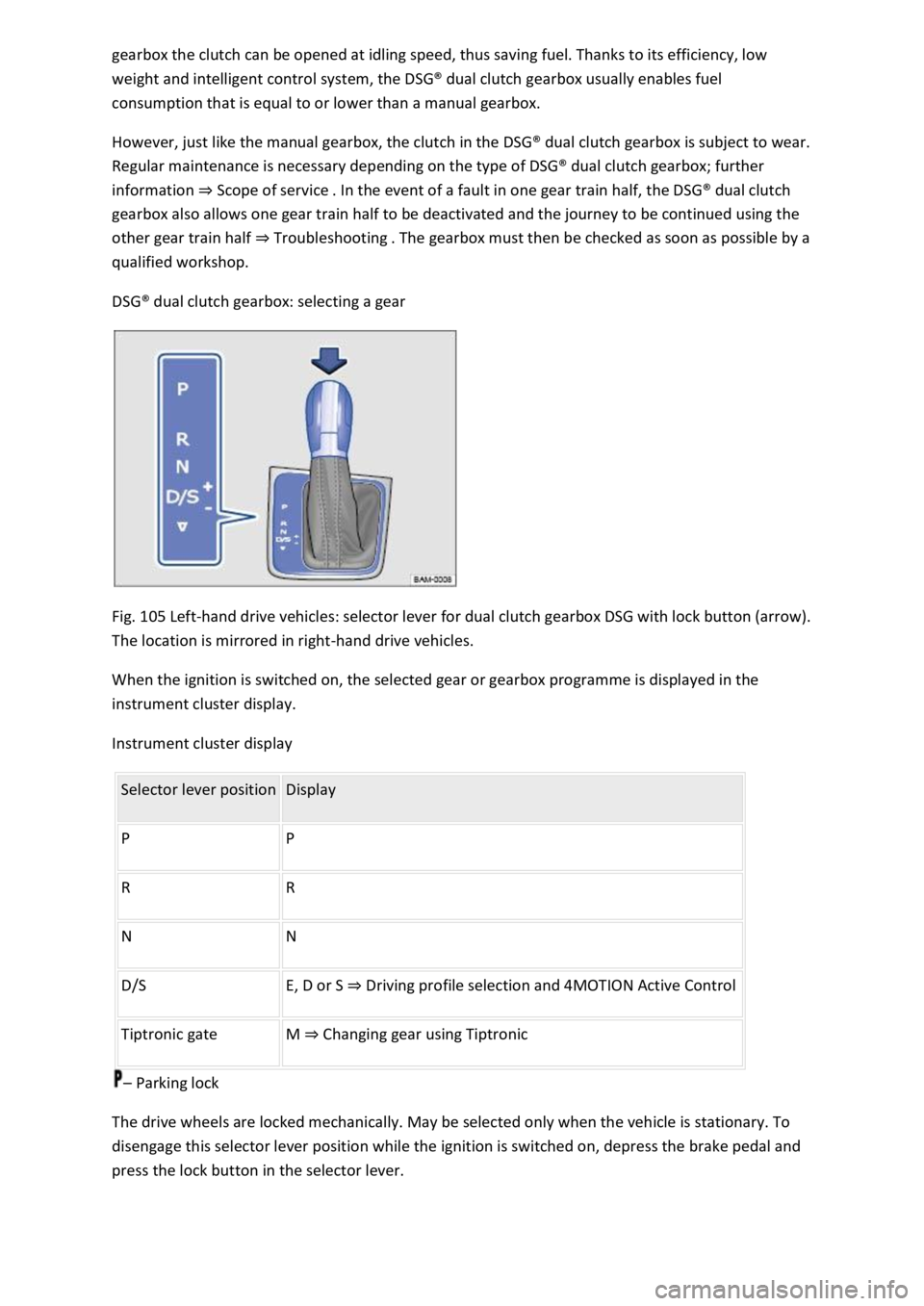
DSG® dual clutch gearbox: selecting a gear
Fig. 105 Left-hand drive vehicles: selector lever for dual clutch gearbox DSG with lock button (arrow).
The location is mirrored in right-hand drive vehicles.
When the ignition is switched on, the selected gear or gearbox programme is displayed in the
instrument cluster display.
Instrument cluster display
Selector lever position Display
P P
R R
N N
D/S E, D or S ⇒ Driving profile selection and 4MOTION Active Control
Tiptronic gate M ⇒ Changing gear using Tiptronic
– Parking lock
The drive wheels are locked mechanically. May be selected only when the vehicle is stationary. To
disengage this selector lever position while the ignition is switched on, depress the brake pedal and
press the lock button in the selector lever.
Page 228 of 502
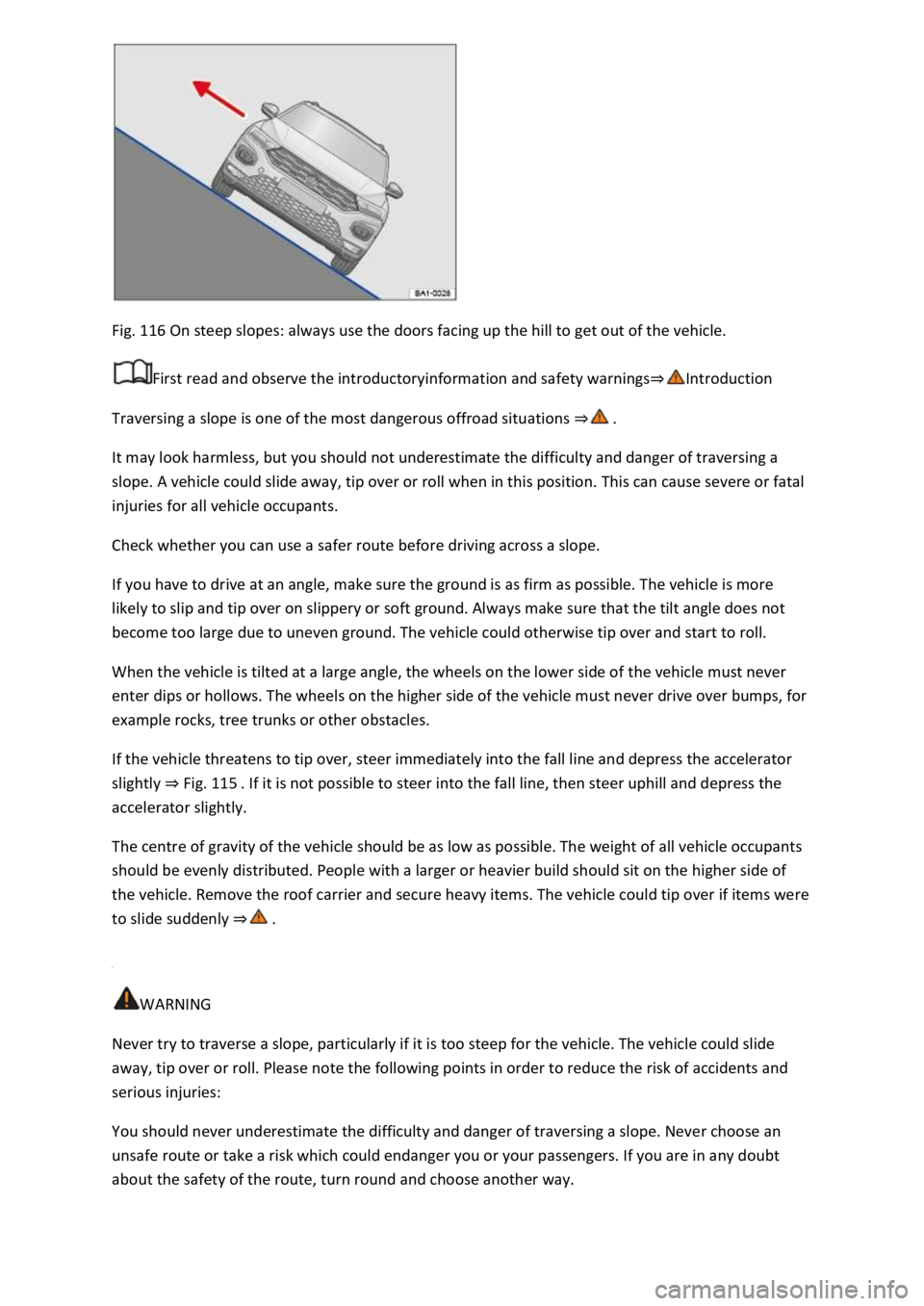
Fig. 116 On steep slopes: always use the doors facing up the hill to get out of the vehicle.
First read and observe the introductoryinformation and safety warnings⇒Introduction
Traversing a slope is one of the most dangerous offroad situations ⇒ .
It may look harmless, but you should not underestimate the difficulty and danger of traversing a
slope. A vehicle could slide away, tip over or roll when in this position. This can cause severe or fatal
injuries for all vehicle occupants.
Check whether you can use a safer route before driving across a slope.
If you have to drive at an angle, make sure the ground is as firm as possible. The vehicle is more
likely to slip and tip over on slippery or soft ground. Always make sure that the tilt angle does not
become too large due to uneven ground. The vehicle could otherwise tip over and start to roll.
When the vehicle is tilted at a large angle, the wheels on the lower side of the vehicle must never
enter dips or hollows. The wheels on the higher side of the vehicle must never drive over bumps, for
example rocks, tree trunks or other obstacles.
If the vehicle threatens to tip over, steer immediately into the fall line and depress the accelerator
slightly ⇒ Fig. 115 . If it is not possible to steer into the fall line, then steer uphill and depress the
accelerator slightly.
The centre of gravity of the vehicle should be as low as possible. The weight of all vehicle occupants
should be evenly distributed. People with a larger or heavier build should sit on the higher side of
the vehicle. Remove the roof carrier and secure heavy items. The vehicle could tip over if items were
to slide suddenly ⇒ .
WARNING
Never try to traverse a slope, particularly if it is too steep for the vehicle. The vehicle could slide
away, tip over or roll. Please note the following points in order to reduce the risk of accidents and
serious injuries:
You should never underestimate the difficulty and danger of traversing a slope. Never choose an
unsafe route or take a risk which could endanger you or your passengers. If you are in any doubt
about the safety of the route, turn round and choose another way.
Page 229 of 502
The vehicle can lose its grip when traversing a slope and slide away sideways, tip over or roll over
and roll down the hill.
The wheels on the lower side of the vehicle must never enter dips or hollows. The wheels on the
higher side of the vehicle must never drive over bumps, for example stones, tree trunks or other
obstacles.
Before traversing a slope, make sure that it is possible to steer into the fall line. Choose another
route if this is not guaranteed. If the vehicle threatens to tip over, steer immediately into the fall line
and depress the accelerator slightly ⇒ Fig. 115 .
If the vehicle is stopped at a large tilt angle when traversing a slope, avoid sudden and uncontrolled
movements in the vehicle. The vehicle can lose its grip and slide away sideways, tip over or roll over
and roll down the hill.
Vehicle occupants should never leave the vehicle via the doors facing down the hill when the vehicle
is stopped sideways on a slope with a large tilt angle to one side. This could cause the centre of
gravity to move to the side. The vehicle could then tip over or roll over and roll down the hill. To
avoid this, always leave the vehicle carefully on the side that is facing uphill ⇒ Fig. 116 .
When getting out the vehicle, make sure that the vehicle door which opens uphill does not close
with its own weight or through carelessness, thus potentially causing injury.
Driving through ditches
First read and observe the introductoryinformation and safety warnings⇒Introduction
Check whether the ramp and tilt angles are small enough to drive through the ditch with the vehicle
⇒ .
If possible, drive through the ditch at an acute angle ⇒ .
The tilt angle must not become too large when driving through the ditch.
WARNING
Never drive through a ditch if the ramp and tilt angles are too steep for the vehicle and the ditch is
too deep. The vehicle could slide away, tip over or roll.
NOTICE
If you drive into the ditch at a right angle, the front wheels will fall in. The underbody of your vehicle
could bottom, get stuck and be damaged. It is then almost impossible to get out of the ditch despite
having all-wheel drive.
Stuck vehicle
First read and observe the introductoryinformation and safety warnings⇒Introduction
Rocking free a vehicle requires training and feeling for the vehicle.
Page 232 of 502

⇒ Operating the speed limiter with the multifunction steering wheel
⇒ Troubleshooting
The speed limiter helps you to stop exceeding a stored speed.
Speed range
The speed limiter is available when driving forwards at speeds from approx. 30 km/h (20 mph).
Driving with the speed limiter
You can interrupt the speed limiter at any time by depressing the accelerator all the way down past
the point of resistance. As soon as the stored speed is exceeded, the green indicator lamp will
flash and an acoustic warning may sound. The speed remains stored in the memory.
The speed limiter function switches back on automatically as soon as the speed drops back below
the stored speed.
Displays
When the speed limiter is switched on, the instrument cluster display shows the stored speed and
the status of the speed limiter:
Shown small or grey: speed limiter not active.Shown large or white: speed limiter active.
Driving downhill
Driving downhill may cause the set speed to be exceeded.
Apply the foot brake to slow the vehicle down, and change down a gear as required.
WARNING
Always switch off the speed limiter after use to avoid unintentional speed control.
The speed limiter does not relieve the driver of their responsibility for the speed of the vehicle. Do
not drive at full throttle if this is not required.
Use of the speed limiter in adverse weather conditions is dangerous and can cause serious injury,
e.g. through aquaplaning, snow, ice, or leaves. Use the speed limiter only when the road and
weather conditions allow it to be used safely.
The speed limiter cannot limit the vehicle speed when travelling downhill. The vehicle speed can
increase under its own weight. Select a lower gear or use the foot brake to slow the vehicle down.
Operating the speed limiter with the multifunction steering wheel
Page 259 of 502
Low-lying vehicle components such as the bumper, spoiler and parts of the running gear, engine or
exhaust system could be damaged. Drive carefully through dips in the road and over drive entrances,
ramps, kerbstones and other objects.
Please adhere to relevant legislation when stopping and parking your vehicle.
Electronic parking brake
Operating the electronic parking brake
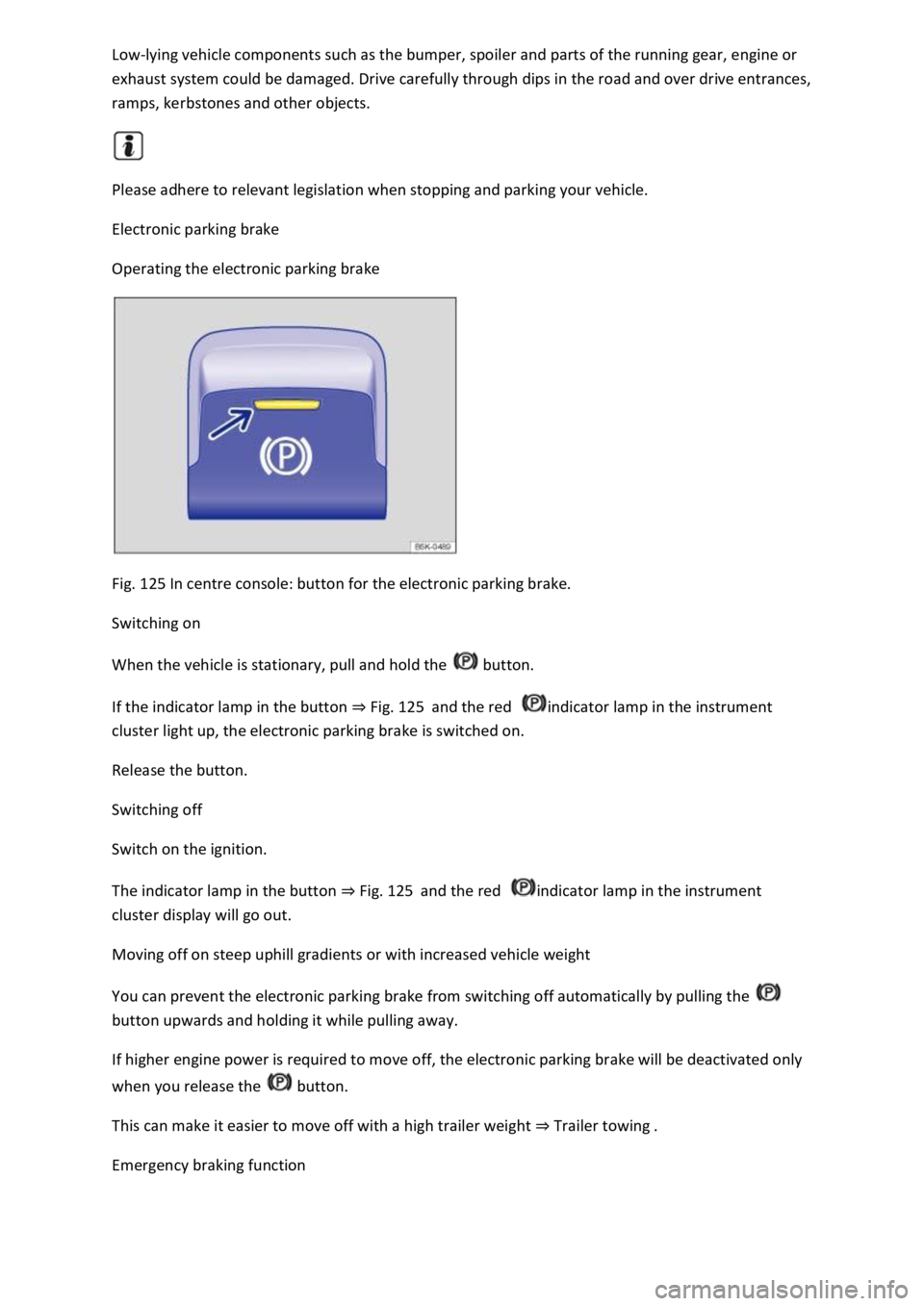
Fig. 125 In centre console: button for the electronic parking brake.
Switching on
When the vehicle is stationary, pull and hold the button.
If the indicator lamp in the button ⇒ Fig. 125 and the red indicator lamp in the instrument
cluster light up, the electronic parking brake is switched on.
Release the button.
Switching off
Switch on the ignition.
The indicator lamp in the button ⇒ Fig. 125 and the red indicator lamp in the instrument
cluster display will go out.
Moving off on steep uphill gradients or with increased vehicle weight
You can prevent the electronic parking brake from switching off automatically by pulling the
button upwards and holding it while pulling away.
If higher engine power is required to move off, the electronic parking brake will be deactivated only
when you release the button.
This can make it easier to move off with a high trailer weight ⇒ Trailer towing .
Emergency braking function
Page 286 of 502

Coat hooks are located on the centre door pillars and on the rear roof grab handles.
Bag hooks are located in the luggage compartment ⇒ Luggage compartment equipment .
WARNING
Hanging up items of clothing can restrict the driver's field of vision and cause accidents and serious
injuries.
Always hang items of clothing on the coat hook in such a way that they do not restrict the driver's
field of vision.
The coat hooks in the vehicle should be used only for lightweight clothing. Never leave any heavy,
hard or sharp objects in the pockets.
NOTICE
Each coat hook may be loaded with a maximum of 2.5 kg.
Drink holders
Introduction
This chapter contains information on the followingsubjects:
⇒ Drink holder in the rear centre armrest
Bottle holders
Bottle holders for bottles up to a maximum volume of 1.5 l are located in the stowage
compartments in the driver and front passenger door.
WARNING
Incorrect use of the drink holders can cause injury.
Never place hot drinks in a drink holder. Hot drinks in a drink holder could be spilled and cause
scalding in any sudden braking manoeuvre or accident.
Ensure that drink bottles or any other objects do not enter the driver footwell and obstruct the
pedals while the vehicle is in motion.
Never place heavy cups, food or any other heavy items in the drink holders. These heavy objects
could be flung through the vehicle interior during an accident and cause serious injuries.
WARNING