Media VOLKSWAGEN T-ROC 2021 Owner´s Manual
[x] Cancel search | Manufacturer: VOLKSWAGEN, Model Year: 2021, Model line: T-ROC, Model: VOLKSWAGEN T-ROC 2021Pages: 502, PDF Size: 9.42 MB
Page 331 of 502

First read and observe the introductoryinformation and safety warnings⇒Introduction
⇒ Petrol .
⇒ Refuelling .
⇒ Checking the engine oil level and refilling the engine oil .
⇒ Jump starting the vehicle .
If you notice misfiring, loss of power or uneven running when driving, reduce speed immediately and
have the vehicle checked by a qualified workshop ⇒ Troubleshooting . Otherwise unburnt fuel can
enter the exhaust system and escape into the atmosphere. The catalytic converter can also be
damaged by overheating.
The emissions may have a sulphur-like smell even when the exhaust purification system is working
properly.
Particulate filter
First read and observe the introductoryinformation and safety warnings⇒Introduction
Function
⇒ Fuel standards .
⇒ Refuelling .
⇒ Engine oil standards .
⇒ Jump starting the vehicle .
Periodic regeneration
The soot in the particulate filter is burnt off at high temperatures on a periodic basis.
To assist the regeneration of the particulate filter, Volkswagen recommends that you avoid making
only short journeys.
Noises, slight smells and increased engine speeds may occur during regeneration. The radiator fan
may run on while the vehicle is moving or when the engine has been switched off.
During the periodic regeneration process, the yellow indicator lamp does not light up.
Troubleshooting
First read and observe the introductoryinformation and safety warnings⇒Introduction
Irregular engine running and faults
Page 332 of 502

If these symptoms occur directly after refuelling, switch off the engine immediately to avoid any
subsequent damage.
Fault in the selective catalytic reduction system
The red refill bottle lamp lights up together with the red spanner lamp.
The engine cannot be restarted.
AdBlue® level too low
The red refill bottle lamp lights up.
The engine cannot be restarted.
he vehicle.
⇒ Refilling AdBlue .
Fault in the selective catalytic reduction system
The yellow refill bottle lamp lights up together with the yellow spanner lamp.
There is a fault in the selective catalytic reduction system or the system is not filled with standard-
compliant AdBlue®.
AdBlue® level low
The yellow refill bottle lamp lights up.
ing range in accordance with ⇒ Refilling AdBlue .
Particulate filter clogged with soot
The yellow particulate filter lamp lights up.
The particulate filter is saturated with soot and requires regeneration. The indicator lamp goes out
automatically when the particulate filter has been regenerated.
–120 km/h (31–75 mph).
-change indicator ⇒ Gear-change indicator .
fter driving for approx. 30 minutes, seek expert assistance
immediately.
Page 333 of 502

Fault in exhaust system
The yellow catalytic converter lamp lights up or flashes.
Faults in the exhaust system caused by misfiring, which can damage the catalytic converter.
to the nearest qualified workshop immediately.
There may be engine faults and fuel consumption may be higher if the indicator lamps are lit up or
flashing.
If and when
Vehicle toolkit
Introduction
This chapter contains information on the followingsubjects:
⇒ Stowage
⇒ Vehicle toolkit contents
Observe any country-specific legislation when securing your vehicle in the event of a breakdown.
Vehicle toolkit in the vehicle
In vehicles that are factory-fitted with a spare wheel, emergency spare wheel or winter wheels,
additional vehicle tools may be located in the luggage compartment.
WARNING
In the event of a sudden driving or braking manoeuvre or accident, a loose vehicle toolkit,
breakdown set and spare wheel or temporary spare wheel could be flung though the vehicle and
cause severe injuries.
always secured in the luggage compartment.
WARNING
Unsuitable or damaged tools in the vehicle toolkit can lead to accidents and injuries.
Stowage
Page 337 of 502

Damaged wiper blades should be replaced immediately. Wiper blades are available from a qualified
workshop.
Cleaning wiper blades
Note for the front windscreen wipers: move the wiper arms to the service position before lifting
them ⇒ Service position .
only in the area of the wiper blade mounting.
⇒ .
Changing the windscreen wiper blades
fting ⇒ Service position .
⇒ Fig. 164 ① and simultaneously pull off the wiper blade in
the direction of the arrow.
r blade with the same length and design onto the wiper arm. Push it on until it
engages.
Changing the wiper blade for the rear window
iper blade mounting.
⇒ Fig. 165 ①.
⇒ Fig. 165 (arrow Ⓐ) and pull it off in the
direction of the arrow Ⓑ at the same time. You may need to use some force to do this.
direction of the arrow. Push it on until it engages ⇒ Fig. 165 Ⓑ. The wiper blade must be in the
folded back position ⇒ Fig. 165 (arrow Ⓐ).
WARNING
Worn or dirty wiper blades reduce visibility and increase the risk of accidents and serious injuries.
nd no longer clean the windows
properly.
Page 354 of 502

Suitable earth connection: preferably the jump lead connection point (earth connection), a
solid metal part which is securely bolted onto the cylinder block, or the cylinder block itself.
The discharged 12-volt vehicle battery must be properly connected to the vehicle's electrical system.
The vehicles must not touch. Otherwise electricity could flow as soon as the positive terminals are
connected.
Ensure that the battery clamps have good metal-to-metal contact with the battery terminals.
If the engine does not start immediately, switch off the starter after about 10 seconds and try again
after about a minute.
If the engine still does not start, seek expert assistance.
Attaching the jump leads
The jump leads should be connected only in the order A – B – C – D⇒ Fig. 177 .
The black jump lead should never be connected to the negative terminal (–) on the 12-volt vehicle
battery. Connecting the lead to the negative terminal can cause incorrect condition evaluation of the
12-volt vehicle battery in the vehicle electronics.
⇒ Starting the engine .
-volt vehicle battery in the engine compartment, if a cover is installed
⇒ 12-volt vehicle battery .
discharged 12-volt vehicle battery ⇒ Fig. 177 ① ⇒ .
providing assistance ⇒ Fig. 177 ②.
⇒ Fig. 177 ③ preferably to a suitable jump start
connection point (earth connection) or otherwise to a solid metal part that is securely bolted onto
the cylinder block, or to the cylinder block itself of the vehicle providing assistance.
-volt battery, connect the other end of the black jump lead
⇒ Fig. 177 ③ preferably to the jump lead connection point (earth connection), or otherwise to a
solid metal part that is securely bolted onto the cylinder block, or to the cylinder block itself ⇒ .
s in such a way that they cannot come into contact with any moving parts in the
engine compartment.
Starting the engine
2-volt vehicle battery and wait two or three
minutes until the engine is running smoothly.
Removing the jump leads
Page 382 of 502
Refill only with distilled water. All other types of water can cause corrosion in the engine due to
the chemical components contained in the water. This can also lead to engine failure. If any other
type of water apart from distilled water has been refilled, the fluid in the cooling system should be
completely replaced immediately by a qualified workshop.
⇒ Fig. 188 . Otherwise the excess coolant will
be forced out of the cooling system when the engine is hot and could cause damage.
completely. Heavy coolant loss is an indication of leaks in the cooling system. The cooling system
should be checked by a qualified workshop as soon as possible. Failure to do so can result in engine
damage.
have entered the cooling system. Do not drive on! Seek expert assistance. Failure to do so can result
in engine damage.
correct openings. The use of incorrect service fluids could result in serious malfunctions and engine
damage.
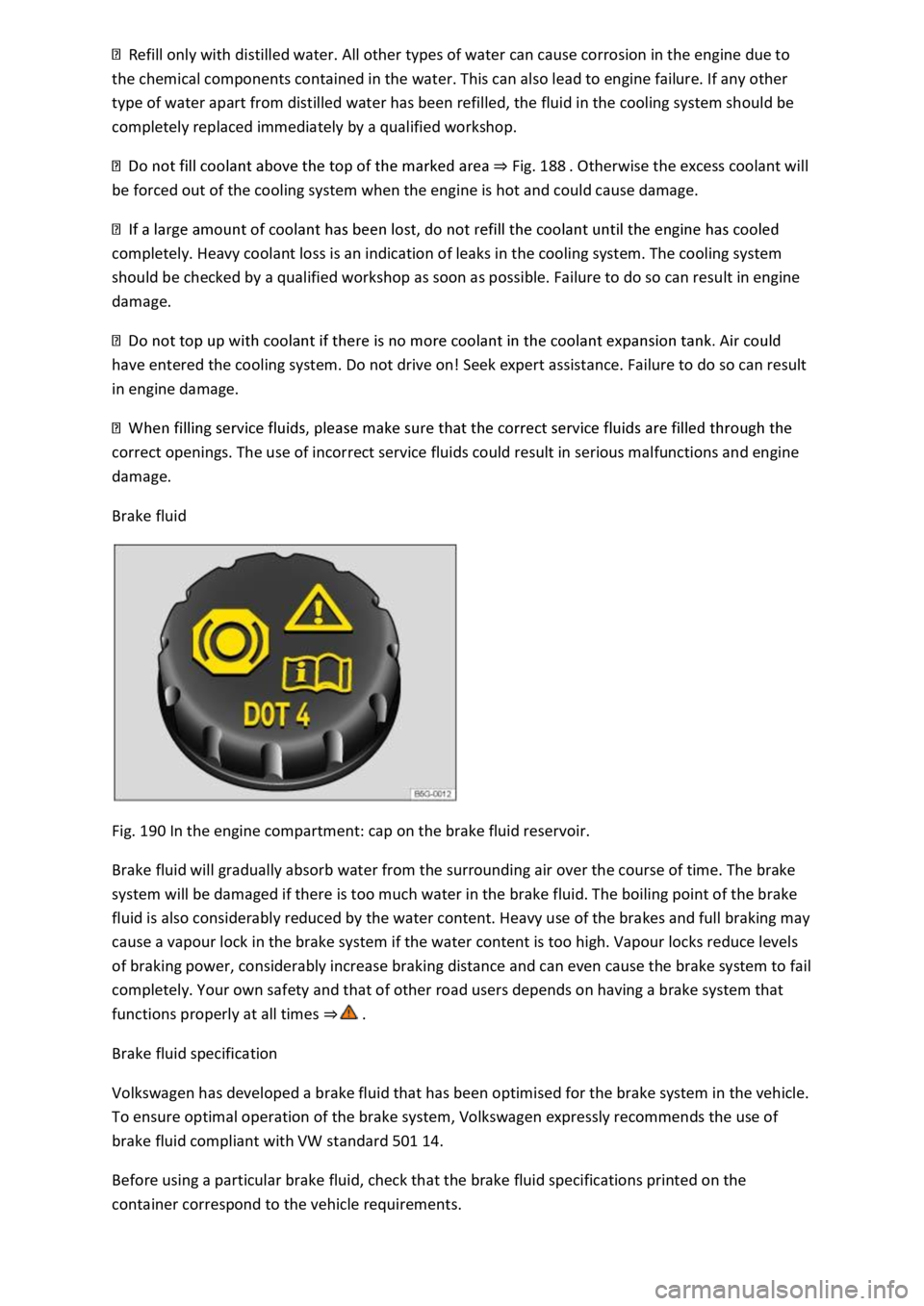
Brake fluid
Fig. 190 In the engine compartment: cap on the brake fluid reservoir.
Brake fluid will gradually absorb water from the surrounding air over the course of time. The brake
system will be damaged if there is too much water in the brake fluid. The boiling point of the brake
fluid is also considerably reduced by the water content. Heavy use of the brakes and full braking may
cause a vapour lock in the brake system if the water content is too high. Vapour locks reduce levels
of braking power, considerably increase braking distance and can even cause the brake system to fail
completely. Your own safety and that of other road users depends on having a brake system that
functions properly at all times ⇒ .
Brake fluid specification
Volkswagen has developed a brake fluid that has been optimised for the brake system in the vehicle.
To ensure optimal operation of the brake system, Volkswagen expressly recommends the use of
brake fluid compliant with VW standard 501 14.
Before using a particular brake fluid, check that the brake fluid specifications printed on the
container correspond to the vehicle requirements.
Page 384 of 502

reduce braking efficiency, considerably increase braking distance and can cause the brake system to
fail completely.
with VW standard 501 14.
fluid or low-quality brake fluid can affect the functioning of the brakes and reduce
their effectiveness.
501 14 is not available, use a high-quality brake fluid
compliant with DIN ISO 4925 CLASS 4 or the US standard FMVSS 116 DOT 4, but only in exceptional
circumstances.
WARNING
Brake fluid is toxic.
brake fluid. There is always a risk of someone drinking from such containers, even if they are labelled
appropriately.
children.
NOTICE
Brake fluid that has leaked or been spilt can damage the vehicle paintwork, plastic parts and tyres.
Immediately wipe off brake fluid that has leaked or been spilt from all parts of the vehicle.
Brake fluid can pollute the environment. Any service fluids that have escaped or been spilt must be
collected and disposed of properly.
12-volt vehicle battery
Introduction
This chapter contains information on the followingsubjects:
⇒ Checking the electrolyte level of the 12-volt vehicle battery
⇒ Charging, replacing, disconnecting and connecting the 12-volt vehicle battery
⇒ Troubleshooting
The 12-volt vehicle battery is a component of the electrical system and serves to supply power in the
vehicle.
Page 386 of 502
-volt vehicle battery. Discharged 12-volt vehicle batteries can already freeze
at temperatures of around 0°C (+32°F). Frozen 12-volt vehicle batteries must be renewed
immediately.
NOTICE
Do not expose the 12-volt vehicle battery to direct daylight for an extended time.
NOTICE
Protect the 12-volt vehicle battery against frost if the vehicle is left standing for extended periods.
-volt vehicle battery can freeze and be destroyed as a result.
When you start the engine after the 12-volt battery has been totally discharged or after jump
starting, you may find that system settings (time, date, personal convenience settings and
programming) have been changed or deleted. Check and correct the settings as necessary once the
12-volt vehicle battery has been sufficiently charged.
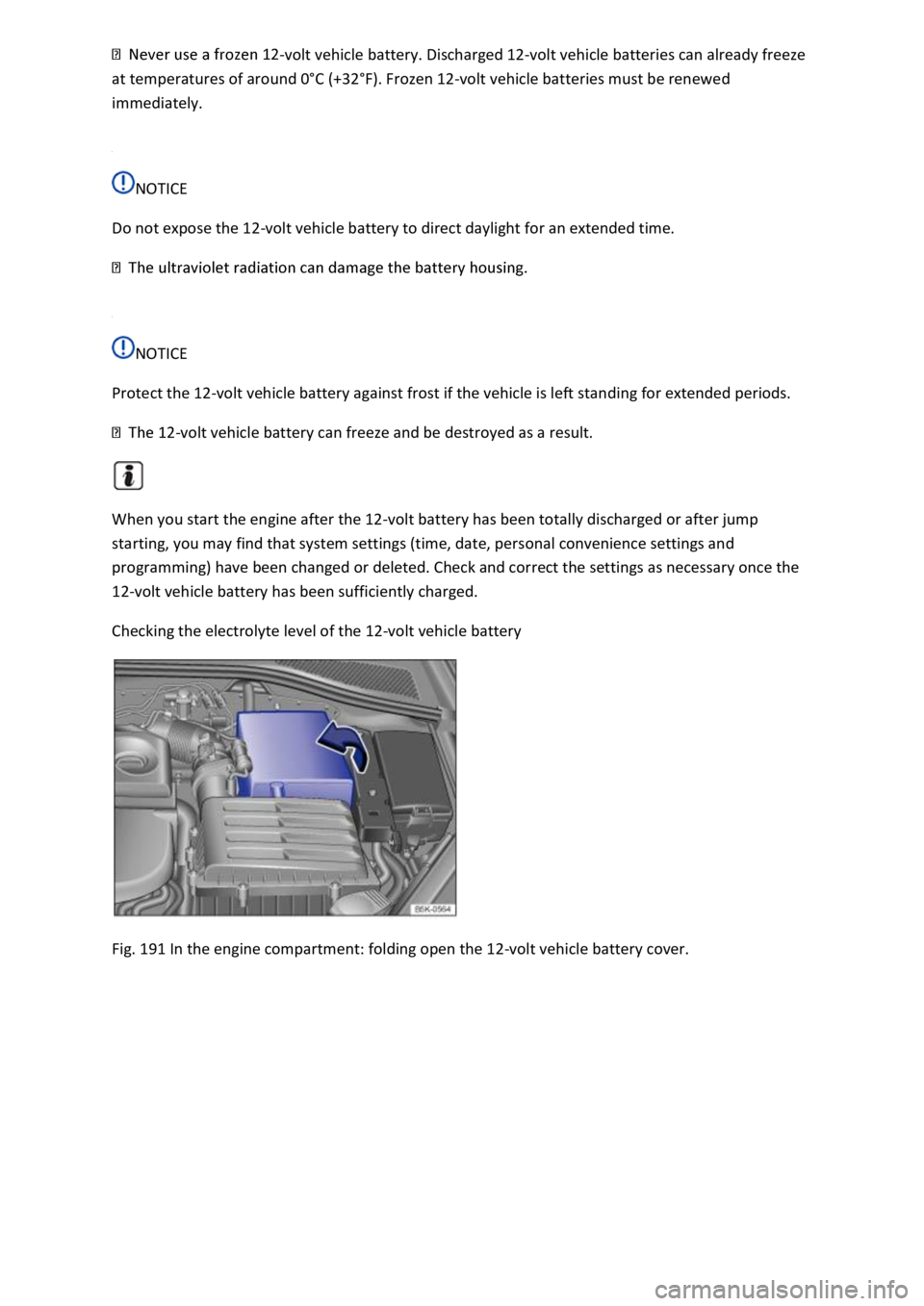
Checking the electrolyte level of the 12-volt vehicle battery
Fig. 191 In the engine compartment: folding open the 12-volt vehicle battery cover.
Page 388 of 502
te is very aggressive. It can burn the skin and can cause blindness. When working with the
12-volt vehicle battery, ensure that your hands, arms and face in particular are protected from acid
spillages.
-volt vehicle battery. Electrolyte may spill out of the battery vents and cause
chemical burns.
-volt vehicle battery.
Then consult a doctor immediately.
lyte is swallowed, consult a doctor immediately.
Charging, replacing, disconnecting and connecting the 12-volt vehicle battery
First read and observe the introductoryinformation and safety warnings⇒Introduction
If you suspect that the 12-volt vehicle battery is damaged or faulty, go to a qualified workshop and
have the 12-volt vehicle battery checked.
Charging the 12-volt vehicle battery
The 12-volt vehicle battery should be charged by a qualified workshop, as the technology used in
factory-fitted 12-volt vehicle batteries requires voltage-limited charging ⇒ . Volkswagen
recommends using a Volkswagen dealership for this purpose.
Replacing the 12-volt vehicle battery
The 12-volt vehicle battery has been developed to suit the conditions of its installation location and
has special safety features. If a 12-volt vehicle battery has to be replaced, find out about the
electromagnetic compatibility, size and necessary maintenance, power and safety requirements for
the new 12-volt vehicle battery at a Volkswagen dealership before purchase. The ventilation opening
of the vehicle battery must always be on the negative terminal side: the ventilation opening on the
positive terminal side must always be sealed.
Only maintenance-free vehicle batteries compliant with the standards TL 825 06 and VW 7 50 73
should be used. These standards must be dated October 2014 or later.
Always have the 12-volt vehicle battery replaced by a qualified workshop, as the vehicle electronics
must be adapted as part of the replacement process. Only qualified workshops have the technology
required to carry out this adjustment correctly. Volkswagen recommends that the 12-volt vehicle
battery is replaced by a Volkswagen dealership.
Disconnecting the 12-volt vehicle battery
Please observe the following if the 12-volt vehicle battery has to be disconnected from the electrical
system in the vehicle:
-theft
alarm.
⇒ .
Page 396 of 502
in this condition can result in blown tyres, accidents and serious injuries. Worn or damaged tyres
must be replaced as soon as possible.
grip.
he vehicle pulls to one side when driving, stop the car
immediately and check the wheels and tyres for damage.
injury, never loosen the bolts on wheel rims with bolted-on rim rings.
damaged, even if the damage is not visible.
ally at high
speeds, and thus cause accidents and serious injuries. Avoid using tyres that are more than six years
old. If you have no alternative, drive slowly and with extra care at all times.
WARNING
If the wheels are incorrectly fastened or if wheel bolts are missing, the wheels could come loose,
leading to a loss of control over the vehicle, causing accidents and serious injuries.
type.
available, tighten the wheel bolts with the wheel wrench and have the torque checked without delay
by the nearest qualified workshop.
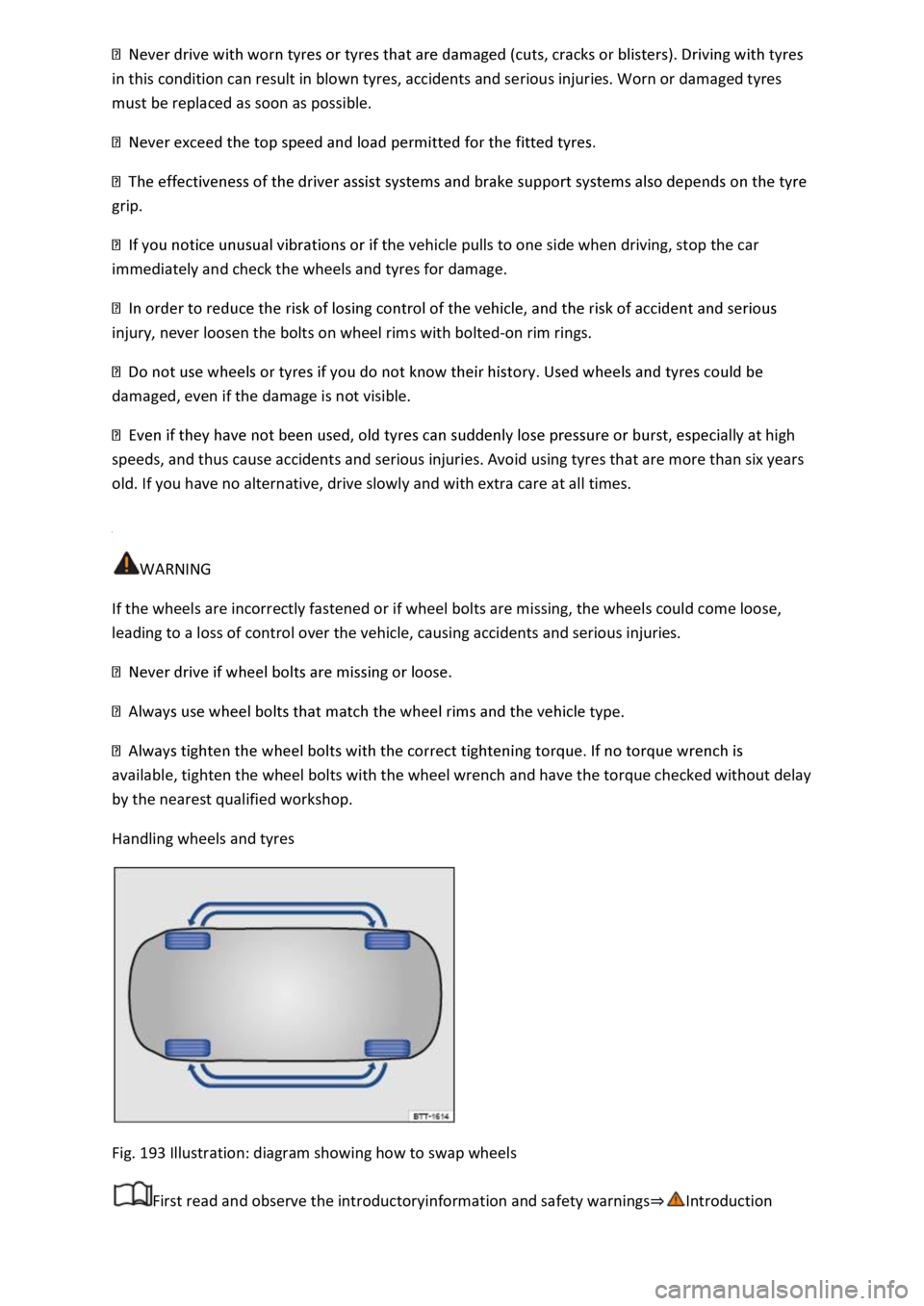
Handling wheels and tyres
Fig. 193 Illustration: diagram showing how to swap wheels
First read and observe the introductoryinformation and safety warnings⇒Introduction