breakdown VOLKSWAGEN T-ROC 2022 User Guide
[x] Cancel search | Manufacturer: VOLKSWAGEN, Model Year: 2022, Model line: T-ROC, Model: VOLKSWAGEN T-ROC 2022Pages: 502, PDF Size: 8.58 MB
Page 425 of 502

Check after driving for 10 minutes
The breakdown set can be used to temporarily and reliably seal any tyre damage caused by foreign
bodies or punctures (up to approx. 4 mm in diameter). Do not remove foreign objects (e.g. screws or
nails) from the tyre!
Once the sealant has been added to the tyre, the tyre pressure must be checked and adjusted again
after approximately 10 minutes of driving.
Seek expert assistance if more than one of the vehicle's tyres is damaged. The breakdown set is
designed to fill only one tyre.
Only use the breakdown set when the vehicle has been safely parked and you are familiar with the
work and safety precautions needed. Seek expert assistance if this is not the case.
The tyre sealant must not be used:
-20
Page 426 of 502
hicle.
to the position P or select a gear on a manual gearbox in order to reduce the risk of unintended
vehicle movement.
WARNING
Tyres that have been filled with sealant will not handle in the same way as a standard tyre.
km/h (50 mph.
km/h (50 mph) and then check the tyre.
Dispose of used or out-of-date sealant in accordance with legal requirements.
A new tyre filler bottle can be obtained from a Volkswagen dealership.
Observe the separate instructions from the manufacturer of the breakdown set.
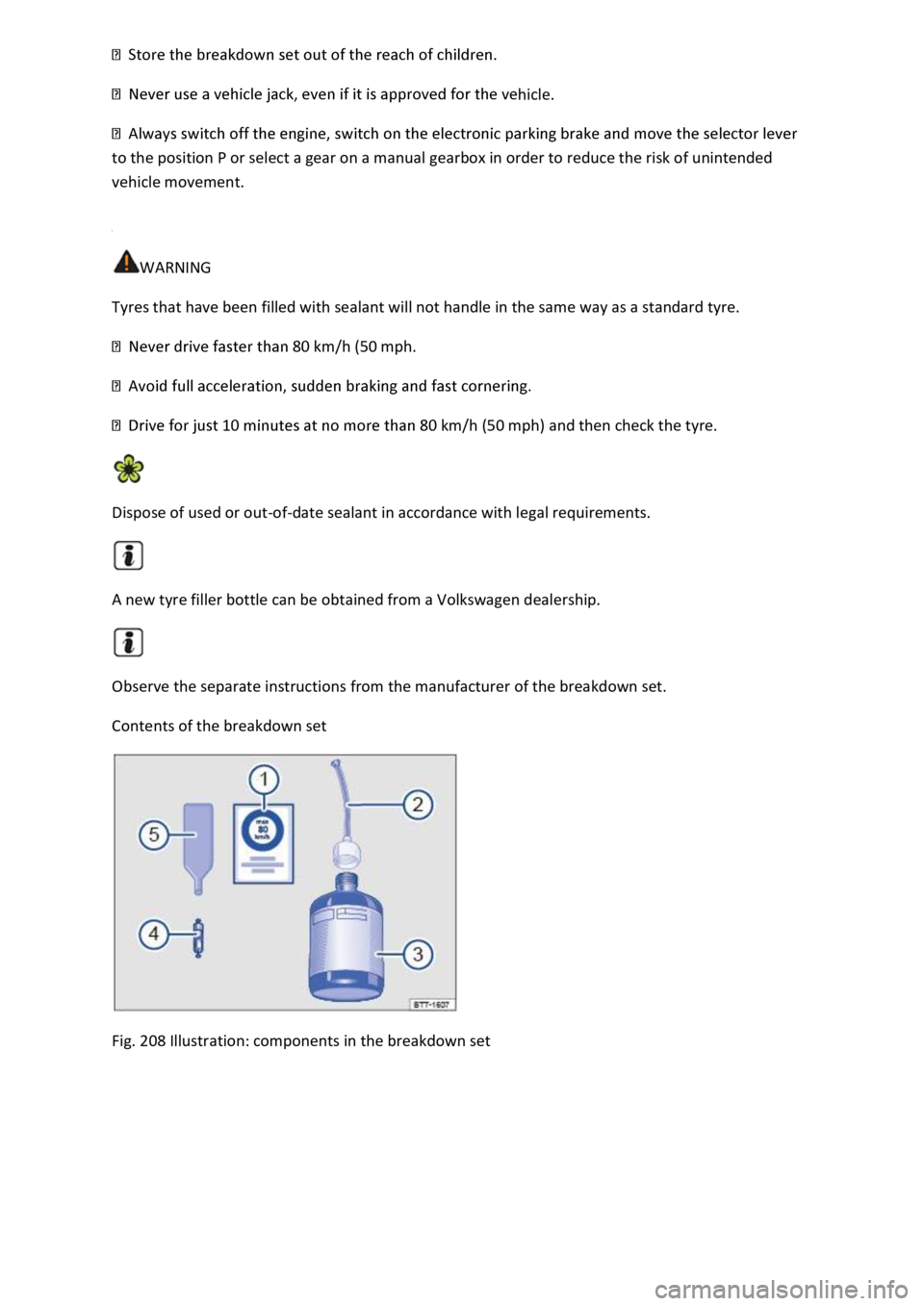
Contents of the breakdown set
Fig. 208 Illustration: components in the breakdown set
Page 427 of 502
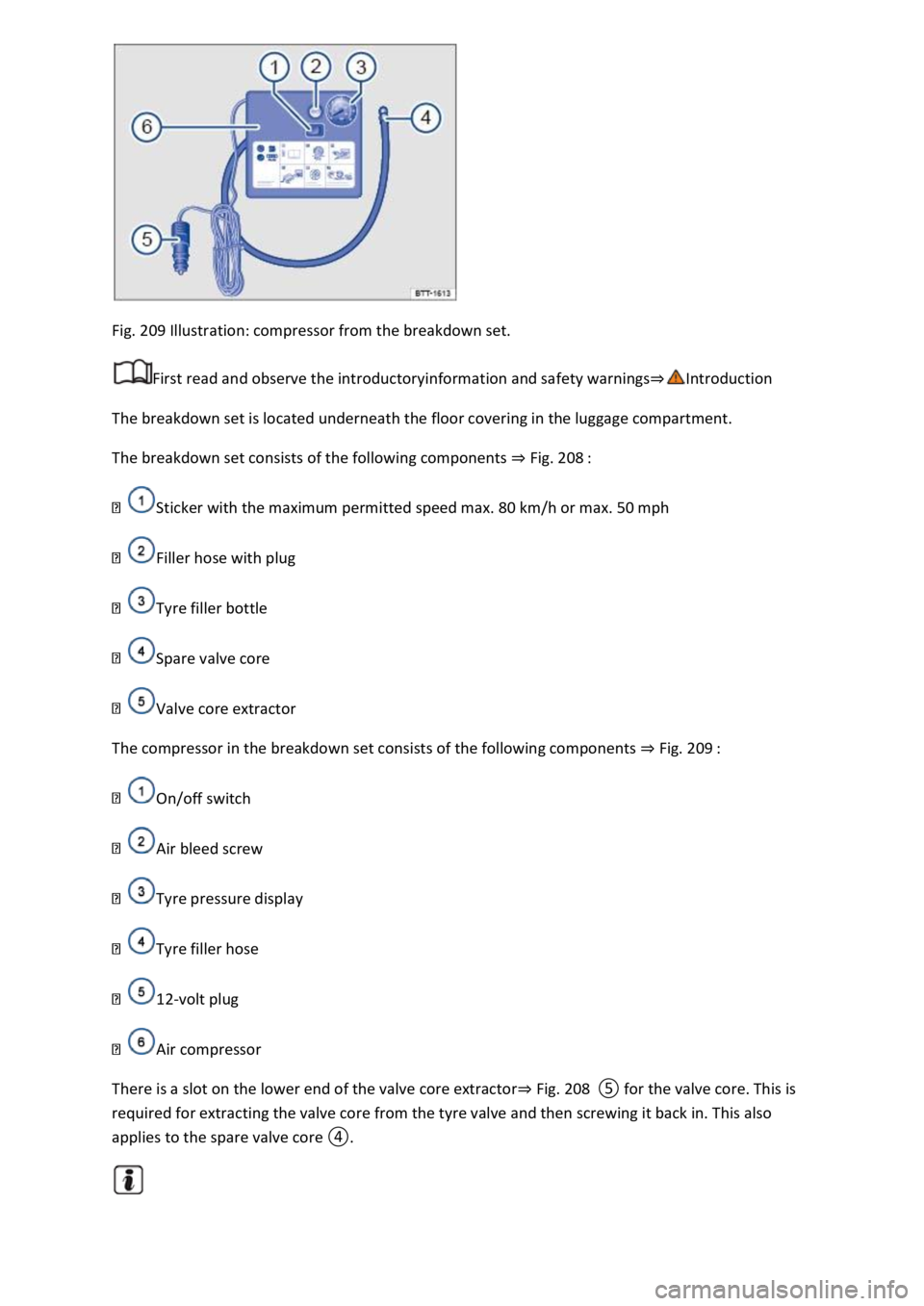
Fig. 209 Illustration: compressor from the breakdown set.
First read and observe the introductoryinformation and safety warnings
The breakdown set is located underneath the floor covering in the luggage compartment.
The breakdown set consists of the following components Fig. 208
Sticker with the maximum permitted speed max. 80 km/h or max. 50 mph
Filler hose with plug
Tyre filler bottle
Spare valve core
Valve core extractor
The compressor in the breakdown set consists of the following components Fig. 209
On/off switch
Air bleed screw
Tyre pressure display
Tyre filler hose
12-volt plug
Air compressor
There is a slot on the lower end of the valve core extractorFig. 208
applies to the spare valve core
Page 429 of 502

Take the breakdown set out of the luggage compartment.
Take the sticker
Do not remove foreign objects (e.g. screws or nails) from the tyre.
WARNING
Ignoring any of the items on this important safety checklist can lead to accidents and severe injuries.
Sealing and inflating tyres
First read and observe the introductoryinformation and safety warnings
Sealing a tyre
Fig.
0to unscrew the valve core from the tyre valve. Place
the core on a clean surface.
Fig.
0vigorously to and fro several times.
Fig.
0tightly onto the tyre filler bottle in a clockwise direction. The
plastic foil on the closure is pierced automatically.
Fig.
0and place the open end fully on the tyre valve.
Fig.
0to screw the valve core back into the tyre valve.
Inflating the tyre
Fig.
Fig.
0is closed.
-volt plug Fig.
0into one of the vehicle's 12-volt sockets Electrical sockets
Page 430 of 502

Fig.
0to switch on the air compressor.
2.5 bar (29 36 psi/200
250 kPa) unning time: 8 minutes
2.5 bar (29 36 psi/200 250 kPa) cannot be achieved, unscrew the tyre
filler hose from the tyre valve.
metres forward or back so that the sealing compound is evenly
distributed in the tyre.
again.
. The tyre cannot be
sealed with the breakdown set. Do not drive on. Seek expert assistance
km/h (50 mph) if a tyre pressure of 2.0 2.5 bar (29
36 psi/200 250 kPa) has been reached.
minutesCheck after driving for 10 minutes
WARNING
The tyre filler hose and the air compressor can get hot during inflation.
r hands and skin from the hot components.
bar (29 psi/200 kPa), the tyre is too damaged. The sealant
is unable to seal the tyre. Do not drive on. Seek expert assistance.
NOTICE
Switch the air compressor off after a maximum of 8 minutes to avoid overheating. Let the air
compressor cool down for a few minutes before switching it back on.
Check after driving for 10 minutes
First read and observe the introductoryinformation and safety warnings
Reconnect the tyre filler hose Fig.
0and read off the tyre pressure on the tyre pressure
1.3 bar (19 psi/130 kPa) and lower:
Page 432 of 502
advisor will note these on the order.
The LongLife mobility guarantee is valid until the next inspection is due. Documentation takes place
at every due inspection.
The type and scope of service work may differ from vehicle to vehicle. Information on specific work
for your vehicle can be requested from a qualified workshop.
WARNING
Inadequate servicing, no servicing at all, or failure to adhere to service intervals can result in
breakdowns, accidents and serious injury.
NOTICE
Volkswagen is not responsible for any vehicle damage caused by inadequate service work or the lack
of part availability.
Regular servicing of your vehicle not only maintains its value, it also ensures that your vehicle
remains roadworthy and in working order. You should therefore have your vehicle serviced
according to the Volkswagen guidelines.
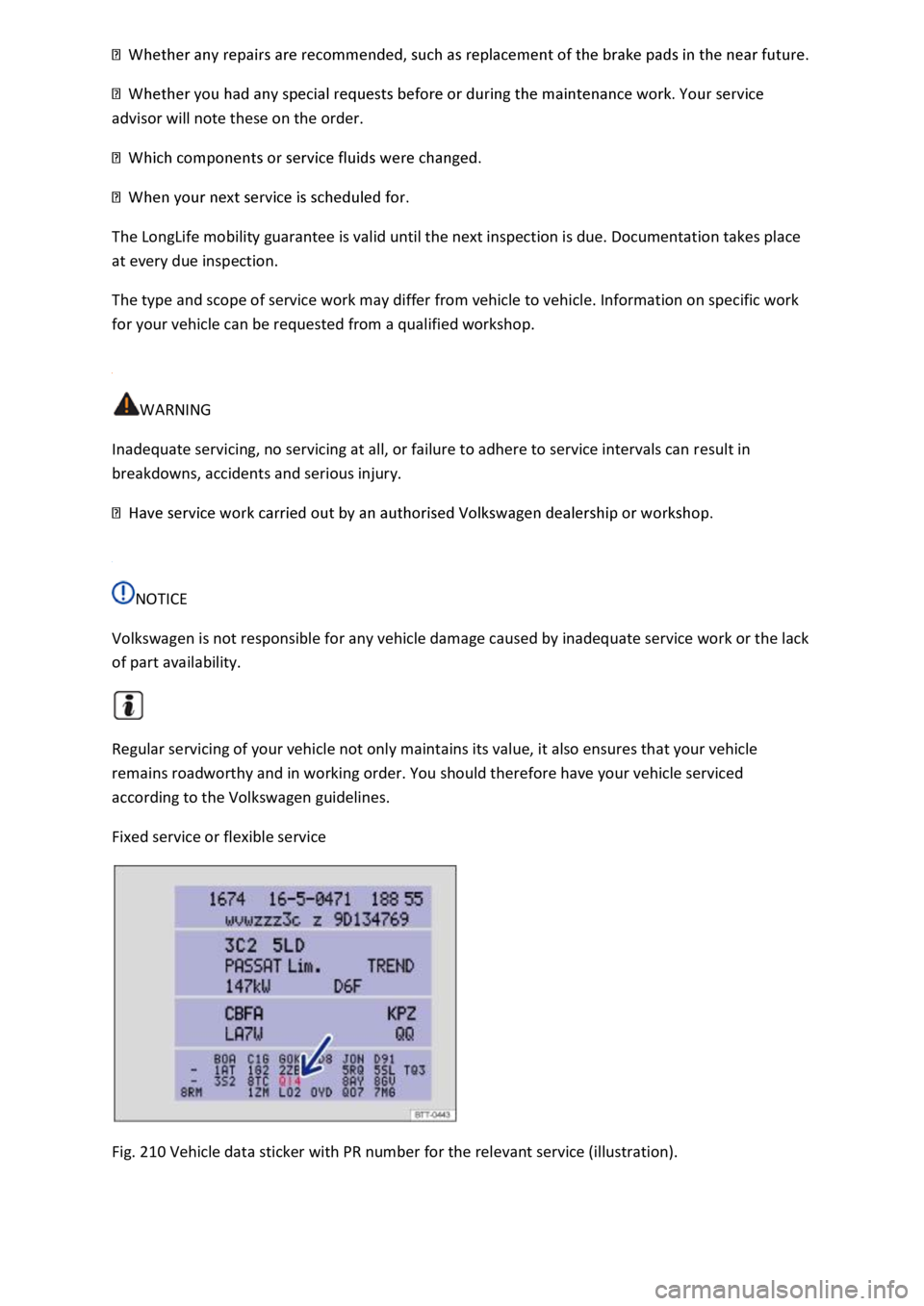
Fixed service or flexible service
Fig. 210 Vehicle data sticker with PR number for the relevant service (illustration).
Page 434 of 502

The specified service intervals and scope of service are always for vehicles used under normal
operating conditions.
If the vehicle is operated under severe conditions, some work will have to be performed before the
next service or at shorter intervals than those specified.
Severe operating conditions are, for example:
th high levels of dust,
This applies particularly to the following components (according to equipment):
Care allergen filter
The service advisor at your qualified workshop will be pleased to advise you on whether your vehicle
requires more frequent work between the normal service intervals due to the conditions under
which it is used.
WARNING
Inadequate servicing, no servicing at all, or failure to adhere to service intervals may result in
breakdowns, accidents or serious injury.
Have service work carried out by an authorised Volkswagen dealership or workshop.
NOTICE
Volkswagen is not responsible for any vehicle damage caused by inadequate service work or the lack
of part availability.
Page 452 of 502

iffer depending on
the country in which the vehicle was sold. Please ask your Volkswagen dealership for further
information.
The selling Volkswagen dealership will issue a comprehensive LongLife mobility guarantee for every
new vehicle which applies from the time of delivery until the first due inspection. If you purchase
your new vehicle directly from Volkswagen AG, Volkswagen AG will issue the LongLife mobility
guarantee from the time of delivery until the first due inspection.
Your Volkswagen dealership will extend the LongLife mobility guarantee until the following
inspection when the due inspection is carried out by the dealership. The service costs include the
entire guarantee package.
The comprehensive LongLife mobility guarantee includes the following services:
If your vehicle can no longer be driven due to a technical defect1), corresponding assistance will be
provided in the case of breakdown or accident. The LongLife mobility guarantee provides with you
protection and mobility.
The inspection is not only about car maintenance - it also ensures that your car remains roadworthy
and in perfect working order. For this reason, servicing should be carried out regularly in accordance
with the manufacturer's specifications.
Your entitlement to the LongLife mobility guarantee is documented in the digital service schedule
each time your car is serviced. A full service history shows that your car has been professionally
maintained and cared for.
1) A vehicle which can no longer be driven is a vehicle which cannot reach a workshop under its own
power.
Data storage and services
Your vehicle is fitted with electronic control units. Some of these are required to make sure your
vehicle remains safe while others provide support while driving (driver assist systems). Furthermore,
your vehicle is equipped with convenience and Infotainment functions, which are also made possible
using electronic control units.
Electronic control units contain data memories which can store information regarding the vehicle
status, component load levels, servicing requirements, technical events and faults on a temporary or
permanent basis. This information generally documents the status of a component, a module, a
system or the environment, e.g.:
. filling levels, tyre pressure, battery status.
deceleration, lateral acceleration, display of fastened seat belts.
tem components, e.g. lights, brakes.
stability control systems.
Page 453 of 502

e.g. temperature, rain.
As well as performing the actual control functions, these data are also used to detect and rectify
faults and help Volkswagen to improve vehicle functions. The majority of these data are temporary
and are only processed within the vehicle itself. Only a very small amount of data is stored in the
event memories or possibly on the vehicle key.
Reading out the vehicle's event memory
There is a diagnostic interface in the vehicle interior for reading out the event memories (on-board
diagnosis)
If you have service work performed on your vehicle, the technical data can be read out of the vehicle
together with the vehicle identification number by service employees, e.g. workshops, or third
parties such as breakdown services. Service work includes, for example, repairs, maintenance,
warranty work or quality assurance measures. The service workshop or third party collects,
processes and uses the data. The data document the vehicle's technical status, help in
troubleshooting and in improving quality and may be sent to Volkswagen in some cases.
Furthermore, the manufacturer is subject to legal product safety requirements. To make sure it
complies with these requirements, the manufacturer requires technical data from the vehicles.
Event memories in the vehicle can be reset by a service workshop as part of repair or service work.
The event memory should be read out and reset only by a qualified workshop. Additional
information on the stored data is available from the qualified workshop.
After a fault has been rectified, the information in the memory relating to the fault is deleted. Other
memory content is overwritten on an ongoing basis.
Event data recorder
This vehicle is equipped with an event data recorder. The main task of an event data recorder is to
record data in particular accident scenarios or accident-like situations, e.g. in the event of airbags
being triggered or a collision with an obstacle on the road. These data help in analysis of how a
vehicle system behaved in these situations. The event data recorder records data relating to driving
dynamics and the restraint system for a short period of 10 seconds or less. This information includes,
for example:
of the driver and front passenger were fastened.
These data help to obtain a better understanding of the circumstances in the situations where
accidents and injuries have occurred.
Data from driver assist systems are also recorded. In addition to information about whether the
systems were switched on or off, available only to a restricted extent or inactive, it is also possible to
determine whether these functions steered, accelerated or braked the vehicle in the above-
described situations. Depending on the vehicle equipment, these systems include the following: