breakdown VOLKSWAGEN T-ROC 2022 Owners Manual
[x] Cancel search | Manufacturer: VOLKSWAGEN, Model Year: 2022, Model line: T-ROC, Model: VOLKSWAGEN T-ROC 2022Pages: 502, PDF Size: 8.58 MB
Page 9 of 502
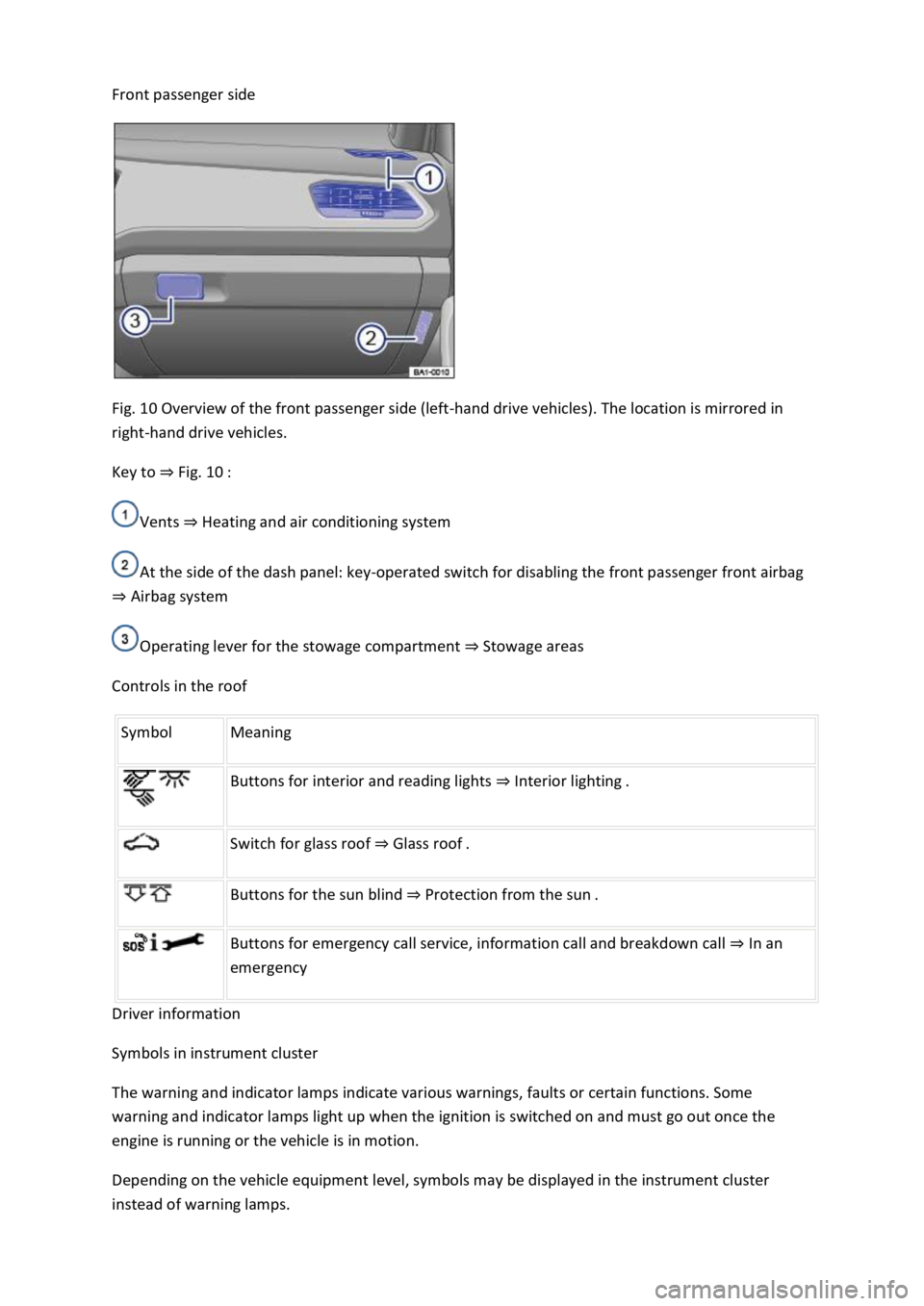
Front passenger side
Fig. 10 Overview of the front passenger side (left-hand drive vehicles). The location is mirrored in
right-hand drive vehicles.
Key to Fig. 10
Vents Heating and air conditioning system
At the side of the dash panel: key-operated switch for disabling the front passenger front airbag
Airbag system
Operating lever for the stowage compartment Stowage areas
Controls in the roof
Symbol Meaning
Buttons for interior and reading lights Interior lighting.
Switch for glass roof Glass roof.
Buttons for the sun blind Protection from the sun.
Buttons for emergency call service, information call and breakdown call In an
emergency
Driver information
Symbols in instrument cluster
The warning and indicator lamps indicate various warnings, faults or certain functions. Some
warning and indicator lamps light up when the ignition is switched on and must go out once the
engine is running or the vehicle is in motion.
Depending on the vehicle equipment level, symbols may be displayed in the instrument cluster
instead of warning lamps.
Page 87 of 502
-visibility waistcoat may be located in a stowage
compartment in the front door trim or in the stowage compartment on the front passenger side
Driver doorFr
The high-visibility waistcoat must comply with legal requirements.
Fire extinguisher
Depending on the equipment, a fire extinguisher may be located in a holder in the footwell under
the front passenger seat.
The fire extinguisher must meet legal requirements, be ready for use at all times and be checked on
a regular basis (see inspection seal on the fire extinguisher).
WARNING
In the event of a sudden driving or braking manoeuvre or accident, loose objects could be flung
though the vehicle and cause severe injuries.
Always secure the first-aid kit, warning triangle and fire extinguisher safely in the holders in the
vehicle.
Stow the high-visibility waistcoat in the stowage compartments so that it can be easily accessed.
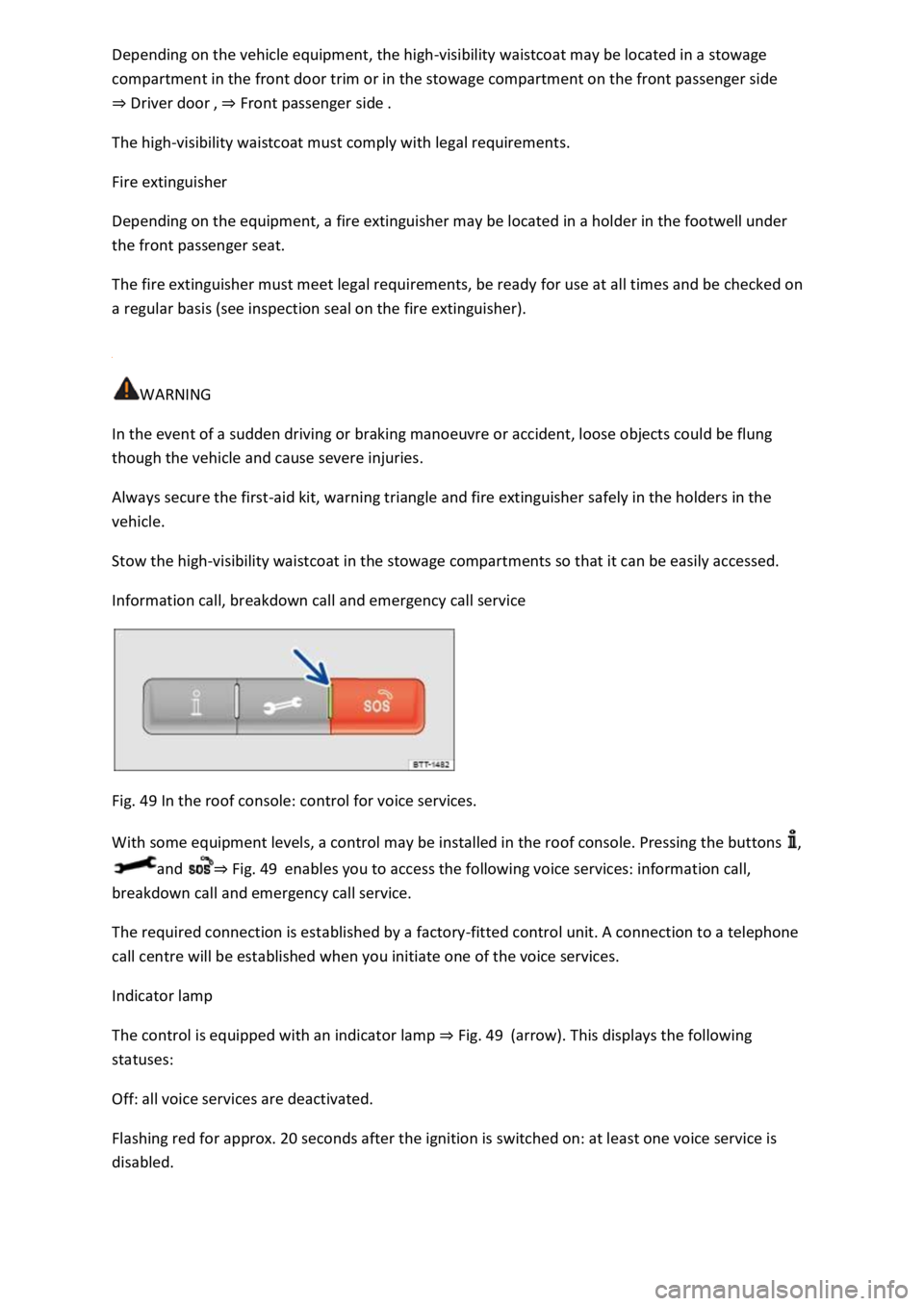
Information call, breakdown call and emergency call service
Fig. 49 In the roof console: control for voice services.
With some equipment levels, a control may be installed in the roof console. Pressing the buttons ,
and Fig. 49enables you to access the following voice services: information call,
breakdown call and emergency call service.
The required connection is established by a factory-fitted control unit. A connection to a telephone
call centre will be established when you initiate one of the voice services.
Indicator lamp
The control is equipped with an indicator lamp Fig.
Off: all voice services are deactivated.
Flashing red for approx. 20 seconds after the ignition is switched on: at least one voice service is
disabled.
Page 88 of 502

specialist workshop.
Lit up green: voice services are available. System is OK.
Flashing green: active connection to a voice service.
Information call
The information call enables you to call the Volkswagen AG hotline.
The information call function is available only in some sales regions.
The telephone call centre communicates in the language registered for the vehicle in Car-Net.
Breakdown call
The breakdown call allows you to seek professional assistance should your vehicle break down.
Some vehicle data, e.g. the current location, are transmitted parallel to the voice call.
The telephone call centre communicates in the language registered for the vehicle in Car-Net.
Emergency call service
If an emergency call is placed manually, or automatically after an accident where an airbag was
triggered, data relevant for the emergency call, e.g. the current vehicle location, will be transmitted
automatically Customer information
The telephone call centre communicates in the language set up in the vehicle's Infotainment system.
English is used if this language is not available at the location of the emergency.
Back-up to 112 emergency number
In some cases, the emergency call service may be restricted or unavailable so the general emergency
call number 112 will be used to conduct an emergency call. In this case, only a voice-based
connection is established. No data will be transmitted, e.g. regarding the vehicle or its location.
The following circumstances may restrict access to the emergency call service and lead to the call
being forwarded to the 112 emergency number:
Your current emergency call location is in an area with no or insufficient mobile communications and
GPS reception. This can also include tunnels, streets with tall buildings, garages, underpasses,
mountains and valleys.
You are in an area with sufficient mobile communications and GPS reception but the
telecommunications provider's mobile network is not available.
The emergency call service is prohibited by law in some countries.
There is no valid licence for using the emergency call service.
The components in the vehicle required for the emergency call service are damaged or do not have a
sufficient power supply.
Page 216 of 502

whether these guidelines will be valid for all situations that could occur.
The many different types of terrain and the associated risks and dangers make it impossible to
describe all possible driving situations. The examples are only general guidelines which are intended
to help you to drive offroad safely. It is crucial that you know what to expect when you drive into
offroad terrain you are unfamiliar with. This will enable you to assess potential dangers in advance.
The driver can use 4MOTION Active Control to activate a variety of vehicle settings in an all-wheel
drive vehicle as required Setting a driving profile
Checklist
Before driving offroad for the first time, take the following steps so you can operate and drive the
vehicle safely offroad:
Observe the basic safety notes Safety instructions for offroad driving.
Familiarise yourself with the vehicle controls.
Check and adjust the seat position Sitting position and fasten the seat belts Seat belts.
Check distance to steering wheel and adjust Steering wheel.
Always wear suitable, well-fitting shoes that provide good grip for your feet when operating the
pedals.
Safety instructions for offroad driving
First read and observe the introductoryinformation and safety warnings
WARNING
The intelligent vehicle technology cannot overcome the laws of physics, and functions only within
the limits of the system. Despite ABS, instability through locked wheels can occur on adverse terrain
e.g. if you brake hard when driving on a loose gravel road. The Electronic Stability Control will be
able to stabilise the vehicle only to a limited extent in these circumstances.
WARNING
Driving offroad can be dangerous and could cause accidents, serious injury, damage to the vehicle
and also a vehicle breakdown far from any assistance.
Never select a dangerous route and never take risks that could endanger you and your passengers. If
you cannot drive on or if you are in any doubt about the safety of the route, turn round and choose
another route.
Even terrain that looks harmless can be difficult and dangerous, and could get you and your
passengers into difficulties. We recommend inspecting the terrain on foot beforehand.
Page 217 of 502

n driving offroad. If you drive too fast or
if a driving manoeuvre is unsuccessful, this could result in serious injuries and vehicle damage.
Never drive faster than the current terrain, road conditions, traffic and weather allow.
Never drive too fast over embankments, ramps or slopes. This could cause the vehicle to lose
contact with the ground. If this happens, you will be unable to steer and will lose control of the
vehicle.
If the vehicle does lose contact with the ground, always point the front wheels straight ahead. If the
wheels are not pointing straight ahead when the vehicle lands, it could roll over.
Terrain might look harmless, but there could be hidden dangers. Potholes, hollows, ditches,
precipices, obstacles, shallows, soft and boggy surfaces are often not recognisable as such and can
be covered either fully or partly by water or grass or branches lying on the ground. Inspect terrain on
foot if necessary.
WARNING
Sporty multipurpose vehicles are subject to a considerably higher risk of rolling over than normal
road passenger vehicles Explanation of some technical terms
In the event of an accident, vehicle occupants not wearing seat belts are subjected to a considerably
higher risk of fatal injury than those wearing seat belts.
The vehicle has a higher centre of gravity and is more prone to rolling over than a normal passenger
car which is unsuited for offroad driving.
Never drive too fast, especially when driving through bends, or carry out any extreme driving
manoeuvres.
Always adjust your speed and driving style to the terrain.
Luggage and other items transported on the roof of the vehicle raise the centre of gravity and will
make the vehicle more likely to roll over.
WARNING
The terrain might look harmless, but there could be hidden dangers. Potholes, hollows, ditches,
precipices, obstacles, shallows, soft and boggy surfaces are often not recognisable as such and can
be covered either fully or partly by water or grass or branches lying on the ground. Driving offroad
over such terrain could cause accidents, serious injury and also a vehicle breakdown.
Carefully inspect any unknown sections of the terrain on foot before driving through them.
Never choose an unsafe route or take a risk which could endanger you or your passengers. If you are
in any doubt about the safety of the route, turn round and choose another way.
Always adjust your speed and driving to match vehicle load levels and visibility, terrain and weather
conditions.
Page 222 of 502

ot on the clutch when driving offroad. When travelling over
uneven ground, you could press the clutch by mistake and lose control of the vehicle. This also
prevents power being transferred between the engine and the gearbox. In addition, driving with the
clutch partially engaged causes premature wear to the clutch lining.
Useful accessories for offroad driving
First read and observe the introductoryinformation and safety warnings
The checklist contains just a few items of equipment that can be very useful for offroad driving. If
you have an instruction manual or fitting instructions for these accessories, you should always take
them with you and observe them as necessary when driving offroad.
Checklist
Useful items when driving offroad:
Water, compass, maps and torch with spare batteries.
Winch, tow bar or rope with sufficient strength.
Mobile telephone, shovel, blankets and rubber boots.
Electrical air compressor for connection to the 12-volt sockets in the vehicle to inflate the tyres.
A wooden board approx. 4 cm thick and approx. 1 metre long or an aluminium frame of similar size:
this can be used to free a vehicle stuck in the mud and provide a platform for a vehicle jack.
Snow chains, additional spare wheels, a breakdown set, jack and box spanner.
Changing gear correctly
First read and observe the introductoryinformation and safety warnings
The correct choice of gear depends on the offroad terrain.
Before attempting to drive through difficult terrain it can be helpful to stop and consider which gear
you should select. After several trips offroad, you will learn which gear to select in conjunction with
the step-down ratio and differential locks for different types of terrain.
General rules
Page 224 of 502

body, for example puddles or shallow water. Never stop in the water, do not reverse, and never
switch off the engine.
Observe further information on driving through water on roads Driving through w
WARNING
Flowing water can develop enormous power and sweep the vehicle away. This can lead to very
dangerous situations which can cause accidents and serious or even fatal accidents.
Never stop the vehicle when in water.
Water in the engine compartment can cause the vehicle to break down in the water.
Soft ground surfaces, underwater obstacles and shallows can cause accidents and can cause the
vehicle to breakdown in the water. This could lead to critical situations.
NOTICE
If you drive through water, parts of the vehicle, such as the engine, drive train, running gear and
vehicle electrics, could sustain severe damage.
When driving through water, always select a section where the ground is solid and where the depth
of the water does not exceed the maximum permitted fording depth of the vehicle.
Never drive through salt, salty surfaces or salt water as salt can cause corrosion. Rinse off all
components that have been exposed to salt or salt water immediately with fresh water.
Offroad driving in snow
First read and observe the introductoryinformation and safety warnings
Fit snow chains to the front wheels only before driving on snow-covered terrain.
Terrain might look harmless, but there could be hidden dangers. This is particularly true of sections
where there are no visible tyre tracks or other tracks.
WARNING
Driving in snow-covered terrain is very dangerous.
Both shallow and deep potholes, hollows, ditches, precipices, frozen surfaces and other obstacles
can be fully or partially covered by snow.
Dangers concealed by snow can cause an accident, serious injuries, or cause the vehicle to break
down in extreme weather conditions.
Page 333 of 502

The yellow catalytic converter lamp lights up or flashes.
Faults in the exhaust system caused by misfiring, which can damage the catalytic converter.
to the nearest qualified workshop immediately.
There may be engine faults and fuel consumption may be higher if the indicator lamps are lit up or
flashing.
If and when
Vehicle toolkit
Introduction
This chapter contains information on the followingsubjects:
Stowage
Vehicle toolkit contents
Observe any country-specific legislation when securing your vehicle in the event of a breakdown.
Vehicle toolkit in the vehicle
In vehicles that are factory-fitted with a spare wheel, emergency spare wheel or winter wheels,
additional vehicle tools may be located in the luggage compartment.
WARNING
In the event of a sudden driving or braking manoeuvre or accident, a loose vehicle toolkit,
breakdown set and spare wheel or temporary spare wheel could be flung though the vehicle and
cause severe injuries.
always secured in the luggage compartment.
WARNING
Unsuitable or damaged tools in the vehicle toolkit can lead to accidents and injuries.
Stowage
Page 403 of 502

The tread wear indicators show if a tyre is worn down. The tyre must be replaced at the latest when
the tread is worn down to the tread wear indicator.
The bottom of the tyre tread has 1.6 mm high tread wear indicators Fig. 196
tyre sidewall indicate the position of the wear indicators Fig. 196
WARNING
Worn tyres are a safety risk and can lead to a loss of control over the vehicle and cause serious
injuries.
indicators.
roads, which can cause the vehicle to
float along the road surface (aquaplaning).
situations and increase braking distance and the risk of skidding.
Tyre damage
First read and observe the introductoryinformation and safety warnings
Damage to tyres and wheel rims is often hidden
and wheel rims for damage.
Changing a wheelor seal the
tyre with the breakdown set and inflate it Breakdown set
, drive slowly and carefully to the next qualified workshop in order to
have the vehicle checked.
Foreign bodies in the tyre
between the tyre tread blocks can be removed.
Changing a wheelor seal the tyre with the breakdown set and
inflate it Breakdown set
olkswagen recommends using a Volkswagen dealership for this
purpose.
Tyre wear
Fast cornering, heavy acceleration and hard braking all increase tyre wear.
Page 424 of 502

theft wheel bolt using the adapter at position Fig.
0
l the other wheel bolts in clockwise direction and tighten them slightly.
tighten the bolts in order but always in diagonally opposite sequence.
Hubcaps
WARNING
Incorrect tightening torque or incorrect use of wheel bolts can lead to a loss of control of the vehicle,
and cause accidents and serious injuries.
ep all wheel bolts and threads in the wheel hubs clean and free from oil and grease. The
wheel bolts must be easy to turn and be tightened to the specified torque.
not use
for loosening or tightening them.
After changing a wheel
First read and observe the introductoryinformation and safety warnings
luggage compartment Vehicle toolkit
Tightening torque of wheel
bolts
as possible.
After changing a wheel, the indicator lamp for the tyre monitoring system may indicate a fault in the
system T
Breakdown set
Introduction
This chapter contains information on the followingsubjects:
Contents of the breakdown set
Preparations
Sealing and inflating tyres