park VOLKSWAGEN T-ROC 2022 User Guide
[x] Cancel search | Manufacturer: VOLKSWAGEN, Model Year: 2022, Model line: T-ROC, Model: VOLKSWAGEN T-ROC 2022Pages: 502, PDF Size: 8.58 MB
Page 146 of 502

ant that the driver positions the exterior and interior mirrors correctly
before starting a journey
Looking in the exterior mirrors and the interior mirror does not allow the driver to see the entire
side and rear area around the vehicle. The area that cannot be seen is known as the blind spot.
There may be objects and other road users in the blind spot.
WARNING
Adjusting the exterior and interior mirrors while the vehicle is moving may cause the driver to
become distracted. This could lead to accidents and serious injuries.
Exterior and interior mirrors should be adjusted only when the vehicle is at a standstill.
When parking, changing lane, or performing an overtaking or turning manoeuvre, always pay careful
attention to the area around the vehicle as objects and other road users may be located in the blind
spot.
Always ensure that the mirrors are positioned correctly and that the rear view is not restricted by
ice, snow, condensation or any other objects.
WARNING
If you estimate the distance from traffic behind you incorrectly, you can cause accidents and serious
injuries.
Curved mirrors (convex or aspheric) enlarge the field of vision and can make objects in the mirror
seem smaller and further away than they actually are.
Using curved mirrors to estimate the distance from other vehicles behind you when changing lanes
can provide inaccurate results and can lead to accidents and serious injuries.
Whenever possible, use the interior mirror to check the exact distance between your vehicle and
following traffic or other objects.
Ensure that you have a good view to the rear of the vehicle.
WARNING
Automatic anti-dazzle mirrors contain an electrolyte fluid which could leak if the mirror is broken.
The leaking electrolyte fluid can cause irritation to the skin, eyes and respiratory organs, especially in
people who suffer from asthma or similar illnesses. Immediately ensure that there is a sufficient
supply of fresh air and get out of the vehicle. If this is not possible, open all of the windows and
doors.
If the electrolyte fluid gets into the eyes or onto the skin, immediately wash the area with plenty of
water for at least 15 minutes and consult a doctor.
Page 163 of 502

Maximum heat output and the fastest possible defrosting of the windows are possible only when
the engine is running. Do not start your journey until you have good visibility.
To help ensure good visibility, make sure that you use the air conditioning system and the rear
window heating correctly.
Auxiliary heater and ventilation
Introduction
This chapter contains information on the followingsubjects:
Switching the auxiliary heater and ventilation on and off
Programming the auxiliary heater and ventilation
Remote control
The auxiliary heater and ventilation system can be used to heat the vehicle interior in the winter and
ventilate it in the summer. It is able to clear ice, condensation and a thin layer of snow from the
windscreen. The auxiliary heater is supplied with fuel from the vehicle fuel tank and can be operated
when the vehicle is stationary with the ignition switched off. The auxiliary ventilation system is
powered by the 12-volt vehicle battery.
Auxiliary heater exhaust system
The emissions generated by the auxiliary heater are discharged via an exhaust pipe underneath the
vehicle. The exhaust pipe must not be blocked by snow, mud or other objects.
WARNING
Among other things, the emissions from the auxiliary heater contain carbon monoxide, which is an
odourless and colourless poisonous gas. Carbon monoxide can cause people to lose consciousness. It
can also cause death.
Never switch on the auxiliary heater when the vehicle is in unventilated or closed rooms nor let the
auxiliary heater run in unventilated or closed rooms.
Never program the auxiliary heater so that it is switched on and runs in unventilated or closed
rooms.
WARNING
Parts of the auxiliary heater exhaust system become very hot. This can cause fires.
Park the vehicle so that no part of the exhaust system can come into contact with any inflammable
material underneath the vehicle, e.g. dry grass.
Page 165 of 502

The 12-volt vehicle battery will discharge if the auxiliary heating or ventilation is run several times
over an extended period. Drive the vehicle for an appropriate distance in between in order to
recharge the 12-volt vehicle battery.
The fuel gauge indication may not be accurate (just above the reserve quantity) when the vehicle is
parked on a slope; this may restrict the function of the auxiliary heater.
The auxiliary heater may switch on automatically when the engine is started at temperatures below
+5
Page 169 of 502
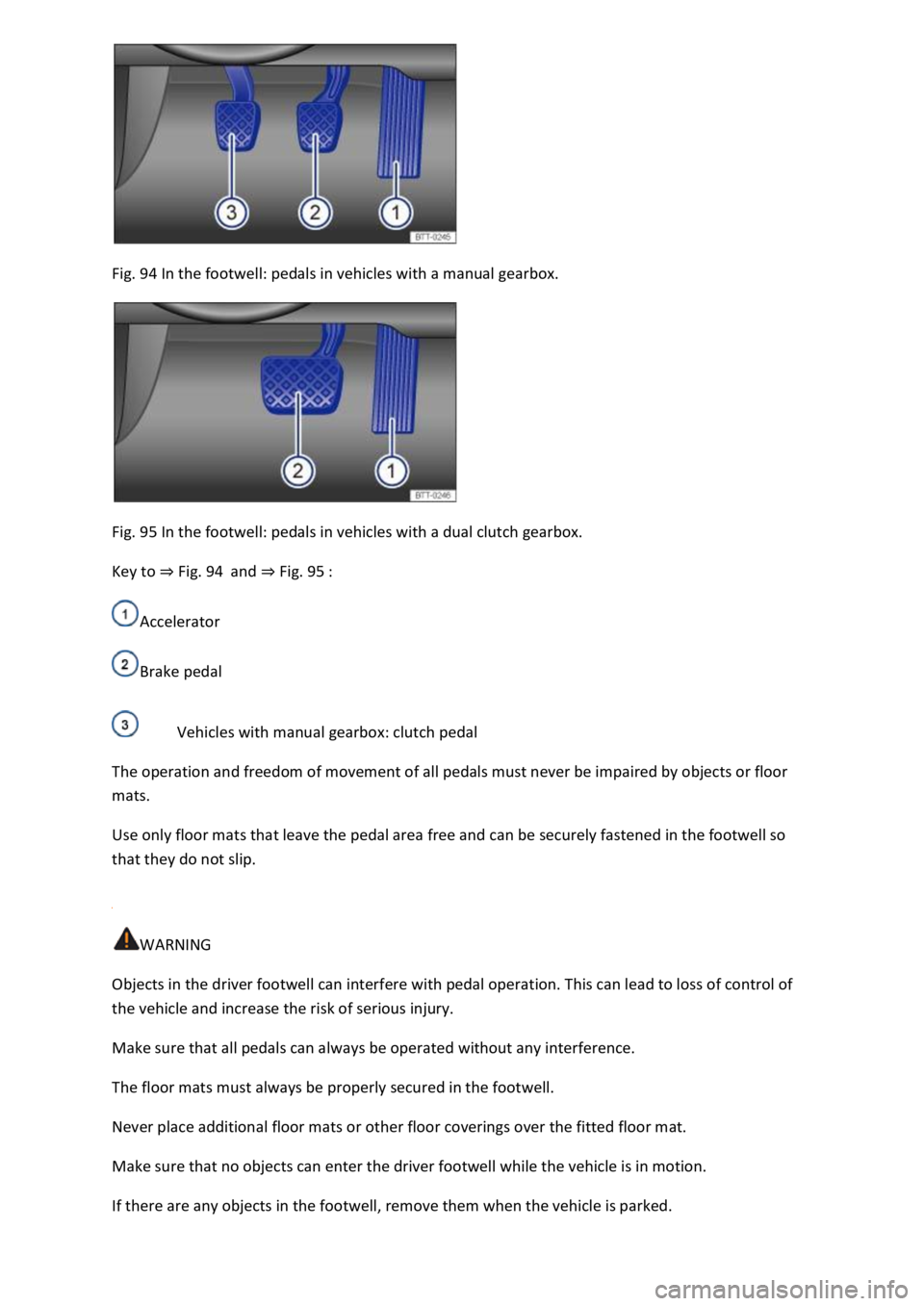
Fig. 94 In the footwell: pedals in vehicles with a manual gearbox.
Fig. 95 In the footwell: pedals in vehicles with a dual clutch gearbox.
Key to Fig. 94and Fig. 95
Accelerator
Brake pedal
Vehicles with manual gearbox: clutch pedal
The operation and freedom of movement of all pedals must never be impaired by objects or floor
mats.
Use only floor mats that leave the pedal area free and can be securely fastened in the footwell so
that they do not slip.
WARNING
Objects in the driver footwell can interfere with pedal operation. This can lead to loss of control of
the vehicle and increase the risk of serious injury.
Make sure that all pedals can always be operated without any interference.
The floor mats must always be properly secured in the footwell.
Never place additional floor mats or other floor coverings over the fitted floor mat.
Make sure that no objects can enter the driver footwell while the vehicle is in motion.
If there are any objects in the footwell, remove them when the vehicle is parked.
Page 184 of 502

Fig.
0
switched on.
Vehicles with a starter button: press the starter button once. The ignition is switched on.
Vehicles with a diesel engine: during the diesel engine preheating phase, the indicator lamp
lights up in the instrument cluster.
Depress and hold the brake pedal until the electronic parking brake has been switched off.
Vehicles with manual gearbox: fully depress the clutch pedal and hold it until the engine has
been started. Move the gear lever to neutral position.
Vehicles with DSG dual clutch gearbox: move the selector lever to position P or N.
Vehicles with ignition lock: turn the vehicle key to position Fig.
0do not depress the
accelerator.
Release the vehicle key once the engine has started.
Vehicles with a starter button: press the starter button Starter buttondo not depress the
accelerator. There must be a valid vehicle key in the vehicle before the engine can be started.
If the engine does not start immediately, switch off the starter and try again after about a minute.
Vehicles with starter button: perform an emergency start if necessary No valid vehicle key
recognised
Vehicles with starter button: the starter button is deactivated if the vehicle was locked with the
vehicle key. If you are in the vehicle and need to start the engine, unlock the vehicle first or perform
an emergency start No valid vehicle key recognised
Switch off the electronic parking brake if you wish to pull away.
WARNING
The risk of serious injury can be reduced with the engine running or when starting the engine.
Never start or run the engine in unventilated or enclosed spaces. The exhaust fumes contain carbon
monoxide, an odourless and colourless toxic gas. Carbon monoxide can cause people to lose
consciousness. It can also cause death.
Never start or run the engine if oil, fuel or any other highly flammable fluids are under or near the
vehicle, or are leaking out of the vehicle, e.g. as the result of damage.
Page 187 of 502

The brake servo will not work when the engine is switched off. More force is required on the brake
pedal to stop the vehicle.
If the vehicle key is removed from the ignition, the steering lock may activate and you will no longer
be able to steer the vehicle.
WARNING
The components of the exhaust system become very hot. This can cause fires and serious injuries.
Never park the vehicle so that parts of the exhaust system can come into contact with any
inflammable material underneath the vehicle, e.g. undergrowth, leaves, dry grass, spilt fuel etc.
Never apply additional underseal or anti-corrosion coatings to the exhaust pipes, catalytic
converters, heat shields or particulate filter.
NOTICE
If the vehicle has been driven at high load for a long period, the engine can overheat when it is
switched off. In order to avoid damage to the engine, allow the engine to run in neutral position for
approximately 2 minutes before switching it off.
After the engine is switched off, the radiator fan in the engine compartment may run on for some
minutes, even if the ignition is switched off or the vehicle key has been removed. The radiator fan
will switch itself off automatically.
Electronic immobiliser
The immobiliser helps to prevent the engine from being started and driven with an unauthorised
vehicle key.
There is a chip in the vehicle key. The immobiliser is automatically deactivated by this when a valid
vehicle key is inserted in the ignition lock.
The electronic immobiliser is automatically activated when the vehicle key is removed from the
ignition lock. In vehicles with Keyless Access, the vehicle key must be outside the vehicle.
The engine can be started only using a Volkswagen Genuine vehicle key with the correct code.
Coded vehicle keys are available from a Volkswagen dealership.
Problem-free operation of the vehicle is guaranteed only with Volkswagen Genuine vehicle keys.
Troubleshooting
Page 191 of 502

A minimum engine temperature has been reached.
Vehicles with Climatronic: the temperature of the vehicle interior is within the preset
temperature range, and the humidity level is not too high.
The defrost function of the air conditioning system is not switched on.
The charge level of the 12-volt vehicle battery is sufficient.
The temperature of the 12-volt vehicle battery is not too low or too high.
The vehicle is not on a steep uphill or downhill gradient.
Vehicles with DSG dual clutch gearbox: the steering wheel is not turned too sharply.
The windscreen heating is not switched on.
Reverse gear is not engaged.
Park Assist is not active.
When the conditions for automatic engine switch-off are fulfilled only during a stationary phase, the
engine can also switch off subsequently, e.g. after switching off the defrost function.
Conditions for an automatic restart
The engine can start automatically under the following conditions:
If the temperature inside the vehicle substantially increases or decreases.
If the vehicle starts rolling.
If the electrical voltage of the 12-volt vehicle battery drops.
If the steering wheel is moved.
As a general rule, the engine always starts again automatically when required by the detected
situation and for the vehicle.
Conditions that require a manual engine start
The engine must be started manually in the following conditions:
If the driver door is opened.
If the bonnet is opened.
Manually deactivating and activating the start/stop system
Press the button in the centre console Fig. 102to deactivate the system manually. If the
start/stop system has been deactivated, the indicator lamp in the button lights up.
Press the button in the centre console again Fig. 102to activate the system manually once
more.
Page 195 of 502

users are not put at risk due to the acceleration and driving style.
Always adjust your driving style in accordance with the flow of traffic.
When the TCS is switched off, the drive wheels may spin, especially if the road surface is wet,
slippery or dirty. This may result in you no longer being able to steer or control the vehicle.
WARNING
When the engine is running, the vehicle will start to move as soon as a gear is engaged and the
clutch is released. This also applies when the electronic parking brake has been switched on.
Never engage reverse gear while the vehicle is in motion.
WARNING
Shifting gears incorrectly to gears that are too low can lead to a loss of control over the vehicle, with
accidents and serious injuries as a consequence.
NOTICE
Serious damage to the clutch and gearbox could occur if the gear lever of the manual gearbox is
shifted to a gear which is too low when travelling at high speeds or at high engine speeds. This also
applies if the clutch remains depressed and the gears do not engage.
NOTICE
Please note the following points in order to avoid damage and premature wear:
Do not rest your hand on the gear lever when driving. The pressure from your hand is passed onto
the selector forks in the gearbox.
Ensure that the vehicle has come to a full stop before engaging reverse gear.
Always fully depress the clutch pedal when changing gear.
Do not hold the vehicle by riding the clutch on uphill gradients with the engine running.
Changing up a gear early will help to save fuel and minimise engine noise.
Troubleshooting
Clutch slipping
Page 199 of 502
WARNING
Unintentional vehicle movements can cause serious injury.
The driver must never leave the driver seat when the engine is running and a position has been
selected. If you have to leave the vehicle while the engine is running, always switch on the electronic
parking brake and move the selector lever to position P.
If the engine is running and the selector lever is in position D/S or R, the vehicle must be held by the
foot brake. The vehicle will creep forward even when the engine is idling, as power transmission is
even then not fully interrupted.
Never select reverse or selector lever position P when the vehicle is in motion.
Never leave the vehicle in selector lever position N. The vehicle will roll downhill irrespective of
whether or not the engine is running.
NOTICE
If the electronic parking brake is not switched on when the vehicle is stationary and the brake pedal
is released when the selector lever is in position P, the vehicle may move a few centimetres forwards
or backwards.
If the lever is moved accidentally to N when driving, take your foot off the accelerator. Wait for the
engine to reach idling speed in the neutral position before selecting a position again.
If the selector lever is left in any position other than P for long periods when the engine is switched
off, the 12-volt vehicle battery will discharge.
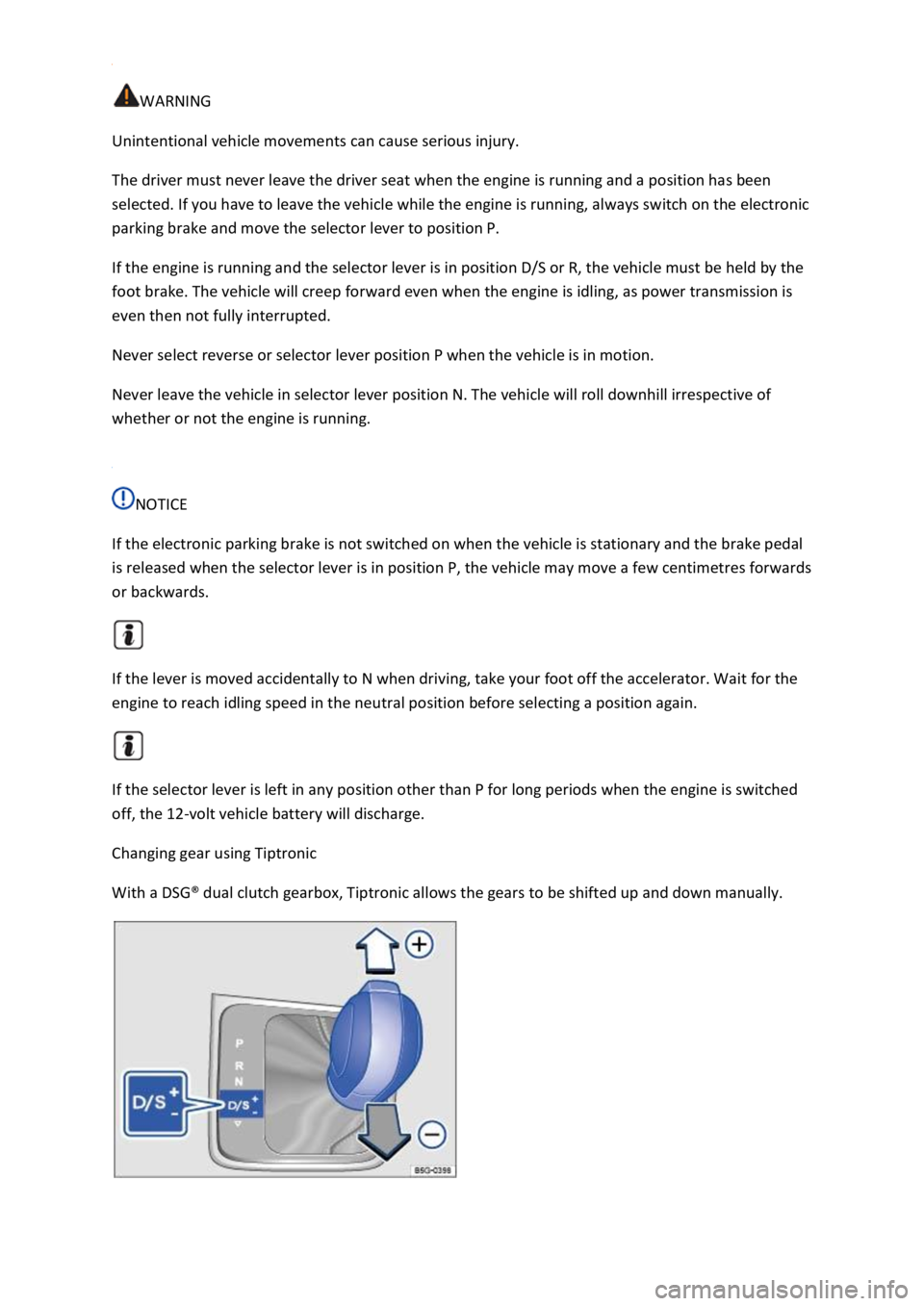
Changing gear using Tiptronic
With a DSG
Page 201 of 502

The steeper the gradient, the lower the gear you will need. Lower gears increase the braking effect
of the engine. Never allow the vehicle to roll down mountains or hills in the neutral position N.
Reduce your speed.
Push the selector lever from position D/S to the right into the Tiptronic gate Changing gear using
Tiptronic
Tap the selector lever to the rear to change down gear.
OR: shift down a gear using the paddles on the steering wheel Changing gear using Tiptronic
Stopping and pulling away on an uphill gradient
The steeper the uphill gradient, the lower the gear you will need.
If you wish to stop the vehicle or pull away when driving uphill, you should use the Auto Hold
function Electronic parking brake
When you stop the vehicle on an uphill gradient with a selected position, the vehicle must always be
prevented from rolling by depressing the brake pedal or by applying the electronic parking brake. Do
not release the brake pedal or switch off the electronic parking brake until you are about to pull
away.
Coasting with DSG