interior VOLKSWAGEN T-ROC 2022 Service Manual
[x] Cancel search | Manufacturer: VOLKSWAGEN, Model Year: 2022, Model line: T-ROC, Model: VOLKSWAGEN T-ROC 2022Pages: 502, PDF Size: 8.58 MB
Page 444 of 502

Remove any dirt with Volkswagen Genuine interior cleaning agent (- 000 096 301 -). Never treat
materials with leather care agents, solvents, wax polish, shoe cream, stain removers or similar
substances.
icles adhering to surfaces: remove with a vacuum cleaner on a regular basis so that the
material is not permanently damaged by abrasion.
- 000 096 301 -). Dab off
dissolved grease and colour particles with an absorbent cloth and then treat with water if necessary.
-
000 096 301 -) and use a mild soap solution1) if necessary.
Natural leather:
Remove fresh soiling with a cotton cloth and mild soap solution1). Do not allow fluids to seep into
the seams.
Treat any dried stains with Volkswagen Genuine leather cleaner (- 000 096 323 -).
Regularly and each time after having finished cleaning, apply care cream with light protection and
impregnating properties. Use a special coloured leather cream if necessary. If the vehicle is parked
outdoors for long periods, you should cover the leather to protect it from direct sunlight.
Never treat leather with solvents, wax polish, shoe cream, stain removers or similar.
-based soiling, e.g. oil: remove fresh stains with an absorbent cloth.
leather cleaner (- 000 096 323 -).
Plastic parts:
Use a soft, moist cloth.
If stubborn soiling cannot be removed with mild soap solution1), use a solvent-free plastic cleaning
agent if necessary, e.g. Volkswagen Genuine plastic cleaner (- 000 096 314 -).
Trim parts, trim strips made of chrome, aluminium or stainless steel:
Clean using a clean, soft cloth and a mild soap solution1) in a dust-free environment.
Anodised surfaces: do not use chrome cleaning products.
Controls:
Remove coarse dirt and other dirt that is difficult to reach using a soft brush. Then use a clean, soft
cloth and a mild soap solution1). Do not allow liquids to enter the controls.
Displays:
Use a Volkswagen Genuine cleaning cloth (- 000 096 166 A -) with a little water, a suitable glass
cleaner or LCD cleaner. Do not clean displays with a dry cloth.
Page 450 of 502

If a mobile phone or two-way radio is used without being connected to the external aerial, the
electromagnetic radiation will not be optimally directed to the outside of the vehicle. Increased
levels of radiation in the vehicle interior can occur in particular in the event of poor reception, e.g. in
rural areas. This can pose a health risk
With some equipment levels, a suitable mobile phone interface may be used to connect the mobile
telephone to the external aerial Infotainment system,. The connection quality is improved
and the range is increased.
Using the telephone
Many countries require a hands-free system to be used when using a telephone inside the vehicle,
e.g. via a Bluetooth
Page 453 of 502

e.g. temperature, rain.
As well as performing the actual control functions, these data are also used to detect and rectify
faults and help Volkswagen to improve vehicle functions. The majority of these data are temporary
and are only processed within the vehicle itself. Only a very small amount of data is stored in the
event memories or possibly on the vehicle key.
Reading out the vehicle's event memory
There is a diagnostic interface in the vehicle interior for reading out the event memories (on-board
diagnosis)
If you have service work performed on your vehicle, the technical data can be read out of the vehicle
together with the vehicle identification number by service employees, e.g. workshops, or third
parties such as breakdown services. Service work includes, for example, repairs, maintenance,
warranty work or quality assurance measures. The service workshop or third party collects,
processes and uses the data. The data document the vehicle's technical status, help in
troubleshooting and in improving quality and may be sent to Volkswagen in some cases.
Furthermore, the manufacturer is subject to legal product safety requirements. To make sure it
complies with these requirements, the manufacturer requires technical data from the vehicles.
Event memories in the vehicle can be reset by a service workshop as part of repair or service work.
The event memory should be read out and reset only by a qualified workshop. Additional
information on the stored data is available from the qualified workshop.
After a fault has been rectified, the information in the memory relating to the fault is deleted. Other
memory content is overwritten on an ongoing basis.
Event data recorder
This vehicle is equipped with an event data recorder. The main task of an event data recorder is to
record data in particular accident scenarios or accident-like situations, e.g. in the event of airbags
being triggered or a collision with an obstacle on the road. These data help in analysis of how a
vehicle system behaved in these situations. The event data recorder records data relating to driving
dynamics and the restraint system for a short period of 10 seconds or less. This information includes,
for example:
of the driver and front passenger were fastened.
These data help to obtain a better understanding of the circumstances in the situations where
accidents and injuries have occurred.
Data from driver assist systems are also recorded. In addition to information about whether the
systems were switched on or off, available only to a restricted extent or inactive, it is also possible to
determine whether these functions steered, accelerated or braked the vehicle in the above-
described situations. Depending on the vehicle equipment, these systems include the following:
Page 454 of 502

Assist).
Park Distance Control.
The data of the event data recorder are recorded only if a particular accident-like situation occurs.
No recordings occur under normal driving conditions. Audio or video data from the vehicle interior
or vehicle surroundings are not stored. Personal data such as name, gender, age or accident location
are also not recorded at any time. However, third parties such as law enforcement agencies can use
corresponding means to link the content of the event data recorder with other sources of data and
thus establish a reference to persons as part of an accident investigation.
Special equipment, access to the legally prescribed diagnostic interface (on-board diagnosis) and
switched-on ignition are required in order to read data out of the event data recorder.
Volkswagen will not access, read out or process data from the event data recorder unless the vehicle
owner (or lessee in the case of leasing) grants their permission. Exceptions to this are contractual or
legal provisions.
Due to its legal product monitoring obligations, Volkswagen is entitled to use the data for field
monitoring and also for research purposes and quality improvements. For research purposes,
Volkswagen makes the data available to third parties in anonymous form, in other words without
any reference to the individual vehicle, vehicle owner or lessee.
Reprogramming control units
All data for the control of components are stored in the control units. Some convenience functions,
such as convenience turn signal, single door unlocking and displays, can be reprogrammed using
special workshop equipment. If the convenience functions are reprogrammed, the specifications and
descriptions in this owner's manual will no longer match the original functions. Volkswagen
recommends having any reprogramming entered into the digital service schedule by a Volkswagen
dealership or qualified workshop.
Information about possible reprogramming can be obtained from the Volkswagen dealership.
Convenience and Infotainment functions
Depending on the equipment selected, you can store your own data in the vehicle's Infotainment
functions. This includes, for example:
data for use with a hands-free system or navigation system.
These data can be stored locally in the vehicle or located on a device that you have connected to the
vehicle, e.g. mobile device, USB stick or MP3 player. If these data are stored in the vehicle, you can
Page 458 of 502

Aerials on the interior of the windows can be identified by thin wires.
NOTICE
Aerials located on the inside of the windows could be damaged by corrosive or acidic substances or
if hard objects rub against the window.
NOTICE
A retrofitted Infotainment system must be compatible with the aerial amplifier fitted as standard in
the vehicle. The aerial amplifier could otherwise be damaged.
Component protection
Some electronic components and control units are fitted with component protection as standard,
e.g. the Infotainment system.
The component protection allows legitimate installation and replacement of components and
control units by a qualified workshop.
The component protection prevents the factory-supplied components from being operated without
restrictions outside the vehicle in the following situations:
When component protection is activated, the message SAFE CP is shown on the instrument cluster
display. Go to a qualified workshop.
Go to a qualified workshop if the message Component theft protection: Infotainment system
availability currently limited. Please switch on the ignition. is displayed in the Infotainment system
and component protection cannot be deactivated.
Information in accordance with the EU Chemicals Regulation REACH
In accordance with the European regulations on chemicals, known as REACH, Volkswagen would like
to inform you about the materials that may be found in your vehicle.
You can access this information online using your vehicle identification number Technical data
https://reachinfo.volkswagen.com
Declaration of conformity
Page 460 of 502

ering in the rear of the vehicle interior because there is
no rear bench seat
Vehicles with four seats: the centre seat on the rear bench seat cannot be used
Transporting children safely
As with vehicles with passenger car approval (M1), approved child restraint systems can be used on
the seats Safe transport of children
Towing a trailer
If the vehicle is approved for towing a trailer, observe any local regulations for driving with a trailer
and using a towing bracket.
If the vehicle exceeds the gross vehicle weight rating or the rear axle load, do not exceed 80 km/h
when towing a trailer. This also applies to countries where higher speeds are permitted. Keep to
country-specific speed limits which may be lower for vehicles with trailers than for vehicles without
trailers.
The vehicle documents contain details of permitted excess loads. If no excess loads are shown, the
vehicle can be driven at 100 km/h, taking account of the laws which apply in different countries.
Technical data
Please refer to the vehicle documentation for technical data.
WARNING
Risk of injury and electric shock from exposed cables.
vehicle are covered up when using the vehicle.
WARNING
Risk of serious injuries due to transporting passengers incorrectly.
ms such as seat
belts and head restraints.
WARNING
Risk of serious and fatal injuries.
Page 488 of 502

214 Vehicle identification number.
Vehicle data sticker
The vehicle data sticker Fig. 213 is located on the cover of the owner's manual and under the
rear luggage compartment trim on the luggage compartment wall. It contains the following data:
Vehicle identification number (chassis number)
Vehicle type, engine power, gearbox type
Engine and gearbox codes, paint number, interior equipment. In the example, the engine code
is CPTA Fig. 213
Additional equipment, PR numbers
Type plate
The type plate Fig. 213can be seen on the lower part of the door pillar when the driver door is
open. Vehicles for certain export countries do not have a type plate.
The type plate contains the following data:
Approval
Gross vehicle weight rating
Gross combination weight rating (vehicle plus trailer)
Gross front axle weight rating
Gross rear axle weight rating
Vehicle identification number (VIN)
The vehicle identification number can be read from outside the vehicle through a viewer in the
windscreen Fig. 214(arrow). The viewer is located in the lower corner of the windscreen. The
vehicle identification number is also stamped on the right-hand water drainage channel. The water
drainage channel is located between the suspension turret and wing. Open the bonnet to gain
access to the vehicle identification number In the engine compartment
The vehicle identification number can be displayed in the Infotainment system using the button
and the and Service function buttons Infotainment system controls and displays
Vehicle data
Page 489 of 502
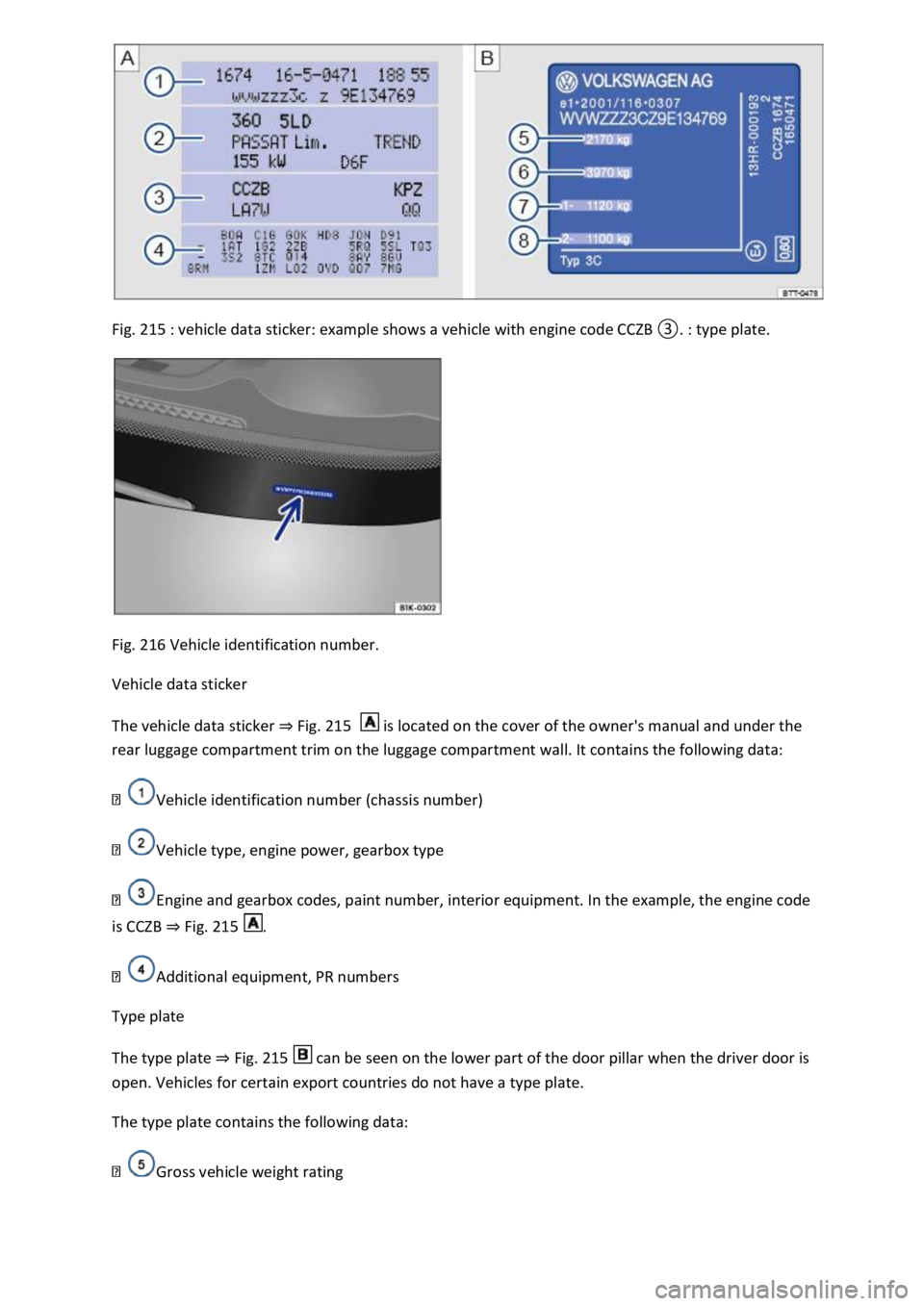
Fig. 215
Fig. 216 Vehicle identification number.
Vehicle data sticker
The vehicle data sticker Fig. 215 is located on the cover of the owner's manual and under the
rear luggage compartment trim on the luggage compartment wall. It contains the following data:
Vehicle identification number (chassis number)
Vehicle type, engine power, gearbox type
Engine and gearbox codes, paint number, interior equipment. In the example, the engine code
is CCZB Fig. 215
Additional equipment, PR numbers
Type plate
The type plate Fig. 215can be seen on the lower part of the door pillar when the driver door is
open. Vehicles for certain export countries do not have a type plate.
The type plate contains the following data:
Gross vehicle weight rating