engine VOLKSWAGEN TIGUAN 2017 Owner´s Manual
[x] Cancel search | Manufacturer: VOLKSWAGEN, Model Year: 2017, Model line: TIGUAN, Model: VOLKSWAGEN TIGUAN 2017Pages: 341, PDF Size: 9.14 MB
Page 240 of 341
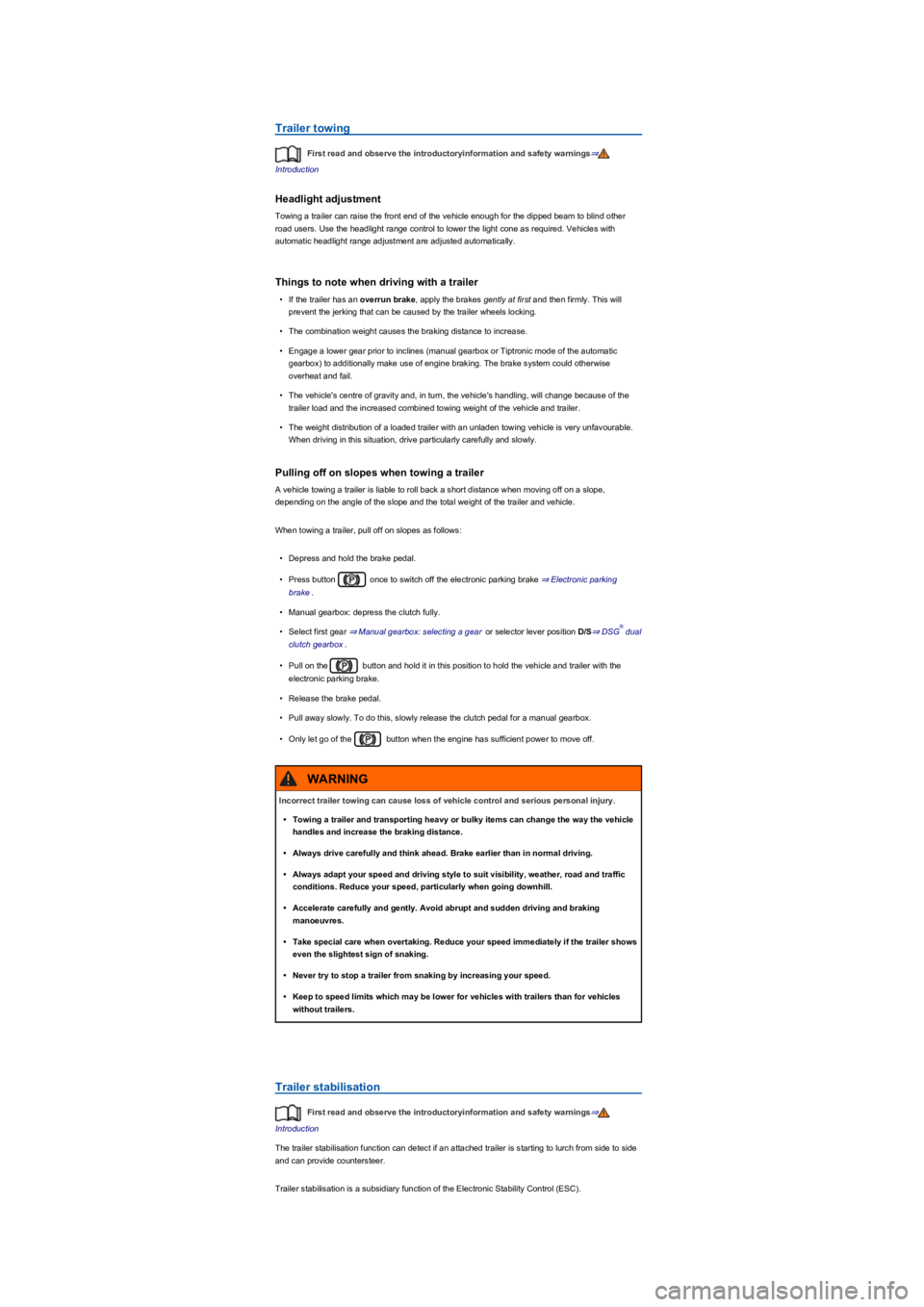
Trailer towing
First read and observe the introductoryinformation and safety warnings⇒
Introduction
Headlight adjustment
Towing a trailer can raise the front end of the vehicle enough for the dipped beam to blind other
road users. Use the headlight range control to lower the light cone as required. Vehicles with
automatic headlight range adjustment are adjusted automatically.
Things to note when driving with a trailer
•If the trailer has an overrun brake, apply the brakes gently at first and then firmly. This will
prevent the jerking that can be caused by the trailer wheels locking.
•The combination weight causes the braking distance to increase.
•Engage a lower gear prior to inclines (manual gearbox or Tiptronic mode of the automatic
gearbox) to additionally make use of engine braking. The brake system could otherwise
overheat and fail.
•The vehicle's centre of gravity and, in turn, the vehicle's handling, will change because of the
trailer load and the increased combined towing weight of the vehicle and trailer.
•The weight distribution of a loaded trailer with an unladen towing vehicle is very unfavourable.
When driving in this situation, drive particularly carefully and slowly.
Pulling off on slopes when towing a trailer
A vehicle towing a trailer is liable to roll back a short distance when moving off on a slope,
depending on the angle of the slope and the total weight of the trailer and vehicle.
When towing a trailer, pull off on slopes as follows:
•Depress and hold the brake pedal.
•Press button once to switch off the electronic parking brake ⇒ Electronic parking
brake.
•Manual gearbox: depress the clutch fully.
•Select first gear ⇒ Manual gearbox: selecting a gear or selector lever position D/S⇒ DSG dual
clutch gearbox.
•Pull on the button and hold it in this position to hold the vehicle and trailer with the
electronic parking brake.
•Release the brake pedal.
•Pull away slowly. To do this, slowly release the clutch pedal for a manual gearbox.
•Only let go of the button when the engine has sufficient power to move off.
Trailer stabilisation
First read and observe the introductoryinformation and safety warnings⇒
Introduction
The trailer stabilisation function can detect if an attached trailer is starting to lurch from side to side
and can provide countersteer.
Trailer stabilisation is a subsidiary function of the Electronic Stability Control (ESC).
®
Incorrect trailer towing can cause loss of vehicle control and serious personal injury.
•Towing a trailer and transporting heavy or bulky items can change the way the vehicle
handles and increase the braking distance.
•Always drive carefully and think ahead. Brake earlier than in normal driving.
•Always adapt your speed and driving style to suit visibility, weather, road and traffic
conditions. Reduce your speed, particularly when going downhill.
•Accelerate carefully and gently. Avoid abrupt and sudden driving and braking
manoeuvres.
•Take special care when overtaking. Reduce your speed immediately if the trailer shows
even the slightest sign of snaking.
•Never try to stop a trailer from snaking by increasing your speed.
•Keep to speed limits which may be lower for vehicles with trailers than for vehicles
without trailers.
WARNING
Page 243 of 341
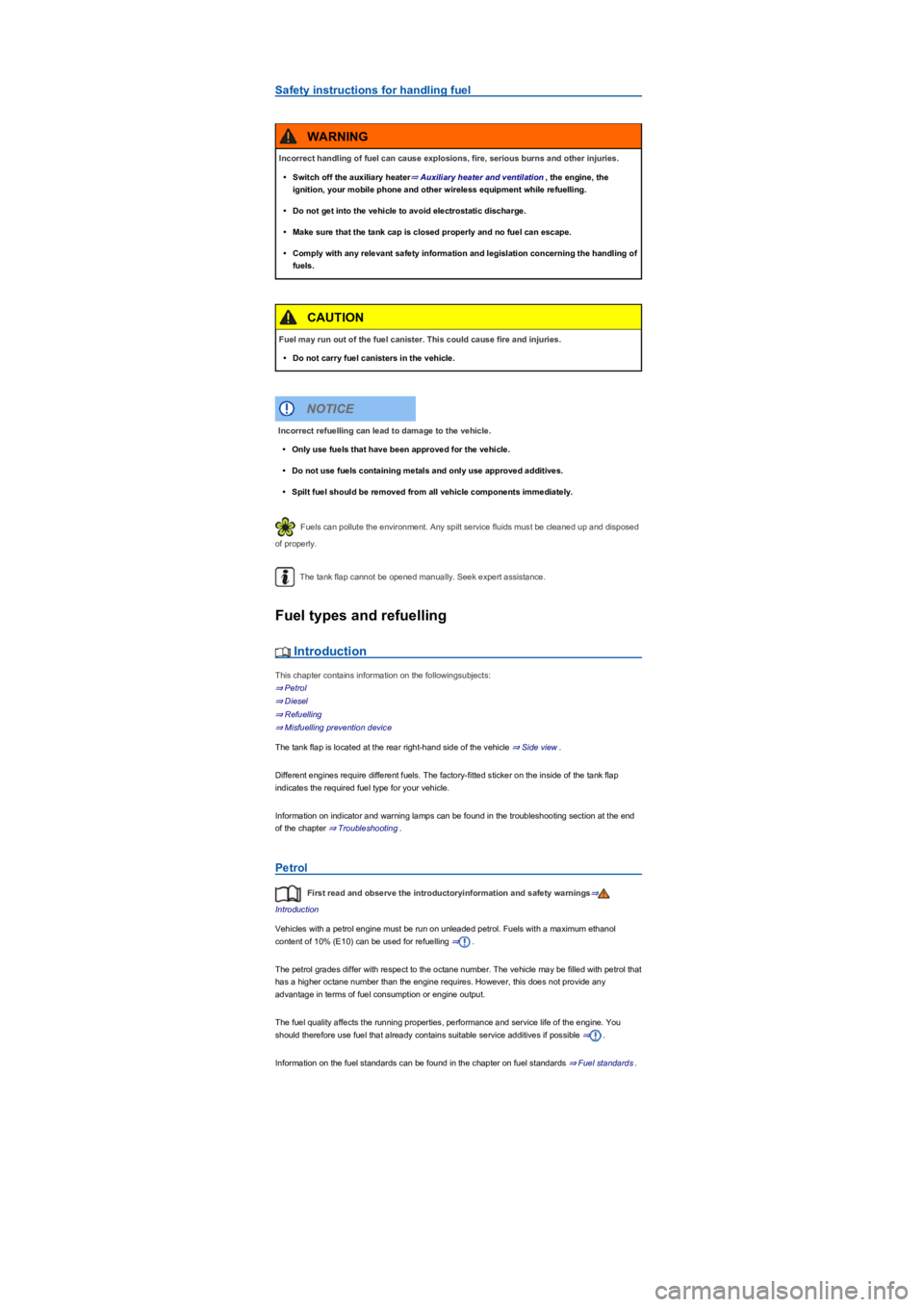
Safety instructions for handling fuel
Fuels can pollute the environment. Any spilt service fluids must be cleaned up and disposed
of properly.
The tank flap cannot be opened manually. Seek expert assistance.
Fuel types and refuelling
Introduction
This chapter contains information on the followingsubjects:
⇒ Petrol
⇒ Diesel
⇒ Refuelling
⇒ Misfuelling prevention device
The tank flap is located at the rear right-hand side of the vehicle ⇒ Side view.
Different engines require different fuels. The factory-fitted sticker on the inside of the tank flap
indicates the required fuel type for your vehicle.
Information on indicator and warning lamps can be found in the troubleshooting section at the end
of the chapter ⇒ Troubleshooting.
Petrol
First read and observe the introductoryinformation and safety warnings⇒
Introduction
Vehicles with a petrol engine must be run on unleaded petrol. Fuels with a maximum ethanol
content of 10% (E10) can be used for refuelling ⇒.
The petrol grades differ with respect to the octane number. The vehicle may be filled with petrol that
has a higher octane number than the engine requires. However, this does not provide any
advantage in terms of fuel consumption or engine output.
The fuel quality affects the running properties, performance and service life of the engine. You
should therefore use fuel that already contains suitable service additives if possible ⇒.
Information on the fuel standards can be found in the chapter on fuel standards ⇒ Fuel standards.
Incorrect handling of fuel can cause explosions, fire, serious burns and other injuries.
•Switch off the auxiliary heater⇒ Auxiliary heater and ventilation, the engine, the
ignition, your mobile phone and other wireless equipment while refuelling.
•Do not get into the vehicle to avoid electrostatic discharge.
•Make sure that the tank cap is closed properly and no fuel can escape.
•Comply with any relevant safety information and legislation concerning the handling of
fuels.
WARNING
Fuel may run out of the fuel canister. This could cause fire and injuries.
•Do not carry fuel canisters in the vehicle.
CAUTION
Incorrect refuelling can lead to damage to the vehicle.
•Only use fuels that have been approved for the vehicle.
•Do not use fuels containing metals and only use approved additives.
•Spilt fuel should be removed from all vehicle components immediately.
NOTICE
Page 244 of 341
Diesel
First read and observe the introductoryinformation and safety warnings⇒
Introduction
Vehicles with a diesel engine must be run on diesel ⇒. If you use diesel with a high sulphur
content, the service intervals are shorter ⇒ Service. Information on countries that use diesel with a
high sulphur content is available from your Volkswagen dealership.
The fuel quality affects the running properties, performance and service life of the engine. You
should therefore use fuel that already contains suitable service additives if possible ⇒.
Information on the fuel standards can be found in the chapter on fuel standards ⇒ Fuel standards.
Winter-grade diesel fuel and filter preheater system
Winter-grade diesel fuel, which can be used at temperatures below -20°C (-4°F), is available during
the cold months. In countries with different climates, diesel for other temperature conditions is
usually available. Information is available from your Volkswagen dealership and filling stations in
the respective country.
Diesel vehicles are equipped with a filter pre-heater system. When using winter-grade diesel fuel,
the fuel system is safe for operation at temperatures down to around -24°C (-11°F).
However, if the fuel has waxed to such an extent that the engine will not start at temperatures
below -24°C (-11°F), place the vehicle in a heated garage or workshop for a while ⇒.
At cold temperatures, louder noises may occur in the diesel engine and the exhaust gas may
be tinged blue.
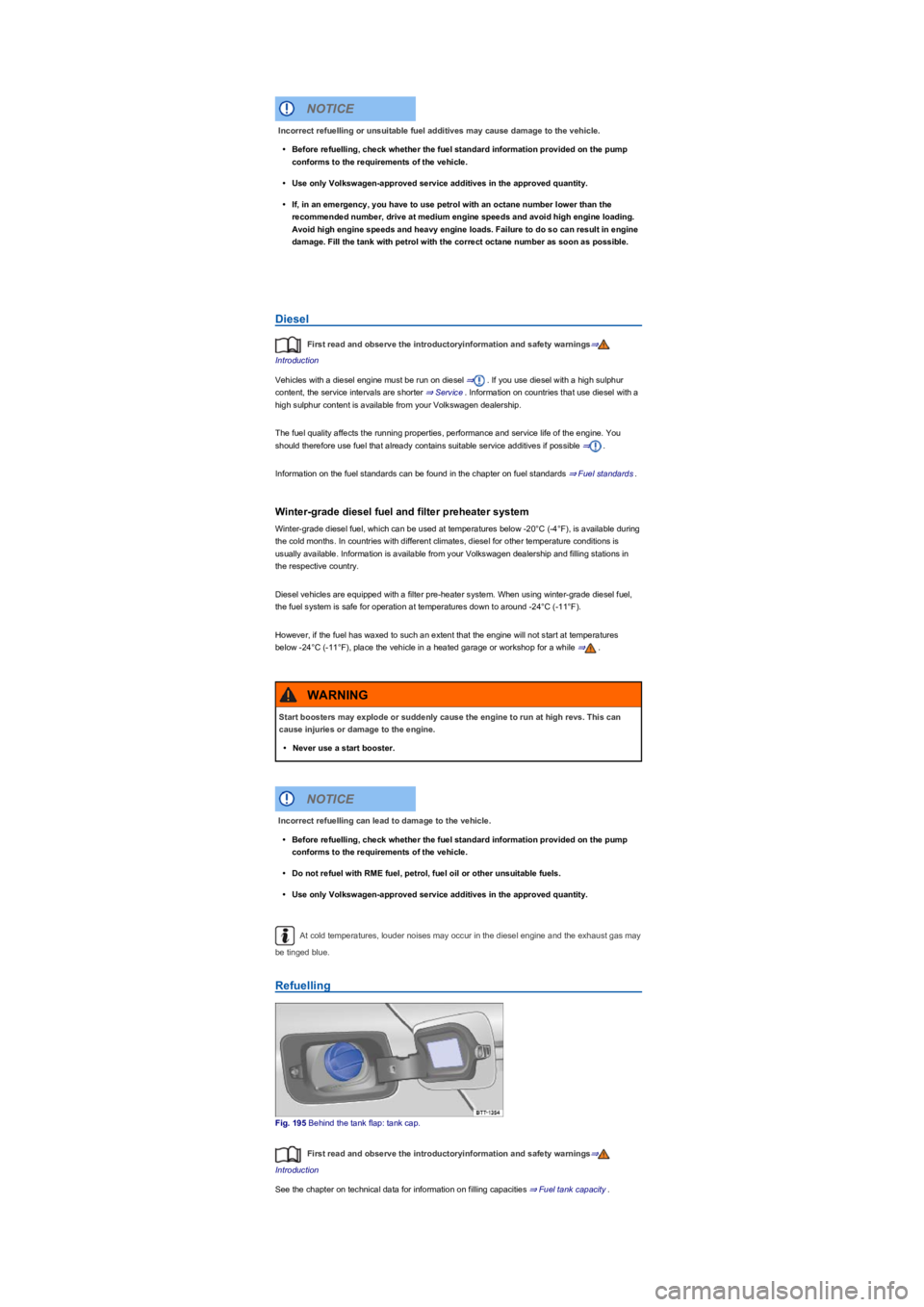
Refuelling
Fig. 195 Behind the tank flap: tank cap.
First read and observe the introductoryinformation and safety warnings⇒
Introduction
See the chapter on technical data for information on filling capacities ⇒ Fuel tank capacity.
Incorrect refuelling or unsuitable fuel additives may cause damage to the vehicle.
•Before refuelling, check whether the fuel standard information provided on the pump
conforms to the requirements of the vehicle.
•Use only Volkswagen-approved service additives in the approved quantity.
•If, in an emergency, you have to use petrol with an octane number lower than the
recommended number, drive at medium engine speeds and avoid high engine loading.
Avoid high engine speeds and heavy engine loads. Failure to do so can result in engine
damage. Fill the tank with petrol with the correct octane number as soon as possible.
NOTICE
Start boosters may explode or suddenly cause the engine to run at high revs. This can
cause injuries or damage to the engine.
•Never use a start booster.
WARNING
Incorrect refuelling can lead to damage to the vehicle.
•Before refuelling, check whether the fuel standard information provided on the pump
conforms to the requirements of the vehicle.
•Do not refuel with RME fuel, petrol, fuel oil or other unsuitable fuels.
•Use only Volkswagen-approved service additives in the approved quantity.
NOTICE
Page 245 of 341
Refuelling process
•Unlock the tank flap with the vehicle key or the button in the driver door.
•Open the tank flap.
•Unscrew the tank cap and place it in the holder on the tank flap.
•The fuel tank is full when the properly operated automatic filler nozzle clicks off for the first time
⇒.
•Screw the tank cap onto the filler neck.
•Close the tank flap.
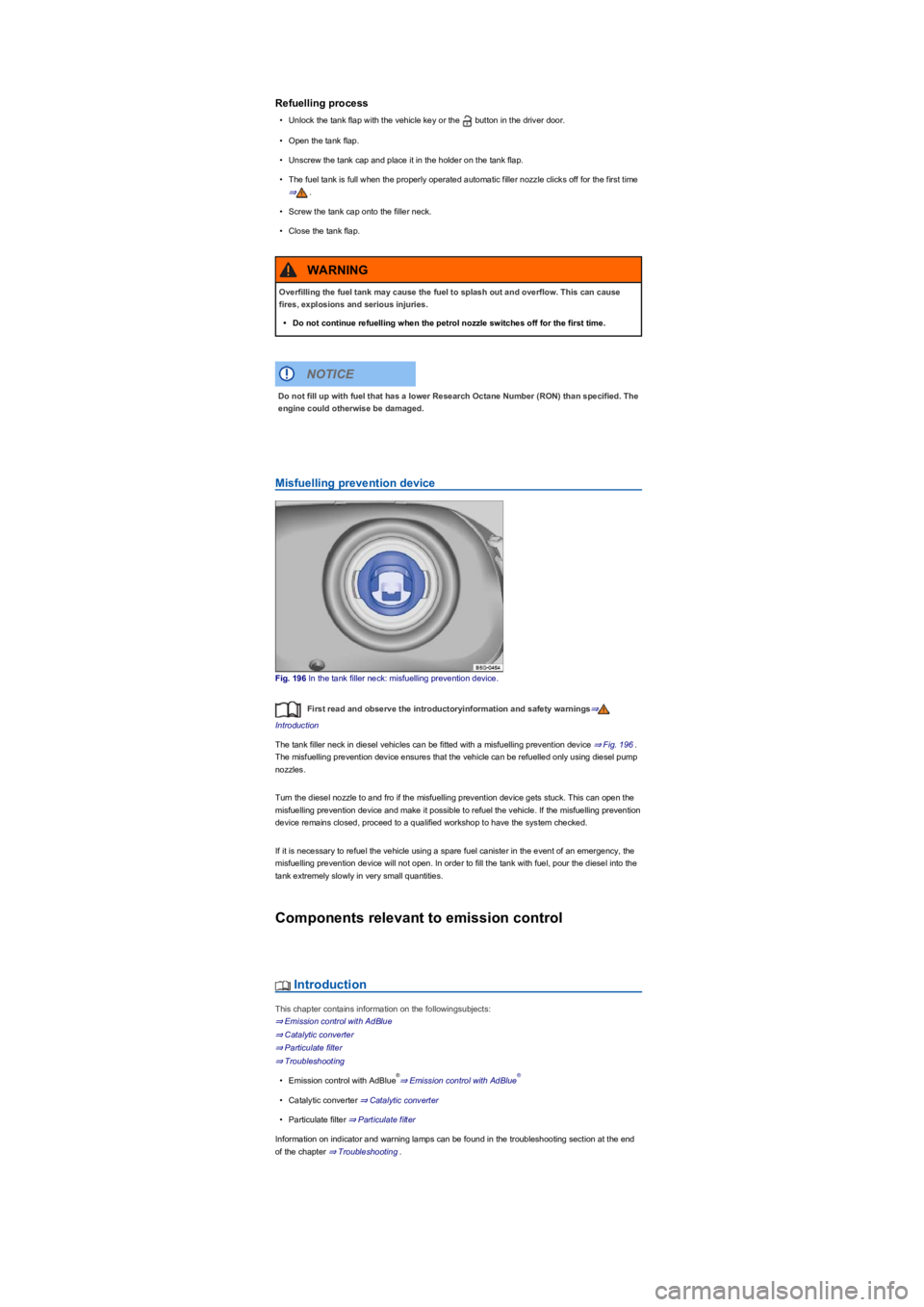
Misfuelling prevention device
Fig. 196 In the tank filler neck: misfuelling prevention device.
First read and observe the introductoryinformation and safety warnings⇒
Introduction
The tank filler neck in diesel vehicles can be fitted with a misfuelling prevention device ⇒ Fig. 196.
The misfuelling prevention device ensures that the vehicle can be refuelled only using diesel pump
nozzles.
Turn the diesel nozzle to and fro if the misfuelling prevention device gets stuck. This can open the
misfuelling prevention device and make it possible to refuel the vehicle. If the misfuelling prevention
device remains closed, proceed to a qualified workshop to have the system checked.
If it is necessary to refuel the vehicle using a spare fuel canister in the event of an emergency, the
misfuelling prevention device will not open. In order to fill the tank with fuel, pour the diesel into the
tank extremely slowly in very small quantities.
Components relevant to emission control
Introduction
This chapter contains information on the followingsubjects:
⇒ Emission control with AdBlue
⇒ Catalytic converter
⇒ Particulate filter
⇒ Troubleshooting
•Emission control with AdBlue⇒ Emission control with AdBlue
•Catalytic converter ⇒ Catalytic converter
•Particulate filter ⇒ Particulate filter
Information on indicator and warning lamps can be found in the troubleshooting section at the end
of the chapter ⇒ Troubleshooting.
Overfilling the fuel tank may cause the fuel to splash out and overflow. This can cause
fires, explosions and serious injuries.
•Do not continue refuelling when the petrol nozzle switches off for the first time.
WARNING
Do not fill up with fuel that has a lower Research Octane Number (RON) than specified. The
engine could otherwise be damaged.
NOTICE
®®
Page 246 of 341
Emission control with AdBlue
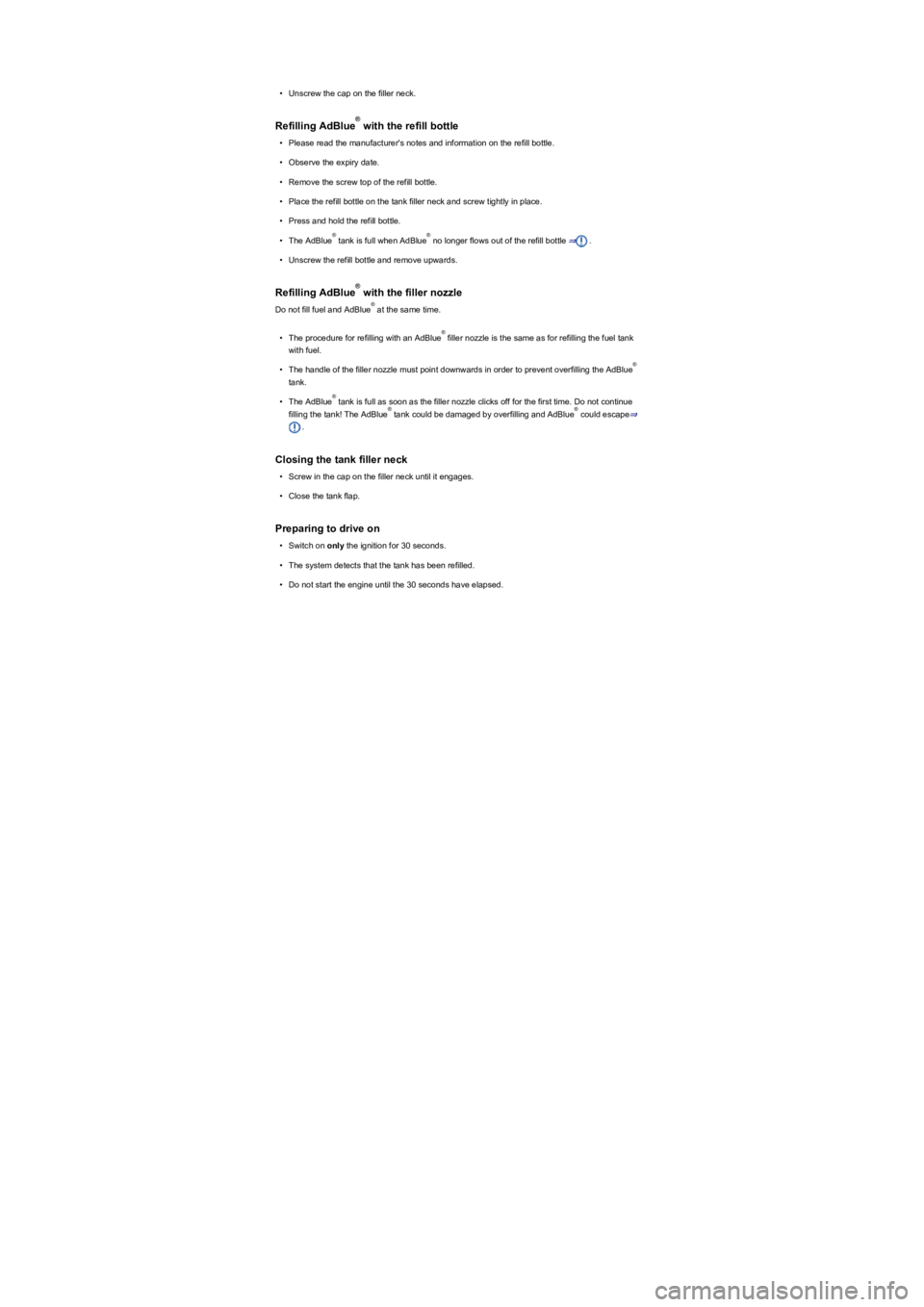
Fig. 197 Behind the tank flap: tank cap for AdBlue.
Fig. 198 Behind the tank flap: refilling AdBlue with the refill bottle or nozzle.
First read and observe the introductoryinformation and safety warnings⇒
Introduction
Key for ⇒ Fig. 197 and ⇒ Fig. 198:
Tank filler neck cap.
Refill bottle.
Filler nozzle.
AdBlue is a registered trademark and is also known as AUS32 or DEF (Diesel Exhaust Fluid).
The AdBlue consumption figures depend on the driving style, the operating temperature and the
ambient temperature. The remaining range and refill quantity can be checked on the instrument
cluster display.
The AdBlue tank must never run empty. As of a remaining distance of approximately 2,400 km,
the instrument cluster display will indicate that the AdBlue must be refilled ⇒ Troubleshooting.
Preparing to refill
•Stop vehicle on a level surface.
•Switch off the ignition.
•Only use AdBlue that complies with the standard ISO 22241-1 ⇒.
Opening the tank filler neck
•Open the tank flap.
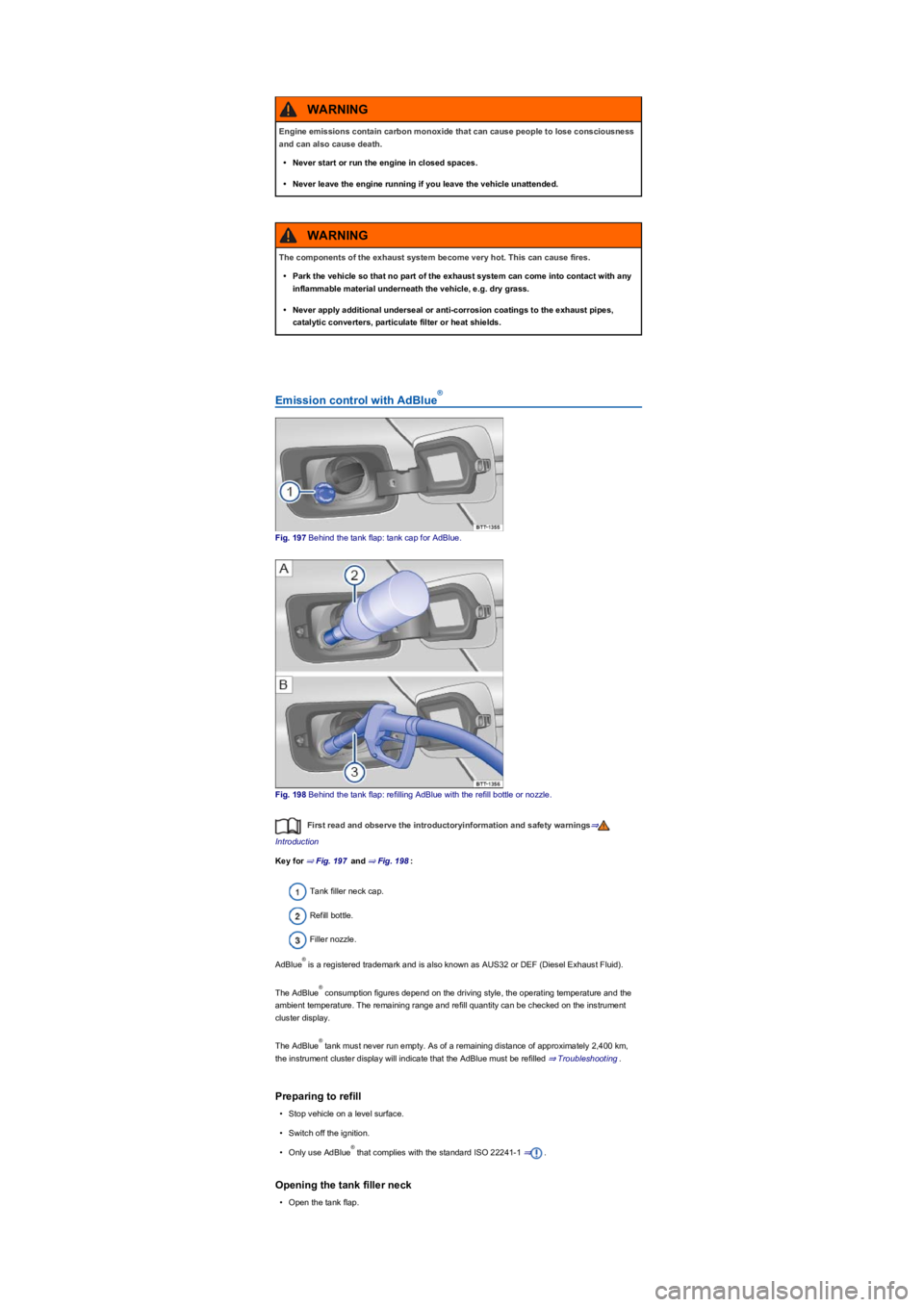
Engine emissions contain carbon monoxide that can cause people to lose consciousness
and can also cause death.
•Never start or run the engine in closed spaces.
•Never leave the engine running if you leave the vehicle unattended.
WARNING
The components of the exhaust system become very hot. This can cause fires.
•Park the vehicle so that no part of the exhaust system can come into contact with any
inflammable material underneath the vehicle, e.g. dry grass.
•Never apply additional underseal or anti-corrosion coatings to the exhaust pipes,
catalytic converters, particulate filter or heat shields.
WARNING
®
®
®
®
®
Page 247 of 341
•Unscrew the cap on the filler neck.
Refilling AdBlue with the refill bottle
•Please read the manufacturer's notes and information on the refill bottle.
•Observe the expiry date.
•Remove the screw top of the refill bottle.
•Place the refill bottle on the tank filler neck and screw tightly in place.
•Press and hold the refill bottle.
•The AdBlue tank is full when AdBlue no longer flows out of the refill bottle ⇒.
•Unscrew the refill bottle and remove upwards.
Refilling AdBlue with the filler nozzle
Do not fill fuel and AdBlue at the same time.
•The procedure for refilling with an AdBlue filler nozzle is the same as for refilling the fuel tank
with fuel.
•The handle of the filler nozzle must point downwards in order to prevent overfilling the AdBlue
tank.
•The AdBlue tank is full as soon as the filler nozzle clicks off for the first time. Do not continue
filling the tank! The AdBlue tank could be damaged by overfilling and AdBlue could escape⇒
.
Closing the tank filler neck
•Screw in the cap on the filler neck until it engages.
•Close the tank flap.
Preparing to drive on
•Switch on only the ignition for 30 seconds.
•The system detects that the tank has been refilled.
•Do not start the engine until the 30 seconds have elapsed.
®
®®
®
®
®
®
®
®®
Page 248 of 341
The refill bottle must be disposed of in accordance with regulations governing the protection
of the environment.
Catalytic converter
First read and observe the introductoryinformation and safety warnings⇒
Introduction
To help ensure long-term functionality in the exhaust system and the catalytic converter:
•Use unleaded petrol only ⇒ Fuel types and refuelling.
•Do not allow the fuel tank to run completely empty.
•Do not overfill engine oil ⇒ Engine oil.
•Do not tow start the vehicle. Use jump leads ⇒ Jump starting.
If you notice misfiring, uneven running or loss of power when the vehicle is moving, reduce speed
immediately. The vehicle should be inspected at the nearest qualified workshop
⇒ Troubleshooting. If this happens, unburnt fuel can enter the exhaust system and escape into the
atmosphere. The catalytic converter can also be damaged by overheating.
The emissions may have a sulphur-like smell even if the emission purification system is
working properly.
Particulate filter
First read and observe the introductoryinformation and safety warnings⇒
Introduction
Function
The particulate filter filters out soot particles in the exhaust gas. Observe the following points to
ensure that the exhaust purification system will work properly for a long time:
AdBlue is an irritant and corrosive fluid that can damage the skin, eyes and breathing
passages upon contact.
•Always observe the instructions for use when using AdBlue. If containers are used
according to the instructions, it is unlikely that a user will come into contact with
AdBlue.
•AdBlue must be kept in the closed original container. Never use empty food
containers, bottles or other containers for this purpose.
•Always store in a safe place out of reach of children.
•If AdBlue gets into the eyes, immediately rinse the eyes with plenty of water for at
least 15 minutes and consult a doctor.
•If AdBlue gets onto the skin, immediately wash the area with plenty of water for at
least 15 minutes and consult a doctor if the skin becomes irritated.
•If AdBlue is swallowed, immediately rinse the mouth out with lots of water for at least
15 minutes. Do not induce vomiting unless instructed to do so by a doctor. Seek
medical assistance immediately.
CAUTION
®
®
®
®
®
®
®
Overfilling AdBlue may damage the tank system and the vehicle.
•Do not fill with more than the maximum refill quantity indicated on the instrument
cluster display.
•Remove any spilt AdBlue as quickly as possible with a damp cloth and plenty of cold
water.
•If the AdBlue has already formed crystals, use warm water and a sponge to remove.
NOTICE
®
®
®
Improper use of AdBlue may cause damage to the vehicle that is not covered by the
warranty.
•Only use AdBlue that complies with the standard ISO 22241-1.
•Do not mix with water, fuel or additives.
•Never fill AdBlue in the diesel tank.
•Do not transport the refill bottle in the vehicle habitually. The bottle may develop a leak
following changes in temperature and damage and the AdBlue may damage the
vehicle interior.
NOTICE
®
®
®
®
Page 249 of 341
•Only refuel with fuels that are suitable for the vehicle ⇒ Fuel types and refuelling.
•Do not allow the fuel tank to run completely empty.
•Use only suitable engine oil for the vehicle and do not overfill ⇒ Engine oil.
•Do not tow start the vehicle. Use jump leads ⇒ Jump starting.
Periodic regeneration
The soot in the particulate filter is burnt off at high temperatures on a periodic basis.
To assist the regeneration of the particulate filter, Volkswagen recommends that you avoid making
only short journeys.
Noises, slight smells and increased engine speeds may occur during regeneration. The radiator fan
may run on while the vehicle is moving or when the engine has been switched off.
During the periodic regeneration process, the yellow indicator lamp does not light
up.
Troubleshooting
First read and observe the introductoryinformation and safety warnings⇒
Introduction
Irregular engine running and malfunctions
If the engine shows signs of irregular running or malfunctions while you are driving, this may mean
that the fuel is of poor quality. Reduce speed immediately. Drive to nearest qualified workshop at
medium engine speeds and low loads on the engine.
If these symptoms occur directly after refuelling, switch off the engine immediately to avoid any
subsequent damage. You should obtain professional assistance.
Warning and indicator lamps
Lights up together with the red warning lamp : fault in the selective catalytic reduction
system. The engine cannot be restarted! Drive straight to a qualified workshop without switching
off the engine and have the system checked ⇒.AdBlue level too low. The engine cannot
be restarted! Switch off the vehicle and refill the AdBlue minimum quantity according to
⇒ Emission control with AdBlue⇒.Lights up together with the yellow warning lamp
: the selective catalytic reduction system is faulty or not filled with standard-compliant
AdBlue. Drive immediately to a qualified workshop and have the system checked.AdBlue
level too low. Refill AdBlue within the displayed remaining range in accordance with ⇒ Emission
control with AdBlue⇒.The particulate filter is saturated with soot and requires
regeneration. Driving at speeds between 50 - 120 km/h (31 - 75 mph) will support regeneration.
Observe the relevant speed limits and the gear recommendation. The indicator lamp goes out
automatically when the particulate filter has been regenerated. If the indicator lamp is still lit up after
driving for around 30 minutes, seek expert assistance immediately.Lit up: malfunction. Have
the engine checked by a qualified workshop.Flashing: misfiring, which damages the catalytic
converter. Drive immediately to the nearest qualified workshop and have the engine checked.
There may be engine faults and fuel consumption may be higher if the indicator lamps are lit
up or flashing.
Colour display only on an instrument cluster with colour display.
Fuel standards
Petrol
Vehicles with a petrol engine must be run on petrol in compliance with the European standard
EN 228 or the German standard DIN 51626-1 ⇒.
Where petrol complying with the specified standard is not available, Volkswagen dealerships will
have information on what fuels are suitable for the vehicle.
1)
®
®
®
®®
®
®
If the AdBlue level is too low, the vehicle cannot be restarted after the ignition has been
switched off. Starting with jump leads is also not possible.
•Refill AdBlue at the latest when the remaining distance reaches approximately
1,000 km.
•Never allow the AdBlue tank to run empty.
NOTICE
®
®
®
1)
Page 250 of 341
Diesel
Vehicles with a diesel engine must be run on diesel in compliance with the European standard
EN 590 or the German standard DIN 590 ⇒.
Where diesel complying with the specified standard is not available, Volkswagen dealerships will
have information on what kind of diesel is suitable for the vehicle.
If and when
Vehicle toolkit
Introduction
This chapter contains information on the followingsubjects:
⇒ Stowage
⇒ Contents
⇒ Collapsible chock
Observe any country-specific legislation when securing your vehicle in the event of a breakdown.
Stowage
First read and observe the introductoryinformation and safety warnings⇒
Introduction
The vehicle tool kit may be located in various positions in the luggage compartment:
•In a bag on the left or right in the stowage areas of the luggage compartment ⇒ Luggage
compartment equipment.
•In a foam rubber holder under the luggage compartment floor ⇒ Luggage compartment
equipment.
In some models, the luggage compartment may contain a loose box with a vehicle tool kit. This
supplied vehicle tool kit is intended for a possible switch of winter tyres and does not need to be
carried in the vehicle at all times.
After using the vehicle jack, crank it back to its original position so that it can be stored
safely.
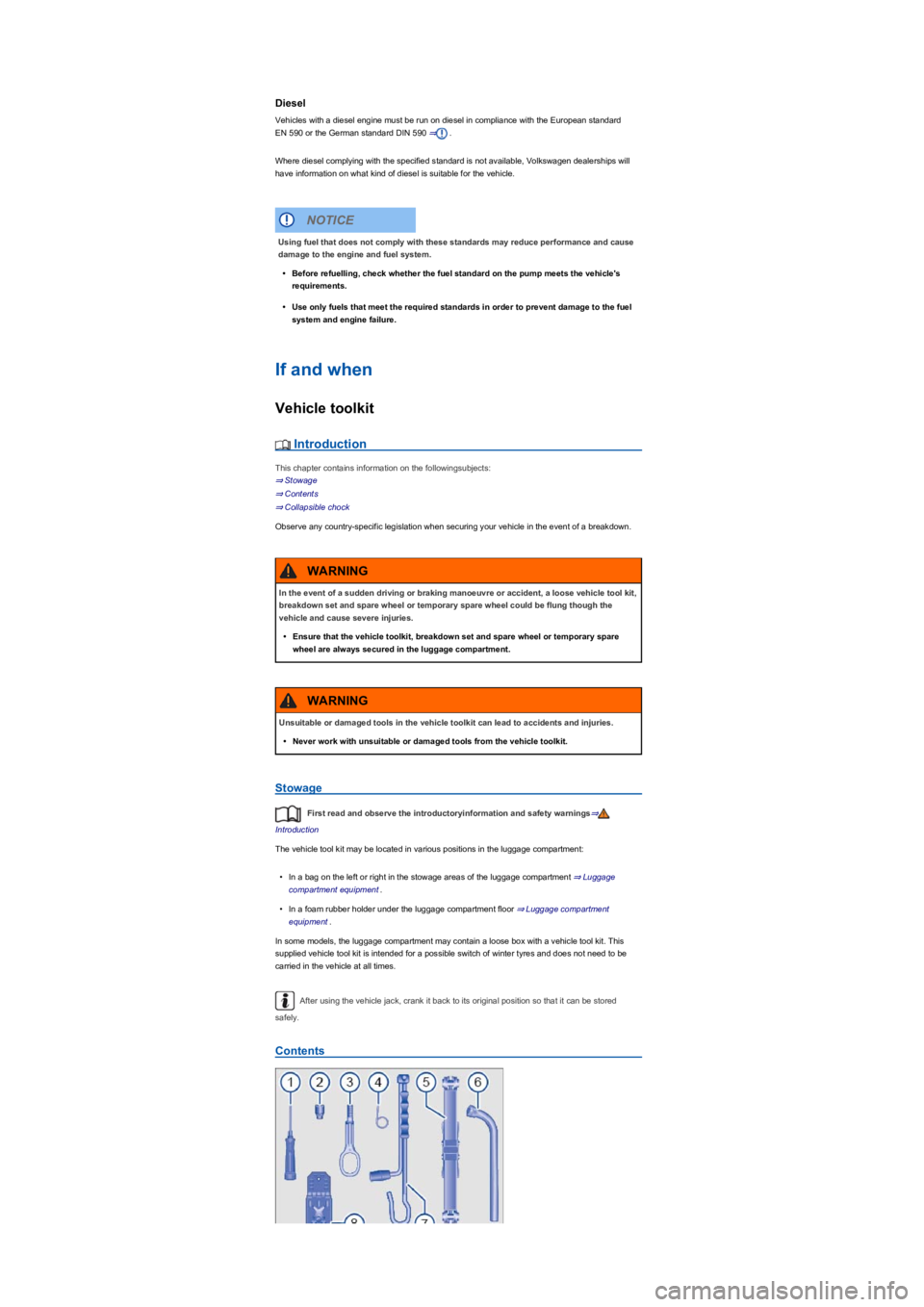
Contents
Using fuel that does not comply with these standards may reduce performance and cause
damage to the engine and fuel system.
•Before refuelling, check whether the fuel standard on the pump meets the vehicle's
requirements.
•Use only fuels that meet the required standards in order to prevent damage to the fuel
system and engine failure.
NOTICE
In the event of a sudden driving or braking manoeuvre or accident, a loose vehicle tool kit,
breakdown set and spare wheel or temporary spare wheel could be flung though the
vehicle and cause severe injuries.
•Ensure that the vehicle toolkit, breakdown set and spare wheel or temporary spare
wheel are always secured in the luggage compartment.
WARNING
Unsuitable or damaged tools in the vehicle toolkit can lead to accidents and injuries.
•Never work with unsuitable or damaged tools from the vehicle toolkit.
WARNING
Page 252 of 341
Wiper blades
Service position
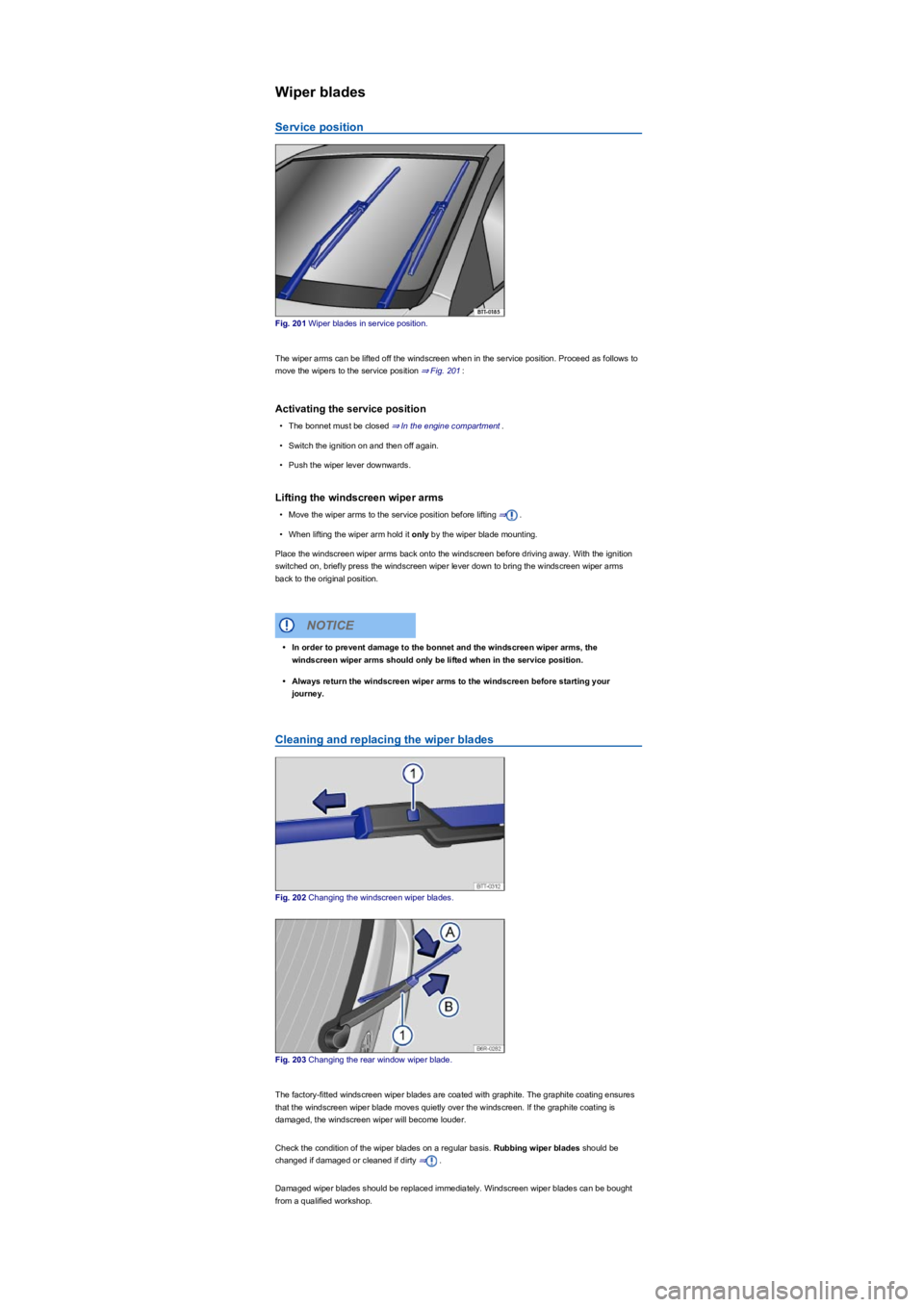
Fig. 201 Wiper blades in service position.
The wiper arms can be lifted off the windscreen when in the service position. Proceed as follows to
move the wipers to the service position ⇒ Fig. 201:
Activating the service position
•The bonnet must be closed ⇒ In the engine compartment.
•Switch the ignition on and then off again.
•Push the wiper lever downwards.
Lifting the windscreen wiper arms
•Move the wiper arms to the service position before lifting ⇒.
•When lifting the wiper arm hold it only by the wiper blade mounting.
Place the windscreen wiper arms back onto the windscreen before driving away. With the ignition
switched on, briefly press the windscreen wiper lever down to bring the windscreen wiper arms
back to the original position.
Cleaning and replacing the wiper blades
Fig. 202 Changing the windscreen wiper blades.
Fig. 203 Changing the rear window wiper blade.
The factory-fitted windscreen wiper blades are coated with graphite. The graphite coating ensures
that the windscreen wiper blade moves quietly over the windscreen. If the graphite coating is
damaged, the windscreen wiper will become louder.
Check the condition of the wiper blades on a regular basis. Rubbing wiper blades should be
changed if damaged or cleaned if dirty ⇒.
Damaged wiper blades should be replaced immediately. Windscreen wiper blades can be bought
from a qualified workshop.
•In order to prevent damage to the bonnet and the windscreen wiper arms, the
windscreen wiper arms should only be lifted when in the service position.
•Always return the windscreen wiper arms to the windscreen before starting your
journey.
NOTICE