engine VOLKSWAGEN TIGUAN 2017 Owner´s Manual
[x] Cancel search | Manufacturer: VOLKSWAGEN, Model Year: 2017, Model line: TIGUAN, Model: VOLKSWAGEN TIGUAN 2017Pages: 341, PDF Size: 9.14 MB
Page 277 of 341
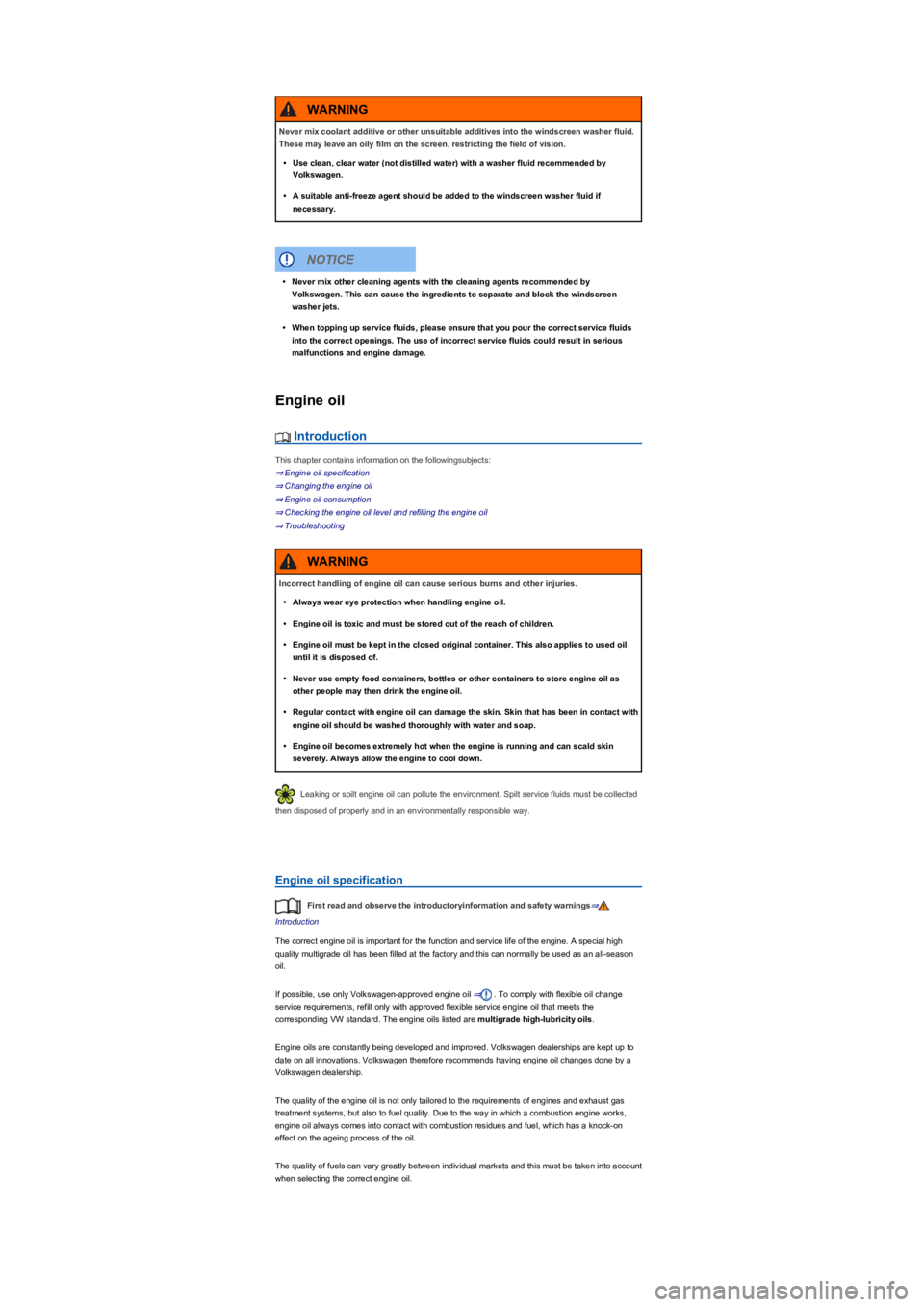
Engine oil
Introduction
This chapter contains information on the followingsubjects:
⇒ Engine oil specification
⇒ Changing the engine oil
⇒ Engine oil consumption
⇒ Checking the engine oil level and refilling the engine oil
⇒ Troubleshooting
Leaking or spilt engine oil can pollute the environment. Spilt service fluids must be collected
then disposed of properly and in an environmentally responsible way.
Engine oil specification
First read and observe the introductoryinformation and safety warnings⇒
Introduction
The correct engine oil is important for the function and service life of the engine. A special high
quality multigrade oil has been filled at the factory and this can normally be used as an all-season
oil.
If possible, use only Volkswagen-approved engine oil ⇒. To comply with flexible oil change
service requirements, refill only with approved flexible service engine oil that meets the
corresponding VW standard. The engine oils listed are multigrade high-lubricity oils.
Engine oils are constantly being developed and improved. Volkswagen dealerships are kept up to
date on all innovations. Volkswagen therefore recommends having engine oil changes done by a
Volkswagen dealership.
The quality of the engine oil is not only tailored to the requirements of engines and exhaust gas
treatment systems, but also to fuel quality. Due to the way in which a combustion engine works,
engine oil always comes into contact with combustion residues and fuel, which has a knock-on
effect on the ageing process of the oil.
The quality of fuels can vary greatly between individual markets and this must be taken into account
when selecting the correct engine oil.
Never mix coolant additive or other unsuitable additives into the windscreen washer fluid.
These may leave an oily film on the screen, restricting the field of vision.
•Use clean, clear water (not distilled water) with a washer fluid recommended by
Volkswagen.
•A suitable anti-freeze agent should be added to the windscreen washer fluid if
necessary.
WARNING
•Never mix other cleaning agents with the cleaning agents recommended by
Volkswagen. This can cause the ingredients to separate and block the windscreen
washer jets.
•When topping up service fluids, please ensure that you pour the correct service fluids
into the correct openings. The use of incorrect service fluids could result in serious
malfunctions and engine damage.
NOTICE
Incorrect handling of engine oil can cause serious burns and other injuries.
•Always wear eye protection when handling engine oil.
•Engine oil is toxic and must be stored out of the reach of children.
•Engine oil must be kept in the closed original container. This also applies to used oil
until it is disposed of.
•Never use empty food containers, bottles or other containers to store engine oil as
other people may then drink the engine oil.
•Regular contact with engine oil can damage the skin. Skin that has been in contact with
engine oil should be washed thoroughly with water and soap.
•Engine oil becomes extremely hot when the engine is running and can scald skin
severely. Always allow the engine to cool down.
WARNING
Page 278 of 341
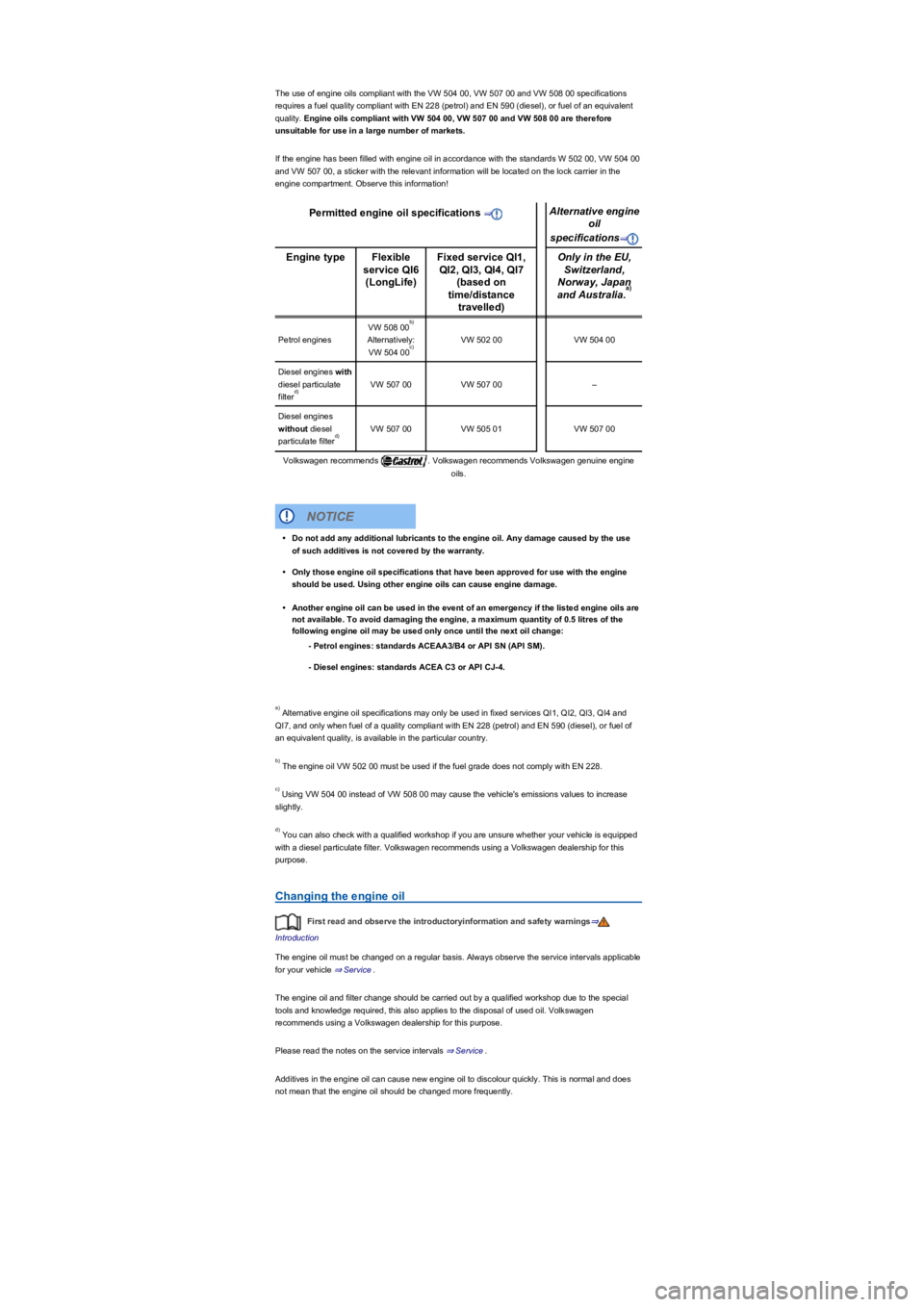
The use of engine oils compliant with the VW 504 00, VW 507 00 and VW 508 00 specifications
requires a fuel quality compliant with EN 228 (petrol) and EN 590 (diesel), or fuel of an equivalent
quality. Engine oils compliant with VW 504 00, VW 507 00 and VW 508 00 are therefore
unsuitable for use in a large number of markets.
If the engine has been filled with engine oil in accordance with the standards W 502 00, VW 504 00
and VW 507 00, a sticker with the relevant information will be located on the lock carrier in the
engine compartment. Observe this information!
Permitted engine oil specifications ⇒Alternative engine
oil
specifications⇒
Engine typeFlexible
service QI6
(LongLife)
Fixed service QI1,
QI2, QI3, QI4, QI7
(based on
time/distance
travelled)
Only in the EU,
Switzerland,
Norway, Japan
and Australia.
Petrol engines
VW 508 00
Alternatively:
VW 504 00
VW 502 00VW 504 00
Diesel engines with
diesel particulate
filter
VW 507 00VW 507 00–
Diesel engines
without diesel
particulate filter
VW 507 00VW 505 01VW 507 00
Volkswagen recommends . Volkswagen recommends Volkswagen genuine engine
oils.
Alternative engine oil specifications may only be used in fixed services QI1, QI2, QI3, QI4 and
QI7, and only when fuel of a quality compliant with EN 228 (petrol) and EN 590 (diesel), or fuel of
an equivalent quality, is available in the particular country.
The engine oil VW 502 00 must be used if the fuel grade does not comply with EN 228.
Using VW 504 00 instead of VW 508 00 may cause the vehicle's emissions values to increase
slightly.
You can also check with a qualified workshop if you are unsure whether your vehicle is equipped
with a diesel particulate filter. Volkswagen recommends using a Volkswagen dealership for this
purpose.
Changing the engine oil
First read and observe the introductoryinformation and safety warnings⇒
Introduction
The engine oil must be changed on a regular basis. Always observe the service intervals applicable
for your vehicle ⇒ Service.
The engine oil and filter change should be carried out by a qualified workshop due to the special
tools and knowledge required, this also applies to the disposal of used oil. Volkswagen
recommends using a Volkswagen dealership for this purpose.
Please read the notes on the service intervals ⇒ Service.
Additives in the engine oil can cause new engine oil to discolour quickly. This is normal and does
not mean that the engine oil should be changed more frequently.
a)
b)
c)
d)
d)
•Do not add any additional lubricants to the engine oil. Any damage caused by the use
of such additives is not covered by the warranty.
•Only those engine oil specifications that have been approved for use with the engine
should be used. Using other engine oils can cause engine damage.
•Another engine oil can be used in the event of an emergency if the listed engine oils are
not available. To avoid damaging the engine, a maximum quantity of 0.5 litres of the
following engine oil may be used only once until the next oil change:
- Petrol engines: standards ACEAA3/B4 or API SN (API SM).
- Diesel engines: standards ACEA C3 or API CJ-4.
NOTICE
a)
b)
c)
d)
Page 279 of 341
Before changing the engine oil, first find out where old oil can be disposed of properly near
you.
Used oil must be disposed of in accordance with regulations governing the protection of the
environment. Never dispose of old oil in locations such as gardens, woods, sewerage systems, on
streets and roads, or in rivers and waterways.
Engine oil consumption
First read and observe the introductoryinformation and safety warnings⇒
Introduction
Engine oil consumption can vary from engine to engine and can change during the working life of
an engine.
The vehicle may consume up to 1.0 litre of engine oil per 2,000 km, depending on how you drive
and the conditions in which the car is used. In new vehicles, consumption is likely to be higher for
the first 5,000 km. The engine oil level must therefore be checked at regular intervals, preferably
when refuelling and before long journeys.
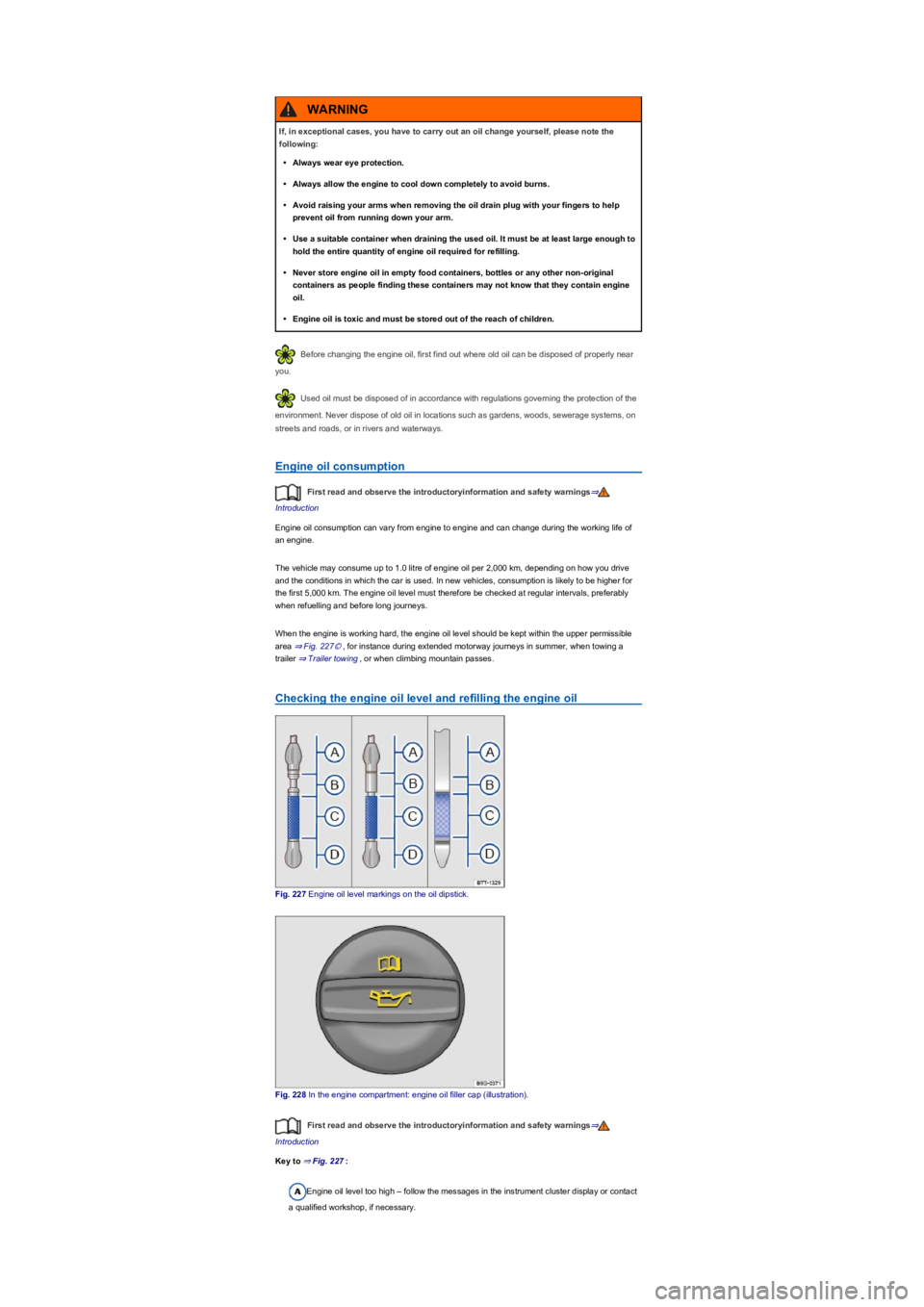
When the engine is working hard, the engine oil level should be kept within the upper permissible
area ⇒ Fig. 227Ⓒ, for instance during extended motorway journeys in summer, when towing a
trailer ⇒ Trailer towing, or when climbing mountain passes.
Checking the engine oil level and refilling the engine oil
Fig. 227 Engine oil level markings on the oil dipstick.
Fig. 228 In the engine compartment: engine oil filler cap (illustration).
First read and observe the introductoryinformation and safety warnings⇒
Introduction
Key to ⇒ Fig. 227:
Engine oil level too high – follow the messages in the instrument cluster display or contact
a qualified workshop, if necessary.
If, in exceptional cases, you have to carry out an oil change yourself, please note the
following:
•Always wear eye protection.
•Always allow the engine to cool down completely to avoid burns.
•Avoid raising your arms when removing the oil drain plug with your fingers to help
prevent oil from running down your arm.
•Use a suitable container when draining the used oil. It must be at least large enough to
hold the entire quantity of engine oil required for refilling.
•Never store engine oil in empty food containers, bottles or any other non-original
containers as people finding these containers may not know that they contain engine
oil.
•Engine oil is toxic and must be stored out of the reach of children.
WARNING
Page 280 of 341
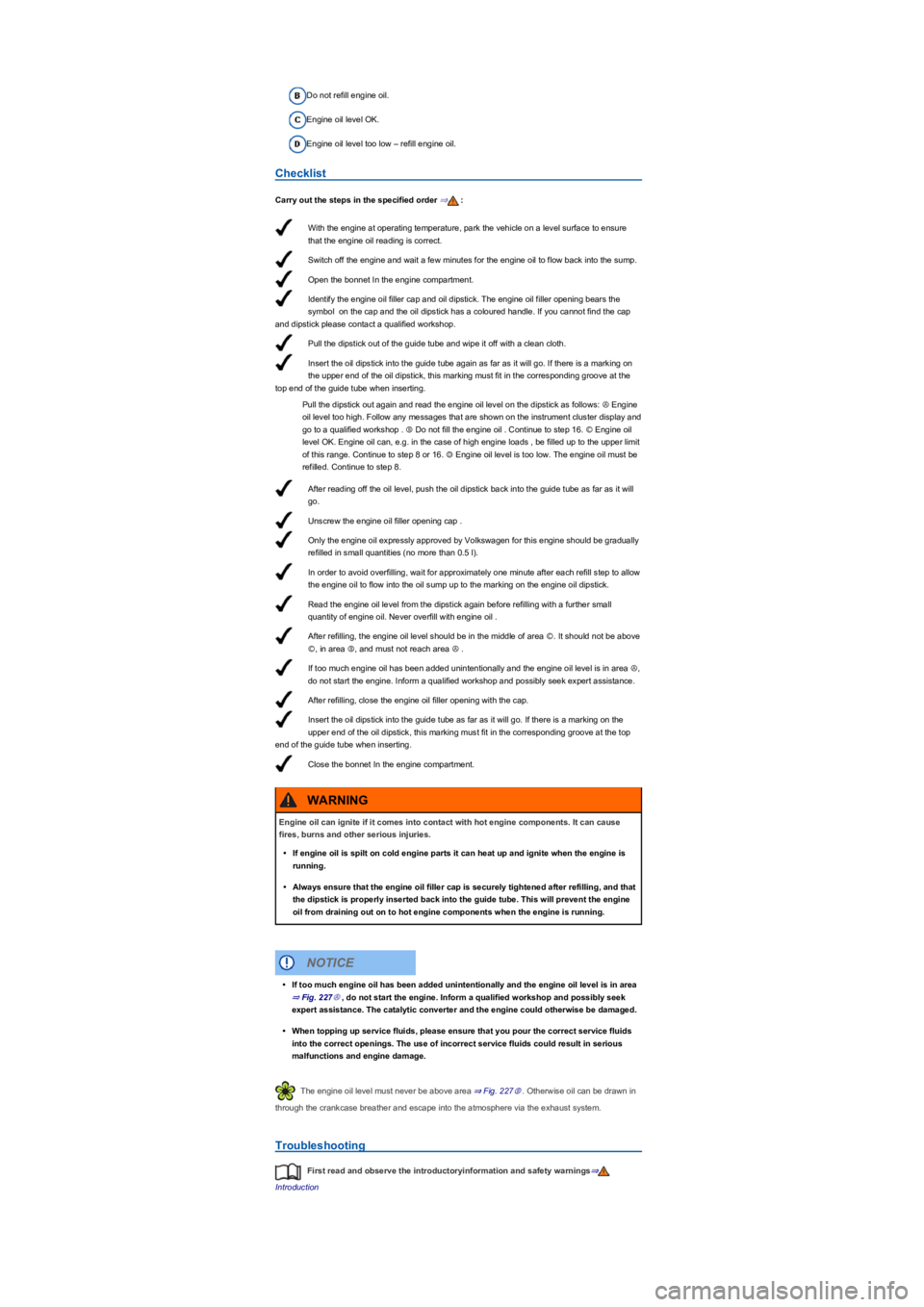
With the engine at operating temperature, park the vehicle on a level surface to ensure
that the engine oil reading is correct.
Switch off the engine and wait a few minutes for the engine oil to flow back into the sump.
Open the bonnet In the engine compartment.
Identify the engine oil filler cap and oil dipstick. The engine oil filler opening bears the
symbol on the cap and the oil dipstick has a coloured handle. If you cannot find the cap
and dipstick please contact a qualified workshop.
Pull the dipstick out of the guide tube and wipe it off with a clean cloth.
Insert the oil dipstick into the guide tube again as far as it will go. If there is a marking on
the upper end of the oil dipstick, this marking must fit in the corresponding groove at the
top end of the guide tube when inserting.
After reading off the oil level, push the oil dipstick back into the guide tube as far as it will
go.
Unscrew the engine oil filler opening cap .
Only the engine oil expressly approved by Volkswagen for this engine should be gradually
refilled in small quantities (no more than 0.5 l).
In order to avoid overfilling, wait for approximately one minute after each refill step to allow
the engine oil to flow into the oil sump up to the marking on the engine oil dipstick.
Read the engine oil level from the dipstick again before refilling with a further small
quantity of engine oil. Never overfill with engine oil .
After refilling, the engine oil level should be in the middle of area Ⓒ. It should not be above
Ⓒ, in area Ⓑ, and must not reach area Ⓐ .
If too much engine oil has been added unintentionally and the engine oil level is in area Ⓐ,
do not start the engine. Inform a qualified workshop and possibly seek expert assistance.
After refilling, close the engine oil filler opening with the cap.
Insert the oil dipstick into the guide tube as far as it will go. If there is a marking on the
upper end of the oil dipstick, this marking must fit in the corresponding groove at the top
end of the guide tube when inserting.
Close the bonnet In the engine compartment.
Do not refill engine oil.
Engine oil level OK.
Engine oil level too low – refill engine oil.
Checklist
Carry out the steps in the specified order ⇒:
Pull the dipstick out again and read the engine oil level on the dipstick as follows: Ⓐ Engine
oil level too high. Follow any messages that are shown on the instrument cluster display and
go to a qualified workshop . Ⓑ Do not fill the engine oil . Continue to step 16. Ⓒ Engine oil
level OK. Engine oil can, e.g. in the case of high engine loads , be filled up to the upper limit
of this range. Continue to step 8 or 16. Ⓓ Engine oil level is too low. The engine oil must be
refilled. Continue to step 8.
The engine oil level must never be above area ⇒ Fig. 227Ⓑ. Otherwise oil can be drawn in
through the crankcase breather and escape into the atmosphere via the exhaust system.
Troubleshooting
First read and observe the introductoryinformation and safety warnings⇒
Introduction
Engine oil can ignite if it comes into contact with hot engine components. It can cause
fires, burns and other serious injuries.
•If engine oil is spilt on cold engine parts it can heat up and ignite when the engine is
running.
•Always ensure that the engine oil filler cap is securely tightened after refilling, and that
the dipstick is properly inserted back into the guide tube. This will prevent the engine
oil from draining out on to hot engine components when the engine is running.
WARNING
•If too much engine oil has been added unintentionally and the engine oil level is in area
⇒ Fig. 227Ⓐ, do not start the engine. Inform a qualified workshop and possibly seek
expert assistance. The catalytic converter and the engine could otherwise be damaged.
•When topping up service fluids, please ensure that you pour the correct service fluids
into the correct openings. The use of incorrect service fluids could result in serious
malfunctions and engine damage.
NOTICE
Page 281 of 341
Warning lamps and text messages may be shown in the instrument cluster display. These warnings
may also be accompanied by acoustic signals.
Engine oil
Lit up: engine oil level too low. Switch off the engine. Check the engine oil level ⇒ Checking
the engine oil level and refilling the engine oil.Flashing: engine oil system fault. Go to a
qualified workshop and have the engine oil sensor checked.Flashing: engine oil pressure
is too low. Do not drive on!
Switch off the engine and check the engine oil level ⇒ Checking the engine oil level and refilling the
engine oil - Do not drive on or remain at idling speed if the warning lamp is flashing even if the
engine oil level is correct. The engine could otherwise be damaged. You should obtain professional
assistance.
Engine coolant
Introduction
This chapter contains information on the followingsubjects:
⇒ Coolant specification
⇒ Checking the coolant level and refilling coolant
You should only carry out work on the cooling system if you know exactly how to perform the
required tasks, are aware of the general safety procedures and have access to the correct
equipment, service fluids and suitable tools. Failing to carry out work correctly can cause serious
injuries ⇒. The work should be carried out by a qualified workshop if you are uncertain.
Volkswagen recommends using a Volkswagen dealership for this purpose.
Coolant and coolant additives can pollute the environment. Spilt service fluids must be
collected then disposed of properly and in an environmentally responsible way.
Coolant specification
First read and observe the introductoryinformation and safety warnings⇒
Introduction
The cooling system is filled at the factory with a mixture of specially prepared water and at least
40% coolant additive G 13 (TL-VW 774 J). The coolant additive is dyed purple. This mixture of
water and coolant additive gives the necessary frost protection down to -25°C (-13°F) and protects
the alloy parts of the cooling system against corrosion. The mixture also prevents scaling and
raises the boiling point of the coolant.
In order to protect the coolant system, the proportion of coolant additive must always be at least
40%, even if anti-freeze is not required in warm weather and warm climates.
If greater frost protection is required in very cold climates, the proportion of anti-freeze additive can
be increased. However, the percentage of coolant additive should not exceed 60%, as this would
reduce the frost protection and the cooling effect.
When refilling the coolant, a mixture of distilled water and at least 40% coolant additive - G 13 - or
- G 12 plus-plus - (TL-VW 774 G) (both of which are dyed purple) must be used in order to obtain
the optimum corrosion protection ⇒. Mixing - G 13 - with the coolant additives - G 12 plus - (TL-
VW 774 F), - G 12 - (dyed red) or - G 11 - (dyed blue-green) will significantly decrease the level of
corrosion protection and should therefore be avoided ⇒.
Engine coolant is toxic.
•Engine coolant should only be kept in sealed original containers in a safe place.
•Never store engine coolant in empty food containers, bottles or any other non-original
containers as people finding these containers may then drink the engine coolant.
•The engine coolant must be stored out of the reach of children.
•Please note that the amount of correct coolant additive used must be sufficient for the
lowest ambient temperature that you expect the vehicle to be exposed to.
•Coolant can freeze at extremely cold outside temperatures, causing the vehicle to
break down. Vehicle occupants with inadequate winter clothing could then freeze to
death as the heating will also no longer function.
WARNING
Page 282 of 341
Coolant and coolant additives can pollute the environment. Spilt service fluids must be
collected then disposed of properly and in an environmentally responsible way.
Checking the coolant level and refilling coolant
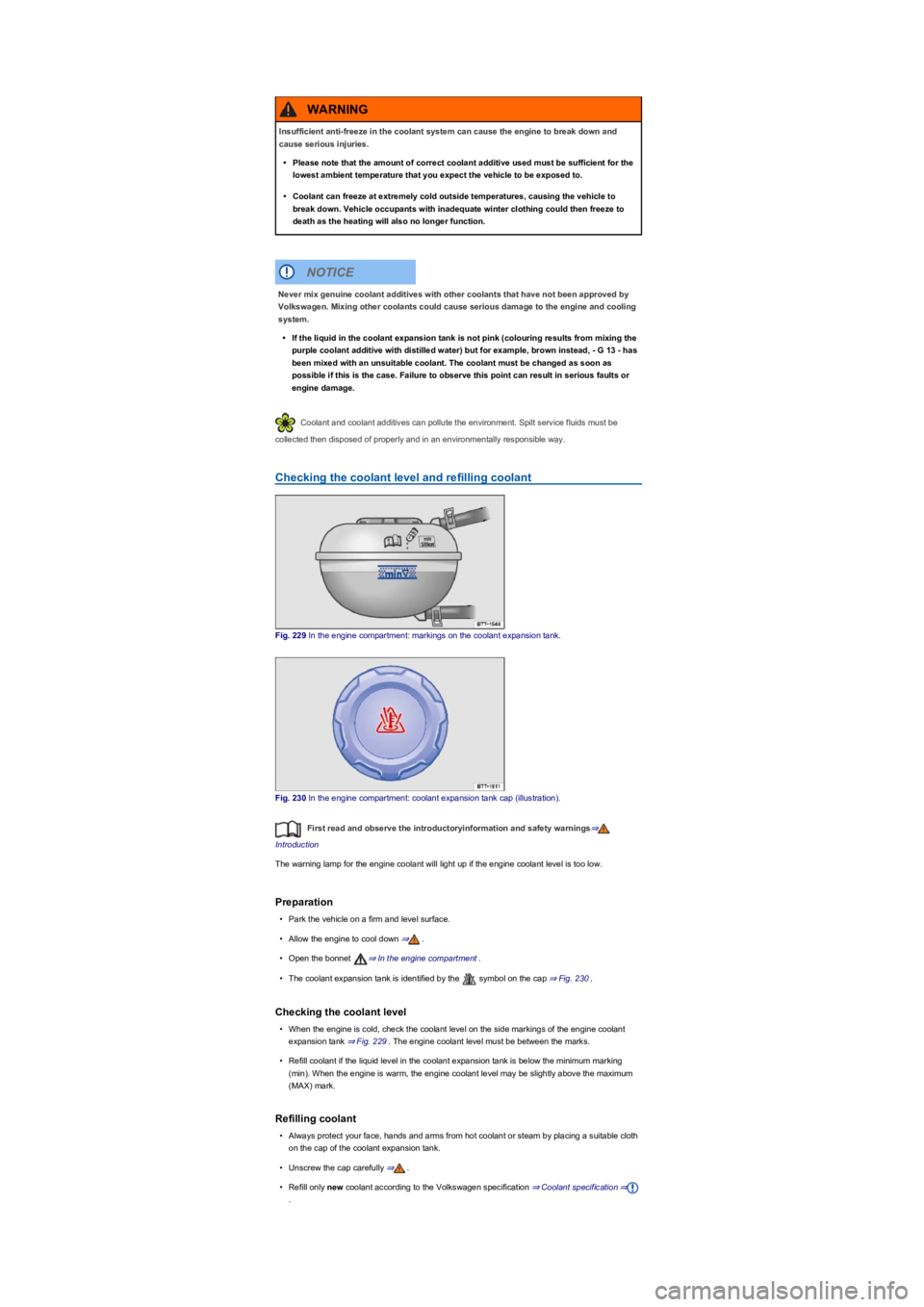
Fig. 229 In the engine compartment: markings on the coolant expansion tank.
Fig. 230 In the engine compartment: coolant expansion tank cap (illustration).
First read and observe the introductoryinformation and safety warnings⇒
Introduction
The warning lamp for the engine coolant will light up if the engine coolant level is too low.
Preparation
•Park the vehicle on a firm and level surface.
•Allow the engine to cool down ⇒.
•Open the bonnet ⇒ In the engine compartment.
•The coolant expansion tank is identified by the symbol on the cap ⇒ Fig. 230.
Checking the coolant level
•When the engine is cold, check the coolant level on the side markings of the engine coolant
expansion tank ⇒ Fig. 229. The engine coolant level must be between the marks.
•Refill coolant if the liquid level in the coolant expansion tank is below the minimum marking
(min). When the engine is warm, the engine coolant level may be slightly above the maximum
(MAX) mark.
Refilling coolant
•Always protect your face, hands and arms from hot coolant or steam by placing a suitable cloth
on the cap of the coolant expansion tank.
•Unscrew the cap carefully ⇒.
•Refill only new coolant according to the Volkswagen specification ⇒ Coolant specification⇒
.
Insufficient anti-freeze in the coolant system can cause the engine to break down and
cause serious injuries.
•Please note that the amount of correct coolant additive used must be sufficient for the
lowest ambient temperature that you expect the vehicle to be exposed to.
•Coolant can freeze at extremely cold outside temperatures, causing the vehicle to
break down. Vehicle occupants with inadequate winter clothing could then freeze to
death as the heating will also no longer function.
WARNING
Never mix genuine coolant additives with other coolants that have not been approved by
Volkswagen. Mixing other coolants could cause serious damage to the engine and cooling
system.
•If the liquid in the coolant expansion tank is not pink (colouring results from mixing the
purple coolant additive with distilled water) but for example, brown instead, - G 13 - has
been mixed with an unsuitable coolant. The coolant must be changed as soon as
possible if this is the case. Failure to observe this point can result in serious faults or
engine damage.
NOTICE
Page 283 of 341
•Only top up coolant if there is coolant residue in the expansion tank. If this is not observed, the
engine could be damaged. If you cannot see any coolant in the expansion tank do not drive
on. Seek professional assistance.
•If you can see coolant residue in the coolant expansion tank, refill coolant until the level remains
stable.
•The coolant level must be between the marks on the coolant expansion tank ⇒ Fig. 229. Do
not fill above the top edge of the marked area⇒.
•Close the cap tightly.
•If in an emergency you do not have access to the required specification ⇒ Coolant
specification, do not use any other coolant additive! Instead, initially refill with distilled water⇒
only. Then add the correct proportion of coolant additive as soon as possible ⇒ Coolant
specification.
Brake fluid
Hot steam or coolant can cause serious burns.
•Never open the bonnet if you can see or hear steam or engine coolant coming out of
the engine compartment. Always wait until you can no longer see or hear escaping
steam or coolant.
•Always allow the engine to cool down completely before carefully opening the bonnet.
Hot components can burn the skin.
•The following points should be noted before opening the bonnet once the engine has
cooled down:
- Switch on the electronic parking brake and move the selector lever to position P
or move the gear lever to the neutral position.
- Switch off the ignition and remove the vehicle key from the ignition lock.
- Always keep children away from the engine compartment and never leave the
vehicle unattended.
•The cooling system is under pressure when the engine is hot. Never open the cap of
the coolant expansion tank when the engine is hot. Coolant may spray out and cause
serious burns and other injuries.
- Turn the cap slowly and very carefully anti-clockwise while exerting gentle
downward pressure on the cap.
- Always protect the face, hands and arms from hot coolant or steam with a large,
thick cloth.
•When refilling, do not spill any service fluids on engine components or on the exhaust
system. The spilt service fluids can start a fire. In certain circumstances, the ethylene
glycol in the engine can catch fire.
WARNING
•Refill only with distilled water. All other types of water can cause corrosion in the
engine due to the chemical components contained therein. This can also lead to engine
failure. If any other type of water than distilled water is refilled, the fluid in the cooling
system should be completely replaced immediately by a qualified workshop.
•Do not fill coolant above the top of the marked area ⇒ Fig. 229. Otherwise the excess
coolant will be pressed out of the cooling system when the engine is hot and could
cause damage.
•If a large amount of coolant has been lost, do not refill the coolant until the engine has
cooled completely. Heavy coolant loss is an indication of leaks in the engine cooling
system. The engine cooling system should be checked by a qualified workshop as
soon as possible. Failure to do so can result in engine damage.
•Do not top up with coolant if there is no more coolant in the coolant expansion tank. Air
could have entered the cooling system. Do not drive on! Seek expert assistance. Failure
to do so can result in engine damage.
•When topping up service fluids, please ensure that you pour the correct service fluids
into the correct openings. The use of incorrect service fluids could result in serious
malfunctions and engine damage.
NOTICE
Page 284 of 341
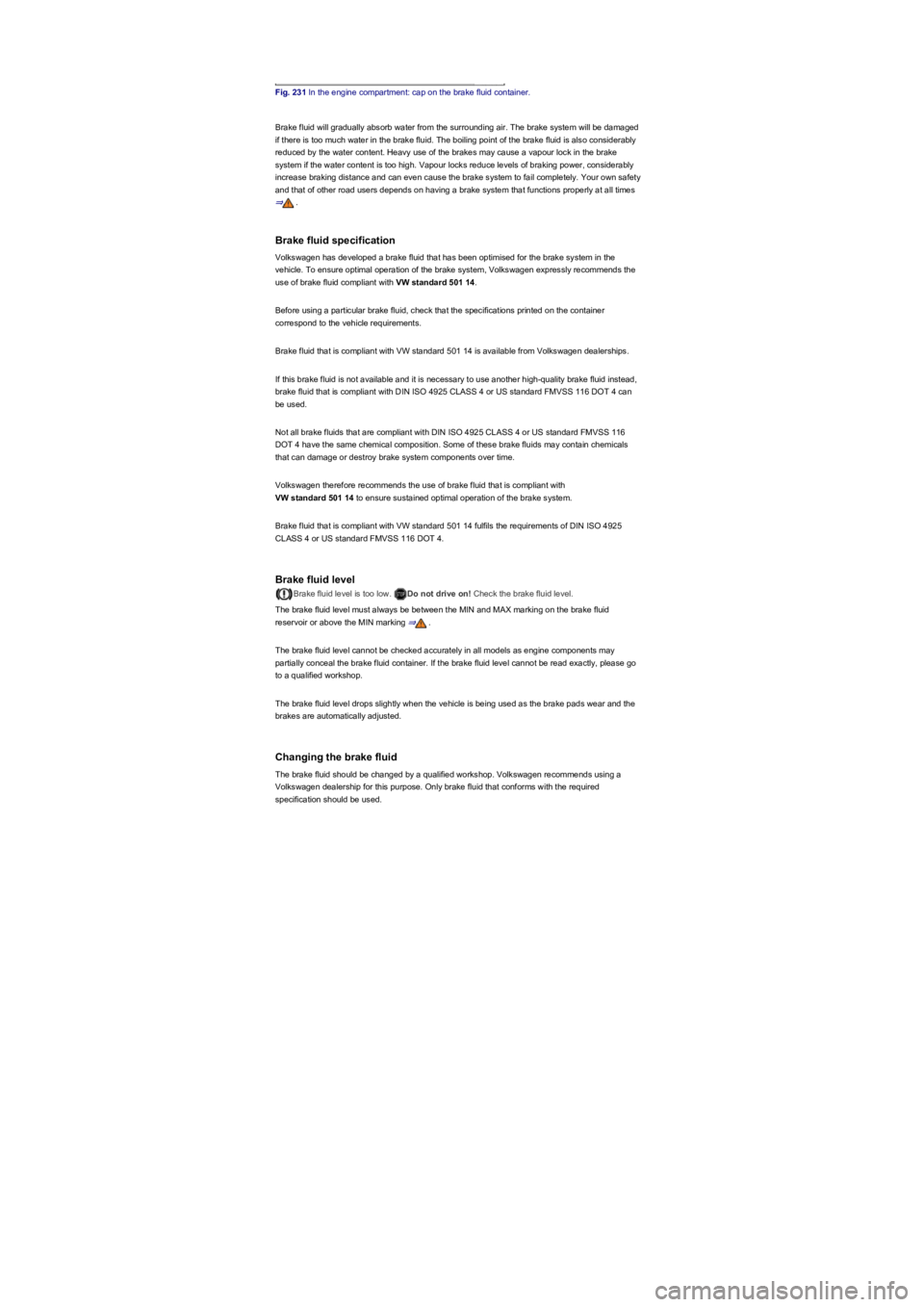
Fig. 231 In the engine compartment: cap on the brake fluid container.
Brake fluid will gradually absorb water from the surrounding air. The brake system will be damaged
if there is too much water in the brake fluid. The boiling point of the brake fluid is also considerably
reduced by the water content. Heavy use of the brakes may cause a vapour lock in the brake
system if the water content is too high. Vapour locks reduce levels of braking power, considerably
increase braking distance and can even cause the brake system to fail completely. Your own safety
and that of other road users depends on having a brake system that functions properly at all times
⇒.
Brake fluid specification
Volkswagen has developed a brake fluid that has been optimised for the brake system in the
vehicle. To ensure optimal operation of the brake system, Volkswagen expressly recommends the
use of brake fluid compliant with VW standard 501 14.
Before using a particular brake fluid, check that the specifications printed on the container
correspond to the vehicle requirements.
Brake fluid that is compliant with VW standard 501 14 is available from Volkswagen dealerships.
If this brake fluid is not available and it is necessary to use another high-quality brake fluid instead,
brake fluid that is compliant with DIN ISO 4925 CLASS 4 or US standard FMVSS 116 DOT 4 can
be used.
Not all brake fluids that are compliant with DIN ISO 4925 CLASS 4 or US standard FMVSS 116
DOT 4 have the same chemical composition. Some of these brake fluids may contain chemicals
that can damage or destroy brake system components over time.
Volkswagen therefore recommends the use of brake fluid that is compliant with
VW standard 501 14 to ensure sustained optimal operation of the brake system.
Brake fluid that is compliant with VW standard 501 14 fulfils the requirements of DIN ISO 4925
CLASS 4 or US standard FMVSS 116 DOT 4.
Brake fluid level
Brake fluid level is too low. Do not drive on! Check the brake fluid level.
The brake fluid level must always be between the MIN and MAX marking on the brake fluid
reservoir or above the MIN marking ⇒.
The brake fluid level cannot be checked accurately in all models as engine components may
partially conceal the brake fluid container. If the brake fluid level cannot be read exactly, please go
to a qualified workshop.
The brake fluid level drops slightly when the vehicle is being used as the brake pads wear and the
brakes are automatically adjusted.
Changing the brake fluid
The brake fluid should be changed by a qualified workshop. Volkswagen recommends using a
Volkswagen dealership for this purpose. Only brake fluid that conforms with the required
specification should be used.
Page 285 of 341
Brake fluid can pollute the environment. Any spilt service fluids must be cleaned up and
disposed of properly.
12-volt vehicle battery
Introduction
This chapter contains information on the followingsubjects:
⇒ Checking the electrolyte level of the 12-volt vehicle battery
⇒ Charging, replacing, disconnecting and connecting the 12-volt vehicle battery
⇒ Troubleshooting
The 12-volt vehicle battery is a component of the electrical system and serves to supply power in
the vehicle.
You should only carry out work on the electrical system if you know exactly how to perform the
required tasks, are aware of the general safety procedures and have access to the correct
equipment, service fluids and suitable tools. Failing to carry out work correctly can cause serious
injuries ⇒. All work should be carried out by a qualified workshop. Volkswagen recommends
using a Volkswagen dealership for this purpose.
Location of the 12-volt vehicle battery
Depending on the vehicle equipment level, the 12-volt vehicle battery may be located in the engine
compartment or in the luggage compartment under the luggage compartment floor.
Explanation of the warnings on the 12-volt vehicle battery
m/k/n948MKAlways wear eye protection!m/k/n947MKElectrolyte is very corrosive
and caustic. Always wear protective gloves and eye protection!m/k/n944MKNo fires,
sparks, naked lights or smoking!m/k/n946MKA highly explosive mixture of gases is given
off when the 12-volt vehicle battery is charging!m/k/n945MKAlways keep children away
from battery acid and the 12-volt vehicle battery!m/k/n949MKAlways observe the owner's
manual!
Brake failure or reduced braking effect can be caused by the brake fluid level being too
low or by brake fluid that is too old or unsuitable.
•The brake system and brake fluid level must be checked regularly.
•The brake fluid should be changed regularly.
•Heavy use of the brakes may cause a vapour lock if the brake fluid is left in the system
for too long. Vapour locks reduce levels of braking power, considerably increase
braking distance and can cause the brake system to fail completely.
•Please ensure that the correct brake fluid is used. Only use brake fluid that is explicitly
compliant with VW standard 501 14.
•Any other brake fluid or a low-quality one can affect the functioning of the brakes and
reduce their effectiveness.
•If a brake fluid compliant with VW standard 501 14 is not available, use a high-quality
brake fluid compliant with DIN ISO 4925 CLASS 4 or the US standard FMVSS 116 DOT
4, but only in exceptional circumstances.
•The refilled brake fluid must be new.
WARNING
Brake fluid is toxic.
•In order to reduce the risk of poisoning, never use bottles or other containers to store
brake fluid. There is always a risk of someone drinking from such containers, even if
they are labelled appropriately.
•Brake fluid must always be stored in its original sealed container and kept out of the
reach of children.
WARNING
Brake fluid that has leaked or been spilt can damage the vehicle paintwork, plastic parts
and tyres. Wipe off brake fluid that has leaked or been spilled immediately from all parts of
the vehicle.
NOTICE
Page 286 of 341
When you start the engine after the 12-volt battery has been totally discharged or after a
successful jump start, you may find that system settings (time, date, personal convenience settings
and programming) have been changed or deleted. Check and correct the settings as necessary
once the 12-volt vehicle battery has been sufficiently charged.
Checking the electrolyte level of the 12-volt vehicle battery
Fig. 232 In the engine compartment: folding open the 12-volt vehicle battery cover.
Fig. 233 Battery window on the top of the 12-volt vehicle battery (illustration).
First read and observe the introductoryinformation and safety warnings⇒
Introduction
The electrolyte level of the 12-volt vehicle battery should be checked regularly in high-mileage
vehicles, in hot countries and in older 12-volt vehicle batteries. The 12-volt vehicle battery is
otherwise maintenance-free.
Any work on the 12-volt vehicle battery and the electrical system can cause serious
chemical burns, fire or electric shocks. Always read the following warnings and safety
information before carrying out any kind of work:
•Switch off the ignition and all electrical consumers before carrying out any work on the
12-volt vehicle battery and also disconnect the negative cable from the 12-volt vehicle
battery.
•Children should always be kept away from electrolyte and the 12-volt vehicle battery.
•Always wear eye protection and protective gloves.
•Electrolyte is very aggressive. It can burn the skin and can cause blindness. When
working with the 12-volt vehicle battery, ensure that your hands, arms and face in
particular are protected from acid spillages.
•Do not smoke during the work, and never work near naked flames or sparks.
•When handling cables and electrical equipment, avoid generating sparks and
electrostatic charge.
•Never short circuit the battery poles.
•Never use a damaged 12-volt vehicle battery. It can explode. Damaged 12-volt vehicle
batteries must be replaced as soon as possible.
•Damaged or frozen 12-volt vehicle batteries must be replaced as soon as possible.
Discharged 12-volt vehicle batteries can already freeze at temperatures of around
0°C (+32°F).
•In vehicles with the 12-volt vehicle battery in the luggage compartment, ensure that the
breather hose is connected properly to the 12-volt vehicle battery.
WARNING
•Do not expose the 12-volt vehicle battery to direct daylight for an extended period as
the UV rays could damage the battery housing.
•If the vehicle is left standing in cold conditions for a long period, protect the 12-volt
vehicle battery from frost. If it freezes, it will be destroyed.
NOTICE