ignition VOLKSWAGEN TIGUAN 2017 Owner´s Manual
[x] Cancel search | Manufacturer: VOLKSWAGEN, Model Year: 2017, Model line: TIGUAN, Model: VOLKSWAGEN TIGUAN 2017Pages: 341, PDF Size: 9.14 MB
Page 218 of 341
First read and observe the introductoryinformation and safety warnings⇒
Introduction
To use: fold the centre armrest down.
Fold the centre armrest back up again when the drink holder is no longer in use.
Ashtray and cigarette lighter
Introduction
This chapter contains information on the followingsubjects:
⇒ Removable ashtray in the drink holder
⇒ Cigarette lighter
Removable ashtray in the drink holder
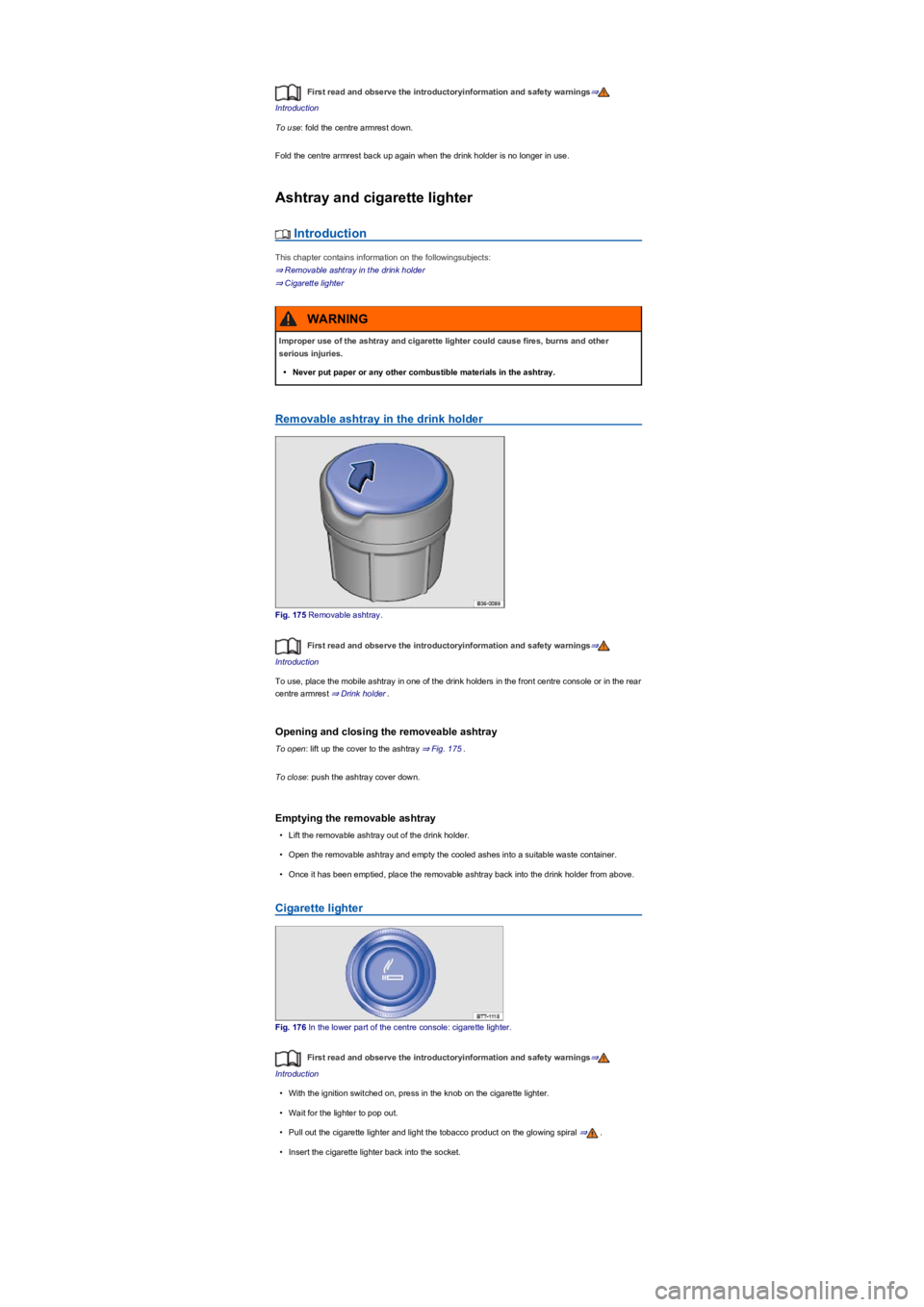
Fig. 175 Removable ashtray.
First read and observe the introductoryinformation and safety warnings⇒
Introduction
To use, place the mobile ashtray in one of the drink holders in the front centre console or in the rear
centre armrest ⇒ Drink holder.
Opening and closing the removeable ashtray
To open: lift up the cover to the ashtray ⇒ Fig. 175.
To close: push the ashtray cover down.
Emptying the removable ashtray
•Lift the removable ashtray out of the drink holder.
•Open the removable ashtray and empty the cooled ashes into a suitable waste container.
•Once it has been emptied, place the removable ashtray back into the drink holder from above.
Cigarette lighter
Fig. 176 In the lower part of the centre console: cigarette lighter.
First read and observe the introductoryinformation and safety warnings⇒
Introduction
•With the ignition switched on, press in the knob on the cigarette lighter.
•Wait for the lighter to pop out.
•Pull out the cigarette lighter and light the tobacco product on the glowing spiral ⇒.
•Insert the cigarette lighter back into the socket.
Improper use of the ashtray and cigarette lighter could cause fires, burns and other
serious injuries.
•Never put paper or any other combustible materials in the ashtray.
WARNING
Page 219 of 341
The cigarette lighter socket can also be used as a 12-volt socket ⇒ Electrical sockets.
Electrical sockets
Introduction
This chapter contains information on the followingsubjects:
⇒ Sockets in the vehicle
Electrical equipment can be connected to the sockets in the vehicle.
The electrical devices must be in good condition. Do not use faulty devices.
The 12-volt socket will work only when the ignition is switched on.
Using electrical consumers with the engine switched off and the ignition switched on will
drain the 12-volt battery.
Unshielded devices can cause interference in the Infotainment system and vehicle
electronics.
Sockets in the vehicle
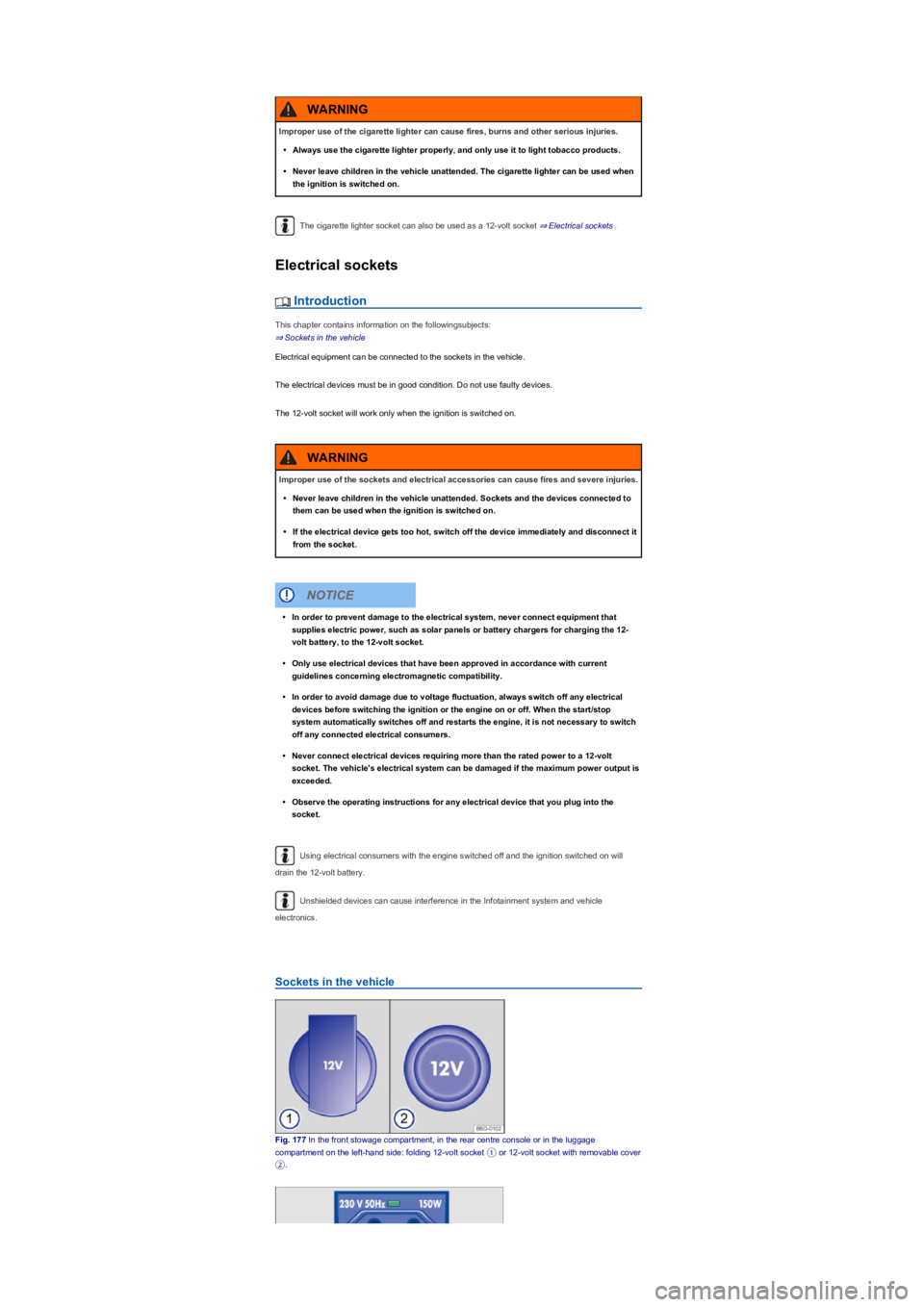
Fig. 177 In the front stowage compartment, in the rear centre console or in the luggage
compartment on the left-hand side: folding 12-volt socket ① or 12-volt socket with removable cover
②.
Improper use of the cigarette lighter can cause fires, burns and other serious injuries.
•Always use the cigarette lighter properly, and only use it to light tobacco products.
•Never leave children in the vehicle unattended. The cigarette lighter can be used when
the ignition is switched on.
WARNING
Improper use of the sockets and electrical accessories can cause fires and severe injuries.
•Never leave children in the vehicle unattended. Sockets and the devices connected to
them can be used when the ignition is switched on.
•If the electrical device gets too hot, switch off the device immediately and disconnect it
from the socket.
WARNING
•In order to prevent damage to the electrical system, never connect equipment that
supplies electric power, such as solar panels or battery chargers for charging the 12-
volt battery, to the 12-volt socket.
•Only use electrical devices that have been approved in accordance with current
guidelines concerning electromagnetic compatibility.
•In order to avoid damage due to voltage fluctuation, always switch off any electrical
devices before switching the ignition or the engine on or off. When the start/stop
system automatically switches off and restarts the engine, it is not necessary to switch
off any connected electrical consumers.
•Never connect electrical devices requiring more than the rated power to a 12-volt
socket. The vehicle's electrical system can be damaged if the maximum power output is
exceeded.
•Observe the operating instructions for any electrical device that you plug into the
socket.
NOTICE
Page 220 of 341
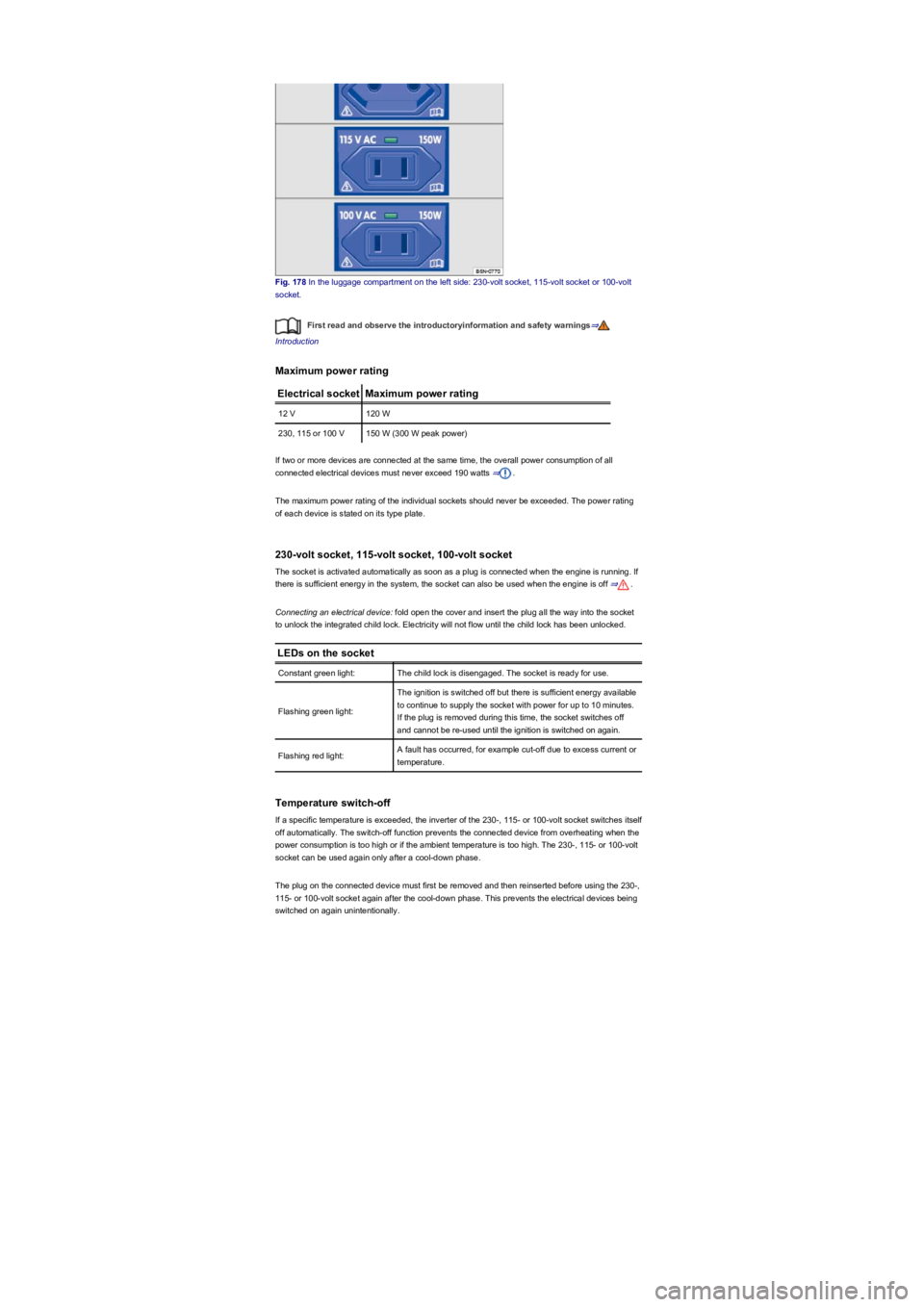
Fig. 178 In the luggage compartment on the left side: 230-volt socket, 115-volt socket or 100-volt
socket.
First read and observe the introductoryinformation and safety warnings⇒
Introduction
Maximum power rating
Electrical socketMaximum power rating
12 V120 W
230, 115 or 100 V150 W (300 W peak power)
If two or more devices are connected at the same time, the overall power consumption of all
connected electrical devices must never exceed 190 watts ⇒.
The maximum power rating of the individual sockets should never be exceeded. The power rating
of each device is stated on its type plate.
230-volt socket, 115-volt socket, 100-volt socket
The socket is activated automatically as soon as a plug is connected when the engine is running. If
there is sufficient energy in the system, the socket can also be used when the engine is off ⇒.
Connecting an electrical device: fold open the cover and insert the plug all the way into the socket
to unlock the integrated child lock. Electricity will not flow until the child lock has been unlocked.
LEDs on the socket
Constant green light:The child lock is disengaged. The socket is ready for use.
Flashing green light:
The ignition is switched off but there is sufficient energy available
to continue to supply the socket with power for up to 10 minutes.
If the plug is removed during this time, the socket switches off
and cannot be re-used until the ignition is switched on again.
Flashing red light:A fault has occurred, for example cut-off due to excess current or
temperature.
Temperature switch-off
If a specific temperature is exceeded, the inverter of the 230-, 115- or 100-volt socket switches itself
off automatically. The switch-off function prevents the connected device from overheating when the
power consumption is too high or if the ambient temperature is too high. The 230-, 115- or 100-volt
socket can be used again only after a cool-down phase.
The plug on the connected device must first be removed and then reinserted before using the 230-,
115- or 100-volt socket again after the cool-down phase. This prevents the electrical devices being
switched on again unintentionally.
Page 243 of 341
Safety instructions for handling fuel
Fuels can pollute the environment. Any spilt service fluids must be cleaned up and disposed
of properly.
The tank flap cannot be opened manually. Seek expert assistance.
Fuel types and refuelling
Introduction
This chapter contains information on the followingsubjects:
⇒ Petrol
⇒ Diesel
⇒ Refuelling
⇒ Misfuelling prevention device
The tank flap is located at the rear right-hand side of the vehicle ⇒ Side view.
Different engines require different fuels. The factory-fitted sticker on the inside of the tank flap
indicates the required fuel type for your vehicle.
Information on indicator and warning lamps can be found in the troubleshooting section at the end
of the chapter ⇒ Troubleshooting.
Petrol
First read and observe the introductoryinformation and safety warnings⇒
Introduction
Vehicles with a petrol engine must be run on unleaded petrol. Fuels with a maximum ethanol
content of 10% (E10) can be used for refuelling ⇒.
The petrol grades differ with respect to the octane number. The vehicle may be filled with petrol that
has a higher octane number than the engine requires. However, this does not provide any
advantage in terms of fuel consumption or engine output.
The fuel quality affects the running properties, performance and service life of the engine. You
should therefore use fuel that already contains suitable service additives if possible ⇒.
Information on the fuel standards can be found in the chapter on fuel standards ⇒ Fuel standards.
Incorrect handling of fuel can cause explosions, fire, serious burns and other injuries.
•Switch off the auxiliary heater⇒ Auxiliary heater and ventilation, the engine, the
ignition, your mobile phone and other wireless equipment while refuelling.
•Do not get into the vehicle to avoid electrostatic discharge.
•Make sure that the tank cap is closed properly and no fuel can escape.
•Comply with any relevant safety information and legislation concerning the handling of
fuels.
WARNING
Fuel may run out of the fuel canister. This could cause fire and injuries.
•Do not carry fuel canisters in the vehicle.
CAUTION
Incorrect refuelling can lead to damage to the vehicle.
•Only use fuels that have been approved for the vehicle.
•Do not use fuels containing metals and only use approved additives.
•Spilt fuel should be removed from all vehicle components immediately.
NOTICE
Page 246 of 341
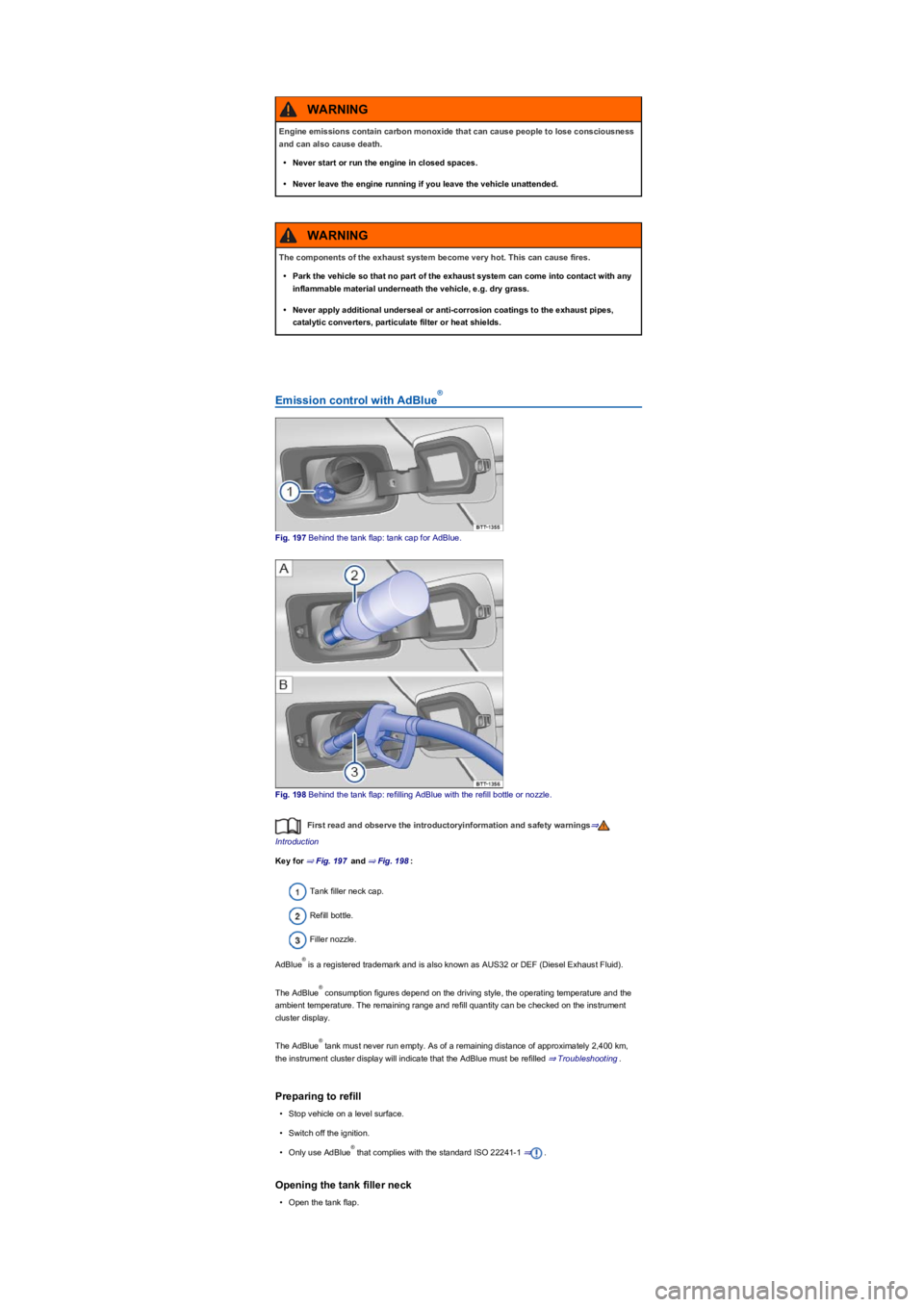
Emission control with AdBlue
Fig. 197 Behind the tank flap: tank cap for AdBlue.
Fig. 198 Behind the tank flap: refilling AdBlue with the refill bottle or nozzle.
First read and observe the introductoryinformation and safety warnings⇒
Introduction
Key for ⇒ Fig. 197 and ⇒ Fig. 198:
Tank filler neck cap.
Refill bottle.
Filler nozzle.
AdBlue is a registered trademark and is also known as AUS32 or DEF (Diesel Exhaust Fluid).
The AdBlue consumption figures depend on the driving style, the operating temperature and the
ambient temperature. The remaining range and refill quantity can be checked on the instrument
cluster display.
The AdBlue tank must never run empty. As of a remaining distance of approximately 2,400 km,
the instrument cluster display will indicate that the AdBlue must be refilled ⇒ Troubleshooting.
Preparing to refill
•Stop vehicle on a level surface.
•Switch off the ignition.
•Only use AdBlue that complies with the standard ISO 22241-1 ⇒.
Opening the tank filler neck
•Open the tank flap.
Engine emissions contain carbon monoxide that can cause people to lose consciousness
and can also cause death.
•Never start or run the engine in closed spaces.
•Never leave the engine running if you leave the vehicle unattended.
WARNING
The components of the exhaust system become very hot. This can cause fires.
•Park the vehicle so that no part of the exhaust system can come into contact with any
inflammable material underneath the vehicle, e.g. dry grass.
•Never apply additional underseal or anti-corrosion coatings to the exhaust pipes,
catalytic converters, particulate filter or heat shields.
WARNING
®
®
®
®
®
Page 247 of 341
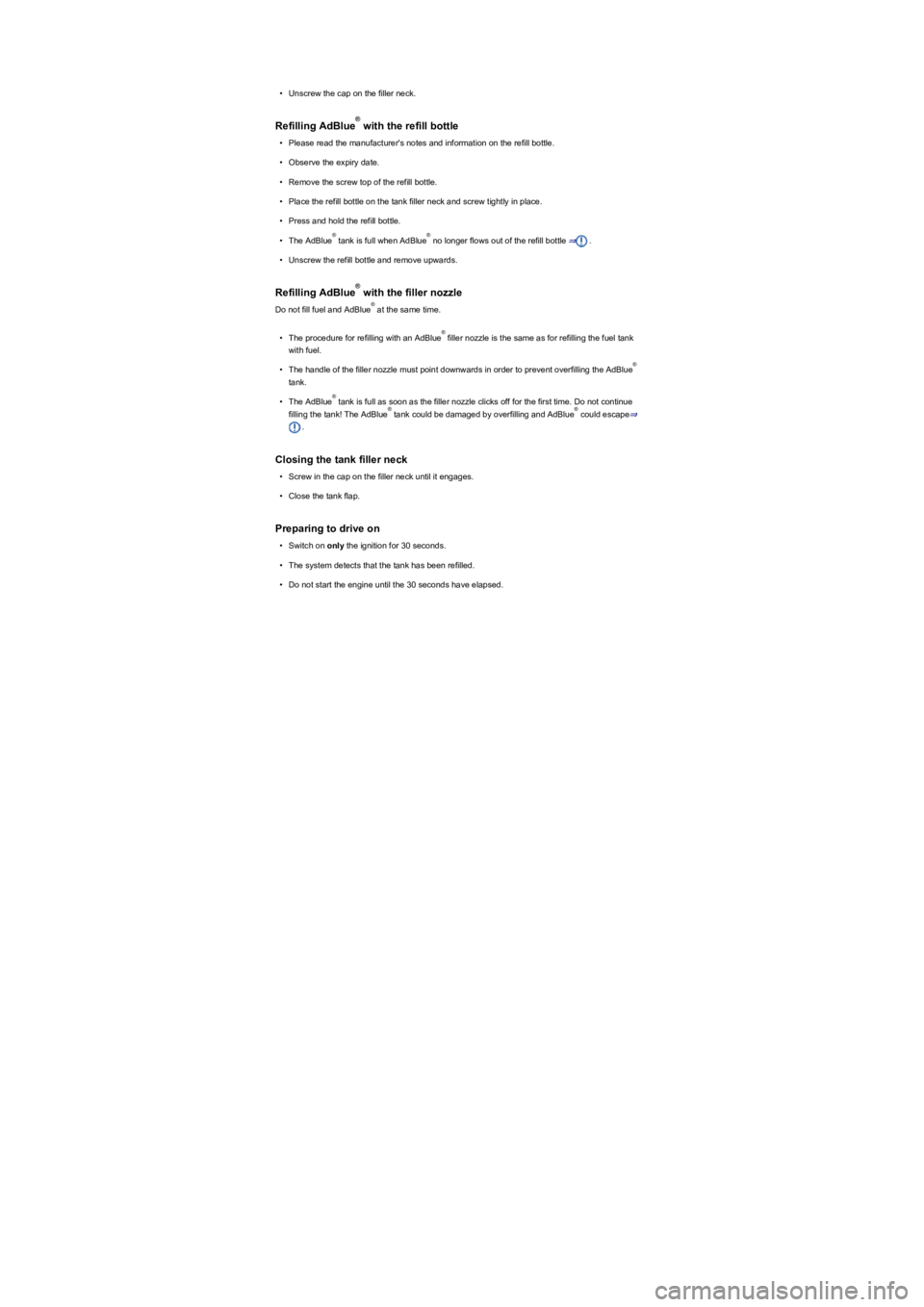
•Unscrew the cap on the filler neck.
Refilling AdBlue with the refill bottle
•Please read the manufacturer's notes and information on the refill bottle.
•Observe the expiry date.
•Remove the screw top of the refill bottle.
•Place the refill bottle on the tank filler neck and screw tightly in place.
•Press and hold the refill bottle.
•The AdBlue tank is full when AdBlue no longer flows out of the refill bottle ⇒.
•Unscrew the refill bottle and remove upwards.
Refilling AdBlue with the filler nozzle
Do not fill fuel and AdBlue at the same time.
•The procedure for refilling with an AdBlue filler nozzle is the same as for refilling the fuel tank
with fuel.
•The handle of the filler nozzle must point downwards in order to prevent overfilling the AdBlue
tank.
•The AdBlue tank is full as soon as the filler nozzle clicks off for the first time. Do not continue
filling the tank! The AdBlue tank could be damaged by overfilling and AdBlue could escape⇒
.
Closing the tank filler neck
•Screw in the cap on the filler neck until it engages.
•Close the tank flap.
Preparing to drive on
•Switch on only the ignition for 30 seconds.
•The system detects that the tank has been refilled.
•Do not start the engine until the 30 seconds have elapsed.
®
®®
®
®
®
®
®
®®
Page 249 of 341
•Only refuel with fuels that are suitable for the vehicle ⇒ Fuel types and refuelling.
•Do not allow the fuel tank to run completely empty.
•Use only suitable engine oil for the vehicle and do not overfill ⇒ Engine oil.
•Do not tow start the vehicle. Use jump leads ⇒ Jump starting.
Periodic regeneration
The soot in the particulate filter is burnt off at high temperatures on a periodic basis.
To assist the regeneration of the particulate filter, Volkswagen recommends that you avoid making
only short journeys.
Noises, slight smells and increased engine speeds may occur during regeneration. The radiator fan
may run on while the vehicle is moving or when the engine has been switched off.
During the periodic regeneration process, the yellow indicator lamp does not light
up.
Troubleshooting
First read and observe the introductoryinformation and safety warnings⇒
Introduction
Irregular engine running and malfunctions
If the engine shows signs of irregular running or malfunctions while you are driving, this may mean
that the fuel is of poor quality. Reduce speed immediately. Drive to nearest qualified workshop at
medium engine speeds and low loads on the engine.
If these symptoms occur directly after refuelling, switch off the engine immediately to avoid any
subsequent damage. You should obtain professional assistance.
Warning and indicator lamps
Lights up together with the red warning lamp : fault in the selective catalytic reduction
system. The engine cannot be restarted! Drive straight to a qualified workshop without switching
off the engine and have the system checked ⇒.AdBlue level too low. The engine cannot
be restarted! Switch off the vehicle and refill the AdBlue minimum quantity according to
⇒ Emission control with AdBlue⇒.Lights up together with the yellow warning lamp
: the selective catalytic reduction system is faulty or not filled with standard-compliant
AdBlue. Drive immediately to a qualified workshop and have the system checked.AdBlue
level too low. Refill AdBlue within the displayed remaining range in accordance with ⇒ Emission
control with AdBlue⇒.The particulate filter is saturated with soot and requires
regeneration. Driving at speeds between 50 - 120 km/h (31 - 75 mph) will support regeneration.
Observe the relevant speed limits and the gear recommendation. The indicator lamp goes out
automatically when the particulate filter has been regenerated. If the indicator lamp is still lit up after
driving for around 30 minutes, seek expert assistance immediately.Lit up: malfunction. Have
the engine checked by a qualified workshop.Flashing: misfiring, which damages the catalytic
converter. Drive immediately to the nearest qualified workshop and have the engine checked.
There may be engine faults and fuel consumption may be higher if the indicator lamps are lit
up or flashing.
Colour display only on an instrument cluster with colour display.
Fuel standards
Petrol
Vehicles with a petrol engine must be run on petrol in compliance with the European standard
EN 228 or the German standard DIN 51626-1 ⇒.
Where petrol complying with the specified standard is not available, Volkswagen dealerships will
have information on what fuels are suitable for the vehicle.
1)
®
®
®
®®
®
®
If the AdBlue level is too low, the vehicle cannot be restarted after the ignition has been
switched off. Starting with jump leads is also not possible.
•Refill AdBlue at the latest when the remaining distance reaches approximately
1,000 km.
•Never allow the AdBlue tank to run empty.
NOTICE
®
®
®
1)
Page 252 of 341
Wiper blades
Service position
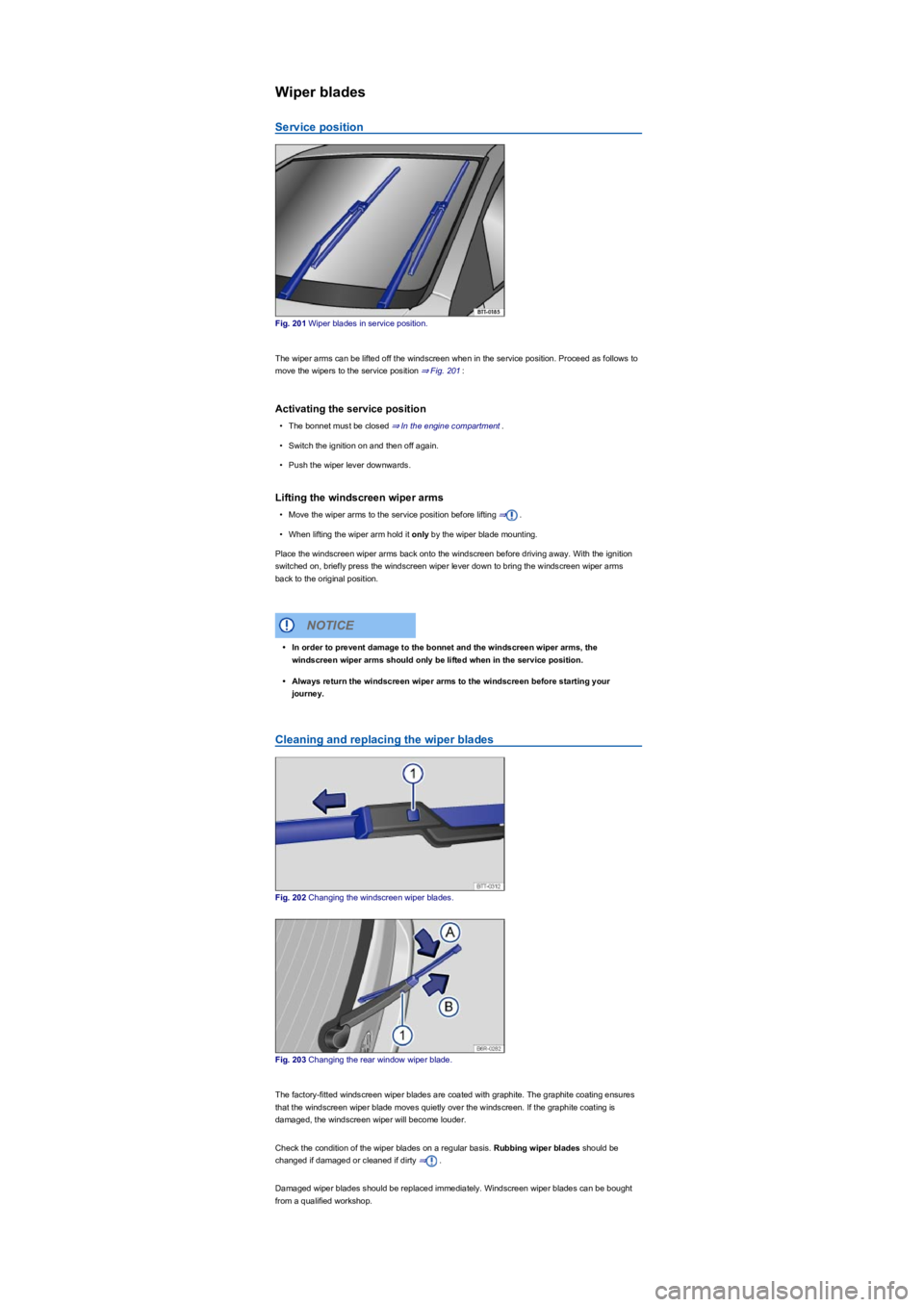
Fig. 201 Wiper blades in service position.
The wiper arms can be lifted off the windscreen when in the service position. Proceed as follows to
move the wipers to the service position ⇒ Fig. 201:
Activating the service position
•The bonnet must be closed ⇒ In the engine compartment.
•Switch the ignition on and then off again.
•Push the wiper lever downwards.
Lifting the windscreen wiper arms
•Move the wiper arms to the service position before lifting ⇒.
•When lifting the wiper arm hold it only by the wiper blade mounting.
Place the windscreen wiper arms back onto the windscreen before driving away. With the ignition
switched on, briefly press the windscreen wiper lever down to bring the windscreen wiper arms
back to the original position.
Cleaning and replacing the wiper blades
Fig. 202 Changing the windscreen wiper blades.
Fig. 203 Changing the rear window wiper blade.
The factory-fitted windscreen wiper blades are coated with graphite. The graphite coating ensures
that the windscreen wiper blade moves quietly over the windscreen. If the graphite coating is
damaged, the windscreen wiper will become louder.
Check the condition of the wiper blades on a regular basis. Rubbing wiper blades should be
changed if damaged or cleaned if dirty ⇒.
Damaged wiper blades should be replaced immediately. Windscreen wiper blades can be bought
from a qualified workshop.
•In order to prevent damage to the bonnet and the windscreen wiper arms, the
windscreen wiper arms should only be lifted when in the service position.
•Always return the windscreen wiper arms to the windscreen before starting your
journey.
NOTICE
Page 254 of 341
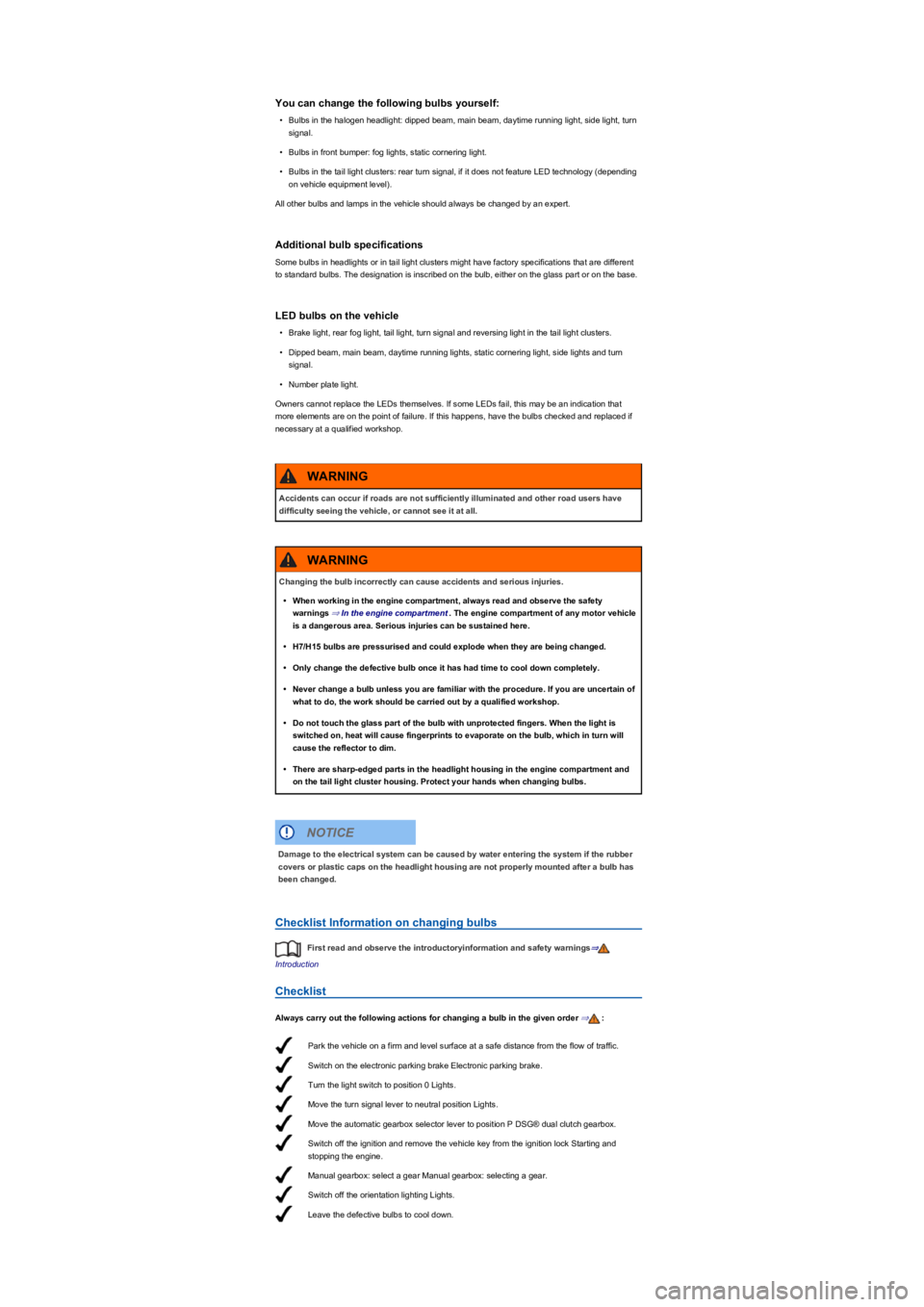
Park the vehicle on a firm and level surface at a safe distance from the flow of traffic.
Switch on the electronic parking brake Electronic parking brake.
Turn the light switch to position 0 Lights.
Move the turn signal lever to neutral position Lights.
Move the automatic gearbox selector lever to position P DSG® dual clutch gearbox.
Switch off the ignition and remove the vehicle key from the ignition lock Starting and
stopping the engine.
Manual gearbox: select a gear Manual gearbox: selecting a gear.
Switch off the orientation lighting Lights.
Leave the defective bulbs to cool down.
You can change the following bulbs yourself:
•Bulbs in the halogen headlight: dipped beam, main beam, daytime running light, side light, turn
signal.
•Bulbs in front bumper: fog lights, static cornering light.
•Bulbs in the tail light clusters: rear turn signal, if it does not feature LED technology (depending
on vehicle equipment level).
All other bulbs and lamps in the vehicle should always be changed by an expert.
Additional bulb specifications
Some bulbs in headlights or in tail light clusters might have factory specifications that are different
to standard bulbs. The designation is inscribed on the bulb, either on the glass part or on the base.
LED bulbs on the vehicle
•Brake light, rear fog light, tail light, turn signal and reversing light in the tail light clusters.
•Dipped beam, main beam, daytime running lights, static cornering light, side lights and turn
signal.
•Number plate light.
Owners cannot replace the LEDs themselves. If some LEDs fail, this may be an indication that
more elements are on the point of failure. If this happens, have the bulbs checked and replaced if
necessary at a qualified workshop.
Checklist Information on changing bulbs
First read and observe the introductoryinformation and safety warnings⇒
Introduction
Checklist
Always carry out the following actions for changing a bulb in the given order ⇒:
Accidents can occur if roads are not sufficiently illuminated and other road users have
difficulty seeing the vehicle, or cannot see it at all.
WARNING
Changing the bulb incorrectly can cause accidents and serious injuries.
•When working in the engine compartment, always read and observe the safety
warnings ⇒ In the engine compartment. The engine compartment of any motor vehicle
is a dangerous area. Serious injuries can be sustained here.
•H7/H15 bulbs are pressurised and could explode when they are being changed.
•Only change the defective bulb once it has had time to cool down completely.
•Never change a bulb unless you are familiar with the procedure. If you are uncertain of
what to do, the work should be carried out by a qualified workshop.
•Do not touch the glass part of the bulb with unprotected fingers. When the light is
switched on, heat will cause fingerprints to evaporate on the bulb, which in turn will
cause the reflector to dim.
•There are sharp-edged parts in the headlight housing in the engine compartment and
on the tail light cluster housing. Protect your hands when changing bulbs.
WARNING
Damage to the electrical system can be caused by water entering the system if the rubber
covers or plastic caps on the headlight housing are not properly mounted after a bulb has
been changed.
NOTICE
Page 259 of 341
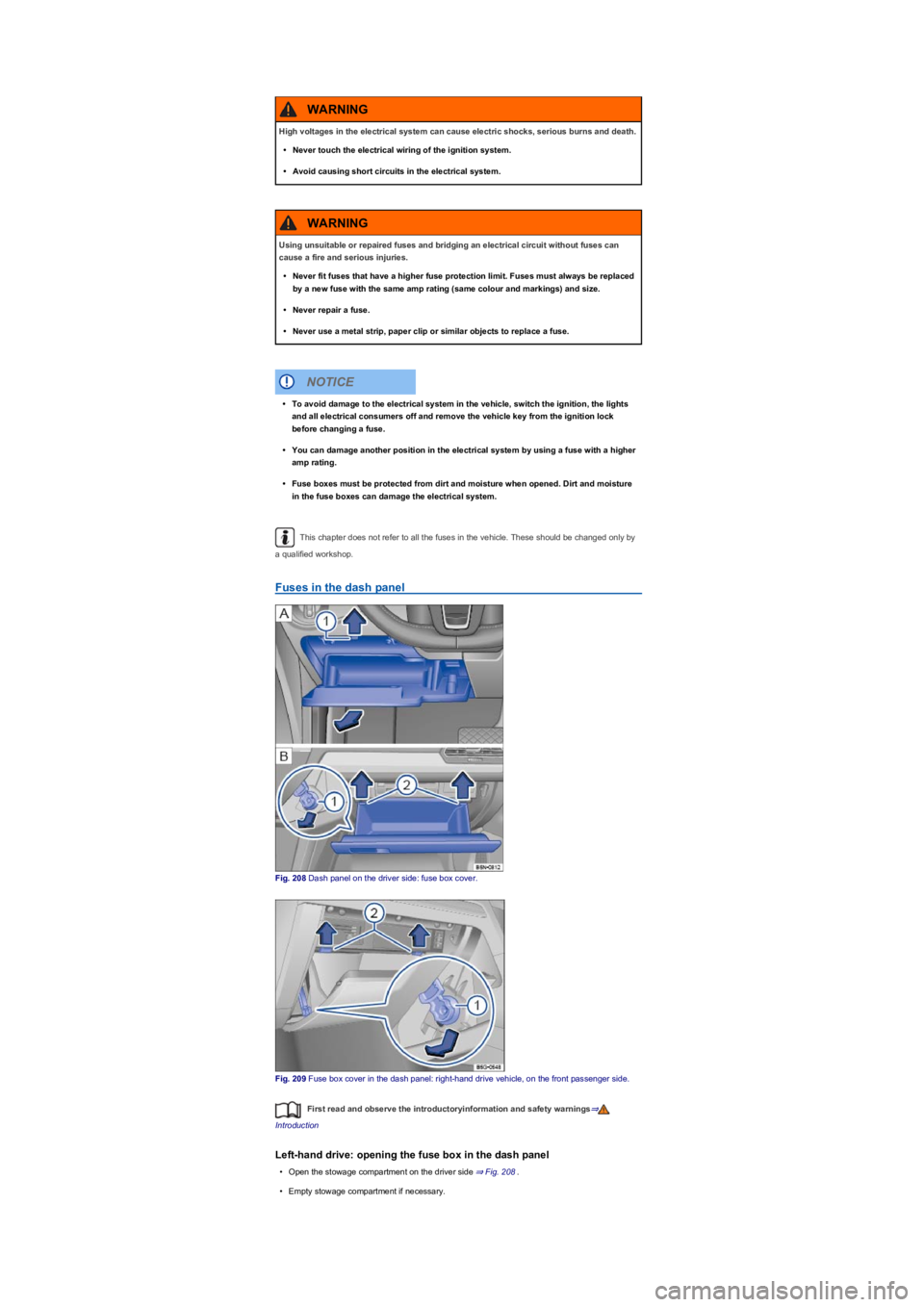
This chapter does not refer to all the fuses in the vehicle. These should be changed only by
a qualified workshop.
Fuses in the dash panel
Fig. 208 Dash panel on the driver side: fuse box cover.
Fig. 209 Fuse box cover in the dash panel: right-hand drive vehicle, on the front passenger side.
First read and observe the introductoryinformation and safety warnings⇒
Introduction
Left-hand drive: opening the fuse box in the dash panel
•Open the stowage compartment on the driver side ⇒ Fig. 208.
•Empty stowage compartment if necessary.
High voltages in the electrical system can cause electric shocks, serious burns and death.
•Never touch the electrical wiring of the ignition system.
•Avoid causing short circuits in the electrical system.
WARNING
Using unsuitable or repaired fuses and bridging an electrical circuit without fuses can
cause a fire and serious injuries.
•Never fit fuses that have a higher fuse protection limit. Fuses must always be replaced
by a new fuse with the same amp rating (same colour and markings) and size.
•Never repair a fuse.
•Never use a metal strip, paper clip or similar objects to replace a fuse.
WARNING
•To avoid damage to the electrical system in the vehicle, switch the ignition, the lights
and all electrical consumers off and remove the vehicle key from the ignition lock
before changing a fuse.
•You can damage another position in the electrical system by using a fuse with a higher
amp rating.
•Fuse boxes must be protected from dirt and moisture when opened. Dirt and moisture
in the fuse boxes can damage the electrical system.
NOTICE