Oil VOLKSWAGEN TIGUAN 2017 Owner´s Manual
[x] Cancel search | Manufacturer: VOLKSWAGEN, Model Year: 2017, Model line: TIGUAN, Model: VOLKSWAGEN TIGUAN 2017Pages: 341, PDF Size: 9.14 MB
Page 130 of 341
m/k/a995MK Vehicles with manual gearbox: change from first to second gear immediately
after setting off. Change to higher gears rapidly.
m/k/a995MK Vehicles with DSG dual clutch gearbox: accelerate slowly and avoid using the
kickdown function.
Gear-change indicator ⇒ Gear-change indicator.
Eco driving profile ⇒ Driving profile selection and 4MOTION Active Control.
Avoid full throttle
Never fully use the maximum speed of the vehicle. Driving at excessive speeds, e.g. above 130
km/h on the motorway, will increase air resistance and thus the amount of force needed to move
the vehicle.
Reduce idling
Drive off immediately with low revs. If you are stopped for a long period, do not allow the engine to
idle but switch it off, e.g. when in a traffic jam or at a railway crossing.
In vehicles with an activated start/stop system, the engine will switch off automatically when the
vehicle is stopping and when the vehicle is stationary ⇒ Start/stop system .
Refuel with moderation
A full fuel tank increases the weight of the vehicle. A fuel tank that is half to three quarters full is
sufficient for urban journeys in particular.
Avoid short journeys
A cold engine has a very high fuel consumption. The optimum operating temperature is reached
only after driving a few miles. The fuel consumption is above average at very low ambient
temperatures, e.g. in winter ⇒ Fig. 116. Plan journeys economically and combine short distances.
Carry out regular maintenance
Regular maintenance is an essential prerequisite for economical driving and increases the service
life of the vehicle.
Observe the correct tyre pressures
An inadequate tyre pressure does not just mean greater wear, but also increases the rolling
resistance of the tyres and thus the fuel consumption. Use optimised rolling resistance tyres.
Adjust the tyre pressure according to the vehicle load. Observe the information on the tyre pressure
sticker ⇒ Useful information about wheels and tyres
Tyre Pressure Loss Indicator or Tyre Pressure Monitoring System ⇒ Tyre monitoring systems.
Use low viscosity engine oil
Fully synthetic engine oils with a low viscosity decrease frictional resistance in the engine and
spread better and more quickly, especially for cold starts.
Do not drive with unnecessary loads in the vehicle
You can reduce fuel consumption by clearing out the luggage compartment before setting off, for
example by removing empty drink crates or unused child seats.
In order to keep the drag coefficient of the vehicle as low as possible, remove attachments and
add-on parts such as ski, bicycle or roof carriers after use.
Save electrical energy
The alternator is driven by the engine and generates power for convenience consumers such as the
air conditioning system, window heating and ventilation. Saving electrical energy is easy, e.g.:
•At high ambient temperatures, ventilate the car before starting a journey and drive a short
distance with open window. Only then switch on the air conditioning system.
•Switch off convenience systems as soon as they have served their purpose.
Adapt your speed and distance from the vehicles ahead to suit visibility, weather, road
and traffic conditions.
WARNING
Page 132 of 341
situations should be avoided that create a heavy load on the brakes, e.g. when driving up close to
the vehicle ahead.
The rate of wear of the brake pads depends to a great extent on the conditions under which the
vehicle is operated and the way in which the vehicle is driven. If the vehicle is used for regular
urban trips, short journeys, and is driven with a sporty driving style, the brake pads must be
regularly checked by a qualified workshop.
When driving with wet brakes, for example after driving through water, after heavy rainfall or after
washing the vehicle, the braking effect may be delayed as the brake discs will be wet, or possibly
iced up (in winter). The brakes must be dried as quickly as possible by careful braking at higher
speed. Please ensure that no following vehicle and no other road user is put at risk as a result of
this action ⇒.
Any salt layer accumulating on the discs and pads will delay the braking effect and increase the
braking distance. If the brakes on the vehicle have not been applied for a long time on roads that
have been gritted with salt, the layer of salt must be reduced through careful braking ⇒.
Corrosion on the brake discs and dirt in the brake pads are facilitated through long periods of
inactivity, low mileage and low load levels. If the brake pads have been hardly used, or if they are at
all corroded, Volkswagen recommends that the brake discs and brake pads be cleaned by braking
strongly several times from high speed. Please ensure that no following vehicle and no other road
user is put at risk as a result of this action ⇒.
Brake servo
The brake servo will only function when the engine is running and reinforces the pressure applied
by the driver on the brake pedal.
If the brake servo is not functioning or the vehicle is being towed, the brake pedal will have to be
depressed more forcefully as the braking distance will be increased due to the lack of assistance for
the brake system ⇒.
Driving with worn brake pads or with a faulty brake system can cause accidents and
serious injuries.
•If the warning lamp lights up either alone or together with a text message in the
instrument cluster display, go to a qualified workshop immediately to have the brake
pads checked and the worn brake pads replaced.
WARNING
New brake pads will not have the optimal braking effect when first fitted.
•New brake pads cannot generate the full braking effect during the first 300 km (186
miles) and must first be run in. A reduced braking effect can be increased by applying
more pressure to the brake pedal.
•You must drive particularly carefully when driving with new brake pads in order to
reduce the risk of accidents, serious injuries and loss of control of the vehicle.
•Never drive too close to other vehicles when running in new brake pads, and never
create a driving situation that will place a heavy load on the brakes.
WARNING
Overheated brakes reduce the braking effect and considerably increase the braking
distance.
•When driving downhill the brakes are placed under particular strain and become hot
very quickly.
•Before driving down a long, steep gradient, reduce speed and change to a lower gear
(with manual gearboxes or in Tiptronic mode with the DSG dual clutch gearbox). This
will make use of the engine braking effect and relieve the load on the brakes.
•Non-standard or damaged front spoilers could restrict the airflow to the brakes and
cause them to overheat.
WARNING
Page 135 of 341
Running in the engine
First read and observe the introductoryinformation and safety warnings⇒
Introduction
Any new engine has to be run in during the first 1,500 kilometres. All moving parts have to adapt
themselves to each other. The engine is subject to higher internal friction during the first hours of
operation than later on.
•Do not depress the accelerator fully.
•Do not drive the vehicle at more than 2/3 of the top engine speed.
•Do not drive with a trailer attached ⇒ Trailer towing.
•Increase the driving speed and engine speed gradually.
The style of driving during the first 1,500 kilometres will also affect the engine quality. Even after
this time – and especially with a cold engine – drive the vehicle at moderate speeds in order to
reduce engine wear and to increase the mileage that the engine can cover.
Do not drive at engine speeds that are too low. Always shift down gear if the engine is not running
smoothly.
New tyres ⇒ Wheels and tyres and brake pads ⇒ Notes on driving must be run in carefully.
If the engine is run in gently, its life will be increased and its oil consumption reduced.
Using the vehicle in other countries and continents
First read and observe the introductoryinformation and safety warnings⇒
Introduction
The vehicle has been manufactured specifically for a particular country and complies with the
registration regulations that applied in that country at the time of vehicle production.
If you want to use the vehicle abroad for a short period, all relevant information and instructions
should be followed ⇒ Safety.
If the vehicle is going to be sold in another country or used in another country for an extended
period, the legal requirements applicable in that country must be observed.
In some cases, certain equipment will have to be fitted or removed and functions deactivated. The
service scope and service types could also be affected. This is particularly important if the vehicle is
driven in another climate region for a long period of time.
Because different frequency bands are used in different countries, the factory-fitted Infotainment
system may not work in other countries.
Troubleshooting
First read and observe the introductoryinformation and safety warnings⇒
Introduction
After driving through water, mud, slush etc., the brakes may react slowly and the braking
distance will be increased as the brake discs and pads will be wet, or possibly iced up in
winter.
•You can dry and de-ice the brakes by performing careful braking manoeuvres. Ensure
that you do not endanger any other road users or violate any legal regulations when
doing so.
•Avoid abrupt and sudden braking manoeuvres directly after driving through water.
WARNING
•If you drive through water, parts of the vehicle, such as the engine, drive train, running
gear and vehicle electrics, could sustain severe damage.
•Never drive through salt water as salt can cause corrosion. Rinse all components that
have been exposed to salt water immediately with fresh water.
NOTICE
•Volkswagen is not responsible for any vehicle damage caused by low-quality fuel,
inadequate servicing work or lack of Genuine Parts.
•Volkswagen cannot be held responsible if the vehicle does not comply with or only
partly complies with the relevant legal requirements in other countries and continents.
NOTICE
Page 136 of 341
Warning lights and text messages are shown on the instrument cluster display. These warnings
may be accompanied by acoustic signals.
Front brake pads worn. Go to a qualified workshop immediately. All brake pads should be
checked and renewed as necessary.
Malfunction in the brake system
A brake circuit may have failed if you have to reduce speed and the vehicle does not brake as
normal (sudden increase in braking distance). This is indicated by the warning lamp and in
some cases by a text message. Go to the nearest qualified workshop immediately to have the fault
corrected. Drive at low speed when doing this and anticipate much longer braking distances and an
increase in the pressure required on the pedal.
Starting and stopping the engine
Introduction
This chapter contains information on the followingsubjects:
⇒ Ignition lock
⇒ Starter button
⇒ Starting the engine
⇒ Stopping the engine
⇒ Electronic immobiliser
⇒ Troubleshooting
Push-starting or tow-starting
For technical reasons, your vehicle must not be push-started or tow-started. Use jump leads to
start the engine instead ⇒ Jump starting.
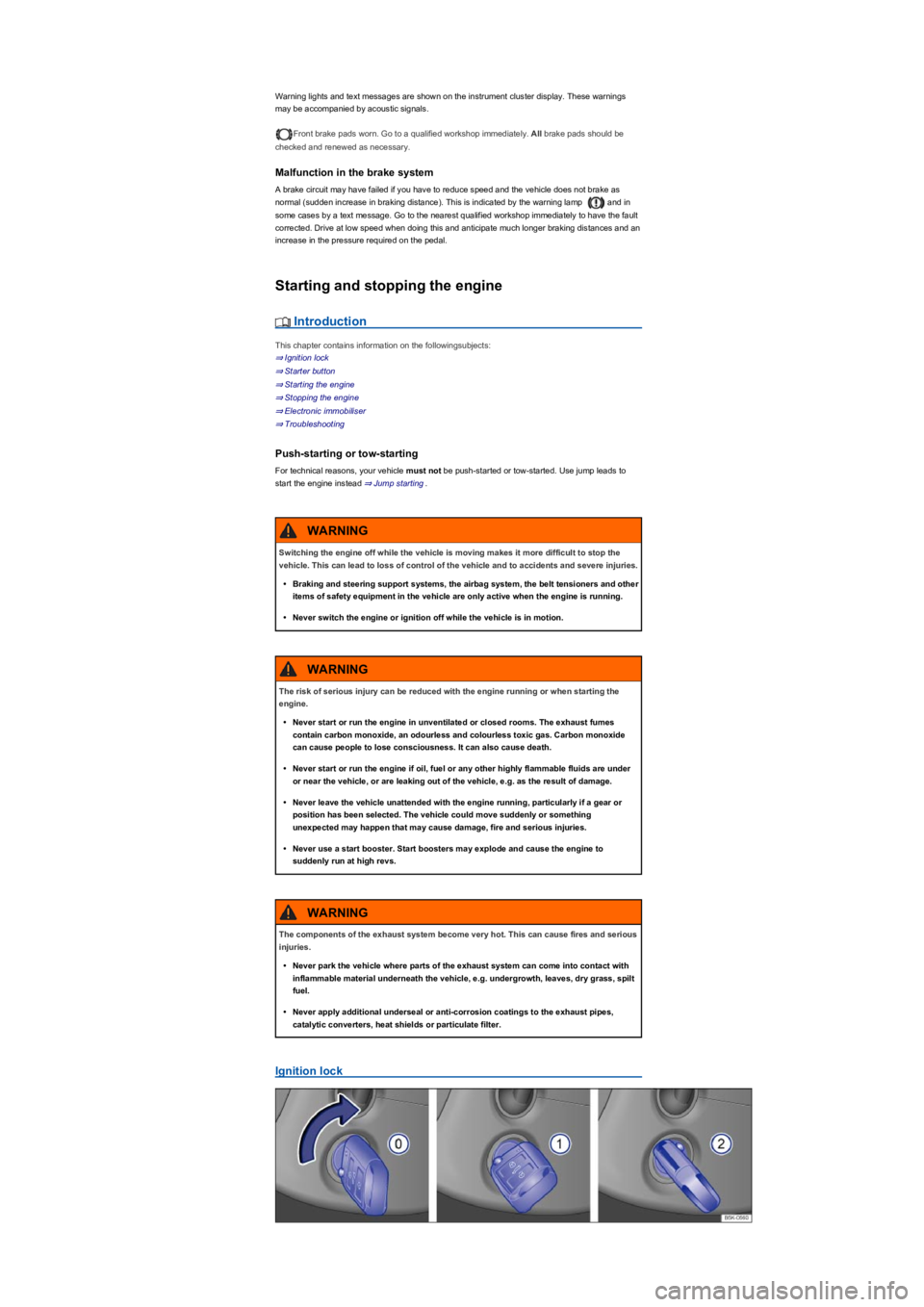
Ignition lock
Switching the engine off while the vehicle is moving makes it more difficult to stop the
vehicle. This can lead to loss of control of the vehicle and to accidents and severe injuries.
•Braking and steering support systems, the airbag system, the belt tensioners and other
items of safety equipment in the vehicle are only active when the engine is running.
•Never switch the engine or ignition off while the vehicle is in motion.
WARNING
The risk of serious injury can be reduced with the engine running or when starting the
engine.
•Never start or run the engine in unventilated or closed rooms. The exhaust fumes
contain carbon monoxide, an odourless and colourless toxic gas. Carbon monoxide
can cause people to lose consciousness. It can also cause death.
•Never start or run the engine if oil, fuel or any other highly flammable fluids are under
or near the vehicle, or are leaking out of the vehicle, e.g. as the result of damage.
•Never leave the vehicle unattended with the engine running, particularly if a gear or
position has been selected. The vehicle could move suddenly or something
unexpected may happen that may cause damage, fire and serious injuries.
•Never use a start booster. Start boosters may explode and cause the engine to
suddenly run at high revs.
WARNING
The components of the exhaust system become very hot. This can cause fires and serious
injuries.
•Never park the vehicle where parts of the exhaust system can come into contact with
inflammable material underneath the vehicle, e.g. undergrowth, leaves, dry grass, spilt
fuel.
•Never apply additional underseal or anti-corrosion coatings to the exhaust pipes,
catalytic converters, heat shields or particulate filter.
WARNING
Page 153 of 341
Steering
Information on steering
The steering should be locked every time you leave the vehicle to make it more difficult for the
vehicle to be stolen.
Steering
The power steering is not hydraulic. It is an electromechanical system. The advantage of this
steering system is that no hydraulic hoses, hydraulic oil, pumps, filter or other parts are required.
The electromechanical system reduces fuel consumption. A hydraulic system requires constant oil
pressure in the system, whereas an electromechanical steering system only needs an energy
supply while steering.
In vehicles with driving profile selection, the selected driving profile can affect the behaviour of the
power steering ⇒ Driving profile selection and 4MOTION Active Control.
Electronic steering column lock in vehicles with starter button
The steering column will be locked if the driver door is opened and the ignition is switched off. For
this, the vehicle should be stationary and, if necessary, the gear selector lever should be in position
P.
If the ignition is not switched off until after the driver door is opened, the electronic steering column
will only be locked when the vehicle is locked using the vehicle key or the sensor in the door
handle.
Mechanical steering column lock (steering lock) in vehicles with an
ignition lock
The steering column is locked if the vehicle key is removed from the ignition lock when the vehicle
is stationary. Turn the steering wheel slightly until the steering lock clicks into place.
Insert the vehicle key into the ignition lock to unlock the steering lock. Turn the steering wheel
slightly to take the load off the steering lock mechanism. Hold the steering wheel in this position and
turn the ignition on.
Electromechanical steering
The power steering provided by the electromechanical steering system automatically adjusts to the
vehicle speed, steering wheel torque and steering wheel angle. The electromechanical steering
only functions when the engine is running.
You will need considerably more strength than normal to steer the vehicle if the power steering is
reduced or has failed completely.
Counter steering assistance
Counter steering assistance provides the driver with power steering in critical driving situations.
Additional steering power helps the driver when counter steering ⇒.
The intelligent Hill Descent Control technology cannot overcome the laws of physics, and
functions only within the limits of the system. Never allow the extra convenience afforded
by pull-away assist systems to tempt you into taking any risks when driving.
•Unintentional vehicle movements can cause serious injury.
•The Hill Descent Control cannot replace the full concentration of the driver.
•Always adapt your speed and driving style to suit visibility, weather, road and traffic
conditions.
•A Hill Descent Control System may not be able to always hold the vehicle on uphill
gradients or brake it sufficiently on all slopes going downhill (e.g. if the ground is
slippery or icy).
WARNING
Always be prepared to brake the vehicle. Accidents and injuries could occur if this is not
ensured.
•The Hill Descent Control system is only a support function and may not be able to
brake the vehicle sufficiently in all situations when driving downhill.
•The vehicle may accelerate despite the Hill Descent Control system.
WARNING
Page 158 of 341
•Press the button in the Infotainment system.
•Touch the Vehicle function button.
•Touch the Selection function button.
•Touch the Off-road function button.
Selecting instruments and setting units
The display shows various instruments ⇒ Fig. 130.
To change instruments, swipe vertically over the display.
The units can be adjusted for some instruments in the Infotainment system ⇒ Operation and
display in the Infotainment system.
Instruments in the off-road display (depends on the vehicle's equipment):
•Altitude: The altitude function shows the current height above sea level.
•Steering angle display: the steering angle of the vehicle is displayed in the range between -
49° and 49°. The value is positive for a left steering angle and negative for a right steering
angle.
•Compass: the compass shows the current driving direction.
•Coolant temperature display: the display corresponds to the temperature display on the
instrument cluster ⇒ Coolant temperature display. At high engine loads and with high outside
temperatures, the needle will move clockwise. This is no cause for concern unless the
indicator lamp in the instrument cluster is lit up or flashing.
•Oil temperature display: the needle is in the middle when the engine has reached operating
temperature. If the needle is in the bottom left area, this means that the engine has not yet
reached its operating temperature. At high engine loads and with high outside temperatures, the
needle will move clockwise. This is no cause for concern unless the indicator lamp in
the instrument cluster is lit up or flashing ⇒ Engine oil.
Adapting the display areas to the driving situation
The displayed instruments can be selected depending on the driving situation, the ambient
conditions and the off-road conditions:
•Sandy terrain: oil, steering angle and coolant temperature display
•Inclines: steering angle and coolant temperature display, altimeter
•Alpine terrain: steering angle display, altimeter, compass
Off-road driving situations
Introduction
This chapter contains information on the followingsubjects:
⇒ Safety notes for driving off-road
⇒ Explanation of some technical terms
⇒ Checklist: Before driving off-road
⇒ General rules and driving tips
⇒ Useful accessories for off-road driving
⇒ Changing gear
⇒ Up hill and down dale
⇒ Driving through water
⇒ Off-road driving in snow
⇒ Driving in sand and mud
⇒ Driving in steep terrain
⇒ Traversing a slope
⇒ Driving through ditches
⇒ If your vehicle gets stuck
⇒ After off-road driving
You can also drive four-wheel drive vehicles off-road in addition to normal roads. It is very important
to read the contents of this section before driving off-road.
The vehicle is not built for expeditions.
The examples given in this chapter are an aid for safe off-road driving. However, we cannot predict
whether these guidelines will be valid for all situations that could occur.
The large variety of landscapes and the associated risks and dangers make it impossible to
describe all possible driving situations. The examples are only general guidelines designed to help
you drive off-road safely. It is crucial that you know what to expect when you drive into off-road
terrain you are unfamiliar with. This will enable you to assess potential danger in advance.
Accidents and injuries can occur if the driver is distracted. Operating the Infotainment
system can distract you from the road.
•Always drive carefully and responsibly.
WARNING
Page 161 of 341
Obtain sufficient information before driving into off-road terrain with the vehicle.
Do not plan day tours that are too long. Take increased fuel requirements for off-road
driving into account.
Refill tank completely. Fuel consumption is considerably higher off-road.
Check that your tyres are suitable for the off-road journey you have planned.
Recommendation for difficult off-road terrain: always have off-road tyres fitted to your
vehicle.
Check the tyre pressure on all tyres and correct them if necessary. This includes the
temporary spare wheel, if fitted.
Check engine oil level and refill engine oil as necessary. The engine will only be supplied
with engine oil when it is driven on or across a steep slope if the engine oil level is
sufficient.
Completely refill the washer fluid reservoir with water and washer fluid.
Fit the towing eye at the front and rear. It is not always possible to fit a towing eye when
the vehicle is stuck.
Check the vehicle tool kit and add tools according to individual requirements Useful
accessories for off-road driving.
Pack luggage in the vehicle as evenly and as low as possible. Secure all loose items.
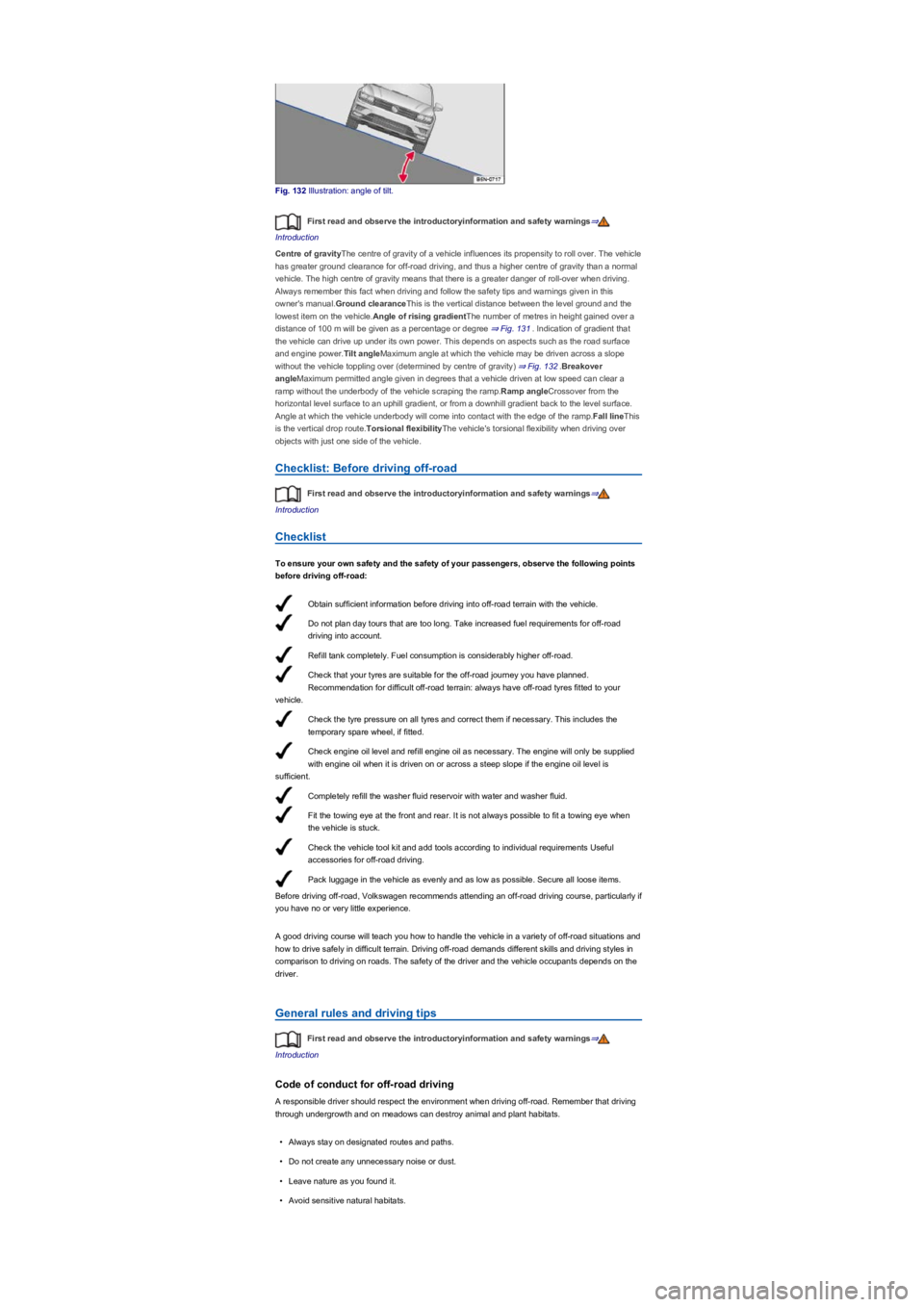
Fig. 132 Illustration: angle of tilt.
First read and observe the introductoryinformation and safety warnings⇒
Introduction
Centre of gravityThe centre of gravity of a vehicle influences its propensity to roll over. The vehicle
has greater ground clearance for off-road driving, and thus a higher centre of gravity than a normal
vehicle. The high centre of gravity means that there is a greater danger of roll-over when driving.
Always remember this fact when driving and follow the safety tips and warnings given in this
owner's manual.Ground clearanceThis is the vertical distance between the level ground and the
lowest item on the vehicle.Angle of rising gradientThe number of metres in height gained over a
distance of 100 m will be given as a percentage or degree ⇒ Fig. 131. Indication of gradient that
the vehicle can drive up under its own power. This depends on aspects such as the road surface
and engine power.Tilt angleMaximum angle at which the vehicle may be driven across a slope
without the vehicle toppling over (determined by centre of gravity) ⇒ Fig. 132.Breakover
angleMaximum permitted angle given in degrees that a vehicle driven at low speed can clear a
ramp without the underbody of the vehicle scraping the ramp.Ramp angleCrossover from the
horizontal level surface to an uphill gradient, or from a downhill gradient back to the level surface.
Angle at which the vehicle underbody will come into contact with the edge of the ramp.Fall lineThis
is the vertical drop route.Torsional flexibilityThe vehicle's torsional flexibility when driving over
objects with just one side of the vehicle.
Checklist: Before driving off-road
First read and observe the introductoryinformation and safety warnings⇒
Introduction
Checklist
To ensure your own safety and the safety of your passengers, observe the following points
before driving off-road:
Before driving off-road, Volkswagen recommends attending an off-road driving course, particularly if
you have no or very little experience.
A good driving course will teach you how to handle the vehicle in a variety of off-road situations and
how to drive safely in difficult terrain. Driving off-road demands different skills and driving styles in
comparison to driving on roads. The safety of the driver and the vehicle occupants depends on the
driver.
General rules and driving tips
First read and observe the introductoryinformation and safety warnings⇒
Introduction
Code of conduct for off-road driving
A responsible driver should respect the environment when driving off-road. Remember that driving
through undergrowth and on meadows can destroy animal and plant habitats.
•Always stay on designated routes and paths.
•Do not create any unnecessary noise or dust.
•Leave nature as you found it.
•Avoid sensitive natural habitats.
Page 163 of 341
•Use the Off-road display ⇒ Off-road display.
Up hill and down dale
First read and observe the introductoryinformation and safety warnings⇒
Introduction
Use off-road mode ⇒ Selecting a driving profile (4MOTION Action Control).
You should drive through rocky terrain at walking pace.
If you are not able to drive around a stone, drive carefully onto the stone with one front wheel and
drive over it slowly ⇒.
Escaping engine oil and brake fluid can pollute the environment. Spilt service fluids must be
collected and then disposed of properly and in an environmentally responsible way.
Driving through water
First read and observe the introductoryinformation and safety warnings⇒
Introduction
Driving through flooded terrain could damage the vehicle ⇒ Checklist: Before driving off-road.
You can drive the vehicle carefully through water with a depth reaching to the bottom edge of the
body, for example puddles or shallow water. Never stop in the water, do not drive in reverse, and
never switch off the engine.
Off-road driving in snow
First read and observe the introductoryinformation and safety warnings⇒
Introduction
Fit snow chains to the front wheels only before driving on snow-covered terrain.
Terrain might look harmless, but there could be hidden dangers. This is particularly true of sections
where there are no tyre tracks.
•You should never drive straight over large obstacles, e.g. boulders or tree stumps, or
drive over such obstacles with one side of the vehicle. Obstacles which require more
ground clearance than is available could damage vehicle components when you drive
over them and thus cause the vehicle to break down.
•Even obstacles that are smaller than the ground clearance selected could come into
contact with the vehicle underbody and thus cause damage which could lead to a
vehicle breakdown. This applies in particular if there is a ditch or soft ground either in
front of or behind the obstacle. This also applies in cases when you drive too quickly
over the obstacle causing the vehicle to bounce.
NOTICE
Strong flowing water can develop enormous power and sweep the vehicle away. This can
lead to very dangerous situations which can cause accidents and serious or even fatal
accidents.
•Never allow the vehicle to stand still in water.
•Water in the engine compartment can cause the vehicle to breakdown in the water.
•Soft ground surface, underwater obstacles and shallows can cause accidents and can
cause the vehicle to breakdown in the water. This could lead to critical situations.
WARNING
If you drive through water, parts of the vehicle, such as the engine, drive train, running
gear and vehicle electrics, could sustain severe damage.
•When driving through water, always select a section where the ground is solid and
where the depth of the water does not exceed the maximum permitted wading depth of
the vehicle.
•Never drive through salt, salty surfaces or salt water as salt can cause corrosion. Rinse
all components that have been exposed to salt or salt water thoroughly with fresh
water.
NOTICE
Page 167 of 341
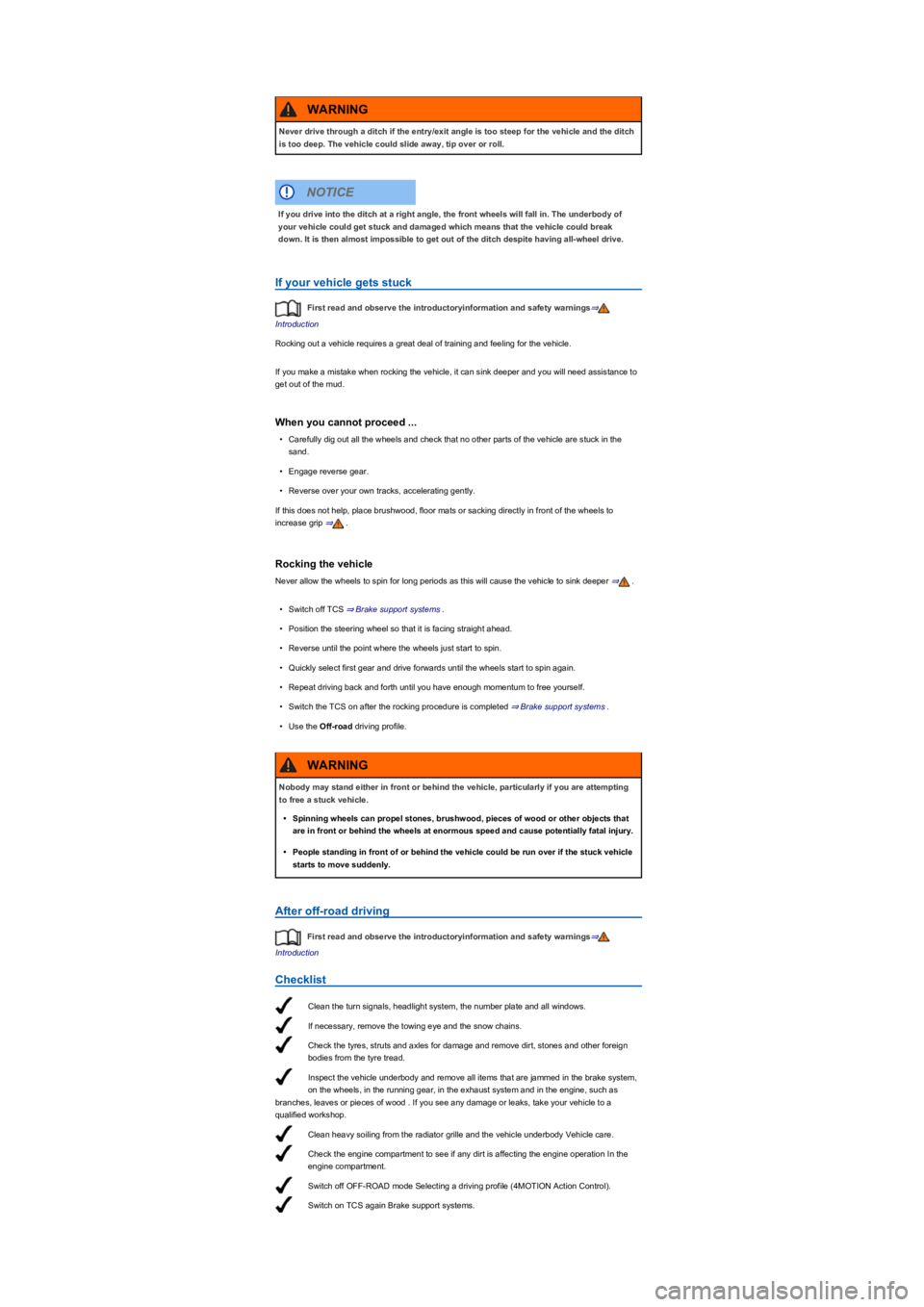
Clean the turn signals, headlight system, the number plate and all windows.
If necessary, remove the towing eye and the snow chains.
Check the tyres, struts and axles for damage and remove dirt, stones and other foreign
bodies from the tyre tread.
Inspect the vehicle underbody and remove all items that are jammed in the brake system,
on the wheels, in the running gear, in the exhaust system and in the engine, such as
branches, leaves or pieces of wood . If you see any damage or leaks, take your vehicle to a
qualified workshop.
Clean heavy soiling from the radiator grille and the vehicle underbody Vehicle care.
Check the engine compartment to see if any dirt is affecting the engine operation In the
engine compartment.
Switch off OFF-ROAD mode Selecting a driving profile (4MOTION Action Control).
Switch on TCS again Brake support systems.
If your vehicle gets stuck
First read and observe the introductoryinformation and safety warnings⇒
Introduction
Rocking out a vehicle requires a great deal of training and feeling for the vehicle.
If you make a mistake when rocking the vehicle, it can sink deeper and you will need assistance to
get out of the mud.
When you cannot proceed ...
•Carefully dig out all the wheels and check that no other parts of the vehicle are stuck in the
sand.
•Engage reverse gear.
•Reverse over your own tracks, accelerating gently.
If this does not help, place brushwood, floor mats or sacking directly in front of the wheels to
increase grip ⇒.
Rocking the vehicle
Never allow the wheels to spin for long periods as this will cause the vehicle to sink deeper ⇒.
•Switch off TCS ⇒ Brake support systems.
•Position the steering wheel so that it is facing straight ahead.
•Reverse until the point where the wheels just start to spin.
•Quickly select first gear and drive forwards until the wheels start to spin again.
•Repeat driving back and forth until you have enough momentum to free yourself.
•Switch the TCS on after the rocking procedure is completed ⇒ Brake support systems.
•Use the Off-road driving profile.
After off-road driving
First read and observe the introductoryinformation and safety warnings⇒
Introduction
Checklist
Never drive through a ditch if the entry/exit angle is too steep for the vehicle and the ditch
is too deep. The vehicle could slide away, tip over or roll.
WARNING
If you drive into the ditch at a right angle, the front wheels will fall in. The underbody of
your vehicle could get stuck and damaged which means that the vehicle could break
down. It is then almost impossible to get out of the ditch despite having all-wheel drive.
NOTICE
Nobody may stand either in front or behind the vehicle, particularly if you are attempting
to free a stuck vehicle.
•Spinning wheels can propel stones, brushwood, pieces of wood or other objects that
are in front or behind the wheels at enormous speed and cause potentially fatal injury.
•People standing in front of or behind the vehicle could be run over if the stuck vehicle
starts to move suddenly.
WARNING
Page 189 of 341
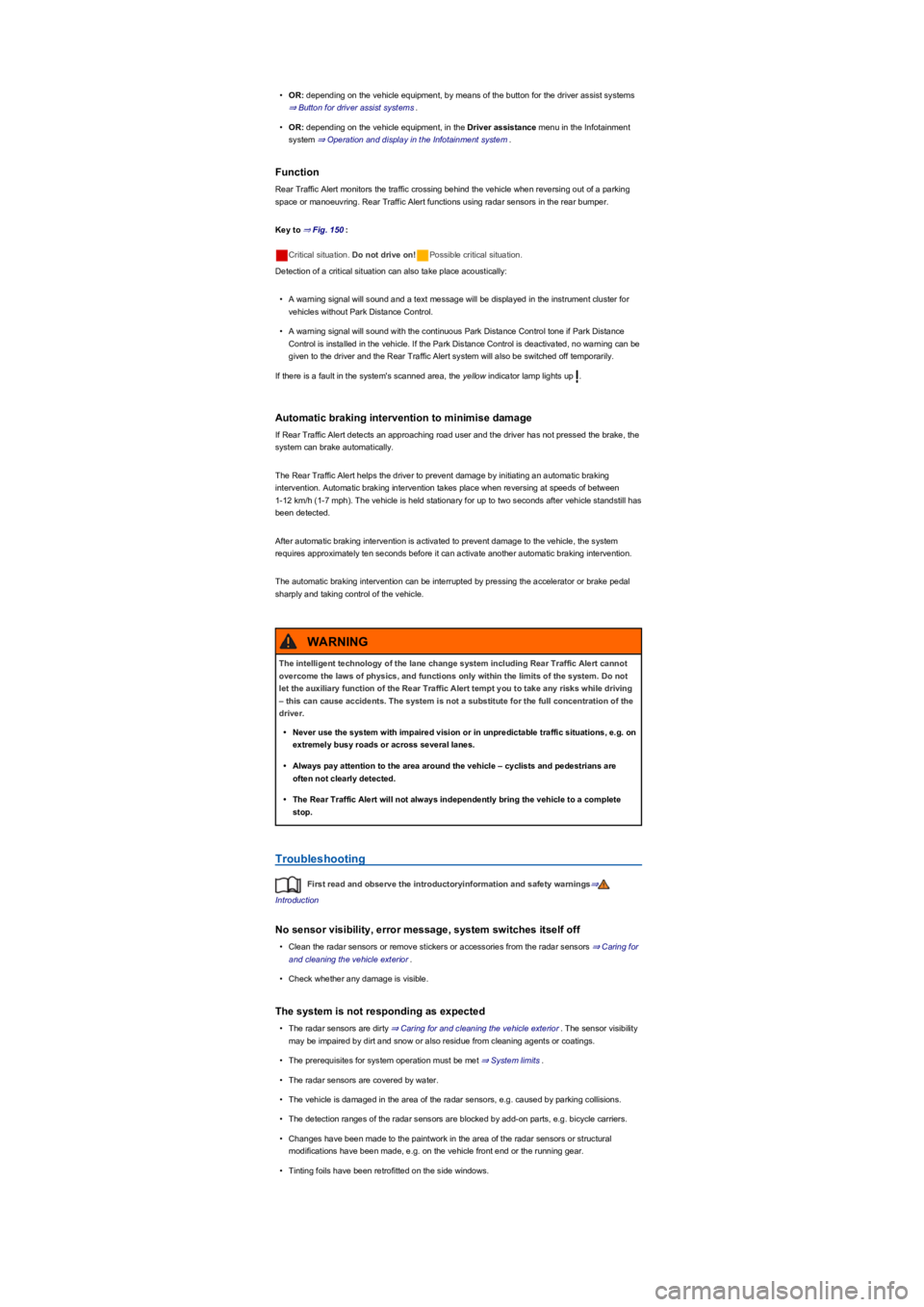
•OR: depending on the vehicle equipment, by means of the button for the driver assist systems
⇒ Button for driver assist systems.
•OR: depending on the vehicle equipment, in the Driver assistance menu in the Infotainment
system ⇒ Operation and display in the Infotainment system.
Function
Rear Traffic Alert monitors the traffic crossing behind the vehicle when reversing out of a parking
space or manoeuvring. Rear Traffic Alert functions using radar sensors in the rear bumper.
Key to ⇒ Fig. 150:
Critical situation. Do not drive on!Possible critical situation.
Detection of a critical situation can also take place acoustically:
•A warning signal will sound and a text message will be displayed in the instrument cluster for
vehicles without Park Distance Control.
•A warning signal will sound with the continuous Park Distance Control tone if Park Distance
Control is installed in the vehicle. If the Park Distance Control is deactivated, no warning can be
given to the driver and the Rear Traffic Alert system will also be switched off temporarily.
If there is a fault in the system's scanned area, the yellow indicator lamp lights up .
Automatic braking intervention to minimise damage
If Rear Traffic Alert detects an approaching road user and the driver has not pressed the brake, the
system can brake automatically.
The Rear Traffic Alert helps the driver to prevent damage by initiating an automatic braking
intervention. Automatic braking intervention takes place when reversing at speeds of between
1-12 km/h (1-7 mph). The vehicle is held stationary for up to two seconds after vehicle standstill has
been detected.
After automatic braking intervention is activated to prevent damage to the vehicle, the system
requires approximately ten seconds before it can activate another automatic braking intervention.
The automatic braking intervention can be interrupted by pressing the accelerator or brake pedal
sharply and taking control of the vehicle.
Troubleshooting
First read and observe the introductoryinformation and safety warnings⇒
Introduction
No sensor visibility, error message, system switches itself off
•Clean the radar sensors or remove stickers or accessories from the radar sensors ⇒ Caring for
and cleaning the vehicle exterior.
•Check whether any damage is visible.
The system is not responding as expected
•The radar sensors are dirty ⇒ Caring for and cleaning the vehicle exterior. The sensor visibility
may be impaired by dirt and snow or also residue from cleaning agents or coatings.
•The prerequisites for system operation must be met ⇒ System limits.
•The radar sensors are covered by water.
•The vehicle is damaged in the area of the radar sensors, e.g. caused by parking collisions.
•The detection ranges of the radar sensors are blocked by add-on parts, e.g. bicycle carriers.
•Changes have been made to the paintwork in the area of the radar sensors or structural
modifications have been made, e.g. on the vehicle front end or the running gear.
•Tinting foils have been retrofitted on the side windows.
The intelligent technology of the lane change system including Rear Traffic Alert cannot
overcome the laws of physics, and functions only within the limits of the system. Do not
let the auxiliary function of the Rear Traffic Alert tempt you to take any risks while driving
– this can cause accidents. The system is not a substitute for the full concentration of the
driver.
•Never use the system with impaired vision or in unpredictable traffic situations, e.g. on
extremely busy roads or across several lanes.
•Always pay attention to the area around the vehicle – cyclists and pedestrians are
often not clearly detected.
•The Rear Traffic Alert will not always independently bring the vehicle to a complete
stop.
WARNING