Oil change VOLKSWAGEN TIGUAN 2017 Owner´s Manual
[x] Cancel search | Manufacturer: VOLKSWAGEN, Model Year: 2017, Model line: TIGUAN, Model: VOLKSWAGEN TIGUAN 2017Pages: 341, PDF Size: 9.14 MB
Page 189 of 341
•OR: depending on the vehicle equipment, by means of the button for the driver assist systems
⇒ Button for driver assist systems.
•OR: depending on the vehicle equipment, in the Driver assistance menu in the Infotainment
system ⇒ Operation and display in the Infotainment system.
Function
Rear Traffic Alert monitors the traffic crossing behind the vehicle when reversing out of a parking
space or manoeuvring. Rear Traffic Alert functions using radar sensors in the rear bumper.
Key to ⇒ Fig. 150:
Critical situation. Do not drive on!Possible critical situation.
Detection of a critical situation can also take place acoustically:
•A warning signal will sound and a text message will be displayed in the instrument cluster for
vehicles without Park Distance Control.
•A warning signal will sound with the continuous Park Distance Control tone if Park Distance
Control is installed in the vehicle. If the Park Distance Control is deactivated, no warning can be
given to the driver and the Rear Traffic Alert system will also be switched off temporarily.
If there is a fault in the system's scanned area, the yellow indicator lamp lights up .
Automatic braking intervention to minimise damage
If Rear Traffic Alert detects an approaching road user and the driver has not pressed the brake, the
system can brake automatically.
The Rear Traffic Alert helps the driver to prevent damage by initiating an automatic braking
intervention. Automatic braking intervention takes place when reversing at speeds of between
1-12 km/h (1-7 mph). The vehicle is held stationary for up to two seconds after vehicle standstill has
been detected.
After automatic braking intervention is activated to prevent damage to the vehicle, the system
requires approximately ten seconds before it can activate another automatic braking intervention.
The automatic braking intervention can be interrupted by pressing the accelerator or brake pedal
sharply and taking control of the vehicle.
Troubleshooting
First read and observe the introductoryinformation and safety warnings⇒
Introduction
No sensor visibility, error message, system switches itself off
•Clean the radar sensors or remove stickers or accessories from the radar sensors ⇒ Caring for
and cleaning the vehicle exterior.
•Check whether any damage is visible.
The system is not responding as expected
•The radar sensors are dirty ⇒ Caring for and cleaning the vehicle exterior. The sensor visibility
may be impaired by dirt and snow or also residue from cleaning agents or coatings.
•The prerequisites for system operation must be met ⇒ System limits.
•The radar sensors are covered by water.
•The vehicle is damaged in the area of the radar sensors, e.g. caused by parking collisions.
•The detection ranges of the radar sensors are blocked by add-on parts, e.g. bicycle carriers.
•Changes have been made to the paintwork in the area of the radar sensors or structural
modifications have been made, e.g. on the vehicle front end or the running gear.
•Tinting foils have been retrofitted on the side windows.
The intelligent technology of the lane change system including Rear Traffic Alert cannot
overcome the laws of physics, and functions only within the limits of the system. Do not
let the auxiliary function of the Rear Traffic Alert tempt you to take any risks while driving
– this can cause accidents. The system is not a substitute for the full concentration of the
driver.
•Never use the system with impaired vision or in unpredictable traffic situations, e.g. on
extremely busy roads or across several lanes.
•Always pay attention to the area around the vehicle – cyclists and pedestrians are
often not clearly detected.
•The Rear Traffic Alert will not always independently bring the vehicle to a complete
stop.
WARNING
Page 248 of 341
The refill bottle must be disposed of in accordance with regulations governing the protection
of the environment.
Catalytic converter
First read and observe the introductoryinformation and safety warnings⇒
Introduction
To help ensure long-term functionality in the exhaust system and the catalytic converter:
•Use unleaded petrol only ⇒ Fuel types and refuelling.
•Do not allow the fuel tank to run completely empty.
•Do not overfill engine oil ⇒ Engine oil.
•Do not tow start the vehicle. Use jump leads ⇒ Jump starting.
If you notice misfiring, uneven running or loss of power when the vehicle is moving, reduce speed
immediately. The vehicle should be inspected at the nearest qualified workshop
⇒ Troubleshooting. If this happens, unburnt fuel can enter the exhaust system and escape into the
atmosphere. The catalytic converter can also be damaged by overheating.
The emissions may have a sulphur-like smell even if the emission purification system is
working properly.
Particulate filter
First read and observe the introductoryinformation and safety warnings⇒
Introduction
Function
The particulate filter filters out soot particles in the exhaust gas. Observe the following points to
ensure that the exhaust purification system will work properly for a long time:
AdBlue is an irritant and corrosive fluid that can damage the skin, eyes and breathing
passages upon contact.
•Always observe the instructions for use when using AdBlue. If containers are used
according to the instructions, it is unlikely that a user will come into contact with
AdBlue.
•AdBlue must be kept in the closed original container. Never use empty food
containers, bottles or other containers for this purpose.
•Always store in a safe place out of reach of children.
•If AdBlue gets into the eyes, immediately rinse the eyes with plenty of water for at
least 15 minutes and consult a doctor.
•If AdBlue gets onto the skin, immediately wash the area with plenty of water for at
least 15 minutes and consult a doctor if the skin becomes irritated.
•If AdBlue is swallowed, immediately rinse the mouth out with lots of water for at least
15 minutes. Do not induce vomiting unless instructed to do so by a doctor. Seek
medical assistance immediately.
CAUTION
®
®
®
®
®
®
®
Overfilling AdBlue may damage the tank system and the vehicle.
•Do not fill with more than the maximum refill quantity indicated on the instrument
cluster display.
•Remove any spilt AdBlue as quickly as possible with a damp cloth and plenty of cold
water.
•If the AdBlue has already formed crystals, use warm water and a sponge to remove.
NOTICE
®
®
®
Improper use of AdBlue may cause damage to the vehicle that is not covered by the
warranty.
•Only use AdBlue that complies with the standard ISO 22241-1.
•Do not mix with water, fuel or additives.
•Never fill AdBlue in the diesel tank.
•Do not transport the refill bottle in the vehicle habitually. The bottle may develop a leak
following changes in temperature and damage and the AdBlue may damage the
vehicle interior.
NOTICE
®
®
®
®
Page 277 of 341
Engine oil
Introduction
This chapter contains information on the followingsubjects:
⇒ Engine oil specification
⇒ Changing the engine oil
⇒ Engine oil consumption
⇒ Checking the engine oil level and refilling the engine oil
⇒ Troubleshooting
Leaking or spilt engine oil can pollute the environment. Spilt service fluids must be collected
then disposed of properly and in an environmentally responsible way.
Engine oil specification
First read and observe the introductoryinformation and safety warnings⇒
Introduction
The correct engine oil is important for the function and service life of the engine. A special high
quality multigrade oil has been filled at the factory and this can normally be used as an all-season
oil.
If possible, use only Volkswagen-approved engine oil ⇒. To comply with flexible oil change
service requirements, refill only with approved flexible service engine oil that meets the
corresponding VW standard. The engine oils listed are multigrade high-lubricity oils.
Engine oils are constantly being developed and improved. Volkswagen dealerships are kept up to
date on all innovations. Volkswagen therefore recommends having engine oil changes done by a
Volkswagen dealership.
The quality of the engine oil is not only tailored to the requirements of engines and exhaust gas
treatment systems, but also to fuel quality. Due to the way in which a combustion engine works,
engine oil always comes into contact with combustion residues and fuel, which has a knock-on
effect on the ageing process of the oil.
The quality of fuels can vary greatly between individual markets and this must be taken into account
when selecting the correct engine oil.
Never mix coolant additive or other unsuitable additives into the windscreen washer fluid.
These may leave an oily film on the screen, restricting the field of vision.
•Use clean, clear water (not distilled water) with a washer fluid recommended by
Volkswagen.
•A suitable anti-freeze agent should be added to the windscreen washer fluid if
necessary.
WARNING
•Never mix other cleaning agents with the cleaning agents recommended by
Volkswagen. This can cause the ingredients to separate and block the windscreen
washer jets.
•When topping up service fluids, please ensure that you pour the correct service fluids
into the correct openings. The use of incorrect service fluids could result in serious
malfunctions and engine damage.
NOTICE
Incorrect handling of engine oil can cause serious burns and other injuries.
•Always wear eye protection when handling engine oil.
•Engine oil is toxic and must be stored out of the reach of children.
•Engine oil must be kept in the closed original container. This also applies to used oil
until it is disposed of.
•Never use empty food containers, bottles or other containers to store engine oil as
other people may then drink the engine oil.
•Regular contact with engine oil can damage the skin. Skin that has been in contact with
engine oil should be washed thoroughly with water and soap.
•Engine oil becomes extremely hot when the engine is running and can scald skin
severely. Always allow the engine to cool down.
WARNING
Page 278 of 341
The use of engine oils compliant with the VW 504 00, VW 507 00 and VW 508 00 specifications
requires a fuel quality compliant with EN 228 (petrol) and EN 590 (diesel), or fuel of an equivalent
quality. Engine oils compliant with VW 504 00, VW 507 00 and VW 508 00 are therefore
unsuitable for use in a large number of markets.
If the engine has been filled with engine oil in accordance with the standards W 502 00, VW 504 00
and VW 507 00, a sticker with the relevant information will be located on the lock carrier in the
engine compartment. Observe this information!
Permitted engine oil specifications ⇒Alternative engine
oil
specifications⇒
Engine typeFlexible
service QI6
(LongLife)
Fixed service QI1,
QI2, QI3, QI4, QI7
(based on
time/distance
travelled)
Only in the EU,
Switzerland,
Norway, Japan
and Australia.
Petrol engines
VW 508 00
Alternatively:
VW 504 00
VW 502 00VW 504 00
Diesel engines with
diesel particulate
filter
VW 507 00VW 507 00–
Diesel engines
without diesel
particulate filter
VW 507 00VW 505 01VW 507 00
Volkswagen recommends . Volkswagen recommends Volkswagen genuine engine
oils.
Alternative engine oil specifications may only be used in fixed services QI1, QI2, QI3, QI4 and
QI7, and only when fuel of a quality compliant with EN 228 (petrol) and EN 590 (diesel), or fuel of
an equivalent quality, is available in the particular country.
The engine oil VW 502 00 must be used if the fuel grade does not comply with EN 228.
Using VW 504 00 instead of VW 508 00 may cause the vehicle's emissions values to increase
slightly.
You can also check with a qualified workshop if you are unsure whether your vehicle is equipped
with a diesel particulate filter. Volkswagen recommends using a Volkswagen dealership for this
purpose.
Changing the engine oil
First read and observe the introductoryinformation and safety warnings⇒
Introduction
The engine oil must be changed on a regular basis. Always observe the service intervals applicable
for your vehicle ⇒ Service.
The engine oil and filter change should be carried out by a qualified workshop due to the special
tools and knowledge required, this also applies to the disposal of used oil. Volkswagen
recommends using a Volkswagen dealership for this purpose.
Please read the notes on the service intervals ⇒ Service.
Additives in the engine oil can cause new engine oil to discolour quickly. This is normal and does
not mean that the engine oil should be changed more frequently.
a)
b)
c)
d)
d)
•Do not add any additional lubricants to the engine oil. Any damage caused by the use
of such additives is not covered by the warranty.
•Only those engine oil specifications that have been approved for use with the engine
should be used. Using other engine oils can cause engine damage.
•Another engine oil can be used in the event of an emergency if the listed engine oils are
not available. To avoid damaging the engine, a maximum quantity of 0.5 litres of the
following engine oil may be used only once until the next oil change:
- Petrol engines: standards ACEAA3/B4 or API SN (API SM).
- Diesel engines: standards ACEA C3 or API CJ-4.
NOTICE
a)
b)
c)
d)
Page 279 of 341
Before changing the engine oil, first find out where old oil can be disposed of properly near
you.
Used oil must be disposed of in accordance with regulations governing the protection of the
environment. Never dispose of old oil in locations such as gardens, woods, sewerage systems, on
streets and roads, or in rivers and waterways.
Engine oil consumption
First read and observe the introductoryinformation and safety warnings⇒
Introduction
Engine oil consumption can vary from engine to engine and can change during the working life of
an engine.
The vehicle may consume up to 1.0 litre of engine oil per 2,000 km, depending on how you drive
and the conditions in which the car is used. In new vehicles, consumption is likely to be higher for
the first 5,000 km. The engine oil level must therefore be checked at regular intervals, preferably
when refuelling and before long journeys.
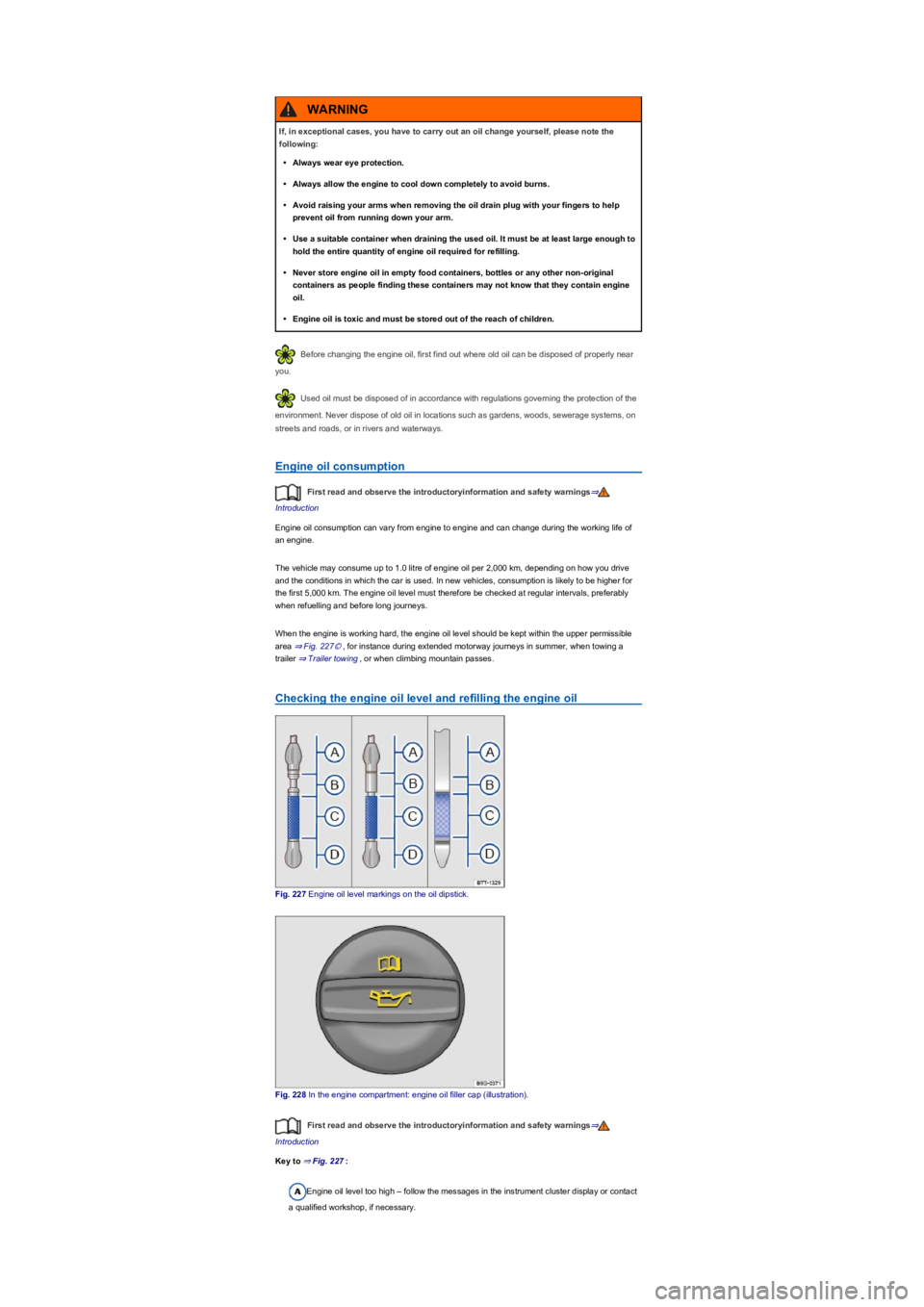
When the engine is working hard, the engine oil level should be kept within the upper permissible
area ⇒ Fig. 227Ⓒ, for instance during extended motorway journeys in summer, when towing a
trailer ⇒ Trailer towing, or when climbing mountain passes.
Checking the engine oil level and refilling the engine oil
Fig. 227 Engine oil level markings on the oil dipstick.
Fig. 228 In the engine compartment: engine oil filler cap (illustration).
First read and observe the introductoryinformation and safety warnings⇒
Introduction
Key to ⇒ Fig. 227:
Engine oil level too high – follow the messages in the instrument cluster display or contact
a qualified workshop, if necessary.
If, in exceptional cases, you have to carry out an oil change yourself, please note the
following:
•Always wear eye protection.
•Always allow the engine to cool down completely to avoid burns.
•Avoid raising your arms when removing the oil drain plug with your fingers to help
prevent oil from running down your arm.
•Use a suitable container when draining the used oil. It must be at least large enough to
hold the entire quantity of engine oil required for refilling.
•Never store engine oil in empty food containers, bottles or any other non-original
containers as people finding these containers may not know that they contain engine
oil.
•Engine oil is toxic and must be stored out of the reach of children.
WARNING
Page 284 of 341
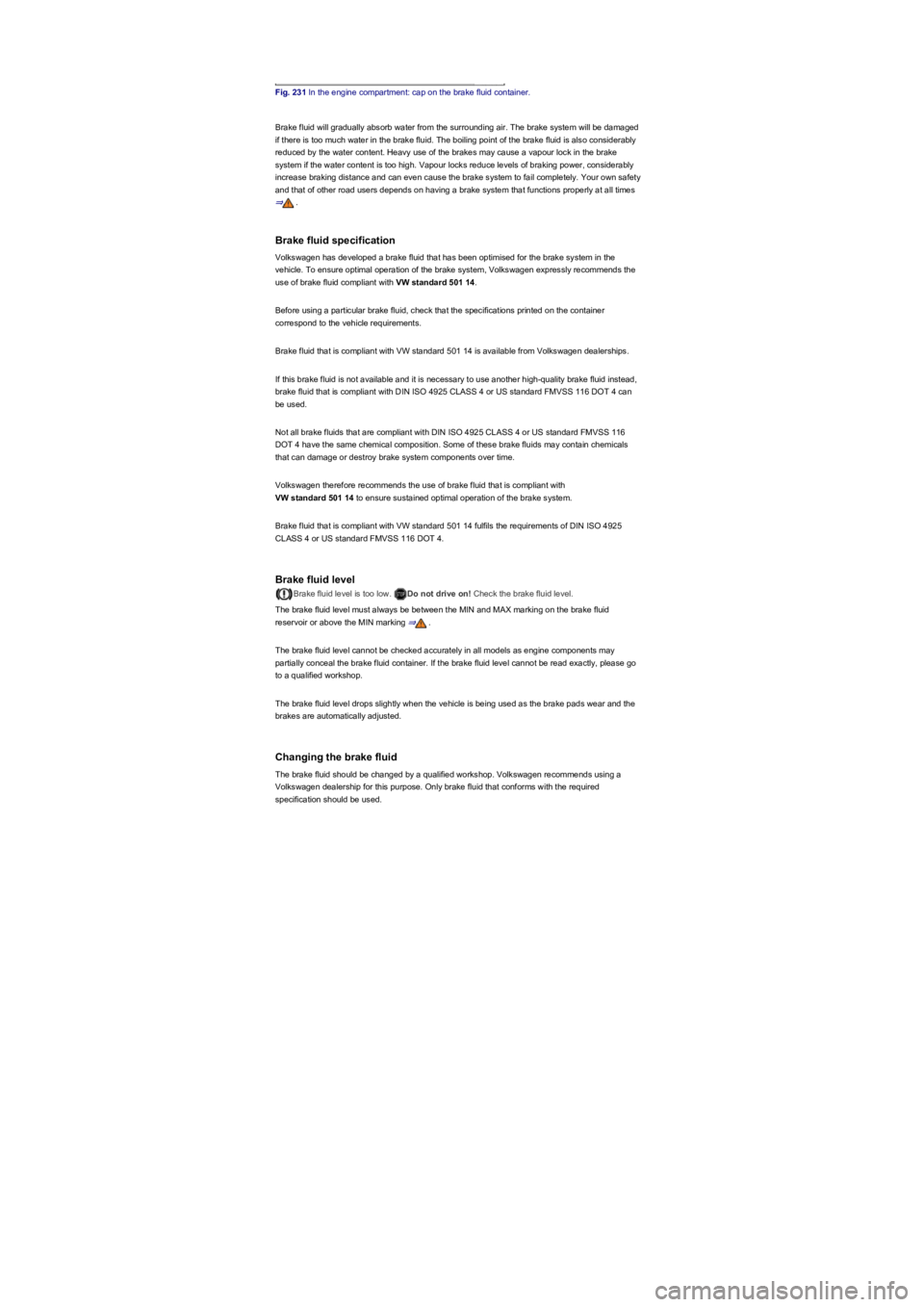
Fig. 231 In the engine compartment: cap on the brake fluid container.
Brake fluid will gradually absorb water from the surrounding air. The brake system will be damaged
if there is too much water in the brake fluid. The boiling point of the brake fluid is also considerably
reduced by the water content. Heavy use of the brakes may cause a vapour lock in the brake
system if the water content is too high. Vapour locks reduce levels of braking power, considerably
increase braking distance and can even cause the brake system to fail completely. Your own safety
and that of other road users depends on having a brake system that functions properly at all times
⇒.
Brake fluid specification
Volkswagen has developed a brake fluid that has been optimised for the brake system in the
vehicle. To ensure optimal operation of the brake system, Volkswagen expressly recommends the
use of brake fluid compliant with VW standard 501 14.
Before using a particular brake fluid, check that the specifications printed on the container
correspond to the vehicle requirements.
Brake fluid that is compliant with VW standard 501 14 is available from Volkswagen dealerships.
If this brake fluid is not available and it is necessary to use another high-quality brake fluid instead,
brake fluid that is compliant with DIN ISO 4925 CLASS 4 or US standard FMVSS 116 DOT 4 can
be used.
Not all brake fluids that are compliant with DIN ISO 4925 CLASS 4 or US standard FMVSS 116
DOT 4 have the same chemical composition. Some of these brake fluids may contain chemicals
that can damage or destroy brake system components over time.
Volkswagen therefore recommends the use of brake fluid that is compliant with
VW standard 501 14 to ensure sustained optimal operation of the brake system.
Brake fluid that is compliant with VW standard 501 14 fulfils the requirements of DIN ISO 4925
CLASS 4 or US standard FMVSS 116 DOT 4.
Brake fluid level
Brake fluid level is too low. Do not drive on! Check the brake fluid level.
The brake fluid level must always be between the MIN and MAX marking on the brake fluid
reservoir or above the MIN marking ⇒.
The brake fluid level cannot be checked accurately in all models as engine components may
partially conceal the brake fluid container. If the brake fluid level cannot be read exactly, please go
to a qualified workshop.
The brake fluid level drops slightly when the vehicle is being used as the brake pads wear and the
brakes are automatically adjusted.
Changing the brake fluid
The brake fluid should be changed by a qualified workshop. Volkswagen recommends using a
Volkswagen dealership for this purpose. Only brake fluid that conforms with the required
specification should be used.
Page 295 of 341
Handling wheels and tyres
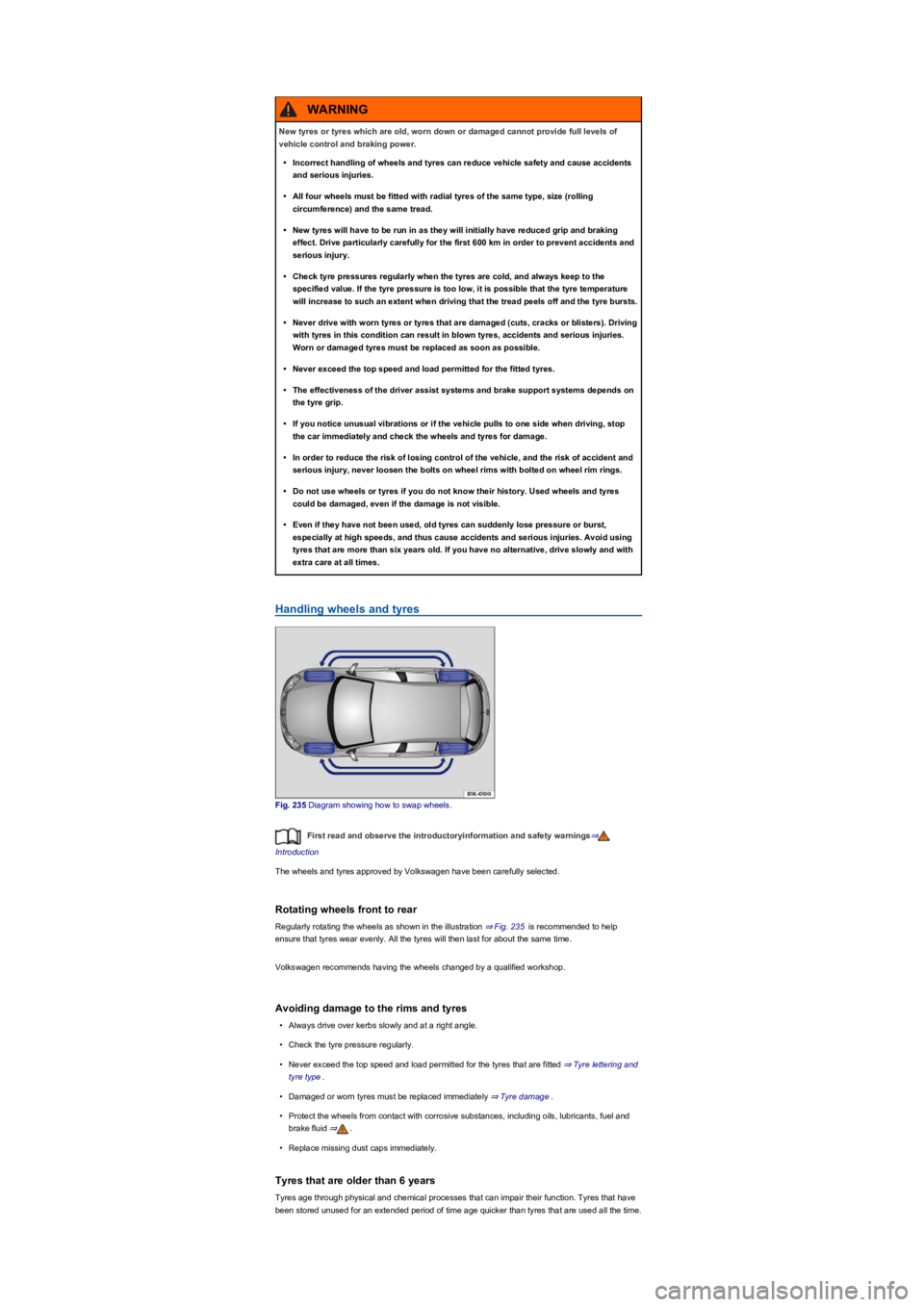
Fig. 235 Diagram showing how to swap wheels.
First read and observe the introductoryinformation and safety warnings⇒
Introduction
The wheels and tyres approved by Volkswagen have been carefully selected.
Rotating wheels front to rear
Regularly rotating the wheels as shown in the illustration ⇒ Fig. 235 is recommended to help
ensure that tyres wear evenly. All the tyres will then last for about the same time.
Volkswagen recommends having the wheels changed by a qualified workshop.
Avoiding damage to the rims and tyres
•Always drive over kerbs slowly and at a right angle.
•Check the tyre pressure regularly.
•Never exceed the top speed and load permitted for the tyres that are fitted ⇒ Tyre lettering and
tyre type.
•Damaged or worn tyres must be replaced immediately ⇒ Tyre damage.
•Protect the wheels from contact with corrosive substances, including oils, lubricants, fuel and
brake fluid ⇒.
•Replace missing dust caps immediately.
Tyres that are older than 6 years
Tyres age through physical and chemical processes that can impair their function. Tyres that have
been stored unused for an extended period of time age quicker than tyres that are used all the time.
New tyres or tyres which are old, worn down or damaged cannot provide full levels of
vehicle control and braking power.
•Incorrect handling of wheels and tyres can reduce vehicle safety and cause accidents
and serious injuries.
•All four wheels must be fitted with radial tyres of the same type, size (rolling
circumference) and the same tread.
•New tyres will have to be run in as they will initially have reduced grip and braking
effect. Drive particularly carefully for the first 600 km in order to prevent accidents and
serious injury.
•Check tyre pressures regularly when the tyres are cold, and always keep to the
specified value. If the tyre pressure is too low, it is possible that the tyre temperature
will increase to such an extent when driving that the tread peels off and the tyre bursts.
•Never drive with worn tyres or tyres that are damaged (cuts, cracks or blisters). Driving
with tyres in this condition can result in blown tyres, accidents and serious injuries.
Worn or damaged tyres must be replaced as soon as possible.
•Never exceed the top speed and load permitted for the fitted tyres.
•The effectiveness of the driver assist systems and brake support systems depends on
the tyre grip.
•If you notice unusual vibrations or if the vehicle pulls to one side when driving, stop
the car immediately and check the wheels and tyres for damage.
•In order to reduce the risk of losing control of the vehicle, and the risk of accident and
serious injury, never loosen the bolts on wheel rims with bolted on wheel rim rings.
•Do not use wheels or tyres if you do not know their history. Used wheels and tyres
could be damaged, even if the damage is not visible.
•Even if they have not been used, old tyres can suddenly lose pressure or burst,
especially at high speeds, and thus cause accidents and serious injuries. Avoid using
tyres that are more than six years old. If you have no alternative, drive slowly and with
extra care at all times.
WARNING
Page 309 of 341
Find a firm and level surface suitable for lifting the vehicle.
Stop the engine, with a manual gearbox select a gear or with a DSG® dual clutch gearbox
move the selector lever to position P DSG® dual clutch gearbox and switch on the
electronic parking brake Parking and manoeuvring.
Chock both wheels on the opposite side of the vehicle using the collapsible chocks or
other suitable objects.
Loosen the wheel bolts Wheel bolts.
Find the jacking point under the vehicle which is closest to the wheel that is being
changed.
Insert the hand crank into the opening on the jack (depending on equipment).
Crank up the jack until it just fits under the jacking point of the vehicle.
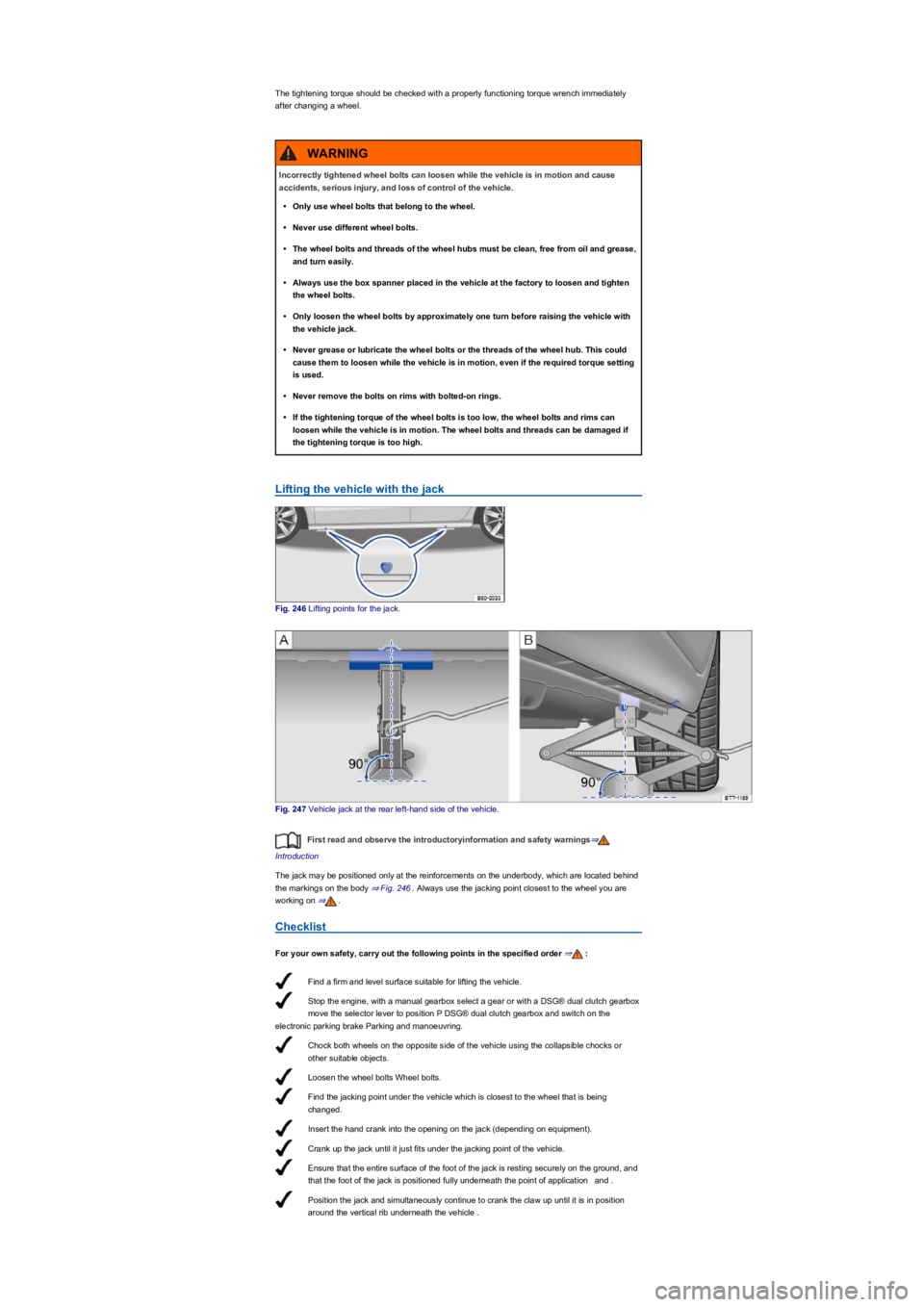
Ensure that the entire surface of the foot of the jack is resting securely on the ground, and
that the foot of the jack is positioned fully underneath the point of application and .
Position the jack and simultaneously continue to crank the claw up until it is in position
around the vertical rib underneath the vehicle .
The tightening torque should be checked with a properly functioning torque wrench immediately
after changing a wheel.
Lifting the vehicle with the jack
Fig. 246 Lifting points for the jack.
Fig. 247 Vehicle jack at the rear left-hand side of the vehicle.
First read and observe the introductoryinformation and safety warnings⇒
Introduction
The jack may be positioned only at the reinforcements on the underbody, which are located behind
the markings on the body ⇒ Fig. 246. Always use the jacking point closest to the wheel you are
working on ⇒.
Checklist
For your own safety, carry out the following points in the specified order ⇒:
Incorrectly tightened wheel bolts can loosen while the vehicle is in motion and cause
accidents, serious injury, and loss of control of the vehicle.
•Only use wheel bolts that belong to the wheel.
•Never use different wheel bolts.
•The wheel bolts and threads of the wheel hubs must be clean, free from oil and grease,
and turn easily.
•Always use the box spanner placed in the vehicle at the factory to loosen and tighten
the wheel bolts.
•Only loosen the wheel bolts by approximately one turn before raising the vehicle with
the vehicle jack.
•Never grease or lubricate the wheel bolts or the threads of the wheel hub. This could
cause them to loosen while the vehicle is in motion, even if the required torque setting
is used.
•Never remove the bolts on rims with bolted-on rings.
•If the tightening torque of the wheel bolts is too low, the wheel bolts and rims can
loosen while the vehicle is in motion. The wheel bolts and threads can be damaged if
the tightening torque is too high.
WARNING
Page 311 of 341
After changing a wheel
First read and observe the introductoryinformation and safety warnings⇒
Introduction
•Clean the tools from the vehicle tool kit and place them back in the foam rubber holder in the
luggage compartment ⇒ Vehicle toolkit.
•Stow the changed wheel securely in the luggage compartment.
•Have the tightening torque of the wheel bolts checked immediately ⇒ Tightening torque for the
wheel bolts.
•The damaged wheel should be replaced as soon as possible.
In vehicles with a Tyre Pressure Loss Indicator, the system has to re-synchronise after
wheels are changed ⇒ Tyre monitoring systems.
Breakdown set
Introduction
This chapter contains information on the followingsubjects:
⇒ Contents of the breakdown set
⇒ Preparation
⇒ Sealing and inflating tyres
⇒ Test after driving for 10 minutes
The breakdown set can be used to temporarily and reliably seal any tyre damage caused by foreign
bodies or punctures (up to approx. 4 mm in diameter). Do not remove foreign objects (e.g.
screws or nails) from the tyre!
Once the sealant has been added to the tyre, the tyre pressure must be checked and adjusted
again after approximately ten minutes of driving.
Seek expert assistance if more than one of the vehicle's tyres is damaged. The breakdown set is
designed to fill only one tyre.
Use the breakdown set only when the vehicle has been safely parked and if you are familiar with
the work and safety precautions needed. Seek expert assistance if this is not the case.
The tyre sealant must not be used:
•If the rim is damaged.
•If the outside temperature is below -20°C (-4°F).
•If there are cuts or punctures in the tyre that are larger than 4 mm.
•If the vehicle was driven with very low tyre pressure or a flat tyre.
•If the use-by date on the tyre filler bottle has expired.
•In conjunction with AirStop tyres. You can tell if your vehicle is equipped with AirStop tyres if
there is the word Seal on the outside of the tyres.
Incorrect torque or incorrect use of wheel bolts can lead to a loss of control of the vehicle,
cause accidents and serious injuries.
•Always keep all wheel bolts and threads in the wheel hubs clean and free from oil and
grease. The wheel bolts must be easy to turn and be tightened to the specified torque.
•The hexagonal socket in the screwdriver handle should only be used for turning wheel
bolts, not use for loosening or tightening them.
WARNING
®®
Page 315 of 341
The vehicle data sticker confirms when the vehicle was first registered or delivered, when the
delivery inspection was carried out, and thus the date from which your vehicle is covered by our
warranty.
Saving the service operations performed (digital service schedule)
Each service record is stored by your Volkswagen dealership and qualified workshop in a central
system. This transparent documentation of the service history allows the service operations
performed to be reproduced at any time. Each time you have your vehicle serviced, Volkswagen
recommends asking for a printed service record, which contains all service work stored in the
system.
With every service, the printout of the previous service record is replaced by a current printout.
The digital service schedule is not available in some markets. In this case, your Volkswagen
dealership will inform you about the documentation process for service work.
Service work
The following information is documented in the digital service schedule by your Volkswagen
dealership or qualified workshop:
•When which service was carried out.
•Whether any repairs are recommended, such as replacement of the brake pads in the near
future.
•Whether you had any special requests before or during the maintenance work (your service
advisor will note these on the order).
•Which components or service fluids were changed.
•When your next service is scheduled for.
The LongLife mobility guarantee is valid until the next inspection is due. Documentation takes place
at every due inspection.
The type and scope of service work may differ from vehicle to vehicle. Information on specific work
for your vehicle can be requested from a qualified workshop.
Regular servicing of your vehicle not only maintains its value, it also ensures that your
vehicle remains roadworthy and in working order. You should therefore have your vehicle serviced
according to the Volkswagen guidelines.
Fixed service or flexible service
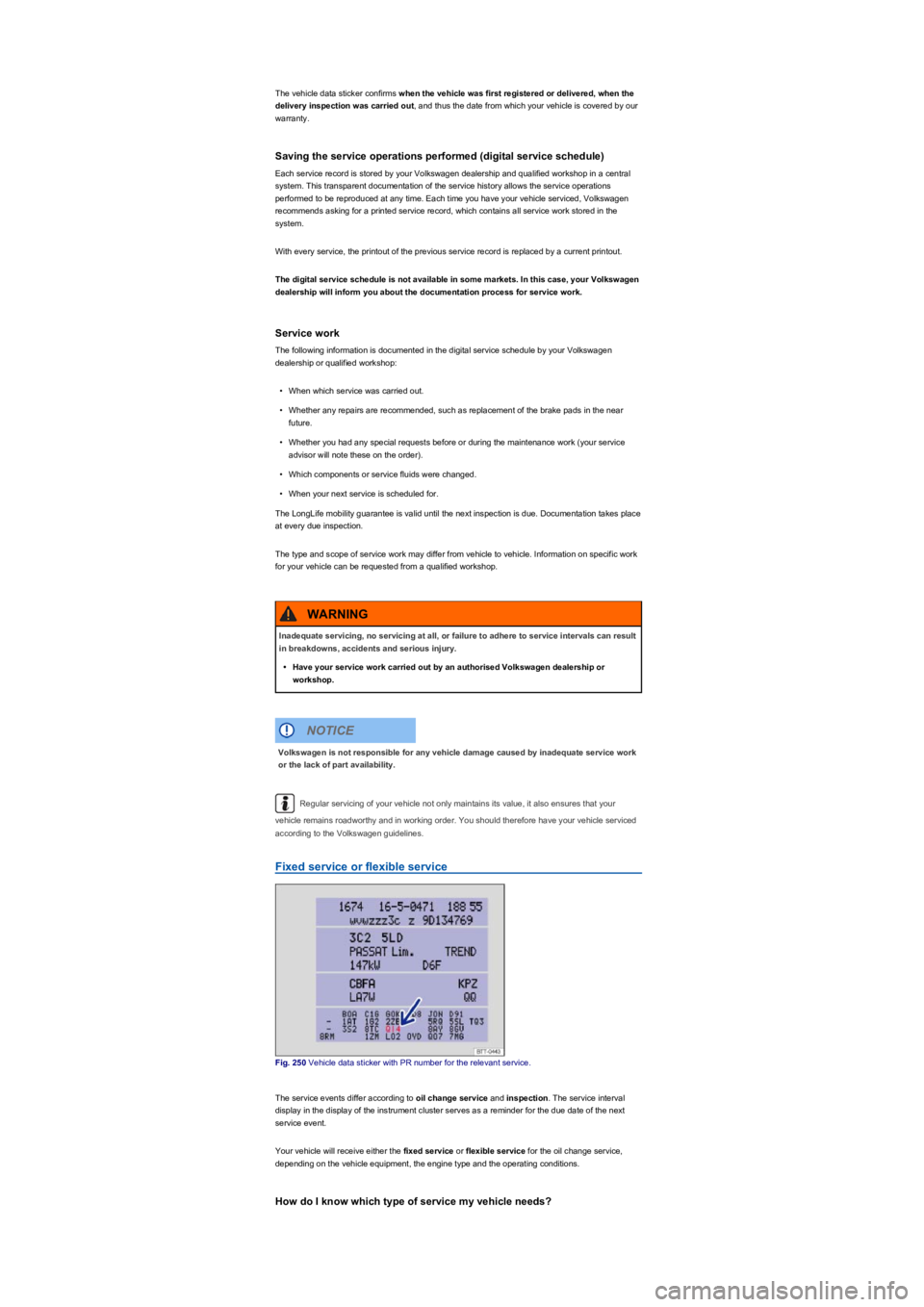
Fig. 250 Vehicle data sticker with PR number for the relevant service.
The service events differ according to oil change service and inspection. The service interval
display in the display of the instrument cluster serves as a reminder for the due date of the next
service event.
Your vehicle will receive either the fixed service or flexible service for the oil change service,
depending on the vehicle equipment, the engine type and the operating conditions.
How do I know which type of service my vehicle needs?
Inadequate servicing, no servicing at all, or failure to adhere to service intervals can result
in breakdowns, accidents and serious injury.
•Have your service work carried out by an authorised Volkswagen dealership or
workshop.
WARNING
Volkswagen is not responsible for any vehicle damage caused by inadequate service work
or the lack of part availability.
NOTICE