Oil change VOLKSWAGEN TIGUAN 2017 Owner´s Manual
[x] Cancel search | Manufacturer: VOLKSWAGEN, Model Year: 2017, Model line: TIGUAN, Model: VOLKSWAGEN TIGUAN 2017Pages: 341, PDF Size: 9.14 MB
Page 316 of 341
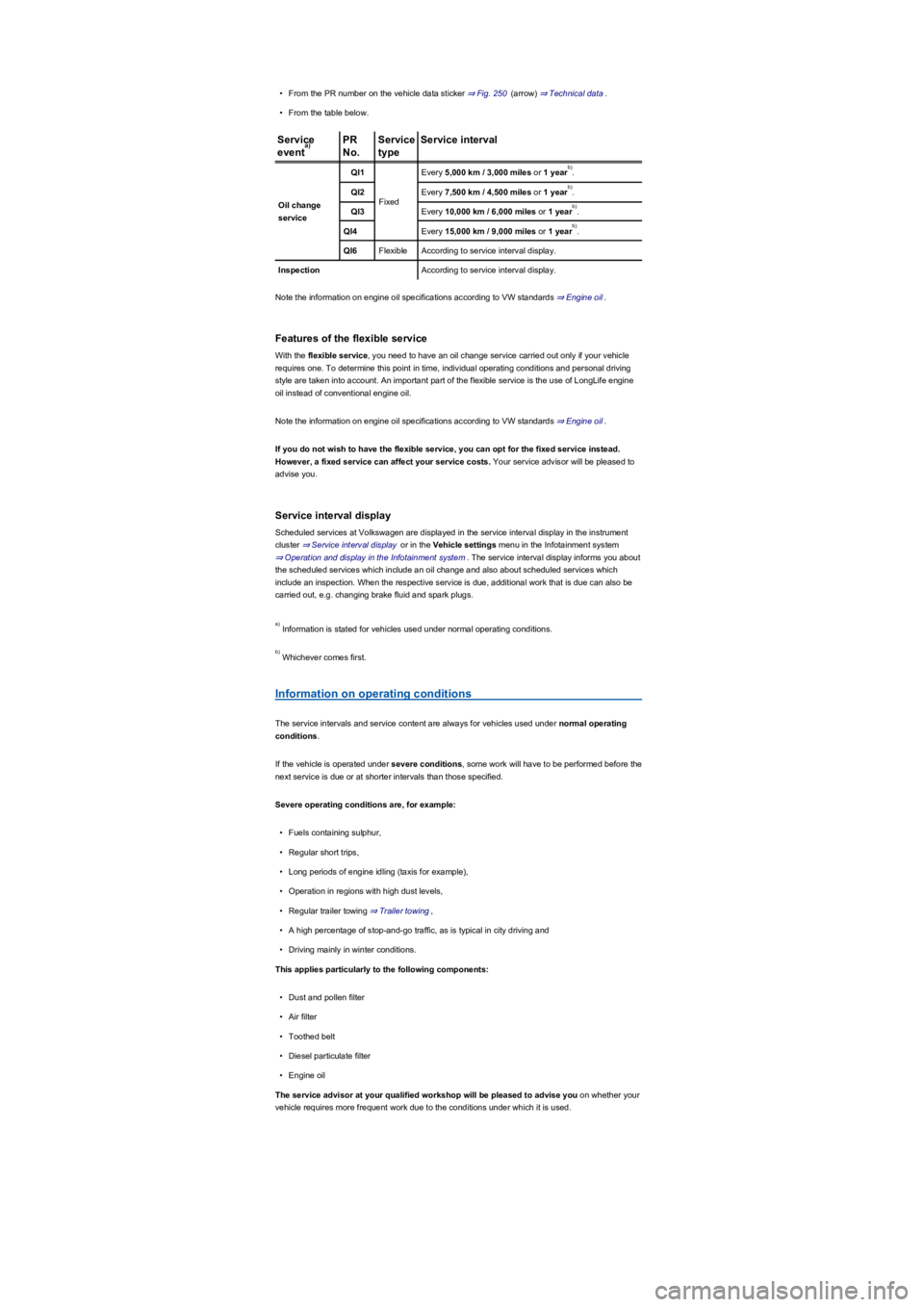
•From the PR number on the vehicle data sticker ⇒ Fig. 250 (arrow) ⇒ Technical data.
•From the table below.
Service
event
PR
No.
Service
type
Service interval
Oil change
service
QI1
Fixed
Every 5,000 km / 3,000 miles or 1 year.
QI2Every 7,500 km / 4,500 miles or 1 year.
QI3Every 10,000 km / 6,000 miles or 1 year.
QI4Every 15,000 km / 9,000 miles or 1 year.
QI6FlexibleAccording to service interval display.
InspectionAccording to service interval display.
Note the information on engine oil specifications according to VW standards ⇒ Engine oil.
Features of the flexible service
With the flexible service, you need to have an oil change service carried out only if your vehicle
requires one. To determine this point in time, individual operating conditions and personal driving
style are taken into account. An important part of the flexible service is the use of LongLife engine
oil instead of conventional engine oil.
Note the information on engine oil specifications according to VW standards ⇒ Engine oil.
If you do not wish to have the flexible service, you can opt for the fixed service instead.
However, a fixed service can affect your service costs. Your service advisor will be pleased to
advise you.
Service interval display
Scheduled services at Volkswagen are displayed in the service interval display in the instrument
cluster ⇒ Service interval display or in the Vehicle settings menu in the Infotainment system
⇒ Operation and display in the Infotainment system. The service interval display informs you about
the scheduled services which include an oil change and also about scheduled services which
include an inspection. When the respective service is due, additional work that is due can also be
carried out, e.g. changing brake fluid and spark plugs.
Information is stated for vehicles used under normal operating conditions.
Whichever comes first.
Information on operating conditions
The service intervals and service content are always for vehicles used under normal operating
conditions.
If the vehicle is operated under severe conditions, some work will have to be performed before the
next service is due or at shorter intervals than those specified.
Severe operating conditions are, for example:
•Fuels containing sulphur,
•Regular short trips,
•Long periods of engine idling (taxis for example),
•Operation in regions with high dust levels,
•Regular trailer towing ⇒ Trailer towing,
•A high percentage of stop-and-go traffic, as is typical in city driving and
•Driving mainly in winter conditions.
This applies particularly to the following components:
•Dust and pollen filter
•Air filter
•Toothed belt
•Diesel particulate filter
•Engine oil
The service advisor at your qualified workshop will be pleased to advise you on whether your
vehicle requires more frequent work due to the conditions under which it is used.
a)
b)
b)
b)
b)
a)
b)
Page 318 of 341
•Water drains: check.
•Road test: perform.
Servicing work
In addition to the inspection work (depending on the operating conditions and vehicle equipment
such as engine, gearbox or service fluids), further servicing work must be performed on your
vehicle. The work dependent on either time and/or mileage.
•Additives: change/top up.
•Brake fluid: change.
•Diesel particulate filter: check.
•Natural gas tank and lines: change.
•Gearbox: change oil/filter.
•Gearbox mountings: change.
•Gas system filter: change.
•Final drive/differential: change oil.
•Diesel fuel filter: change/drain.
•Air filter: change.
•Engine: change oil/filter.
•Dust and pollen filter: change.
•Spark plugs: change.
•Toothed belt/toothed belt tensioning roller: check/change.
It is also possible to have servicing work carried out in between the scheduled service events
⇒ Fixed service or flexible service.
The scope of service is subject to change for technical reasons (continuous further development of
components). Your Volkswagen dealership or qualified workshop always has the latest information
about any changes.
Vehicle care
Notes on vehicle care
Regular and expert care helps to maintain the value of the vehicle.
Leaving stains, dirt and other deposits on the surface of vehicle components and cloth seat covers
for a long time can make it difficult to clean and treat them. Stains, dirt and deposits may become
impossible to remove, particularly if left for a long time.
For proper cleaning and care, Volkswagen recommends using Genuine care products that have
been matched to your vehicle. Consult a qualified workshop if you have any specific questions or if
vehicle parts are not listed.
1)
Incorrect care and cleaning of vehicle parts can impair the safety features of the vehicle
and cause serious injury.
•Vehicle parts must be cleaned according to the manufacturer's instructions.
•Always use approved or recommended cleaning products.
•Do not use solvent-based cleaning products. Solvents can cause irreparable damage
to the airbag modules.
•Protect your hands and arms against parts with sharp edges, e.g. when cleaning the
underbody or the insides of the wheel housings.
WARNING
Dirty, misted or iced over windows reduce visibility and increase the risk of accidents and
severe injuries. This could impair the safety equipment of the vehicle.
•Only drive when you have a clear view through all windows.
•Do not treat the windscreen with water-repellent window coating agents. In
unfavourable conditions, they can cause increased dazzle.
WARNING
Page 325 of 341
Repairs and structural modifications should be carried out by a qualified workshop. Volkswagen
recommends using a Volkswagen dealership for this purpose.
•Repainting and paint touch-ups in the area around the sensors may impair the function of the
system in question.
•As the Volkswagen badge influences the view of the radar sensor in the front area, drive the
vehicle only with the original Volkswagen badge.
Engine and transmission guard
An engine and transmission guard can reduce the risk of damage to the underside of the vehicle
and to the engine oil sump.
Depending on where the vehicle is used, it may be a good idea to have an engine and transmission
guard installed, e.g. if the vehicle will be driven over kerbs, on driveways or on unsurfaced roads. If
you wish to have one fitted, Volkswagen recommends contacting your Volkswagen dealership.
Repairs and faults in the airbag system
Repairs and technical modifications must always be carried out according to Volkswagen
specifications⇒.
Modifications and repairs to the front bumper, the doors, the front seats, the headliner, or the
bodywork should be carried out by a qualified workshop. System components and airbag system
sensors might be fitted on these vehicle components.
If you work on the airbag system or remove and install parts of the system when performing other
repair work, parts of the airbag system may be damaged. The consequence may be that, in the
event of an accident, the airbag inflates incorrectly or does not inflate at all.
Regulations must be observed to ensure that the effectiveness of the airbags is not reduced and
that removed parts do not cause any injuries or environmental pollution. Qualified workshops are
familiar with these requirements.
Any modifications to the vehicle's suspension could prevent the airbag system from working
properly during a collision. For example, using tyre/rim combinations that have not been approved
by Volkswagen, lowering the vehicle, making modifications to the suspension rate including work on
the springs, struts and shock absorbers could change the forces that are measured by the airbag
sensors and sent to the electronic control unit. Some changes to the suspension could cause the
forces measured by the sensors to increase, for example. This can lead to the airbag system being
triggered in collision scenarios where it normally would not be triggered if modifications to the
suspension had not been made. Other modifications can cause the forces measured by the
sensors to decrease, therefore preventing the airbag system from being triggered when it should
have been.
Incorrect repairs and modifications can cause malfunctions and damage to the vehicle
and impair the effectiveness of the driver assist systems. This can result in accidents and
severe injuries.
•Repairs and modifications to your vehicle should be carried out only by a qualified
workshop.
WARNING
Unsuitable spare parts and accessories, incorrectly carried out work, modifications and
repairs can lead to damage to the vehicle and cause accidents and serious injuries.
•Volkswagen strongly recommends you use only approved Volkswagen accessories
and Volkswagen Genuine Parts. These parts and accessories have been specially
tested by Volkswagen for suitability, reliability and safety.
•Repairs and modifications to your vehicle should only be carried out by a qualified
workshop. Qualified workshops have the necessary tools, diagnostic equipment, repair
information and qualified personnel.
•Never fit parts to your vehicle that are in any way different from the factory-fitted parts.
•Never secure or mount objects such as drink holders or telephone holders either on or
next to the airbag covers or within the deployment zones of the airbag modules.
•Only use rim/tyre combinations which have been approved by Volkswagen for your
vehicle type.
WARNING
®
Page 330 of 341
Third-party services
If you are able to use online services provided by a party other than the manufacturer, these
services are the sole responsibility of the provider in question and are subject to this provider's data
protection policy and terms and conditions of use. Volkswagen has no influence over the content
exchanged in these services.
Please refer to the provider in question for information about the type, scope and purpose of the
collection and use of personal data related to third-party services.
Please note the further information on Volkswagen Car-Net services ⇒ Mobile online
services.
Information stickers and plates
Safety certificates, stickers and plates showing important vehicle operation information are factory-
fitted in the engine compartment and on certain vehicle parts, such as the tank flap, front passenger
sun visor, driver door pillar or under/on the luggage compartment floor.
•Never remove or damage the safety certificates, stickers and plates. They must remain legible
at all times.
•If vehicle parts bearing safety certificates, stickers or plates are removed from the vehicle,
replacement safety certificates, stickers or plates with the same information must be applied
properly to the new parts by the qualified workshop.
Safety certificate
There is a safety certificate on the door pillar of the driver door which states that all necessary
safety standards and specifications from the transport safety authorities of the particular country
were met at the time of production. The month and year of production and the chassis number may
also be listed. Observe notes in the owner's manual.
Fluids in the air conditioning system
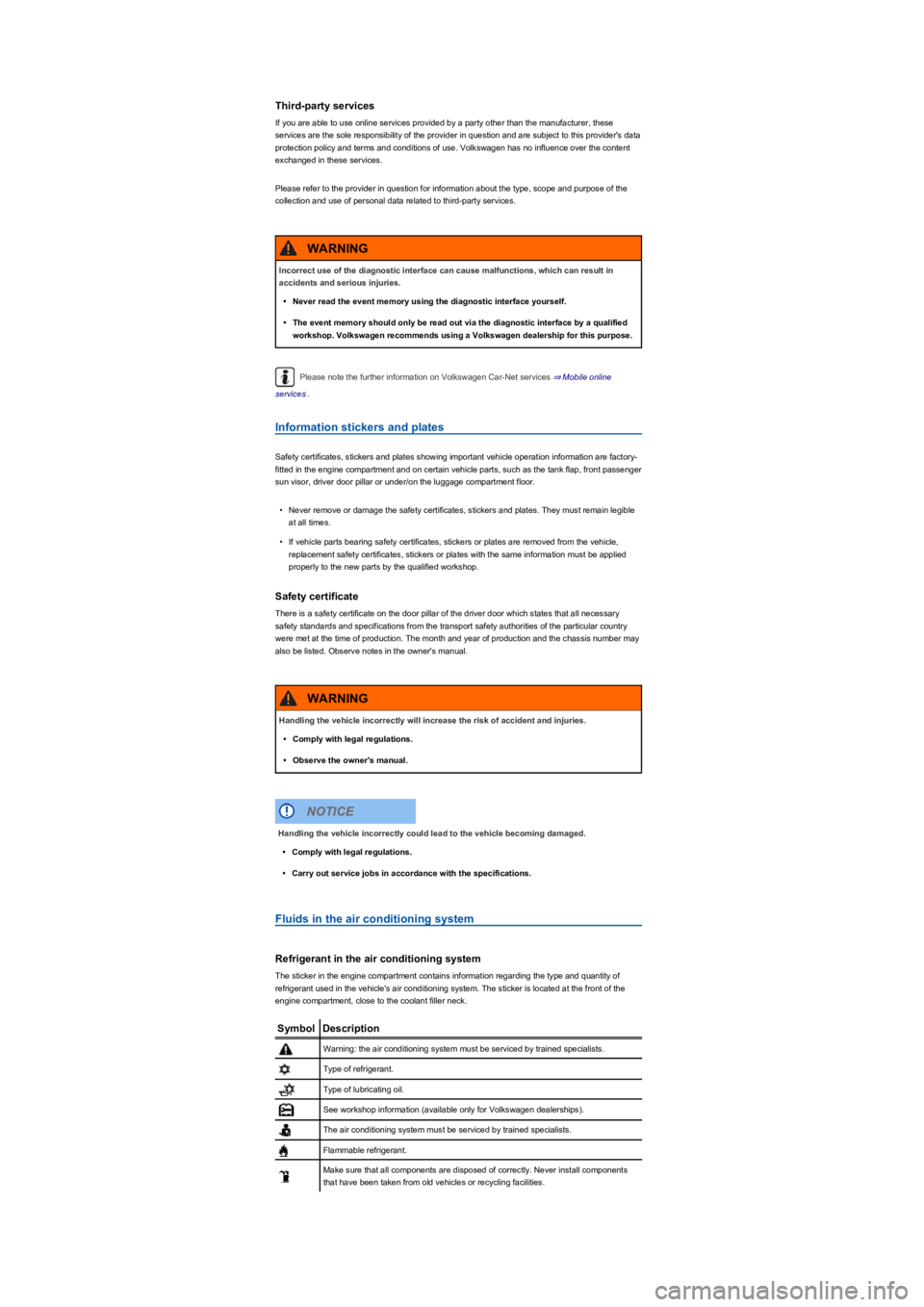
Refrigerant in the air conditioning system
The sticker in the engine compartment contains information regarding the type and quantity of
refrigerant used in the vehicle's air conditioning system. The sticker is located at the front of the
engine compartment, close to the coolant filler neck.
SymbolDescription
Warning: the air conditioning system must be serviced by trained specialists.
Type of refrigerant.
Type of lubricating oil.
See workshop information (available only for Volkswagen dealerships).
The air conditioning system must be serviced by trained specialists.
Flammable refrigerant.
Make sure that all components are disposed of correctly. Never install components
that have been taken from old vehicles or recycling facilities.
Incorrect use of the diagnostic interface can cause malfunctions, which can result in
accidents and serious injuries.
•Never read the event memory using the diagnostic interface yourself.
•The event memory should only be read out via the diagnostic interface by a qualified
workshop. Volkswagen recommends using a Volkswagen dealership for this purpose.
WARNING
Handling the vehicle incorrectly will increase the risk of accident and injuries.
•Comply with legal regulations.
•Observe the owner's manual.
WARNING
Handling the vehicle incorrectly could lead to the vehicle becoming damaged.
•Comply with legal regulations.
•Carry out service jobs in accordance with the specifications.
NOTICE
Page 331 of 341
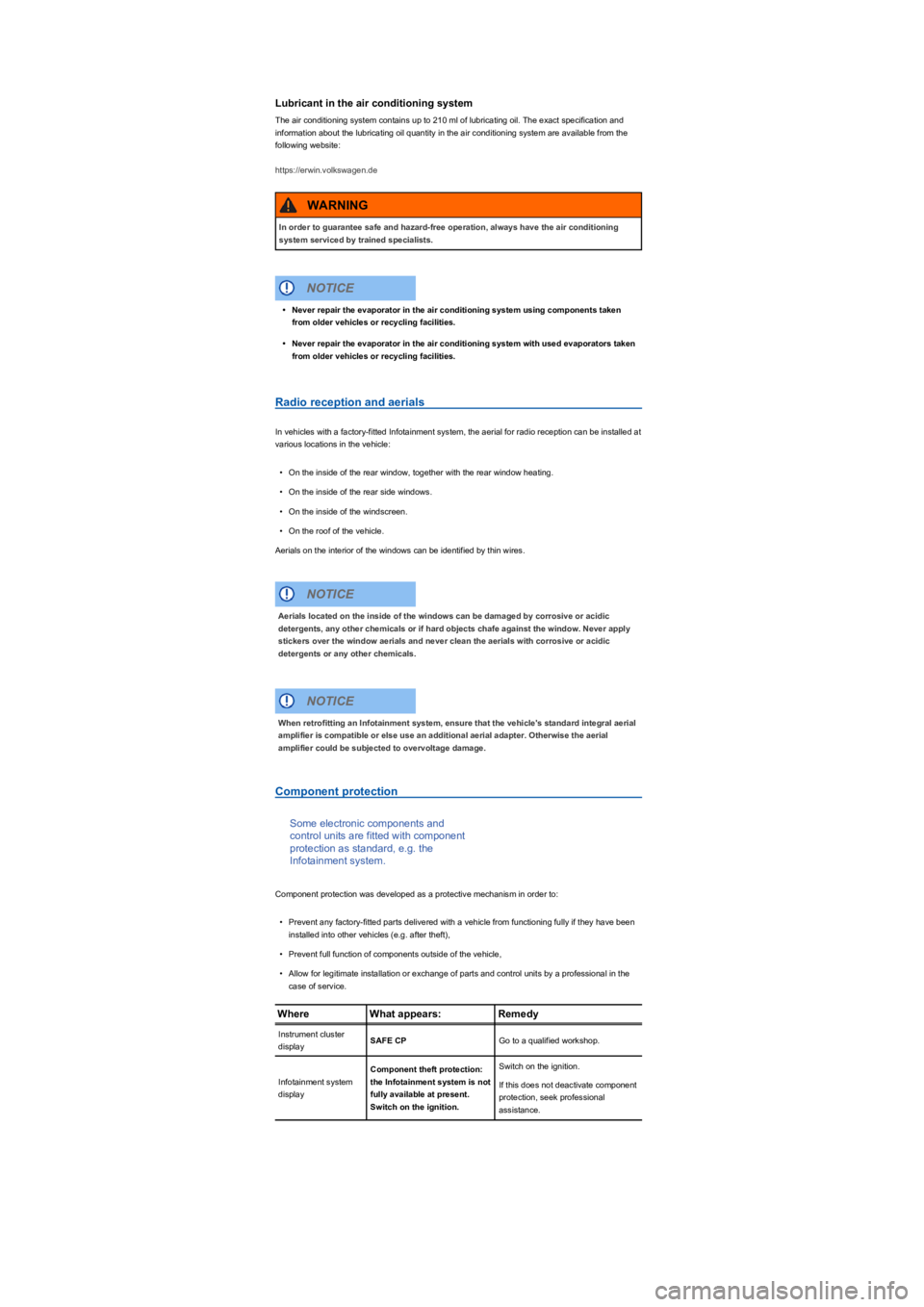
Lubricant in the air conditioning system
The air conditioning system contains up to 210 ml of lubricating oil. The exact specification and
information about the lubricating oil quantity in the air conditioning system are available from the
following website:
https://erwin.volkswagen.de
Radio reception and aerials
In vehicles with a factory-fitted Infotainment system, the aerial for radio reception can be installed at
various locations in the vehicle:
•On the inside of the rear window, together with the rear window heating.
•On the inside of the rear side windows.
•On the inside of the windscreen.
•On the roof of the vehicle.
Aerials on the interior of the windows can be identified by thin wires.
Component protection
Some electronic components and
control units are fitted with component
protection as standard, e.g. the
Infotainment system.
Component protection was developed as a protective mechanism in order to:
•Prevent any factory-fitted parts delivered with a vehicle from functioning fully if they have been
installed into other vehicles (e.g. after theft),
•Prevent full function of components outside of the vehicle,
•Allow for legitimate installation or exchange of parts and control units by a professional in the
case of service.
WhereWhat appears:Remedy
Instrument cluster
displaySAFE CPGo to a qualified workshop.
Infotainment system
display
Component theft protection:
the Infotainment system is not
fully available at present.
Switch on the ignition.
Switch on the ignition.
If this does not deactivate component
protection, seek professional
assistance.
In order to guarantee safe and hazard-free operation, always have the air conditioning
system serviced by trained specialists.
WARNING
•Never repair the evaporator in the air conditioning system using components taken
from older vehicles or recycling facilities.
•Never repair the evaporator in the air conditioning system with used evaporators taken
from older vehicles or recycling facilities.
NOTICE
Aerials located on the inside of the windows can be damaged by corrosive or acidic
detergents, any other chemicals or if hard objects chafe against the window. Never apply
stickers over the window aerials and never clean the aerials with corrosive or acidic
detergents or any other chemicals.
NOTICE
When retrofitting an Infotainment system, ensure that the vehicle's standard integral aerial
amplifier is compatible or else use an additional aerial adapter. Otherwise the aerial
amplifier could be subjected to overvoltage damage.
NOTICE